Our text explores the mediatization phenomenon in smaller organizations in geographically remote towns. Through a theoretical-practical study of an applied nature and with an exploratory-descriptive objective, we aim to highlight how the current media ecosystem is used and appropriated while also describing the communicative strategies employed by a group of thirteen organizations situated in the northwest region of the Brazilian state of Rio Grande do Sul. For our methodology, we utilized participant observation, employing techniques to analyze the social media presence of each organization over thirty days. Additionally, we conducted a strategic communication audit targeting specific audiences and indepth interviews with professionals responsible for their communication. The outcome of our efforts is a comprehensive mapping that delves into and describes the mediatization phenomenon within these organizations, which, in our perspective, is in the process of establishment.
## I. INTRODUCTION
Historically, transformations in media environments have redefined the forms and processes of human sociability, impacting both individuals and organizations. This redefinition involves the interplay between changes in culture, society, and organizations on the one hand and transformations in media, communications, and socio-organizational relationships on the other. In a context where the interdependence of individuals with the media is becoming increasingly profound, the mediatization of their social, cultural, and political practices and processes becomes more evident.
With mediationization, socio-organizational potentials and vulnerabilities emerge across any territory, prompting professionals and researchers to understand their configuration, causes, and effects in all aspects of society. Furthermore, concerning communication practices and processes, media environments, with digitalization, enable the reversal of roles between emission and reception. It also allows different individuals to be consumers and producers of content simultaneously. The transformation in communication paradigms affects large media conglomerates and individuals and organizations that now need to manage their audiences' movements in media environments strategically.
From this context, it is essential to note that organizations in various sectors located in major urban centers or near industries such as technology, innovation, media, entertainment, or foreign trade, initially have well-established communication strategies. Subsequently, these same organizations have qualified professionals with theoretical-practical expertise in media communication, especially in the digital realm. However, in cities far from major population centers, smaller organizations primarily focusing on the local market often find themselves relatively distant from strategic media appropriation, as commonly reported in specialized articles, university studies, and success stories.
Our focus in this presentation is to discuss the mediatization movement in smaller organizations in rural cities. Through a theoretical-practical study of an applied nature and with an exploratory-descriptive objective, our narrative attempts to highlight how a group of thirteen organizations representing the microregions shaping the northwest region of the Brazilian state of Rio Grande do Sul configures the uses and appropriations of the current media ecosystem.
To accomplish this, our narrative about the research development unfolds throughout the text, presented in four sections. The first section is dedicated to methodological characterization, the second to theoretical-epistemological dialogue, and the third is employed to scrutinize the reality revealed by our empirical object while allowing the creation of two maps illustrating the mediatization phenomenon in the organizations of the concerned territory. Finally, in the fourth and last section, we conclude our account by highlighting other possible studies to be generated from our research.
## II. METHODOLOGICAL APPROACH AND RESEARCH DESIGN
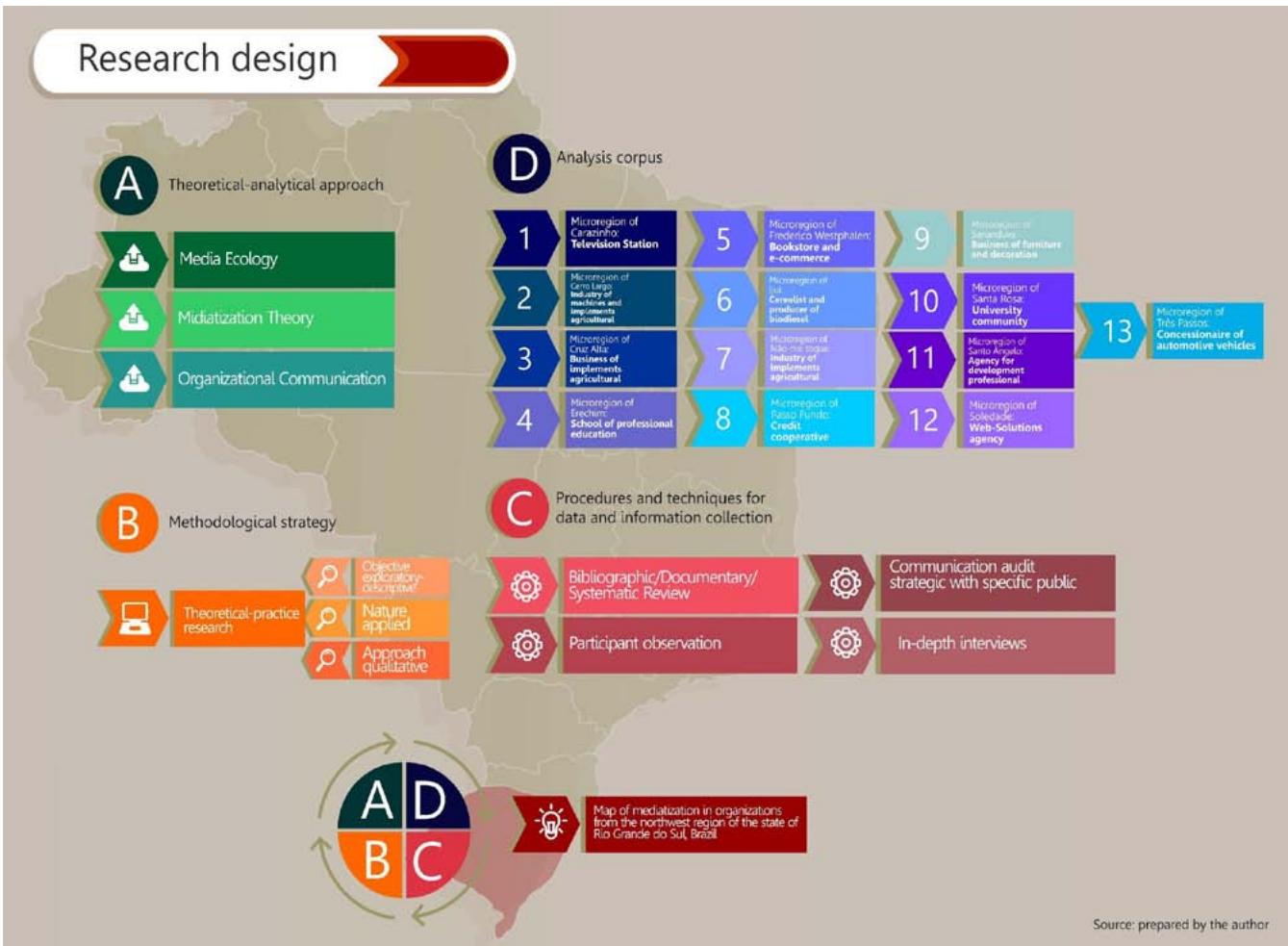
The economic sectors of the researched organizations primarily encompass retail e-commerce; sale and distribution of motor vehicles; industry, production, and commercialization of implements for agribusiness; production and commercialization of agricultural machinery; cereal production with biodiesel manufacturing; affiliate of a television station; credit cooperative; furniture and decoration trade; professional development agency; professional education school; community-university; and web solutions development agency[^3].
Considering the context and the anticipations in the initial considerations, this research engages in a dialogue and scrutiny of how mediatization manifests in medium and small-sized organizations outside major urban centers. This exploration seeks to understand their institutional positioning amid individuals' deepening interrelation and interdependence with the media. Additionally, we describe the media uses the apps, operations, and communication strategies while highlighting the processes and practices adopted by these organizations.
We constructed the mediatization phenomenon to achieve this, drawing on media ecology and organizational communication studies. This approach allowed us to present the communicational reality of our empirical object. Through a theoretical-epistemological dialogue, we reflected on the interrelation and interdependence of media within organizations and their audiences. Subsequently, we read the situational and cultural reality of the field (Santos, 2015). To operationalize this reflection, we engaged the thirteen organizations through three data collection approaches: participant observation (Peruzzo, 2012), strategic communication audit with specific audiences (Kunsch, 2012), and in-depth individual interviews (Gaskell, 2017). Over thirty days, we closely monitored the digital media of each of the thirteen organizations. This process involved qualitatively analyzing their communicational and strategic construction within the current media ecosystem. We considered [A] informational flows, [B] the relevance of information, [C] levels of interaction with user audiences, [D] aesthetic and graphic patterns, and [E] processes of media convergence.
Following the initial approaches, we conducted in-depth interviews with communication professionals designated by each organization. Seven of these professionals are outsourced, with functional ties to communication agencies. The remaining interviewed professionals are employees with institutional affiliations. It is worth noting that among the thirteen professionals interviewed, five are journalists, four are advertisers, three are public relations specialists, and one is an administrator with expertise in digital marketing. Only three interviewed individuals with institutional ties are Communication managers; the other four collaborate with other areas in their organizations.
For each interview, we conducted meetings via Google Meet, lasting an average of one to two hours, structured by a semi-structured script. In these meetings, we juxtaposed the institutional discourse of these professionals with the information obtained and developed through the previous approaches.
Following this, we present the overall plan applied to develop the research, emphasizing the analytical approaches we employed on the collected data and information, the procedures and techniques used to obtain such data and information, our empirical
object, and finally, the achievement of our exploratory-descriptive objective.
## III. THE MEDIATED ORGANIZATIONAL CONTEXT
With the growing mediation of social practices, communication processes are also affected, especially concerning organizations, as radio, television, press, and other media converge into the digital realm and are reconfigured to generate interactivity. This perspective also applies to other technologies that operate as suitable media environments for mediating different socio-organizational interactions, even if not initially designed for this purpose. Examples include social media platforms, messaging apps, platforms for virtual games, and various other technological resources available in the current media ecosystem.
In the contemporary era, we have moved beyond the sender/receiver and medium-message dichotomy. With the phenomenon of mediation, we witness the inversion of the sender and receiver poles. In other words, in traditional broadcast communications, these poles had well-defined positions, but with the evolution of the media ecosystem, we observe a particular shift in their positions. Now, anyone can become both a sender and receiver of information, reflecting the democratization of technologies and their extensive reach through the intertwining of physical devices (hardware) and virtual environments (software). This context allows individuals with internet access to consume content and produce it, creating broad and multicultural networks of relationships. Media communication in today's society is no longer confined to media institutions; it is accessible to anyone proficient in digital technologies.
As a result, developing a networked society and consolidating digital social media favors the deepening of mediation in social and organizational practices. In this context, social media emerges as a strategic resource, becoming allies for organizations by facilitating real-time multi-level interaction. This situation can potentially engage organizations with their target audiences while fostering the circulation and feedback of collective knowledge and intelligence.
Social media platforms constitute spaces for the virtualization of sociability. Initially designed for network interconnection free from territorial barriers, these platforms have evolved into strategic resources for organizations to gain visibility and public legitimacy through qualified relationships with their audiences.
According to Recuero, Bastos, and Zagos (2018), this configuration of social media consists of two central elements: social actors (individuals, institutions, groups) and connections (interactions and social ties). These platforms, therefore, present themselves as intricate networks of mathematically configured nodes, creating dense media environments whose underlying logic and operations often go unnoticed in everyday life. Media permeates all processes and practices of human sociability, living in what Sodré (2012) calls the technointegration and the bios mediaticus.
The bios mediaticus is the territory of media, where individuals accessing this environment are never the same when they leave, having transformed. This process extends to society and its organizations, as individuals who experience changes within the mediatic bios subsequently transform others in their social and organizational relationships.
The most significant change brought about by social media, the primary resource of the mediating bios, is the ability to do almost anything within its environments. Beyond enabling individuals to be consumers, producers, and transmitters of information, social media platforms create spaces where physical reality is ubiquitous with mediating reality. This characteristic favors the development of omnichannel communication within organizations - a communication strategy integrated, simultaneous, and symmetrical across all media environments an organization uses to enhance its relationships, with mediation as a potentializing meta-process (Fernandes & Silva, 2020).
In the expansive networked society, understanding communication within the scope of mediation has become a constant challenge for organizations, particularly in the last decade. They have had to envision new strategies or renew existing ones to engage with their audiences in the various organisms that compose the current media ecosystem. Today, organizations need to synchronize and make every communication and relational strategy inseparable, not only converging and adapting broadcast communication processes with directed communication practices but also crafting discursive narratives tailored to each media environment. In communication, there remains a need to align and adapt organizational culture to messages, language, resources, time, visual, and graphic typology to ensure that mediatic processes focused on socio-organizational interaction occur effectively and reach their target audiences.
Observing the historical trajectory of communication within the context of mediation, especially in recent years, we perceive the emergence of more participatory social actors. These individuals with social media technologies hold influences that ultimately redefine organizational culture. Thus, mediating environments contribute to these actors increased social and organizational participation, enabling dialogical and proximity relationships between internal and external actors associated with organizations (Fernandes & Silva, 2020a).
Therefore, communication in the mediated organizational context involves the interaction between what the organization communicates and the communication of its audiences. Being present in these environments does not make an organization part of the mediatic bios. Still, by developing a robust action plan to be present in these environments, considering internal and external organizational realms, and appropriating the logic of media, the organization becomes a mediated socio-organizational environment.
## IV. MEDIA AND COMMUNICATION
### STRATEGIES AMID THE MEDIATIZATION
#### OF ORGANIZATIONS
Despite the redefinition of interactional paradigms stemming from the mediated social experience, the emergence of social media, and the knowledge they provide to their users, communication within organizations, especially those considered in this research, remains instrumental rather than embracing the strategic potential offered by the current media ecosystem. When we scrutinize the technointegration in the mediatic bios, the communication and relational strategies of these organizations, the processes and practices fall short of the recursive possibilities of mediation. Particularly in the digital realm, media environments still need to be fully integrated into the culture of many organizations despite being present and highly palpable in the daily lives of their organizational and social actors.
We understand that mediated communication alters habits and shapes culture and social dynamics. These changes also impact organizations, presenting a significant challenge in understanding the phenomenon of mediation, especially concerning the formation of virtual communities (social networks), which are mediated by technical devices with redefined logic and affordances[^4], have already become integral to contemporary society.
People and organizations can and should use social media in a plural, accessible manner, expanding various categories of interaction, reflection, participation, or communication in general. Individuals now engage in activities once limited to professionals, reshaping communication's linear informational pathways. The opening up of media, even informally, affects and alters organizational practices or the social construction of reality.
With the shift in cultural communication paradigms—where media operate as socio-organizational extensions—users realize the symbolic power they hold. The transition from mere spectators to opinion formers or, as the current hype defines it, digital influencers (Terra, 2021) for brands and organizations. From this characteristic, problems or opportunities arise. The outcome depends on the culture adopted and implemented within their framework and the conversion strategies between what the organization communicates and what is communicated about the organization.
Examining the data and information collected from the study, we observe that the communicative reality of these organizations is still predominantly instrumental. Despite the resources available to mediate culture and society, these organizations are still in their early stages. Thus, it can be asserted that mediation in the researched organizations is still in the establishment process, quite different from other regions and countries where mediation has already deepened or become entrenched (Couldry & Hepp, 2020).
Continuing our narrative, we present two maps that succinctly depict the context of mediation in organizations located in the northwest region of Rio Grande do Sul. In these maps, we explore and describe the mediatic configurations and communication strategies.
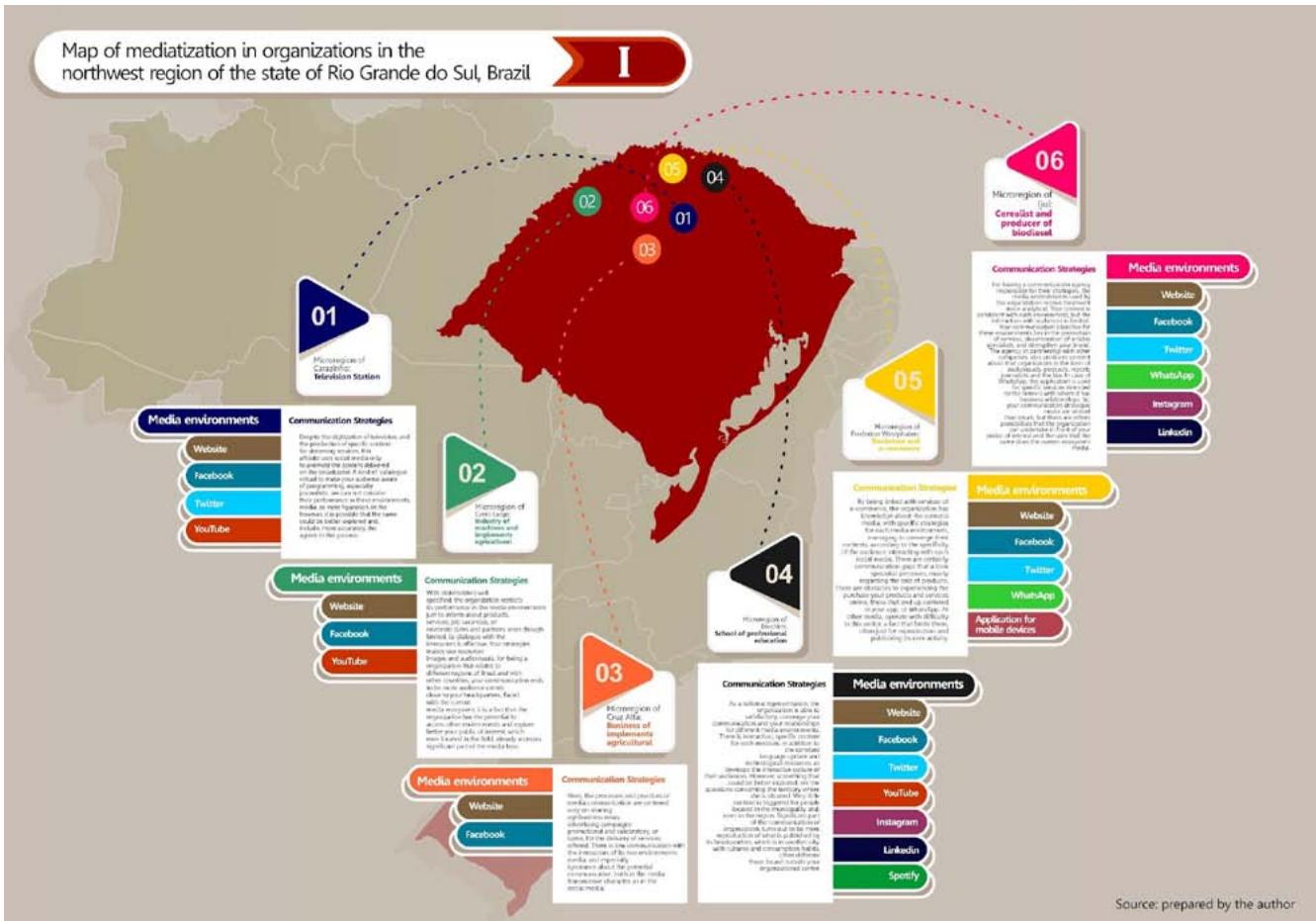
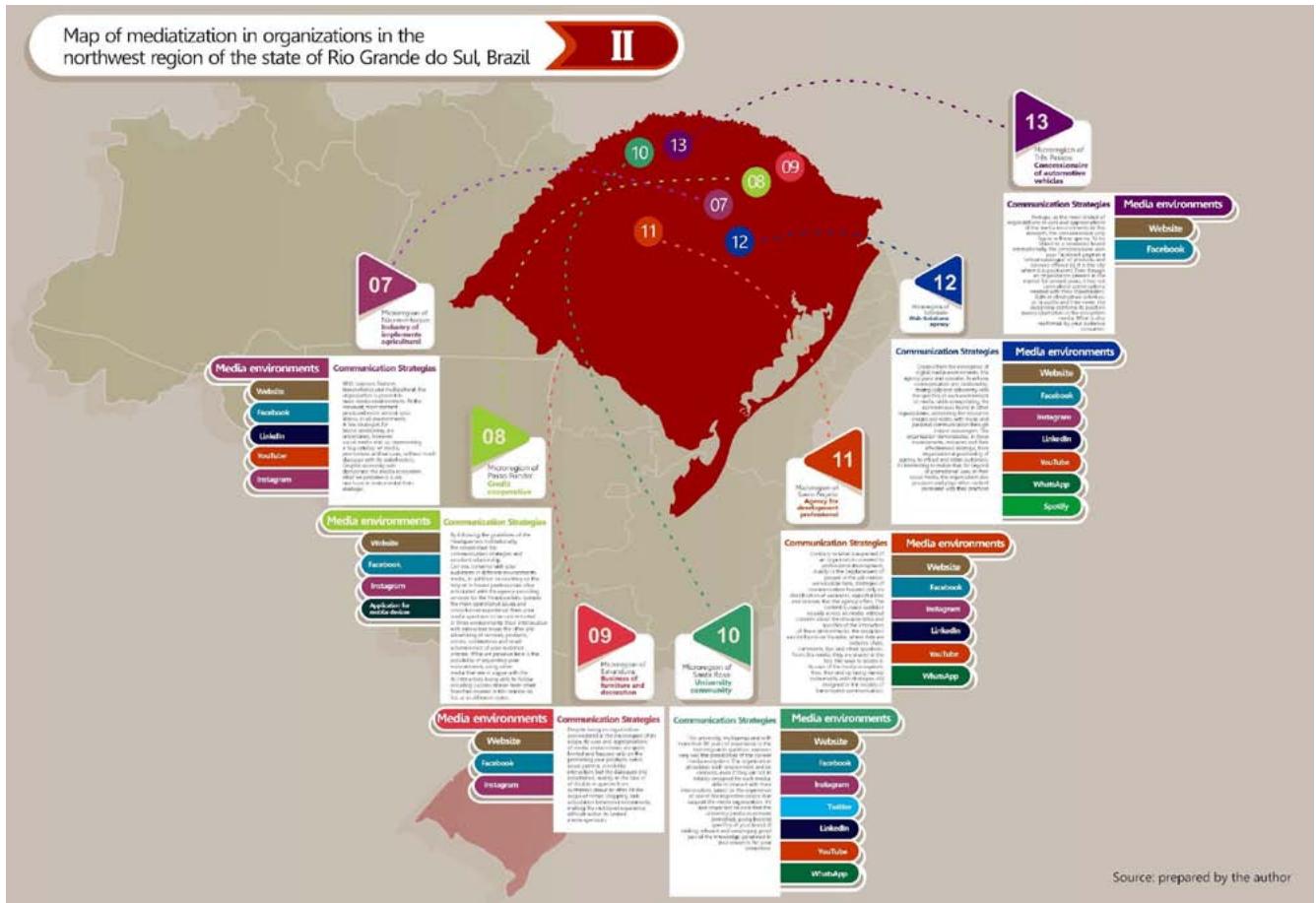
As we can see from the maps, even though the researched organizations navigate through the primary media environments, most still need to learn about the resources these technologies offer to make their communication and relationship strategies more aligned with the interests of their audiences. This situation worsens the further their core activities are from communication or technology. In this context, there is a behavioral pattern or a particular reproduction of marketable content and social interaction formats. Due to the lack of appropriation of these environments, these organizations produce meanings that must align with their communicational reality and, more importantly, their audiences' reality.
They merely replicate strategies that are more common to broadcast transmission communication in media environments, where communicational culture is still centered on past habits, beliefs, and views, overlooking mediation's multifaceted and influential connections. Even in transmission media environments like radio and television, strategies need to be adapted according to the logic of each medium. With mobility and hyperconnectivity, the need to transverse communicational processes and practices, converging content and organizational objectives and policies for each new environment the organization accesses, becomes even more urgent.
By not embracing these characteristics, organizational actors, increasingly interdependent on media, have limited access to the new meanings that organizational mediation can offer. They seek the strategic relationships they desire and imagine in other brands in these environments.
The organizational discourse presented by most researched organizations needs to be more consistent and different from their practice. Their representatives claim to understand and be familiar with the current spectrum of the media ecosystem. They say they research, identify, and monitor their target audiences and other users. However, in practice, this only happens in part. There are common characteristics present throughout the sample, both positive and negative. The organizational and relational presence on social media, for the most part, functions as a mere extension of broadcast communication strategies. However, even with a technical and instrumental discourse, organizations understand and perceive that there is still much to be explored in the media field. According to their managers, the time and resources for qualification need to be improved regarding the constant and accelerated technological development and mediation methods to mediate organizations.
It is important to note that courses and events that address this theme or similar topics are usually held outside the regional axis, which also complicates and increases the cost of access. Thus, there is the infrastructure for the operation and appropriation of the media ecosystem, and organizations and their professionals know the potential for its adoption. However, the use based on similarity (from the experience of established brands) determines the mediatized organizational communication of these organizations.
Considering this, we must remember that historically, media was intuitively integrated into society's daily life. In other words, we learned to use each resource based on daily experience or the already consolidated experience of others. However, in the context of social media, even though the intuitive method is a constant in the daily lives of many, the accelerated technological development and media education that younger generations are perfecting require organizations and their professionals to have a more agile and specialized appropriation of the current media ecosystem.
## V. SOME CONCLUSIONS
This text explores and describes the media configurations and communication strategies of small and medium-sized organizations from various sectors, geographically located in regions distant from major urban centers, through the lenses of mediatization, illuminated by media ecology and organizational communication.
Through applied research, we observed, for thirty days, the media environments accessed by thirteen organizations, attempting to highlight their positioning in the interrelation and interdependence of media organisms in the current socio-organizational context. This context, by extension, aligns with the understanding of the conversion of communication strategies in the face of the mediatization of culture and society.
We encountered organizations with a mediatized organizational profile, equipped with technical resources and efficient knowledge for an ideal appropriation of media environments. However, a significant portion of the sample needs to explore these resources, making their experience within the media bios fragmented and with limited strategic impact. This demonstrates a need for more understanding of the deepening interrelation between technologies, society, and their organizations.
In cases where there are resources but no interest or limited knowledge about the mediatized socio-organizational context, even when expressing concern about the ubiquity of face-to-face and mediated sociability, communication ends up losing value. In other words, dialogues with their audiences become deficient, fail to generate brand experiences, and do not add value to institutional image. Despite potential recursiveness, the apparent limitations in management or professional specialization result in the communication of these organizations in media environments happening instrumentally.
Indeed, there are processes in mediatization. This is evident when we revisit the information presented in Maps I and II, noting that eight researched organizations cover a broad and varied spectrum of media, compared to five that only use more conventional media. This situation supports our understanding that some uses, and communication strategies found in various media environments can often be carried out by these organizations intuitively. Thus, the logic of each media ends up being experimented with and tested without genuinely understanding and comprehending this logic from a cultural perspective, with causes and consequences of the uses and misuses of the media ecosystem in the communication of these organizations.
This is one of the potential issues to reflect on the media field and its relationship with organizations, operating from twisted logics of the mediated, its more visible elements, and ongoing experiments in society. In this perspective, technologies are more thoroughly investigated, not as determinants of processes but as an environment in experimentation in the face of what we tentatively define as an organizational phenomenon in mediatization.
By no means do we intend to belittle or criticize the behavior of these organizations or establish models and standards facing the mediatization of the current socio-organizational praxis? We intend to counter what theories teach us with the discourse and practice of the market. This is pertinent to favor both professional formation and qualification and to encourage the pursuit of expansion of studies on this theme, object, and reality. We have yet to expose the identity of the sample, including for the preservation of its professionals, managers, and other audiences.
In concluding our report, mediatization is still a developing process in organizations in cities distant from major urban centers. However, this research is far from determining that the media configurations and organizational strategies of the researched empirical object are an axiom or a closed field of ideas. On the contrary, it presents itself as an open field, an instrument to guide other approaches and broaden the scope of discussion about the mediatized social context of organizations.
[^3]: We have omitted the identification of the organizations comprising the research corpus to respect the privacy of their representatives and align with ethical norms for conducting research in the Social and Applied Sciences field. _(p.2)_
[^4]: According to Gibson (2014) and Hjarvard (2014), in this research, we interpret affordances as the standard and potential uses that a given object possesses. When applied to understanding the field of media and communications, our concept of affordances of technological artifacts allows various actions to be performed, organized, or even excluded based on their appropriation in mediated interaction processes. _(p.4)_
[^1]: In our current research, we regard social media environments as platforms such as Facebook, Instagram, LinkedIn, Twitter, Snapchat, and TikTok; streaming platforms like Spotify, YouTube, and others; mobile applications exclusively developed for organizational use; instant messengers such as WhatsApp; in addition to their Institutional Portals. _(p.1)_
[^2]: The northwest region constitutes one of the seven mesoregions in the Brazilian state of Rio Grande do Sul. It consists of a union of 216 municipalities, grouped and organized into thirteen microregions, with the municipalities above serving as their headquarters. _(p.2)_
Generating HTML Viewer...
References
12 Cites in Article
Bruna Flesch,Igor Tedeschi,Rodrigo Figueiredo,Lúcio Prade,Márcio Da Silva (2020). A Functional Safety Methodology Based on IEC 61508 for Critical Reliability FPGA-Based Designs.
Fabio Fernandes,Marcela E Silva (2020). COMUNICAÇÃO OMNICHANNEL: CONVERGINDO RELACIONAMENTOS E EXPERIÊNCIAS OFF-LINE E ON-LINE.
F Fernandes,M Silva (2020). Research, Development & Innovation: Design Thinking as a method and Organizational Communication as a strategy.
G Gaskell (2017). Qualitative research with text, image and sound: a practical manual.
James Gibson (2014). The Ecological Approach to Visual Perception.
S Hjarvard (2014). The mediatization of culture and society.
M Kunsch (2012). Audit of organizational communication.
C Peruzzo (2012). Participant observation, and action research.
Raquel Recuero,Gabriela Zago,Marco Bastos (2018). Twitter in Political Campaigns.
A Santos (2015). Scientific Methodology: the construction of knowledge.
M Sodré (2012). Mirror Anthropology: a theory of linear and network communication.
C Terra (2021). Digital brands and influencers: how to transform organizations into digital content producers.
No ethics committee approval was required for this article type.
Data Availability
Not applicable for this article.
How to Cite This Article
Fabio Frá Fernandes. 2026. \u201cOrganizations In Social Media Environments: Strategy, Communication, And Mediatization\u201d. Global Journal of Human-Social Science - H: Interdisciplinary GJHSS-H Volume 23 (GJHSS Volume 23 Issue H9): .
Explore published articles in an immersive Augmented Reality environment. Our platform converts research papers into interactive 3D books, allowing readers to view and interact with content using AR and VR compatible devices.
Your published article is automatically converted into a realistic 3D book. Flip through pages and read research papers in a more engaging and interactive format.
Our text explores the mediatization phenomenon in smaller organizations in geographically remote towns. Through a theoretical-practical study of an applied nature and with an exploratory-descriptive objective, we aim to highlight how the current media ecosystem is used and appropriated while also describing the communicative strategies employed by a group of thirteen organizations situated in the northwest region of the Brazilian state of Rio Grande do Sul. For our methodology, we utilized participant observation, employing techniques to analyze the social media presence of each organization over thirty days. Additionally, we conducted a strategic communication audit targeting specific audiences and indepth interviews with professionals responsible for their communication. The outcome of our efforts is a comprehensive mapping that delves into and describes the mediatization phenomenon within these organizations, which, in our perspective, is in the process of establishment.
Our website is actively being updated, and changes may occur frequently. Please clear your browser cache if needed. For feedback or error reporting, please email [email protected]
Thank you for connecting with us. We will respond to you shortly.