I. INTRODUCTION
Growth is defined as the complete series of physiologic and anatomic changes taking place between the prenatal life and the close of senility. Growth prediction is an assessment of alteration in the direction and speed of growth. Growth pattern of an individual can be influenced by various factors such as genetics, environmental factors and nutritional supply. Evaluating the growth pattern meticulously before initiating treatment improves the reliability and stability of treatment in orthodontic patients.
The advent of lateral cephalogram has brought drastic changes in diagnosis and treatment planning in Orthodontics. It became an important tool in clinical and research domains to assess the underlying skeletal disproportions. Cephalometry permits the evaluation of the spatial relationships between cranial, dental and surface structures. All the evaluations are done by certain landmarks or points on the skull being used for the quantitative analyses and measurements. There are various methods and parameters which are used for predicting mandibular growth pattern using lateral cephalogram. Y-axis angle, SN-GoGn, Frankfort mandibular plane angle, Jarabak's ratio and Facial axis angle are most broadly adopted lateral cephalogram parameters for predicting mandibular growth pattern.3
Bjork suggested structural signs such as curvature of mandibular canal, inclination of condylar head, intermolar angle shape of lower border of mandible, depth of antagonial notch, lower anterior facial height and interincisal angle to find the direction of mandibular growth. Davidovitch studied the association between Bjork structures and skeletal patterns, suggesting that these characteristics can be used radiographically to examine the growth trends.
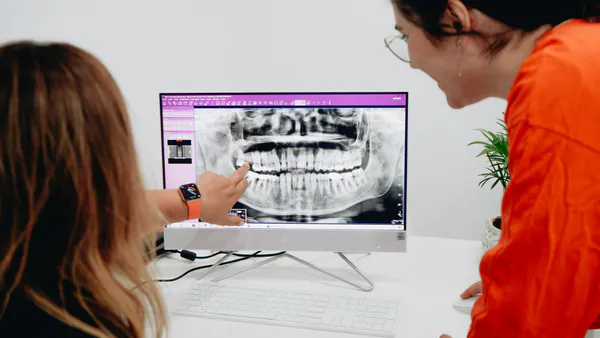
In everyday practice, an orthopantomogram is routinely utilized to provide a bilateral perspective and adequate data on vertical measurements. The number of teeth present, caries, root resorption, ankylosis, impacted teeth, and shape of the condyles, temporomandibular joints, sinuses, fractures, cysts, alveolar bone levels, and tumors have all been studied using it. Several studies have concluded that orthopantomogram (OPG) can effectively assess ramus height and gonial angle as lateral cephalogram.[4,7,8] However, lateral cephalogram cannot be reliably used for measuring the right and left sides of cranial structures individually. This is due to overlapping of both the sides and interference of superimposed images.
The reliability of cephalometric measurements when determined on OPG is still to be investigated. Thus, purpose of this study was to determine the mandibular growth pattern using various parameters of OPG.
II. MATERIAL AND METHODOLOGY
An analytical study was designed in which 84 pretreatment lateral cephalograms (28 average, 28 horizontal, 28 vertical mandibular growth pattern) and 84 pretreatment orthopantomogram (28 average, 28 horizontal and 28 vertical mandibular growth pattern) of same patients were retrieved from the record room of Department of Orthodontics, Sri Siddhartha dental college, Tumakuru. The study involved one key person and one examiner. The key person collected the radiographs, did coding and appraised the examiner regarding the parameters. The pretreatment orthopantomograms and lateral cephalograms were divided into three mandibular growth pattern based on SN-Go-Gn angle:
- Average (G1): 28-36 degrees (Average)
- Hypodivergent (G2): degrees (Horizontal)
- Hyperdivergent (G3): ≥ 38 (Vertical)
Examiner was blinded regarding the study radiographs. The parameters measured to evaluate mandibular growth pattern in the present study includes:
- Inclination of condylar head (ICH): angle between a tangent to the condylar head and tangent to posterior border of the ramus.
- Curvature of mandibular canal (CMC): angle between a line parallel with the first centimeter of the mandibular foramen and a line representing the direction of mandibular canal closest to the mental foramen.
- Anti gonial notch (AN): vertical distance from deepest part of notch concavity to a tangent
through the two points of greatest convexity on the inferior border of mandible, either side of the notch.
- Gonial angle (Go): angle formed by the base of the mandible and posterior border of ramus.
The selected radiographs was traced on 0.03 tracing paper, landmarks located, lines and angles were drawn and the above mentioned variables were measured. The values obtained from linear and angular measurements on orthopantomogram and lateral cephalogram were compared, later the correlation between orthopantomogram (OPG) and lateral cephalogram in evaluating mandibular growth pattern was assessed.
III. STATISTICAL ANALYSIS
SPSS (Statistical Package for Social Sciences) version 20. (IBM SPASS statistics [IBM corp. released 2011] was used to perform the statistical analysis
Data collected from pretreatment radiographs was entered in the excel spread sheet.
Descriptive statistics of the explanatory and outcome variables was calculated by mean, standard deviation for quantitative variables, frequency and proportions for qualitative variables.
Inferential statistics like
ANOVA was applied to compare among the groups with post-hoc Bonferroni for pair-wise comparison of Orthopantomogram and Lateral Cephalogram parameters.
Paired sample t test was used to compare the difference between Orthopantomogram and Lateral Cephalogram parameters.
Pearson's correlation to correlate the parameters of lateral cephalogram and orthopantomogram was computed.
The level of significance was set at
IV. RESULTS
On assessing the mean mandibular plane angle among horizontal, average and vertical, it was found highest for vertical mandibular growth pattern. There was a statistically significant difference seen between all the three groups in pairwise post hoc analysis.
a) Lateral Cephalogram
The Gonial angle for horizontal, average and vertical mandibular growth pattern in lateral cephalogram was , , respectively. The P value obtained was 0.00 and was statistically significant. The antagonial notch for horizontal, average and vertical mandibular growth pattern in lateral cephalogram was , , respectively. The P value obtained was 0.16 and was statistically non-significant. The curvature of mandibular canal for horizontal, average and vertical mandibular growth pattern in lateral cephalogram was , , respectively. The P value obtained was 0.61 and was statistically non-significant. The inclination of condylar head for horizontal, average and vertical mandibular growth pattern in lateral cephalogram was , , respectively. The P value obtained was 0.50 and was statistically non-significant. (Table 1).
| LATERAL CEPH | Horizontal | Average | Vertical | P value |
| GONIAL ANGLE | 122.82±2.03 | 126.68±4.05 | 129.82±4.9 | 0.00* Significant |
| AN | 1.38±0.87 | 1.56±0.89 | 1.97±1.01 | 0.16 NS |
| CMC | 134.96±3.76 | 136±3.17 | 136±3.59 | 0.61 NS |
| ICH | 167.25±3.77 | 165.82±4.4 | 166.68±3.28 | 0.50 NS |
| Kruskal Wallis test; *Statistically significant, p<0.05, NS- not significant | ||||
The Gonial angle for horizontal, average and vertical mandibular growth pattern in orthopantomogram was , , respectively. The P value obtained was 0.00 and was statistically significant. The antagonical notch for horizontal, average and vertical mandibular growth pattern in orthopantomogram was , , respectively. The P value obtained was 0.04 and was statistically significant. The curvature of mandibular canal for horizontal, average and vertical mandibular growth pattern in orthopantomogram was , , respectively. The P value obtained was 0.46 and was statistically non-significant. The inclination of condylar head for horizontal, average and vertical mandibular growth pattern in orthopantomogram was , , respectively. The P value obtained was 0.28 and was statistically non-significant. (Table 2)
| OPG | Horizontal | Average | Vertical | P value |
| GONIAL ANGLE | 123.38±4.4 | 127.59±3.4 | 130.07±5.35 | 0.00* Significant |
| AN | 1.35±0.88 | 1.39±0.84 | 1.70±0.94 | 0.04* Significant |
| CMC | 135.95±3.89 | 136.71±3.18 | 158.96±114.81 | 0.46 NS |
| ICH | 167±2.48 | 165.73±4.14 | 165.16±9.48 | 0.28 NS |
| Kruskal Wallis test; *Statistically significant, p<0.05, NS- not significant | ||||
V. DISCUSSION
Facial growth and development are of major concern to the clinician. The direction and amount of growth will significantly modify the type of orthodontic treatment modality. The ability to predict growth patterns of maxilla, mandible and other craniofacial structures plays a major role in improving the reliability of treatment planning and long term success of orthodontic patients.3
After the introduction of cephalometric radiography in 1931 by Broadbent, it has been used as a primary tool for Orthodontic diagnosis and treatment planning. All the evaluations are done by certain points or landmarks on the skull for the quantitative analyses and measurements. Mandibular growth is primarily related to Condylar growth, it differs in forward and backward rotations. FMA, SN-GoGn, Y-axis angle, facial axis angle and Jarabak's ratio are the widely used parameters measured on lateral cephalogram to predict the growth pattern of mandible. However, the inherent ambiguity of locating landmarks and surfaces on the x-ray image as the image lacks hard edges, shadows and well defined outlines are major drawbacks of lateral cephalogram technique. High radiation exposure and cost are important limitations of this technique. Panoramic radiography provides information such as axial inclination of teeth, maturation phases and comprehensive view of surrounding tissue. This technique is used mainly because of its comparatively low radiation exposure, patient's comfort and significant amount of diagnostic information which is attained by examining all the teeth and basal bone at once.
Measurements on panoramic radiographs have been called into question because of different methodological errors that include distortion and magnification of images.4
Right and left side structures can be effortlessly visualized individually using orthopantomogram, cluding any overlapping or superimposing structures that helps in minimizing the methodological errors. The possible application of OPG for evaluating angular and linear measurements is being investigated using different parameters. In order to validate OPG as an assessment tool for identifying growth pattern there should be more parameters for determining the direction of growth and its reliability has to be checked.
In this present study mandibular growth pattern was assessed with three angular and one linear parameter measured on orthopantomogram. The pretreatment orthopantomograms and lateral head films were categorized into three mandibular growth pattern based on SN-Go-Gn angle. The values obtained from angular and linear measurements on orthopantomogram and lateral cephalogram were compared.
In this study mandibular plane angle was measured between SN-Go-Gn in lateral cephalogram. Statistical significant difference was found in the vertical growth pattern (39.07±1.86 degree) with which is in line with the study done by Davidovitch et al where he found mandibular plane as a predictor to check for the divergence pattern of an individual. Significant statistical difference was found between G1, G2 and G3 ( ).[6]
Gonial angle represents the form of mandible2 and also plays an important role in predicting growth, profile changes and the condition of the lower anterior teeth. Studies have evaluated the association of gonial angle with mandibular divergence and investigated the integrity of gonial angle when measured on OPG and lateral cephalogram. It was shown that gonial angle is related with mandibular divergence and can be employed as a predictor of vertical growth pattern. These studies emphasized on the fact that gonial angle can be assessed on OPG as precisely as lateral cephalogram. The result obtained in this study showed result in accordance with the earlier studies. Gonial angle was highest for vertical growth pattern in OPG (130±5.35 degree) and lateral cephalogram (129±4.9 degree). There was a statistical difference between horizontal, average and vertical groups . It can be deduced that OPG can be used to determine gonial angle as accurately as lateral head films.
Implant study has found that the prominence of deep antegonial notching is increased by the process of bone deposition under the gonial angle. The presence of a deep mandibular antegonial notch is suggestive of reduced mandibular growth potential and a vertical mandibular growth pattern when analyzed on lateral cephalogram. In the present study, antegonial notch was highest for vertical growth pattern in lateral cephalogram (1.97±1.01 degree) and OPG (1.70±0.94 degree). Statistically significant difference seen between horizontal and vertical groups when evaluated in OPG.
Curvature of mandibular canal (CMC) reflects the initial shape of the mandible and curving of mandibular canal can differentiate horizontal and vertical growth pattern. The mandibular canal and the trabaculae related to it can be considered as stationary because they are not remodeled to the same amount as the outer surface of jaw. The curvature of canal tends to be more pronounced than the mandibular contour in vertical type of condylar growth that is in horizontal growth pattern. Comparison of mean mandibular canal curvature among three growth patterns in this study showed highest value for vertical growth pattern degree) in OPG. When measured on lateral cephalogram, the mean curvature of mandibular canal was high for both average and vertical growth pattern but statistically no difference was found between all three groups.
Forward or backward inclination of the condylar head is a distinguishing sign that can predict the direction of growth. Forward inclination of condylar head is presumed to be found in vertical growth pattern and backward inclination in horizontal growth pattern.[5] Davidovitch highlighted that when there are changes in remodelling in localized areas of condyle, there can be differences in the direction and amount of condylar growth.[6] This variation in the condylar growth can lead to slight differences in condylar inclination values in different skeletal groups.[5] In the present study the mean inclination of condylar head was highest for horizontal growth mandibular growth pattern in OPG (165.73±4.4 degree). The result obtained was contrast from the studies of Issacson et al, Herbert et al which suggested that condylar head is further forwardly inclined in hyperdivergent group and backwardly placed in hypodivergent group.[16]
According to Bjork, not all the morphologic characteristics would be found in a particular individual, but the greater the number of features present, the more accurate the prediction would be. There are various parameters which are used for predicting mandibular growth pattern using lateral cephalogram. An alternative method for predicting growth pattern using certain parameters on OPG has been investigated in this study. The accuracy of using OPG as an alternative tool for lateral cephalogram was analyzed using more number of parameters which makes the study more relevant. Based on the results obtained from the present study it is clear that certain parameters like gonial angle and antagonical notch can be used for predicting different growth patterns and also the selected parameters can be evaluated using OPG.
Further longitudinal studies with more samples has to be done to evaluate the other parameters which is useful to assess the mandibular growth pattern in OPG.
VI. CONCLUSION
Evaluation of growth pattern carefully before the starting of treatment plays an important role in the long term success and reducing the risk of lapse in an individual. Various parameters should be used in a guarded fashion to enhance the Orthodontist's ability to predict the growth pattern. Different craniofacial parameters have been successfully used in the prediction of growth pattern using lateral cephalogram, though the reliable parameters used for the evaluation on growth pattern on Orthopantomogram is limited. The results of present study evaluating Bjork's indicators in different skeletal pattern on OPG and lateral cephalogram showed that gonial angle and antagonial depth can be used as reliable parameters for growth prediction. It can be concluded that certain parameters like gonial angle and antagonial notch can be used for assessing mandibular growth pattern using OPG.
Clinical Significance
Orthopantomogram which has been already in use for diagnosing several other conditions with its cost effectiveness can emerge as a useful assessment tool which has reduced radiation exposure and convenient for the patients in reducing the need for multiple radiographs for diagnosing and prediction of mandibular growth pattern in orthodontic cases.