This scientific article proposes an enhanced analysis of Higher Education Institutions (HEIs) in Brazil, focusing on Public HEIs (Federal, State, and Municipal) and Private HEIs (Community-based, Confessional, Philanthropic, and for-profit). The adopted approach stems from a meticulous historical analysis of face-to-face Civil Engineering courses, considering the various intermediary regions in Brazil. The study is based on data from the National Higher Education Assessment System (SINAES), the Higher Education Census, as well as demographic and territorial data provided by IBGE, and information from CONFEA. The theoretical framework of this article is grounded in the essential concepts of Brazilian Higher Education, Higher Education Institutions, the National Higher Education Assessment System, Civil Engineering Courses, and the Civil Construction Industry. A relevant factor incorporated into this analysis is the impact of territory, encompassing not only physical and environmental characteristics but also cultural and infrastructural issues.
## I. INTRODUCTION
This scientific article proposes an in-depth investigation into the reality of Brazilian Higher Education, with a focus on the Civil Engineering course. The scope of this research is situated within the context of the assessment and regulation of higher education, aiming to present a comprehensive analysis of data related to the in-person Civil Engineering course. The evaluation parameters considered encompass territorial, demographic, and indicators from the National
Author α: Doutor em Informática na Educação, Instituto Federal de Roraima - IFRR - Av. Tuxaua de Farias, s/n - Bonfim/RR.
Author p: Doutor em Educação, Universidade Federal do Rio Grande do Sul - Av. Paulo Gama, 110 - Porto Alegre/RS.
System of Higher Education Assessment (SINAES), the Higher Education Census, as well as demographic and territorial data from IBGE, and information from CONFEA.
The choice of the in-person Civil Engineering course at the national level as the object of study is justified by its relevance in the formation of professionals who play a crucial role in the social development of cities and regions. Furthermore, the predominant history of offering this course in the in-person modality facilitates the analysis, given the significant sample representativeness, eliminating the need to consider distance learning courses.
The Brazilian educational scenario is influenced by territorial factors that go beyond physical and environmental characteristics, incorporating cultural and infrastructural aspects. The methodology adopted for this research is quantitative in nature, with data collection and basic research established as methodological techniques. Data analysis is conducted through indicators, providing a comprehensive view of the current landscape of the in-person Civil Engineering course.
By exploring Brazilian intermediate regions with lower Human Development Index (HDI), specifically those with at least one active Civil Engineering course. This analysis is essential for guiding Higher Education Institutions (HEIs) managers in strategic decision-making regarding the expansion, maintenance, or reduction of course offerings.
In addition to data analysis, this article presents the development stages of the PanoramaEDU website, a technological tool designed to provide transparency and access to information about in-person Civil Engineering courses, contributing to informed decision-making and planning in the educational sphere.
In this context, this research aims to fill a gap by offering a detailed analysis of the reality of in-person Civil Engineering courses nationwide, considering various Brazilian intermediate regions. The objective is to provide support for managers, public bodies, and other stakeholders interested in improving Brazilian higher education, contributing to the development of effective and informed strategies.
## II. METHOD
This study adopts a quantitative approach grounded in indicators and statistical data, as advocated by Diehl (2004). Quantitative research employs statistical techniques in both data collection and analysis, aiming for results that minimize potential distortions in analysis and interpretation, providing a more robust margin of safety.
Although the use of quantitative data in Brazilian educational research has historically faced challenges, as observed by Gatti (2004), this study chose to employ this methodology to construct a comprehensive overview of Higher Education in Brazil, specifically focusing on the on-site Civil Engineering course.
The research was designed to facilitate the construction of the overview through a website. In this context, the relevance of mobile technologies and mobile applications stands out, enabling access to information and knowledge quickly and flexibly, without time and space restrictions.
The employed method followed the planning of the thesis objectives, prioritizing their achievement. Initially, data collection was carried out, encompassing information from CC, CPC, ENADE reports based on SINAES, as well as data from the Higher Education Census. Additionally, demographic and territorial data from IBGE, including the Brazilian Statistical Yearbook and the Cities Portal, were considered, along with information on the number of registered civil engineers per municipality from CONFEA.
The data collection for the courses began with a search in the National Register of Courses and Institutions of Higher Education (e-MEC Register). Reports from the Higher Education Census, with a focus on disclosure tables, were used to collect data and build the overview. IBGE information, such as the new regional division of federative units into intermediate regions, was utilized.
Facing difficulties in obtaining data at the intermediate level of the region, usually available at the municipal or state level, the conversion of this data to intermediate regions was carried out. This conversion involved the summation of municipality numbers per intermediate region. The criteria adopted for data conversion and analysis enabled a reading of the national situation of the on-site Civil Engineering course, identifying peculiarities in the analyzed intermediate regions. Detailed results are presented in the next chapter, highlighting the national overview of the course and the analysis of five Brazilian intermediate regions with lower HDI, one in each major region of the country, along with the construction of the PanoramaEdu website.
## III. RESULTS
The results obtained through the collection, processing, and analysis of data, along with the interpretation of this information, enable the identification of differentiated readings. This involves observing Public Higher Education Institutions (Federal, State, and Municipal) and Private Institutions (Community, Confessional, Philanthropic, and for-profit), thereby allowing for the exploration of the perspective on the profile of courses nationwide and in their respective intermediary regions.
Subsequently, the Brazilian panorama of Higher Education in Civil Engineering in 2022 is presented. To introduce the results, the overview of the course is first provided in terms of national status. Following this, the results of the Intermediate Regions are presented, with consideration given to one Intermediate Region in each major Brazilian region (Central-South, Northeast, North, Southeast, and South), totaling five regions, following the criterion of lower Human Development Index (HDI).
### a) Overview of the Civil Engineering Course in Brazil
Brazil is a country situated in South America, with an estimated population of 213,317,639 inhabitants as of 2021. Due to its vast dimensions, its territory spans 8,510,345.538 km2 and is divided into five major regions: North, Northeast, South, Southeast, and Midwest. Brazil is a Federative Republic organized politically and administratively into states, municipalities, and districts. There are 26 Brazilian states, in addition to the Federal District, totaling 27 Federative Units that constitute the Federative Republic of Brazil (IBGE, 2022). The Brazilian population density is 25.07 inhabitants/km2.
In 2017, the Brazilian states were subdivided into Intermediate Geographic Regions and Immediate Geographic Regions. Intermediate Geographic Regions represent an intermediate scale between the Federative Units and Immediate Geographic Regions. The delimitation of Intermediate Geographic Regions sought to include Metropolises or Regional Capitals, preferably. In some cases, especially where there were no Metropolises or Regional Capitals, smaller urban centers that were representative of the Immediate Geographic Regions that composed their respective Intermediate Geographic Regions were used. Intermediate Geographic Regions organize the territory, articulating Immediate Geographic Regions through a differentiated higher-hierarchy center based on private and public management flows and the existence of urban functions of greater complexity. Quantitatively, the country has 133 Intermediate Geographic Regions, 510 Immediate Geographic Regions, and 5,570 municipalities (IBGE, 2022).
The offering of on-site civil engineering courses in Brazil in 2022, in gross terms, is 1,366 courses, collectively providing 220,769 vacancies according to data from the E-MEC system of INEP, spread throughout the national territory. However, only 1,098 courses are currently active and underway, reducing the number of vacancies to 179,515, a difference of 41,254 fewer vacancies.
The 1,098 courses currently in operation are distributed across the five major Brazilian regions, serving as the subject of quantitative analysis in this Panorama of Higher Education in On-Site Civil Engineering.
Subsequently, graphs presenting the results of the national panorama of On-Site Civil Engineering courses are provided, considering the various indicators of this thesis.
Course in institutions
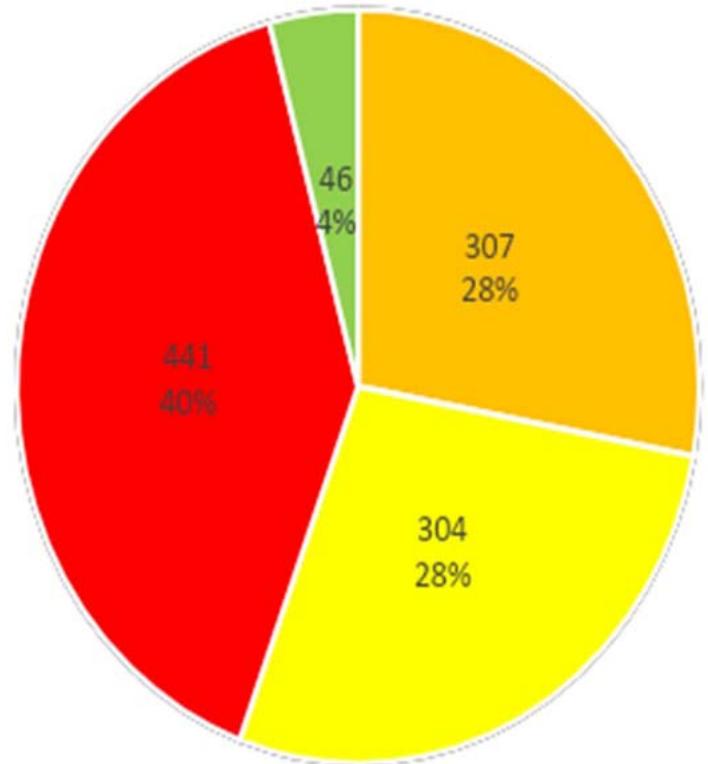
Graph 1: Number of courses by academic organization
Source: National Register of Higher Education Courses and Institutions - e-MEC Register.
- University
- University center
- Faculty
- Institute
Given the above chart, it is evident that the courses are well distributed, with a notable increase in the number of on-site civil engineering courses offered by Federal Institutes. Despite their characteristic nature of providing technical courses, these institutes respond to the demand for higher education in civil engineering. However, the program is also prevalent in universities, constituting $40\%$ of the total quantity of existing courses.
Course by Administrative Category
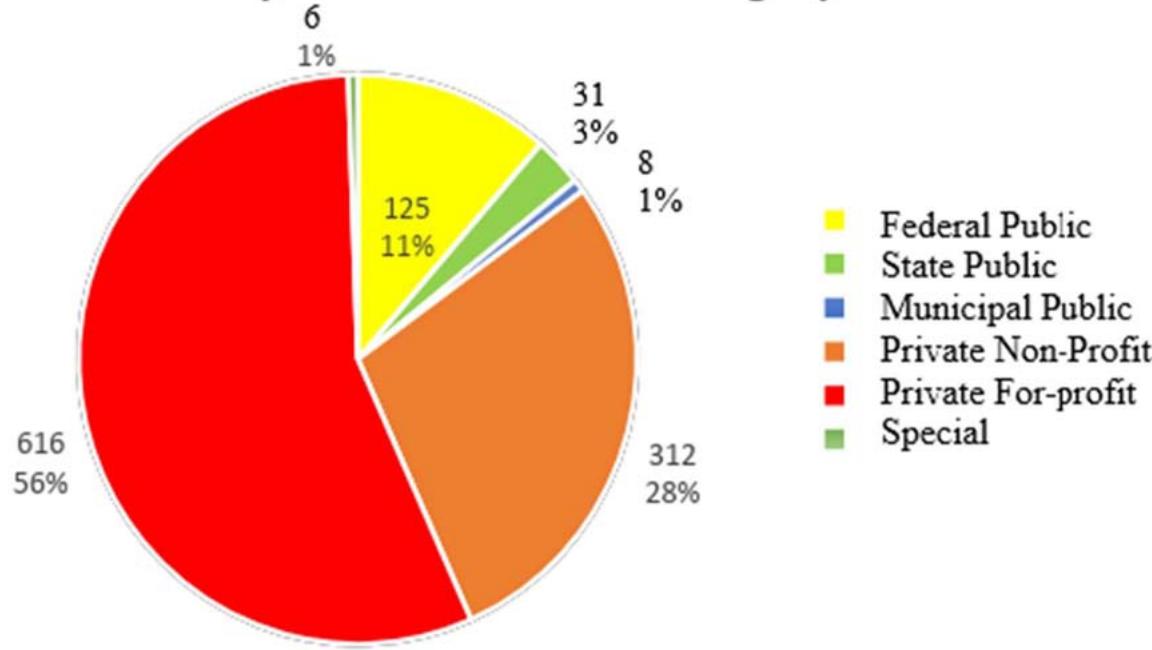
Graph 2: Number of courses by administrative category
Source: National Register of Higher Education Courses and Institutions - e-MEC Register.
According to the chart, it is evident that the course is offered by For-Profit Private HEIs, totaling $56\%$. Following this, there is a $28\%$ allocation in Non-Profit Private HEIs and an $11\%$ allocation in Federal Public HEIs.
Considering the total number of civil engineering courses offered by private HEIs (both for profit and non-profit), we observe a total of $84.5\%$ of courses in Brazil. This highlights a noteworthy aspect to be considered in the analysis: the in-person Civil Engineering course tends to be pursued in private HEIs. To confirm this, it is necessary to examine the authorized positions at this point.
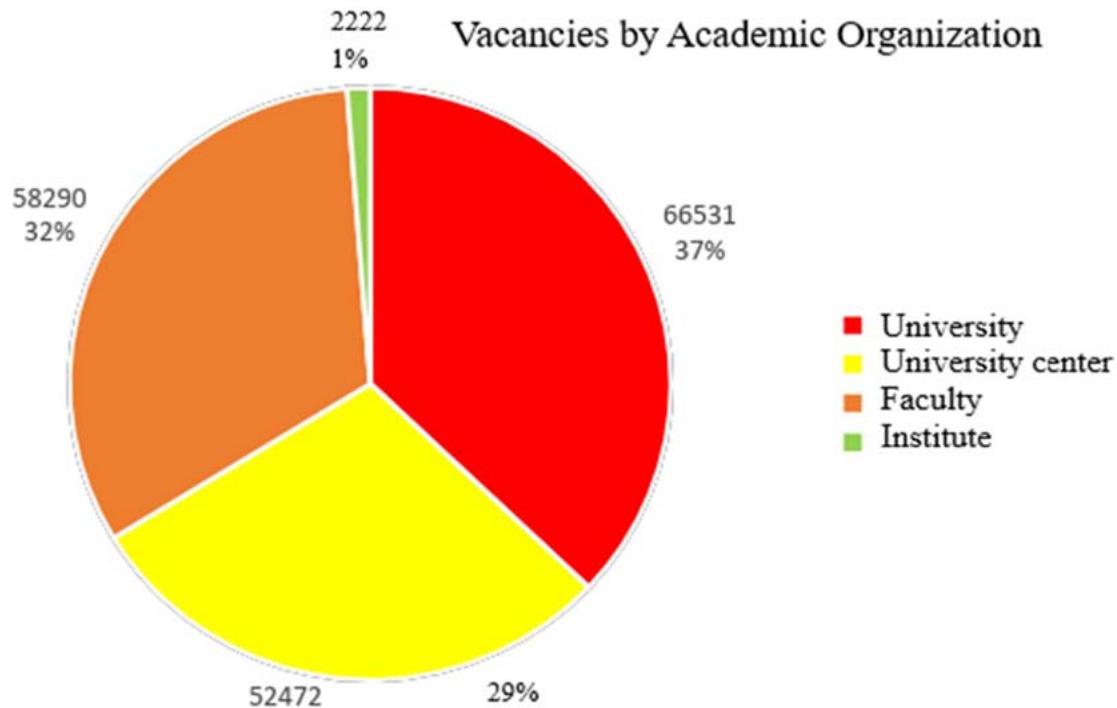
Graph 3: Number of vacancies in courses by academic organization
Source: National Register of Higher Education Courses and Institutions - e-MEC Register.
From the observations derived from the graph, a discernible trend toward equilibrium in the number of available positions among Universities, University Centers, and Colleges becomes apparent. Notably, the number of positions in Universities stands out, constituting $37.06\%$ of the total. Despite Institutes featuring a lower count of positions, the figure of 2,222 vacancies still represents approximately $1.24\%$ of the total, signifying a noteworthy outcome.
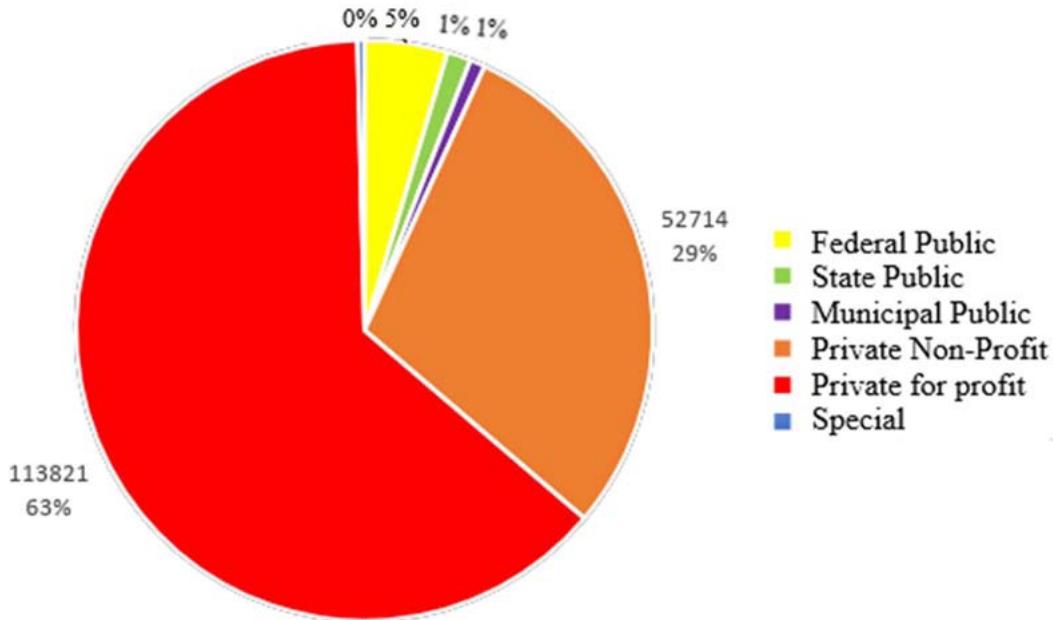
Administrative Category x Vacancies
Source: National Register of Higher Education Courses and Institutions - e-MEC Register.
#### Graph 4: Number of vacancies in courses by administrative category
Given what is presented in the previous graph, it is evident that the largest quantity of positions is in private higher education institutions (HEIs) with profit-making purposes, nearly 114,000 positions, representing $64\%$ of the positions offered in this administrative category. This graph is crucial in responding to the fact that the On-site Civil Engineering course is predominantly offered in both for-profit and non-profit private HEIs, totaling 166,535 positions, corresponding to $93\%$ of the positions offered in the country.
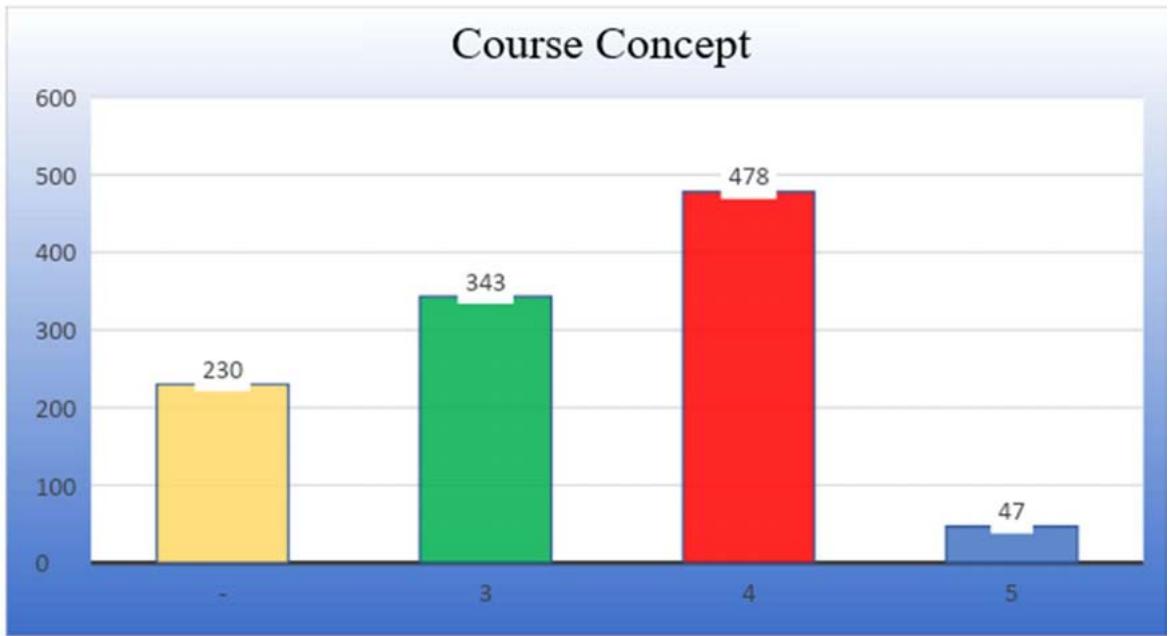
Graph 5: Number of courses according to the course concept - CC
Source: National Register of Higher Education Courses and Institutions - e-MEC Register.
The concept of Course 4 represents the on-site civil engineering course, totaling 478 courses, constituting $44\%$. Within this total, only 47 courses have a Course Concept rating of 5, which is the maximum rating in the indicator. Even with this information, it is evident that there are not many civil engineering courses at the highest standard. However, this data alone is insufficient to assert a scarcity of civil engineering courses with the maximum rating, as other variables need to be considered. Nevertheless, it remains a relevant datum, given that only $4\%$ of on-site courses have a rating of 5 in this concept. With a Course Concept of 3, there are 343 courses, representing $31\%$, and 230 courses, $21\%$, lack a rating in this indicator.
Despite this data raising concerns, it is observed that the majority of courses in this indicator have a Course Concept rating of 4, indicating that the courses in the country meet the indicator's criteria as being Very Good. Furthermore, $79\%$ of courses demonstrate sufficiency in the Course Concept indicator.
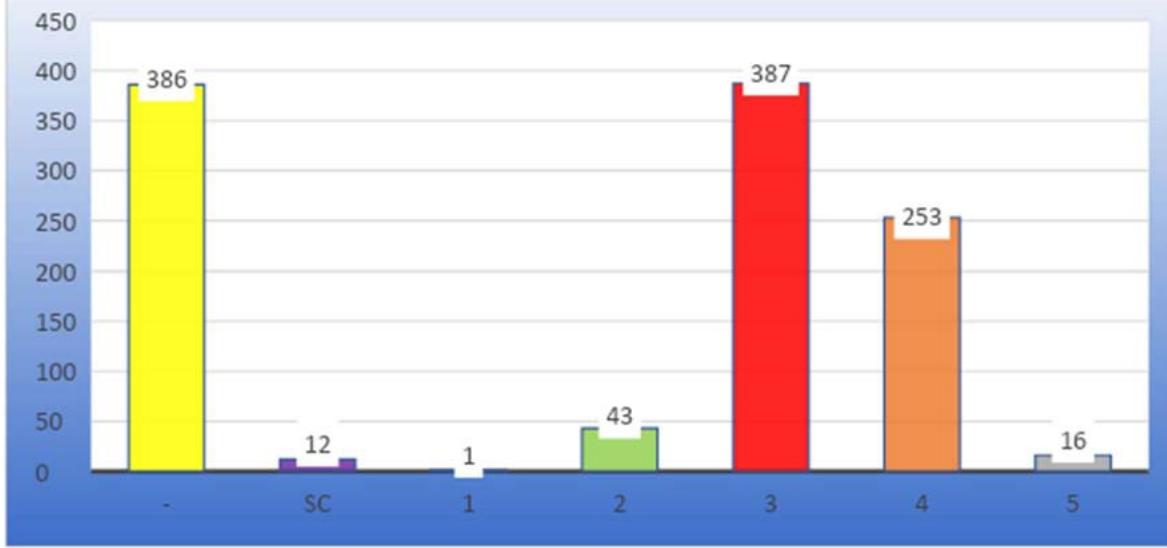
Preliminary Course Concept
Source: National Register of Higher Education Courses and Institutions - e-MEC Register.
Graph 6: Number of courses according to the Preliminary Course Concept – CPC.
Regarding the Preliminary Course Concept, concept 3 had the highest frequency, accounting for $35\%$. It is crucial to note, upon observing the graph, that there are courses with a concept lower than the level of sufficiency, which is the concept grade 3. In other words, $4\%$ of the courses have CPC scores of 1 or 2. It is noteworthy to emphasize the concept 4, constituting $23\%$ Additionally, when combining courses with concepts 3, 4, and 5, there is a total of $60\%$ of courses demonstrating sufficiency in the CPC concept.
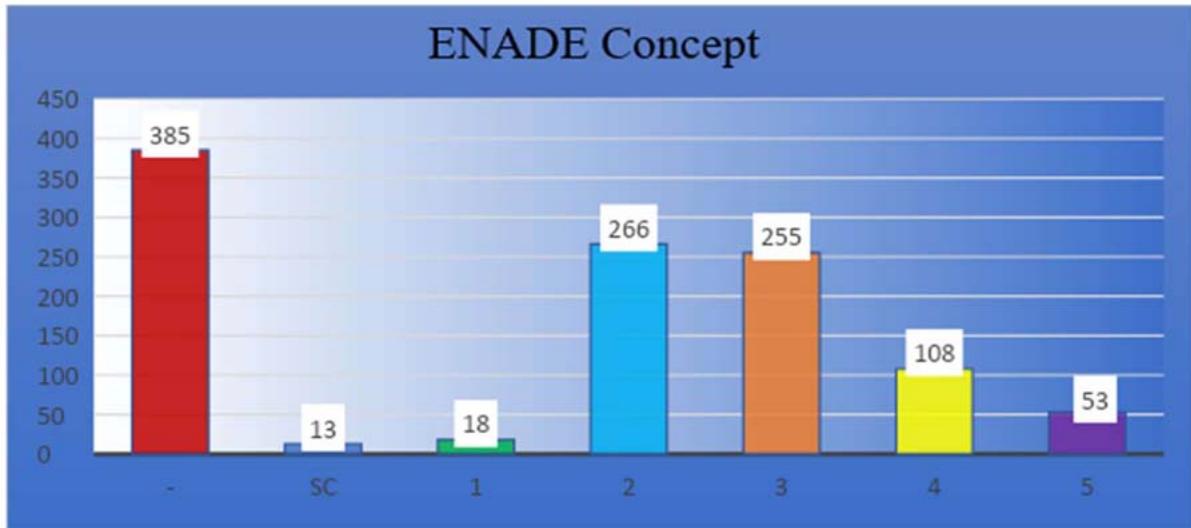
Graph 7: Number of courses according to the ENADE concept
Source: National Register of Higher Education Courses and Institutions - e-MEC Register.
Regarding the ENADE (National Student Performance Exam), the results indicate that the majority of courses do not have a rating, totaling 385 courses. Among those with a rating, the highest frequency is observed with ratings 2 and 3, suggesting a normal distribution trend in the indicator.
Upon analyzing regulatory data, it was found that only 6 courses in the country have both CC (Course Concept) 5 and ENADE 5. This finding raises concerns, as achieving the highest quality in higher education in Brazil is a goal that very few courses manage to attain, constituting only $0.54\%$ of the total. These courses are as follows: Universidade Federal de Viçosa - UFV, Universidade Federal de Lavras - UFLA, Centro Federal de Educação Tecnológica de Minas Gerais - CEFET/MG, Universidade Federal de Itajuba - UNIFEI, Faculdade IBMEC, and Instituto Federal de Educação, Ciência e Tecnologia de São Paulo - IFSP.
These courses are located in Minas Gerais (5) and São Paulo (1). Consequently, it can be concluded that Minas Gerais is the state with the highest prominence in regulatory results, with four out of the thirteen intermediate regions being served by courses that received the highest rating (Course Concept 5).
However, it is crucial to note that courses are operating with low ratings in both Course Concept and ENADE. There are 18 courses with an ENADE rating of 1, with one course standing out negatively, as it not only has an ENADE rating of 1 but also a Preliminary Course
Concept rating of 1. This is the Civil Engineering course at Faculdades Integradas Dom Pedro II in the municipality of São José do Rio Preto in the state of São Paulo.
The discovery that the state of São Paulo exhibits both extremes, featuring a Civil Engineering course with the highest ratings and another with the lowest ratings, is not surprising. This can be attributed to the demographic dimensions of the state of São Paulo, which has an estimated population of 46,649,132 inhabitants.
#### IDHM
To ascertain the feasibility of comparing the indicators of SINAES (CC, CPC, and ENADE) with the HDI, it is necessary to assess the normality of the sample, as substantiated by the calculations below:
$$
\bar {X} = \frac {1}{n} \sum_ {i = 1} ^ {n} X _ {i}
$$
$$
IDHM "Calculation of the Mean" = 3668,211 / 5565 = 0,659
$$
The calculated sample standard deviation is 0.071991; rounding it to 0.072 is warranted, as the Human Development Index (HDI) employs three decimal places.
Table 1: Interval scale according to standard deviation of the HDI
<table><tr><td>Standard deviation</td><td>HDI range</td></tr><tr><td>σ -3</td><td>0,418 - 0,514</td></tr><tr><td>σ -2</td><td>0,515 - 0,586</td></tr><tr><td>σ -1</td><td>0,587 - 0,659</td></tr><tr><td>σ 1</td><td>0,659 - 0,730</td></tr><tr><td>σ 2</td><td>0,731 - 0,802</td></tr><tr><td>σ 3</td><td>0,803 - 0,875</td></tr></table>
IDHM - Normal Distribution
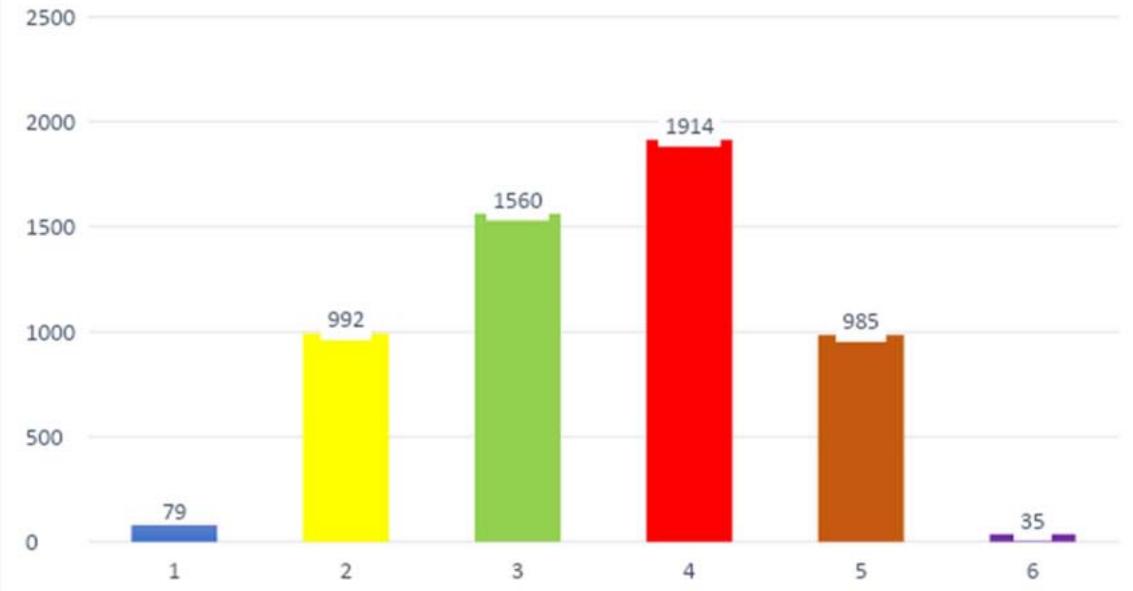
Graph 8: Normal distribution of IDHM Brazil
Source: Prepared by the author
The p-value of the Anderson-Darling normality test (A2) was computed utilizing the following formula.:
$$
A ^ {2} = \left(- n - \frac {1}{n} \sum_ {i = 1} ^ {n} ((2 i - 1) \ln \Phi (Z _ {i}) + (2 (n - i) + 1) \ln (1 - \Phi (Z _ {i})))\right)
$$
Where $\Phi$ is the cumulative standard normal distribution, and $Z_i$ represents the corresponding normalized scores. The associated "p" value is $p = 0 \geq 0.05$, indicating that we lack sufficient evidence to claim a significant deviation from normality in the sample data; hence, we do not reject normality.
Consequently, it can be asserted that based on the Anderson-Darling normality test result, the distribution of the Human Development Index (IDH) in Brazilian municipalities tends towards a normal distribution.
Given this outcome, considering that the indicators of the National System of Higher Education Assessment (SINAES) - such as Institutional Concept (CC), Course Concept (CPC), and National Student Performance Exam (ENADE) - tend to follow a normal distribution, it becomes possible to establish a parameter for the Human Development Index according to the table below:
Table 2: Number of municipalities according to normal distribution
<table><tr><td>Standard deviation</td><td>IDHM Range</td><td>No. Counties</td></tr><tr><td></td><td></td><td></td></tr><tr><td>σ -3</td><td>0,000 - 0,514</td><td>79</td></tr><tr><td>σ -2</td><td>0,515 - 0,586</td><td>992</td></tr><tr><td>σ -1</td><td>0,587 - 0,659</td><td>1560</td></tr><tr><td>σ 1</td><td>0,659 - 0,730</td><td>1914</td></tr><tr><td>σ 2</td><td>0,731 - 0,802</td><td>985</td></tr><tr><td>σ 3</td><td>0,803 – 1,000</td><td>35</td></tr></table>
Under the classification of the Human Development Index (IDHM) based on parameter definitions, the analysis scale considers the following developmental ranges:
1. Very low human development (1): IDHM between 0.000 and 0.499;
2. Low human development (2): IDHM between 0.500 and 0.599;
3. Medium human development (3): IDHM between 0.600 and 0.699;
4. High human development (4): IDHM between 0.700 and 0.799;
5. Very high human development (5): IDHM between 0.800 and 1.000.
Table 3: Distribution of municipalities according to the IDHM scale
<table><tr><td>IDHM Scale</td><td>IDHM Range</td><td>No. Counties</td></tr><tr><td>Very low</td><td>0,000 - 0,499</td><td>32</td></tr><tr><td>Low</td><td>0,500 - 0,599</td><td>1367</td></tr><tr><td>Average</td><td>0,600 - 0,699</td><td>2233</td></tr><tr><td>High</td><td>0,700 - 0,799</td><td>1889</td></tr><tr><td>Very High</td><td>0,800 – 1,000</td><td>44</td></tr></table>
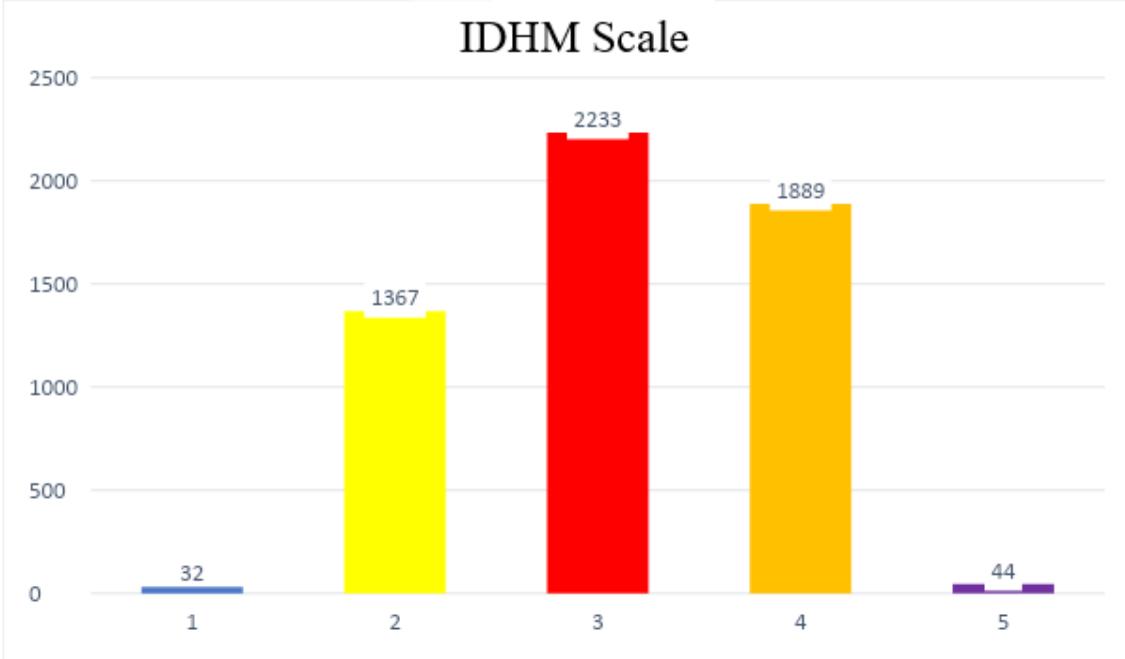
Graph 9: Number of municipalities according to the IDHM scale
Source:PNUD,2013.
The Human Development Index (HDI) of Brazil is 0.765, thus placing it in the category of high HDI. It ranks 84th in the global ranking, and from the graph, it is evident that the majority of Brazilian municipalities fall within the range of medium HDI.
Upon presenting the data, it is possible to perform several cross-analyses between the indicators, revealing interesting findings. The purpose of this analysis is to contribute to the decision-making process for the opening of on-site Civil Engineering courses by Higher Education Institution (HEI) administrators. The results presented here are not intended to exhaust the search for information, and it is recommended to conduct a local demand survey to complement the provided data.
The first cross-analysis was conducted to determine the ratio between the population and the number of civil engineers. The result obtained was 213,317,639/367,953 = 579.74, meaning there is approximately 1 civil engineer for every 580 people in the country. Consequently, there are 1.72 active civil engineers per 1000 inhabitants.
The second cross-analysis examined the ratio between the number of civil engineers and the number of companies in the construction industry. The result was 367,953/125,067 = 2.94, indicating that there are almost 3 active civil engineers for each construction industry company in Brazil.
The third cross-analysis aimed to determine the ratio between the number of people employed in construction industry companies and the number of active civil engineers. The result was 1,903,715/367,953 = 5.17, meaning there are 5 employed individuals in construction industry companies for every active civil engineer in the country.
The fourth cross-analysis was conducted to assess the ratio between the number of engineers and the number of available slots in on-site civil engineering courses. The result was 367,953/179,515 = 2.05, demonstrating that the number of active civil engineers is almost double the number of available slots in active on-site civil engineering courses.
The fifth cross-analysis focused on the ratio between the number of engineers and the number of courses. The result was 367,953/1,098 = 335.11, indicating there are approximately 335 active civil engineers for each active on-site civil engineering course.
The sixth cross-analysis aimed to determine the ratio between the number of people employed in construction industry companies and the number of available slots in on-site civil engineering courses in Brazil. The result was 1,903,715/179,515 = 10.60, signifying that there are approximately 11 employed individuals in construction industry companies for each available slot in active on-site civil engineering courses.
The seventh cross-analysis focused on the ratio between the number of people employed in construction industry companies and the number of active on-site civil engineering courses. The result was 1,903,715/1,098 = 1733.8, indicating that there are approximately 1734 employed individuals in construction industry companies for each active on-site civil engineering course.
The eighth cross-analysis aimed to determine the ratio between the Brazilian population and the number of people employed in construction industry companies. The result obtained was 213,317,639/1,903,715 = 112.05, meaning there is approximately 1 employed individual in construction industry companies for every 112 people.
The ninth cross-analysis aimed to determine the average between the number of people employed in construction industry companies and the number of companies in the construction industry. The result was $1,903,715 / 125,067 = 15.22$, indicating that there is an average of 15 employed individuals in each construction industry company.
The tenth cross-analysis aimed to determine the ratio between the Brazilian population and the number of companies in the construction industry. The result obtained was 213,317,639/125,067 = 1705.62, signifying that there is approximately 1 construction industry company to serve approximately 1706 people.
The eleventh cross-analysis focused on the ratio between the number of construction industry companies and the number of active on-site civil engineering courses. The result was 125,067/1,098 = 113.9, indicating that there are approximately 114 construction industry companies for each active on-site civil engineering course.
The twelfth cross-analysis aimed to determine the ratio between the national population and the number of available slots in active on-site civil engineering courses. The result was 213,317,639/179,515 = 1188.3, signifying that there is 1 slot for every 1188 people in Brazil.
The thirteenth cross-analysis aimed to determine the ratio between the number of available slots in active on-site civil engineering courses and the number of construction industry companies. The result was $179,515 / 125,067 = 1.43$, demonstrating that there are approximately 1.5 construction industry companies for each available slot in active on-site civil engineering courses.
The fourteenth cross-analysis aimed to determine the ratio between the national population and the number of active on-site civil engineering courses. The result obtained was 213,317,639/1,098 = 194,278.35, indicating that there is 1 active on-site civil engineering course for every 194,278 inhabitants.
Table 4: Summary of crossings at national level
<table><tr><td>Crossings</td><td>Result</td></tr><tr><td>Population/active civil engineers</td><td>580 inhabitants for each engineer</td></tr><tr><td>Active civil engineers/construction industry
companies</td><td>3 engineers for each company</td></tr><tr><td>People employed in construction industry
companies/active civil engineers</td><td>5 people employed for each engineer</td></tr><tr><td>Active civil engineers/vacancies on courses</td><td>2 engineers for each place on the courses</td></tr><tr><td>Engenheiros civis ativos/número de@cursos</td><td>335 engineers for each course</td></tr><tr><td>People employed in companies in the
construction industry/vacancies on courses</td><td>11 people employed for each place on the courses</td></tr><tr><td>People employed in construction industry
companies/civil engineering courses</td><td>1734 people employed for each course</td></tr><tr><td>Population/people employed in construction industry companies</td><td>112 inhabitants for each person employed</td></tr><tr><td>Persons employed in construction industry companies/construction industry companies</td><td>15 people employed in each company</td></tr><tr><td>Construction industry population/companies</td><td>1706 inhabitants for each company</td></tr><tr><td>Companies in the construction industry/civil engineering courses</td><td>114 companies for each course</td></tr><tr><td>Population/number of vacancies</td><td>1188 inhabitants for each place on the courses</td></tr><tr><td>Crossings</td><td>Result</td></tr><tr><td>Number of places on courses/companies in the construction industry</td><td>1.5 places on courses for each company</td></tr><tr><td>National population/civil engineering courses</td><td>194,278 inhabitants for each course</td></tr></table>
From the presented results, the recurrence of the following national profile of the on-site civil engineering course was observed:
The on-site civil engineering course is offered in private for-profit colleges, with a course rating of 4, a preliminary course rating of 3, and an ENADE rating of 2. The ratio of active civil engineers to the number of courses is 335 civil engineers per course; the number of individuals employed in construction industry sector companies relative to the number of courses is 1734 employed individuals per course; currently, there are 114 companies in the construction industry sector for each course, and the population ratio is 194,278 inhabitants for each initiated on-site civil engineering course in activity.
All the results presented in this overview can serve as a foundation for managers operating in Brazilian public and private higher education institutions to undertake planning and make decisions regarding on-site civil engineering courses.
According to Franco and Longhi (2021, p. 244):
The manager organizes the institution politically and administratively. Facilitates the development and systematization of programs, plans, processes, strategies, and procedures; clarifies and prioritizes budgets, evaluates, proceeds, enhances, or retracts. Initiates processes, ensures their replanning, organizes instances, delegates authority, and promotes responsible democratic management to mobilize the internal and external community, seeking support for the systemic operation to achieve the institutional mission and objectives.
These results, at the national level, already demonstrate the wealth of information upon which academic studies can be grounded from this panorama. However, despite the recurrence of courses aligning with the aforementioned national profile, not all courses and intermediate regions reflect this reality.
In light of this, the analysis of indicators yields divergent results when considering the criterion of intermediate regions with lower HDI, featuring at least one in-person Civil Engineering course in operation and initiated in the Central-West, Northeast, North,
Southeast, and South Regions, totaling 5 regions. Similarly, the subsequent focus will be on intermediate regions where there are no in-person Civil Engineering courses in operation and initiated, as this outcome indicates potential scarcity of courses in these intermediate regions.
It is important to emphasize that, given the volume of information, a decision by the author, in agreement with the advisor, has been made to include in the appendix a brief analysis of the results for an intermediate region by Federal Unit, considering the criterion of intermediate regions with the lowest HDI, while also specifying the criterion that there must be at least one in-person Civil Engineering course in operation and initiated.
b) Overview of On-Site Civil Engineering Courses in the Five Intermediate Regions with the Lowest Human Development Index (HDI).
Midwest: Intermediate Region of Corumbá
The Intermediate Geographic Region of Corumbá is one of the three intermediate regions in the Brazilian state of Mato Grosso do Sul and one of the 134 intermediate regions in Brazil, established by the Brazilian Institute of Geography and Statistics (IBGE) in 2017. It comprises 13 municipalities, distributed across three immediate geographic regions. The total estimated population for the year 2021, as reported by the IBGE, is 367,327 inhabitants, spread over a total area of 131,050.917 km2. Corumbá is the most populous municipality in the intermediate region, with 112,669 inhabitants, according to 2021 estimates from the Brazilian Institute of Geography and Statistics.
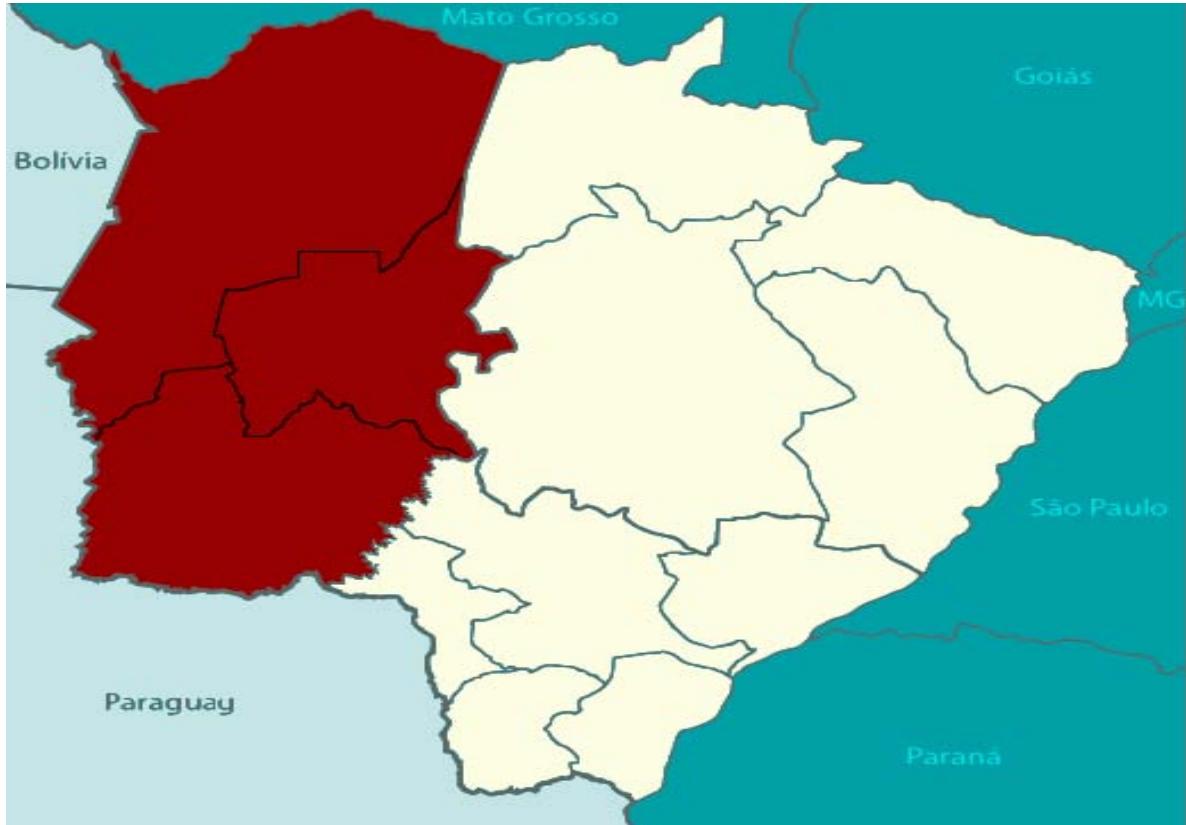 Figure 1: Map of the intermediate region of Corumbá
Source: HUNTER (2020).
The Intermediate Region of Corumbá is the area with the lowest Human Development Index (HDI) in the
State of Mato Grosso do Sul and in the Central-West region.
Municipalities of the Intermediate Region CORUMBÁ
<table><tr><td>Municipalities of the Intermediate Region CORUMBÁ</td><td>Active Civil Engineers</td><td>IDH</td><td>Position IDH</td><td>Estimated Population 2021</td><td>Population Density Estimated</td></tr><tr><td>Ladário</td><td>8</td><td>0,704</td><td>1776</td><td>24040</td><td>67,86</td></tr><tr><td>Corumbá</td><td>21</td><td>0,688</td><td>2224</td><td>112.669</td><td>1,75</td></tr><tr><td>Porto Murtinho</td><td>1</td><td>0,666</td><td>2759</td><td>17460</td><td>0,99</td></tr><tr><td>Nicaque</td><td>0</td><td>0,639</td><td>3312</td><td>13794</td><td>3,52</td></tr><tr><td>Jardim</td><td>19</td><td>0,712</td><td>1546</td><td>26375</td><td>12,41</td></tr><tr><td>Guia Lopes da Laguna</td><td>3</td><td>0,675</td><td>2545</td><td>9754</td><td>7,96</td></tr><tr><td>Caracol</td><td>1</td><td>0,647</td><td>3172</td><td>6247</td><td>2,12</td></tr><tr><td>Bonito</td><td>7</td><td>0,67</td><td>2663</td><td>22401</td><td>4,17</td></tr><tr><td>Bela Vista</td><td>9</td><td>0,698</td><td>1969</td><td>24842</td><td>5,07</td></tr><tr><td>Miranda</td><td>5</td><td>0,632</td><td>3448</td><td>28423</td><td>5,19</td></tr><tr><td>Municipalities of the Intermediate Region CORUMBÁ</td><td>Active Civil Engineers</td><td>IDH</td><td>Position IDH</td><td>Estimated Population 2021</td><td>Population Density Estimated</td></tr><tr><td>Bodoquena</td><td>2</td><td>0,666</td><td>2759</td><td>7802</td><td>3,01</td></tr><tr><td>Aquidauana</td><td>21</td><td>0,688</td><td>2224</td><td>48184</td><td>2,82</td></tr><tr><td>Anastácio</td><td>5</td><td>0,663</td><td>2828</td><td>25336</td><td>8,70</td></tr><tr><td>TOTAL</td><td>102</td><td>0,673</td><td>2598°</td><td>367.327</td><td>2,80</td></tr></table>
The intermediate region has only 1 Public On-Site Civil Engineering course, offered by IFMS, a Federal Public institution, with 40 authorized slots in the municipality of Aquidauana, and it has not yet received any SINAES rating. This indicates that the course is authorized but has not undergone the recognition process.
The intermediate region does not have any Private On-Site Civil Engineering courses offered by private initiatives.
In the State of Mato Grosso do Sul, there are 669 construction industry companies employing 17,504 people, according to data from the Brazilian Statistical Yearbook for the year 2019, in a region with 367,327 inhabitants and 102 active civil engineers registered with CONFEA. Based on this information, the following data cross-references were conducted:
The first cross-reference for the intermediate region aimed to determine the ratio between the population and the number of civil engineers. The result obtained was 367,327/102 = 3,601.24, indicating that there is 1 active civil engineer for every 3,601 people.
The second cross-reference for the intermediate region aimed to verify the ratio between the number of construction industry companies and the number of civil engineers. The result obtained was $620 / 102 = 6.07$, indicating that there are 6 construction industry companies for every active civil engineer.
The third cross-reference aimed to verify the ratio between the number of people employed in construction industry companies and the number of active civil engineers. The result obtained was 16,172 / $102 = 158.55$, meaning that there are approximately 159 people employed in construction industry companies for every active civil engineer in the intermediate region.
The fourth cross-reference for the intermediate region aimed to verify the ratio between the number of engineers and the number of slots in on-site civil engineering courses. The result obtained was $102 / 40 = 2.55$, demonstrating that the number of active civil engineers is nearly double the number of available slots in on-site civil engineering courses that are currently in operation.
The sixth cross-reference for the intermediate region aimed to verify the ratio between the number of people employed in construction industry companies and the number of slots in the on-site civil engineering course in the intermediate region. The result obtained was $16,172 / 40 = 404.3$, signifying that there are practically 404 people employed in construction industry companies in the state for each slot in the on-site civil engineering courses currently in operation in the intermediate region.
The seventh cross-reference for the intermediate region aimed to verify the ratio between the number of people employed in construction industry companies in the state and the number of on-site civil engineering courses currently in operation. However, since the intermediate region has only one course, the result obtained was $16,172 / 1 = 16,172$. This result indicates that there are 16,172 people employed in construction industry companies for the single on-site civil engineering course currently in operation in the intermediate region.
The eighth cross-reference aimed to verify the ratio between the population of the intermediate region and the number of people employed in construction industry companies in the state. The result obtained was 367,327/16,172 = 22.71, meaning there is approximately 1 person employed in construction industry companies for every 23 inhabitants.
The ninth cross-reference in the state aimed to verify the average between the number of people employed in construction industry companies and the number of construction industry companies. The result obtained was $16,172 / 620 = 26.08$, indicating that there is an average of 26 people employed in each construction industry company.
The tenth cross-reference aimed to verify the ratio between the population of the intermediate region and the number of construction industry companies. The result obtained was $367,327 / 620 = 592.46$, signifying that there is approximately 1 construction industry company in the state to serve 592 people in the intermediate region.
The eleventh cross-reference aimed to verify the ratio between the number of construction industry companies and on-site civil engineering courses currently in operation. The result obtained was $620 / 1 = 620$, which is approximately 620 construction industry companies for each on-site civil engineering course currently in operation in the intermediate region.
The twelfth cross-reference aimed to verify the ratio between the population of the intermediate region and the number of slots in on-site civil engineering courses currently in operation. The result obtained was $367,327 / 40 = 9,183.17$, meaning there is 1 slot for approximately every 9,183 people in the intermediate region.
The thirteenth cross-reference aimed to verify the ratio between the number of slots in on-site civil engineering courses currently in operation and the number of construction industry companies. The result obtained was $620 / 40 = 15.5$, indicating that there are approximately 16 construction industry companies for each slot in on-site civil engineering courses currently in operation.
important to consider the population density of the region, which is 2.80 inhabitants per square kilometer.
Table 9: Summary of crossings at the intermediate region level of Corumbá
<table><tr><td>Crossings</td><td>Result</td></tr><tr><td>Population/active civil engineers</td><td>3601 inhabitants per engineer</td></tr><tr><td>Construction industry companies/active civil engineers</td><td>6 companies per engineer</td></tr><tr><td>People employed in construction industry companies/active civil engineers</td><td>159 people employed per engineer</td></tr><tr><td>Active civil engineers/course vacancies</td><td>2 engineers per course vacancy</td></tr><tr><td>Active civil engineers/number of courses</td><td>102 engineers per course</td></tr><tr><td>People employed in construction industry companies/course vacancies</td><td>404 people employed per course vacancy</td></tr><tr><td>People employed in construction industry companies/civil engineering courses</td><td>16172 people employed per course</td></tr><tr><td>Population/people employed in construction industry companies</td><td>23 inhabitants per employed person</td></tr><tr><td>People employed in construction industry companies/construction industry companies</td><td>Average of 26 people employed in each company</td></tr><tr><td>Population/construction industry companies</td><td>592 inhabitants per company</td></tr><tr><td>Construction industry companies/civil engineering courses</td><td>620 companies per course</td></tr><tr><td>Population/number of vacancies</td><td>9183 inhabitants per course vacancy</td></tr><tr><td>Construction industry companies/number of course vacancies</td><td>16 companies per course vacancy</td></tr></table>
Source:Developed by the author
The intermediate region has only one Public On-site Civil Engineering course, offered at IFMS, therefore, a Federal Public institution, with 40 authorized slots in the municipality of Aquidauana, and it does not yet have any SINAES concept, indicating that the course is authorized but has not yet undergone the recognition process.
The intermediate region does not have an On-site Civil Engineering course offered by private initiative. The state of Mato Grosso do Sul has 669 construction industry companies employing 17,504 people, according to data from the Brazilian Statistical Yearbook for the year 2019, in a region with 367,327 inhabitants and 102 active civil engineers in CONFEA. Given this information, the following data cross-references were conducted:
The second cross-reference for the intermediate region was conducted to check the ratio between the number of construction industry companies and the number of civil engineers. The result obtained was 620/102 = 6.07, indicating there are 6 construction industry companies for every active civil engineer.
The third cross-reference aimed to check the ratio between the number of people employed in construction industry companies and the number of active civil engineers. The result obtained was 16,172/102 = 158.55, meaning there are approximately 159 people employed in construction industry companies per active civil engineer in the intermediate region.
The fourth cross-reference for the intermediate region aimed to check the ratio between the number of Engineers and the number of slots in on-site civil engineering courses. The result obtained was $102 / 40 = 2.55$, demonstrating that the number of active civil engineers is almost twice the number of slots in on-site civil engineering courses currently in progress.
The sixth cross-reference for the intermediate region aimed to check the ratio between the number of people employed in construction industry companies and the number of slots in the on-site civil engineering course in the intermediate region. The result obtained was $16,172 / 40 = 404.3$, indicating there are practically 404 people employed in construction industry companies per slot in on-site civil engineering courses currently in progress in the intermediate region.
The seventh cross-reference for the intermediate region aimed to check the ratio between the number of people employed in construction industry companies in the state and the number of on-site civil engineering courses currently in progress. However, as the intermediate region has only one course, the result obtained was $16,172 / 1 = 16,172$. The result shows 16,172 people employed in construction industry companies for the single on-site civil engineering course currently in progress.
The eighth cross-reference aimed to check the ratio between the population of the intermediate region and the number of people employed in construction industry companies in the state. The result obtained was $367,327 / 16,172 = 22.71$, meaning there is approximately 1 person employed in construction industry companies for every 23 inhabitants.
The ninth cross-reference in the state aimed to check the average between the number of people employed in construction industry companies and the number of construction industry companies. The result obtained was $16,172 / 620 = 26.08$, indicating an average of 26 people employed in each construction industry company.
The tenth cross-reference aimed to check the ratio between the population of the intermediate region and the number of construction industry companies. The result obtained was $367,327 / 620 = 592.46$, meaning there is approximately 1 construction industry company in the state to serve 592 people in the intermediate region.
The eleventh cross-reference aimed to check the ratio between the number of construction industry companies and the on-site civil engineering courses currently in progress. The result obtained was $620 / 1 = 620$, approximately 620 construction industry companies for each on-site civil engineering course currently in progress in the intermediate region.
The twelfth cross-reference aimed to check the ratio between the population of the intermediate region and the number of slots in on-site civil engineering courses currently in progress. The result obtained was $367,327 / 40 = 9,183.17$, meaning there is 1 slot for approximately every 9,183 people in the intermediate region.
The thirteenth cross-reference aimed to check the ratio between the number of slots in on-site civil engineering courses currently in progress and the number of construction industry companies. The result obtained was $620 / 40 = 15.5$, demonstrating that there are approximately 16 construction industry companies for each slot in on-site civil engineering courses currently in progress.
The fourteenth cross-reference aimed to check the ratio between the population of the intermediate region and the number of on-site civil engineering courses currently in progress. The result obtained was $367,327 / 1 = 367,327$, meaning there is 1 on-site civil engineering course currently in progress for every 367,327 inhabitants. Despite the significant result, it is important to consider the region's population density, which is 2.80 inhabitants/km2.
#### Northeast: Intermediate region of Paulo Afonso
The Geographical Intermediate Region of Paulo Afonso is one of the ten intermediate regions in the Brazilian state of Bahia and one of the 134 intermediate regions in Brazil, created by the Brazilian Institute of Geography and Statistics (IBGE) in 2017. It consists of 30 municipalities distributed across five immediate geographical regions.
Its total estimated population by the Brazilian Institute of Geography and Statistics (IBGE) for 2021 is 820,216 inhabitants, distributed over a total area of 40,788.175 km2. Paulo Afonso is the most populous municipality in the intermediate region, with 119,213 inhabitants, according to 2021 estimates from the Brazilian Institute of Geography and Statistics (IBGE).
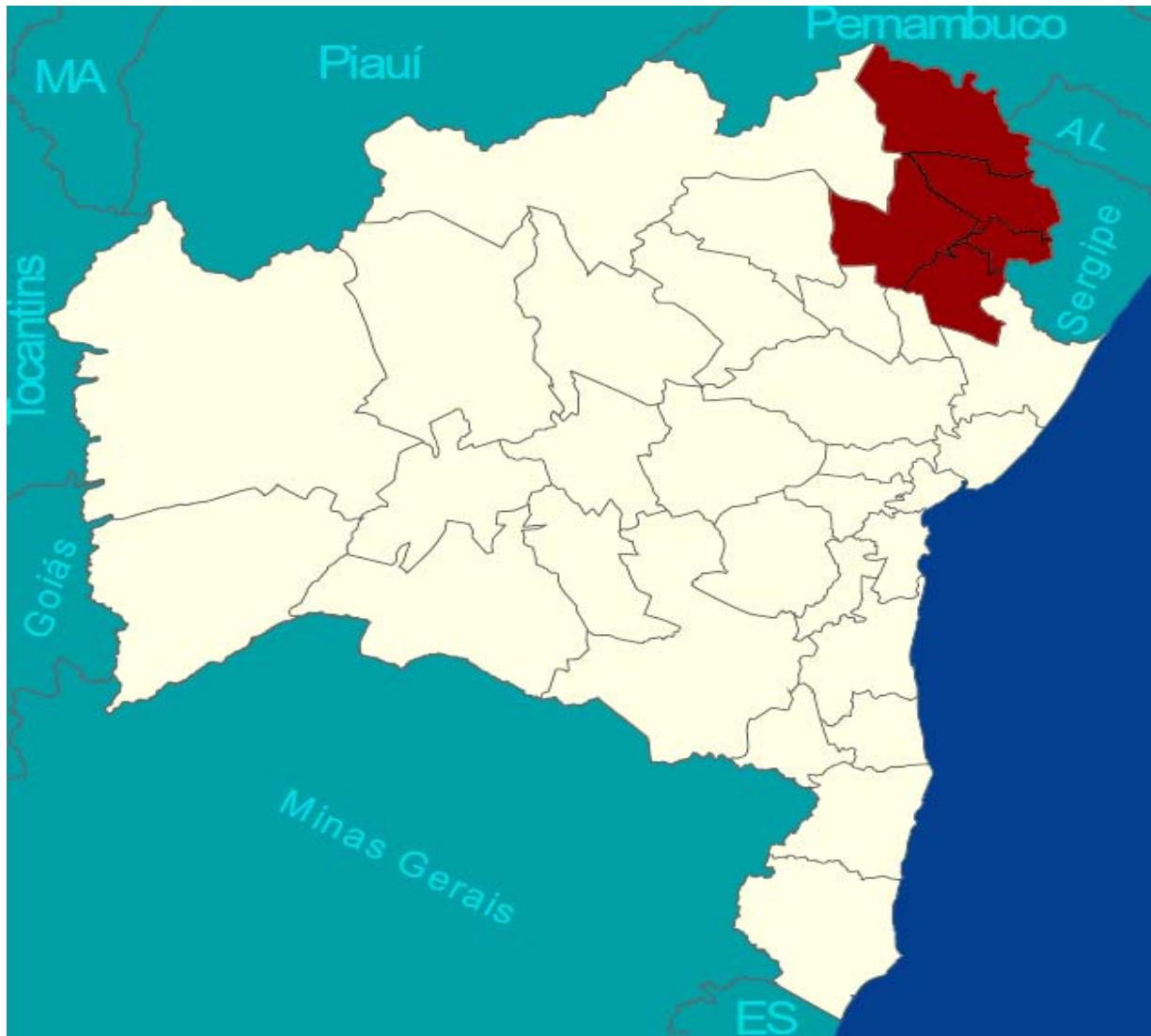 Figure 2: Map of Paulo Afonso's intermediate region
Source: HUNTER (2020).
The Intermediate Region of Paulo Afonso is the area with the lowest Human Development Index (HDI) in the State of Bahia and the Northeast region.
Table 10: Data of municipalities in the intermediate region of Paulo Afonso
<table><tr><td>Municipalities of the Intermediate Region Paulo Afonso</td><td>Active Civil Engineers</td><td>IDH</td><td>Position IDH</td><td>Estimate Populati on 2021</td><td>Population Density Estimated</td></tr><tr><td>Santa Brígida</td><td>3</td><td>0,546</td><td>5253</td><td>13917</td><td>14,89</td></tr><tr><td>Rodelas</td><td>3</td><td>0,632</td><td>3448</td><td>9548</td><td>4,32</td></tr><tr><td>Paulo Afonso</td><td>69</td><td>0,577</td><td>4695</td><td>119213</td><td>77,19</td></tr><tr><td>Macurúré</td><td>2</td><td>0,604</td><td>4055</td><td>7752</td><td>3,04</td></tr><tr><td>Glória</td><td>2</td><td>0,593</td><td>4309</td><td>15247</td><td>9,73</td></tr><tr><td>Chorrochó</td><td>3</td><td>0,6</td><td>4144</td><td>11221</td><td>3,73</td></tr><tr><td>Abaré</td><td>2</td><td>0,575</td><td>4742</td><td>20594</td><td>12,83</td></tr><tr><td>Tucano</td><td>33</td><td>0,579</td><td>4654</td><td>50903</td><td>23,15</td></tr><tr><td>Ribeira do Pombal</td><td>49</td><td>0,601</td><td>4123</td><td>54097</td><td>43,20</td></tr><tr><td>Ribeira do Amparo</td><td>2</td><td>0,512</td><td>5494</td><td>14631</td><td>22,71</td></tr><tr><td>Olindina</td><td>2</td><td>0,559</td><td>5066</td><td>28373</td><td>44,51</td></tr><tr><td>Nova Soure</td><td>5</td><td>0,555</td><td>5128</td><td>27047</td><td>27,97</td></tr><tr><td>Cipó</td><td>8</td><td>0,601</td><td>4123</td><td>17402</td><td>103,38</td></tr><tr><td>Banzaé</td><td>6</td><td>0,579</td><td>4654</td><td>13251</td><td>32,35</td></tr><tr><td>Quijingue</td><td>2</td><td>0,544</td><td>5277</td><td>27672</td><td>20,04</td></tr><tr><td>Monte Santo</td><td>10</td><td>0,506</td><td>5510</td><td>49145</td><td>16,19</td></tr><tr><td>Euclides da Cunha</td><td>24</td><td>0,567</td><td>4903</td><td>61112</td><td>30,17</td></tr><tr><td>Canudos</td><td>2</td><td>0,562</td><td>5002</td><td>16832</td><td>4,72</td></tr><tr><td>Municipalities of the Intermediate Region Paulo Afonso</td><td>Active Civil Engineers</td><td>IDH</td><td>Position IDH</td><td>Estimate Populati on 2021</td><td>Population Density Estimated</td></tr><tr><td>Cansanção</td><td>8</td><td>0,557</td><td>5098</td><td>34929</td><td>25,83</td></tr><tr><td>Paripiranga</td><td>20</td><td>0,577</td><td>4695</td><td>29124</td><td>65,86</td></tr><tr><td>Heliópolis</td><td>5</td><td>0,563</td><td>4984</td><td>12946</td><td>41,30</td></tr><tr><td>Fátima</td><td>8</td><td>0,559</td><td>5066</td><td>17801</td><td>48,84</td></tr><tr><td>Cicero Dantas</td><td>21</td><td>0,585</td><td>4515</td><td>32636</td><td>39,80</td></tr><tr><td>Antas</td><td>6</td><td>0,592</td><td>4334</td><td>19659</td><td>61,48</td></tr><tr><td>Adustina</td><td>7</td><td>0,546</td><td>5253</td><td>17209</td><td>27,35</td></tr><tr><td>Sítio do Quinto</td><td>11</td><td>0,533</td><td>5370</td><td>9431</td><td>13,78</td></tr><tr><td>Pedro Alexandre</td><td>1</td><td>0,513</td><td>5490</td><td>16698</td><td>18,77</td></tr><tr><td>Novo Triunfo</td><td>2</td><td>0,554</td><td>5146</td><td>15445</td><td>55,46</td></tr><tr><td>Jeremoabo</td><td>21</td><td>0,547</td><td>5244</td><td>40832</td><td>9,56</td></tr><tr><td>Coronel João Sá</td><td>2</td><td>0,535</td><td>5361</td><td>15549</td><td>19,49</td></tr><tr><td>TOTAL</td><td>339</td><td>0,565</td><td>4941°</td><td>820.216</td><td>20,10</td></tr></table>
The intermediate region hosts two ongoing academic programs, both of which are privately operated for profit. Both programs hold a course accreditation rating of 3, and they have received an ENADE (National Student Performance Exam) rating of 2.
Table 11: Number of courses in the intermediate region of Paulo Afonso
<table><tr><td>Intermediate Region</td><td>Courses</td><td>PF</td><td>PE</td><td>PM</td><td>PSFL</td><td>PCFL</td><td>UNI</td><td>CEU</td><td>FAC</td><td>INST</td></tr><tr><td>Paulo Afonso</td><td>2</td><td>0</td><td>0</td><td>0</td><td>0</td><td>2</td><td>0</td><td>1</td><td>1</td><td>0</td></tr></table>
The courses are offered in different municipalities: UniAGES has 100 authorized slots in the municipality of Paripiranga; FDL has 200 authorized slots in the municipality of Ribeira do Pombal. The intermediate region does not have a Public On-site Civil Engineering course.
The state of Bahia has 2,010 construction industry companies employing 79,518 people according to data from the Brazilian Statistical Yearbook for the year 2019, and the intermediate region has 820,216 inhabitants with 339 active civil engineers registered with CONFEA.
Given this information, the following data cross-references were conducted:
The first cross-reference in the intermediate region was conducted to determine the ratio between the population and the number of civil engineers. The result obtained was $820,216 / 339 = 2,419.52$, indicating that there is 1 active civil engineer for every 2,419 people.
The second cross-reference in the intermediate region was conducted to verify the ratio between the number of construction industry companies and the number of civil engineers. The result obtained was $2,010 / 339 = 5.92$, meaning there are approximately 6 active civil engineers for each construction industry company.
The proposed fifth cross-reference to verify the ratio between the number of engineers and the number of courses yielded the result: $339 / 2 = 169.5$, meaning there are approximately 170 active civil engineers for each on-site civil engineering course currently in progress.
The sixth cross-reference in the intermediate region was conducted to verify the ratio between the number of people employed in construction industry companies and the number of slots in the on-site civil engineering course in the intermediate region. The result obtained was $79,518 / 300 = 265.06$, indicating that there are 265 people employed in the state's construction industry companies for each slot in on-site civil engineering courses currently in progress in the intermediate region.
The seventh cross-reference in the intermediate region was conducted to verify the proportion between the number of people employed in construction industry companies in the state and the number of on-site civil engineering courses currently in progress. However, as the intermediate region has only one course, the result obtained was $79,518 / 2 = 39,759$. The result shows that 39,759 people are employed in construction industry companies for the single on-site civil engineering course currently in progress.
The eighth cross-reference was conducted to verify the proportion between the population of the intermediate region and the number of people employed in construction industry companies in the state. The result obtained was 820,216/79,518 = 10.31, meaning there is approximately 1 person employed in construction industry companies for every 10 inhabitants.
The ninth cross-reference in the state was conducted to verify the average between the number of people employed in construction industry companies and the number of construction industry companies. The result obtained was 79,518/2,010 = 39.56, signifying that there is an average of 40 people employed in each construction industry company.
The tenth cross-reference was conducted to verify the ratio between the population of the intermediate region and the number of construction industry companies. The result obtained was 820,216/2,010 = 408.07, indicating that there is approximately construction industry company in the state to serve 408 inhabitants of the intermediate region.
The eleventh cross-reference was conducted to verify the ratio between the number of construction industry companies and the on-site civil engineering courses currently in progress. The result obtained was $2010 / 2 = 1,005$, which means there are 1,005 construction industry companies for each on-site civil engineering course currently in progress in the intermediate region.
The twelfth cross-reference was conducted to verify the ratio between the population of the intermediate region and the number of slots in on-site civil engineering courses currently in progress. The result obtained was $820,216 / 300 = 2734.05$, meaning there is 1 slot for approximately every 2734 people in the intermediate region.
The thirteenth cross-reference was conducted to verify the ratio between the number of slots in on-site civil engineering courses currently in progress and the number of construction industry companies. The result obtained was $2010 / 300 = 6.7$, demonstrating that there are approximately 7 construction industry companies for each slot in on-site civil engineering courses currently in progress.
The fourteenth cross-reference was conducted to verify the ratio between the population of the intermediate region and the number of on-site civil engineering courses currently in progress. The result obtained was $820,216 / 2 = 410,108$, indicating that there is 1 on-site civil engineering course currently in progress for every 410,108 inhabitants.
Table 12: Summary of crossings at the intermediate region level of Paulo Afonso
<table><tr><td>Crossings</td><td>Result</td></tr><tr><td>Population/Active Civil Engineers</td><td>2419 inhabitants per engineer</td></tr><tr><td>Construction Industry Companies/Active Civil Engineers</td><td>6 companies per engineer</td></tr><tr><td>People employed in construction industry companies/Active Civil Engineers</td><td>235 people employed per engineer</td></tr><tr><td>Active Civil Engineers/Course vacancies</td><td>1 engineer per course vacancy</td></tr><tr><td>Active Civil Engineers/Number of courses</td><td>170 engineers per course</td></tr><tr><td>People employed in construction industry companies/Course vacancies</td><td>265 people employed per course vacancy</td></tr><tr><td>People employed in construction industry companies/Civil Engineering courses</td><td>39759 people employed per course</td></tr><tr><td>Population/People employed in construction industry companies</td><td>10 inhabitants per employed person</td></tr><tr><td>People employed in construction industry companies/Construction industry companies</td><td>Average of 40 people employed in each company</td></tr><tr><td>Population/Construction industry companies</td><td>408 inhabitants per company</td></tr><tr><td>Construction industry companies/Civil Engineering courses</td><td>1005 companies per course</td></tr><tr><td>Population/Number of course vacancies</td><td>2734 inhabitants per course vacancy</td></tr><tr><td>Construction industry companies/Number of course vacancies</td><td>7 companies per course vacancy</td></tr><tr><td>National population/Civil Engineering courses</td><td>410,108 inhabitants per course</td></tr></table>
Paulo Afonso is an intermediate region that hosts only two on-site civil engineering courses in private higher education institutions (IES). The region lacks the availability of on-site civil engineering courses in public IES, indicating a potential unmet demand. Therefore, it is incumbent upon the administrators of public IES to analyze to determine the feasibility of offering such a program to cater to the region. Additionally, it has been observed that the existing courses have ENADE scores of 2, suggesting a need for public IES administrators to assess the creation of a high-quality on-site civil engineering course that can, in the long run, stimulate the development of the intermediate region with a low Human Development Index (HDI). The ratio of engineers to course openings is the lowest among the five regions, indicating a limited number of active civil engineers despite a significant number of available slots in the two courses. It is noteworthy that the ratio of the intermediate region's population to the number of courses is the highest among the five regions, attributed to the limited number of courses in the intermediate region. This reinforces the necessity for public IES administrators to thoroughly evaluate the feasibility of offering at least one new high-quality on-site civil engineering course to meet the needs of the intermediate region of Paulo Afonso.
#### North: Intermediate Region of Marabá
The Geographical Intermediate Region of Maraba is one of the seven intermediate regions in the Brazilian state of Pará and one of the 134 intermediate regions in Brazil, established by the Brazilian Institute of Geography and Statistics (IBGE) in 2017. It encompasses 23 municipalities distributed across three immediate geographical regions. The total estimated population by the IBGE for 2021 is 1,302,858 inhabitants, spread over a total area of $109,083.881\mathrm{km}^2$. Maraba is the most populous municipality in the intermediate region, with 287,664 inhabitants according to 2021 estimates from the IBGE.
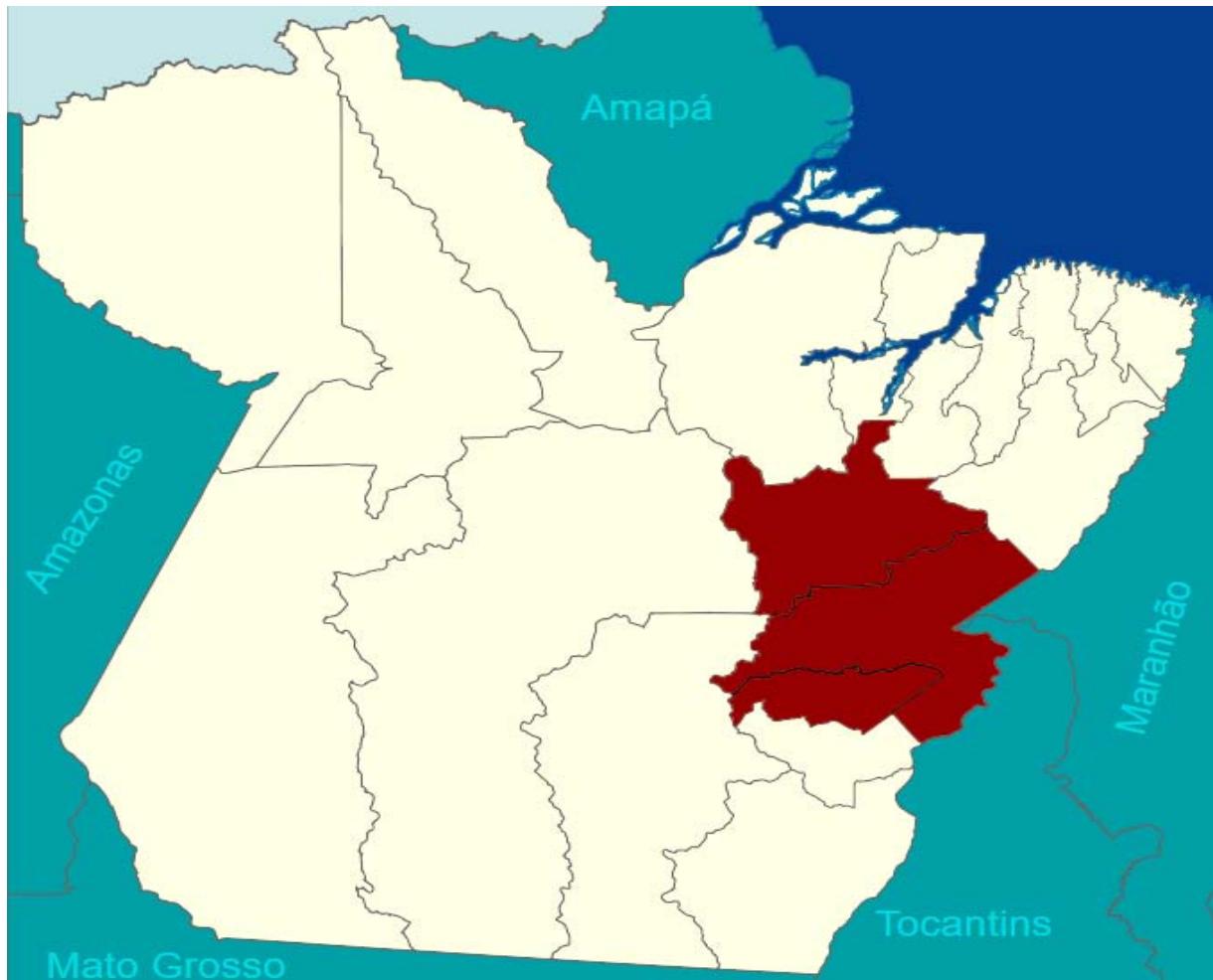 Figure 3: Map of the intermediate region of Marabá
Source: HUNTER (2020).
The Intermediate Region of Maraba is the area that encompasses courses initiated in activities with the lowest Human Development Index (HDI) in the State of Pará and the Northern Region.
Table 13: Data from municipalities in the intermediate region of Marabá
<table><tr><td>Municipalities of the Marabá Intermediate Region</td><td>Active civil Engineers</td><td>IDH</td><td>Position IDH</td><td>Estimated Population 2021</td><td>Estimated Demographic Density</td></tr><tr><td>São João do Araguaia</td><td>2</td><td>0,55</td><td>5194</td><td>14105</td><td>11,02</td></tr><tr><td>São Geraldo do Araguaia</td><td>6</td><td>0,595</td><td>4255</td><td>24566</td><td>7,75</td></tr><tr><td>São Domingos do Araguaia</td><td>5</td><td>0,594</td><td>4284</td><td>25945</td><td>18,63</td></tr><tr><td>Rondon do Pará</td><td>9</td><td>0,604</td><td>4101</td><td>53242</td><td>6,45</td></tr><tr><td>Picarra</td><td>1</td><td>0,563</td><td>4984</td><td>12976</td><td>3,91</td></tr><tr><td>Palestina do Pará</td><td>1</td><td>0,589</td><td>4416</td><td>7575</td><td>7,69</td></tr><tr><td>Nova Ipixuna</td><td>7</td><td>0,581</td><td>4614</td><td>17027</td><td>10,88</td></tr><tr><td>Marabá</td><td>411</td><td>0,668</td><td>2716</td><td>287.664</td><td>19,01</td></tr><tr><td>Jacundá</td><td>17</td><td>0,622</td><td>3653</td><td>60517</td><td>30,13</td></tr><tr><td>Itupiranga</td><td>11</td><td>0,528</td><td>5408</td><td>53439</td><td>6,78</td></tr><tr><td>Brejo Grande do Araguaia</td><td>1</td><td>0,591</td><td>4372</td><td>7357</td><td>5,70</td></tr><tr><td>Bom Jesus do Tocantins</td><td>4</td><td>0,589</td><td>4416</td><td>17254</td><td>6,12</td></tr><tr><td>Abel Figueiredo</td><td>2</td><td>0,622</td><td>3653</td><td>7536</td><td>12,27</td></tr><tr><td>Parauapebas</td><td>231</td><td>0,715</td><td>1454</td><td>218787</td><td>31,77</td></tr><tr><td>Eldorado do Carajás</td><td>11</td><td>0,56</td><td>5049</td><td>34069</td><td>11,52</td></tr><tr><td>Curionópolis</td><td>5</td><td>0,636</td><td>3378</td><td>17764</td><td>7,49</td></tr><tr><td>Canaã dos Carajás</td><td>37</td><td>0,673</td><td>2598</td><td>39103</td><td>12,42</td></tr><tr><td>Tucuruí</td><td>134</td><td>0,666</td><td>2759</td><td>116605</td><td>55,94</td></tr><tr><td>Pacajá</td><td>1</td><td>0,515</td><td>5481</td><td>49110</td><td>4,15</td></tr><tr><td>Novo Repartimento</td><td>9</td><td>0,537</td><td>5345</td><td>78488</td><td>5,09</td></tr><tr><td>Goianésia do Pará</td><td>7</td><td>0,56</td><td>5049</td><td>41678</td><td>5,93</td></tr><tr><td>Breu Branco</td><td>8</td><td>0,568</td><td>4884</td><td>68597</td><td>17,40</td></tr><tr><td>Baião</td><td>2</td><td>0,578</td><td>4670</td><td>49454</td><td>13,15</td></tr><tr><td>TOTAL</td><td>922</td><td>0,596</td><td>4238</td><td>1.302858</td><td>11,94</td></tr></table>
The region hosts five active academic programs, with three being privately owned for-profit institutions and two being federally funded public universities. Notably, the federal public program offered by UNIFESSPA stands out, holding a course rating of 4 and an ENADE (National Student Performance Exam) rating of 5. Additionally, the for-profit private program at
Pitágoras College, Parauapebas Campus (FPUP), deserves recognition for achieving a course rating of 4. The remaining programs all hold a course rating of 3 and include UFPA, Pitágoras College, Marabá Campus; Pitágoras University, Marabá Campus; and Pitágoras College, Marabá Campus.
Table 14: Number of courses in the intermediate region of Marabá
<table><tr><td>Intermediate Region</td><td>Courses</td><td>PF</td><td>PE</td><td>PM</td><td>PSFL</td><td>PCFL</td><td>UNI</td><td>CEU</td><td>FAC</td><td>INST</td></tr><tr><td>Marabá</td><td>5</td><td>2</td><td>0</td><td>0</td><td>0</td><td>3</td><td>3</td><td>1</td><td>2</td><td>0</td></tr></table>
The courses offered in the municipality of Maraba are as follows: UNIFESSPA with 60 authorized slots, Faculdade Pitágoras de Maraba with 80 authorized slots, and Centro Universitário Pitágoras de Maraba with 140 authorized slots. The UFPA course is offered in the municipality of Tucuruí with 48 authorized slots, and the FPUP course is offered in the municipality of Parauapebas with 50 authorized slots.
The state of Pará has 667 construction industry companies employing 31,249 people, according to data from the Brazilian Statistical Yearbook for the year 2019. The intermediate region has a population of 1,302,858 and comprises 922 active civil engineers registered with CONFEA.
In light of this information, the following data cross-referencing was conducted:
The second cross-reference for the intermediate region aimed to examine the ratio between the number of construction industry companies and the number of civil engineers. The result obtained was $667 / 378 = 2.13$, signifying that there are 2 active civil engineers for each construction industry company.
The third cross-reference for the intermediate region sought to determine the ratio between the number of people employed in construction industry companies and the number of active civil engineers. The result obtained was $31,249 / 992 = 31.5$, indicating that there are approximately 32 people employed in construction industry companies per active civil engineer in the intermediate region.
The fourth cross-reference for the intermediate region aimed to examine the ratio between the number of civil engineers and the number of slots in on-site civil engineering courses. The result obtained was 992/378 = 2.62, demonstrating that the number of active civil engineers is approximately three times the number of slots in on-site civil engineering courses currently in progress.
The fifth cross-reference aimed to determine the ratio between the number of civil engineers and the number of courses. The result obtained was $992 / 5 = 198.4$, meaning there are 198 active civil engineers for each on-site civil engineering course currently in progress.
The sixth cross-reference for the intermediate region aimed to determine the ratio between the number of people employed in construction industry companies and the number of slots in on-site civil engineering courses in the intermediate region. The result obtained was 31,249/378 = 82.67, indicating that there are approximately 83 people employed in construction industry companies for each slot in on-site civil engineering courses currently in progress in the intermediate region.
The seventh cross-reference for the intermediate region aimed to determine the ratio between the number of people employed in construction industry companies in the state and the number of on-site civil engineering courses currently in progress. However, as the intermediate region has only one course, the result obtained was $31,249 / 5 = 6,249.8$. This result indicates that there are approximately 6,250 people employed in construction industry companies for the single on-site civil engineering course currently in progress.
The eighth cross-reference aimed to determine the ratio between the population of the intermediate region and the number of people employed in construction industry companies in the state. The result obtained was 1,302,858/31,249 = 41.69, meaning there is approximately one person employed in construction industry companies for every 42 people in the intermediate region.
The ninth cross-reference for the state aimed to determine the average ratio between the number of people employed in construction industry companies and the number of construction industry companies. The result obtained was $31,249 / 667 = 46.85$, indicating an average of 47 people employed in each construction industry company.
The tenth cross-reference aimed to determine the ratio between the population of the intermediate region and the number of construction industry companies. The result obtained was 1,302,858/667 = 1,953.31, signifying that there is approximately one construction industry company in the state to serve every 1,953 people in the intermediate region.
The eleventh cross-reference aimed to determine the ratio between the number of construction industry companies and the on-site civil engineering courses currently in progress. The result obtained was
667/5 = 133.4, indicating that there are 133 construction industry companies for each on-site civil engineering course currently in progress in the intermediate region.
The twelfth cross-reference aimed to determine the ratio between the population of the intermediate region and the number of slots in on-site civil engineering courses currently in progress. The result obtained was 1,302,858/378 = 3,446.71, meaning there is one slot for approximately every 3,446 people in the intermediate region.
The thirteenth cross-reference aimed to determine the ratio between the number of slots in on-site civil engineering courses currently in progress and the number of construction industry companies. The result obtained was $667 / 378 = 1.76$, indicating that there are approximately 2 construction industry companies for each slot in on-site civil engineering courses currently in progress.
The fourteenth cross-reference aimed to determine the ratio between the population of the intermediate region and the number of on-site civil engineering courses currently in progress. The result obtained was 1,302,858/5 = 260,571.6, meaning there is one on-site civil engineering course currently in progress for every 260,571 inhabitants.
Table 15: Summary of crossings at the intermediate region level of Marabá
<table><tr><th>Crossings</th><th>Result</th></tr><tr><td>Population/active civil engineers</td><td>1413 inhabitants per engineer</td></tr><tr><td>Construction industry companies/active civil engineers</td><td>2 companies per engineer</td></tr><tr><td>People employed in construction industry companies/active civil engineers</td><td>32 people employed per engineer</td></tr><tr><td>Active civil engineers/course vacancies</td><td>3 engineers per course</td></tr><tr><td>Active civil engineers/number of courses</td><td>198 engineers per course</td></tr><tr><td>People employed in construction industry companies/course vacancies</td><td>83 people employed per course vacancy</td></tr><tr><td>People employed in construction industry companies/civil engineering courses</td><td>6250 people employed per course</td></tr><tr><td>Population/people employed in construction industry companies</td><td>42 inhabitants per employed person</td></tr><tr><td>People employed in construction industry companies/construction industry companies</td><td>Average of 47 people employed in each company</td></tr><tr><td>Population/construction industry companies</td><td>1953 inhabitants per company</td></tr><tr><td>Construction industry companies/civil engineering courses</td><td>133 companies per course</td></tr><tr><td>Population/number of vacancies</td><td>3446 inhabitants per course vacancy</td></tr></table>
Marabá is an intermediate region with the provision of five on-site civil engineering courses by both private and public higher education institutions (HEIs). Consequently, it is evident that there is a higher demand for these courses in this region compared to others under analysis. Therefore, an examination by the HEI administrators in the region is warranted to assess the feasibility of maintaining these offerings to meet the local demand. The analysis reveals a competitive market for civil engineers, as evidenced by the intersection of construction industry companies with the number of active civil engineers, which is the lowest among the five regions. Similarly, the number of employed individuals in construction industry companies in relation to the number of active civil engineers is also the lowest, indicating a scarcity of companies and consequently, a limited workforce in the sector. This is further supported by the intersection of active civil engineers in relation to course vacancies, which is three times higher than the number of offered vacancies.
This intersection allows for the observation and reinforcement of the fact that despite having a higher number of trained civil engineers in the region compared to other analyzed regions, the average number of individuals working in companies is the highest among the five intermediate regions. This suggests that the local market is predominantly comprised of large and medium-sized companies in the sector.
This result is noteworthy, as the region with fewer construction sector companies yields the best ratio in terms of population and number of construction industry companies among the analyzed regions. For HEI administrators in the region, it is recommended to assess the continuation of these courses, as there is no evidence of a shortage of courses or engineers in the region, and there are few local construction sector companies.
Southeast: Intermediate region of Teófilo Otoni
The Geographical Intermediate Region of Teófilo Otoni is one of the thirteen intermediate regions in the Brazilian state of Minas Gerais and one of the 134 intermediate regions in Brazil, established by the Brazilian Institute of Geography and Statistics (IBGE) in 2017. It comprises 86 municipalities, distributed across seven immediate geographical regions. The total estimated population by the IBGE for 2021 is 1,225,731 inhabitants, spread over a total area of $77,935.048\mathrm{km}^2$. Teófilo Otoni is the most populous municipality in the intermediate region, with 141,269 inhabitants, according to 2021 estimates from the IBGE.
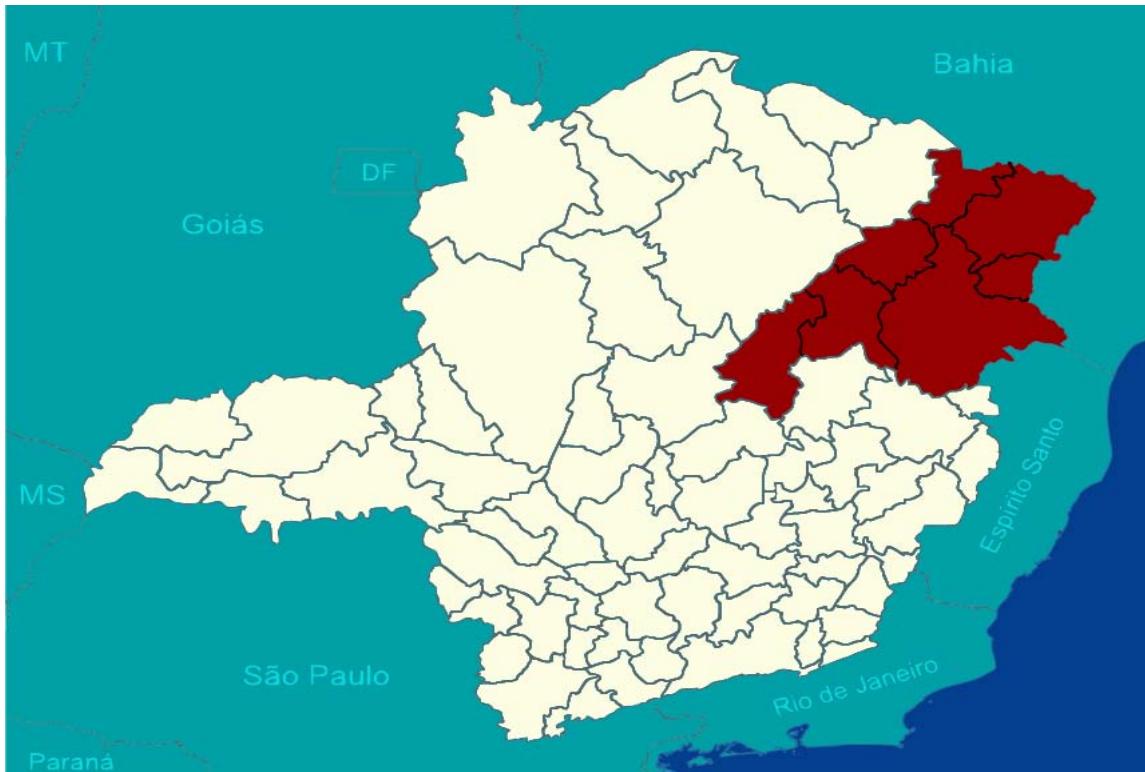 Figure 4: Map of the intermediate region of Teófilo Otoni
Source: HUNTER (2020).
The Intermediate Region of Teófilo Otoni is the area characterized by educational programs initiated in activities within the lowest Human Development Index
(HDI) in the State of Minas Gerais and the Southeast Region.
Table 16: Data of municipalities in the intermediate region of Teófilo Otoni
<table><tr><td>Municipal data from the Intermediate Region of Teófilo Otoni.</td><td>Active Civil engineers</td><td>IDH</td><td>Position IDH</td><td>Estimated population 2021</td><td>Population Density Estimated</td></tr><tr><td>Teófilo Otoni</td><td>471</td><td>0,701</td><td>1866</td><td>141269</td><td>43,57</td></tr><tr><td>Serra dos Aimorés</td><td>4</td><td>0,651</td><td>3090</td><td>8725</td><td>40,85</td></tr><tr><td>Setubinha</td><td>5</td><td>0,542</td><td>5293</td><td>12493</td><td>23,36</td></tr><tr><td>São José do Divino</td><td>6</td><td>0,658</td><td>2946</td><td>3851</td><td>11,71</td></tr><tr><td>Poté</td><td>13</td><td>0,624</td><td>3607</td><td>16675</td><td>26,67</td></tr><tr><td>Ponto dos Volantes</td><td>11</td><td>0,595</td><td>4255</td><td>12235</td><td>10,09</td></tr><tr><td>Pescador</td><td>7</td><td>0,656</td><td>2986</td><td>4261</td><td>13,42</td></tr><tr><td>Pavão</td><td>5</td><td>0,627</td><td>3534</td><td>8390</td><td>13,95</td></tr><tr><td>Padre Paraíso</td><td>34</td><td>0,596</td><td>4238</td><td>20346</td><td>37,37</td></tr><tr><td>Ouro Verde de Minas</td><td>6</td><td>0,595</td><td>4255</td><td>5895</td><td>33,59</td></tr><tr><td>Novo Oriente de Minas</td><td>15</td><td>0,555</td><td>5128</td><td>10800</td><td>14,30</td></tr><tr><td>Novo Cruzeiro</td><td>14</td><td>0,571</td><td>4827</td><td>31339</td><td>18,40</td></tr><tr><td>Nova Módia</td><td>4</td><td>0,63</td><td>3487</td><td>3548</td><td>9,43</td></tr><tr><td>Nanuque</td><td>53</td><td>0,701</td><td>1866</td><td>40583</td><td>26,73</td></tr><tr><td>Monte Formoso</td><td>4</td><td>0,541</td><td>5306</td><td>4939</td><td>12,81</td></tr><tr><td>Malacacheta</td><td>23</td><td>0,618</td><td>3735</td><td>18556</td><td>25,49</td></tr><tr><td>Frei Gaspar</td><td>5</td><td>0,59</td><td>4395</td><td>5858</td><td>9,34</td></tr><tr><td>Franciscópolis</td><td>3</td><td>0,603</td><td>4081</td><td>5287</td><td>7,37</td></tr><tr><td>Catuji</td><td>6</td><td>0,54</td><td>5325</td><td>6206</td><td>14,79</td></tr><tr><td>Carlos Chagas</td><td>25</td><td>0,648</td><td>3156</td><td>18516</td><td>5,78</td></tr><tr><td>Carai</td><td>9</td><td>0,558</td><td>5081</td><td>23872</td><td>19,21</td></tr><tr><td>Campanário</td><td>4</td><td>0,616</td><td>3771</td><td>3739</td><td>8,45</td></tr><tr><td>Municipal data from the Intermediate Region of Teófilo Otoni.</td><td>Active Civil engineers</td><td>IDH</td><td>Position IDH</td><td>Estimated population 2021</td><td>Population Density Estimated</td></tr><tr><td>Ataléia</td><td>11</td><td>0,588</td><td>4444</td><td>12496</td><td>6,80</td></tr><tr><td>Ladainha</td><td>5</td><td>0,541</td><td>5306</td><td>18272</td><td>21,09</td></tr><tr><td>Itaobim</td><td>39</td><td>0,629</td><td>3501</td><td>20997</td><td>30,92</td></tr><tr><td>Itambacuri</td><td>28</td><td>0,634</td><td>3407</td><td>23207</td><td>16,35</td></tr><tr><td>Itaipé</td><td>20</td><td>0,552</td><td>5169</td><td>12910</td><td>26,84</td></tr><tr><td>Veredinha</td><td>4</td><td>0,632</td><td>3448</td><td>5733</td><td>9,07</td></tr><tr><td>Turmalina</td><td>10</td><td>0,736</td><td>876</td><td>20280</td><td>17,58</td></tr><tr><td>Minas Novas</td><td>26</td><td>0,633</td><td>3433</td><td>31509</td><td>17,38</td></tr><tr><td>Chapada do Norte</td><td>4</td><td>0,598</td><td>4198</td><td>15334</td><td>18,45</td></tr><tr><td>Capelinha</td><td>55</td><td>0,653</td><td>3055</td><td>38321</td><td>39,69</td></tr><tr><td>Aricanduva</td><td>1</td><td>0,582</td><td>4590</td><td>5305</td><td>21,80</td></tr><tr><td>Angelândia</td><td>1</td><td>0,597</td><td>4215</td><td>8594</td><td>46,40</td></tr><tr><td>Água Boa</td><td>20</td><td>0,576</td><td>4718</td><td>13319</td><td>10,08</td></tr><tr><td>Leme do Prado</td><td>8</td><td>0,67</td><td>2663</td><td>4923</td><td>17,57</td></tr><tr><td>Itamarandiba</td><td>21</td><td>0,646</td><td>3186</td><td>35130</td><td>12,84</td></tr><tr><td>Santo Antônio do Jacinto</td><td>5</td><td>0,574</td><td>4764</td><td>11570</td><td>22,96</td></tr><tr><td>Santa Maria do Salto</td><td>1</td><td>0,613</td><td>3847</td><td>5203</td><td>11,80</td></tr><tr><td>Salto da Divisa</td><td>4</td><td>0,608</td><td>3957</td><td>7014</td><td>7,47</td></tr><tr><td>Rubim</td><td>10</td><td>0,609</td><td>3927</td><td>10269</td><td>10,63</td></tr><tr><td>Rio do Prado</td><td>0</td><td>0,605</td><td>4029</td><td>5117</td><td>10,66</td></tr><tr><td>Palmópolis</td><td>3</td><td>0,565</td><td>4941</td><td>5196</td><td>11,99</td></tr><tr><td>Mata Verde</td><td>6</td><td>0,581</td><td>4614</td><td>8700</td><td>38,23</td></tr><tr><td>Felisburgo</td><td>2</td><td>0,583</td><td>4562</td><td>7548</td><td>12,65</td></tr><tr><td>Bandeira</td><td>4</td><td>0,599</td><td>4167</td><td>4738</td><td>9,79</td></tr><tr><td>Almenara</td><td>89</td><td>0,642</td><td>3254</td><td>42380</td><td>18,47</td></tr><tr><td>Jordânia</td><td>9</td><td>0,628</td><td>3519</td><td>10872</td><td>19,88</td></tr><tr><td>Joaíma</td><td>5</td><td>0,587</td><td>4467</td><td>15476</td><td>9,29</td></tr><tr><td>Jequitinhonha</td><td>24</td><td>0,615</td><td>3796</td><td>25555</td><td>7,27</td></tr><tr><td>Jacinto</td><td>6</td><td>0,62</td><td>3702</td><td>12320</td><td>8,84</td></tr><tr><td>Serro</td><td>13</td><td>0,656</td><td>2986</td><td>20915</td><td>17,17</td></tr><tr><td>Serra Azul de Minas</td><td>1</td><td>0,557</td><td>5098</td><td>4292</td><td>19,63</td></tr><tr><td>Senador Modesto Gonçalves</td><td>3</td><td>0,62</td><td>3702</td><td>4056</td><td>4,26</td></tr><tr><td>Santo Antônio do Itaqué</td><td>2</td><td>0,558</td><td>5081</td><td>3763</td><td>12,30</td></tr><tr><td>Presidente Kubitschek</td><td>0</td><td>0,595</td><td>4255</td><td>3000</td><td>15,85</td></tr><tr><td>Gouveia</td><td>9</td><td>0,681</td><td>2412</td><td>11811</td><td>13,62</td></tr><tr><td>São Gonçalo do Rio Preto</td><td>0</td><td>0,64</td><td>3291</td><td>3178</td><td>10,10</td></tr><tr><td>Felício dos Santos</td><td>3</td><td>0,606</td><td>3999</td><td>4656</td><td>13,01</td></tr><tr><td>Diamantina</td><td>57</td><td>0,716</td><td>1427</td><td>47924</td><td>12,31</td></tr><tr><td>Datas</td><td>1</td><td>0,616</td><td>3771</td><td>5431</td><td>17,51</td></tr><tr><td>Couto de Magalhães de Minas</td><td>4</td><td>0,659</td><td>2924</td><td>4436</td><td>9,13</td></tr><tr><td>Carbonita</td><td>6</td><td>0,638</td><td>3333</td><td>9432</td><td>6,47</td></tr><tr><td>Alvorada de Minas</td><td>1</td><td>0,572</td><td>4802</td><td>3605</td><td>9,63</td></tr><tr><td>Virgem da Lapa</td><td>18</td><td>0,61</td><td>3902</td><td>13729</td><td>15,80</td></tr><tr><td>Francisco Badaró</td><td>2</td><td>0,622</td><td>3653</td><td>10311</td><td>22,34</td></tr><tr><td>Coronel Murta</td><td>6</td><td>0,627</td><td>3534</td><td>9209</td><td>11,29</td></tr><tr><td>Berilo</td><td>8</td><td>0,628</td><td>3519</td><td>11813</td><td>20,12</td></tr><tr><td>Araçuáí</td><td>63</td><td>0,663</td><td>2828</td><td>36715</td><td>16,41</td></tr><tr><td>José Gonçalves de Minas</td><td>2</td><td>0,632</td><td>3448</td><td>4474</td><td>11,73</td></tr><tr><td>Jenipapo de Minas</td><td>7</td><td>0,624</td><td>3607</td><td>7781</td><td>27,35</td></tr><tr><td>Itinga</td><td>14</td><td>0,6</td><td>4144</td><td>15053</td><td>9,12</td></tr><tr><td>Pedra Azul</td><td>16</td><td>0,627</td><td>3534</td><td>24333</td><td>15,25</td></tr><tr><td>Medina</td><td>20</td><td>0,624</td><td>3607</td><td>20701</td><td>14,41</td></tr><tr><td>Divisópolis</td><td>3</td><td>0,609</td><td>3927</td><td>11396</td><td>19,89</td></tr><tr><td>Municipal data from the Intermediate Region of Teófilo Otoni.</td><td>Active Civil engineers</td><td>IDH</td><td>Position IDH</td><td>Estimated population 2021</td><td>Population Density Estimated</td></tr><tr><td>Divisa Alegre</td><td>0</td><td>0,608</td><td>3957</td><td>6946</td><td>58,96</td></tr><tr><td>Comercinho</td><td>2</td><td>0,593</td><td>4309</td><td>6624</td><td>10,11</td></tr><tr><td>Cachoeira de Pajeú</td><td>5</td><td>0,578</td><td>4670</td><td>9470</td><td>13,61</td></tr><tr><td>Águas Vermelhas</td><td>9</td><td>0,601</td><td>4123</td><td>13656</td><td>10,86</td></tr><tr><td>Umburatiba</td><td>1</td><td>0,638</td><td>3333</td><td>2582</td><td>6,36</td></tr><tr><td>Santa Helena de Minas</td><td>5</td><td>0,567</td><td>4903</td><td>6406</td><td>23,17</td></tr><tr><td>Fronteira dos Vales</td><td>2</td><td>0,592</td><td>4331</td><td>4542</td><td>14,16</td></tr><tr><td>Crisálita</td><td>4</td><td>0,585</td><td>4515</td><td>6814</td><td>7,05</td></tr><tr><td>Bertópolis</td><td>1</td><td>0,594</td><td>4284</td><td>4609</td><td>10,77</td></tr><tr><td>Águas Formosas</td><td>21</td><td>0,645</td><td>3201</td><td>19285</td><td>23,51</td></tr><tr><td>Machacalis</td><td>9</td><td>0,64</td><td>3291</td><td>7112</td><td>21,39</td></tr><tr><td>TOTAL</td><td>1466</td><td>0,613</td><td>3847</td><td>1.225.731</td><td>15,72</td></tr></table>
The region has five active courses, comprising one federal public course, two private non-profit courses, and two private for-profit courses. The UFVJM course holds a course concept rating of 3 and an ENADE (National Student Performance Exam) rating of
4. The course at Faculdade Presidente Antônio Carlos de Teófilo Otoni has a course concept rating of 5 and an ENADE rating of 2. The courses at UNEC, UNIDOCTUM, and Faculdade ALFAUNIPAC in Almenara all have a course concept rating of 3.
Table 17: Number of courses in the intermediate region of Teófilo Otoni
<table><tr><td>Intermediate Region</td><td>Courses</td><td>PF</td><td>PE</td><td>PM</td><td>PSFL</td><td>PCFL</td><td>UNI</td><td>CEU</td><td>FAC</td><td>INST</td></tr><tr><td>Teófilo Otoni</td><td>5</td><td>1</td><td>0</td><td>0</td><td>2</td><td>2</td><td>1</td><td>2</td><td>2</td><td>0</td></tr></table>
The courses are offered in the municipalities of Diamantina, Teófilo Otoni, Nanuque, Teófilo Otoni, and Almenara, respectively: UFVJM has 80 authorized vacancies; President Antonio Carlos College of Teófilo Otoni has 120 authorized vacancies; UNEC has 120 authorized vacancies; UNIDOCTUM has 80 authorized vacancies, and ALFAUNIPAC College of Almenara has 100 authorized vacancies.
The State of Minas Gerais has 6,835 construction industry companies employing 262,482 people, according to data from the Brazilian Statistical Yearbook for the year 2019. The intermediate region has a population of 1,225,731 and 1,466 active civil engineers registered with CONFEA.
In Light of this Information, the Following Data Cross-Referencing was Conducted:
The first cross-referencing in the intermediate region aimed to determine the ratio between the population and the number of civil engineers. The result obtained was 1,225,731/1,466 = 836.1, meaning there is 1 active civil engineer for every 836 people.
The second cross-referencing aimed to verify the ratio between the number of construction industry companies in the state and the number of civil engineers. The result obtained was $6,835 / 1,466 = 4.66$, meaning there are approximately 5 active civil engineers in the intermediate region for each construction industry company in the state.
The third cross-referencing aimed to verify the ratio between the number of people employed in construction industry companies and the number of active civil engineers. The result obtained was 262,482/1,466 = 179.05, meaning there are approximately 179 people employed in construction industry companies in the state for each active civil engineer in the intermediate region.
The fourth cross-referencing in the intermediate region aimed to verify the ratio between the number of engineers and the number of vacancies in on-site civil engineering courses. The result obtained was 1,466/500 = 2.93, indicating that the number of active civil engineers is approximately three times the number of vacancies in on-site civil engineering courses currently underway.
The fifth cross-referencing aimed to verify the ratio between the number of engineers and the number of courses. The result obtained was $1,466 / 5 = 293.2$, meaning there are 293 active civil engineers for each on-site civil engineering course currently underway.
The sixth cross-referencing in the intermediate region aimed to verify the ratio between the number of people employed in construction industry companies and the number of vacancies in on-site civil engineering courses in the intermediate region. The result obtained was $262,482 / 500 = 524.96$, indicating that there are approximately 525 people employed in construction industry companies in the state for each vacancy in on-site civil engineering courses currently underway in the intermediate region.
The seventh cross-referencing in the intermediate region aimed to verify the ratio between the number of people employed in construction industry companies in the state and the number of on-site civil engineering courses currently underway. The result obtained was 262,482/5 = 52,496.4. This result indicates that there are 52,496 people employed in construction industry companies for the only on-site civil engineering course currently underway in the intermediate region.
The eighth cross-referencing aimed to verify the ratio between the population of the intermediate region and the number of people employed in construction industry companies in the state. The result obtained was 1,225,731/262,482 = 4.67, meaning there is approximately 1 person employed in construction industry companies for every 5 people.
The ninth cross-referencing in the state aimed to verify the average between the number of people employed in construction industry companies and the number of construction industry companies. The result obtained was 262,482/6,835 = 38.4, meaning there are, on average, 38 people employed in each construction industry company.
The tenth cross-referencing aimed to verify the ratio between the population of the intermediate region and the number of construction industry companies. The result obtained was 1,225,731/6,835 = 179.33, meaning there is approximately 1 construction industry company in the state to serve 179 people in the intermediate region.
The eleventh cross-referencing aimed to verify the ratio between the number of construction industry companies and the on-site civil engineering courses currently underway. The result obtained was $6,835 / 5 = 1,367$, indicating that there are 1,367 construction industry companies for each on-site civil engineering course currently underway in the intermediate region.
The twelfth cross-referencing aimed to verify the ratio between the population of the intermediate region and the number of vacancies in on-site civil engineering courses currently underway. The result obtained was 1,225,731/500 = 2,451.46, meaning there is 1 vacancy for approximately every 2,451 people in the intermediate region.
The thirteenth cross-referencing aimed to verify the ratio between the number of vacancies in on-site civil engineering courses currently underway and the number of construction industry companies. The result obtained was $6,835 / 500 = 13.67$, indicating that there are approximately 14 construction industry companies for each vacancy in on-site civil engineering courses currently underway.
The fourteenth cross-referencing aimed to verify the ratio between the population of the intermediate region and the number of on-site civil engineering courses currently underway. The result obtained was
1,225,731/5 = 245,146.2, meaning there is 1 on-site civil engineering course currently underway for every 245,146 inhabitants in the intermediate region.
Population/number of vacancies 2451 inhabitants per course vacancy
<table><tr><td>Crossings</td><td>Result</td></tr><tr><td>Population/active civil engineers</td><td>836 inhabitants per engineer</td></tr><tr><td>Construction industry companies/active civil engineers /</td><td>5 companies per engineer</td></tr><tr><td>People employed in construction industry companies/active civil engineers</td><td>179 individuals employed per engineer</td></tr><tr><td>Active civil engineers/course vacancies</td><td>3 engineers per course</td></tr><tr><td>Active civil engineers/number of courses</td><td>293 engineers per course</td></tr><tr><td>People employed in construction industry companies/course vacancies</td><td>525 individuals employed per course</td></tr><tr><td>People employed in construction industry companies/civil engineering courses</td><td>52496 individuals employed per course</td></tr><tr><td>Population/people employed in construction industry companies</td><td>5 inhabitants per employed individual</td></tr><tr><td>People employed in construction industry companies/construction industry companies</td><td>Average of 38 individuals employed in each company</td></tr><tr><td>Population/construction industry companies</td><td>179 inhabitants per company</td></tr><tr><td>Construction industry companies/civil engineering courses</td><td>1367 companies per course</td></tr><tr><td>Population/number of vacancies</td><td>2451 inhabitants per course vacancy</td></tr><tr><td>Construction industry companies/number of course vacancies</td><td>14 companies per course vacancy</td></tr><tr><td>National population/civil engineering courses</td><td>245,146 inhabitants per course</td></tr></table>
Teófilo Otoni is an intermediate region with the provision of five on-site civil engineering courses by private and public higher education institutions (IES). Thus, it is evident that there are five courses available to meet local demand. However, an analysis by IES administrators is necessary to assess the feasibility of new offerings and the viability of maintaining or expanding the current number of available slots. This analysis should consider the competitive market for civil engineers, as reflected in the ratio of the population to the number of active civil engineers, which proved to be the lowest among the five regions.
On the other hand, the region has shown itself to be a highly attractive market for new on-site civil engineering courses, boasting the best result in the ratio between employed individuals in construction industry companies and the number of civil engineering courses. This is also evident in the ratio between employed individuals in construction industry companies and the number of available slots in these courses. The results indicate the need for a thorough study by IES administrators to evaluate the feasibility of new offerings and the maintenance or expansion of current offerings to cater to the intermediate region.
#### South: Intermediate region of Guarapuava
The Intermediate Geographic Region of Guarapuava is one of the six intermediate regions in the Brazilian state of Paraná and one of the 134 intermediate regions in Brazil, established by the Brazilian Institute of Geography and Statistics (IBGE) in 2017. It comprises 19 municipalities, distributed across two immediate geographic regions.
The total estimated population of this region, according to the Brazilian Institute of Geography and Statistics (IBGE) for 2021, is 427,222 inhabitants, spread over a total area of 19,291.794 km2. Guarapuava is the most populous municipality in the intermediate region, from the Brazilian Institute of Geography and Statistics with 183,755 inhabitants, according to 2021 estimates (IBGE).
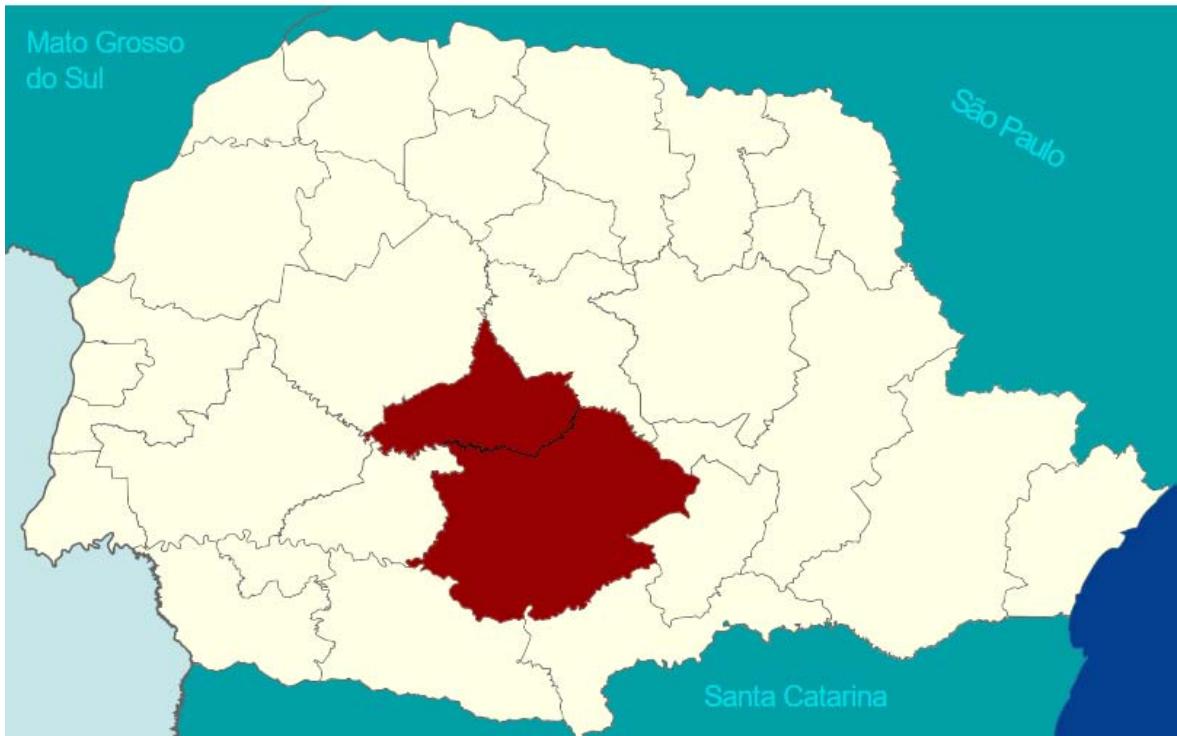 Figure 5: Map of the intermediate region of Guarapuava
Source: HUNTER (2020).
The Intermediate Region of Guarapuava is the with the lowest Human Development Index (HDI) in the area that hosts educational programs initiated in regions State of Paraná and the Southern Region.
Table 19: Data from municipalities in the intermediate region of Guarapuava.
<table><tr><td>Municipalities of the Guarapuava Intermediate Region</td><td>Active Civil Engineers</td><td>IDH</td><td>Position IDH</td><td>Estimated Population 2021</td><td>Population Density Estimated</td></tr><tr><td>Turvo</td><td>6</td><td>0,672</td><td>2621</td><td>12977</td><td>13,82</td></tr><tr><td>Reserva do Iguaçu</td><td>5</td><td>0,648</td><td>3156</td><td>8127</td><td>9,74</td></tr><tr><td>Prudentópolis</td><td>46</td><td>0,676</td><td>2524</td><td>52776</td><td>23,48</td></tr><tr><td>Pinhão</td><td>21</td><td>0,654</td><td>3030</td><td>32722</td><td>16,34</td></tr><tr><td>Inácio Martins</td><td>4</td><td>0,6</td><td>4144</td><td>11117</td><td>11,87</td></tr><tr><td>Guarapuava</td><td>280</td><td>0,731</td><td>993</td><td>183755</td><td>58,00</td></tr><tr><td>Guamiranga</td><td>3</td><td>0,669</td><td>2691</td><td>8881</td><td>36,27</td></tr><tr><td>Goioxim</td><td>1</td><td>0,641</td><td>3275</td><td>6997</td><td>9,96</td></tr><tr><td>Foz do Jordão</td><td>6</td><td>0,645</td><td>3201</td><td>4466</td><td>18,97</td></tr><tr><td>Cantagalo</td><td>11</td><td>0,635</td><td>3393</td><td>13340</td><td>22,86</td></tr><tr><td>Candói</td><td>11</td><td>0,635</td><td>3393</td><td>16126</td><td>10,65</td></tr><tr><td>Campina do Simão</td><td>0</td><td>0,63</td><td>3487</td><td>3831</td><td>8,54</td></tr><tr><td>Nova Tebas</td><td>2</td><td>0,651</td><td>3090</td><td>5252</td><td>9,62</td></tr><tr><td>Mato Rico</td><td>0</td><td>0,632</td><td>3448</td><td>3142</td><td>7,96</td></tr><tr><td>Santa Maria do Oeste</td><td>3</td><td>0,609</td><td>3927</td><td>9210</td><td>11,00</td></tr><tr><td>Pitanga</td><td>33</td><td>0,702</td><td>1842</td><td>29686</td><td>17,84</td></tr><tr><td>Palmital</td><td>27</td><td>0,639</td><td>3312</td><td>12755</td><td>15,59</td></tr><tr><td>Laranjal</td><td>2</td><td>0,585</td><td>4515</td><td>5719</td><td>10,22</td></tr><tr><td>Boa Ventura de São Roque</td><td>6</td><td>0,655</td><td>3008</td><td>6343</td><td>10,22</td></tr><tr><td>TOTAL</td><td>467</td><td>0,648</td><td>3156</td><td>427.222</td><td>2,21</td></tr></table>
The region hosts three active academic programs, comprising one federal public course and two private for-profit courses. The academic program at UTFPR holds a course rating of 4 and an ENADE
(National Student Performance Exam) rating of 5. The academic program at Centro Universitário Campo Real holds a course rating of 4, while the program at FG has a course rating of 3.
Table 20: Number of courses in the Intermediate region of Guarapuava
<table><tr><td>Intermediate Region</td><td>Courses</td><td>PF</td><td>PE</td><td>PM</td><td>PSFL</td><td>PCFL</td><td>UNI</td><td>CEU</td><td>FAC</td><td>INST</td></tr><tr><td>Guarapuava</td><td>3</td><td>1</td><td>0</td><td>0</td><td>0</td><td>2</td><td>1</td><td>1</td><td>1</td><td>0</td></tr></table>
The courses are offered in the municipality of Guarapuava: UTFPR has 88 authorized vacancies; Centro Universitário Campo Real has 80 authorized vacancies; FG has 120 authorized vacancies.
The State of Paraná has 4,890 construction industry companies employing 111,282 people, according to data from the Brazilian Statistical Yearbook for the year 2019. The intermediate region has 427,222 inhabitants and 467 active civil engineers according to CONFEA.
In light of this information, the following data cross-references were conducted:
The first cross-reference in the intermediate region was performed to determine the ratio between the population and the number of civil engineers. The result obtained was $427,222 / 467 = 914.82$, meaning there is 1 active civil engineer for approximately every 915 people.
The second cross-reference was conducted to verify the ratio between the number of construction industry companies in the state and the number of civil engineers. The result obtained was $4,890 / 467 = 10.47$, indicating there are 10 active civil engineers in the intermediate region for each construction industry company in the state.
The fifth cross-reference aimed to verify the ratio between the number of engineers and the number of courses. The result obtained was $467 / 3 = 155.66$, meaning there are approximately 156 active civil engineers for each on-site civil engineering course currently in progress.
The sixth cross-reference in the intermediate region was conducted to verify the ratio between the number of people employed in construction industry companies and the number of vacancies in on-site civil engineering courses in the intermediate region. The result obtained was $111,282 / 288 = 386.39$, indicating that there are 386 people employed in construction industry companies in the state for each vacancy in on-site civil engineering courses currently in progress in the intermediate region.
The seventh cross-reference in the intermediate region aimed to verify the ratio between the number of people employed in construction industry companies in the state and the number of on-site civil engineering courses currently in progress. The result obtained was $111,282 / 3 = 37,094$, demonstrating that there are 37,094 people employed in construction industry companies for the single on-site civil engineering course currently in progress.
The eighth cross-reference was conducted to verify the ratio between the population of the intermediate region and the number of people employed in construction industry companies in the state. The result obtained was 427,222/111,282 = 3.84, meaning there is approximately 1 person employed in construction industry companies for every 4 people in the intermediate region.
The eleventh cross-reference aimed to verify the ratio between the number of construction industry companies and the on-site civil engineering courses currently in progress. The result obtained was 4,890/3 = 1630, indicating approximately 1630 construction industry companies for each on-site civil engineering course currently in progress in the intermediate region.
The twelfth cross-reference aimed to verify the ratio between the population of the intermediate region and the number of vacancies in on-site civil engineering courses currently in progress. The result obtained was $427,222 / 288 = 1483.41$, meaning there is 1 vacancy for approximately every 1483 people in the intermediate region.
The thirteenth cross-reference aimed to verify the ratio between the number of vacancies in on-site civil engineering courses currently in progress and the number of construction industry companies. The result obtained was $4,890 / 288 = 16.97$, indicating 17 construction industry companies for each vacancy in on-site civil engineering courses currently in progress.
The fourteenth cross-reference aimed to verify the ratio between the population of the intermediate region and the number of on-site civil engineering courses currently in progress. The result obtained was $427,222 / 3 = 142,407.33$, meaning there is 1 on-site civil engineering course currently in progress for every 142,407 inhabitants.
Table 21: Summary of crossings at the intermediate region of Guarapuava
<table><tr><th>Crossings</th><th>Result</th></tr><tr><td>Population/active civil engineers</td><td>915 inhabitants per engineer</td></tr><tr><td>Construction industry companies/active civil engineers</td><td>10 companies per engineer</td></tr><tr><td>People employed in construction industry companies/active civil engineers</td><td>238 people employed per engineer</td></tr><tr><td>Active civil engineers/course vacancies</td><td>2 engineers per course vacancy</td></tr><tr><td>Active civil engineers/number of courses</td><td>156 engineers per course</td></tr><tr><td>People employed in construction industry companies/course vacancies</td><td>386 people employed per course vacancy</td></tr><tr><td>People employed in construction industry companies/civil engineering courses</td><td>37,094 people employed per course</td></tr><tr><td>Population/people employed in construction industry companies</td><td>4 inhabitants per employed person</td></tr><tr><td>People employed in construction industry companies/construction industry companies</td><td>Average of 23 people employed per company</td></tr><tr><td>Population/construction industry companies</td><td>87 inhabitants per company</td></tr><tr><td>Construction industry companies/civil engineering courses</td><td>1,630 companies per course</td></tr><tr><td>Population/number of vacancies</td><td>1,483 inhabitants per course vacancy</td></tr><tr><td>Construction industry companies/number of course vacancies</td><td>17 companies per course vacancy</td></tr><tr><td>Population/civil engineering courses</td><td>142,407 inhabitants per course</td></tr></table>
Guarapuava is an intermediate region that offers a face-to-face civil engineering course by both private and public Higher Education Institutions (HEIs). In other words, it can be observed that there is a supply of civil engineering course to meet the demand in the region. However, it is incumbent upon the HEI administrators to analyze to determine the feasibility of maintaining these offerings to serve the region. This is particularly important given the competitive market for civil engineers due to the smaller population of the region. Despite this, the ratio of construction industry companies to the number of active civil engineers is the most favorable among the five regions analyzed. Similarly, the number of individuals employed in construction industry companies compared to the number of active civil engineers is also optimal, indicating that the region provides diverse opportunities compared to the other regions.
Nevertheless, the proportion of the population in the intermediate region relative to the number of people employed in construction industry companies is the lowest among the five regions, as previously mentioned. Additionally, the average number of people employed in construction industry companies relative to the number of construction industry companies is the lowest among the five regions analyzed. This can be explained by the high number of companies, which is reflected in the population-to-construction-industry-companies ratio, the lowest among the five intermediate regions.
Due to the region having the smallest population in relation to the number of courses, it may seem that there is no room for new civil engineering courses in the area. However, upon examining the proportions between the number of construction industry companies and face-to-face civil engineering courses, the region's population compared to the number of available slots, and the number of construction industry companies relative to the number of slots in the courses, it is evident that the intermediate region of Guarapuava exhibits the best results among the five intermediate regions analyzed. This indeed allows HEI administrators to conduct a demand study and assess the feasibility of offering new courses or increasing the slots for existing face-to-face civil engineering courses in the intermediate region.
To facilitate a visual understanding of the proportions among the five regions analyzed in this thesis, the summary table of the five intermediate regions is presented below.
Table 22: Summary of crossings of the 5 intermediate regions
<table><tr><th>Crossings</th><th>Corumbá</th><th>Paulo Afonso</th><th>Marabá</th><th>Teófilo Otoni</th><th>Guarapuava</th></tr><tr><td>Population/Active Civil Engineers</td><td>3601</td><td>2419</td><td>1413</td><td>836</td><td>915</td></tr><tr><td>Construction Industry Companies/Active Civil Engineers</td><td>6</td><td>6</td><td>2</td><td>5</td><td>10</td></tr><tr><td>People Employed in Construction Industry Companies/Active Civil Engineers</td><td>26</td><td>40</td><td>47</td><td>38</td><td>23</td></tr><tr><td>Population/Construction Industry Companies</td><td>592</td><td>408</td><td>1953</td><td>179</td><td>87</td></tr><tr><td>Construction Industry Companies/Civil Engineering Courses</td><td>620</td><td>1005</td><td>133</td><td>1367</td><td>1630</td></tr><tr><td>Population/Number of Vacancies</td><td>9183</td><td>2734</td><td>3446</td><td>2451</td><td>1483</td></tr><tr><td>Construction Industry Companies/Course Vacancies</td><td>16</td><td>7</td><td>2</td><td>14</td><td>17</td></tr><tr><td>Population/Civil Engineering Courses</td><td>367327</td><td>410108</td><td>260571</td><td>245146</td><td>142407</td></tr></table>
In light of this information, it is evident that intermediate regions exhibit distinct characteristics, and some particularities were observed, highlighted in each of the following data intersections:
The first data intersection conducted aims to determine the ratio between the population and the number of active civil engineers. The results are as follows: Corumbá has the highest population compared to the number of active civil engineers, while Teófilo Otoni has the lowest ratio.
The second intersection is conducted to assess the ratio between the number of construction industry companies in the state and the number of civil engineers. The findings indicate that Guarapuava has the highest number of construction industry companies compared to the number of active civil engineers, whereas Maraba exhibits the lowest ratio.
The third intersection examines the ratio between the number of people employed in construction industry companies and the number of active civil engineers. The results show that Guarapuava has the highest number of people employed in construction industry companies compared to the number of active civil engineers, while Maraba presents the lowest ratio.
The fourth intersection of the intermediate region evaluates the ratio between the number of engineers and the number of vacancies in on-site civil engineering courses. The outcomes reveal that Marabá and Teófilo Otoni are the regions with the highest number of active civil engineers compared to the number of vacancies in on-site civil engineering courses, with Paulo Afonso having the lowest ratio.
The fifth proposed intersection assesses the ratio between the number of engineers and the number of courses. Teófilo Otoni is identified as the region with the highest number of active civil engineers compared to the number of on-site civil engineering courses, while Corumbá exhibits the lowest ratio.
The sixth intersection of the intermediate region aims to determine the ratio between the number of people employed in construction industry companies and the number of vacancies in the on-site civil engineering course of the intermediate region. Teófilo Otoni is found to be the region with the highest number of people employed in construction industry companies compared to the number of vacancies in on-site civil engineering courses, and Marabá presents the lowest ratio.
The seventh intersection of the intermediate region assesses the ratio between the number of people employed in construction industry companies in the state and the number of on-site civil engineering courses initiated in activity. The results indicate that Teófilo Otoni has the highest number of people employed in construction industry companies compared to the number of on-site civil engineering courses, while Marabá presents the lowest ratio.
The eighth intersection evaluates the ratio between the population of the intermediate region and the number of people employed in construction industry companies in the state. Maraba is identified as the region with the highest population in the intermediate region compared to the number of people employed in construction industry companies, while Guarapuava has the lowest ratio.
The ninth intersection assesses the average between the number of people employed in construction industry companies and the number of construction industry companies. Maraba is recognized as the region with the highest average between the number of people employed in construction industry companies and the number of construction industry companies, with Guarapuava presenting the lowest average.
The tenth intersection is conducted to evaluate the ratio between the population of the intermediate region and the number of construction industry companies. The results indicate that Maraba has the highest population compared to the number of construction industry companies, while Guarapuava has the lowest ratio.
The eleventh intersection assesses the ratio between the number of construction industry companies and the on-site civil engineering courses initiated in activity. Guarapuava is identified as the region with the highest number of construction industry companies compared to the on-site civil engineering courses initiated in activity, while Marabá presents the lowest ratio.
The twelfth intersection examines the ratio between the population of the intermediate region and the number of vacancies in on-site civil engineering courses initiated in activity. The findings reveal that Corumbá has the highest population compared to the number of vacancies in on-site civil engineering courses initiated in activity, with Guarapuava having the lowest ratio.
The thirteenth cross-examination was conducted to examine the ratio between the number of openings in active civil engineering courses and the number of companies in the construction industry. The following result was obtained: Guarapuava is the region with the highest number of openings in active civil engineering courses compared to the number of construction industry companies, and Maraba exhibited the lowest ratio.
The fourteenth cross-examination aimed to verify the ratio between the population of the intermediate region and the number of active civil engineering courses. The following result was obtained: Paulo Afonso is the region with the highest population compared to the number of active civil engineering courses, while Guarapuava presented the lowest ratio.
As clarified by Boswell, Stiller, and Straubhaar (2004), the lack of specific workers may occur due to "incompatibility" or mismatch in the labor market, leading to shortages in a particular region, occupation, or field of activity. There are four types of mismatch: qualitative, regional, preference-related, and information-related.
In the case of qualitative mismatch, even if there are enough workers, they may lack the required level of qualification or skills demanded by the market, either due to a lack of experience or inadequate training. Regional considerations are relevant, as shortages may occur in aggregate terms if there is a balance between supply and demand, and workers are unwilling to relocate to distant cities or regions where job opportunities exist. Preferences can also lead to mismatches, as not all job seekers may fit the characteristics required for a particular occupation, even if there are job openings. Finally, there are deficits related to information, which tend to be resolved when job openings and workers "meet" through traditional market mechanisms (Boswell, Stiller, Straubhaar, 2004).
Based on the results presented in this study, according to Boswell, Stiller, and Straubhaar (2004), it is crucial to recognize that a shortage of workers may coexist with unemployment. In other words, job openings may go unfilled due to a lack of specific skills, or unemployed workers may be unwilling to take up certain activities or relocate to other regions. Similarly, when there is demand for job openings, employers may not be willing or able to offer higher salaries or create conditions that encourage changes in occupation or location. All these factors need to be considered in the analysis to support decision-making by higher education institution managers.
According to Franco and Longhi (2021), management must act as a driving force and protagonist in the conservation, construction, and use of knowledge for the development of Higher Education from the perspectives of socio-environmental sustainability, creative and responsible innovation, and social justice. This requires unfolding into three systematizing axes: 1) institutional conceptions and guidelines in Higher Education management; 2) organization and institutional decision-making processes in Higher Education management; and 3) academic associative movements and Higher Education management.
In light of the above, we now proceed to present the intermediate regions that do not have in-person civil engineering courses currently in operation.
Brazilian intermediate regions without in-person civil engineering courses initiated in activity. The Northeast and North regions of Brazil are the ones facing signs of scarcity in on-site civil engineering courses that have commenced activities.
In the Northeast, five intermediary regions do not have the course available:
- In Maranhão, the intermediate region of Presidente Dutra lacks an initiated in-person civil engineering course. This intermediate region comprises 28 municipalities and three immediate regions: Presidente Dutra, São João dos Patos, and Colinas.
- In the state of Piauí, the intermediate regions of Picos, São Raimundo Nonato, and Corrente – Bom Jesus currently lack any onsite Civil Engineering courses that have been initiated and are in operation. The intermediate region of Picos comprises 58 municipalities and 04 immediate regions: Picos, Paulistana, Oeiras, and Simplício Mendes. The intermediate region of São Raimundo Nonato encompasses 21 municipalities and 02 immediate regions: São Raimundo Nonato and São João do Piauí. Similarly, the intermediate region of Corrente – Bom Jesus includes 22 municipalities and 02 immediate regions: Corrente and Bom Jesus.
- In the state of Rio Grande do Norte, the intermediate region of Caicó lacks the provision of a face-to-face Civil Engineering course that has commenced activities. The intermediate region of Caicó encompasses 24 municipalities and 02 immediate
regions: Caicó and Currais Novos. "In total, there are 13 immediate regions and 153 municipalities in the northeastern region of Brazil that do not have the provision of in-person Civil Engineering courses in progress.
In the northern region, 6 intermediate regions do not offer the course:
- In the Acre state, the intermediate region of Cruzeiro do Sul lacks a face-to-face civil engineering course that has commenced activities. The intermediate region of Cruzeiro do Sul comprises 8 municipalities and 2 immediate regions: Cruzeiro do Sul and Tarauacá.
- In Amapá, the intermediate Oiapoque-Porto Grande region lacks a locally initiated in-person civil engineering course. The intermediate Oiapoque-Porto Grande region comprises 10 municipalities and 02 immediate regions: Oiapoque and Porto Grande.
- In the state of Amazonas, the intermediate regions of Tefé, Lábrea, and Parintins lack on-site civil engineering courses that have been initiated and are currently active. The intermediate region of Tefé encompasses 21 municipalities, distributed across 3 immediate regions: Tefé, Tabatinga, and Eirunepé. The intermediate region of Lábrea consists of 9 municipalities and 2 immediate regions: Lábrea and Manicóre. Similarly, the intermediate region of Parintins includes 11 municipalities and 2 immediate regions: Parintins and Itacoatiara.
- In Roraima, the intermediate region of Rorainópolis-Caracára lacks a locally initiated in-person civil engineering course. The intermediate region of Rorainópolis-Caracára comprises 6 municipalities and 2 immediate regions: Rorainópolis and Caracáraí.
In total, there are 13 immediate regions and 65 municipalities in the Brazilian northern region that lack the provision of on-site Civil Engineering courses currently in progress. In contrast to the situations in the Northeast and North regions, such a phenomenon does not occur in the Central-West, Southeast, and South regions, as all intermediate regions within these areas have at least one on-site Civil Engineering course currently in progress.
This overview of the Civil Engineering course highlights regional disparities. In light of this context, it falls upon higher education administrators to guide decision-making processes, taking into consideration the region under analysis. They must weigh the hierarchical structure of course offerings, as well as instruments and devices within the various academic architectures of the respective Higher Education Institutions (HEIs). Deliberation on programs, teaching, research, extension, and management is necessary for planning, organizing, directing, making decisions, and evaluating, all while serving the academic community in the surrounding area (FRANCO; LONGHI, 2021).
Following this presentation of quantitative results regarding the panorama of Higher Education in on-site Civil Engineering courses, the focus now shifts to the development of the PanoramaEdu application. With this website, the expectation is to enhance transparency and facilitate access to information, enabling users to construct scenarios for higher education.
For Higher Education, the production of a website with organized information and mapping that illustrates the survey of various indicators related to the spaces and individuals in an intermediate region can underpin significant actions in constructing a project involving educational opportunities in the territory.
Thus, the mapping carried out in this thesis can serve as a technological tool demonstrating the Panorama of Higher Education regarding the course and can be utilized by HEI administrators, schools, public authorities, or social movements to record opportunities in a specific intermediate region or municipality. In addition to its positive aspects, this mapping has revealed local problems by presenting data from the intermediate region. In light of these considerations, the development of PanoramaEdu is presented.
### c) Development of PanoramaEdu
For the development of PanoramaEdu, an academic partnership was established among Ana Beatzis Sales Ramos, Gabriel Sebastiano de Maria, and Dr. Adriana Soares Pereira, who are respectively a student, a student, and a professor in the Bachelor's degree program in Information Systems at the Department of Information Technology (DTeInf) of the Federal University of Santa Maria (UFSM) – Frederico Westphalen Campus, in collaboration with the author of this Thesis.
The following sections outline the phases of PanoramaEdu's development, describing the planning of the Panorama App prototype. Subsequently, the evolution of the PanoramaEdu website is presented, along with the envisioned changes and implementations made from the initial prototype version, which started as an app and transitioned into a responsive website.
### d) PanoramaEdu App Prototype
The PanoramaEdu App prototype was developed by student Ana Beatrix Sales Ramos under the guidance of Dr. Adriana Soares Pereira as part of her Bachelor's thesis project in Information Systems at DTeclnf, UFSM's Frederico Westphalen Campus. The planned prototype is detailed below.
To substantiate decisions regarding the prototype's design, a search was conducted to identify suitable technologies for app development. Following the acquisition of project requirements at the outset of development, the developer conducted a study to determine the technology that best aligns with the project (COSTA, 2017).
Express is a rapid, flexible, and minimalist web framework for Node.js, a browserless environment for executing JavaScript. It provides a robust set of features for web and mobile applications, along with utility methods for HTTP and middleware. JSON, or JavaScript Object Notation, is a subset of the JavaScript programming language. Given that all data in this format aims to fulfill a pre-ordered set of commands resulting in a program, JSON is defined as a textual representation of structured data in a collection of key/value pairs (FREITAS; BIRNFELD; SARAIVA, 2021).
jQuery, an open-source JavaScript toolkit, is employed for creating dynamic web applications. It is cross-browser, functioning uniformly across platforms and browsers, supports asynchronous server communication (AJAX) more straightforwardly than JavaScript, employs CSS-based element selectors, supports animations and effects, and offers various widgets and themes (MATOS; ZABOT, 2020).
React Native allows the creation of "HTML5 apps" or "hybrid apps" for Android and iOS development. The framework combines Objective-C, Java, or Swift, and an example of its application is Discord. React Native exposes JavaScript interfaces to platform APIs, enabling applications to access resources such as the user's camera and location (ESCUDELARIO; PINHO, 2021).
Decisions regarding the PanoramaEdu app prototype initially embraced the Model-View-Controller (MVC) architecture. This pattern defines the software division into three interconnected layers, each serving a specific purpose. In this model, data is passed between layers through predefined interfaces, ensuring information isolation and security, given that in applications, most information resides on the device itself. Figure 6 presents the proposed initial screen of the application.
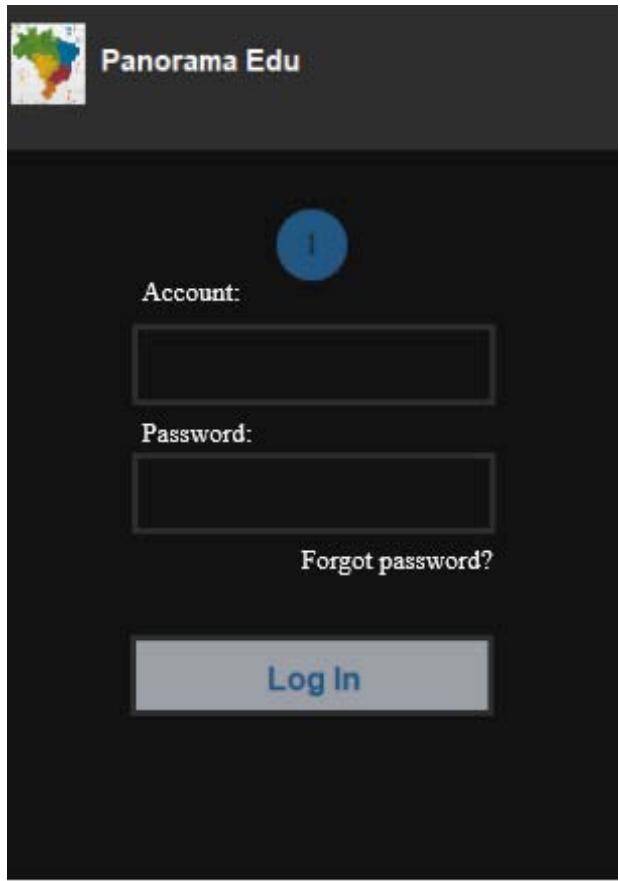
Source: Prepared by the PanoramaEdu team Figure 6: Prototype - Panorama Edu Login Screen
Following the proposed model, here is the prototype of each screen and its functionalities in the PanoramaEdu application:
- PanoramaEdu Menu Screen: This screen holds paramount significance within the application, as it serves as the primary navigation hub for the majority of the application's features.
- PanoramaEdu Registered Courses Screen: On this screen, a list of registered courses will be displayed, presenting information and images of the respective educational institutions.
- PanoramaEdu Course Map Screen: This screen features a map of Brazil, divided into intermediate regions, with the displayed
courses indicated on the map as illustrated in Figure 7.
- PanoramaEduLogout Screen: When the user wishes to close the application, a prompt will
inquire whether they indeed want to exit and log out of the application.
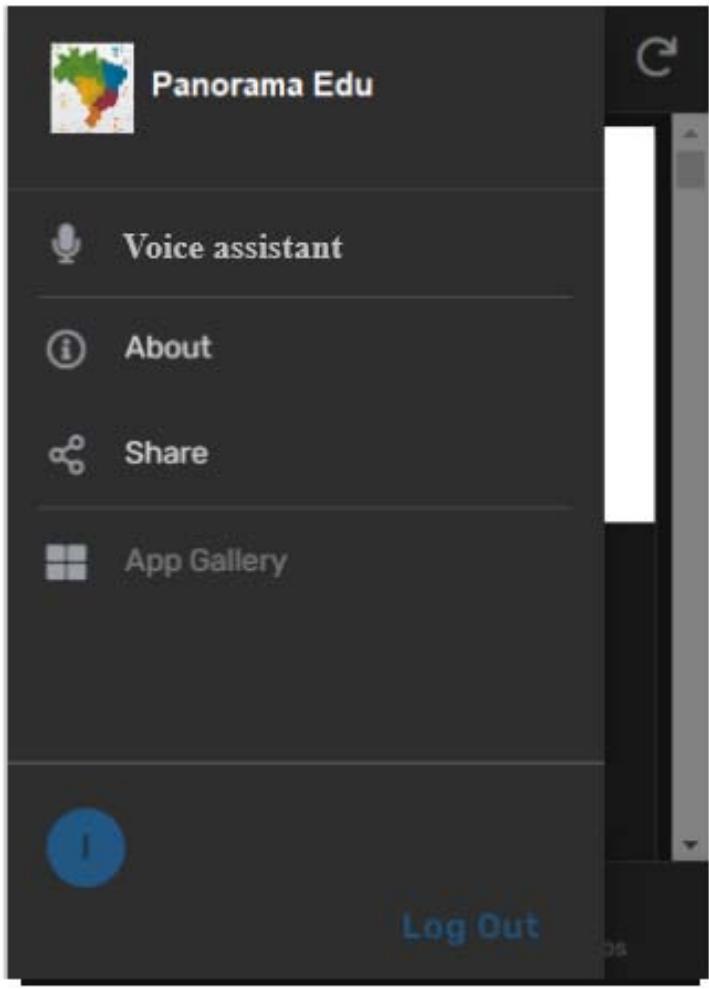
Source: Prepared by the PanoramaEdu team Figure 7: Prototype - PanoramaEdu Menu Screen
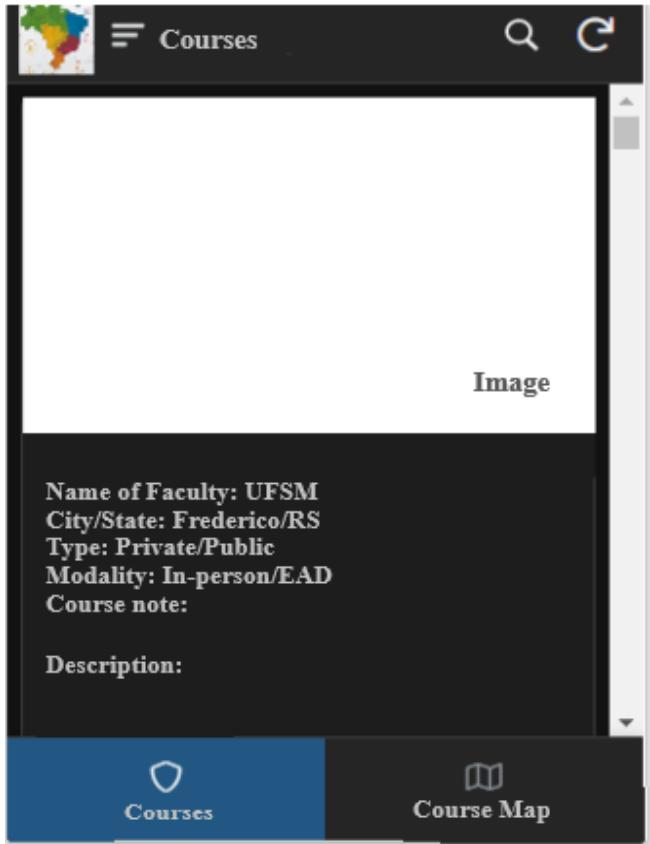
Source: Prepared by the PanoramaEdu team
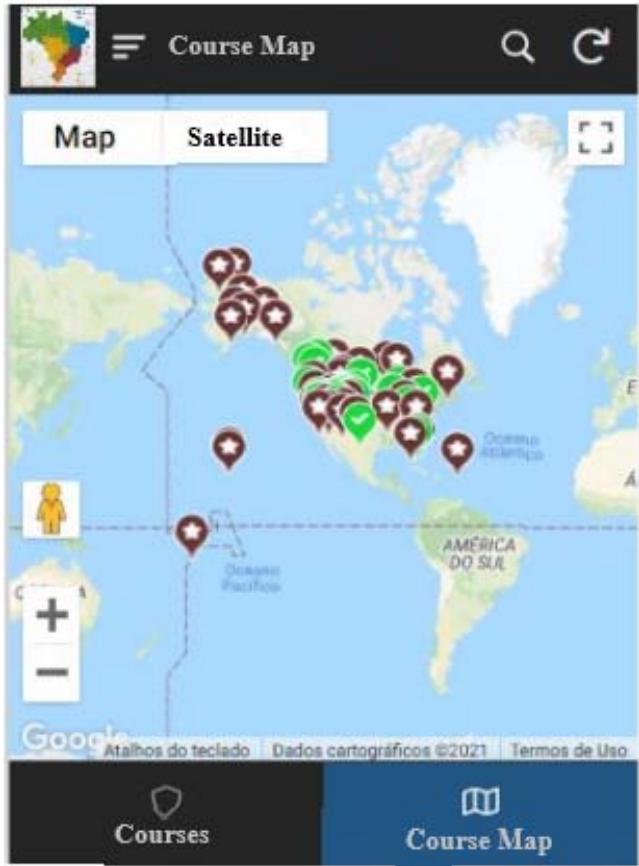 Figure 8: Prototype - PanoramaEdu Registered Courses Screen Source: Prepared by the PanoramaEdu team
After the approval of the prototype project for the PanoramaEdu App, there were few advances in its development. Due to personal reasons, the academic Ana Beatz Sales Ramos chose not to participate in the team, leading to the need to find another person to develop the virtual environment. In this context, the academic Gabriel Sebastiano de Maria joined the team and took on the responsibility of developing the website. The process of how the development occurred is described below.
### e) Development of the PanoramaEdu Website
The definitions of the PanoramaEdu application prototype were modified during the website development process. The main change was in the interface, which followed the architecture of responsive web design to allow web pages to respond to any device without loss of information for the user.
The content of a responsive website adapts to the space allocated to it, adjusting the visualization and navigability without losing information, regardless of the device, screen resolution, size, touch or mouse interface, whether it is mobile or not.
It is not the physical size of the screen or device that matters in responsive design, but its resolution. Responsive web design involves a series of techniques and technologies combined to make a single application work on a variety of devices as practically as possible. It is not only web professionals who have recognized this need. Small and large companies are looking for ways to make their web projects accessible regardless of where the user may access them (FISHER; SHARKIE, 2013, p. 2).
A web page with responsive content can be accessed on conventional computers, laptops, smartphones, tablets, TVs, and any other device with internet access, presenting itself well.
For the development of the website, PHP 7 was chosen, being a server-side scripting language embedded in HTML, which can be understood as a collection of HTML supertags that allow adding server functions to web pages. PHP has little to do with layout, events, or anything related to the appearance of a web page. In fact, most of what PHP does is invisible to the end user.
Bootstrap, a style framework, is used in development, providing a range of features, styles, and templates to make web development easy and fast. This framework offers resources that facilitate the creation of responsive interfaces, i.e., interfaces that adjust automatically for a good display on different devices.
The website hosting will be performed at the address: www.ufrgs.br/panoramaedu. Below are some screens from the PanoramaEdu website during its development, which is not yet finalized.
Source: Prepared by the PanoramaEdu team Figure 10: Development - home screen of the PanoramaEdu website For the initial screen of the proposed virtual environment, an explanatory summary of the theme and a registration proposal for new users, as well as a login
and password for accessing the environment, are presented.
With the explanatory summary of the theme, the user has the opportunity to comprehend the content available in the virtual environment and choose to register in order to gain access.
intention is to ascertain the user's access profile, which includes options such as student, teacher, or higher education administrator. Users will be prompted to provide information about their current educational institution (IES) or school, as the virtual environment aims to become interactive in the future and respond to user demands.
 Figure 11: Development - PanoramaEdu Maps website screen
Source: Prepared by the PanoramaEdu team
The screen above depicts the current status of the territorial map under construction. In the information bubble option, course-related information is suggested for the user to gain awareness and access to data that has been collected and processed for presentation within this virtual environment.
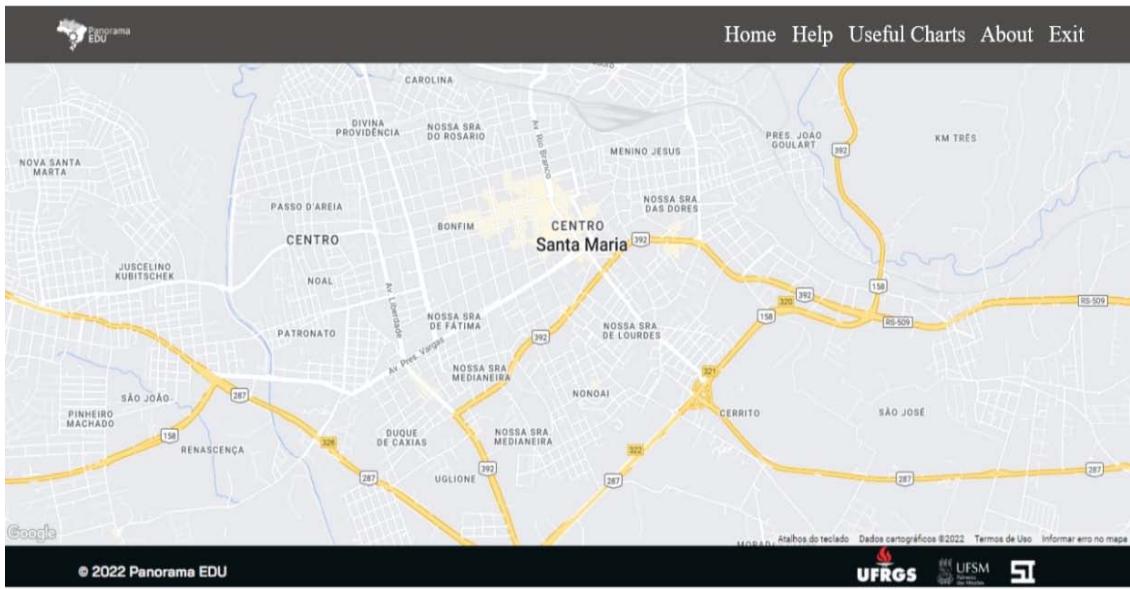 Figure 12: Developed screen - PanoramaEdu website map loaded
Source: Prepared by the PanoramaEdu team
This is the proposal for the main navigation screen in the virtual environment. The menu consists of "Home," to which the user can always return during navigation to the start of the navigation screen. The "Help" menu aims to include all help information on navigating the environment, shortcuts, and FAQs. It also intends to provide the user with a contact record, in the form of opening a ticket, detailing their request.
In the "Useful Graphics" menu, some thesis graphics will be initially presented. However, the intention is that, through interaction with users, new analysis graphics of the landscape will be proposed. The "About" menu will present a detailed study with the introduction of the team of authors and developers, an explanation of the virtual environment, and a link to access the final version of this thesis.
For the continued development of the virtual environment, the goal is to include information that allows users to cross-reference indicators and compare courses, thereby generating reports for use, for example, in decisions by higher education institution managers, in future teacher research, and to meet the information needs regarding students' courses. It is intended to include an artificial intelligence software related to conversation interfaces and chatbots, as well as customer support and data generation.
The development of the virtual environment had the main objective of serving as a reference for the development of studies and virtual environments, to extend the environment to other higher education courses in different knowledge areas, and to assess the possibility of developing the virtual environment for Brazilian Higher Education, respecting the specificities of each knowledge area in all higher education courses.
### f) Final Version of the PanoramaEDU Website
Below are images from the online version of the PHP website in October 2022.
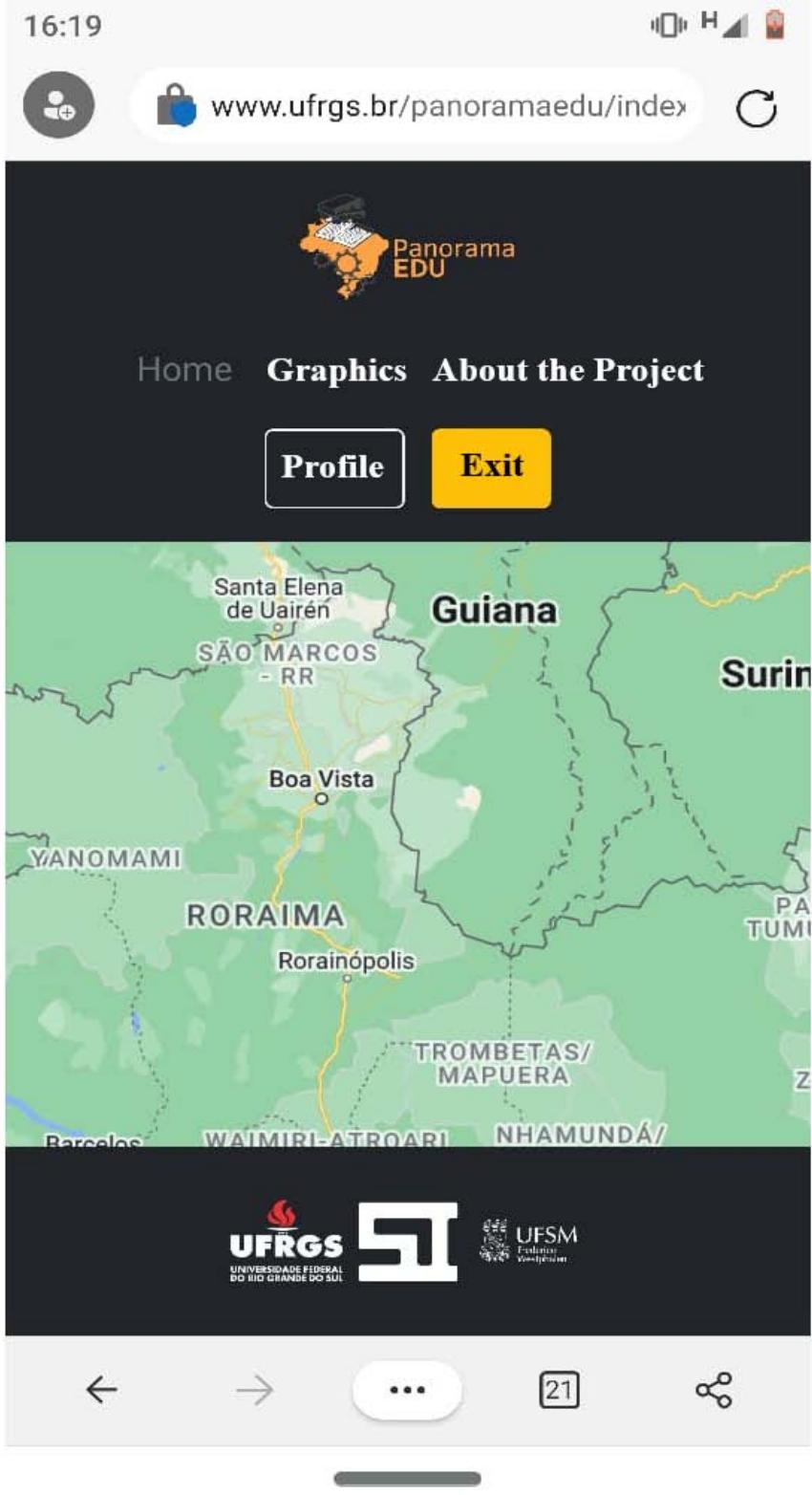
Source: Prepared by the PanoramaEdu team Figure 13: Home screen - PanoramaEdu Map website on mobile device
#### 16:22

Figure 9: Prototype - PanoramaEdu Course Map Screen




www.ufrgs.br/panoramaedu/sobre

 Panel label: Panorama EDU.
Home Graphics About the project
Profile
Exit
### O PanoramaEDU
The development of PanoramaEdu emerged from the writing of the Doctoral Thesis entitled "PANORAMA DA ED. SUPERIOR BRAZILEIRA: the vision of the Civil Engineering course", when doctoral student Lucas Socoloski Gudolle and his advisor Doctor Sérgio Roberto Kieling Franco decided to not only present the results of the panorama of the face-to-face civil engineering course in the Brazilian context, but also allow interactivity through the website


 Panel label: UFSM Endowment.




 Figure 14: Project screen - PanoramaEdu website on mobile device
Source: Prepared by the PanoramaEdu team
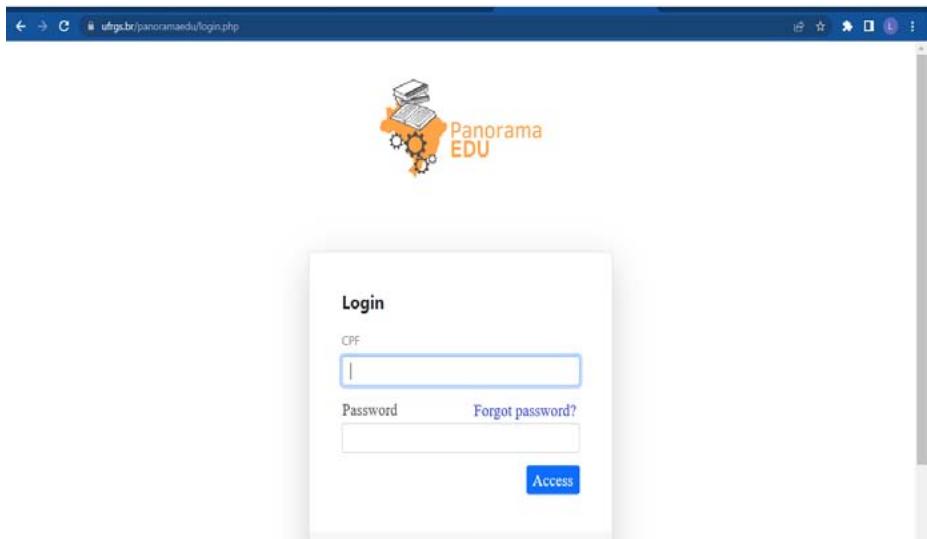
Source: Prepared by the PanoramaEdu team
Figure 15: Login screen - PanoramaEdu website on the computer
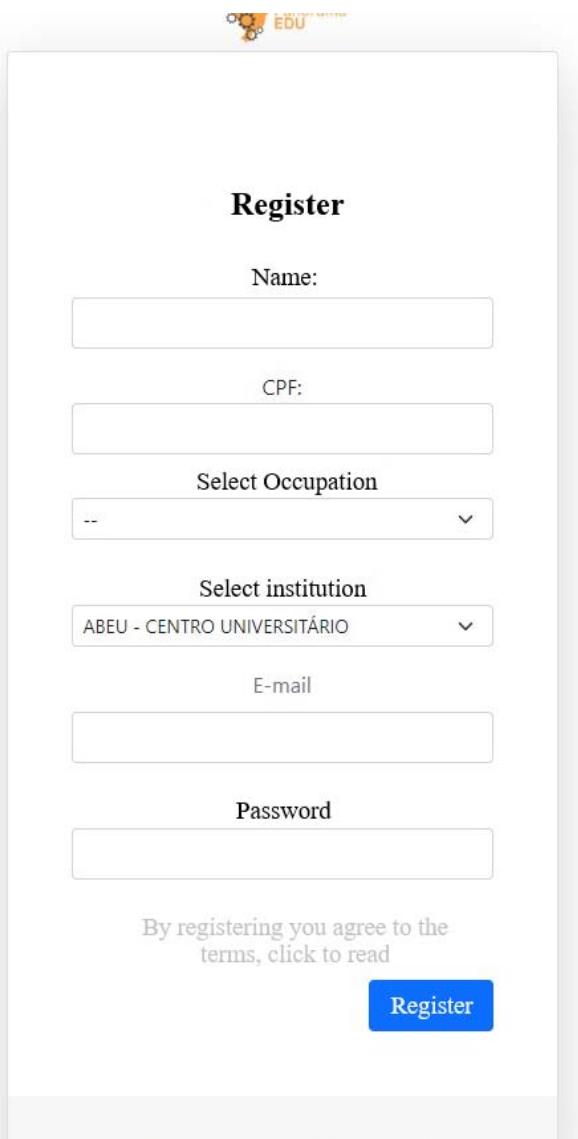 Figure 16: Registration screen - PanoramaEdu website on the mobile device
Source: Prepared by the PanoramaEdu team
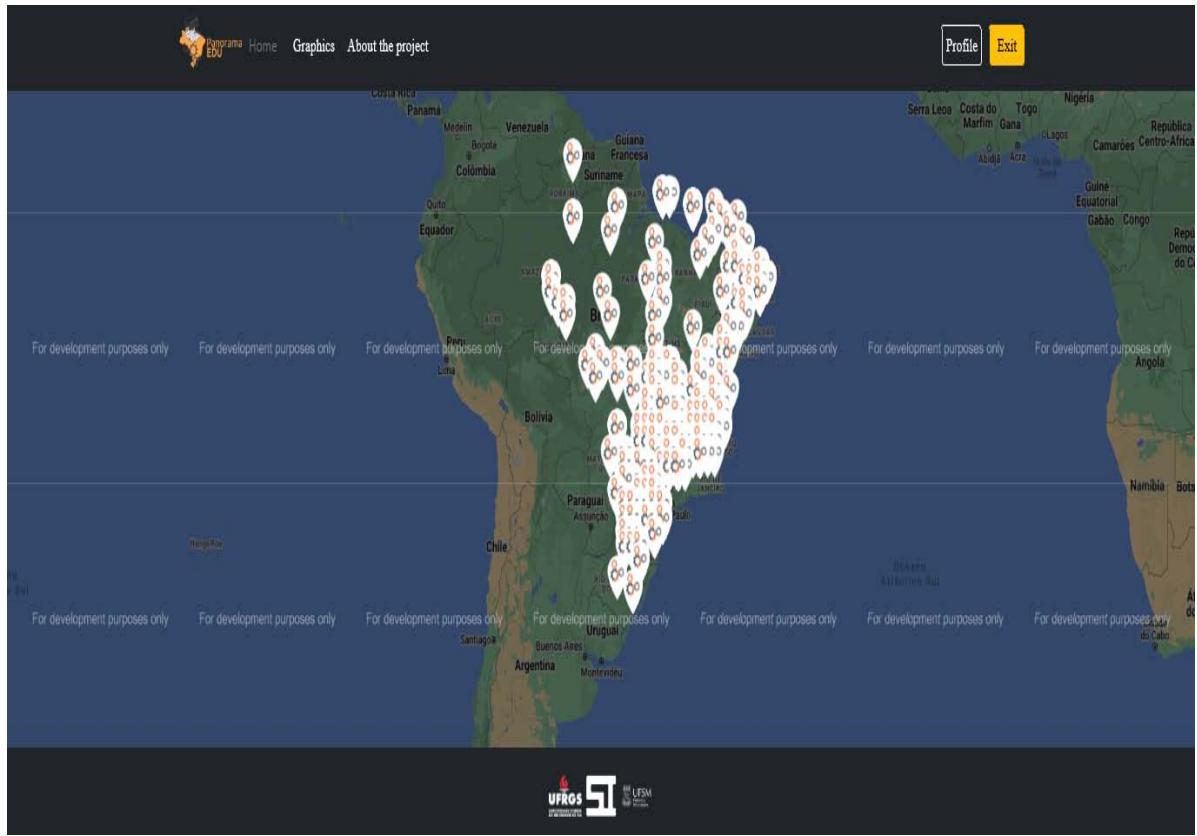
Source: Prepared by the PanoramaEdu team
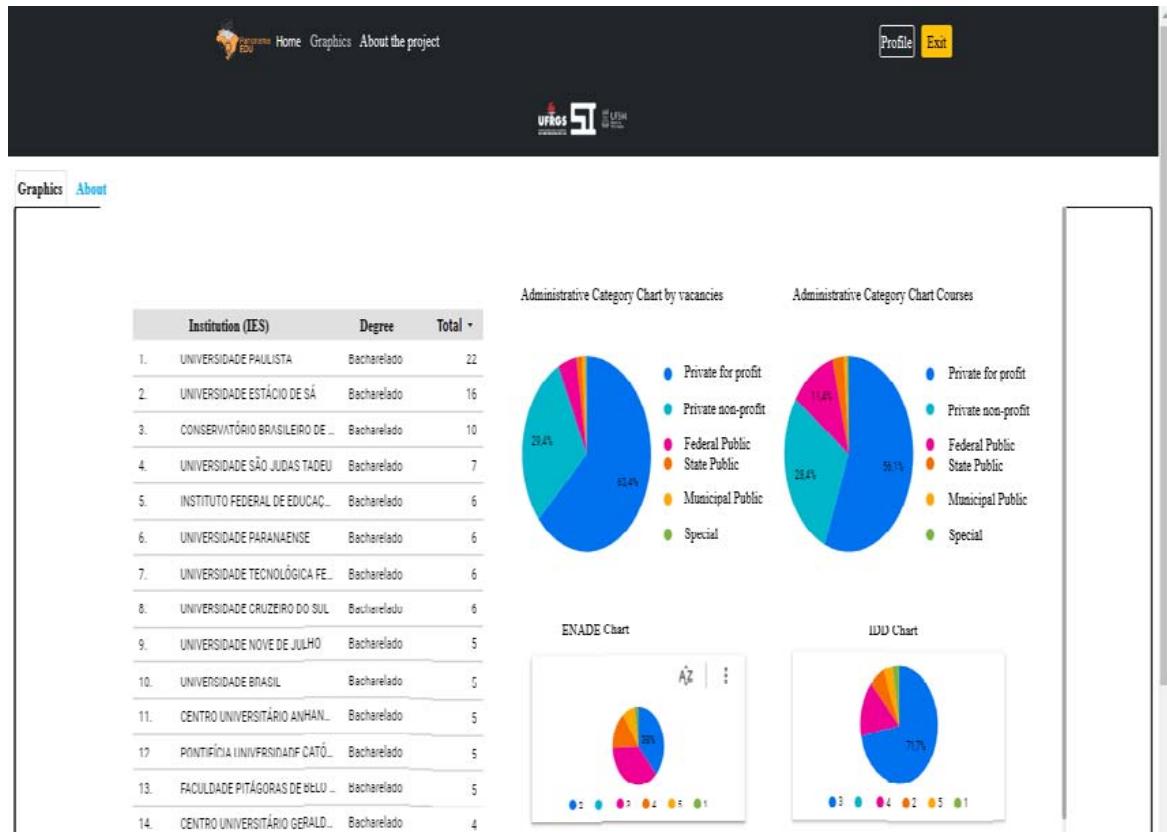 Figure 17: Main screen of the PanoramaEdu website on the computer Source: Prepared by the PanoramaEdu team Figure 18: Graphics screen from the PanoramaEdu website on the computer
## IV. FINAL CONSIDERATIONS
The current research fulfilled its scope by conducting the collection, processing, analysis, and presentation of data, indicators, and results, culminating in a comprehensive overview of the on-site Civil Engineering course in Public (Federal, State, and Municipal) and Private (Community, Confessional, Philanthropic, and For-Profit) Higher Education Institutions (HEIs) in Brazil, as well as in the intermediate regions of the country.
The overall objective was fully achieved, as evidenced by the presentation of the national panorama of the course and the analysis of intermediate regions with lower Human Development Index (HDI), covering one intermediate region in each of the five major national regions.
The specific objectives were also entirely met. The first focused on presenting the national panorama of indicators for the on-site Civil Engineering course in HEIs, requiring data collection from various sources, with an emphasis on indicators from the National System of Higher Education Assessment (SINAES), Brazilian Institute of Geography and Statistics (IBGE), HDI, and Federal Council of Engineering and Agronomy (CONFEA).
The second specific objective, involving the analysis of indicators for five Brazilian intermediate regions with the lowest HDI, was achieved after formulating the methodology for data processing and analysis. This process allowed for the identification of regions showing signs of a shortage of the course, as well as those without the course in operation in the North and Northeast regions of Brazil.
The third objective, related to the construction of the PanoramaEdu Website to present data on on-site Civil Engineering courses in Brazilian HEIs, was achieved through academic collaboration. The partnership established with Prof. Dr. Adriana Soares Pereira, academic Ana Beatzis Sales Ramos, and academic Gabriel Sebastiano de Maria, all from the Information Systems course at UFSM, enabled the development of the prototype, Beta version, and final version of the website.
The challenges faced during the doctoral program primarily centered on the development of the PanoramaEdu Website, requiring efforts to overcome setbacks and establish partnerships for project execution. Nevertheless, the prototype was developed, providing an accessible online version.
The analysis of the five intermediate regions revealed traces of a shortage of civil engineering training, related to obstacles such as access and transportation difficulties, combined with adverse geographical conditions, such as significant distances from capitals and medium-sized municipalities.
Regarding the research problem on the current panorama of on-site Civil Engineering courses, the results highlighted that the general characteristics of the courses presented in the results section do not reflect the reality of some institutions. It was observed that, despite the prevalence of courses in profitable private colleges, with course ratings of 4, preliminary course ratings of 3, and ENADE ratings of 2, there are courses that do not follow this evaluative pattern. The analysis also revealed the absence of on-site Civil Engineering courses in 153 municipalities in the Northeast region and 64 municipalities in the North region, indicating signs of scarcity in territories with significant geographical and demographic challenges.
Limitations encountered during the research, such as difficulties in developing the PanoramaEdu Website and the scarcity of specific data from intermediate regions, were overcome with strategies such as adopting data conversion methods and establishing academic partnerships. Access to the website is expected to influence decisions by higher education managers, enabling informed investments in regions with a lack or few courses, contributing to long-term local development.
In summary, this research not only addressed the proposed problem but also made a significant contribution to understanding the distribution and situation of on-site Civil Engineering courses in the national and regional context, providing a solid foundation for decision-making in the field of higher education.
Generating HTML Viewer...
References
101 Cites in Article
Ana Agapito (2016). Ensino superior no Brasil: expansão e mercantilização na contemporaneidade.
D Amaral,F Dedini,Ensino,Engenharia,Brasil (2020). Unknown Title.
Oresti Banos (2015). implementation and validation of a novel open framework for agile development of mobile health applications.
Gustavo Barbosa,Souza (2019). REFLEXÕES QUANTO A EFETIVIDADE DAS REGIÕES GEOGRÁFICAS IMEDIATAS DA MATA SUL DE PERNAMBUCO.
Alexandre Barros,Rands (2024). Regional Inequality in Perfectly Competitive Markets: The Role of Natural Resources and Economic Infrastructure.
(2007). G Overview of Brazilian Higher Education: The Perspective of the Civil Engineering Program Brasileira de Estudos Regionais e Urbanos.
Andrea Bottoni,Edélcio Sardano,Jesus; Costa De,Galileu Bonifácio Filho,Da (2013). Uma breve história da Universidade no Brasil: de Dom João a Lula e os desafios atuais.
Brasil (1988). Constituição da República Federativa do Brasil.
Brasil (1997). Conselho Nacional de Educação/ Câmara de Educação Superior.
Brasil (2001). Conselho Nacional de Educação/ Câmara de Educação Superior.
Brasil (2003). Conselho Nacional de Educação/ Câmara de Educação Superior.
(1995). Unknown Title.
Daniela Cunda,Ana Bliacheriene (1996). LEIS DE ACESSO A INFORMAÇÕES PARA UM ESTADO (T)EC(N)OLÓGICO E DEMOCRÁTICO DE DIREITO.
Brasil (2022). Unknown Title.
Daniela Cunda,Ana Bliacheriene (2001). LEIS DE ACESSO A INFORMAÇÕES PARA UM ESTADO (T)EC(N)OLÓGICO E DEMOCRÁTICO DE DIREITO.
Brasil (2022). Decreto nº 119-A, de 7 de janeiro de 1890.
Brasil (2004). Unknown Title.
(2008). Unknown Title.
Georgia Assumpção,Hugo Campos,Ana De Albuquerque,Aline Dos Santos (2010). EDUCAÇÃO A DISTÂNCIA NO IBGE: O USO DE VÍDEO AULAS NO TREINAMENTO DA PESQUISA DE ORÇAMENTOS FAMILIARES 2017/2018.
Brasil (2010). Unknown Title.
Gustavo Santanna (2013). A LEI DE ACESSO À INFORMAÇÃO COMO INSTRUMENTO PARA IMPLEMENTAÇÃO DE UMA GOVERNANÇA PÚBLICA ELETRÔNICA.
Brasil (2014). Planejando a Próxima Década: Conhecendo as 20 Metas do Plano Nacional da Educação.
Georgia Assumpção,Hugo Campos,Ana De Albuquerque,Aline Dos Santos (2017). EDUCAÇÃO A DISTÂNCIA NO IBGE: O USO DE VÍDEO AULAS NO TREINAMENTO DA PESQUISA DE ORÇAMENTOS FAMILIARES 2017/2018.
Brasil (2022). Unknown Title.
C Boswell,S Stiller,T Straubhaar (2004). Forecasting labour and skills shortages: how can projections better inform labour migration policies? Luxembourg: Office for Official Publications of the European Communities Report.
Ana Carlos,Fani Alessandri (2007). O Espaço Urbano: Novos Escritos sobre a Cidade.
Marie Carvalho,Jane Soares,; Neves,; Breno,Rafaela Melo,Cultiveduca (2016). Anais dos Workshops do Congresso Brasileiro de Informática na Educação.
Cristina Carvalho,Helena Almeida,De (2013). A mercantilização da educação superior brasileira e as estratégias de mercado das instituições lucrativas.
Roberto Corrêa,Lobato (1995). O espaço urbano. São Paulo.
Danúbia Sá-Caput,Laisa Paineiras-Domingos,Eliane Guedes-Aguiar,Rafaelle Carvalho-Lima,Severo De Paoli,Danielle Soares Morel,Igor Bastos,Clailson Farias,Cláudia Figueiredo,Glenda Dias,Eric Frederico,Mario Filho (1997). Could Hair Loss be a Relevant Symptom Associated with Chikungunya?.
Roberto Corrêa,Lobato (2000). Região e organização espacial.
F Costa (2017). Sistema inteligente para localização de descargas parciais em transformadores de potência.
(2017). Trabalho de Conclusão de Curso (Graduação em Sistemas de Informação) -UNIVERSIDADE FEDERAL DO ESTADO DO RIO DE JANEIRO -Rio de.
L Cunha (1975). A expansão do ensino superior: causas e consequências.
L Cunha (1988). A universidade reformada: o Golpe de 1964 e a modernização do ensino superior.
M Cunha (2011). Gestão estratégica de IES: modelos e funções do planejamento estratégico em universidades públicas e privadas de Palmas -Tocantins (Dissertação de mestrado).
De Oliveira Nunes,; Edson,Fernandes,; Ivanildo,Julia Albrecht (2015). Regulação e Ensino Superior no Brasil.
José Dias Sobrinho,Qualidade (2008). Qualidade, avaliação: do SINAES a índices.
Astor Diehl,Antonio (2004). Pesquisa em ciências sociais aplicadas: métodos e técnicas.
J Duarte (2009). Território de identidade e multiterritorialidade, paradigmas para a formulação de uma nova regionalização na Bahia.
Julian Donaubauer,Birgit Meyer,Peter Nunnenkamp (1929). A New Global Index of Infrastructure: Construction, Rankings and Applications.
Eunice Durham,Ribeiro (2003). O ensino superior no Brasil: público e privado.
B Escudelario,D Pinho (2021). React Native: Desenvolvimento de aplicativos mobile com React.
Maria Fávero (2006). A universidade no Brasil: das origens à Reforma Universitária de 1968.
Gerald Finkel (1997). The economics of the construction industry.
A Fisher,C Sharkie (2013). Jump Start Responsive Web Design.
D Fortes Noções de construção civil e desenho arquitetônico.
Sérgio Franco (2021). Políticas da Educação Superior.
V Freire (2014). Revisão mostra o país um pouco pobre.
P Freitas,H Birnfeld,K Saraiva,M Al (2021). Programação Back End III.
Adelar Fochezatto,Cristiano Ghinis,Ponzoni (2011). Determinantes do crescimento da construção civil no Brasil e no Rio Grande do Sul: evidências da análise de dados em painel.
Juliana Brito (2009). Adequação da matriz curricular da graduação em nutrição às diretrizes curriculares nacionais em uma instituição de ensino superior do Distrito Federal.
A Giddens (1989). A constituição da sociedade.
Jefferson Cabral,Neil Júnior,Ricardo Rangel,Fátima Oliveira (2015). EDUCAÇÃO CORPORATIVA COMO GERADORA DE VANTAGEM COMPETITIVA PARA AS ORGANIZAÇÕES, EM UM AMBIENTE DE RÁPIDAS MUDANÇAS.
Lucas Gudolle,Alessandra Blando,Sérgio Franco (2021). ENSINO REMOTO EMERGENCIAL NA EDUCAÇÃO SUPERIOR: UMA REFLEXÃO BASEADA EM PAULO FREIRE.
David Harvey (2006). A produção capitalista do espaço.
A Dos Santos,C Neumann Jr.,E Faria (2015). ESTUDO DO PROCESSO DE LIXIVIAÇÃO DURANTE 40 ANOS NO CONCRETO DE ENCHIMENTO DA CASA DE FORÇA DA BARRAGEM PRINCIPAL DE CONCRETO DE ITAIPU.
Inep -Instituto Nacional De Estudos E Pesquisas Educacionais Anísio Teixeira CPC.
Inep -Instituto Nacional De Estudos E Pesquisas Educacionais Anísio Teixeira (2017). ENADE.
Inep -Instituto Nacional De Estudos E Pesquisas Educacionais Anísio Teixeira (2017). Cadernos de Estudos e Pesquisas em Políticas Educacionais.
Inep -Instituto Nacional De Estudos E Pesquisas Educacionais Anísio Teixeira (2017). Cadernos de Estudos e Pesquisas em Políticas Educacionais.
Jared Keengwe,Malini Bhargava (2014). Mobile learning and integration of mobile technologies in education.
Ricardo Kureski (2008). Produto interno bruto, emprego e renda do macrossetor da construção civil paranaense em 2006.
H Lefebvre (1968). O direito e a cidade.
Lara Lima,Carlos Loureiro,Francelino Sousa,André Lopes (2019). Espraiamento urbano e seus impactos nas desigualdades socioespaciais da acessibilidade ao trabalho em Fortaleza.
Karl Marx (2017). Unknown Title.
B Martins (1986). Le nouvel enseigment supérieur privé au Brésil (1964-1983): rencontre d'une demande sociale et d'une opportunité politique.
C Martins (1988). Ensino pago: um retrato sem retoques.
E Matos,D Zabot,Com Bootstrap E (2020). ANGULAR -COMO DESENVOLVER APPS RESPONSIVOS.
Mauricio Molina,Leonardo Aguilar,; Junior,Waldyr Azevedo (2014). Formação em engenharia civil: desafios para o currículo na UFJF.
Gabriel Montes,Artur Reis (2011). Investimento público em infraestrutura no período pós-privatizações.
Antônio Netto,Carbonari (2011). O capital estrangeiro e os investimentos na educação do Brasil.
C Neves (2002). A estrutura do ensino superior no Brasil.
Clarissa Neves (2009). Using Social Inclusion Policies to Enhance Access and Equity in Brazil’s Higher Education.
Daniel Neves (2022). Golpe Militar de 1964 e o início da ditadura no Brasil.
Naiara Oliveira (2009). Os desafios para a qualidade do ensino nas universidades públicas e privadas: um estudo descritivo e exploratório.
Valeria Oliveira,; Faria,Eaaq Oliveira (2012). O papel da Indústria da Construção Civil na organização do espaço e do desenvolvimento regional.
(2014). Organização para a Cooperação e Desenvolvimento Econômico (OCDE).
O' Sullivan,Arthur (2004). Introdução à Economia: Princípios e Ferramentas.
M Paula (2002). A modernização da universidade e a transformação da intelligentzia universitária.
R Perico (2009). Geografia política, geopolítica e gestão do território no Brasil: agendas, atores e pesquisas.
I Phase (2005). Educating the Engineer of 2020.
André Pires,Helena Sampaio,Ana Carneiro,De,Futuro (2022). A PANDEMIA DE COVID-19 COMO CATALISADORA DE MUDANÇAS NO ENSINO SUPERIOR.
K Powell,M Rey (2015). Exploring a resourse dependency perspective as an organizational strategy for building resourse capacity: implications for public higher education universities.
Ipea Pnud,Fjp (2013). Índice de Desenvolvimento Humano Municipal Brasileiro.
Joseane Rosa (2021). Cresce número de mestres e doutores na educação superior.
G Rámirez (2011). Ensino superior no mundo.
Alexandre Rands (2012). Desigualdades regionais no Brasil: natureza, causas, origens e solução.
Nina Ranieri (2000). Educação superior, direito e estado: na Lei de diretrizes e bases.
Francisco Rigolon,; José Zagari,Maurício Piccinini,Serrão (1997). O investimento em infra-estrutura e a retomada do crescimento econômico sustentado.
Dilvo Ristoff (2004). O novo perfil do campus brasileiro: uma análise do perfil socioeconômico do estudante de graduação.
Dilvo Ristoff (2013). Os desafios da educação superior na Ibero-América: inovação, inclusão e qualidade.
D Ristoff (2014). O novo perfil do campus brasileiro: uma análise do perfil socioeconômico do estudante de graduação.
B Santos (2005). A universidade do século XXI.
Milton Santos (1993). A urbanização brasileira.
Milton Santos (1997). Espaço e método.
Milton Santos (2006). A Natureza do espaço: Técnica e Tempo, Razão e Emoção.
Leandro Milani Corrêa,Bruno Clemente Guingo (2016). Localização, Segmentação e Quantificação de Placas Ateroscleróticas Calcificadas e Não Calcificadas.
Marcos Saquet,Aurélio (2005). A relação espaço-tempo e a apreensão do movimento em estudos territoriais.
Flávia Scherer,Luciane (2007). A consolidação de empresas brasileira de construção pesada em mercados externos.
P Scott,Sguissardi,José Sousa,; Vieira De,Luis Cunha,Henrique (1984). Universities and University Business Models: reflections on governance and structures.
No ethics committee approval was required for this article type.
Data Availability
Not applicable for this article.
How to Cite This Article
Felipe Oliveira Neves. 2026. \u201cOverview of Brazilian Higher Education: The Perspective of the Civil Engineering Program\u201d. Global Journal of Human-Social Science - G: Linguistics & Education GJHSS-G Volume 24 (GJHSS Volume 24 Issue G2): .
Explore published articles in an immersive Augmented Reality environment. Our platform converts research papers into interactive 3D books, allowing readers to view and interact with content using AR and VR compatible devices.
Your published article is automatically converted into a realistic 3D book. Flip through pages and read research papers in a more engaging and interactive format.
This scientific article proposes an enhanced analysis of Higher Education Institutions (HEIs) in Brazil, focusing on Public HEIs (Federal, State, and Municipal) and Private HEIs (Community-based, Confessional, Philanthropic, and for-profit). The adopted approach stems from a meticulous historical analysis of face-to-face Civil Engineering courses, considering the various intermediary regions in Brazil. The study is based on data from the National Higher Education Assessment System (SINAES), the Higher Education Census, as well as demographic and territorial data provided by IBGE, and information from CONFEA. The theoretical framework of this article is grounded in the essential concepts of Brazilian Higher Education, Higher Education Institutions, the National Higher Education Assessment System, Civil Engineering Courses, and the Civil Construction Industry. A relevant factor incorporated into this analysis is the impact of territory, encompassing not only physical and environmental characteristics but also cultural and infrastructural issues.
Our website is actively being updated, and changes may occur frequently. Please clear your browser cache if needed. For feedback or error reporting, please email [email protected]
Thank you for connecting with us. We will respond to you shortly.