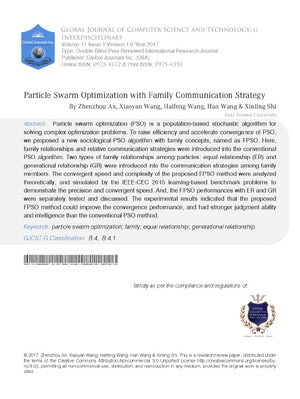

Particle Swarm Optimization with Family Communication Strategy

§ Yuxi Normal University

Send Message

To: Author

Particle Swarm Optimization with Family Communication Strategy

Article Fingerprint

ReserarchID

CSTONUX9

Particle Swarm Optimization with Family Communication Strategy Banner

Key Research Insights

Synthesized scholarly intelligence & interactive research assistant
  • English
  • Afrikaans
  • Albanian
  • Amharic
  • Arabic
  • Armenian
  • Azerbaijani
  • Basque
  • Belarusian
  • Bengali
  • Bosnian
  • Bulgarian
  • Catalan
  • Cebuano
  • Chichewa
  • Chinese (Simplified)
  • Chinese (Traditional)
  • Corsican
  • Croatian
  • Czech
  • Danish
  • Dutch
  • Esperanto
  • Estonian
  • Filipino
  • Finnish
  • French
  • Frisian
  • Galician
  • Georgian
  • German
  • Greek
  • Gujarati
  • Haitian Creole
  • Hausa
  • Hawaiian
  • Hebrew
  • Hindi
  • Hmong
  • Hungarian
  • Icelandic
  • Igbo
  • Indonesian
  • Irish
  • Italian
  • Japanese
  • Javanese
  • Kannada
  • Kazakh
  • Khmer
  • Korean
  • Kurdish (Kurmanji)
  • Kyrgyz
  • Lao
  • Latin
  • Latvian
  • Lithuanian
  • Luxembourgish
  • Macedonian
  • Malagasy
  • Malay
  • Malayalam
  • Maltese
  • Maori
  • Marathi
  • Mongolian
  • Myanmar (Burmese)
  • Nepali
  • Norwegian
  • Pashto
  • Persian
  • Polish
  • Portuguese
  • Punjabi
  • Romanian
  • Russian
  • Samoan
  • Scots Gaelic
  • Serbian
  • Sesotho
  • Shona
  • Sindhi
  • Sinhala
  • Slovak
  • Slovenian
  • Somali
  • Spanish
  • Sundanese
  • Swahili
  • Swedish
  • Tajik
  • Tamil
  • Telugu
  • Thai
  • Turkish
  • Ukrainian
  • Urdu
  • Uzbek
  • Vietnamese
  • Welsh
  • Xhosa
  • Yiddish
  • Yoruba
  • Zulu
Reading Preferences
Font Size
Line Spacing
Background
This converted HTML version may contain rendering inconsistencies. Please refer to the PDF for the authoritative version, or click here to provide feedback.

Abstract

Particle swarm optimization (PSO) is a population-based stochastic algorithm for solving complex optimization problems. To raise efficiency and accelerate convergence of PSO, we proposed a new sociological PSO algorithm with family concepts, named as FPSO. Here, family relationships and relative communication strategies were introduced into the conventional PSO algorithm. Two types of family relationships among particles: equal relationship (ER) and generational relationship (GR) were introduced into the communication strategies among family members. The convergent speed and complexity of the proposed FPSO method were analyzed theoretically, and simulated by the IEEE-CEC 2015 learning-based benchmark problems to demonstrate the precision and convergent speed. And, the FPSO performances with ER and GR were separately tested and discussed. The experimental results indicated that the proposed FPSO method could improve the convergence performance, and had stronger judgment ability and intelligence than the conventional PSO method.

References

27 Cites in Article
  1. J Kennedy,R Eberhart (1995). Particle swarm optimization.
  2. Salim Lahmiri,Mounir Boukadoum (2016). Combined partial differential equation filtering and particle swarm optimization for noisy biomedical image segmentation.
  3. (2016). Retracted: Medical Dataset Classification: A Machine Learning Paradigm Integrating Particle Swarm Optimization with Extreme Learning Machine Classifier.
  4. S,Wang Phillips,J Yang,P Sun,Y Zhang (2016). Magnetic resonance brain classification by a novel binary particle swarm optimization with mutation and time-varying acceleration coefficients.
  5. Raja Mehmood,Hyo Lee (2016). Emotion recognition from EEG brain signals based on particle swarm optimization and genetic search.
  6. S Chu,F Roddick,J Pan (2005). A parallel particle swarm optimization algorithm with communication strategies.
  7. Chao-Li Sun,Jian-Chao Zeng,Jeng-Shyang Pan (2009). An Improved Particle Swarm Optimization with Feasibility-Based Rules for Constrained Optimization Problems.
  8. P Suganthan (1999). Particle swarm optimizer with neighborhood operator.
  9. J Kennedy,R Mendes (2002). Topological Structure and Particle Swarm Performance.
  10. J Kennedy (1999). Small worlds and mega-minds: Effects of neighborhood topology on particle swarm performance.
  11. M Montes De Oca,J P~ena,T Stiiutzle,C Pinciroli,M Dorigo (2009). Heterogeneous Particle Swarm Optimizers.
  12. P Spanevello,M Montes De Oca (2009). Experiments on Adaptive Heterogeneous PSO Algorithms.
  13. M Clerc,J Kennedy (2002). The particle swarm: Explosion, stability, and convergence in a multidimensional complex space.
  14. E Burgess,H Locke (1945). The Family: From Institution to Companionship.
  15. F Van Den,A Berghand,Engelbrecht (2006). A study of particle swarm optimization particle trajectories.
  16. X Fei (1981). Shengyu zhidu (The Regime of Childbirth).
  17. J Liang,B Qu,P Suganthan (2014). Problem Definitions and Evaluation Criteria for the CEC 2015 Competition on Learning-based Real-Parameter Single Objective Optimization.
  18. M Montes De Oca,T Stiiutzle,K Van Den Enden,M Dorigo (2009). Incremental Social Learning in Particle Swarms.
  19. Marco Montes De Oca,Thomas Stützle (2008). Towards incremental social learning in optimization and multiagent systems.
  20. M Montes De Oca,K Van Den Enden,T Stiiutzle (2008). Incremental particle swarm-guided local search for continuous optimization.
  21. C Monson,K Seppi (2006). Adaptive diversity in PSO.
  22. R Eberhart,Y Shi (2007). Computational Intelligence: Concepts to Implementations.
  23. J Kennedy,R Eberhart,Y Shi (2001). Swarm Intelligence.
  24. G Wittemyer,I Douglas-Hamilton,W Getz (2005). The socioecology of elephants: analysis of the processes creating multitiered social structures.
  25. G Wittemyer,W Getz (2007). Hierarchical dominance structure and social organization in African elephants, Loxodonta africana.
  26. Z An,X Shi,J Zhang,J Lu (2011). A Family Particle Swarm Optimization Based on Tree Structure.
  27. Zhenzhou An,Xiaoyan Wang,Xinling Shi (2017). A Study on the Convergence of Family Particle Swarm Optimization.

Funding

No external funding was declared for this work.

Conflict of Interest

The authors declare no conflict of interest.

Ethical Approval

No ethics committee approval was required for this article type.

Data Availability

Not applicable for this article.

How to Cite This Article

Zhenzhou An, Xiaoyan Wang, Han Wang, wangxinyao3, xlshi. 2017. "Particle Swarm Optimization with Family Communication Strategy". Global Journal of Computer Science and Technology - G: Interdisciplinary GJCST-G Volume 17 (GJCST Volume 17 Issue G1).

Download Citation

Journal Specifications

Crossref Journal DOI 10.17406/gjcst

Print ISSN 0975-4350

e-ISSN 0975-4172

Keywords
Classification
B.4 B.4.1
Version of record

v1.2

Issue date
September 19, 2017

Language
English
Order Article Reprint
Experiance in AR

Explore published articles in an immersive Augmented Reality environment. Our platform converts research papers into interactive 3D books, allowing readers to view and interact with content using AR and VR compatible devices.

Read in 3D

Your published article is automatically converted into a realistic 3D book. Flip through pages and read research papers in a more engaging and interactive format.

Article Matrices
Total Views: 1.9K
Total Downloads: 144
All Trends

Request Access

Please fill out the form below to request access to this research paper. Your request will be reviewed by the editorial or author team.
X

This is the heading

Lorem ipsum dolor sit amet, consectetur adipiscing elit. Ut elit tellus, luctus nec ullamcorper mattis, pulvinar dapibus leo.


High-quality academic research articles on global topics and journals.

Particle Swarm Optimization with Family Communication Strategy

Zhenzhou An
Zhenzhou An Yuxi Normal University
Xiaoyan Wang
Xiaoyan Wang
Han Wang
Han Wang