Article Fingerprint
ReserarchID
23DS9

Choose where you want to hide AI Takeaway. Your site-wide choice will be remembered in this browser.
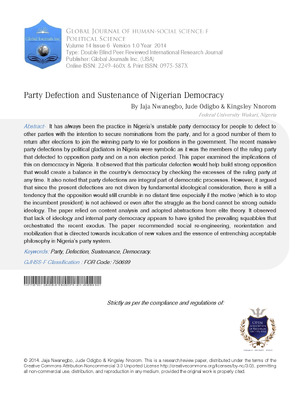
It has always been the practice in Nigeria’s unstable party democracy for people to defect to other parties with the intention to secure nominations from the party, and for a good number of them to return after elections to join the winning party to vie for positions in the government. The recent massive party defections by political gladiators in Nigeria were symbolic as it was the members of the ruling party that defected to opposition party and on a non election period. This paper examined the implications of this on democracy in Nigeria. It observed that this particular defection would help build strong opposition that would create a balance in the country’s democracy by checking the excesses of the ruling party at any time. It also noted that party defections are integral part of democratic processes. However, it argued that since the present defections are not driven by fundamental ideological consideration, there is still a tendency that the opposition would still crumble in no distant time especially if the motive (which is to stop the incumbent president) is not achieved or even after the struggle as the bond cannot be strong outside ideology. The paper relied on content analysis and adopted abstractions from elite theory. It observed that lack of ideology and internal party democracy appears to have ignited the prevailing squabbles that orchestrated the recent exodus. The paper recommended social re-engineering, reorientation and mobilization that is directed towards inculcation of new values and the essence of entrenching acceptable philosophy in Nigeria’s party system.
Jude Odigbo. 2014. "Party Defection and Sustenance of Nigerian Democracy". Global Journal of Human-Social Science, Global Journal of Human-Social Science - F: Political Science GJHSS-F Volume 14 (GJHSS Volume 14 Issue F6).
Crossref Journal DOI 10.17406/GJHSS
Print ISSN 0975-587X
e-ISSN 2249-460X
v1.2
Explore published articles in an immersive Augmented Reality environment. Our platform converts research papers into interactive 3D books, allowing readers to view and interact with content using AR and VR compatible devices.
Your published article is automatically converted into a realistic 3D book. Flip through pages and read research papers in a more engaging and interactive format.
Total Score: 103
Country: Nigeria
Subject: Global Journal of Human-Social Science
Authors: Jude Odigbo, Jaja Nwanegbo, Kingsley Nnorom (PhD/Dr. count: 0)
View Count (all-time): 292
Total Views (Real + Logic): 2068
Total Downloads (simulated): 122
Publish Date: 2014 01, Wed
Monthly Totals (Real + Logic):
We use cookies and similar technologies to improve site performance, understand traffic, and enhance your publishing experience. Cookie Policy
Choose which optional cookies Global Journals can use. Your preference applies across this platform and can be updated any time.
These cookies are required for core website functionality and security.

Lorem ipsum dolor sit amet, consectetur adipiscing elit. Ut elit tellus, luctus nec ullamcorper mattis, pulvinar dapibus leo.