
I. INTRODUCTION
The Internet connection from root servers, the United States, Japan, Holland and Sweden are the main nodes. Japan is the nation with the highest connection speed (61.0 mbps), Sweden ranks fourth (18.2 mbps), Holland is sixth (8.8 mbps) and the United States occupies tenth place (4.8 mbps) (Carreón, Espinoza and García, 2019). The economic, technological and social consequences of globalization are described to propose the Theory of Mobile Consumption that explains the consumption of products and services through mobile telephony (Garcia, 2021).
From this panorama it is necessary to investigate the impact of the use of technologies, devices and electronic networks based on the management, production and transfer of knowledge focused on the optimization of resources and the innovation of processes (Garcia et al., 2020). In the first case, the codification of knowledge implies the concatenation of objectives, tasks and goals. In the second aspect, process innovation suggests the establishment of an agenda focused on the inheritance of knowledge and learning of training styles (Hernandez et al., 2021).
This paper sets out the theoretical frameworks of utilitarian entrepreneurship regarding the acceptance of technology, risk aversion and perceived utility to explain the entrepreneurship process from the deliberate, planned and systematic rationality of intensive use of technologies, devices and networks. Social (Garcia, 2021).
Next, the specialized and updated studies of the state of the question regarding entrepreneurial utilitarianism from the use of electronic technologies, devices and networks are presented, assuming that the decision to carry out the project's undertaking involves the optimization of information, thus as process innovation (Velazquez et al., 2020).
In the end, the trajectories of relationships between categories, variables and indicators are specified to observe entrepreneurial utilitarianism and contrast it with opportunism that is an improvised, emotional and intuitive process (Garcia et al., 2020).
II. THEORY OF OPPORTUNISM
A model is presented in which it is included and demonstrates that the perception of utility is the determinant of the use of mobile Internet (Carreón, Fierro & García, 2019). Based on the above scenario, it is proposed that individuals, being immersed in information communication flows and networks, become potential consumers when acquiring a mobile phone (Garcia, 2021).
Precisely, in the following section, the Mobile Consumption Theory (TCM) is explained, which explains the determinants of consumption through a mobile phone (Carreón, Villegas and García, 2019). The Theory of Mobile Consumption states that individuals carry out their purchases through a mobile phone based on their utilitarian perceptions and purchase decisions (Sanchez et al., 2020).
The TCM maintains that people consume basic products and services through the consumption of secondary products (Carreón, Hernandez and García, 2019). Individuals when buying a mobile phone or any product and technological information communication service, are exposed to the consumption of basic products and services that are advertised and sold through the technologies (Garcia et al., 2020).
Therefore, the TCM argues that it is the perceptions of utility, innovation and efficiency that determine the consumption of products and services that are advertised and sold through the mobile phone (García, Espinoza and Carreón, 2018). TCM provides the indirect effect of perception of a technological innovation on the consumption of products and services via said mobile technology (García, 2021).
It explains the relationship between ICTs with individuals saturated with multiple activities, people who buy and people who work as supervisors or vendors (García, Martínez and Quintero, 2019). The TCM predicts the use of the mobile Internet from a cognitive process that begins perceptually and ends behaviorally (Sanchez et al., 2019). From the TCM, the study detailed below was carried out (García et al., 2019).
The perception of utility is the central axis of the knowledge management agenda because it translates statistical data into meanings of commitment, entrepreneurship and innovation, as well as generates new protocols for information processing whenever the objectives and goals are subject to the climate of tasks, supports and relationships between stakeholders (Hernandez, Carreon and Garcia, 2019). The TCM raises three explanations of the consumption of products and services through the mobile phone.
III. STUDIES OF OPPORTUNISM
The work related to the management, production and transfer of knowledge has focused on entrepreneurship indicated by opportunism, optimization and process innovation (Carreon, Hernandez, Garcia, Garcia, Rosas & Aguilar, 2014). This is because it is considered that opportunistic entrepreneurship leads to rational entrepreneurship. It is this sense that the observation of such a conversion suggests the decomposition and comparison of both emotional and deliberate, opposite and complementary processes (Aldana et al., 2018).
Opportunism has been widely observed in scenarios of resource shortages, shortages, unhealthiness and lack of public services. It is an informal structure of news and intuitions aimed at subsistence and survival that lead people and groups to organize around trials of successes and mistakes (Elizarraráz, Molina, Quintero, Sánchez & García, 2018).
Opposing opportunism is optimization, which is based on the control and management of resources as a result of knowledge, experience and wisdom (Hernandez & Valencia, 2016). It is an intermediate phenomenon between opportunism and innovation which requires the competition of leaders and talents considered as intangible assets of organizations.
At an extreme opposite of opportunism, process innovation suggests the evolution of technology acceptance, the usefulness of devices and the intensive use of social networks (Hernández, Anguiano, Valdés, Limón & García, 2018). It is true that in these areas' opportunism is in force, but to a lesser extent with respect to the scenarios of development in which it emerges as is the case in the markets on wheels.
Decision-making, focused on the opportunistic entrepreneurial spirit, distances itself from risk and benefit balances, while innovations are based on the balance of costs and benefits, or on the maximization of profits versus minimization. of losses this is the utilitarianism of entrepreneurship that consists in the emergence of opportunism and the consolidation of innovations, prior to the optimization of resources (Mendoza, Ramirez & Atriano, 2016).
This breakdown is observable in management since the translation of experiences and knowledge implies the opportunism of knowledge translators and promoters of wisdom (Quintero, Velázquez, Sales & Padilla, 2016). This is the case of unicorn or starup companies that are designed for exponential growth based on the opportunism of a non-existent product or process in the market (Carreon et al., 2014).
In the case of the production of knowledge focused on the development and consolidation of systematic reviews and findings of relationships between components of a product or process, opportunism is in force, but to a lesser extent since it is gradually replaced by the optimization of resources (Robles, Alviter, Ortega & Martinez, 2016). It is that of the companies that create knowledge that are exposed to reorganize their objectives, protocols and goals in order to survive the dynamics of the market as understood by alliances between micro, small and medium enterprises (Bermudez et al., 2019).
As for the translation of knowledge focused on the learning of knowledge from an academic, professional and occupational training, opportunism remains sighted, but already very oriented towards the discovery of heuristics or procedural shortcuts (Sales, Quintero & Velázquez, 2016). These prolegòmenos of innovative entrepreneurship are distinguished by their ability to link phases or entities that had not been observed together. Knowledge-creating companies exemplify this type of conversion from opportunism to innovation, mainly observed in the relationships between traditional leaderships regarding emerging talents (Garcia et al., 2016).
IV. MODELLNG OF OPPORTUNISM
From the theoretical, conceptual and empirical frameworks reviewed, it is possible to notice the trajectories of relations between the diemnsions, categories, variables and indicators reported in the specialized and updated liuterature from 2019 to 2021 (Martinez et al., 2019).
The first emerging and preponderant path refers to the provisions that are aversive or prone to entrepreneurship and that are geared towards the academic, professional and labor training of talents in their process aimed at the conversion of intangible assets (Sánchez, Hernández, Martínez, Villegas & García, 2018). This issue begins with the formation of academic habitus and culminates with process innovation, mediating entrepreneurial opportunism and resource optimization.
In a second route, the emergence of opportunistic proposals that shapes the unicorn projects of the starups has been observed as a process to inform that it is institutionalized as risk capital increases its responsibilities (Vazquez, Barrientos, Quintero, Velázquez, 2016). This is how the isomorphism that distinguishes innovative companies leads them to become resource optimizing organizations to guarantee profit based on the exploitation of the original idea rather than the commitment to new proposals.
A third route refers to the injection of seed capital to knowledge reproductive projects. It is based on a corporate and isomorphic institutionalization with respect to a matrix (Juarez, 2020). It is the documented case of the oriental companies that based on family traditions grew gradually until they reached the optimization of resources and in the end acquire the innovations and not only reproduce the knowledge of the West.
This is how the objective of the present work was to specify a model for the study of the perception of utility, considering the dimensions that literature contributes with respect to the acceptance of technology, the propensity to information and the motivation for achievement.
Formulation. Do perceptions of the level of utility and the degree of innovation have an indirect, positive and significant effect on the level of use?
V. METHOD
There were 100 students selected from the Metropolitan Autonomous University. 65 men (25 studied in CBI, 26 in CBS and 14 in CSH) and 121 women (22 in CBI, 59 in CBS and 40 in CSH).
In the first phase, the reliability and validity of the instruments that measured the five variables was built and established.
In the second phase, the likelihood of adjusting indirect and direct, negative and positive, and significant causal relationships between the study variables was modeled and demonstrated.
From the Opportunism Theory, twelve indicators were established that configured three dimensions for the five variables of the measurement model that were subjected to a confirmatory factor analysis of the main components with varimax rotation and maximum likelihood (Garcia et al., 2020). The results reject the hypothesis of factorial unidimensionality for three variables of the measurement model.
Scale of the perception of the level of utility. 12 items with response options from "strongly disagree" to "strongly agree". The table shows the convergence (indicated by the factor weight) of the reagents with respect to the factor (Bustos et al., 2021).
Scale of the perception of the degree of efficiency. 12 items with response options from "never" to "always". Considering the factor weights of the perceptual variable of self-efficiency, the convergence of four reagents is demonstrated (Garcia et al., 2017).
Scale of the level of use. 12 items with response options from "less than ten minutes" to "more than twenty minutes.
The psychometric properties of the instruments that measure the study variables are detailed in the table where they meet the requirements for multivariable analysis.
During the first week of the spring quarter of 2021 at the UAM-I library, students were asked how often they used their phone to download images, sounds and speeches to select the ideal sample. Subsequently, the questionnaire was provided indicating a response time of 30 minutes to answer it.
VI. RESULTS
From the Mobile Consumption Theory, a new model was designed with the variables that met the criteria of reliability (alpha greater than.60) and validity (factorial weight greater than.300). Multiple linear regression was calculated to establish the determinants of the dependent variable and the non-linear relationship between independent variables. The scheme shows that the perception factor of academic utility is the main determinant of the level factor of Internet use for academic purposes (see Table 1).
| RC1 | RC2 | RC3 | RC4 | Uniqueness | |||||||
| R1 | 0.522 | 0.529 | 0.322 | ||||||||
| R2 | -0.869 | 0.248 | |||||||||
| R3 | -0.930 | 0.091 | |||||||||
| R4 | 0.432 | -0.582 | 0.243 | ||||||||
| R5 | 0.565 | 0.461 | |||||||||
| R6 | 0.444 | 0.647 | 0.388 | ||||||||
| R7 | -0.935 | 0.055 | |||||||||
| R8 | 0.538 | 0.558 | 0.083 | ||||||||
| R9 | 0.742 | 0.402 | 0.223 | ||||||||
| R10 | 0.956 | 0.118 | |||||||||
| R11 | -0.470 | 0.598 | 0.274 | ||||||||
| R12 | 0.625 | 0.445 | 0.423 | 0.175 | |||||||
| R13 | 0.485 | 0.605 | 0.517 | 0.191 | |||||||
| R14 | 0.811 | 0.130 | |||||||||
| R15 | -0.903 | 0.263 | |||||||||
| R16 | -0.444 | -0.731 | 0.165 | ||||||||
| R17 | 0.486 | -0.640 | 0.331 | ||||||||
| R18 | 0.643 | 0.612 | 0.106 | ||||||||
| R19 | -0.660 | 0.488 | |||||||||
| R20 | 0.713 | -0.455 | 0.251 | ||||||||
| R21 | 0.836 | 0.165 | |||||||||
| R22 | 0.893 | 0.182 | |||||||||
| R23 | -0.690 | 0.384 | |||||||||
| R24 | -0.529 | 0.588 | 0.131 | ||||||||
| R25 | -0.711 | -0.403 | 0.348 | ||||||||
| R26 | 0.695 | 0.476 | |||||||||
| R27 | -0.918 | 0.451 | 0.129 | ||||||||
| R28 | 0.816 | 0.443 | 0.170 | ||||||||
| R29 | 0.679 | -0.402 | 0.120 | ||||||||
| R30 | 0.781 | ||||||||||
Source: Elaborated with data study, Method: Principal components, rotation: Promax, R = Reactive, RC1 = Perception of entrepreneurial innovation (21% total variance explained), RC2 = Perception of entrepreneurial optimization (18% total variance explained), RC3 = Perception of entrepreneurial exploration (14% total variance explained), RC4 = Perception of entrepreneurial breakdown (7% total variance explained).
This finding indicates a modification of the TCM measurement model by proposing a direct, positive and significant effect of the utility factor on the use for academic purposes. That is, a person looking to buy for example a book, could get it if there was a virtual library connected to the mobile phone (see Table 2).
| RC1 | RC2 | RC3 | RC4 | ||||||
| RC1 | 1.000 | -0.054 | 0.140 | -0.056 | |||||
| RC2 | -0.054 | 1.000 | -0.091 | 0.304 | |||||
| RC3 | 0.140 | -0.091 | 1.000 | 0.182 | |||||
| RC4 | -0.056 | 0.304 | 0.182 | 1.000 | |||||
Similar reasoning would imply the perception factor of self-efficiency as a determinant of academic mobile use. An individual looking for academic information could find it through his mobile phone. However, the causal relationship lacking the required significance suggests the exclusion of the variable (see Figure 1).
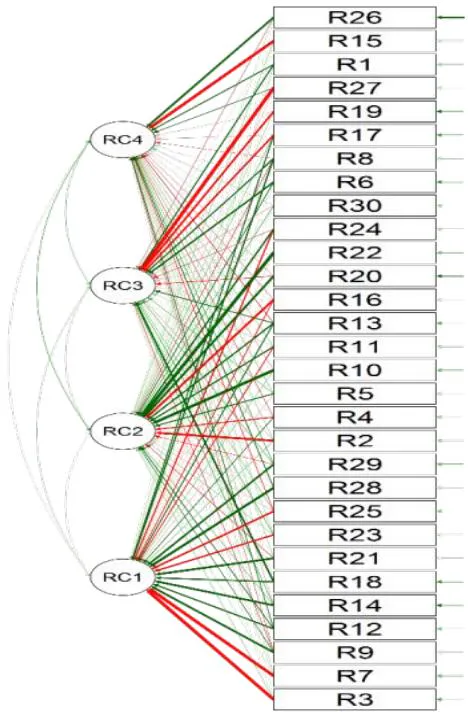
Source: Elaborated with data study, RC1 = Perception of entrepreneurial innovation, RC2 = Perception of entrepreneurial optimization, RC3 = Perception of entrepreneurial exploration, RC4 = Perception of entrepreneurial breakdown
The strength of association between independent variables indicates its spurious implication.
Finally, the level of mobile Internet use for academic purposes is explained by the two independent variables in percent of their variability.
From the original measurement model only two variables maintain a causal relationship that selects them for inclusion in another measurement model. These consequences and implications are discussed below.
VII. Discussion
The objective of the present work was to specify a model for the study of the perception of utility, considering the dimensions reported in the literature, as well as those established in the present work, but its design limited the contributions to the analyzed sample, suggesting the extension of work towards other scenarios and other study samples.
In relation to the perception of utility that literature identifies as concomitant to the perceived ease of use (Martínez, Espinoza and García, 2019). The present work has shown that it affects, together with the perception of efficiency, the intensive use of electronic technologies, devices and networks.
Regarding the perception of effectiveness that literature links to the perception of control (Villegas, 2019). The present study has shown that when interrelated with the perception of utility generates a predictive structure of Internet use.
In relation to the use of the Internet, literature stands out as a result of the interrelationship between perceptions of utility, ease, efficiency and control (Villegas, Carreón and García, 2019). The present work has shown that the perception of utility associated with the perception of effectiveness generates a structure that determines the use of the Internet.
Research lines concerning the associative structure of the perception of utility with the perception of efficiency and these as determinants of the use of the Internet will explain the rational, deliberate, planned and systematic process of acceptance of technology.
VIII. CONCLUSION
The objective of this paper was to specify a model based on the theory of mobile consumption, which highlights the relationship between perceptions as determinants of the use of technologies, devices and networks.
However, the present work proposed a modification of the perceptual structure in order to increase the predictive power of the theory of mobile consumption, highlighting the association between the perception of utility and the perception of efficacy as predictors of behavior.
Research lines concerning the predictive structure of electronic consumption will explain the associative relationship between utility and perceived effectiveness, as well as its impact on the use of the Internet.