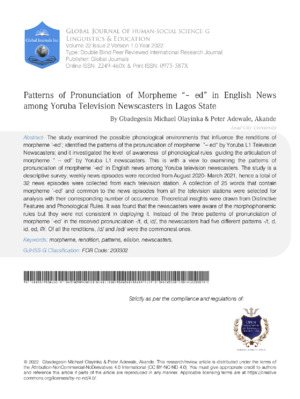
Patterns of Pronunciation of Morpheme “– ed” in English News among Yoruba Television Newscasters in Lagos State

α
Gbadegesin Michael Olayinka
σ
Peter Adewale
Peter Adewale
ρ
Akande
Akande

Send Message

To: Author

Patterns of Pronunciation of Morpheme “– ed” in English News among Yoruba Television  Newscasters in Lagos State


Article Fingerprint

ReserarchID

N6323

Patterns of Pronunciation of Morpheme “– ed” in English News among Yoruba Television  Newscasters in Lagos State Banner

AI TAKEAWAY

Connecting with the Eternal Ground
  • English
  • Afrikaans
  • Albanian
  • Amharic
  • Arabic
  • Armenian
  • Azerbaijani
  • Basque
  • Belarusian
  • Bengali
  • Bosnian
  • Bulgarian
  • Catalan
  • Cebuano
  • Chichewa
  • Chinese (Simplified)
  • Chinese (Traditional)
  • Corsican
  • Croatian
  • Czech
  • Danish
  • Dutch
  • Esperanto
  • Estonian
  • Filipino
  • Finnish
  • French
  • Frisian
  • Galician
  • Georgian
  • German
  • Greek
  • Gujarati
  • Haitian Creole
  • Hausa
  • Hawaiian
  • Hebrew
  • Hindi
  • Hmong
  • Hungarian
  • Icelandic
  • Igbo
  • Indonesian
  • Irish
  • Italian
  • Japanese
  • Javanese
  • Kannada
  • Kazakh
  • Khmer
  • Korean
  • Kurdish (Kurmanji)
  • Kyrgyz
  • Lao
  • Latin
  • Latvian
  • Lithuanian
  • Luxembourgish
  • Macedonian
  • Malagasy
  • Malay
  • Malayalam
  • Maltese
  • Maori
  • Marathi
  • Mongolian
  • Myanmar (Burmese)
  • Nepali
  • Norwegian
  • Pashto
  • Persian
  • Polish
  • Portuguese
  • Punjabi
  • Romanian
  • Russian
  • Samoan
  • Scots Gaelic
  • Serbian
  • Sesotho
  • Shona
  • Sindhi
  • Sinhala
  • Slovak
  • Slovenian
  • Somali
  • Spanish
  • Sundanese
  • Swahili
  • Swedish
  • Tajik
  • Tamil
  • Telugu
  • Thai
  • Turkish
  • Ukrainian
  • Urdu
  • Uzbek
  • Vietnamese
  • Welsh
  • Xhosa
  • Yiddish
  • Yoruba
  • Zulu

Abstract

The study examined the possible phonological environments that influence the renditions of morpheme ‘-ed’; identified the patterns of the pronunciation of morpheme “-ed” by Yoruba L1 Television Newscasters; and it investigated the level of awareness of phonological rules guiding the articulation of morpheme ” -ed” by Yoruba L1 newscasters. This is with a view to examining the patterns of pronunciation of morpheme ‘-ed’ in English news among Yoruba television newscasters. The study is a descriptive survey; weekly news episodes were recorded from August 2020-March 2021, hence a total of 32 news episodes were collected from each television station. A collection of 25 words that contain morpheme ‘-ed’ and common to the news episodes from all the television stations were selected for analysis with their corresponding number of occurrence. Theoretical insights were drawn from Distinctive Features and Phonological Rules. It was found that the newscasters were aware of the morphophonemic rules but they were not consistent in deploying it. Instead of the three patterns of pronunciation of morpheme ‘-ed’ in the received pronunciation -/t, d, id/, the newscasters had five different patterns -/t, d, id, ed, /. Of all the renditions, /d/ and /ed/ were the commonest ones.

References

23 Cites in Article
  1. García Aliaga,C (2007). The Role of Phonetic Training in L2 Speech Learning.
  2. K Bradley-Bennett (2007). Chapter 1. Significance of Pronunciation in Language and Foreign Language Teaching.
  3. M Celce-Murcia,J Goodwin (1991). Teaching Pronunciation.
  4. Thomas Dillon,Donald Wells (2000). Effects of Pronunciation Training Using Automatic Speech Recognition on Pronunciation Accuracy of Korean English Language Learners.
  5. M Gbadegesin (2016). Articulation of Dental Fricatives and Phonological Environments among JS1 and SS3 Students in Saki-west.
  6. S Griffiths,M Purver,G Wiggins (2015). From Phoneme to Morpheme: A Computational Model.
  7. Jeremy Harmer (2001). Book Review : The Practice of English Language Teaching.
  8. Murat Hismanoglu,Sibel Hismanoglu (2006). Language teachers’ preferences of pronunciation teaching techniques: traditional or modern?.
  9. Murat Hismanoglu,S Hismanoglu (2011). The pronunciation of the inter-dental sounds of English: an articulation problem for Turkish learners of English and solutions.
  10. Ivypanda (2020). Morphophonemic Rules Theory, Its Pros and Cons.
  11. R James (2010). Chapter 1. Significance of Pronunciation in Language and Foreign Language Teaching.
  12. J Kenworthy (1987). Teaching English Pronunciation.
  13. A Martínez-Flor,E Usó-Juan,E Soler (2006). Towards Acquiring Communicative Competence through Speaking.
  14. P Meyer (2005). Synchronic English linguistics: An introduction.
  15. Joan Morley (1991). The Pronunciation Component in Teaching English to Speakers of Other Languages.
  16. J Morley (1994). A Multidimensional Curriculum Design for Speech-pronunciation Instruction.
  17. W Nurhayati,Dwi (2015). MORPHOLOGICAL AND MORPHOPHONEMIC PROCESS OF ALAY VARIATION.
  18. M Otlowski (1998). Pronunciation: What Are the Expectations? The Internet TESL Journal.
  19. C Paulston,M Burder (1976). Teaching English as a Second Language. Techniques and Procedures.
  20. J Parera (1990). Morfologi.
  21. Faisal Rahman,Bahasa (2011). Alay VS Bahasa Indonesia.
  22. Andrew Radford,Martin Atkinson,David Britain,Harald Clahsen,Andrew Spencer (2009). Linguistics.
  23. Mousmita Sarma,Kandarpa Sarma (2014). Phoneme-Based Speech Segmentation using Hybrid Soft Computing Framework.

Funding

No external funding was declared for this work.

Conflict of Interest

The authors declare no conflict of interest.

Ethical Approval

No ethics committee approval was required for this article type.

Data Availability

Not applicable for this article.

How to Cite This Article

Gbadegesin Michael Olayinka. 2026. \u201cPatterns of Pronunciation of Morpheme “– ed” in English News among Yoruba Television Newscasters in Lagos State\u201d. Global Journal of Human-Social Science - G: Linguistics & Education GJHSS-G Volume 22 (GJHSS Volume 22 Issue G2): .

Download Citation

Yoruba news pronunciation and linguistic patterns research.
Issue Cover
GJHSS Volume 22 Issue G2
Pg. 33- 40
Journal Specifications

Crossref Journal DOI 10.17406/GJHSS

Print ISSN 0975-587X

e-ISSN 2249-460X

Keywords
Classification
GJHSS-G Classification: FOR Code: 200302
Version of record

v1.2

Issue date

March 12, 2022

Language
en
Experiance in AR

Explore published articles in an immersive Augmented Reality environment. Our platform converts research papers into interactive 3D books, allowing readers to view and interact with content using AR and VR compatible devices.

Read in 3D

Your published article is automatically converted into a realistic 3D book. Flip through pages and read research papers in a more engaging and interactive format.

Article Matrices
Total Views: 1921
Total Downloads: 44
2026 Trends
Related Research

Published Article

The study examined the possible phonological environments that influence the renditions of morpheme ‘-ed’; identified the patterns of the pronunciation of morpheme “-ed” by Yoruba L1 Television Newscasters; and it investigated the level of awareness of phonological rules guiding the articulation of morpheme ” -ed” by Yoruba L1 newscasters. This is with a view to examining the patterns of pronunciation of morpheme ‘-ed’ in English news among Yoruba television newscasters. The study is a descriptive survey; weekly news episodes were recorded from August 2020-March 2021, hence a total of 32 news episodes were collected from each television station. A collection of 25 words that contain morpheme ‘-ed’ and common to the news episodes from all the television stations were selected for analysis with their corresponding number of occurrence. Theoretical insights were drawn from Distinctive Features and Phonological Rules. It was found that the newscasters were aware of the morphophonemic rules but they were not consistent in deploying it. Instead of the three patterns of pronunciation of morpheme ‘-ed’ in the received pronunciation -/t, d, id/, the newscasters had five different patterns -/t, d, id, ed, /. Of all the renditions, /d/ and /ed/ were the commonest ones.

Our website is actively being updated, and changes may occur frequently. Please clear your browser cache if needed. For feedback or error reporting, please email [email protected]

Request Access

Please fill out the form below to request access to this research paper. Your request will be reviewed by the editorial or author team.
X

Quote and Order Details

Contact Person

Invoice Address

Notes or Comments

This is the heading

Lorem ipsum dolor sit amet, consectetur adipiscing elit. Ut elit tellus, luctus nec ullamcorper mattis, pulvinar dapibus leo.

High-quality academic research articles on global topics and journals.

Patterns of Pronunciation of Morpheme “– ed” in English News among Yoruba Television Newscasters in Lagos State

Gbadegesin Michael Olayinka
Peter Adewale
Peter Adewale
Akande
Akande

Research Journals