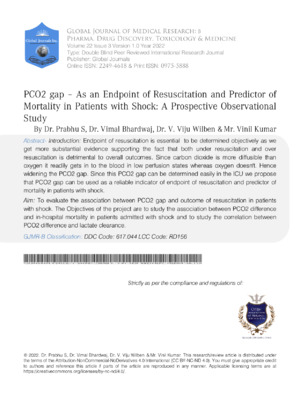
Pco2 Gap – As an Endpoint of Resuscitation and Predictor of Mortality in Patients With Shock: A Prospective Observational Study

α
Dr. Prabhu S
Dr. Prabhu S
σ
Dr. Vimal Bhardwaj
Dr. Vimal Bhardwaj
ρ
Dr. V. Viju Wilben
Dr. V. Viju Wilben

Send Message

To: Author

Pco2 Gap – As an Endpoint of Resuscitation and Predictor of Mortality in Patients With Shock: A Prospective Observational Study

Article Fingerprint

ReserarchID

PDDTMM48U3

Pco2 Gap – As an Endpoint of Resuscitation and Predictor of Mortality in Patients With Shock: A Prospective Observational Study Banner

AI TAKEAWAY

Connecting with the Eternal Ground
  • English
  • Afrikaans
  • Albanian
  • Amharic
  • Arabic
  • Armenian
  • Azerbaijani
  • Basque
  • Belarusian
  • Bengali
  • Bosnian
  • Bulgarian
  • Catalan
  • Cebuano
  • Chichewa
  • Chinese (Simplified)
  • Chinese (Traditional)
  • Corsican
  • Croatian
  • Czech
  • Danish
  • Dutch
  • Esperanto
  • Estonian
  • Filipino
  • Finnish
  • French
  • Frisian
  • Galician
  • Georgian
  • German
  • Greek
  • Gujarati
  • Haitian Creole
  • Hausa
  • Hawaiian
  • Hebrew
  • Hindi
  • Hmong
  • Hungarian
  • Icelandic
  • Igbo
  • Indonesian
  • Irish
  • Italian
  • Japanese
  • Javanese
  • Kannada
  • Kazakh
  • Khmer
  • Korean
  • Kurdish (Kurmanji)
  • Kyrgyz
  • Lao
  • Latin
  • Latvian
  • Lithuanian
  • Luxembourgish
  • Macedonian
  • Malagasy
  • Malay
  • Malayalam
  • Maltese
  • Maori
  • Marathi
  • Mongolian
  • Myanmar (Burmese)
  • Nepali
  • Norwegian
  • Pashto
  • Persian
  • Polish
  • Portuguese
  • Punjabi
  • Romanian
  • Russian
  • Samoan
  • Scots Gaelic
  • Serbian
  • Sesotho
  • Shona
  • Sindhi
  • Sinhala
  • Slovak
  • Slovenian
  • Somali
  • Spanish
  • Sundanese
  • Swahili
  • Swedish
  • Tajik
  • Tamil
  • Telugu
  • Thai
  • Turkish
  • Ukrainian
  • Urdu
  • Uzbek
  • Vietnamese
  • Welsh
  • Xhosa
  • Yiddish
  • Yoruba
  • Zulu

References

25 Cites in Article
  1. Jean-Louis Vincent,Daniel De Backer (2013). Circulatory Shock.
  2. Angela Acheampong,Jean-Louis Vincent (2015). A positive fluid balance is an independent prognostic factor in patients with sepsis.
  3. John Boyd,Jason Forbes,Taka-Aki Nakada,Keith Walley,James Russell (2011). Fluid resuscitation in septic shock: A positive fluid balance and elevated central venous pressure are associated with increased mortality*.
  4. Yasser Sakr,Paolo Rubatto Birri,Katarzyna Kotfis,Rahul Nanchal,Bhagyesh Shah,Stefan Kluge,Mary Schroeder,John Marshall,Jean-Louis Vincent (2017). Higher Fluid Balance Increases the Risk of Death From Sepsis: Results From a Large International Audit*.
  5. M Varpula,S Karlsson,E Ruokonen,V Pettila (2006). Mixed venous oxygen saturation cannot be estimated by central venous oxygen saturation in septic shock.
  6. Paul Van Beest,Jorrit Hofstra,Marcus Schultz,E Boerma,Peter Spronk,Michael Kuiper (2008). The incidence of low venous oxygen saturation on admission to the intensive care unit: a multi-center observational study in The Netherlands.
  7. C Ince,M Sinaasappel (1999). Microcirculatory oxygenation and shunting in sepsis and shock.
  8. Ryan Arnold,Nathan Shapiro,Alan Jones,Christa Schorr,Jennifer Pope,Elisabeth Casner,Joseph Parrillo,R Dellinger,Stephen Trzeciak (2008). Multi-Center Study of Early Lactate Clearance as a Determinant of Survival in Patients with Presumed Sepsis.
  9. Jeffrey Kraut,Nicolaos Madias (2014). Lactic Acidosis.
  10. Paul Van Beest,Mariska Lont,Nicole Holman,Bert Loef,Michaël Kuiper,E Boerma (2013). Central venous-arterial pCO2 difference as a tool in resuscitation of septic patients.
  11. B Vallet,M Pinsky,M Cecconi (2013). Resuscitation of patients with septic shock: please “mind the gap”!.
  12. Benoit Vallet,Jean-Louis Teboul,Stephen Cain,Scott Curtis (2000). Venoarterial CO<sub>2</sub> difference during regional ischemic or hypoxic hypoxia.
  13. J Cuschieri,E Rivers,M Donnino,M Katilius,G Jacobsen,H Nguyen,N Pamukov,H Horst (2005). Central venous-arterial carbon dioxide difference as an indicator of cardiac index.
  14. Fabrice Vallée,Benoit Vallet,Olivier Mathe,Jacqueline Parraguette,Arnaud Mari,Stein Silva,Kamran Samii,Olivier Fourcade,Michèle Genestal (2008). Central venous-to-arterial carbon dioxide difference: an additional target for goal-directed therapy in septic shock?.
  15. Max Weil,Abdelmonen Afifi (1970). Experimental and Clinical Studies on Lactate and Pyruvate as Indicators of the Severity of Acute Circulatory Failure (Shock).
  16. Tim Jansen,Jasper Van Bommel,F Schoonderbeek,Steven Sleeswijk Visser,Johan Van Der Klooster,Alex Lima,Sten Willemsen,Jan Bakker (2010). Early Lactate-Guided Therapy in Intensive Care Unit Patients.
  17. Alan Jones,N Shapiro,S Trzeciak (2010). Lactate Clearance vs Central Venous Oxygen Saturation as Goals of Early Sepsis Therapy<subtitle>A Randomized Clinical Trial</subtitle>.
  18. Glenn Hernandez,Ricardo Castro,Carlos Romero,Claudio De La Hoz,Daniela Angulo,Ignacio Aranguiz,Jorge Larrondo,Andres Bujes,Alejandro Bruhn (2011). Persistent sepsis-induced hypotension without hyperlactatemia: Is it really septic shock?.
  19. Jihad Mallat,Malcolm Lemyze,Mehdi Meddour,Florent Pepy,Gaelle Gasan,Stephanie Barrailler,Emmanuelle Durville,Johanna Temime,Nicolas Vangrunderbeeck,Laurent Tronchon,Benoît Vallet,Didier Thevenin (2016). Ratios of central venous-to-arterial carbon dioxide content or tension to arteriovenous oxygen content are better markers of global anaerobic metabolism than lactate in septic shock patients.
  20. J West (1990). Gas transport to the periphery: how gases are moved to the peripheral tissues.
  21. X.-G Sun,J Hansen,H Ting (2000). Comparison of exercise cardiac output by the fick principle using oxygen and carbon dioxide.
  22. Max Weil,Eric Rackow,Robert Trevino,William Grundler,Jay Falk,Martin Griffel (1986). Difference in Acid-Base State between Venous and Arterial Blood during Cardiopulmonary Resuscitation.
  23. J Ducey,J Lamiell,G Gueller (1992). Arterial-venous carbon dioxide tension difference during severe hemorrhage and resuscitation.
  24. Gustavo Ospina-Tascón,Diego Bautista-Rincón,Mauricio Umaña,José Tafur,Alejandro Gutiérrez,Alberto García,William Bermúdez,Marcela Granados,César Arango-Dávila,Glenn Hernández (2013). Persistently high venous-to-arterial carbon dioxide differences during early resuscitation are associated with poor outcomes in septic shock.
  25. S Madabhushi,A Trikha,R Anand,R Ramachandran,P Singh,V Rewari (2021). Temporal Evolution of the PcvCO2-PaCO2/CaO2-CcvO2 Ratio vs Serum Lactate during Resuscitation in Septic Shock.

Funding

No external funding was declared for this work.

Conflict of Interest

The authors declare no conflict of interest.

Ethical Approval

No ethics committee approval was required for this article type.

Data Availability

Not applicable for this article.

How to Cite This Article

Dr. Prabhu S. 2026. \u201cPco2 Gap – As an Endpoint of Resuscitation and Predictor of Mortality in Patients With Shock: A Prospective Observational Study\u201d. Global Journal of Medical Research - B: Pharma, Drug Discovery, Toxicology & Medicine GJMR-B Volume 22 (GJMR Volume 22 Issue B3): .

Download Citation

Resuscitation and mortality prediction in shock patients for clinical insights.
Journal Specifications

Crossref Journal DOI 10.17406/gjmra

Print ISSN 0975-5888

e-ISSN 2249-4618

Keywords
Classification
GJMR-B Classification: DDC Code: 617.044 LCC Code: RD156
Version of record

v1.2

Issue date

February 11, 2023

Language
en
Experiance in AR

Explore published articles in an immersive Augmented Reality environment. Our platform converts research papers into interactive 3D books, allowing readers to view and interact with content using AR and VR compatible devices.

Read in 3D

Your published article is automatically converted into a realistic 3D book. Flip through pages and read research papers in a more engaging and interactive format.

Article Matrices
Total Views: 1327
Total Downloads: 45
2026 Trends
Related Research

Published Article

Abstract not found

Our website is actively being updated, and changes may occur frequently. Please clear your browser cache if needed. For feedback or error reporting, please email [email protected]

Request Access

Please fill out the form below to request access to this research paper. Your request will be reviewed by the editorial or author team.
X

Quote and Order Details

Contact Person

Invoice Address

Notes or Comments

This is the heading

Lorem ipsum dolor sit amet, consectetur adipiscing elit. Ut elit tellus, luctus nec ullamcorper mattis, pulvinar dapibus leo.

High-quality academic research articles on global topics and journals.

Pco2 Gap – As an Endpoint of Resuscitation and Predictor of Mortality in Patients With Shock: A Prospective Observational Study

Dr. Prabhu S
Dr. Prabhu S
Dr. Vimal Bhardwaj
Dr. Vimal Bhardwaj
Dr. V. Viju Wilben
Dr. V. Viju Wilben

Research Journals