Peculiarities of UAV Construction for Flights at High Altitudes

α
Onishchenko Alexander Andreevich
α State University "Kyiv Aviation Institute" State University "Kyiv Aviation Institute"

Send Message

To: Author

Peculiarities of UAV Construction for Flights at High Altitudes

Article Fingerprint

ReserarchID

525FW

Peculiarities of UAV Construction for Flights at High Altitudes Banner

AI TAKEAWAY

Connecting with the Eternal Ground
  • English
  • Afrikaans
  • Albanian
  • Amharic
  • Arabic
  • Armenian
  • Azerbaijani
  • Basque
  • Belarusian
  • Bengali
  • Bosnian
  • Bulgarian
  • Catalan
  • Cebuano
  • Chichewa
  • Chinese (Simplified)
  • Chinese (Traditional)
  • Corsican
  • Croatian
  • Czech
  • Danish
  • Dutch
  • Esperanto
  • Estonian
  • Filipino
  • Finnish
  • French
  • Frisian
  • Galician
  • Georgian
  • German
  • Greek
  • Gujarati
  • Haitian Creole
  • Hausa
  • Hawaiian
  • Hebrew
  • Hindi
  • Hmong
  • Hungarian
  • Icelandic
  • Igbo
  • Indonesian
  • Irish
  • Italian
  • Japanese
  • Javanese
  • Kannada
  • Kazakh
  • Khmer
  • Korean
  • Kurdish (Kurmanji)
  • Kyrgyz
  • Lao
  • Latin
  • Latvian
  • Lithuanian
  • Luxembourgish
  • Macedonian
  • Malagasy
  • Malay
  • Malayalam
  • Maltese
  • Maori
  • Marathi
  • Mongolian
  • Myanmar (Burmese)
  • Nepali
  • Norwegian
  • Pashto
  • Persian
  • Polish
  • Portuguese
  • Punjabi
  • Romanian
  • Russian
  • Samoan
  • Scots Gaelic
  • Serbian
  • Sesotho
  • Shona
  • Sindhi
  • Sinhala
  • Slovak
  • Slovenian
  • Somali
  • Spanish
  • Sundanese
  • Swahili
  • Swedish
  • Tajik
  • Tamil
  • Telugu
  • Thai
  • Turkish
  • Ukrainian
  • Urdu
  • Uzbek
  • Vietnamese
  • Welsh
  • Xhosa
  • Yiddish
  • Yoruba
  • Zulu

Abstract

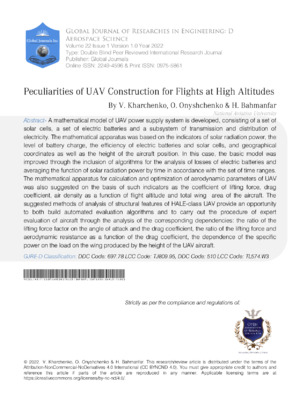
A mathematical model of UAV power supply system is developed, consisting of a set of solar cells, a set of electric batteries and a subsystem of transmission and distribution of electricity. The mathematical apparatus was based on the indicators of solar radiation power, the level of battery charge, the efficiency of electric batteries and solar cells, and geographical coordinates as well as the height of the aircraft position. In this case, the basic model was improved through the inclusion of algorithms for the analysis of losses of electric batteries and averaging the function of solar radiation power by time in accordance with the set of time ranges. The mathematical apparatus for calculation and optimization of aerodynamic parameters of UAV was also suggested on the basis of such indicators as the coefficient of lifting force, drag coefficient, air density as a function of flight altitude and total wing area of the aircraft. The suggested methods of analysis of structural features of HALE-class UAV provide an opportunity to both build automated evaluation algorithms and to carry out the procedure of expert evaluation of aircraft through the analysis of the corresponding dependencies: the ratio of the lifting force factor on the angle of attack and the drag coefficient, the ratio of the lifting force and aerodynamic resistance as a function of the drag coefficient, the dependence of the specific power on the load on the wing produced by the height of the UAV aircraft.

References

23 Cites in Article
  1. Andrea Gilli,Mauro Gilli (2018). Emerging Technologies: Unmanned Aerial Vehicles.
  2. (2016). Unmanned Aerial Vehicles for Military Applications.
  3. R Mink (2020). Unmanned Aerial Vehicles.
  4. Kamesh Namuduri,Damien Sauveron (null). Safety, Security, and Privacy Aspects in UAV Networks.
  5. Gabriel Militaru,Dan Popescu,Loretta Ichim (2019). UAV to Satellite Communication Systems.
  6. Keeryun Kang,J Prasad,Eric Johnson (2016). Active Control of a UAV Helicopter with a Slung Load for Precision Airborne Cargo Delivery.
  7. Hongliang Zhang,Lingyang Song,Zhu Han (2020). Unmanned Aerial Vehicle Applications over Cellular Networks for 5G and Beyond.
  8. Kamran Ahmad,Hammad Rahman (2012). Flutter Analysis of X-HALE UAV-A Test Bed for Aeroelastic Results Validation.
  9. M Lee,C Cho,S Jang (2010). HALE UAV Composite Wing Structure Design.
  10. Mohammadreza Tarihi,Mohammad Mahdinejad Noori,Mohammadhossein Madani (2020). Improving the Performance of HALE UAV Communication Link Through MIMO Cooperative Relay Strategy.
  11. Kamran Ahmad,Hammad Rahman (2012). Flutter Analysis of X-HALE UAV-A Test Bed for Aeroelastic Results Validation.
  12. R Furfaro,B Ganapol,L Johnson,S Herwitz (2005). Model-based neural network algorithm for coffee ripeness prediction using Helios UAV aerial images.
  13. G Romeo,G Frulla (1084). Heliplat®: high altitude very-long endurance solar powered UAV for telecommunication and Earth observation applications.
  14. Christopher Brooke,Ben Clutterbuck (2019). Mapping Heterogeneous Buried Archaeological Features Using Multisensor Data from Unmanned Aerial Vehicles.
  15. Andrew Klesh,Pierre Kabamba (2009). Solar-Powered Aircraft: Energy-Optimal Path Planning and Perpetual Endurance.
  16. Gao Xian‐zhong,Hou Zhong‐xi,Guo Zheng,Zhu Xiong‐feng,Liu Jian‐xia,Chen Xiao‐qian (2013). Parameters determination for concept design of solar‐powered, high‐altitude long‐endurance UAV.
  17. Xiao Liu,Shu Li,Yao Tang (2015). Fuel System Configuration and Restructuring of MALE and HALE UAV.
  18. Hoyon Hwang,Jaeyoung Cha,Jon Ahn (2019). Solar UAV design framework for a HALE flight.
  19. Tanisha Joshi,Jay Dhameliya,Tanvi Prakash,Sohrab Mistri,Chandra Yerramalli,Anirban Guha,Rajkumar Pant (2019). Conceptual Design and Sizing of a Wing-Tip Extension Mechanism for HALE UAV.
  20. Jaw-Kuen Shiau,Der-Ming Ma,Chih-Wei Chiu,Jie-Ren Shie (2010). Optimal Sizing and Cruise Speed Determination for a Solar-Powered Airplane.
  21. G Romeo,G Frulla,E Cestino (2007). Design of a High-Altitude Long-Endurance Solar-Powered Unmanned Air Vehicle for Multi-Payload and Operations.
  22. J Shiau,D Ma,P Yang,C Wang (2009). Design of a solar power management system for an experimental UAV.
  23. Andrew Klesh,Pierre Kabamba (2009). Solar-Powered Aircraft: Energy-Optimal Path Planning and Perpetual Endurance.

Funding

No external funding was declared for this work.

Conflict of Interest

The authors declare no conflict of interest.

Ethical Approval

No ethics committee approval was required for this article type.

Data Availability

Not applicable for this article.

How to Cite This Article

Onishchenko Alexander Andreevich. 2026. \u201cPeculiarities of UAV Construction for Flights at High Altitudes\u201d. Global Journal of Research in Engineering - D: Aerospace Science GJRE-D Volume 22 (GJRE Volume 22 Issue D1): .

Download Citation

Alt text: Academic article on UAV construction at high altitudes, focusing on engineering and aerospace research.
Journal Specifications

Crossref Journal DOI 10.17406/gjre

Print ISSN 0975-5861

e-ISSN 2249-4596

Keywords
Classification
GJRE-D Classification: DDC Code: 697.78 LCC Code: TJ809.95, DDC Code: 510 LCC Code: TL574.W3
Version of record

v1.2

Issue date

June 18, 2022

Language
en
Experiance in AR

Explore published articles in an immersive Augmented Reality environment. Our platform converts research papers into interactive 3D books, allowing readers to view and interact with content using AR and VR compatible devices.

Read in 3D

Your published article is automatically converted into a realistic 3D book. Flip through pages and read research papers in a more engaging and interactive format.

Article Matrices
Total Views: 1692
Total Downloads: 36
2026 Trends
Related Research

Published Article

A mathematical model of UAV power supply system is developed, consisting of a set of solar cells, a set of electric batteries and a subsystem of transmission and distribution of electricity. The mathematical apparatus was based on the indicators of solar radiation power, the level of battery charge, the efficiency of electric batteries and solar cells, and geographical coordinates as well as the height of the aircraft position. In this case, the basic model was improved through the inclusion of algorithms for the analysis of losses of electric batteries and averaging the function of solar radiation power by time in accordance with the set of time ranges. The mathematical apparatus for calculation and optimization of aerodynamic parameters of UAV was also suggested on the basis of such indicators as the coefficient of lifting force, drag coefficient, air density as a function of flight altitude and total wing area of the aircraft. The suggested methods of analysis of structural features of HALE-class UAV provide an opportunity to both build automated evaluation algorithms and to carry out the procedure of expert evaluation of aircraft through the analysis of the corresponding dependencies: the ratio of the lifting force factor on the angle of attack and the drag coefficient, the ratio of the lifting force and aerodynamic resistance as a function of the drag coefficient, the dependence of the specific power on the load on the wing produced by the height of the UAV aircraft.

Our website is actively being updated, and changes may occur frequently. Please clear your browser cache if needed. For feedback or error reporting, please email [email protected]

Request Access

Please fill out the form below to request access to this research paper. Your request will be reviewed by the editorial or author team.
X

Quote and Order Details

Contact Person

Invoice Address

Notes or Comments

This is the heading

Lorem ipsum dolor sit amet, consectetur adipiscing elit. Ut elit tellus, luctus nec ullamcorper mattis, pulvinar dapibus leo.

High-quality academic research articles on global topics and journals.

Peculiarities of UAV Construction for Flights at High Altitudes

Onishchenko Alexander Andreevich
Onishchenko Alexander Andreevich State University "Kyiv Aviation Institute"

Research Journals