





1. Introduction
In Bangladesh, land is not only considered the source of livelihood but also defines social class, position, political power, and legal activities. The wealthy elite class accumulates land for speculation and commercialization of agriculture while alienating the rural poor and small farmers, leaving them landless. Marginalized people like Rural, indigenous, and women in Bangladesh struggle with bureaucratic barriers, patriarchal norms, and forced evictions, particularly from khas land1.
Bangladesh is one of the most densely populated countries, where 1119 people live per square kilometer, and 40 lakh families are still landless (Bangladesh Bureau of Statistics, 2024). Although the Bangladesh Constitution identified land rights as fundamental in Articles 42, 13, and 27, the reality remains grim for these vulnerable populations. Land distribution in Bangladesh has a long history. During British rule, landlords called zamindars got legal rights to land, while poor farmers lost control over the land they worked. This system stayed even after independence. After 1971, the state introduced land reform to reduce inequality by giving surplus land held by large landowners to the landless. The goal was to support poor peasants and freedom fighters. However, due to weak enforcement, corruption, and the social power of elites, most of the land stayed with the rich. The poor remained landless, especially rural farmers, women, and lower-caste groups. This deepened class divisions and reinforced social inequality in villages. This historical exclusion led to land inequality, weak land reforms, and power imbalances, and continues to present conditions limiting the rights of the marginalized communities. Moreover, systemic corruption in land administration, inadequate land policy reforms, and political interference have long impeded efforts to address landlessness meaningfully. Bangladesh also struggles to meet its land SDG (15)2 targets due to deforestation, urbanization, and weak policy enforcement (I, 2025).
In addition to socio-political barriers, marginalized communities also face religious, cultural and gender-specific challenges in accessing land rights. Women, despite playing a central role in agricultural production, frequently face discrimination when it comes to land ownership. Patriarchal norms, religious bindings, inheritance laws, social norms and the lack of legal awareness among women contribute to their systemic exclusion from land ownership. Similarly, indigenous communities continue to face encroachment on their ancestral lands, with insufficient protection from the government.
This article intends to explore the intricate challenges of land rights in Bangladesh, examining the socio-political, legal, and cultural dimensions that perpetuate landlessness. Through a policy analysis, the paper will highlight the need for reforms in policy, land governance, and legal systems to ensure a more inclusive and equitable distribution of land in the country.
2. Objectives
This article seeks to explore the ongoing struggles of these marginalized communities in securing land rights through a socio-economic lens. By examining the historical context, power dynamics, and the role of social movements, this analysis will shed light on the persistent challenges faced by these groups and the implications for social justice in Bangladesh. Additionally, this article will evaluate the existing legal and policy frameworks, identifying gaps and opportunities for reform that could pave the way for a more equitable distribution of land and resources. The basic objectives of this articles are:
To analyze the contemporary challenges faced by marginalized communities in Bangladesh in securing land rights.
To evaluate the effectiveness of existing legal and policy frameworks in addressing land rights issues and propose actionable solutions to enhance land security for marginalized communities.
3. Historical Context of Land Rights in Bangladesh
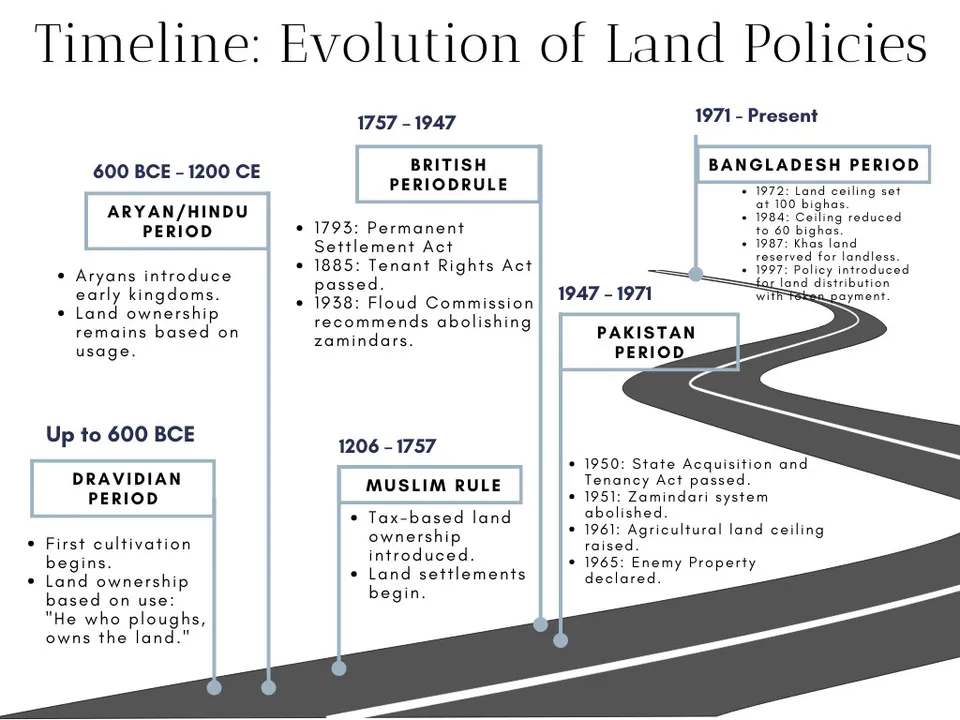
3.1. Pre-Buddhist and Early Kingdoms
Before the Aryan people, early Bengal had no kingdoms or states; society was in forms of clans based on blood relationships (Hasnat et al., 2018). The Aryan people were communal, with tribes practicing agriculture and managing land collectively.
They had to clear the land by cutting down bushes and trees before using it for farming (Alam, 2018). Land was considered a shared resource, and there was no concept of private ownership (Hasnat et al., 2018). Tribalism3 dominated the social structure in the pre-classical era. Communities had a hierarchy with clan chiefs or headmen acting as the authority figures over land distribution. This period reflects how land served as a key resource for survival, with minimal social conflict over ownership due to communal use.
3.1.1. Mauryan Empire
Under the Mauryan empire, especially during the era of Emperor Ashoka, Bengal was integrated into one of the first significant empires of the Indian subcontinent. This period marked the beginning of centralized governance and the formal administration of land. The mainstream economic sources of this period were Land revenue systems (Bhaga and Shita) where farmers were required to pay land taxes (one-sixth and one fifth of the agricultural production) to the state (Rajakumara., 2021). This move toward land taxation created a system where land began to be viewed as an economic resource.
Kautilya’s Arthashastra4 was the first to categorize land into state land and private land, offering insights into land governance during the Maurya Empire (Bhattacharya, 1979). It detailed how land was surveyed, classified, and taxed according to its agricultural productivity. This period was the beginning of the stratification of land ownership in Bengal, as land became a source of revenue for the ruling and their tenants.
3.1.2. Gupta Empire
During the Gupta period, land ownership became more hierarchical. The Gupta rulers granted large tracts of land to Brahmins, royal officials or religious institutions as tax-free grants called ‘agrahara’5 (Singh & Hashmi, 2022). These grants created an elite class of landlords who controlled significant portions of agricultural land, thus marginalizing the peasants. This period represents the emergence of class structures based on land ownership, where the ruling class (landowners and elites) exploited the surplus labor of the peasantry. The caste system began to intertwine with land ownership, where higher castes, especially Brahmins, controlled land, while the lower castes worked. This laid the groundwork for feudalism, where social stratification was tied to land tenure and ownership.
3.1.3. Pala Dynasty
The Pala dynasty, which ruled over Bengal and Bihar, marked a period of relative prosperity and the expansion of agriculture. Rulers employed land officials like the Kestrapa (head of land use division) and Pramtr (head of land measurements) to ensure efficient agricultural production and revenue collection (M. Singh, 2024). But Land grants continued to be made to Buddhist monasteries and temples, creating large estates owned by religious institutions. The theocratic feudalism system became more entrenched, where landlords and religious leaders controlled land, and peasants worked on these lands under obligations to pay taxes or share crops. The Pala rulers themselves were considered major landowners, with centralized control over vast territories.
3.1.4. Sena Dynasty
The Sena dynasty, which rose to power following the decline of the Pala Empire in Bengal, not only maintained but also deepened the existing feudal structure through strategic land grant practices. They were Hindus who further embedded the caste system into land distribution, with Brahmins receiving lands, while the lower castes continued to be landless peasants or tenants. This system helps in organizing production and establishing a centralized revenue collection.
3.2. Muslim Rule
3.2.1. Delhi Sultanate
Under the Delhi Sultanate, the Muslim rulers introduced the Iqta system (assignments of land; later known as jagirs during Mughal times) in Bengal, where land was granted to military officials and nobles in return for service (Islam & Bosworth, n.d.). This system was different from the earlier Hindu-based land grants where Brahmins were gifted land as a religious duty. Instead, under Islamic rule, land was seen as the property of the state, and the Iqtadars were simply managers or revenue collectors, not owners. They collected taxes from the peasants who worked the land but had to send a portion of the revenue back to the central government. This system changed the power structure in rural society. A new elite class emerged made up of military men and state officials who had political and economic control over land but were not rooted in the traditional caste system. While upper-caste Hindu landlords had dominated earlier, now Muslim rulers and nobles gained authority.
3.2.2. Mughal Rule
The Mughal Empire brought major changes to land administration in Bengal and other parts of the subcontinent. Two key systems were introduced during this time: the Mansabdari system and the Zamindari system. The empire organized land into a structured hierarchy of administrative units Subas (provinces), Sarkars (districts), Parganas (groups of villages), and Jagirs (land assignments to nobles and officials). These systems aimed to make revenue collection more efficient and centralized. The Zamindars6 under the Mughals were responsible for collecting taxes on behalf of the state, but unlike in earlier periods, they had some autonomy over the land they controlled.
Under Emperor Akbar, the Ain-i-Akbari7 codified the land revenue system, which was based on the agricultural production by tenants. The peasants were required to pay taxes, and the revenues contributed significantly to the Mughal treasury. Despite the more formalized approach to land management, peasants remained vulnerable to exploitation by landlords and tax collectors. The land-owning elite, whether Mughal nobles or Hindu Zamindars (landlords), maintained control over vast tracts of land. The patrimonialism of the Mughal state ensured that land remained concentrated in the hands of a few elites, while the rural population remained largely landless.
3.3. Colonial Legacy: Historical Land distribution During British Rule and Lingering effects
3.3.1. British Colonial Era
During British colonial rule in Bengal, the Permanent Settlement of 1793 introduced the Zamindari system, which changed rural society. The British gave land ownership to Zamindars (landlords) and made them responsible for collecting taxes from the peasants. This created a new class structure, where a few landowners held power, and most rural people became landless or poor tenants. Many peasants could not pay high taxes and were forced off their land, increasing landlessness and poverty.
The system promoted agrarian capitalism, as Zamindars focused on profits from cash crops like indigo and jute. Peasants had little control and faced exploitation. In response, they began to resist, leading to movements like the Indigo Revolt and the Tebhaga Movement8.
3.3.2. Pakistan Period
During the Pakistan period, land became a major issue in East Pakistan (now Bangladesh). After the 1947 Partition, a huge number of people migrated, from East Pakistan for India, and many Muslims migrated in from India. This sudden and large movement of people caused land conflicts. Muhajirs ( known as Refugees) were given land left behind by Hindus, but many of them did not get full legal rights to that land. This created uncertainty, tension, and competition over land ownership in rural and urban areas.
In 1950, the government passed the East Bengal State Acquisition and Tenancy Act, which officially ended the Zamindari system (Bangladesh on Record, 2022) [3]. The goal was to take land from big landlords and give it to the peasants who actually worked on it. But in practice, many large landowners kept control by using legal tricks or political connections. As a result, the class structure in rural areas did not change much, rich families still owned most of the land, and peasants remained poor and landless. The dissatisfaction with land policies was one of the factors that fueled political tensions between East and West Pakistan, as East Pakistan felt economically and politically marginalized. This discontent, combined with other social, political, and economic factors, contributed to the growing independence movement, eventually leading to the liberation of Bangladesh in 1971.
3.4. Post-Independence Reforms: Land Reforms and Their impact on Marginalized Communities
3.4.1. Post-Independence Era
After Bangladesh’s independence in 1971, land reforms were a critical part of the new government’s agenda, aimed at redistributing land more equitably. The newly formed state sought to dismantle the feudal legacies of the colonial period through a series of land reforms. One of the first significant steps was the Land Reform Ordinance of 1984, which set ceilings on land ownership and aimed to distribute excess land to the landless (Salauddin, 2005). This reform attempted to address the imbalance created during the colonial era by redistributing land to those without access, especially marginalized communities such as landless farmers and indigenous groups.
The neoliberal economic policies of the 1990s further complicated land reforms, as privatization and market liberalization favored landowners and large corporations. This led to a shift in agricultural land being used for industrial purposes, displacing marginalized communities and exacerbating landlessness. Today, land conflicts are frequent, and marginalized groups, including women and indigenous communities, continue to face severe challenges in securing land rights.
4. Findings Discussion
4.1. Contemporary Challenges of Marginalized Communities to Securing Land Rights
According to the Population and Housing Census 2022, 68.34% of Bangladesh’s population resides in rural areas, with 32.9% of them being landless and 29.5% owning less than 0.05 acres of land (10). In 2021-2022, approximately 87% of the rural population in Bangladesh was directly involved in agriculture, which contributed about 11.5% to the country’s GDP (Bangladesh Bureau of Statistics, 2023) [2]. Surprisingly, by November 2023, the government declared half of Bangladesh’s districts free of landless people, but evidence contradicts the claim of zero landlessness (Stand for Her Land Campaign, n.d.). The scarcity of land with high prices, combined with urbanization and industrialization, intensifies the problems of dysfunctional land administration and insecure land rights, leaving marginalized groups even more vulnerable.
The land administration system in Bangladesh is outdated, and mostly record processes are manual, which is actually very slow in the process. There are two main department to govern land administration in Bangladesh:
The Ministry of Lands governs the Land Appeal Board, Land Commission, Land Reform Board, Directorate General Land Record and Survey, Land Administration Training Centre, and Assistant Commissioner (Land) (Figure 2).
The Ministry of Law, Justice and Parliamentary affairs, Inspector General of Registry, District Registry Office and Sub Registry Office are responsible for changes in land ownership and taxation (Figure 2).
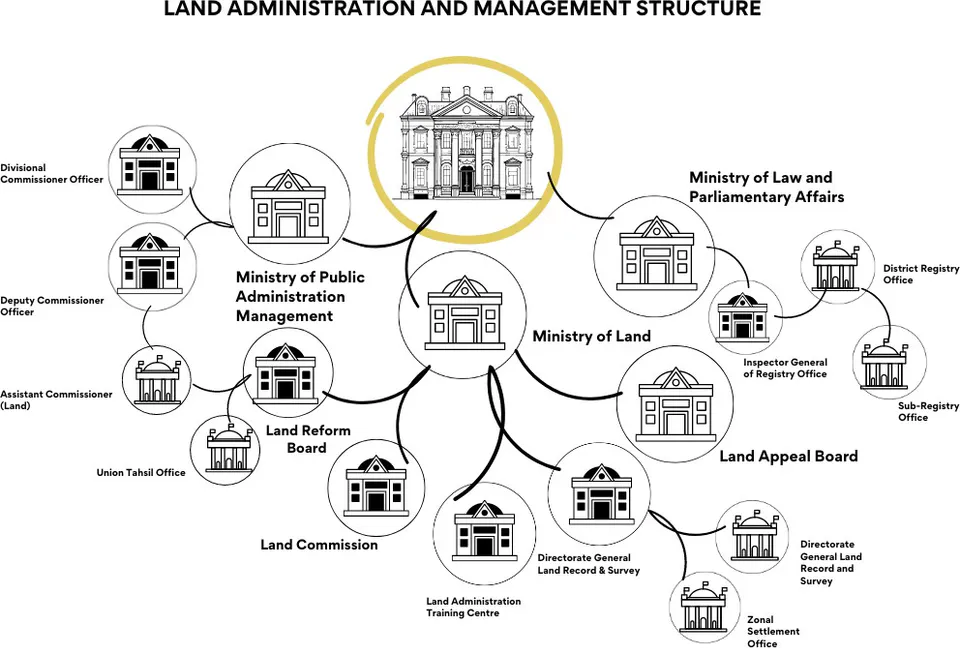
This complex and analogue land administration system with inadequate land is not easier for marginalized landless peoples to access land data and information. With a 74.66 literacy rate, people in rural areas are facing problems when they try to sell or buy any land. With the scarcity of land, according to population, and due to lack of proper anti-corruption monitoring, the land administration is full of corruption. According to a report, 44.9% of land administrative services are corrupted in the system. Most of the time, these corrupt officials are delayed in services, threaten to make their land paper faulty, pressurize them to bribe. & people who have money & power, are always dependent on this speed money practice to avoid chaos.
4.2. Why Land Policies Fail?
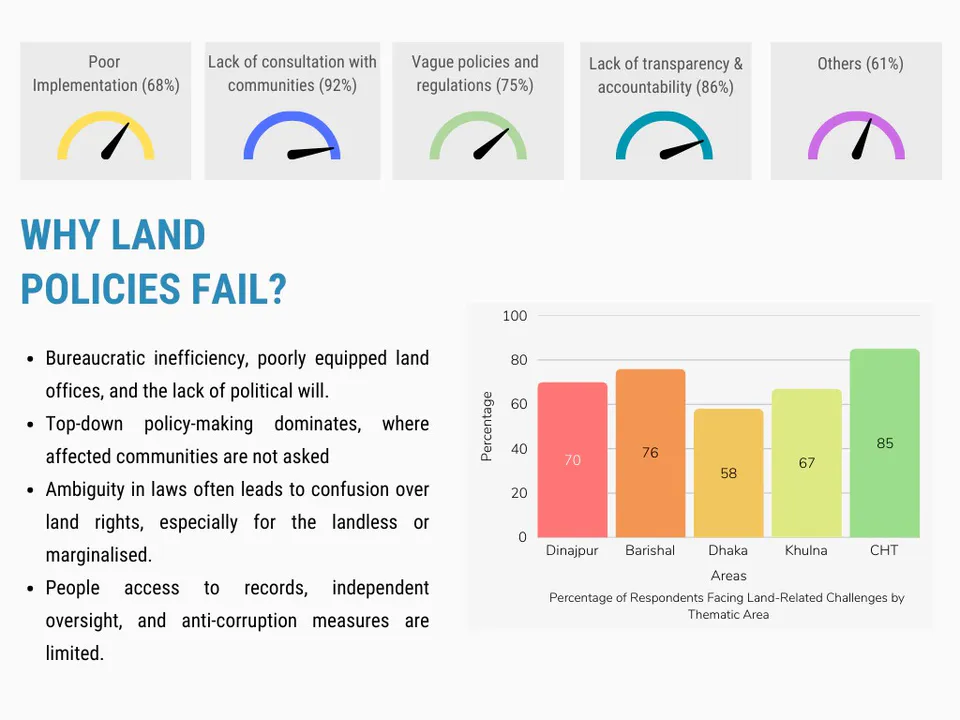
Many respondents identified poor implementation as the primary reason for land policy failure. While policies may exist on paper, they are rarely enforced effectively due to bureaucratic delays, lack of coordination among agencies, or insufficient resources. Another major concern is the lack of consultation with communities, which creates a top-down approach that alienates the very people the policies aim to serve. Unclear rules and regulations were also cited, as overlapping mandates and legal ambiguities create confusion over land ownership and rights. Furthermore, the lack of transparency and accountability in how land decisions are made and enforced undermines trust and fosters perceptions of corruption and favoritism. Together, these issues reveal deep governance gaps and the need for more inclusive, transparent, and enforceable land policy frameworks.
4.3. Priority Groups for Land Policies
Survey findings highlight a strong consensus that land policies in Bangladesh must prioritize historically marginalized and underserved populations. Among respondents, the most frequently identified priority groups were:
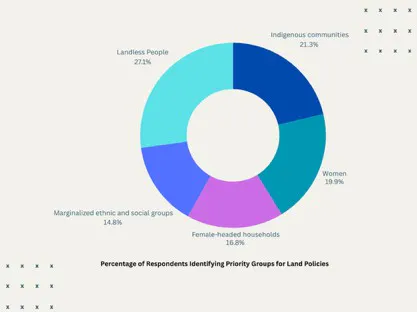
This pie chart clearly indicates that stakeholders recognize deep-rooted structural inequalities in land access and ownership. These findings are consistent with secondary data, such as the FAO’s Land Tenure Guidelines (Food and Agriculture Organization of the United Nations [FAO], 2012), which stress the importance of protecting vulnerable populations, particularly women and indigenous peoples, in land governance. According to a World Bank study 2020 (World Bank, 2020) [16], only 9.5% of women in Bangladesh legally own land, despite playing a critical role in agriculture and household livelihoods. Similarly, the Chittagong Hill Tracts Commission has reported continued encroachment and denial of customary land rights for indigenous communities.
Respondents in the survey emphasized that without explicit legal and institutional recognition, these populations will remain excluded from land ownership and benefit-sharing. The results call for equity-based policy frameworks, where land governance is designed not just to be neutral, but actively redistributive, addressing the social, gender, and ethnic disparities that have long persisted in Bangladesh’s land sector.
4.4. Who Do People Rely on Land Governance?
Findings from the survey reveal a clear preference for local civil society organizations (CSOs) and community leaders as trusted representatives in land-related decision-making. 44% of respondents expressed trust in local civil society organizations (CSOs), while 38% placed their confidence in community leaders. In stark contrast, only 22% trusted government agencies, and an even smaller proportion, just 29%, trusted political leaders to represent their interests. Additionally, 5% of respondents mentioned other actors, such as religious leaders and NGOs. These figures highlight a deep-rooted skepticism toward formal institutions and a preference for more grassroots, accessible, and responsive forms of representation in land governance.
These results suggest a significant trust gap between communities and formal state institutions. Respondents view CSOs and community leaders as more approachable, transparent, and grounded in community realities. In contrast, skepticism toward government bodies and political representatives points to a perceived lack of accountability, responsiveness, and inclusivity in official land governance structures.
This aligns with broader regional trends. A study by the Asian NGO Coalition (Asian NGO Coalition for Agrarian Reform and Rural Development [ANGOC], n.d.) found that grassroots actors play a critical role in advocating for land rights and often serve as intermediaries in resolving land conflicts. Similarly, Transparency International Bangladesh has repeatedly highlighted issues of corruption, bureaucratic delay, and elite capture within land administration systems, factors that erode public trust in state institutions.
The evidence underscores a critical need for land policies that formally recognize and incorporate community-based representation. Strengthening the role of CSOs, customary leaders, and other local actors could enhance the legitimacy, inclusiveness, and effectiveness of land governance frameworks in Bangladesh.
4.5. Features of a People-Centered Land Policy: What Communities Demand
The survey reveals a strong and consistent vision among respondents for what constitutes a truly people-centered land policy. These priorities highlight a desire for land governance systems that respect rights, foster equity, and are locally enforceable. Respondents emphasized that legal protections alone are insufficient unless they are translated into accessible language and implemented with mechanisms that ordinary citizens can use without fear or confusion.
This is echoed by the Voluntary Guidelines on the Responsible Governance of Tenure (VGGT), which emphasize that land tenure systems should recognize customary rights, support dispute resolution, and enable participation of all relevant stakeholders, especially vulnerable groups. A study by ILC Asia (International Land Coalition, n.d.) also found that countries with stronger participatory frameworks in land policy making have lower conflict rates and greater compliance at the grassroots level.
The message is clear: people-centered land policy must move beyond top-down legal frameworks. It must empower communities, respect local contexts, and include practical enforcement pathways that reduce barriers to justice and inclusion in land access.
4.6. Community Engagement in Policy Processes: A Call for Inclusive Governance
The survey reveals overwhelming support for meaningful, sustained community engagement in land policy development and implementation. It reflects a widespread belief that communities should not be passive recipients of policy decisions but active participants in shaping and evaluating land governance. Respondents repeatedly warned against tokenistic involvement, where community voices are solicited but ignored in actual decision-making. Instead, they envision institutionalized platforms where local knowledge and lived experience are integrated into policy cycles.
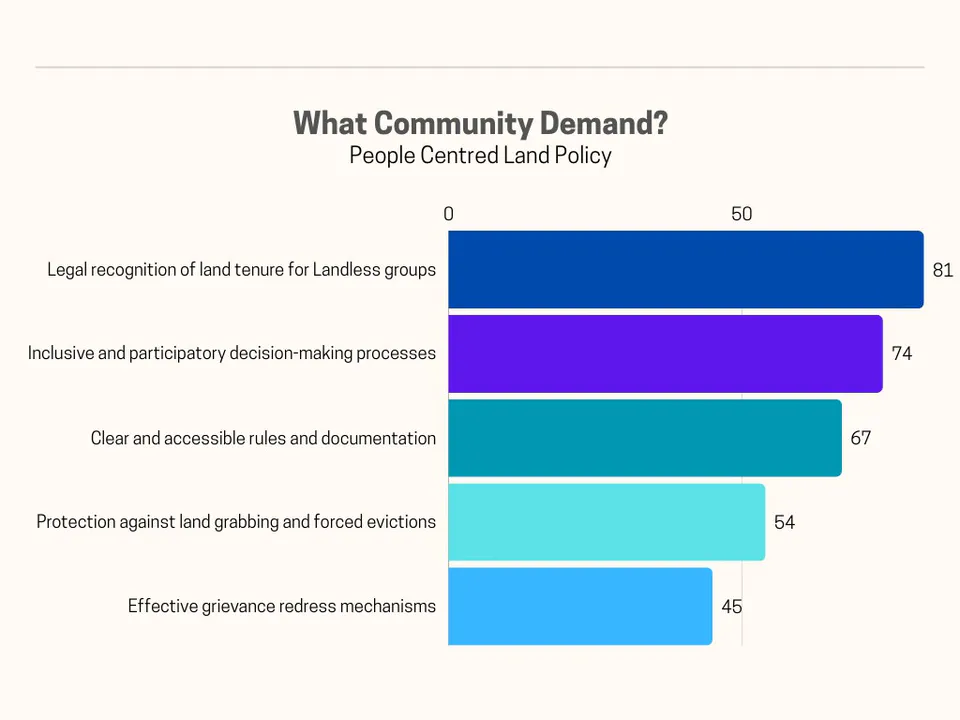
This aligns with best practices outlined in the FAO’s VGGT guidelines and supported by global research. According to the International Land Coalition (International Land Coalition, n.d.), participatory policy processes significantly increase legitimacy, compliance, and long-term success of land reforms. In countries like the Philippines and Nepal, structured engagement through multi-stakeholder platforms has proven effective in reducing land conflict and improving policy outcomes. The message from the ground is clear: Participation must be deliberate, structured, and continuous, not occasional or symbolic. A truly people-centered policy framework requires building trust-based mechanisms where communities are empowered as full partners in land governance.
4.7. Use of Technology in Land Governance
Respondents noted that technology has the potential to increase accountability, reduce corruption, and simplify bureaucratic procedures, long standing barriers to equitable land access. Tools like blockchain for land registries, mobile-based GIS mapping, and SMS alert systems for land-related updates were identified as promising innovations.
However, the enthusiasm was tempered by a strong caution: without deliberate efforts to ensure inclusion, such innovations may reinforce digital divides. This is especially relevant for rural communities, indigenous groups, and women who may face systemic exclusion from digital access. The World Bank’s 2023 Digital Development report confirms that in Bangladesh, only 26% of rural women regularly use digital services, compared to 48% of urban men, a gap that must be addressed in policy planning (World Bank, 2023) [17].
Respondents emphasized that any technological integration must be accompanied by digital literacy training, affordable access infrastructure, and community ownership of tools. When implemented equitably, technology can be a transformative force for justice and transparency in land governance.
5. Evaluation of Policy Effectiveness & Suggestions for Improvement
| No. | Policy / Law | Year | Key Articles / Sections | Discussion / Gaps |
|---|---|---|---|---|
| 1 | State Acquisition and Tenancy Act | 1950 | Various | Aimed to abolish the zamindari system and redistribute land to tenants. Implementation has been partial, with many tenants not receiving ownership rights. |
| 2 | East Bengal Tenancy Rules | 1955 | Various | Provided guidelines for tenancy rights. Enforcement has been inconsistent, leading to tenant insecurity. |
| 3 | Land Reform Policy | 1972 | Presidential Orders | Re-established land ceiling at 33.3 acres and aimed to distribute surplus land to the landless. Actual distribution fell short due to administrative challenges. |
| 4 | Land Development Tax Ordinance | 1976 | Ordinance No. XLII | Consolidated various land-related taxes. However, deficiencies in record systems hinder effective tax collection. |
| 5 | Acquisition and Requisition of Immovable Property Ordinance | 1982 | Ordinance No. II | Provided legal framework for land acquisition. Lacked comprehensive compensation and rehabilitation measures for affected persons. |
| 6 | Land Reform Ordinance | 1984 | Ordinance No. X | Limited future land acquisitions to 21 acres and recognized sharecroppers’ rights. Enforcement has been weak, and evasion remains common. |
| 7 | Cluster Village Program | 1988 | Government Initiative | Resettled landless people on state land. Limited in scale, benefiting only a small fraction of the landless population. |
| 8 | Land Administration Manual | 1991 | Manual | Provided instructions for land office operations. Implementation varies across regions, leading to administrative inefficiencies. |
| 9 | Non-Agricultural Khas Land Management and Settlement Policy | 1995 | Policy Document | Aimed to distribute non-agricultural khas land. Implementation faces challenges due to lack of updated land records. |
| 10 | Bangladesh Environment Conservation Act | 1995 | Act No. 1 | Focused on environmental conservation, including land use. Enforcement is limited, leading to continued environmental degradation. |
| 11 | Agricultural Khas Land Management and Settlement Policy | 1997 | Policy Document | Targeted distribution of agricultural khas land to the landless. Political influence and lack of transparency hinder effective distribution. |
| 12 | National Land Use Policy | 2001 | Policy Document | Aimed to regulate land use and prevent unplanned urbanization. Implementation is fragmented due to lack of coordination among agencies. |
| 13 | Vested Property Return Act | 2001 | Act No. 16 | Intended to return properties seized under the Vested Property Act. Bureaucratic delays and corruption impede restitution. |
| 14 | Restitution of Vested Property Act (Amendment) | 2002 | Act No. 33, 34 | Amended provisions for property restitution. Implementation remains slow and ineffective. |
| 15 | Balumhal and Soil Management Act | 2010 | Act | Regulated sand and soil extraction to prevent environmental degradation. Enforcement is weak, leading to continued illegal extraction. |
| 16 | National Economic Zone Act | 2010 | Act | Facilitated establishment of economic zones. Land acquisition for zones often leads to displacement without adequate rehabilitation. |
| 17 | Acquisition and Requisition of Immovable Property Act | 2017 | Act | Updated legal framework for land acquisition. Still lacks comprehensive measures for fair compensation and rehabilitation. |
| 18 | Land Appeal Board Ordinance | 1989 | Ordinance | Established a board to handle land disputes. Overburdened with cases, leading to delays in dispute resolution. |
| 19 | Land Reforms Board Ordinance | 1989 | Ordinance | Created to oversee land reform implementation. Limited authority and resources hinder effectiveness. |
| 20 | Waqf Ordinance | 1962 | Ordinance | Governed management of religious endowments. Lack of transparency and accountability in Waqf property management. |
| 21 | Easements Act | 1882 | Act | Provided rights for passage and water. Often overlooked in land development, leading to disputes. |
| 22 | Alluvion and Diluvion Regulation | 1825 | Regulation | Addressed land changes due to river movements. Outdated provisions fail to address current challenges. |
| 23 | Land Management Manual | 1991 | Manual | Offered guidelines for land administration. Implementation is inconsistent across regions. |
| 24 | Immovable Property Acquisition Manual | 1997 | Manual | Provided procedures for property acquisition. Lacks clarity on compensation and rehabilitation processes. |
| 25 | Land Zoning Policy | 2001 | Policy Document | Aimed to categorize land for specific uses. Enforcement is weak, leading to unplanned land use changes. |
| 26 | Digital Land Management System Initiatives | Ongoing | Government Projects | Efforts to digitize land records and services. Progress is slow, and digital divide affects accessibility. |
| 27 | Char Land Settlement Policy | Various | Policy Documents | Focused on settlement of riverine lands. Implementation is hindered by frequent land changes and lack of infrastructure. |
| 28 | Urban Khas Land Distribution Policy | Various | Policy Documents | Targeted distribution of urban khas land to the poor. Political interference and lack of transparency affect outcomes. |
| 29 | Land Survey and Record Modernization Projects | Ongoing | Government Projects | Aimed to update land records and maps. Delays and resource constraints impede progress. |
| 30 | Community-Based Land Management Initiatives | Various | NGO and Government Programs | Encouraged participatory land management. Success varies based on community engagement and support. |
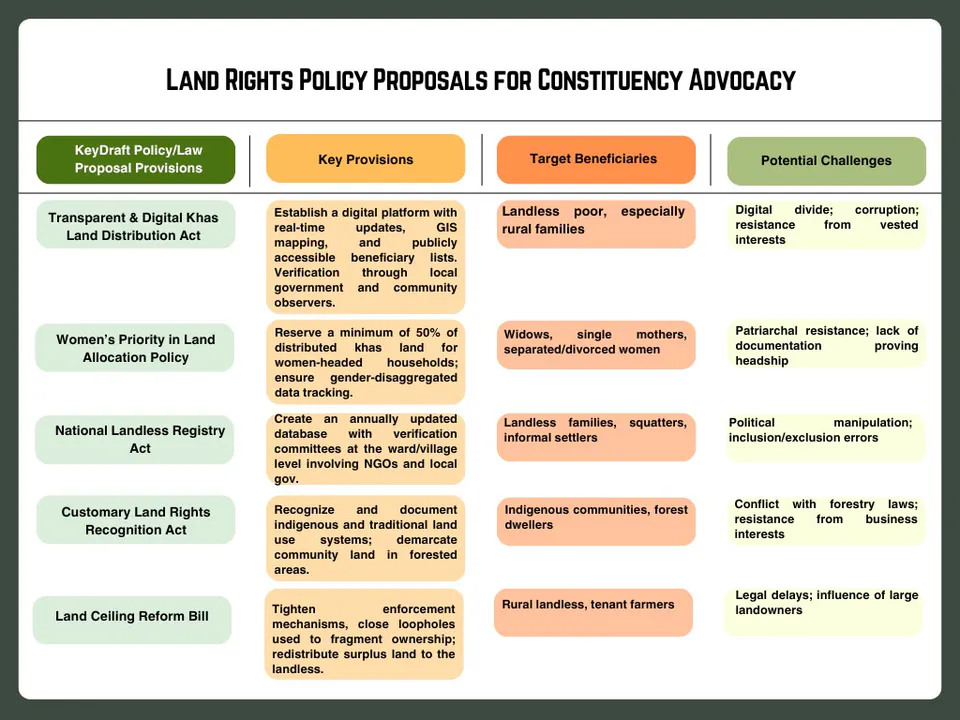
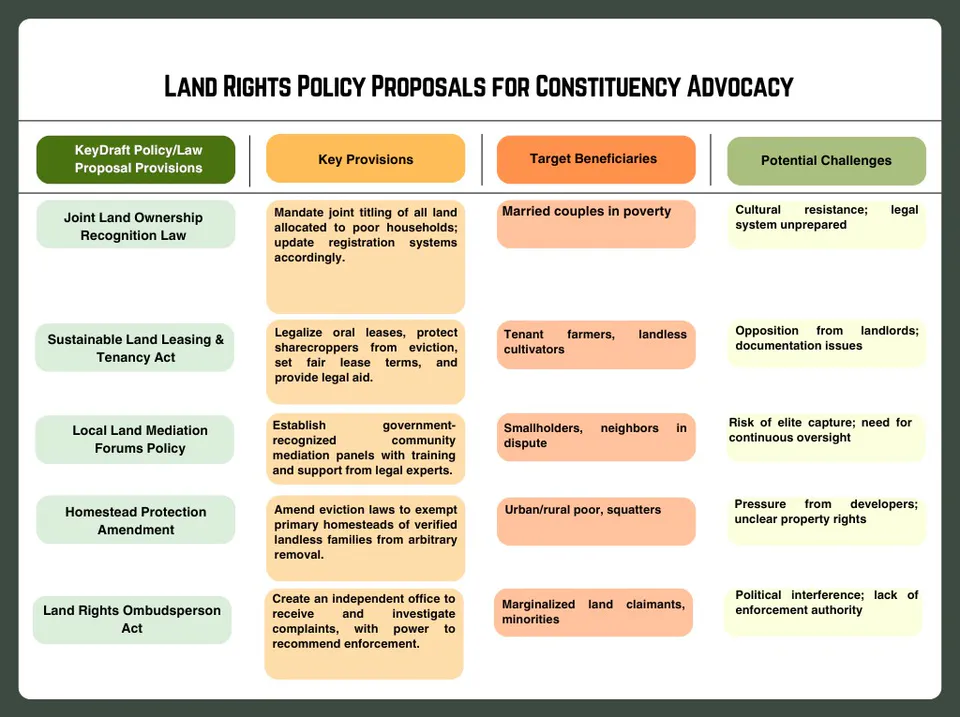
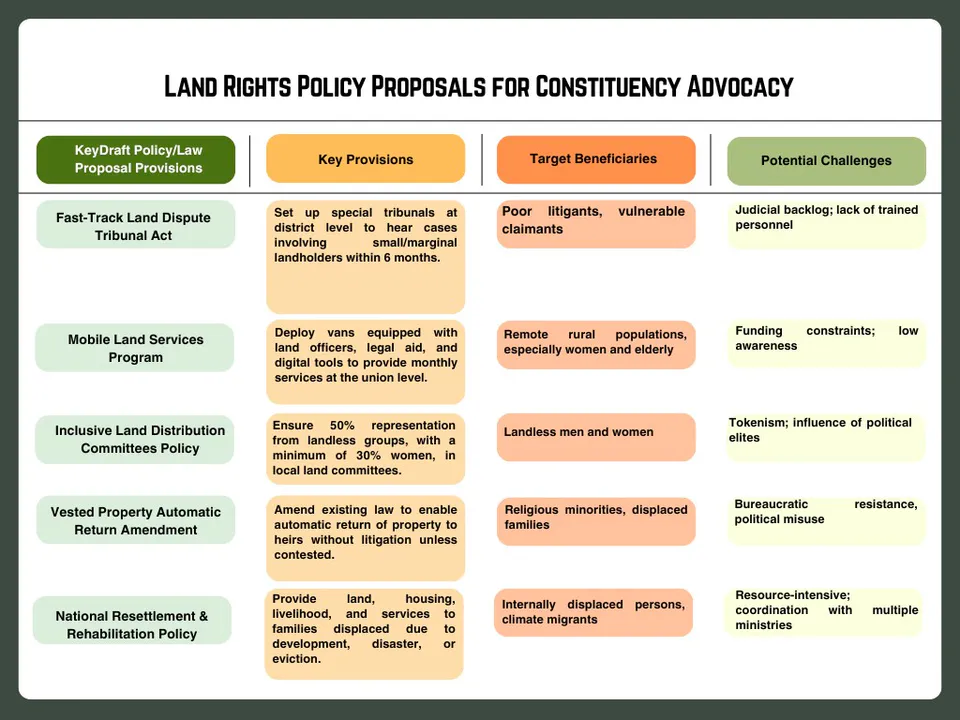
6. Inclusive Land Rights Policy Proposals for Constituency Advocacy
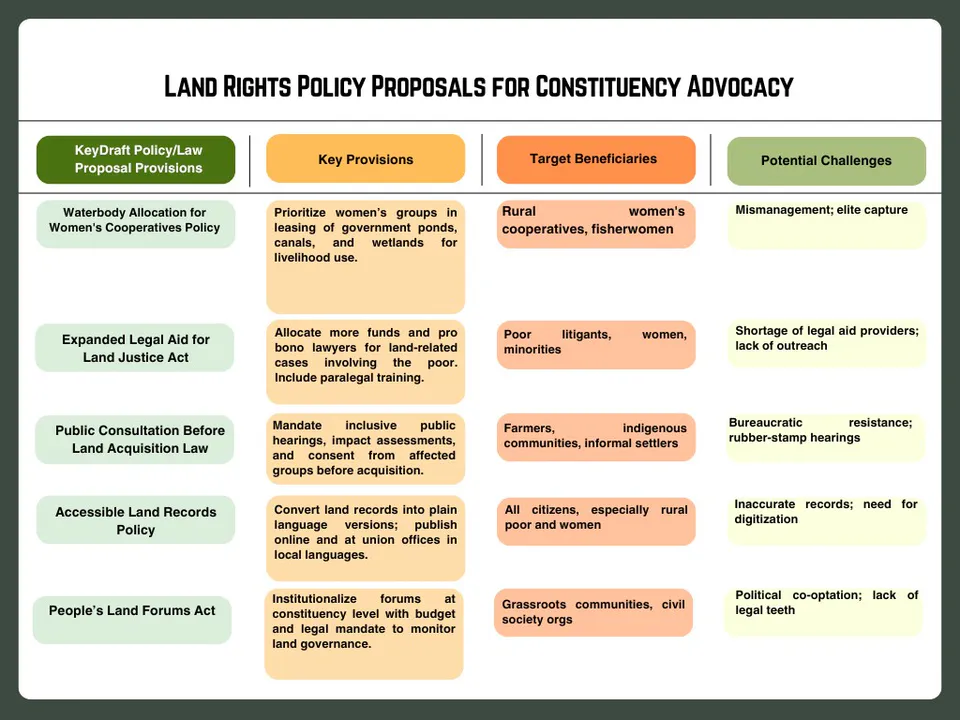
7. Conclusion
The findings of this study illuminate a fundamental truth: land in Bangladesh is not merely a commodity, it is a cornerstone of identity, security, and dignity. Yet, for far too many, particularly women, indigenous peoples, and the landless poor, this cornerstone remains precariously out of reach. Despite decades of reforms, legal frameworks, and institutional experimentation, the lived reality of land governance continues to be shaped by exclusion, opacity, and inequity.
What communities across Bangladesh are demanding is not simply better policy, but a profound shift in the philosophy of governance itself. They envision a system where justice is not procedural but tangible; where rights are not only codified but realized; where participation is not symbolic but structural.
This requires embracing a people-centered paradigm: one that prioritizes the historically marginalized, builds trust through accountable institutions, and recognizes the centrality of community knowledge in shaping sustainable solutions. Technology, while promising, must serve as a tool for empowerment, not another frontier of exclusion.
Equally, the evaluation of existing policies reveals that legal intent alone is insufficient without implementation capacity, transparency, and political will. A policy is only as effective as the systems that animate it, and those systems must be reoriented toward justice, not merely efficiency.
Ultimately, land governance must be understood not only as an administrative task but as a moral and political responsibility. The future of equitable land access in Bangladesh depends on whether institutions are willing to share power, listen deeply, and act boldly. The voices in this survey are not just data points; they are a call to reimagine land governance as a foundation for a more just, inclusive, and resilient society.
Footnotes
Khas land refers to government-owned land in Bangladesh that is legally classified as state property. It is often unused or fallow land and is intended for redistribution to landless and marginalized populations for cultivation, housing, or livelihood purposes. The term “khas” comes from Persian, meaning “special” or “exclusive,” indicating its status as property held directly by the state. ↩
SDG 15 focuses on protecting, restoring, and promoting sustainable use of land ecosystems, combating desertification, and halting land degradation and biodiversity loss. ↩
Tribalism refers to strong loyalty to one’s own ethnic or social group, often leading to exclusion or conflict with others. ↩
Kautilya’s Arthashastra is an ancient Indian treatise on statecraft, economics, and governance, written around the 4th century BCE. ↩
Agrahara refers to land grants given by ancient Indian kings to Brahmins, often tax-free, for religious and educational purposes. ↩
Zamindars were landowners in colonial and pre-colonial India who collected taxes from peasants on behalf of the state, often exercising significant local power and control over land. ↩
Ain-i-Akbari is a 16th-century administrative and statistical record of the Mughal Empire, compiled by Abul Fazl, detailing Emperor Akbar’s governance, including land revenue systems. ↩
Tebhaga Movement was a 1940s peasant uprising in Bengal demanding two-thirds of the harvest (tebhaga) for sharecroppers instead of the traditional one-half share to landlords. ↩


