
1. Introduction
Currently, without a cure, Alzheimer’s disease (AD) is a progressive neurodegenerative disorder that primarily affects older people [1]. Significantly affecting work and social skills, it is marked by a gradual loss in memory and other cognitive functions. AD first affects learning and information retrieval mechanisms, gradually reducing the ability to acquire new knowledge. As the disease progresses, it worsens further, culminating in the inability to preserve remote memories [2, 3, 4]. AD is a complex condition whose causes are not yet fully understood, but it is believed to result from an interaction between genetic, environmental, and lifestyle factors. Genetic predisposition is significant, especially in cases with mutations in the APP, PSEN1, and PSEN2 genes, as well as the presence of the APOEε4 allele, which increases the risk of developing the disease [5, 6, 7, 8, 9, 10, 11, 12, 13, 14, 15, 16, 17, 18, 19].
Aging, the primary risk factor, is associated with chronic inflammation and the accumulation of neurotoxic proteins, which are directly related to the pathogenesis of AD [20]. Rapidly becoming one of the most burdensome, deadly, and economically challenging diseases of the 21st century, Alzheimer’s disease is the most common kind of dementia. Though its leading cause is still controversial among scientists, growing data suggests a multifactorial pathological cascade drives AD progression. Important factors are the unusual buildup of beta-amyloid () peptides, mitochondrial dysfunction, and a continuous neuroinflammatory response mainly driven by activated glial cells, especially astrocytes and microglia. These mechanisms operate synergistically, leading to progressive neurodegeneration and cognitive decline [21]. The impact of dementias extends beyond affected individuals, reaching their families and society as a whole, mainly due to the high socioeconomic burden these conditions impose [22]. The World Health Organization (WHO) estimates that dementia accounts for 11.9% of the years lived with a disability brought on by non-communicable diseases; its worldwide cost was projected at $604 billion in 2010 [23, 24, 25, 26, 27, 28]. Alzheimer’s disease emphasizes the pressing need for creative treatments tackling its biological basis in light of its severe effects on people, families, and society. In this regard, synthetic peptides and lysine, among other novel therapeutic strategies, seem to be hopeful answers that directly attack the pathological mechanisms driving the progression of the illness. These developments provide a point of clinical progress and the possibility of lowering the social load connected to this terrible disease [29, 30, 31, 32, 33, 34, 35, 36, 37, 38].
Considering the increasing influence of Alzheimer’s disease, new treatments like synthetic peptides and lysine must go through thorough safety assessments before clinical use. Peptide immunogenicity is a significant issue since even tiny peptide fragments can cause negative immune reactions, undermining treatment effectiveness [38]. Though necessary, lysine can be harmful in large doses since it disturbs the metabolism of other amino acids [38]. Though preclinical findings are encouraging, thorough clinical studies are required to guarantee that the therapeutic advantages surpass the possible hazards. Peptides and lysine use have become a promising treatment for AD since they may affect important pathological mechanisms driving disease progression. Synthetic peptides have shown the ability to interfere with -amyloid aggregation, one of the primary markers of AD, promoting its destabilization and preventing the formation of neurotoxic amyloid plaques. On the other hand, lysine, an essential amino acid, has shown beneficial effects in controlling neuroinflammation and inhibiting the formation of cross-links in -amyloid and tau proteins. These mechanisms may contribute to reducing the accumulation of protein aggregates in the brain and preserving neuronal function [39].
Lysine is an essential amino acid acquired only via diet and is vital in protein synthesis and metabolism. Its capacity to affect the development of -amyloid plaques and tau tangles and alter neuroinflammation has drawn interest in AD studies. These outcomes help to maintain neuronal integrity and lower neurodegeneration. Peptides short chains of amino acids involved in cellular signaling have also indicated promise in similarly altering neurodegenerative processes. While bioactive peptides can lower inflammation, promote synaptic plasticity, and improve cognitive performance, research indicates that lysine may prevent the aggregation of pathological proteins [40, 41, 42, 43, 44, 45, 60].
Building on these results, molecular approaches aimed at aggregating harmful proteins and the inflammatory pathways in the brain show significant therapeutic promise. Lysine’s capacity to control beta-amyloid aggregation, combined with the effects of bioactive peptides in reducing neuroinflammation and enhancing cognitive performance suggests that these strategies may affect AD progression. These advances position peptides and lysine-based chemicals as hopeful contenders for the following therapeutic interventions. Notwithstanding these developments, the quest for more potent therapies remains a significant difficulty, therefore stressing the need to investigate these approaches more to handle the growing worldwide load of AD.
This study will give a thorough overview of AD, stressing the pressing need for more efficient therapeutic approaches. It also aims to show the creative therapeutic potential of peptides and lysine, stressing their capacity to alter pathological processes of AD, including the accumulation of beta-amyloid and tau proteins, and their encouraging qualities in regulating neuroinflammation.
2. Materials and Methods
The present study is a qualitative systematic review conducted by the Preferred Reporting Items for Systematic Reviews and Meta-Analyses (PRISMA) guidelines [46, 47, 48]. The search strategies employed specific MeSH and DeCS terms combined with Boolean operators adapted for each database (Table 1). For example, in PubMed, the strategy used was ("Peptides" [MeSH Terms] AND "Alzheimer Disease" [MeSH Terms]) AND ("Lysine" [MeSH Terms]) AND ("2010/01/01" [Date - Publication]: "2024/10/15" [Date - Publication]). Filters were applied to include only full-text articles available in English or Portuguese, with a focus on studies published since 2010. In the Cochrane Library, the exact keywords were applied with filters set for clinical trials and systematic reviews. For Scopus, the search included TITLE-ABS-KEY ("peptides" AND "lysine" AND "Alzheimer’s disease"), limited to peer-reviewed articles. The exact search sequences, filters, and date limits for each database were recorded in Table 1 to ensure transparency. Three reviewers independently selected studies from PubMed, Cochrane, Scopus, LILACS, and SciELO. The last database search was conducted on October 15, 2024. Additionally, the reference lists of all included articles and relevant reviews were manually examined to identify other pertinent studies. Organizational websites such as ClinicalTrials.gov and the World Health Organization’s International Clinical Trials Registry Platform were also consulted to include ongoing or unpublished studies.
Studies were included in this review if they met the following criteria: (1) original research articles involving experimental or observational designs; (2) published in English or Portuguese between 2010 and 2024; (3) investigations on the use of peptides and/or lysine as therapeutic interventions for Alzheimer’s disease, in both animal and human models; and (4) availability of full-text access. Exclusion criteria included review articles, case reports, incomplete or duplicate records, studies in which the interventions did not specify peptides or lysine, and those that did not align with the central research question defined by the PICO strategy.
Table 1. Detailed search strategy. The search was conducted in the PubMed, Cochrane Library, Scopus, SciELO, and LILACS databases in October 2024, with the following MeSH/DeCS terms and combinations.
| DATABASE | SEARCH STRATEGY | APPLIED FILTERS | Free full-text articles available in |
|---|---|---|---|
| PubMed | ("Alzheimer Disease" [MeSH Terms] AND "Lysine" [MeSH Terms]) AND "Peptides" [MeSH Terms] AND ("2010/01/01" [Date] : "2024/12/31" [Date - Publication]) | AND Publication] | both English and Portuguese. |
| Cochrane | "Peptides" AND "Lysine" AND "Alzheimer Disease" | - | Clinical trials and systematic reviews: Interventional studies and structured evidence syntheses. |
| Scopus | TITLE-ABS-KEY ("peptides" AND "lysine" AND "Alzheimer’s disease") | AND | Full articles, peer-reviewed. |
| SciELO/ LILACS | ("Peptídeos") AND ("Doença de Alzheimer") AND ("Lisina") | - | Full articles, Portuguese/English, 2010-2024. |
* Source: Prepared by the authors (2024).
To facilitate data synthesis, studies were grouped according to the type of intervention (isolated peptides, isolated lysine, or combined), the experimental model (animal vs. human), and the primary outcomes assessed, allowing for a structured comparison between similar methodologies and findings. The selection process for identifying relevant studies was conducted in three stages: first, article titles were screened to assess alignment with the topic of interest. Next, abstracts of articles that passed the initial screening were reviewed to determine if they met the inclusion criteria. Finally, the full texts of selected articles were thoroughly examined to ensure compliance with all criteria established for this study. The documents were organized using the Mendeley Reference Manager tool. In cases of disagreement regarding study inclusion, the studies were excluded.
The central research question of the article was developed based on the PICO strategy (Table 2), in which the eligible components of the study were defined as follows: Population (P): Patients diagnosed with Alzheimer’s disease; Intervention (I): Use of peptides and the amino acid lysine as a therapeutic approach for the treatment of Alzheimer’s disease; Comparison (C): Patients diagnosed with Alzheimer’s disease who do not use peptides and the amino acid lysine as a therapeutic approach; Outcome (O): Peptides and lysine contributing to the inhibition of protein aggregation, exhibiting neuroprotective, antioxidant, and anti-inflammatory properties, as well as improving cognitive function. To conclude the methods section, the guiding research question was formulated as follows: "What is the impact of using peptides and the amino acid lysine as a therapeutic approach for Alzheimer’s disease?", This will be addressed in the results and discussion sections of the article.
Table 2. The formulation of the main research question was guided by the PICO strategy which seeks to evaluate the therapeutic effects of using peptides and lysine in the treatment of Alzheimer’s disease.
| Acronym | Definition | Description |
|---|---|---|
| P | Population | Patients who have received a clinical diagnosis of Alzheimer’s. |
| I | Intervention | Use of peptides and the amino acid lysine as a therapeutic approach for AD. |
| C | Comparison | Individuals with AD who are not undergoing therapy with peptides and lysine. |
| O | Outcome | Therapy reduces protein aggregation, protects neurons, offers antioxidant effects, etc. |
* Source: Prepared by the authors (2025).
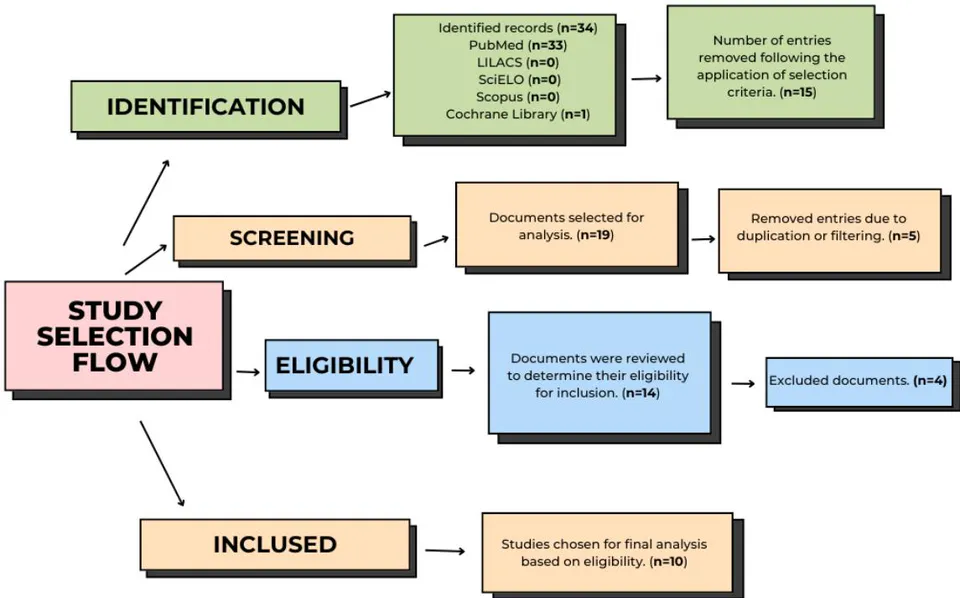
The Grading of Recommendations Assessment, Development, and Evaluation (GRADE) methodology was used to analyze the reliability of the selected studies (Tables 3, 4, 5, 6, and 7). The data obtained were presented in a graph and subsequently analyzed. Thirty-four documents were found using the stipulated keywords, 15 of which did not meet the established inclusion criteria. After eliminating duplicates and screening the titles and abstracts, five more articles were discarded. Of the 14 remaining records, four were deemed inappropriate after a full reading, resulting in the final selection of 10 articles (see Flowchart 1). The studies included in this systematic review prioritized open-access articles with full-text availability.
Methodological and practical considerations motivated this decision, aiming to ensure transparency, reproducibility, and equitable access to the examined data. Additionally, open-access materials allow for a more comprehensive evaluation of the entire text, honoring institutional resources at the time of the study. Scientifically relevant studies published in indexed journals were included. Therefore, this choice should not be seen as compromising the quality of the review. However, the exclusion of paywalled articles may be acknowledged as a specific limitation, given the variety of databases consulted, the application of standardized descriptors (MeSH/DeCS), and a methodical screening approach as recommended by the PRISMA protocol. Study selection was conducted independently by two reviewers (A and B), who assessed the relevance of titles and abstracts based on previously established inclusion and exclusion parameters. Disagreements at this stage were resolved through dialogue or with the intervention of a third reviewer (C). The full texts of potentially eligible articles were then retrieved and analyzed separately by both reviewers; any disagreements were resolved through consensus. To minimize potential bias and ensure uniformity in the process, an Excel spreadsheet recording system was used to support all screening decisions. The process also included semi-automatic selection tools designed to identify key terms efficiently. The entire process was recorded and summarized in a PRISMA flowchart (Flowchart 1), and inter-reviewer agreement measures were subsequently calculated.
Table 3. Grading of Recommendations, Assessment, Development and Evaluation (GRADE) used to assess the quality of selected articles. Study Type: Experimental (animal).
| AUTHORS (YEAR) | STUDY TYPE | RISK OF BIAS | INCONSISTENCY | DIRECTION | PRECISION | QUALITY |
|---|---|---|---|---|---|---|
| Pan et al. (2022) | Exp. (animal) | Low | N/A | D | Moderate | Moderate |
| Bai et al. (2022) | Exp. (animal) | Low | N/A | D | Low | High |
| Fonseca-Gomes et al. (2024) | Exp. (animal) | Low | N/A | D | Moderate | Moderate |
| Long et al. (2024) | Exp. (animal) | Moderate | Moderate | D | Moderate | Moderate |
| Song et al. (2023) | Exp. (animal) | Low | N/A | D | Low | High |
* Source: Prepared by the authors (2025). D (Direct), I (Indirect).
Table 4. GRADE assessment for Case Control studies.
| AUTHORS (YEAR) | STUDY TYPE | BIAS | INCONSISTENCY | DIRECTION | PRECISION | QUALITY |
|---|---|---|---|---|---|---|
| Li et al. (2022) | Case Control | Low | N/A | D | Low | High |
| Puris et al. (2021) | Case Control | Moderate | High | D | High | Low |
* Source: Prepared by the authors (2025).
Table 5. GRADE assessment for Retrospective Experimental study.
| AUTHORS (YEAR) | STUDY TYPE | BIAS | INCONSISTENCY | DIRECTION | PRECISION | QUALITY |
|---|---|---|---|---|---|---|
| Yu et al. (2021) | Retr. Exp. | Moderate | Moderate | D | Moderate | Moderate |
* Source: Prepared by the authors (2025).
Table 6. GRADE assessment for Literature Review.
| AUTHORS (YEAR) | STUDY TYPE | BIAS | INCONSISTENCY | DIRECTION | PRECISION | QUALITY |
|---|---|---|---|---|---|---|
| Rubey (2010) | Lit. Review | High | High | I | High | Very Low |
* Source: Prepared by the authors (2025).
Table 7. GRADE assessment for Experimental (animal model & in vitro).
| AUTHORS (YEAR) | STUDY TYPE | BIAS | INCONSISTENCY | DIRECTION | PRECISION | QUALITY |
|---|---|---|---|---|---|---|
| Bellver-Sanchis et al. (2022) | Exp. (animal/in-vitro) | Low | N/A | D | Moderate | Moderate |
* Source: Prepared by the authors (2025).
Data extraction was also conducted independently by two reviewers using a standardized data collection form developed explicitly for this review. Extracted variables included study characteristics (author, year, country), participant details (species, sample size, age), intervention specifics (peptide sequences, lysine dosages, routes of administration), outcome measures, and sources of funding. When discrepancies arose, they were discussed and resolved, with clarifications requested directly from the study authors if necessary. In cases where data were missing or ambiguously reported, assumptions were documented, and related sensitivity analyses were planned to assess the impact of these uncertainties. Data extraction was supported by an online automation tool that incorporated natural language processing features to streamline the process. Manual verification was performed on a random sample to ensure accuracy. In most cases, the analysis of the selected studies showed moderate to high quality, supporting the therapeutic potential of peptides and lysine for Alzheimer’s disease. Although many of these studies were conducted in animal models, typical of preclinical research, the results provide a strong foundation for future human studies. This underscores the need for continued investigation through well-designed clinical trials that can validate and expand upon the existing data.
3. Results
The strategy adopted for the search and selection of articles followed a structured model, encompassing the phases of identification, screening, eligibility assessment, and final inclusion. Initially, scientific databases (previously mentioned) were consulted to locate publications relevant to the topic. The studies found were assessed based on titles and abstracts, following the predefined inclusion and exclusion criteria. In the next phase, the full texts of the pre-selected articles were examined to ensure methodological consistency and data relevance. Ultimately, only the studies that fully met the established requirements were incorporated into the review, ensuring the reliability and quality of the scientific evidence used. Of the 10 articles evaluated in this review, as shown in Table 8, the highest number of publications occurred in 2022 (), indicating a recent increase in academic interest in the topic.
Regarding the classification of the journals involved, according to the Qualis system, the analyzed studies were published in journals with high editorial standards, ranging from strata A1 to A3 as rated by CAPES. This reflects the scientific relevance of the selected sources. Most of the studies () employed experimental methodologies to support their hypotheses and develop theoretical foundations, indicating a preference for practical, evidence-based approaches. One article adopted a theoretical perspective, contributing a conceptual and integrative analysis of the data.
Table 8. Characteristics of the evaluated studies.
| ID | Authorship/ Year | Journal | Qualis | Methods | Objectives |
|---|---|---|---|---|---|
| 01 | Pan et al. (2022) | Cell Metabolism | (A1) | Experimental | Understanding how a positive feedback mechanism involving epigenetic modifications in histones (acetylation) and stimulation of the PKM2 enzyme in microglia is related to the progression of the disease. |
| 02 | Bai et al. (2022) | Cell Reports | (A1) | Experimental | To analyze how SIRT2 regulates the acetylation modification of amyloid precursor protein (APP) and what is its influence on cognitive abilities and pathological aspects associated with AD in transgenic APP/PS1 mouse models. |
| 03 | Li et al. (2022) | J. Biol. Chem. | (A1) | Case-control | Transcription factor EB (TFEB) influences the formation of lysosomes and the elimination of in transgenic models of APP/PS1 mice, evaluating the effects of Trichostatin A (TSA) on this acetylation and cognitive function. |
| 04 | Yu et al. (2021) | Soc. Mass Spectrom. | (A1) | Retr. Exp. | To examine the conformational changes, post-translational adjustments, and molecular connections that affect lysine exposure, clarifying pathological processes and brain performance. |
| 05 | Fonseca-Gomes et al. (2024) | Molecular Therapy | (A1) | Experimental | To analyze the effectiveness and reliability of the TAT-TrkB peptide as a therapeutic approach for AD, recovering the activity of BDNF and its receptor TrkB. |
| 06 | Long et al. (2024) | Pharmacol. Res. | (A1) | Experimental | To analyze the function of Kallistatin in the regulation of cognitive activity and glutamate balance, with emphasis on transgenic mouse models (KAL-TG). |
| 07 | Puris et al. (2021) | Scientific Reports | (A1) | Case-control | To investigate the consequences of systemic inflammation caused by lipopolysaccharide (LPS) on the metabolic and lipid profiles of plasma and brain in APdE9 transgenic mice. |
| 08 | Song et al. (2023) | J. Clin. Invest. | (A1) | Prospective Exp. | To analyze the effects of acetylation of the tau protein at lysine residue 280, understanding its influence on the anomalous formation of tau aggregates and clinical progression. |
| 09 | Rubey (2010) | Neuropsychiatr. Dis. Treat. | (A3) | Literature Review | To examine if supplemental administration of lysine may prevent or delay the progression of AD, with emphasis on the possible inhibition of the reactivation of HSV-1. |
| 10 | Bellver-Sanchis et al. (2022) | ChemMedChem | (A1) | Experimental | Discovery of novel compounds capable of inhibiting G9a, a lysine methyltransferase enzyme essential for the silencing of genes associated with cognition and memory. |
* Source: Prepared by the authors based on data obtained throughout the study (2024).
4. Discussion
Peptides and the amino acid lysine have been increasingly investigated as promising therapeutic alternatives for Alzheimer’s disease (AD) due to their ability to influence molecular pathways involved in the pathophysiology of the condition. Evidence suggests that certain peptides can act to interrupt the aggregation of toxic proteins, such as beta-amyloid, contributing to the prevention or reduction of senile plaque formation, one of the main neuropathological characteristics of AD. Lysine, in turn, plays essential roles in regulating protein metabolism and preserving cellular structure, potentially promoting neuronal protection mechanisms and aiding in the recovery of synapses affected by progressive degeneration of nervous tissue. Although the results are encouraging in preclinical models, these compounds still require validation regarding their efficacy and safety in humans, which requires verification of well-structured clinical trials [57].
In the study conducted by Pan et al. (2022) [49], lactylation of histone H4 at lysine 12 (H4K12) was observed in microglial cells from experimental models of Alzheimer’s disease, showing that this epigenetic alteration is directly associated with microglial dysfunction and the worsening of the neurodegenerative condition. These results indicated that lactylation of lysine 12 on histone H4 (H4K12la) stimulates the transcription of genes related to the glycolytic pathway, triggering a cycle that increases neuroinflammation. Abolishing the activity of the enzyme pyruvate kinase M2 (PKM2) has proven to be a promising approach for restoring microglial function and reducing amyloid beta () peptide concentrations, pointing to new therapeutic avenues for combating Alzheimer’s disease. The study explored other post-translational modifications of histone lysine residues, with an emphasis on lysine five on histone H4 (H4K5la), associated with gene expression regulation; lysine eight on the same histone (H4K8la), linked to transcriptional control; and, primarily, lysine 12 (H4K12la), whose alteration is directly related to the microglial dysfunction observed in AD. Other relevant modifications include lysine 18 on the same histone H3 (H3K18la), whose lactation can influence chromatin organization, and lysine 23 on the same histone (H3K23la), associated with the regulation of gene activity [49].
Recurrent epigenetic modifications, such as the acetylation of lysine residues in histones, directly influence chromatin conformation and the regulation of gene transcription. Notable among these modifications is the acetylation of lysine 12 on histone H4 (H4K12la), which has been shown to be a central element in the activation of genes involved in glycolysis, contributing to the microglial dysfunction observed in Alzheimer’s disease. Further understanding of the mechanisms that regulate gene expression, as well as the investigation of the origin and progression of the disease [49], directly depends on the analysis of these epigenetic alterations. Studies indicate that the regulation of neuroinflammation and the control of gene expression through histone acetylation may represent key elements in the therapeutic approach to neurodegenerative diseases, such as Alzheimer’s disease. These insights reinforce the importance of developing clinical strategies targeting these epigenetic mechanisms, with potential impact on public policy formulation and the allocation of resources for research in this area.
Furthermore, future studies should prioritize the analysis of interactions between microglia and neurons, in addition to the search for reliable biomarkers that allow monitoring the progression of the disease [49]. Bai et al. (2022) [50] investigated the impact of amyloid precursor protein (APP) acetylation on the pathological mechanisms associated with Alzheimer’s disease. The objective was to understand how this epigenetic modification influences APP processing and the production of amyloid peptides related to disease progression. For this, two specific peptides were analyzed: APP-K132-AC and APP-K134-AC. The APP-K132-AC peptide, which represents APP with acetylation at lysine 132, has the sequence ac-SDALLVPDK(ac)CKFLHQERMD-NH2 and was considered relevant for exploring cellular interactions and functions of APP in the context of AD. This posttranslational modification has the potential to alter both the conformation and biological activity of the protein [50]. The APP-K134-AC peptide, whose sequence is ac-LVPDKCK(ac)FLHQERMD-NH2, represents the amyloid precursor protein with acetylation at lysine position 134. This modification directly interferes with APP processing and the formation of amyloid peptides. Acetylations at positions K132 and K134 promote structural and functional alterations in APP, impacting its processing dynamics and contributing to the generation of amyloid aggregates, central elements in the progression of Alzheimer’s disease [50]. These modifications were analyzed using different experimental approaches. Immunocytochemistry was used to observe the distribution and colocalization of APP and SIRT2 in primary neurons. Western blot analysis allowed the identification and quantification of APP acetylation levels, as well as the products generated by its cleavage. Streptavidin pulldown assays were used to measure the presence of APP on the cell surface in N2a-sw cell lines. At the same time, mass spectrometry enabled the precise identification of the lysine residues modified by acetylation in APP. Finally, ELISA tests were used to evaluate in detail the effects of APP acetylation on the pathophysiology of the disease, measuring the levels of sAPP and sAPP in brain tissue extracts [50]. These findings reinforce the role of epigenetic modifications in the functional control of APP and expand the understanding of the molecular mechanisms involved in Alzheimer’s disease, contributing to the identification of potential therapeutic targets.
From this perspective, Li et al. (2022) [51] report that the administration of Trichostatin A (TSA), a histone deacetylase (HDAC) inhibitor, to APP/PS1 transgenic mice—an experimental model of Alzheimer’s disease—showed initial effects in both reducing disease burden and improving cognitive function. However, these findings still require confirmation through human clinical studies. The mechanism of action of TSA appears to be related to its ability to stimulate the expression of genes involved in autophagy and lysosome formation, processes that may contribute to the reduction of -amyloid accumulation, one of the main neuropathological hallmarks of AD. As a result, a significant reduction in -amyloid () plaques was observed, with a 62.8% decrease in the cortex and 71.3% in the hippocampus, compared to control animals treated with saline. TSA treatment also increased the expression of genes associated with lysosome formation and autophagy activation, highlighting the essential role of transcription factor EB (TFEB) acetylation in inducing these cellular mechanisms [51]. Mice receiving TSA demonstrated significant improvements in behavioural tests aimed at assessing learning and memory, such as the Morris water maze. These animals took less time to locate the submerged platform and crossed the area where it was positioned more frequently, compared to the control group, indicating superior cognitive performance. The study highlighted the fundamental role of transcription factor EB (TFEB) acetylation in its translocation to the nucleus and subsequent activation, in addition to highlighting the importance of controlling this process in the regulation of lysosomal biogenesis. The findings indicate that the induction of TFEB acetylation, combined with the inhibition of histone deacetylase (HDAC) activity, may represent a promising therapeutic approach for the treatment of Alzheimer’s disease, as well as other neurodegenerative conditions [51]. Data obtained from preclinical studies indicate significant advances in therapeutic strategies for Alzheimer’s disease; however, it is important to emphasize that these findings are still in their infancy and require confirmation through extensive clinical trials in human populations. One example is the use of trichostatin A (TSA) in murine models, which resulted in a significant reduction in -amyloid burden, ranging from 62.8% to 71.3% [51], demonstrating a significant impact on the pathological processes involved in disease progression. Despite the encouraging results, several challenges remain, such as dosage adjustments, limitations related to pharmacokinetics and safety, and the complexity of biological responses in humans, which can differ significantly from those observed in animal models. Although these therapeutic approaches represent innovative alternatives with potential for success, they must be evaluated cautiously. This reinforces the importance of well-designed clinical studies to validate their efficacy and applicability in the context of Alzheimer’s disease.
In the study conducted by Yu et al. (2021) [40], 103 differentially exposed (DE) peptides were identified from 97 human proteins—most of which were more prevalent in samples from individuals diagnosed with Alzheimer’s disease. The research focused on lysine accessibility and conformational changes in proteins present in brain tissues affected by the disease. The results indicate an increased exposure of lysine residues in proteins associated with the formation of neurofibrillary tangles and RNA splicing disorders, both considered characteristic features of the pathophysiology of AD. The analysis conducted by Yu et al. also addressed structural modifications in proteins related to the disease, especially those involved in misfolding and protein aggregation. This research aimed to understand how the accessibility of lysine residues in protein peptides, including tau, and elements involved in RNA splicing, can impact the pathological mechanisms of Alzheimer’s disease. Ten proteins related to RNA splicing and tau were selected based on their functional importance and role in AD progression, contributing to the identification of 15,370 peptides throughout the analysis. These peptides have the potential to guide the development of therapeutic strategies. They are essential for deepening our understanding of the processes of anomalous protein folding and RNA splicing dysfunction, both considered hallmarks of Alzheimer’s disease. To achieve these insights, the proteins were extracted under preserved physiological conditions and subsequently subjected to Tandem Mass Tag (TMT) labeling, enzymatic digestion with trypsin, separation by liquid chromatography, and mass spectrometry analysis on an LC/LC-MS/MS platform [40]. Large-scale labeling studies using Tandem Mass Tag (TMT) to assess lysine availability revealed increased exposure of lysine residues in 9 of the 10 proteins involved in RNA splicing in brain samples from individuals with Alzheimer’s disease. This pattern suggests that the increased accessibility of these regions may be associated with conformational changes and dysfunction in splicing mechanisms. In contrast, tau protein showed reduced lysine accessibility, reinforcing its propensity for aggregation and aberrant folding, processes already recognized as central to the pathogenesis of AD [40].
Variations in the accessibility of lysine residues have also been identified in proteins associated with mitochondrial and synaptic functions, indicating that these structural modifications may impact multiple cellular processes and contribute to disease progression. These changes in lysine availability reflect molecular interactions and conformational changes that are crucial for deciphering the biological mechanisms involved in Alzheimer’s disease pathology, offering valuable insights for the development of new therapeutic approaches [40]. Targeting TrkB receptor cleavage, Fonseca-Gomes et al. (2024) [41] investigated the mechanisms of synaptic dysfunction associated with Alzheimer’s disease. The study evaluated the efficacy of TAT-TrkB peptides, designed to prevent BDNF receptor fragmentation and restore synaptic activity in murine models of the disease. These peptides combine the TAT domain, known for its ability to cross cell membranes, with a sequence derived from the TrkB receptor, allowing their entry into cells and the reactivation of signaling compromised in AD. The TAT-TrkB peptides were chosen for their ability to restore TrkB receptor function, whose integrity is affected during disease progression. Factors contributing to the improvement of cognitive deficits include inhibition of TrkB cleavage, stimulation of the BDNF signaling pathway, and strengthening of synaptic plasticity. Lysine played an essential role in the structure of the TAT-TrkB peptide, functioning as a positively charged residue that facilitates interaction with cell membranes. The peptide’s entry into cells was facilitated by overcoming the lipid barrier of the plasma membrane, promoted by the positive charge present in its structure. The presence of lysine also contributed to the peptide’s conformational stability and solubility in solution, enhancing its functional activity [41]. The experimental design involved the application of the TAT-TrkB peptide to transgenic mice of the 5XFAD line, followed by tests to evaluate synaptic plasticity, TrkB receptor cleavage, and the animals’ cognitive performance. Investigation of the peptide’s effects on preventing receptor cleavage and restoring synaptic function allowed us to elucidate relevant molecular aspects of Alzheimer’s disease, in addition to pointing to new therapeutic possibilities [41].
Long et al. (2024) [52] explored the connection between glutamate balance and cognitive performance in experimental models of Alzheimer’s disease, with an emphasis on glutamatergic system dysfunction as a contributing factor to neurodegeneration and the progression of the disease. The research analyzed the role of kallistatin in regulating glutamine synthesis and maintaining glutamate homeostasis, in addition to evaluating its influence on cognitive abilities in transgenic mice of the KAL-TG line, which present phenotypic characteristics compatible with AD.
The peptides analyzed in this study were Kallistatin, hydrocortisone, and fenofibrate. Among them, Kallistatin was the main focus of the investigation due to its emerging role in promoting neuroprotection. Hydrocortisone and fenofibrate were included as complementary therapeutic agents. The data obtained offer new mechanistic insights into the action of Kallistatin, presenting novel results that have not yet been described in peer-reviewed publications or other established scientific sources [58, 59]. Considering that glutamate is one of the main excitatory neurotransmitters of the central nervous system, its regulation was the subject of study. The research examined how cognitive deterioration in Alzheimer’s models is related to dysregulation of glutamate homeostasis, often associated with excitotoxicity. The potential of Kallistatin to modulate glutamate levels and offer protection against its toxic effects was also evaluated, to preserve or improve cognitive function [52].
Studies have shown that Kallistatin stimulates glutamine synthesis, attenuating glutamate-induced toxicity and contributing to the preservation of cognitive functions. Hydrocortisone and fenofibrate also showed beneficial effects, demonstrating efficacy in mitigating the consequences of neurodegeneration [52]. To assess cognitive performance, KAL-TG transgenic mice underwent behavioral tests such as the Morris water maze and the Y-maze. In parallel, the expression of proteins involved in glutamine synthesis was analyzed in brain tissue samples, while blood samples were collected to measure Kallistatin and glutamate levels [52]. The results revealed that Kallistatin regulation is associated with improved glutamate homeostasis and the maintenance of cognition in animal models. Furthermore, treatments with hydrocortisone and fenofibrate have shown therapeutic potential in reducing the impacts of neurodegeneration, reinforcing Kallistatin as a promising target for intervention strategies in Alzheimer’s disease [52].
The findings of the study by Puris et al. (2021) [53], which investigated the impacts of systemic inflammation in transgenic mice of the APdE9 line, revealed several relevant metabolic alterations. The analyses indicated variations in the lipid profiles of the cortex and hippocampus in animals exposed to lipopolysaccharide (LPS). Specifically, a decrease in certain phospholipids, such as PE ae C40:7 and PC aa C35:3/PE aa C38:3, was detected, while other compounds, such as PC ae C36:6 and PC ae C36:5, showed increased levels. -amyloid () deposition was correlated with white matter degradation, suggesting that the molecular mechanisms underlying these lipid and metabolic alterations are complex and cell-specific. Statistical analysis was conducted with methodological rigor, using t-tests and ANOVA to compare cytokine and metabolite levels between experimental groups, with application of Bonferroni correction to ensure the significance of the results [53]. The most impacted biochemical pathways were identified using the MetaboAnalyst 4.0 pathway analysis module, allowing detailed comparison of the main characteristics of the evaluated metabolites. These findings reinforce the importance of investigating metabolic alterations in the context of Alzheimer’s disease, highlighting the potential role of systemic inflammation in modulating these dynamics [53]. In a complementary study, Song et al. (2023) [54] demonstrated that the monoclonal antibody Y01 has high specific affinity for the acetylated residue K280 of the tau protein, being able to inhibit its acetylation-induced aggregation [61]. Fluorescence assays with thioflavin T (ThT) revealed that the addition of the Y01 antibody significantly reduced the formation of tau aggregates treated with the p300 enzyme, in a concentration-dependent manner.
The modification of the lysine 280 residue (K280) was performed to explore its role in tau protein acetylation and the formation of pathological aggregates. By replacing K280 with alanine (K280A), researchers were able to analyze how this modification influences tau release, its cellular toxicity, and its contribution to the progression of tauopathies. The monoclonal antibody Y01 demonstrated high efficacy in detecting the acetylated residue tau-acK280, both in brain tissue samples from P301L transgenic mice and in human cerebrospinal fluid. The interaction between Y01 and tau residues occurs through hydrogen bonds and complementary electrostatic forces, suggesting its therapeutic potential in neutralizing and eliminating protein aggregates associated with the disease [54].
Rubey (2010) [55] presented relevant evidence regarding the possible link between herpes simplex virus type 1 (HSV-1) and Alzheimer’s disease, in addition to discussing the therapeutic potential of lysine supplementation [63, 64, 65, 66]. The study revealed that HSV-1 DNA was identified in a high proportion of approximately 90% of the brains of elderly individuals, including those diagnosed with AD. These data suggest that the virus can remain latent in brain tissue for long periods and be reactivated, contributing to the pathological processes associated with the disease.
Diets high in lysine and low in arginine have been associated with inhibition of HSV-1 reactivation, suggesting that lysine may act as a possible viral suppressor. In this context, the Mediterranean diet, characterized by a high lysine to arginine ratio, has been correlated with a lower incidence of Alzheimer’s disease. Studies showing a lower risk of AD among individuals who regularly consume fish, a food with a high lysine to arginine ratio, reinforce this hypothesis [55]. Research conducted by Rubey (2010) [55] also highlighted that a rural community in India has significantly lower rates of Alzheimer’s disease compared to other regions. This pattern may be related to a diet rich in dairy products, which also have a high lysine to arginine ratio, offering a possible nutritional explanation for the lower prevalence of the disease. By inhibiting the activity of herpes simplex virus type 1 (HSV-1) in the central nervous system, lysine, especially when present in high concentrations, may play a crucial role in preventing the formation of neurofibrillary tangles and amyloid plaques, pathological structures associated with Alzheimer’s disease. These data suggest that exploring the interactions between dietary habits, lysine levels, and HSV-1 reactivation represents a promising approach for developing effective preventive strategies against AD. According to Bellver-Sanchis and collaborators (2022) [56], studies highlighting experimental models [67, 68, 69, 70] demonstrated the high efficacy of G9a enzyme inhibitors, identified through virtual screening based on molecular structure. The chemical compounds analyzed in the study showed a promising ability to cross the blood-brain barrier and, in addition, were able to significantly reduce age-related paralysis in a transgenic model of Alzheimer’s disease, specifically in the CL2006 line of the nematode Caenorhabditis elegans. These inhibitors also proved effective in lowering -amyloid aggregation, one of the main neuropathological markers of AD.
Among the key epigenetic regulators involved in Alzheimer’s disease, the enzyme G9a, also known as lysine methyltransferase or euchromatin histone-lysine N-methyltransferase 2 (EHMT2), stands out. Its central function is to catalyze the methylation of lysine nine on histone H3 (H3K9), generating marks such as H3K9me1 and H3K9me2, which are directly associated with the repression of gene transcription. This modification alters the chromatin structure, making it more condensed and less accessible to transcription factors. G9a exerts control over the expression of genes essential for development, cellular differentiation, and stress response. Due to its ability to silence genes related to learning and memory, it has been widely studied as a therapeutic target in several pathologies, including cancer, psychiatric disorders, and neurodegenerative diseases such as AD [56].
In the current scenario of therapeutic research for Alzheimer’s disease, two strands are gaining prominence: peptide-based strategies and those involving lysine modulation. Peptide interventions, such as the TAT-TrkB peptide, have demonstrated efficacy in preserving synaptic function, restoring long-term potentiation (LTP), and attenuating tau protein hyperphosphorylation, reinforcing its neuroprotective role and its ability to stimulate synaptic plasticity. On the other hand, studies on lysine reveal relevant mechanisms, such as interference with -amyloid aggregation and changes in lysine accessibility in approximately 17% of the AD-associated proteome. Furthermore, indirect effects, such as suppression of HSV-1 replication, suggest a possible reduction in the risk of developing the disease. Complementing these approaches, therapies with HDAC and G9a inhibitors have shown a significant impact on reducing the formation of amyloid plaques and aggregates, with reduction rates between 62.8% and 71.3% even under conditions of low blood-brain barrier permeability. These findings reinforce the importance of addressing multiple pathological mechanisms involved in Alzheimer’s disease, such as controlling neuroinflammation, regulating acetylation processes, and preventing the formation of protein aggregates. The heterogeneity of the experimental designs and methodologies employed in the analyzed studies prevents a rigorous quantitative meta-analysis, justifying the adoption of a narrative approach to compare the effects of peptide-based interventions and lysine modulation. Nevertheless, the available data indicate that both strategies have complementary therapeutic potential, offering promising avenues for the development of innovative approaches to the treatment of AD.
When considering the clinical applicability of peptide and lysine-based therapies, it is essential to evaluate their safety profiles carefully. Because peptides are derived from biological sources, they exhibit natural immunogenicity, especially when used systemically or in prolonged treatments. This requires rigorous preclinical immunotoxicity studies, as undesirable immunological reactions can compromise therapeutic efficacy or generate adverse effects. Similarly, although lysine is an essential dietary component, its supplementation at supraphysiological levels, particularly in therapeutic settings, raises concerns regarding metabolic overload, risk of nephrotoxicity, and competition for the transport and metabolism of other amino acids [38]. In the field of emerging therapies for Alzheimer’s disease, lysine-derived compounds aimed at inhibiting the O-GlcNAcase enzyme have stood out for their selectivity and low toxicity in in vitro studies and in murine models, as evidenced by Weber et al. (2024) [38]. Despite encouraging results in the preclinical phase, clinical data in humans are still scarce, which highlights the need for comprehensive toxicological and pharmacokinetic studies before these agents can be considered for therapeutic application.
In light of the evidence accumulated over the past few decades, it is clear that Alzheimer’s disease can be addressed through multiple innovative therapeutic strategies, including dietary interventions, peptide-based therapies, enzyme inhibitors, and monoclonal antibodies. These approaches target central mechanisms of the disease, such as aberrant protein aggregation, neuroinflammation, and metabolic dysregulation, seeking to minimize the structural and functional impairments associated with disease progression. Despite the promising results obtained in experimental models, large and methodologically rigorous clinical studies are still needed to confirm the efficacy and safety of these interventions in humans. Advances in understanding the molecular processes underlying AD, combined with the development of more specific therapies, can redefine the therapeutic landscape for the disease, offering more effective prospects for patients and their caregivers.
Financing Agency
The articles analyzed received incentives for study and research, with funding earmarked for the completion of the respective works. Table 9, presented below, brings together all the articles examined, including their authors and titles, as well as the respective funding agencies responsible for supporting the research.
Table 9. Authorship, Study Title, and Funding Agency for the Studies
| ID | Authorship/ Year | Title | Financing Agency |
|---|---|---|---|
| 01 | Pan et al. (2022) | Positive feedback regulation of microglial glucose metabolism by histone H4 lysine 12 lactylation in Alzheimer’s disease | Grants from the National Natural Science Foundation of China. |
| 02 | Bai et al. (2022) | Inhibition of SIRT2 promotes APP acetylation and ameliorates cognitive impairment in APP/PS1 transgenic mice | National Key R&D Program of China, National Natural Science Foundation of China, and other research institutions. |
| 03 | Li et al. (2022) | TFEB acetylation promotes lysosome biogenesis and ameliorates Alzheimer’s disease-relevant phenotypes in mice | Fudan University, Ministry of Education, State Key Laboratory of Medical Neurobiology, and national innovation programs. |
| 04 | Yu et al. (2021) | Global profiling of lysine accessibility to evaluate protein structure changes in Alzheimer’s disease | National Institutes of Health (NIH), Alzheimer’s Research Foundation, and mass spectrometry analysis infrastructure support. |
| 05 | Fonseca-Gomes et al. (2024) | A small TAT-TrkB peptide prevents BDNF receptor cleavage and restores synaptic physiology in Alzheimer’s disease | University of Lisbon, Joao Lobo Antunes Institute of Molecular Medicine, Research Institute for Medicines (iMed.ULisboa), and European entities. |
| 06 | Long et al. (2024) | Kallistatin leads to cognition impairment via downregulating glutamine synthetase | Sun Yat-sen University, Guangdong Institute of Medical Neurobiology, and State Key Laboratory of Tropical Disease Control in China. |
| 07 | Puris et al. (2021) | Metabolomic and lipidomic changes triggered by LPS-induced systemic inflammation in transgenic APdE9 mice | University of Eastern Finland, Joao Lobo Antunes Institute of Molecular Medicine, and European/international organizations. |
| 08 | Song et al. (2023) | Monoclonal antibody Y01 prevents tauopathy progression induced by lysine 280-acetylated tau in cell and mouse models | ADEL Institute of Science & Technology, Yonsei University, Asan Medical Center, Korea Brain Research Institute, and Sungkyunkwan University. |
| 09 | Rubey (2010) | Could lysine supplementation prevent Alzheimer’s dementia? A novel hypothesis | The article does not explicitly mention sources of funding or institutional support. |
| 10 | Bellver-Sanchis et al. (2022) | Structure-Based Virtual Screening and in vitro/in vivo Analyses of G9a Inhibitors | Universitat de Barcelona, Central University of Rajasthan, University of Santiago de Compostela, and Northwestern University. |
* Source: Prepared by the authors based on data obtained throughout the study (2024).
5. Conclusions
Research on peptides and the amino acid lysine as therapies for Alzheimer’s disease reveals significant potential in modulating pathological processes associated with the disease. Peptides, especially those that act on -amyloid aggregation, demonstrate the ability to destabilize neurotoxic amyloid plaques. In turn, lysine regulates protein metabolism and cell stabilization, promoting neuroprotection and synaptic recovery. These substances reduce the accumulation of protein aggregates and control neuroinflammation, a determining factor in the progression of the disease. Although the results are promising, further studies are necessary to validate the efficacy and safety of using peptides and lysine in humans. Rigorous clinical trials are essential to confirm the therapeutic benefits and deepen the understanding of the mechanisms of action. Moreover, continuing research is crucial to elucidate molecular interactions and develop effective interventions that improve patients’ quality of life.
Furthermore, the systematic literature review highlights the growing evidence that these interventions can inhibit protein aggregation and exhibit neuroprotective, antioxidant, and anti-inflammatory properties. This suggests that using peptides and lysine may improve cognitive function in patients with the disease. However, it is important to recognize this study’s limitations, such as the variability of the methods in the reviewed articles and the predominance of studies in animal models, which may limit the generalizability of the results. For future research, it is recommended to conduct controlled clinical trials and investigations into the molecular mechanisms underlying these therapeutic effects.
The findings of this study are important because they may lead to the development of new therapeutic approaches, significantly contributing to the management of Alzheimer’s disease. Identifying therapeutic targets, such as the inhibition of PKM2 and the modulation of APP acetylation, opens new perspectives for interventions that may alter the course of the disease. Therefore, the formulation of public policies focused on the treatment of Alzheimer’s disease, which affects millions of people globally, should be encouraged. Therefore, searching for new therapies is urgent, and peptides and lysine may represent a valuable contribution in this context. This work emphasizes the importance of continuing the investigation into the role of these compounds in the treatment of Alzheimer’s disease, highlighting the need for a collaborative effort among researchers, clinicians, and policymakers to transform discoveries into effective practices that benefit patients with this neurodegenerative disease.