Loading menu…

Perception of Cautery Healing Effect among Infantsa Parents at the Southwestern Area of Saudi Arabia

§ king khalid university, college of medicine

Send Message

To: Author

Perception of Cautery Healing Effect among Infantsa Parents at the Southwestern Area of Saudi Arabia

Article Fingerprint

ReserarchID

8U8KE

Perception of Cautery Healing Effect among Infantsa Parents at the Southwestern Area of Saudi Arabia Banner

Key Research Insights

Synthesized scholarly intelligence & interactive research assistant
  • English
  • Afrikaans
  • Albanian
  • Amharic
  • Arabic
  • Armenian
  • Azerbaijani
  • Basque
  • Belarusian
  • Bengali
  • Bosnian
  • Bulgarian
  • Catalan
  • Cebuano
  • Chichewa
  • Chinese (Simplified)
  • Chinese (Traditional)
  • Corsican
  • Croatian
  • Czech
  • Danish
  • Dutch
  • Esperanto
  • Estonian
  • Filipino
  • Finnish
  • French
  • Frisian
  • Galician
  • Georgian
  • German
  • Greek
  • Gujarati
  • Haitian Creole
  • Hausa
  • Hawaiian
  • Hebrew
  • Hindi
  • Hmong
  • Hungarian
  • Icelandic
  • Igbo
  • Indonesian
  • Irish
  • Italian
  • Japanese
  • Javanese
  • Kannada
  • Kazakh
  • Khmer
  • Korean
  • Kurdish (Kurmanji)
  • Kyrgyz
  • Lao
  • Latin
  • Latvian
  • Lithuanian
  • Luxembourgish
  • Macedonian
  • Malagasy
  • Malay
  • Malayalam
  • Maltese
  • Maori
  • Marathi
  • Mongolian
  • Myanmar (Burmese)
  • Nepali
  • Norwegian
  • Pashto
  • Persian
  • Polish
  • Portuguese
  • Punjabi
  • Romanian
  • Russian
  • Samoan
  • Scots Gaelic
  • Serbian
  • Sesotho
  • Shona
  • Sindhi
  • Sinhala
  • Slovak
  • Slovenian
  • Somali
  • Spanish
  • Sundanese
  • Swahili
  • Swedish
  • Tajik
  • Tamil
  • Telugu
  • Thai
  • Turkish
  • Ukrainian
  • Urdu
  • Uzbek
  • Vietnamese
  • Welsh
  • Xhosa
  • Yiddish
  • Yoruba
  • Zulu
Reading Preferences
Font Size
Line Spacing
Background
This converted HTML version may contain rendering inconsistencies. Please refer to the PDF for the authoritative version, or click here to provide feedback.

Abstract

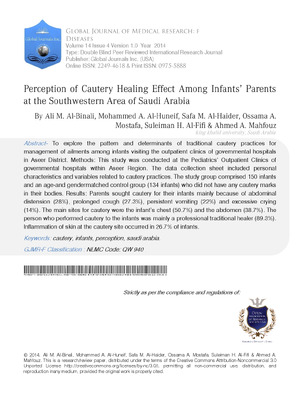
To explore the pattern and determinants of traditional cautery practices for management of ailments among infants visiting the outpatient clinics of governmental hospitals in Aseer District. Methods: This study was conducted at the Pediatrics’ Outpatient Clinics of governmental hospitals within Aseer Region. The data collection sheet included personal characteristics and variables related to cautery practices. The study group comprised 150 infants and an age-and gendermatched control group (134 infants) who did not have any cautery marks in their bodies. Results: Parents sought cautery for their infants mainly because of abdominal distension (28%), prolonged cough (27.3%), persistent vomiting (22%) and excessive crying (14%). The main sites for cautery were the infant’s chest (50.7%) and the abdomen (38.7%). The person who performed cautery to the infants was mainly a professional traditional healer (89.3%). Inflammation of skin at the cautery site occurred in 26.7% of infants.

References

19 Cites in Article
  1. 1. Penson RT,Castro CM,Seiden MV,Chabner BA,Lynch TJ (2001). Complementary, Alternative, Integrative, or Unconventional Medicine?. Oncologist, 6, 463-473.
  2. 2. Eran Ben-Arye,Moshe Frenkel,Anat Klein,Moshe Scharf (2008). Attitudes toward integration of complementary and alternative medicine in primary care: Perspectives of patients, physicians and complementary practitioners. Patient Education and Counseling, 70(3), 395-402.
  3. 3. Ong P,Bodeker G (2002). Health Status of People Using Complementary and Alternative Medical Practitioner Services in 4 English Counties. American Journal of Public Health, 92(10), 1653-1656.
  4. 4. Jelle Stekelenburg,Bastiaan Jager,Pascal Kolk,Esther Westen,Anke Kwaak,Ivan Wolffers (2005). Health care seeking behaviour and utilisation of traditional healers in Kalabo, Zambia. Health Policy, 71(1), 67-81.
  5. 5. Abdullah MA (1993). Traditional practices and other sociocultural factors affecting the health of children in Saudi Arabia. Ann Trop Paediatr, 13(3), 227-32.
  6. 6. Struthers R,Eschiti VS,Patchell B (2004). Traditional indigenous healing: Part I. Complement Ther Nurs Midwifery, 10(3), 141-9.
  7. 7. Shankar K,Liao LP (2004). Traditional systems of medicine. Phys Med Rehabil Clin N Am, 15(4), 725-47.
  8. 8. H. Albilani (2004). Traditional medicine among gulf Arabs: part II. Blood-letting. Heart Views, 5, 74-85.
  9. 9. Al-Habeeb TA (2002). Knowledge, beliefs and practice of faith healers in Saudi Arabia. The Arab J Psychiatry, 13, 81-91.
  10. 10. Al-Habeeb TA (2003). A pilot study of faith healers' views on evil eye, jinn possession, and magic in the Kingdom of Saudi Arabia. SSFCM Journal, 10(3), 31-38.
  11. 11. Norah Al-Rowais,Eiad Al-Faris,Ashry Mohammad,Mohammad Al-Rukban,Hamza Abdulghani (2010). Traditional Healers in Riyadh Region: Reasons and Health Problems for Seeking Their Advice. A Household Survey. The Journal of Alternative and Complementary Medicine, 16(2), 199-204.
  12. 12. A. Ahmad (2004). Determinants of complementary alternative medicine (CAM) use. Complement Ther Med, 12, 99-111.
  13. 13. K. Abou-Elhamd (2009). Kaiy as traditional therapy for pain: is it helpful or a myth?. J Laryngol Otol, 123(5), 566-8.
  14. 14. Lamk Al-Lamki (2011). Complementary and Alternative Medicine: Where do we stand in the 21st century? Sultan Qaboos Univ Med J. Sultan Qaboos University Medical Journal, 11(2), 161-164.
  15. 15. El-Ghazali GE,Al-Khalifa KS,Saleem GA,Abdallah EM (2010). Traditional medicinal plants indigenous to Al- Rass province, Saudi Arabia. Journal of Medicinal Plants Research, 4(24), 2680-2683.
  16. 16. Shaikh BT,Hatcher J (2005). Complementary and Alternative Medicine in Pakistan: Prospects and Limitations. eCAM, 2(2), 139-142.
  17. 17. Hassan Azaizeh,Bashar Saad,Edwin Cooper,Omar Said (2010). Traditional Arabic and Islamic medicine: A Re-emerging health aid. Evidence-Based Complementary and Alternative Medicine, 7(4), 419-424.
  18. 18. Kim S,Hohrmann JL,Clark S (2005). A Multicenter Study of Complementary and Alternative Medicine Usage among ED Patients. Acad Emerg Med, 12, 377-380.
  19. 19. J. Tilburt,F. Miller (2007). Responding to Medical Pluralism in Practice: A Principled Ethical Approach. The Journal of the American Board of Family Medicine, 20(5), 489-494.

Funding

No external funding was declared for this work.

Conflict of Interest

The authors declare no conflict of interest.

Ethical Approval

No ethics committee approval was required for this article type.

Data Availability

Not applicable for this article.

How to Cite This Article

Ali M. Dr. Al-Binali. 2014. "Perception of Cautery Healing Effect among Infantsa Parents at the Southwestern Area of Saudi Arabia". Global Journal of Medical Research - F: Diseases GJMR-F Volume 14 (GJMR Volume 14 Issue 43 (F4)).
More Citation Formats

Download Citation

Journal Specifications

Crossref Journal DOI 10.17406/gjmra

Print ISSN 0975-5888

e-ISSN 2249-4618

Keywords
Classification
GJMR-F Classification NLMC Code: QW 940
Version of record
v1.2

Issue date
September 15, 2014

Language
English
Order Article Reprint
Experience in AR

Explore published articles in an immersive Augmented Reality environment. Our platform converts research papers into interactive 3D books, allowing readers to view and interact with content using AR and VR compatible devices.

Read in 3D

Your published article is automatically converted into a realistic 3D book. Flip through pages and read research papers in a more engaging and interactive format.

Article Matrices
Total Views: 1.4K
Total Downloads: 87
All Trends

Request Access

Please fill out the form below to request access to this research paper. Your request will be reviewed by the editorial or author team.
X

This is the heading

Lorem ipsum dolor sit amet, consectetur adipiscing elit. Ut elit tellus, luctus nec ullamcorper mattis, pulvinar dapibus leo.


High-quality academic research articles on global topics and journals.

Perception of Cautery Healing Effect among Infantsa Parents at the Southwestern Area of Saudi Arabia

Ali Al-Binali
Ali Al-Binali king khalid university, college of medicine