
I. INTRODUCTION
This chapter presents background of the study, statement of the problem, objective of the study, research question, significant of the study, scope and limitation of the study as presented below.
a) Background of the Study
One major area that could be investigated is the extent to which the MSE's owners and managers keep records of their business operations. Bookkeeping is the first essential step of accounting which as a system provides a source of information to owners and managers of MSE's operating in any industry for use in the measurement of financial performance. The importance of financial performance measurement to any business entity cannot be over-emphasized. In this sense, the accounting bases, concepts and principles adopted ought to capture and report all the relevant accounting information to ensure reliability in its measurement.
Cooley and Edwards, (1983) argue that MSEs must devise strategies of solving internal problems of managerial challenges that immensely retard their success. The internal factors are managerial skills, workforce, accounting systems and financial management practices. However, since the accounting department is perceived as a service unit to support the firm's operations by making available information on costs and performance indicators, a large number of business failures have been attributed to inability of financial managers to account properly the current assets and the current liabilities of their respective firms (Dodge & Robbins, 1992 and Ooghe, 1998).
Poor finance management has been posted as the main cause of failure on the MSE's (Longeneter et al 2006). Bowen (2009) observes that there is a strong relationship between business performance and the level of training in the business management especially in business finance record keeping. Business management entails keeping proper records of the business transactions. Knowledge and skills in bookkeeping is especially one major factor that impacts positively on sustainability and growth of MSEs. Failure to record business financial transactions (bookkeeping) leads to collapsing of the business within few month of its establishment (Germain 2009). In essence, recordkeeping is one thing an entrepreneur cannot afford to ignore.
Maseko and Manyani (2011) stipulate that MSEs business recordkeeping is the backbone of one's business. As much as it seems to be a laborious task for many, it will make or break one's business. Keeping accurate records is actually what creates a profitable business. In essence, one should not take MSEs recordkeeping lightly. Germain (2010) observes that most business operators especially those in MSEs perceive recordkeeping as a chore that must be done to simply get back some much needed cash at the end of a particular period of time for example after an year. However, actually, accurate recordkeeping is not as important to many business operators. With this perspective, it is no wonder so many of these businesses fail from the beginning (Wanjohi (2012).
Furthermore research has also confirmed that poor or lack of recordkeeping in a business and especially the Small enterprises lead to their collapsing (Germain 2010). The effort made by the Government and the banks in Ethiopia is vital for not only the growth of MSE's sector but also for the overall economic growth of the country. Research in the area of MSE's would therefore be important if the country's economy and hence poverty reduction is to be realized. In essence, the cause for collapsing of majority of the MSE's few months of their operation should be investigated for the purpose of coming up with fruitful intervention measures.
Research has shown that in any business, recordkeeping is the first step of the accounting process, which also includes classifying, reporting and analyzing the business financial data. It involves organizing and tracking receipts, cancelled checks and other records generated by financial transactions. Bookkeepers chronologically record all transactions: cash disbursements, cash receipts, sales and purchases, and others in a journal and post the journal entries to a general ledger of accounts, which is essential for preparation of monthly financial statements. This is imperative for a profitable business. Further, research has in the past shown that in business management, proper keeping of records of all business transactions is vital for the success of the business (King and McGrath 1998). In addition, Butler (2009) asserts that without accurate and complete records of business transactions the business is doomed to fail at its onset.
b) Statement of the Problem
Profit and wealth maximization is most often the priority of every business entities with no exception of
MSE's. Attitude towards financial record keeping and reporting is inferred to be the factors affecting a MSE's business operations. This going to assured through a good accounting bases, concepts and principles adopted, that ought to capture and report all the relevant accounting or financial information to ensure reliability in its measurement (Haryana, 2012). For example, reported profits reflect changes in wealth of owners and this can explain why major economic decisions in business are centered on financial performance as measured by profitability, (Cooley and Edwards, 2004).
The poor performance of small and medium scale business can be attributed to hosts of factors of poor accounting record keeping. Thus, the accounting department is perceived as a service unit to support the MSE's operations by making available financial information on costs and performance indicators. However, a large number of MSE's business weakness and failures have been attributed to inability of financial managers to account properly the current assets and the current liabilities of their respective firms (Dodge & Robbins, 2012). The study by Cooley and Edwards, (2005) argue that MSEs must devise strategies of solving internal problems of managerial challenges that immensely retard their success. The internal factors are managerial skills, workforce, accounting systems and financial management practices.
In effective adoption of basic accounting procedures and financial reporting that have been implemented and applied in MSEs is also pointed as a challenge to have good financial record keeping practices and financial report. A study by Victor, (2012), state that "The four main qualitative characteristics of financial statements", states objective of financial statements is to satisfy the information needs of a range of its users were it is not properly addressed by MSEs. The researcher further stated that for financial statements and reports to achieve this objective they must possess specific characteristics; the four primary attributes are understandability, relevance, reliability and comparability must be kept. However, there are other qualitative characteristics of financial statements like consistency and fair presentation. These characteristics define what makes financial statements useful to the users that will be hand in hand with basic accounting procedures and financial reporting used.
It is also imperative to state that the absence of financial reports impair the growth of the MSE which is prevailed in the selected four towns. It is therefore in the wake of finding out the reasons behind small scale enterprises' inability to keep proper accounting records and failure to give financial reports, the researchers deemed it appropriate to undertake this research work. This study therefore explores the perceptions of financial record keeping and financial report practices of MSEs in selected four towns.
c) Objective of the Study
i. General objective
The main objective of the study was to assess the perception of accounting records keeping and financial reporting practices of MSE's in selected four towns.
ii. Specific Objective
In addition to the above general objective the following specific objective will be:
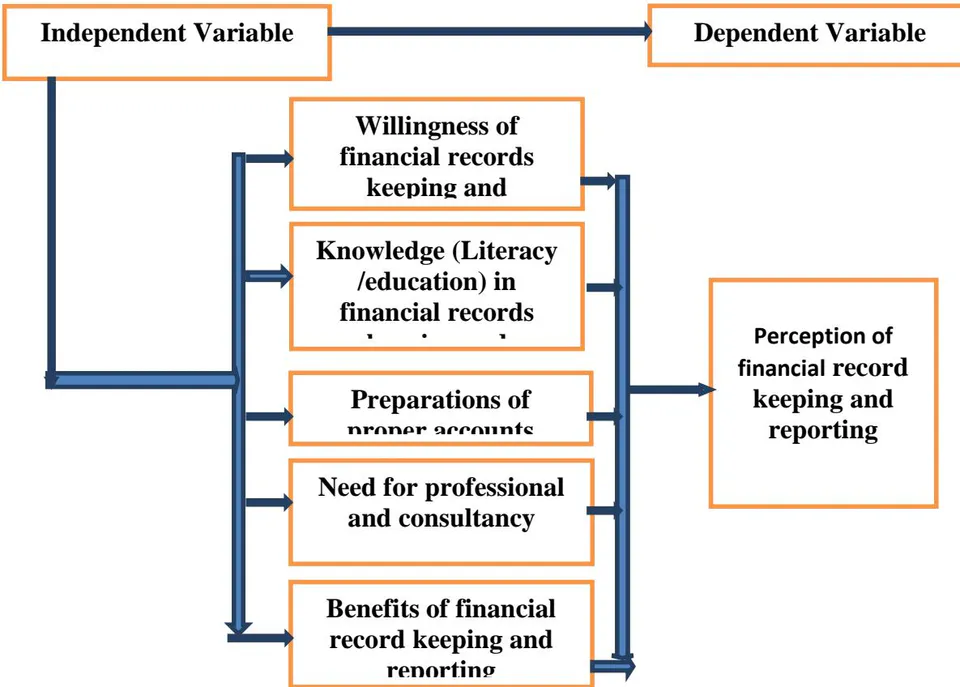
To assess MSE willingness of having financial records keeping and reporting.
To assess the MSE knowledge toward financial records keeping and reporting.
To analyze the preparations of proper accounts for financial records keeping and reporting.
To assess the need for professional and consultancy in financial records keeping and reporting.
To assess the perceived benefits of financial records keeping and reporting.
d) Research Question
The study will point on the following research questions:
How does MSE willingness toward having financial records keeping and reporting?
What is the MSE knowledge toward financial records keeping and reporting?
What is the practice of MSE in having proper accounts for financial records keeping and reporting?
How does the need for professional and consultancy for financial records keeping and reporting?
How does perceived benefits from financial records keeping and reporting?
e) Significant of the study
The study investigates the perception of MSE's owners or managers/employees in keeping records of their business operations. The findings of this study likely provide a more comprehensive picture of the current status of MSE's perceptions of recordkeeping, that lead to a better understanding of this phenomenon and thereby the development of more effective strategies to aid effective record keeping of the MSE's. Additionally, the findings contribute to bridging of the wide gap that exists between having and not having financial record, since it would suggest of ensuring MSE's toward recordkeeping and reporting practice. The information generated also helps for MSE promoters, research and development organizations, policy makers, government and MSE support institutions for their activities in designing of policies and strategies that facilitate the loan delivery for the MSE firms. Finally, the findings of the study may add theoretical and empirical literature to the body of knowledge in areas of financial record keeping by the MSE that practitioners and other researcher may use in their research work.
f) Scope and limitation of the study
This study was conducted based on data collected from the perception of the study participants or MSE owner, manger and employee which was subjective in responding about financial record keeping by the MSE firms which may lack objectivity on the data gathered. This study focused on perceptions of financial record keeping and reporting by the MSE's in selected four towns. According to, Germain, (2010) one major factor that has been blamed for the failure of the MSE's is poor or lack of knowledge in the financial record keeping and business financial management. Very few researches have been conducted in this area were this study will indeed undertake to fill the gap considering the selected four towns. For the purpose of investigation, the study has not determined other factors that may lead to weak financial record keeping MSE's.
CHAPTER TWO
II. LITERATURE REVIEW
a) Theoretical Literature
i. Definition of small and medium enterprise
Storey (1994) and Amoako (2012), argues that there is no single, uniformly acceptable, definition of small and medium entities. Thus, the definition of MSE varies and is dependent upon whose point of view (Taylor and Adair, 1994). In 1996, the European Commission established a new definition of small and medium enterprises based on four quantitative criteria (EC. 1996): a) The total number of employees in the enterprise;
b) The annual volume of the turnover;
c) The total of the assets in the enterprise balance; and d) The degree of independence of the enterprise or the ownership over it.
Consequently, the European commission (2003) defines MSEs as enterprises which employ fewer than 250 persons and/or have an annual turnover not exceeding EUR 50 million, and/or an annual balance sheet total not exceeding EUR 43 million.
In Asia, The Hong Kong Institute of Certified Public Accountants (2005) states that an entity is considered to be an MSE in Hong Kong so long as its total annual revenue is not more than HK50 million, at the reporting date with number of employees not more than 50.
The International Accounting Standards Committee Foundation (IASCF) (2007) also defines an MSE as an entity that is not obligated to public accountability and thus publishes general purpose financial statements for external users.
In Ghana, the most commonly used definition of MSEs is the number of employees of the enterprise. In applying this definition, however, there is some controversy in respect of the arbitrariness and cut off points used by the various official records (Amoako, 2012; Dalitso and Quartey, 2000).
ii. Importance of Bookkeeping in MSEs
Bookkeeping is the first essential step of accounting which as a system provide a source of information to owners and managers of MSEs operating in any industry for use in the measurement of financial performance. The importance of financial performance measurement to any business entity cannot be over-emphasized. In this sense, the accounting bases, concepts and principles adopted ought to capture and report all the relevant accounting information to ensure reliability in its measurement. Cooley and Edwards, (1983) contend that reported profits reflect changes in wealth of business owners. This can explain why major economic decisions in business are centered on financial performance as measured by profitability. Moreover, European Commission (EC), 2008) affirms that accounting information is important for a successful management of any business entity, whether large or small. It is therefore imperative that the accounting practices of MSEs source complete and relevant financial information needed to improve economic decisions made by entrepreneurs. In essence, accurate bookkeeping in MSEs is vital for the purpose of informing accounting in the enterprise.
Maseko and Manyani (2011) stipulate that Micro and Small business recordkeeping is the backbone of one's business. As much as it seems to be a laborious task for many, it will make or break one's business. Keeping accurate records is actually what creates a profitable business. In essence, one should not take MSEs recordkeeping lightly. Germain (2010) observes that most business operators especially those in MSE perceive recordkeeping as a chore that must be done to simply get back some much needed cash at the end of a particular period of time for example after an year. However, actually, accurate recordkeeping is not as important to many business operators. With this perspective, it is no wonder so many of these businesses fail from the beginning (Wanjohi (2012).
If one does not keep accurate and complete records the success of business will be threatened in many ways. For example one may end up paying more tax than is due because of lack of evidence of tax deductible expenditure or/and inaccurate sales. If one pays an accountant to prepare the business accounts they will charge based on how long it will take them. If one's records are more accurate this will reduce the time taken and therefore reduce the amount they charge, (Commonwealth of Australia 2010).
The aforementioned reasons are sufficient to ensure one keeps good books and records but the most important reason is to ensure one has control over the business and that one can assess its profitability and the cash flow situation therefore ensuring awareness of any potential problems as soon as possible and can make business decisions with all available information at hand. In order to achieve this crucial control of a business, one has to consider keeping accurate records. This leads one to find out which records must be kept for the purpose of the success of a business.
iii. Basic recordkeeping skills required for MSEs
MSEs Owners have many tasks. One of the most important and vital to the success of their business is keeping good records. According to Howard (2009) many small businesses fail to keep adequate records. This leads to major problems and quite possibly the closing of the business. Evidence shows that keeping good records helps increase the chances of business survival. In essence, the MSEs owners or manager should be personally involved in record keeping (Sian, 2006). Good record keeping will make them more aware of what is going on in their businesses and it will save them money.
The system used to record information may vary from business to business, but the principles are the same (Howard, 2009). According to Walistedt (1996) one must record all monies coming and going out of the business. The first action to take is to identify financial transactions. Look at how the business operates and identify how financial transactions are processed. The question the owner or manager need to ask is how he invoice customers and how the inventory is purchased.
This is followed by making a list of these transactions and the paperwork that supports them. One has to put a system in place for records and set up and operate a system that includes the following: Sales that is used to record invoices relating to sales, Purchases that is used to record invoices relating to purchases, Cash transactions that is used to record cash payments and receipts, Returns that is used to record credits given to customers and for goods returned and the General that is used to record other transactions.
Another key action of the manager or owner of the MSEs is to identify paid and unpaid items. One has to set up two files. One used to store the paid items and the other to store unpaid items. Decision should also be made when to write up entries where one has to set up a procedure for recording entries. Information should be recorded consistently and at set times. Daily is ideal, but one may be able to do it weekly or monthly, depending on the amount of transactions. One has to make sure that the records are being followed and set up and operate systems for checking and monitoring the recording of financial information. It is essential to make sure that an invoice has been issued for every transaction; that a receipt is requested and obtained for every purchase Zhou, 2010). It is also imperative to reconcile frequently once a month, reconcile the petty cash against receipts and even the bank statements. This will enable to check that all payments have reached the owner of the enterprise account.
iv. Determining Accurate Records in MSEs
In many countries, the laws mostly require that the Enterprises prepare financial statements and, often, have them audited. (EC, 2008). This requires that the owners of the enterprises have some knowledge of bookkeeping and accounting. Ismail and King (2007) conclude that the development of a sound accounting information in MSEs depends on the owners' level of accounting knowledge. Research has shown that majority of the MSEs owners do not have the required accounting knowledge and therefore few able owners use professional firms to account for their business (Keasy and Short, 1990; Bohman and Boter 1984).
However, Jayabalan and Dorasamy (2009) argue that the high cost of hiring professional accountants leaves the MSEs owner or managers with no option but to relegate accounting information management. Wichman (1983) concludes that accounting and marketing pose major challenges to management of MSEs and recommends that managers or owners in MSEs must learn about record keeping and accounting.
According to research, there are some basic financial records MSEs managers or owners need to keep for the success of a business. These basic records will normally include the sales day book (sales journal), purchases day book (purchases journal), cash receipt book, cheque payments book, petty cash book, general journal, nominal ledger, debtors' ledger and creditors' ledger. These according to McMahon, (1999) must be kept and maintained in a sound accounting arrangement. In essence, one has to ensure proper record of the following financial records: (i) a record of all business sales, with copies of any invoices one has issued, (ii) a record of all one's business purchases and expenses, (iii) invoices for all business purchases and expenses, (iv) details of any amounts one personally pay into or take from the business and (v) copies of business bank statements Entrepreneur or an accountant will use these records to create a profit and loss account which shows the sales income one received, and the expenses one paid, and what profit/loss one actually made.
Furthermore, since businesses are different, there are many specific types of detailed records that may need to be kept. Some examples of records one should keep include: cash book petty cash book, order notes and invoices, copy sales invoices, details of any other business income received, details of any private money brought into the business, till rolls or other form of electronic record of sales, details of any other income, any cash taken out of the till to pay small business expenses, bills and invoices for purchases and expenses, a record of stock on hand at the end of the year and all bank and building society statements, pass books, cheque stubs and paying-in slips which include details of business transactions. Perhaps cash flow is one of the major records in any enterprise. Germain (2010) asserts that small businesses must consider maintaining a positive cash flow as a vital element. A pertinent question one might ask at this point is; to what extent do the owners and managers of MSEs in Kenya keep good records of their business transactions? It would be helpful to curried out a study in Kenya in endeavor to answer this question.
v. Problems of small scale business
Small businesses often face a variety of problems related to their size. A frequent cause of bankruptcy is mismanagement of funds. This is often a result of poor accounting procedures rather than undercapitalization and economic conditions. Again, when they first start out, many small business owners under price their products to a point where even at their maximum capacity, it would be impossible to break even. Cost controls or price increases often resolve this problem. This requires accounting knowledge. Another problem for many small businesses is termed the 'Entrepreneurial Myth' or E-Myth. The mythic assumption is that an expert in a given technical field will also be expert at running that kind of business. Additional business management skills are needed to keep a business running smoothly.
vi. Reports Records
All businesses are obliged to keep financial reports which are generated from proper books of accounts which have accurately recorded the day-to-day transactions of the business. According to Henry & Co Accountancy Services the Purchases Book, Sales Book, Cash Book, Creditors Ledger, Debtors Ledger and General Ledger must be maintained and kept up-to-date. (www.henryco.ie/book_keeping)
vii. Financial Reports
Financial statements are means through which those in charge of the business entity report to stakeholders information about the entity's financial position, financial performance, and cash flows by providing information about its assets, liabilities, equity, income and expenses, other changes in equity, and cash flows. (Mirza and Halt, 2011).
Financial statements are generated by first organizing, and then analyzing numbers from the business activities. Understanding financial statements is essential to the success of a small business. They can be used as a roadmap to steer the business in the right direction and help to avoid costly breakdowns.
According to Mirza and Halt, the various financial statements that together would be considered a complete set of financial report include, Statement of Financial Position/ the balance sheet, the Income Statement/Profit and Loss Statement, the Statement of Cash Flows, the Statement of Changes in Owner's.
viii. Characteristics of financial statements
In his article, "The four main qualitative characteristics of financial statements", Victor D. said that the main objective of financial statements is to satisfy the information needs of a range of its users. He further stated that for financial statements and reports to achieve this objective they must possess specific characteristics; the four primary attributes are understandability, relevance, reliability and comparability. However, there are other qualitative characteristics of financial statements like consistency and fair presentation. These characteristics define what makes financial statements useful to the users. (Victor, 2012)
ix. Preparation and Reporting of financial statements
The International Accounting Standards Board (IASB) In July 2009 issued the International Financial Reporting Standards (IFRS) for the preparation and reporting of financial statements by Small and Medium-Sized Entities (IFRS for MSEs). This Standard provides an easy framework that can be applied by small business entities in place of the full set of International Financial Reporting Standards (IFRS), Mirza& Holt (2011). The standards are necessary for comparability both with the entity's financial statements of previous periods and with those of other entities. In view of this, the Small Businesses are required to follow the standards and guidelines of the IFRS in the preparation of the financial statements.
x. The effects of failure to prepare financial reports in MSE
No business can succeed in the long term without knowing exactly where its profits come from, what its expenses are and how much it is making and spending --it needs financial statements. The importance of good accounting records and financial statements to a small business cannot be over emphasized. Keeping good accounting records and financial statements are even more important for a small business than for other businesses. (www.helium.com).
A small business usually has few assets. Any crisis will sink it because it has nothing to fall back on. That is why proper bookkeeping and financial statements is a must for small businesses. Good accounting records will ensure that the financial statements of the business are readily available when required. A business' financial statements provide various financial information that business owners and creditors use to evaluate the business financial performance. Financial statements are also important to business managers because it helps them in running the business. (Way, 2007) But most small business or home-based-business entrepreneurs neglect any sort of financial statement, believing that their businesses are too small to need it. Without financial statements, decisions and daily activities of enterprises are based on guesses--not facts and thereby lead to the collapse of the enterprise.
b) Empirical Literature
In the 21st century, the critical roles Small and medium-sized enterprises (MSEs) play in economic growth and sustainable development of every nation cannot be over-emphasized especially for the rural economy (Maseko and Manyani, 2011; Tambunan, 2009). A major indicator of a booming economy is a vibrant Small and Medium Enterprises (MSEs) sub-economy and how efficient they contribute to GDP.
Cooley and Edwards, (1983) argue that MSEs must devise strategies of solving internal problems of managerial challenges that immensely retard their success. The internal factors are managerial skills, workforce, accounting systems and financial management practices. However, since the accounting department is perceived as a service unit to support the firm's operations by making available information on costs and performance indicators, a large number of business failures have been attributed to inability of financial managers to account properly the current assets and the current liabilities of their respective firms (Dodge & Robbins, 1992 and Ooghe, 1998).
Enterprises are categorized by size, sector and the motivations of their owners. There cannot be a universal means to the provision of services and policy formulation. As such it is argued that management techniques which are critical for large firms may not be appropriate for the small ones, yet some basic record-keeping and financial awareness are essential for their survival (Chittenden, Poutziouris, and Michaela, 1998).
Jarvis, Kitching, Curran, and Lightfoot (1996) also reported that the financial management skills of small business are not same as those of large ones. They found that personal and business goals of owner/mangers owner have diverse directions. These are forms an integral part in the strategies which they adopt and are, therefore, prominent in their firms" information systems. These personal business goals when not well tailored can render less time to the accounting and finance function. Nayak and Greenfield (1994) also empirically support the argument that micro firms lack signs of any systematic accounting practices.
A core function of accounting systems is to avail accurate information to owners and managers of MSEs operating in any industry for use in the measurement of financial performance. Consequently, the importance of financial performance measurement to any enterprise, big or small, cannot be over-emphasized (Padachi, 2012; Amoako et al, 2013). In other words, since profit maximization is most often the priority of business entities, the accounting bases, concepts and principles adopted ought to capture and report all the relevant accounting information to ensure reliability in its measurement (Haryana, 2012; Amidu and Abor, 2005; Mbroh and Atom, 2012).
Reported profits reflect changes in wealth of owners and this can explain why major economic decisions in business are centered on financial performance as measured by profitability, (Cooley and Edwards, 1983). It therefore doesn't come as a surprise when the European Commission (EC), 2008) established that appropriate accounting information is important for a successful management of any business entity, irrespective of the size.
Son et al. (2006) in conformity to previous studies found out that socioeconomic and domestic factors, such as the level of economic development, the legal and regulatory system, educational and professional infrastructure, colonial heritage, and history and culture, are likely to influence the relevance of small companies" financial information(UNCTAD, 2000; Saudagaran & Diga, 2003; Kosmala - MacLullich, Sikorska, & Gierusz, 2004; Sevic, 2004).
Staubus (1961, 1977) also promote the notion that a critical factor behind the identification of users and the uses of corporate financial information is "decision-usefulness" theory which states that accounting is described as a process of providing relevant information to the relevant decision makers (Gary, Owen, & Adams, 1996). Therefore Son et al., (2006) strongly suggest that the usefulness of financial information is ascertained by how it aids the users in making rational decisions, and the users' perspectives of the objective of the financial reporting also make it easier to choose accounting treatments.
Another finding is in support of the fact that daily decision making by owner/directors is most often based on accounting information. Furthermore taxation authorities also form part of users of the financial statements of small and medium size entities. However, accounting standard setting bodies also consider it on the general purpose of financial statements and exclude the specific needs of these two users (Son et al., 2006).
Carsberg, Page, Sindall, and Waring (1985) and Deakins & Husain (1994) indicated that financial statements of MSEs play important role in lending decisions of banks, in which banks are the main source of external finance to them. In Ghana, since there is no statutory requirement for the MSEs" financial information to be publicly disclosed, the numbers of users of the MSEs" financial reports are perceived to be limited.
On the issue of user needs, the use of profitability information according to Page (1984) is the core for MSEs externally reported information. Furthermore, the author realized that beside the profitability most of the respondents believed that the turnover of a company should be disclosed. In another study, the directors rated the disclosure of directors" emolument as the most insignificant disclosure requirement.
When it comes to limitations on the use of MSE financial reports, Son et al. (2006) found that the accounting expertise was viewed as the prime challenge to the use of financial information by the MSEs" directors. The researchers further argue that the directors perceived little benefits from the current reporting practices, because they did not understand the information and because the quality of information produced was low. As a result, the directors had a low awareness of cost-benefit considerations of reporting tasks.
c) Conceptual Framework
The following conceptual frame work is developed for the study.
CHAPTER THREE
III. RESEARCH METHODOLOGY
a) Research Design
The study design was a descriptive and explanatory research type. A descriptive survey attempts to describe characteristics of subjects or phenomena, opinions, attitudes, preferences and perceptions of persons of interest to the researcher (Bel, 2001). Moreover, a descriptive type aims at obtaining information from a representative selection of the population and from that sample the researcher is able to present the findings as being representative of the population as a whole (Mugenda and Mugenda, 1999).
The study was also guided by both qualitative and quantitative research approach.
b) Target Population
The target population of this study was MSEs found in the selected four towns. The owners and managers MSE was used as the respondent for this study to offer information majorly about the role accounting record keeping and financial reporting practices has played in their enterprises. Since enterprises can be managed by managers employed and by the owners (act as managers of their business) of the enterprise, were seen as most appropriate to give out the required information by this study. The total target population of this study is presented below:
| No. | Description | Nekemte town | Gimbii Town | Shambu town | Dembi Dolo Town | Total |
| 1 | Manufacturing | 317 | 84 | 22 | 41 | 464 |
| 2 | Construction | 406 | 305 | 43 | 31 | 785 |
| 3 | Agriculture | 17 | 23 | 14 | 8 | 62 |
| 4 | Dairy | 118 | 85 | 68 | 60 | 331 |
| 5 | Mineral | 3 | 6 | 4 | 7 | 20 |
| 6 | Service | 797 | 406 | 295 | 325 | 1823 |
| 7 | Trading | 637 | 341 | 326 | 368 | 1672 |
| Total | 2,295 | 1,250 | 760 | 840 | 5,145 |
c) Sampling method and sample size selection
Sampling is the process of selecting individuals for a study (McMillan and Schumacher, 1999). For the purpose of this study probability sampling techniques by using simple random sampling technique was used to sample the respondents. The total sample size was calculated using Slovin's sampling formula:
Where e is the level of precision, i.e., Population size; and n = sample size
d) Data Type, Source and Method of Data Collection
i. Data Type and Source
The necessary data required for this study was both primary and secondary data. Primary data was acquired through a questionnaire which is designed in linkert scale forms of structured type questioners. Secondary data was collected via books, articles, journals, publications, audited annual reports of the company under this study and internet sources of related materials.
ii. Method of Data Collection
The primary data was collected through self-administrative structure. The questioners was accessed to MSE's owners and manager through self-administration and data collector, since the entire respondents are found in selected four towns.
e) Model Specification
Different researcher uses different model in their analysis of the effect of explanatory variables on the dependent variables under investigation. In this study, for determining the severity and specificity of the independent variables over the dependent variable (financial record keeping and reporting) in the study, the following regression model is applied.
Where: FRKR = Financial record keeping and reporting which is a dependent variable in the study.
The explanatory or independent variable of the study used in the regression analysis includes:
Will= Willingness of financial record keeping and reporting.
Knw= Knowledge of financial record keeping and reporting.
PrAct= Proper account for financial record keeping and reporting.
ProfCon= Need for professional and consultancy for financial record keeping and reporting.
PerBen= perceived benefit for financial record keeping and reporting.
e = is the stochastic random term.
According to Greene (2012),, Homser and Lemeshow (2000), and Treiman (2009) multinomial (polytomous) logistic regression fits maximum likelihood models with discrete dependent variables when the dependent variable takes on more than two outcomes and the outcomes have no natural ordering. If the dependent variable takes on only two outcomes, estimates are identical to those produced by the logistic regression model which calculate the OR as a measure of the strengthens of the association between the outcome and a covariate.
To understand what means the perception of financial record keeping and reporting let as consider the dependant variable y coded into three outcomes:
1 = 'I have not yet started to use record keeping',
2= 'I have started but face difficult to use record keeping',
3= 'I have started to use record keeping', and x = the explanatory variable
In the multinomial model, the study estimates a set of coefficients: , , ... corresponding to each outcome as follow:
Setting to allow for the identifiability of the model, the equations become:
f) Method of Data Process, Presentation and Analysis
The qualitative data was organized and arranged according to the objectives of the study. The data collected was again coded, and organized into categories and labeled. The data collected was checked for completeness and consistency of the responses, edited and then entered in Statistical Package for Social Science (SPSS) version 20 software and STATA 10.0. Descriptive analysis and multinomial logistic regression model was employed for the data analysis. The descriptive parts analyzed the result of the study using frequency, percentages. The multinomial logistic regression and correlation between each explanatory variable is explained. Finally, interpretation of the data will be made. The data will be then to be presented in form of graphs and tables.
CHAPTER FOUR
IV. ANAYSIS AND PRESENTATION
a) Introduction
This chapter presents the study analysis and presentation. The chapter includes the study demographic information, the survey result referring to perceptions of financial records keeping and reporting practice by MSEs in Four Wollega zonal administrations.
b) Demographic information
This section presents the study demographic information concerning MSEs in Four Wollega zonal administrations.
| No. | Demographic information | Demographic information | Frequency | Percentage |
| 1 | Construction | 27 | 15% | |
| Trading | 2 | 1% | ||
| Agriculture | 11 | 6% | ||
| Dairy | 2 | 1% | ||
| Service | 63 | 35% | ||
| Manufacturing | 57 | 32% | ||
| Mineral | 16 | 9% | ||
| Total | 178 | 100% | ||
| 2 | Age of your business | 1 to 5 years | 26 | 15% |
| 6 years to 10 years | 112 | 63% | ||
| 11 years to 15 years | 34 | 19% | ||
| More than 16 years | 6 | 3% | ||
| 3 | Number of employees | One to five | 32 | 18.0 |
| Five to twenty | 102 | 57.3 | ||
| Twenty one to fifty | 39 | 21.9 | ||
| Above fifty | 5 | 2.8 | ||
| 4 | Manager of your business | The owner | 122 | 69% |
| Employed /salary manager | 48 | 27% | ||
| Someone else | 8 | 4% | ||
| 5 | Academic background | Under 12 Grade | 86 | 48% |
| Twelve complete | 52 | 29% | ||
| TVET/Diploma | 28 | 16% | ||
| BA/BSC and above | 12 | 7% |
Table 4.1 shows that 32% of the MSEs are Manufacturing, 15% of the MSEs are Construction, 1% of the MSEs are Trading, 6% of the MSEs are Agriculture, 1% of the MSEs are Dairy, 63% of the MSEs are Service and 9% of the MSEs are Mineral. This result indicates majority of the respondents are engaged in service and manufacturing.
Table 4.1 shows that 15% of the MSEs are owned by persons that are from 1 to 5 years old, 63% of the MSEs are owned and operated by young people from 6 years to 10 years old and 19% of the respondents are 11 years to 15 years and 3% are more than 16 years. Majority of MSE are below the age of 15 which means majority of the MSE owners are of the young generation, and of them 1.2% are in their teen age.
Table 4.1 shows that 15% of the MSEs have one to five employees, 63% of the MSEs have five to twenty employees, 19% of the MSEs have Twenty one to fifty employees and 3% of the MSEs have above fifty employees. This result indicates majority of MSE have employee more than five.
Table 4.1 shows that 69% of the MSEs are owner manager, 27% are employed manager/salary manager and 4% of the MSEs are someone else. This result indicates majority of MSE are managed by the owners.
Table 4.1 shows that 48% of the MSEs are under 12 grade, 29% of the MSEs are twelve complete, 16% of the MSEs are TVET/Diploma and 7% of the MSEs are BA/BSC and above. This result indicates majority of MSE are under 12 grades were they lack of having financial records keeping.
c) Perception of financial records keeping and reporting
This section presents the perception of financial records keeping and reporting in reference to their willingness, owners' literacy (education), preparations of proper accounts, hired professional and consultancy and benefits of recordkeeping by the MSE sample taken from four Wollega zonal administrations.
d) Willingness of FRKR
The study result and analysis concerning willingness 'of financial records keeping and reporting by MSEs is presented in the following table 4.2 below.
| No. | Description | Level of agreement | Descriptive statistics | ||
| F | % | Mean | |||
| 1 | Willing to have financial record keeping that make one more aware of what is going on in a business. | Strongly Disagree(1) | 7 | 3.9 | 4.17 |
| Disagree(2) | 14 | 7.9 | |||
| Undecided (3) | 1 | .6 | |||
| Agree (4) | 76 | 42.7 | |||
| Strongly Agree (5) | 80 | 44.9 | |||
| 2 | I believe that MSE business such as mine should keep accounting records being kept and maintained. | Strongly Disagree(1) | 107 | 60.1 | 1.97 |
| Disagree(2) | 29 | 16.3 | |||
| Undecided (3) | 2 | 1.1 | |||
| Agree (4) | 20 | 11.2 | |||
| Strongly Agree (5) | 20 | 11.2 | |||
| 178 | 100.0 | ||||
| 3 | Other concerned body like tax authority forces me rather than my own interest to have financial records keeping and reporting. | Strongly Disagree(1) | 8 | 4.5 | 3.78 |
| Disagree(2) | 32 | 18.0 | |||
| Undecided (3) | 5 | 2.8 | |||
| Agree (4) | 80 | 44.9 | |||
| Strongly Agree (5) | 53 | 29.8 | |||
| 178 | 100.0 | ||||
| 4 | I always recognize that financial records keeping and reporting is a tedious activity. | Strongly Disagree(1) | 25 | 14.0 | 3.29 |
| Disagree(2) | 40 | 22.5 | |||
| Undecided (3) | 0 | 0 | |||
| Agree (4) | 84 | 47.2 | |||
| Strongly Agree (5) | 29 | 16.3 | |||
| 178 | 100.0 | ||||
As it can be observed from the table above, majority of the respondents 156 (87.6%) did say agree, saying that they have the willingness of having financial record keeping that makes Micro and Small Enterprises more aware of what is going on in their businesses. The mean score of 4.17 also evidenced Micro and Small Enterprises have an interest towards having financial records and report. Hence, the result indicates that Micro and Small Enterprises have an interest to understand what is going on in the businesses by having record keeping and producing financial that reflect their financial operation.
Majority of respondent 136 (in percent 76.4%) are disagree, saying that I do not believe MSE business such as mine should keep financial records being kept and maintained. The mean of 1.97 also supports that they are disagreed with the statement. This result indicates MSE are in perception not having financial record and report practice at their current level of financial performance.
Again majority of respondent 133 (in percent 74.7%) are agree saying that other concerned body like tax authority forces me rather than my own interest to have financial records and reporting. The mean of 3.78 also supports that they are agreed with the statement. This result indicates that MSE are not initiated by themselves to have financial record and reporting practice. This shows they were rarely considered financial record and report practice is for their business concern, rather it is by the external push.
In addition, majority of respondent 113 (in percent 63.5%) are agree that they recognize financial record keeping and reporting is a tedious activity. The mean of 3.29 also supports that they are agreed with the statement. This result indicates that MSE are perceived financial record and reporting is a tedious activity.
e) Knowledge (education) in FRKR
The study result concerning MSE owners' or employee knowledge (education) in financial records keeping is presented in the following table 4.3 and analyzed below.
| No. | Description | Level of agreement | Descriptive statistics | ||
| F | % | Mean | |||
| 1 | I have some basic knowledge of bookkeeping and accounting that helps me to have records keeping and reporting of my business transaction. | Strongly Disagree(1) | 110 | 61.8 | 1.57 |
| Disagree(2) | 54 | 30.3 | |||
| Undecided (3) | 2 | 1.1 | |||
| Agree (4) | 5 | 2.8 | |||
| Strongly Agree (5) | 7 | 3.9 | |||
| 2 | I did not know what I'm doing and easily understand what is going on in my business. | Strongly Disagree(1) | 17 | 9.6 | 3.69 |
| Disagree(2) | 13 | 7.3 | |||
| Undecided (3) | 19 | 10.7 | |||
| Agree (4) | 111 | 62.4 | |||
| Strongly Agree (5) | 18 | 10.1 | |||
| 3 | I confirm that my business has been very successful even if I don't practice record keeping and reporting of my business. | Strongly Disagree(1) | 20 | 11.2 | 3.80 |
| Disagree(2) | 11 | 6.2 | |||
| Undecided (3) | 0 | 0 | |||
| Agree (4) | 101 | 56.7 | |||
| Strongly Agree (5) | 46 | 25.8 | |||
| 178 | 100.0 | ||||
| 4 | I look for knowledge at how the business operates and identify how financial transactions are processed. | Strongly Disagree(1) | 16 | 9.0 | 3.62 |
| Disagree(2) | 24 | 13.5 | |||
| Undecided (3) | 12 | 6.7 | |||
| Agree (4) | 86 | 48.3 | |||
| Strongly Agree (5) | 40 | 22.5 | |||
| 178 | 100.0 | ||||
As indicated in table 4.3, concerning their level of knowledge of bookkeeping and accounting majority of respondent 164 (in percent 92.1%) did say disagree. The mean score of 1.57 also shows the same. This result indicates majority MSE owner and employees have no basic knowledge of bookkeeping and accounting that helps them to have records keeping and reporting of their business.
In regards to understand and control what is going on in their business, majority of the respondent 129 (in percent 72.5%) did agree saying that, I face difficulty to easily understand and control what is going on in their business which causes to unable to have financial record and reporting.
Majority of the respondent 147 (in percent ) confirm that they agree saying my business has been very successful even if I don't practice record keeping and reporting of my business. The mean score of 3.80 also shows they agreed with the statement. This result indicates MSE are perceived that their business will proceed and successful even if they have no financial record promptly. This cause Micro and Small Enterprise financial record and reporting practice, to be odd till right now in four Nekemte zonal administrations.
Regarding knowledge, majority of the respondent 126 (in percent 70.8%) are agree saying I look for knowledge at how the business operates and identify how financial transactions are processed. The mean score of 3.62 also shows they agreed with the statement. This result indicates that, MSE are looking for the knowledge at which the business operates and identify how financial transactions are processed.
f) Preparations of proper accounts
The study result concerning preparation of proper accounting financial records keeping is presented in the following table 4.4 and analyzed below.
| No. | Description | Level of agreement | Descriptive statistics | ||
| F | % | Mean | |||
| 1 | My business keep accounting records, such as; purchase book, sales (receipt) book, expenditure (bills) book, payroll records and asset register. | Strongly Disagree(1) | 64 | 36.0 | 2.02 |
| Disagree(2) | 61 | 34.3 | |||
| Undecided (3) | 8 | 4.5 | |||
| Agree (4) | 20 | 11.2 | |||
| Strongly Agree (5) | 25 | 14.0 | |||
| 2 | My businesses consider no need to have separate account for different financial information in financial record keeping and reporting. | Strongly Disagree(1) | 18 | 10.1 | 3.69 |
| Disagree(2) | 26 | 14.6 | |||
| Undecided (3) | 3 | 1.7 | |||
| Agree (4) | 78 | 43.8 | |||
| Strongly Agree (5) | 53 | 29.8 | |||
| 3 | My business uses one account for all purpose to have practice of record keeping and reporting of my business. | Strongly Disagree(1) | 29 | 16.3 | 3.39 |
| Disagree(2) | 16 | 9.0 | |||
| Undecided (3) | 8 | 4.5 | |||
| Agree (4) | 106 | 59.6 | |||
| Strongly Agree (5) | 19 | 10.7 | |||
| 178 | 100.0 | ||||
As it can be observed from the table above, majority of the respondents 125 (70.3%) did say disagree, saying that they do not keep accounting records, such as; purchase book, sales (receipt) book, expenditure (bills) book, payroll records and asset register. The mean score of 2.02 also evidenced Micro and Small Enterprises not have different books of financial records. Hence, the result indicates Micro and Small Enterprises do not practiced keeping accounting records, such as; purchase book, sales (receipt) book, expenditure (bills) book, payroll records and asset register.
Majority of the respondents 131 (73.6%) did say agree that they consider no need to have separate account for different financial information in financial record keeping and reporting. The mean score of 3.69 also evidenced the same. Hence, the result indicates that Micro and Small Enterprises consider no need to have separate account for different financial information, were it must to keep a record of financial information accordingly in financial record keeping and reporting.
In addition, Majority of the respondents 125 (70.3%) did say agree that they uses one account for all purpose to have practice of record keeping and reporting of my business. The mean score of 3.39 also evidenced Micro and Small Enterprises do not need a separate account to have financial record keeping and reporting. Hence, the result indicates that Micro and Small Enterprises uses of one account for all purpose makes ineffective record keeping and reporting of their business financial operation.
g) Need for professional and consultancy in FRKR
The study result concerning hired professional and consultancy in financial records keeping is presented in the following table 4.5 and analyzed below.
| No. | Description | Level of agreement | Descriptive statistics | ||
| F | % | Mean | |||
| 1 | My business considers that It is waste of money to employ an accountant to help me to have financial record and reporting. | Strongly Disagree(1) | 17 | 9.6 | 3.76 |
| Disagree(2) | 10 | 5.6 | |||
| Undecided (3) | 21 | 11.8 | |||
| Agree (4) | 80 | 44.9 | |||
| Strongly Agree (5) | 50 | 28.1 | |||
| 2 | The use of consultants helps me to have practice of financial record and reporting of my business. | Strongly Disagree(1) | 38 | 21.3 | 2.49 |
| Disagree(2) | 85 | 47.8 | |||
| Undecided (3) | 8 | 4.5 | |||
| Agree (4) | 23 | 12.9 | |||
| Strongly Agree (5) | 24 | 13.5 | |||
| 3 | My business needs a periodic training to learn more about record keeping and reporting. | Strongly Disagree(1) | 14 | 7.9 | 3.75 |
| Disagree(2) | 18 | 10.1 | |||
| Undecided (3) | 8 | 4.5 | |||
| Agree (4) | 96 | 53.9 | |||
| Strongly Agree (5) | 42 | 23.6 | |||
| 4 | My business have not yet got concerned body that is responsible in providing a basic input how to practice financial record keeping and reporting. | Strongly Disagree(1) | 53 | 29.8 | 2.50 |
| Disagree(2) | 64 | 36.0 | |||
| Undecided (3) | 13 | 7.3 | |||
| Agree (4) | 15 | 8.4 | |||
| Strongly Agree (5) | 33 | 18.5 | |||
NB: Strongly Disagree refers to (1), Disagree refers to (2), Undecided refers to (3), Agree refers to (4), Strongly Agree refers to (5), F- refers to frequency,% - refers to percentage.
As it can be observed from the table above, majority of the respondents 130 (73%) did say agree that, they consider as a waste of money to employ an accountant to help them to have financial record and reporting. The mean score of 3.76 also evidenced Micro and Small Enterprises not need an accountant to have financial records. Hence, the result indicates that Micro and Small Enterprises do not hire a professional considers that it is waste of money to employ an accountant to help me to have financial record and reporting.
Again as s it can be observed from the table above, majority of the respondents 123 (68.1%) did say that they do not need to use of consultants to have financial record and reporting of their business. The mean score of 2.49 also evidenced the same. Hence, the result indicates that Micro and Small Enterprises do not require the use of consultants for financial record and preparation of legal financial reporting of their business.
Majority of the respondents 138 (77.5%) did say that my business needs a periodic training to learn more about record keeping and reporting. The mean score of 3.75 also evidenced the same. Hence, the result indicates that Micro and Small Enterprises needs a periodic training to learn more about record keeping and preparation of legal financial reporting of their business.
As it can be observed from the table above, majority of the respondents 117 (65.8%) did say that My business have not yet got concerned body that is responsible in providing a basic input how to practice financial record keeping and reporting. The mean score of 2.50 also evidenced Micro and Small Enterprises have not yet got concerned body that is responsible in providing a basic input how to practice financial record keeping and reporting. Hence, the result indicates that Micro and Small Enterprises have not yet got concerned body that is responsible in providing a basic input how to practice financial record keeping and reporting.
h) Perceived Benefits from FRKR
The study result concerning Benefits of recordkeeping in financial records keeping is presented in the following table 4.6 and analyzed below.
| No. | Description | Level of agreement | Descriptive statistics | ||
| F | % | Mean | |||
| 1 | Financial record keeping and reporting helps to understand and analyses the spending and revenue and in calculating my business profit. | Strongly Disagree(1) | 13 | 7.3 | 3.52 |
| Disagree(2) | 45 | 25.3 | |||
| Undecided (3) | 0 | 0 | |||
| Agree (4) | 75 | 42.1 | |||
| Strongly Agree (5) | 45 | 25.3 | |||
| 2 | Financial record keeping and reporting assists to know and back up a tax deductions to be paid to tax authority. | Strongly Disagree(1) | 1 | .6 | 4.06 |
| Disagree(2) | 30 | 16.9 | |||
| Undecided (3) | 10 | 5.6 | |||
| Agree (4) | 53 | 29.8 | |||
| Strongly Agree (5) | 84 | 47.2 | |||
| 3 | Financial record keeping and reporting ensures accuracy of each payroll period and amount, to make sure that each employee receives the proper amount. | Strongly Disagree(1) | 11 | 6.2 | 4.12 |
| Disagree(2) | 20 | 11.2 | |||
| Undecided (3) | 0 | 0 | |||
| Agree (4) | 82 | 46.1 | |||
| Strongly Agree (5) | 65 | 36.5 | |||
| 178 | 100.0 | ||||
| 4 | Having financial record keeping and reporting assist in making accurate report of current spending and revenue to help compare actual results with projections in the business budget. | Strongly Disagree(1) | 26 | 14.6 | 3.67 |
| Disagree(2) | 18 | 10.1 | |||
| Undecided (3) | 0 | 0 | |||
| Agree (4) | 77 | 43.3 | |||
| Strongly Agree (5) | 57 | 32.0 | |||
| 178 | 100.0 | ||||
NB: Strongly Disagree refers to (1), Disagree refers to (2), Undecided refers to (3), Agree refers to (4), Strongly Agree refers to (5), F- refers to frequency,% - refers to percentage.
As indicated in table 4.6, the respondents were asked financial record keeping and reporting helps to understand and analyses the spending and revenue and in calculating my business profit. Majority of the respondent (in percent%) did say agree. The mean score of 3.52 also evidences the same. The result indicates that, MSE are aware of the benefit of financial record keeping and reporting that helps to understand and analyses the spending and revenue and in calculating their business profit.
As indicated in table 4.6, the respondents were agree with financial record keeping and reporting assists to know and back up a tax deductions. The mean score of 4.06 also evidences the same. The result indicates that, MSE are financial record keeping and reporting assists to know and back up a tax deduction to be paid to tax authority.
As indicated in table 4.6, the respondents were agree with financial record keeping and reporting ensures accuracy of each payroll period and amount to make sure that each employee receives the proper amount. The mean score of 4.12 also evidences the same. The result indicates that, MSE are financial record keeping and reporting ensures accuracy of each payroll period and amount to make sure that each employee receives the proper amount.
As indicated in table 4.6, the respondents were agree with having financial record keeping and reporting assist in making accurate report of current spending and revenue to help compare actual results with projections in the business budget. The mean score of 3.67 also evidences the same. The result indicates that, MSE are having financial record keeping and reporting assist in making accurate report of current spending and revenue to help compare actual results with projections in the business budget.
i) Multinomial logistic Regression result The multinomial logistic regression result is shown below:
| Multinomial logistic regression | Number of obs = 178LR chi2(38) = 129.57Prob > chi2 = 0.0000Pseudo R2 = 0.4375 | |||||
| Log likelihood = -83.309855 | ||||||
| pfrkp | Coef. | Std. Err. | z | P>|z| | [95% Conf. Interval] | |
| 2 | ||||||
| w1 | -.709973 | .2932559 | -2.42 | 0.015 | -1.284744 | -.1352021 |
| w2 | .3895574 | .1938779 | 2.01 | 0.045 | .0095638 | .7695511 |
| w3 | .6711217 | .3643352 | 1.84 | 0.065 | -.0429621 | 1.385206 |
| w4 | .2862615 | .2990725 | 0.96 | 0.338 | -.2999098 | .8724327 |
| l1 | -1.785827 | .9357942 | -1.91 | 0.056 | -3.61995 | .048296 |
| l2 | -.0018027 | .2539423 | -0.01 | 0.994 | -.4995204 | .4959151 |
| l3 | .2827183 | .3420306 | 0.83 | 0.408 | -.3876494 | .953086 |
| l4 | -.0432676 | .251696 | -0.17 | 0.864 | -.5365827 | .4500474 |
| pa1 | -.1563346 | .2630563 | -0.59 | 0.552 | -.6719155 | .3592463 |
| pa2 | -.3290497 | .2713962 | -1.21 | 0.225 | -.8609764 | .202877 |
| pa3 | -.2223584 | .2759995 | -0.81 | 0.420 | -.7633075 | .3185908 |
| pc1 | .4649913 | .4161414 | 1.12 | 0.264 | -.3506309 | 1.280613 |
| pc2 | .2103695 | .2321985 | 0.91 | 0.365 | -.2447313 | .6654702 |
| pc3 | .0473682 | .2890587 | 0.16 | 0.870 | -.5191764 | .6139129 |
| pc4 | -.3142526 | .2228367 | -1.41 | 0.158 | -.7510044 | .1224993 |
| pb1 | .139412 | .2744681 | 0.51 | 0.611 | -.3985357 | .6773597 |
| pb2 | -.0681835 | .4173413 | -0.16 | 0.870 | -.8861575 | .7497904 |
| pb3 | -.3089824 | .4500565 | -0.69 | 0.492 | -1.191077 | .573112 |
| pb4 | .3740594 | .3378478 | 1.11 | 0.268 | -.28811 | 1.036229 |
| _cons | -1.768118 | 3.666613 | -0.48 | 0.630 | -8.954548 | 5.418313 |
| 3 | ||||||
| w1 | -.9180454 | .3397132 | -2.70 | 0.007 | -1.583871 | -.2522198 |
| w2 | .388813 | .2658288 | 1.46 | 0.144 | -.1322019 | .909828 |
| w3 | -.1853513 | .3193039 | -0.58 | 0.562 | -.8111754 | .4404728 |
| w4 | .4569218 | .3342703 | 1.37 | 0.172 | -.1982359 | 1.11208 |
| l1 | -1.303451 | .8333721 | -1.56 | 0.118 | -2.93683 | .3299288 |
| l2 | .7683354 | .565698 | 1.36 | 0.174 | -.3404123 | 1.877083 |
| l3 | 1.682115 | .5459052 | 3.08 | 0.002 | .6121608 | 2.75207 |
| l4 | .8989161 | .4935511 | 1.82 | 0.069 | -.0684262 | 1.866258 |
| pa1 | -.3158776 | .3784157 | -0.83 | 0.404 | -1.057559 | .4258035 |
| pa2 | -.2364627 | .3683406 | -0.64 | 0.521 | -.958397 | .4854716 |
| pa3 | -.08121 | .3091608 | -0.26 | 0.793 | -.687154 | .5247341 |
| pc1 | 2.113441 | .5875667 | 3.60 | 0.000 | .9618316 | 3.265051 |
| pc2 | -.2996611 | .4647535 | -0.64 | 0.519 | -1.210561 | .611239 |
| pc3 | .1301825 | .3384698 | 0.38 | 0.701 | -.5332061 | .793571 |
| pc4 | -.3839061 | .3329284 | -1.15 | 0.249 | -1.036434 | .2686215 |
| pb1 | .238556 | .4511179 | 0.53 | 0.597 | -.6456188 | 1.122731 |
| pb2 | -2.59416 | .6499883 | -3.99 | 0.000 | -3.868113 | -1.320206 |
| pb3 | -.2576668 | .5806552 | -0.44 | 0.657 | -1.39573 | .8803965 |
| pb4 | -.4976779 | .3778663 | -1.32 | 0.188 | -1.238282 | .2429265 |
| _cons | -4.868554 | 3.969955 | -1.23 | 0.220 | -12.64952 | 2.912415 |
From the above result, the Likelihood Ratio Chi-Square test (LR chi = 129.57) that for both equations (I have not yet started to use record keeping to I have started but face difficult to use record keeping and I have not yet started to use record keeping) that at least
Researchers own computation, (2017) one of the predictors' regression coefficient is not equal to zero.
The small p-value from the LR test, < 0.00001, would lead us to conclude that at least one of the regression coefficients in the model is not equal to zero.
Thus the model prob > chi = 0.0000 which proofs p-value from the LR test is < 0.0000.
Logistic regression does not have an equivalent to the R-squared that is found in OLS regression; rather pseudo-R-square statistics. Because this statistic does not mean what R-square means in OLS regression (the proportion of variance of the response variable explained by the predictors), we suggest interpreting this statistic with great caution.
Financial record keeping and reporting is the response variable in the multinomial logistic regression. Underneath financial record keeping and reporting are two replicates of the predictor variables, representing the two models that are estimated: I have started but face difficult to use record keeping relative to I have not yet started to use record keeping and I have started to use record keeping relative to I have not yet started to use record keeping.
In this instance, Stata, by default, set I have not yet started to use record keeping as the referent group, and therefore estimated a model for I have started but face difficult to use record keeping relative to I have not yet started to use record keeping and a model for I have started to use record keeping relative to I have not yet started to use record keeping. Since the parameter estimates are relative to the referent group, the standard interpretation of the multinomial logit is that for a unit change in the predictor variable, the logit of outcome m relative to the referent group is expected to change by its respective parameter estimate (which is in log-odds units) given the variables in the model are held constant.
The multinomial logit estimate for a one unit increase in the score for I have started but face difficult to use record keeping relative to I have not yet started to use record keeping, given the other variables in the model are held constant.
An increase in willing to have record keeping that makes to aware what is going on in my business score by one point, the multinomial log-odds for preferring I have started but face difficult to use record keeping relative to I have not yet started to use record keeping would be expected to decrease the perception of having financial record keeping by 0.389 unit while holding all other variables in the model constant.
An increase to believe MSE business like me should keeping record score by one point, the multinomial log-odds for preferring I have started but face difficult to use record keeping relative to I have not yet started to use record keeping would be expected to increase the perception of financial record keeping and reporting by 0.7099 unit while holding all other variables in the model constant.
The remaining explanatory variables are insignificant and checked whether the result is in line with the descriptive result analysis.
CHAPTER FIVE
V. CONCLUSION AND RECOMMENDATION
a) Summary of the Major Findings
Five independent variables were analyzed to look at the financial record keeping and reporting practice of MSE in four selected town of Wollega administrative zone. The major summary is presented as follow:
Willingness of FRKR In regard with willingness of FRKR the study result indicates that Micro and Small Enterprises have an interest to understand what is going on in their businesses by having record keeping and producing financial that reflect their financial operation. Result also indicates MSE are in perception of unforeseen financial record and report practice at their current level financial performance. In addition, result indicates that MSE are not initiated by them-selves rather it is by the external push to have financial record and reporting practice. Finally study result indicates that MSE are perceived financial record and reporting is a tedious activity.
Knowledge (education) in FRKR
The study result indicates MSE owner and employees have no basic knowledge of bookkeeping and accounting that helps them to have records keeping and reporting of their business. They also face difficulty to easily understand and control what is going on in their business which causes to unable to have financial record and reporting. In addition study result indicates MSE are perceived that their business will proceed and successful even if they have no financial record promptly. This cause Micro and Small Enterprise financial record and reporting practice, to be odd till right now in four Nekemte zonal administrations. The study result also indicates MSE are looking for the knowledge at which the business operates and identify how financial transactions are processed.
▶ Preparations of proper accounts
Concerning preparations of proper accounts the study result indicates Micro and Small Enterprises do not practiced keeping accounting records, such as; purchase book, sales (receipt) book, expenditure (bills) book, payroll records and asset register. In addition the result indicates that Micro and Small Enterprises consider no need to have separate account for different financial information and uses of one account for all purpose, makes ineffective record keeping and reporting of their business financial operation.
Need for professional and consultancy in FRKR
The result indicates that Micro and Small Enterprises do not hire a professional considering that it is waste of money to employ an accountant to help them to have financial record and reporting. The result also indicates that Micro and Small Enterprises do not require the use of consultants for financial record and preparation of legal financial reporting of their business. The result indicates that Micro and Small Enterprises needs a periodic training even though they have not yet got concerned body that is responsible in providing a basic input how to practice financial record keeping and reporting.
▶ Perceived Benefits from FRKR In regard to perceived benefits, the result indicates that, MSE are aware of the benefit of financial record keeping and reporting that helps to understand and analyses the spending and revenue and in calculating their business profit. The result indicates that, financial record keeping and reporting assists to know and back up a tax deduction to be paid to tax authority. The result indicates that, MSE financial record keeping and reporting ensures accuracy of each payroll period and amount to make sure that each employee receives the proper amount. The result indicates that, MSE are having financial record keeping and reporting assist in making accurate report of current spending and revenue to help compare actual results with projections in the business budget.
b) Recommendation
The study forewords the following recommendation:
The governments have to provide an understanding of the need for financial record keeping in order make Micro and Small Enterprise to keep financial record by the will of them-selves than external push. Having this understanding also makes Micro and Small Enterprise to consider record keeping is simple task than tedious activity.
Micro and Small Enterprise owners have to learn how to have record keeping through short term training as one part of its operational activity. The government, especially MSE office, tax authority and academic institution have to work in providing the knowledge of financial record keeping through minimum training means.
Micro and Small Enterprise owners need to hire a professional in order to have a full flagged financial record keeping. In addition, if this makes in effective record keeping MSE need to use of consultants for financial record and preparation of legal financial reporting.
The governments have to develop the suitable record keeping guidance which will be easier and simple to understand with such sector. This guidance system may goes together by establishing a record keeping be legal mandatory to all MSEs business.
Micro and Small Enterprise have to make a separate record keeping for proper account as per the type of business transaction occurred rather than one account for all records.
APPENDIX 1: QUESTIONNAIRES
This questionnaire is on the subject "to assess the perception of financial records keeping and reporting practices of MSE's in selected towns of four zones (East Wollega, West Wollega, Kelem Wollega and Horo Guduru Wollega). Your honest and objective answers to the following questions will be highly appreciated and acknowledge. The information supplied will be treated in utmost confidentiality and use mainly for the purpose in which the study is intended.
Part One: Demographic Information
| Manufacturing | () | ||
| Construction | () | ||
| Trading | () | ||
| 1 | Types of business (MSE) | Agriculture | () |
| Dairy | () | ||
| Service | () | ||
| Mineral | () | ||
| Total | () | ||
| 2 | Age of your business | 1 to 5 years | () |
| 6 years to 10 years | () | ||
| 11 years to 15 years | () | ||
| More than 16 yearsOne to five | ()() | ||
| 3 | Number of employees | Five to twenty | () |
| Twenty one to fifty | () | ||
| Above fifty | () | ||
| 4 | Manager of your business | The owner | () |
| Employed /salary manager | () | ||
| Someone else | () | ||
| 5 | Academic background | Under 12 Grade | () |
| Twelve complete | () | ||
| TVET/Diploma | () | ||
| BA/BSC and above | () | ||
Part Two: Survey Questioner
- What do you say about your financial record-keeping and reporting practice?
I have not yet started to use record keeping () i have started but face difficult to use record keeping ()
I have started to use record keeping
- Please rate your level of agreement by ticking in the column provided after you understood the question asked below:
| No. | Items | Level of agreement | ||||
| Perception of financial records keeping and financial reporting | SD(1) | D(2) | U(3) | A(4) | SA(5) | |
| Willingness of records keeping | ||||||
| 1 | Willing to have financial record keeping that make one more aware of what is going on in a business. | |||||
| 2 | I believe that MSE business such as mine should keep accounting records being kept and maintained. | |||||
| 3 | Other concerned body like tax authority forces me rather than my own interest to have financial records keeping and reporting. | |||||
| 4 | I always recognize that financial records keeping and reporting is a tedious activity. | |||||
| Knowledge (education) in financial records keeping | ||||||
| 1 | I have some basic knowledge of bookkeeping and accounting that helps me to have records keeping and reporting of my business transaction. | |||||
| 2 | I did not know what I'm doing and easily understand what is going on in my business. | |||||
| 3 | I confirm that my business has been very successful even if I don't practice record keeping and reporting of my business. | |||||
| 4 | I look for knowledge at how the business operates and identify how financial transactions are processed. | |||||
| Preparations of proper accounts | ||||||
| 1 | My business keep accounting records, such as; purchase book, sales (receipt) book, expenditure (bills) book, payroll records and asset register. | |||||
| 2 | My businesses consider no need to have separate account for different financial information in financial record keeping and reporting. | |||||
| 3 | My business uses one account for all purpose to have practice of record keeping and reporting of my business. | |||||
| Need for professional and consultancy | ||||||
| 1 | My business considers that It is waste of money to employ an accountant to help me to have financial record and reporting. | |||||
| 2 | The use of consultants helps me to have practice of financial record and reporting of my business. | |||||
| 3 | My business needs a periodic training to learn more about record keeping and | |||||
PERCEPTIONS OF FINANCIAL RECORDS KEEPING AND REPORTING PRACTICES AMONG MICRO AND SMALL ENTERPRISES' A CASE OF WOLLEGA ZONAL ADMINISTRATION - WESTERN OROMIA REGION
| reporting. | ||||||
| 4 | My business have not yet got concerned body that is responsible in providing a basic input how to practice financial record keeping and reporting. | |||||
| Benefits of recordkeeping | ||||||
| 1 | Financial record keeping and reporting helps to understand and analyses the spending and revenue and in calculating my business profit. | |||||
| 2 | Financial record keeping and reporting assists to know and back up a tax deductions to be paid to tax authority. | |||||
| 3 | Financial record keeping and reporting ensures accuracy of each payroll period and amount, to make sure that each employee receives the proper amount. | |||||
| 4 | Having financial record keeping and reporting assist in making accurate report of current spending and revenue to help compare actual results with projections in the business budget. |
Please specify concerning financial record keeping and reporting issues