I. INTRODUCTION
Let be a graph, where is the set of its vertices and is the set of its edges. Two distinct vertices are called independent if is not an edge in . Two vertices are called neighbors (adjacent) if is an edge in . The degree (valency) of a vertex is the number of edges with the vertex as an end point. A graph with no loops or multiple edges is called a simple graph. A graph is said to be connected if every pair of vertices has a path connecting them otherwise the graph is disconnected. A graph is called induced subgraph of if and is an edge in wherever and are distinct vertices in and is an edge in , is called proper if . A cycle graph is a graph that consists of a single cycle, or in other words, some number of distinct vertices connected in a closed chain. The cycle graph with vertices is denoted by . The number of vertices in equals the number of edges, and every vertex has degree 2. The wheel graph or -wheel is a graph that contains a cycle of order , and for which every graph vertex in the cycle is connected to one other graph vertex which is called the hub. A bipartite graph is a graph whose vertex set can be split into two sets A and B in such a way that each edge of the graph joins a vertex in A to a vertex in B. A vertex coloring of a graph is a way of coloring the vertices of the graph such that no two adjacent vertices share the same color. A clique of a graph G is a maximal complete subgraph. In this case each pair of vertices of the clique are adjacent. The clique number of a graph is the number of graph vertices in the largest clique of G, [8]. The clique number of a cycle graph , n odd is 3 and 2 otherwise. For a wheel graph , n is even the clique number is 4 and is 3 otherwise. The chromatic number of a graph G is the smallest number of colors needed to color the vertices of a graph G so that no two adjacent vertices share the same color, and is often denoted by . A graph G is called perfect if for every induced subgraph H of G, . Note that if G is a perfect graph, then every induced subgraph of G is also perfect,[2].
II. PERFECT FOLDING
Definition (2-1)
Ref
Let and be two simple graphs and be continuous map. Then is called a graph map, if (i) For each vertex , is a vertex in .
(ii) For each edge , , [3].
Definition (2-2)
A graph map is called a graph folding if and only if f maps vertices to vertices and edges to edges, i.e., if (i) For each vertex , is a vertex in .
(ii) For each edge , is an edge in , [4].
Note that if the vertices of an edge are mapped to the same vertex, then the edge e will collapse to this vertex and hence we cannot get a graph folding. In other words, any graph folding cannot maps edges to loops but it may map loops, if there is any, to loops.
Definition(2-3)
Let and be simple connected graphs. We call a graph folding perfect folding if its image is a perfect subgraph of .
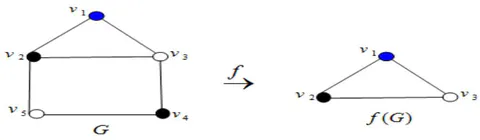
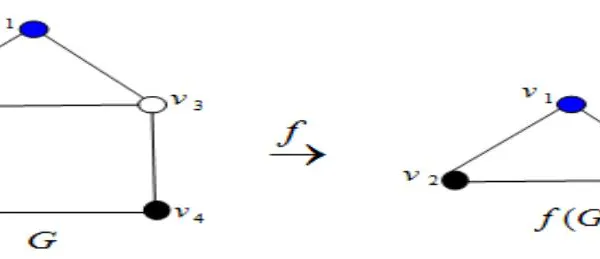
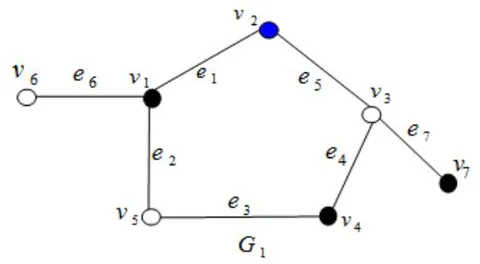
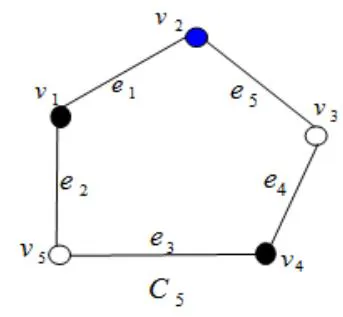
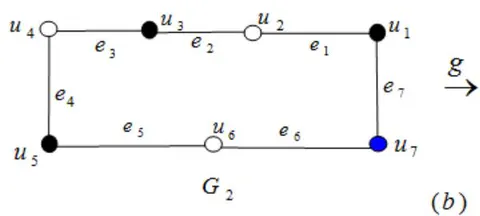
In general the image of a graph folding is not a perfect graph e.g., if is the imperfect graph shown in Fig.(1-a), where and . Then the graph folding defined by and is not a perfect folding. While if we consider the imperfect graph shown in Fig.(1-b), where and .
Then the graph folding defined by and is a perfect folding. The omitted vertices and edges in this example and through the paper will be mapped to themselves.
Theorem (2-4)
Let G be a simple connected graph such that the number of . If the chromatic number is equal to two, then G can be perfectly folded.
Proof From [5], any simple connected graph G such that and can be folded to an edge. In this case , and thus the graph G can be perfectly folded to an edge.
Example (2-5)
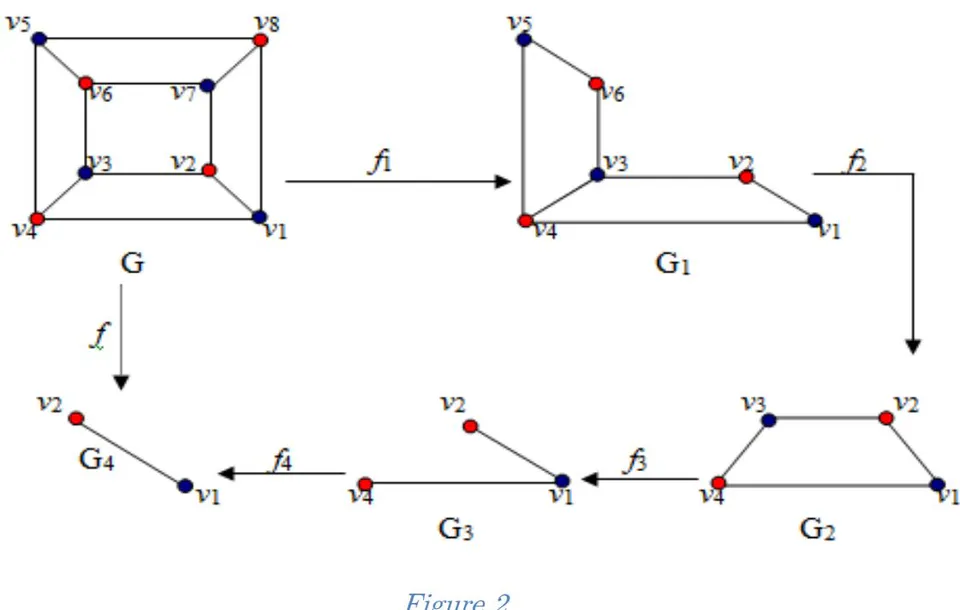
The cubic graph G with , shown in Fig. (2) can be folded to an edge by the graph folding . This folding can be done by the composition of a sequence of foldings and , see Fig.(2). And hence the graph folding is a perfect.
Any folding of a bipartite graph (complete) is a perfect folding. Proof
This follows from the fact that the chromatic number of a bipartite graph is equal to two, and thus it can be perfectly folded.
Example (2-7)
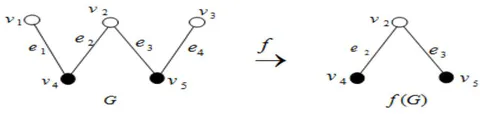
Consider the bipartite graph G shown in Fig.(3). A graph folding defined by and is a perfect folding.
The chromatic number of a cycle graph , n > 2 where n is odd is 3 while that for n even is 2, [1].
Theorem (3-1)
Any folding of a cycle graph of an even number of edges is a perfect folding.
Proof
This follows from the fact that , n is an even number is equal to two. Thus can be perfectly folded.
Example (3-2)
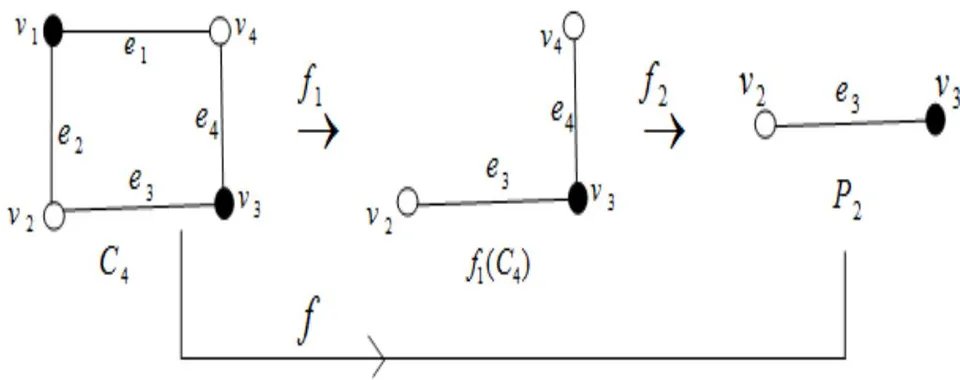
Consider the cycle graph where , the graph folding defined by and , i=1,2,4 is a perfect folding, see Fig.(4).
It should be noted that the cycle graph cannot be folded, [4].
Theorem (3-3)
Let , be a cycle graph of an odd number of edges (vertices). Then can be perfectly folded to .
Since has an odd number of edges (vertices). Thus the graph has three color classes, say , and . We can color the vertices of alternatively with the two colors of and except the last two edges one will join a vertex colored by the color of and a vertex colored by the color of and the other edge will join a vertex colored by the color of and a vertex colored by the color of . Thus the number of vertices of color class the number of vertices color class
, but has only one vertex w. We can define a graph folding , n is odd, by mapping vertices of to a vertex of , say u, and mapping the vertices of to a vertex of , say v, finally mapping w into itself. Thus we have three vertices u, v, w and hence three edges in the image i.e., we have . But , i.e., the graph folding f is perfect.
Example (3-4)
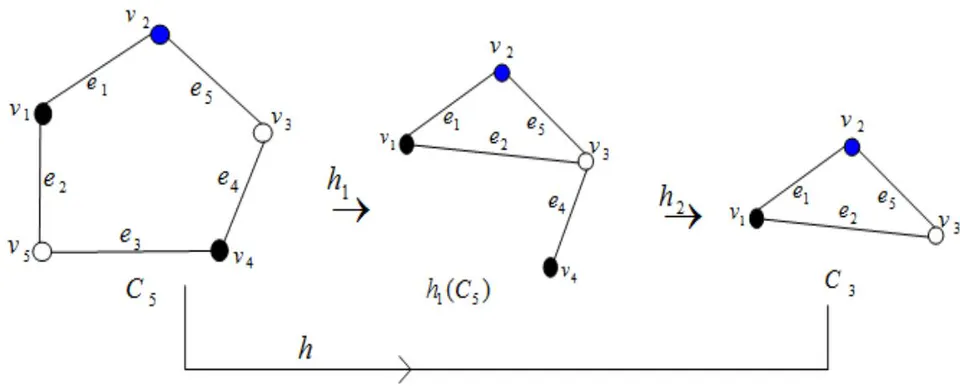
Let and be the graph folding defined by and , is a perfect folding, see Fig.(5). This can be done by the composition of the two graph foldings defined by , and defined by , .
The chromatic number of a wheel graph if n is odd is 3 and 4 if n is even, [1].
Theorem (4-1)
Any wheel graph of an odd number of vertices can be perfectly folded to .
A wheel graph of order n, n is an odd number, is a graph that contains a cycle of even order n - 1, and each vertex in the cycle is
Ref connected to the hub. In this case the chromatic number , thus the graph can be colored by using three colors A, B and C. One color for the hub, say A, and the vertices of the even cycle can be colored alternatively with two colors B and C, i.e., if the set of vertices of the cycle is , then the colors B and C have the following vertices, and . Now we can define a graph folding by mapping the vertices of B to a vertex of B, the vertices of C to a vertex of C and the hub onto itself. The image of this map will contain three vertices, three edges and thus we have , i.e., the graph folding is perfect.
Example (4-2)
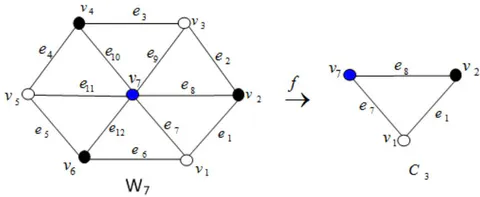
Consider the wheel graph and the graph folding defined by , i=3,5, , j=4,6 and , k=1,...,12. This graph folding is perfect, see Fig.(6).
It should be noted that the wheel graph of an even number of vertices cannot be folded, [4], and hence cannot be perfectly folded.
V. THE CLIQUE NUMBER AND PERFECT FOLDING
The chromatic number of any graph is equal to or greater than its clique number, i.e., . For connected graphs , where n is the number of vertices of the graph G, [7].
Theorem (5-1)
Let G be a simple connected graph, if the clique number equal to the chromatic number equal to 2 and , then the graph G can be perfectly folded.
It is immediately follows from Theorem (2-4) and since , then G can be perfectly folded.
Example (5-2)
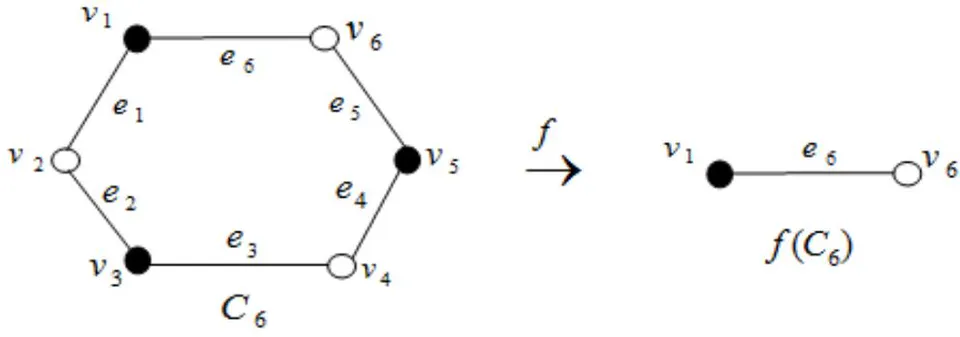
Consider the cycle graph shown in Fig.(7). A graph folding defined by and , is a perfect folding.
Theorem (5-3)
Let be a simple connected graph such that no. . If , then the graph can be perfectly folded to a clique of order .
Proof
Let , then we have a maximal complete subgraph of vertices. This complete graph cannot be folded, [3]. These vertices must be colored by different colors . Now the other vertices of , will be colored by the colors , in such a way that any edge will joins two vertices of different colors. So we can define a sequence of graph folding , where , , , by mapping the vertices to other vertices but of the same color, until we get the -clique which cannot be folded any more. And hence , i.e., the graph folding is a perfect.
Example (5-4)
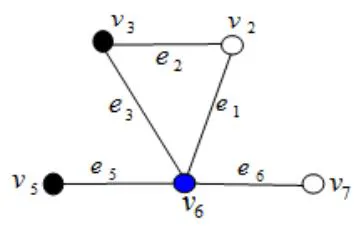
Consider the house graph G with 5 vertices and 6 edges shown in Fig.(8), where . This graph can be folded to a triangle by the graph folding defined by which is a perfect folding.
Notes