
I. INTRODUCTION
Face recognition systems (FRS) is a biometric identification mechanism, like other methods such as (fingerprint, voice recognition, iris recognition and handwritten recognition), is shown to be more important both theoretically and practically [1,2]. Face is a complex multidimensional structure and needs good computing techniques for recognition. To find out exact identity of any person, face recognition is very essential technology. Can recognize a number of faces learned throughout our lifespan and identify that faces at a glance even though that persons became old in age. There may be variations in faces due to aging and distractions like beard, glasses or change of hairstyles [3,4,5,6]. Face detection from a single image or sequence of image is a challenging task, because of the variance in size, orientation, color, expression, occlusion, and luminance of image, to build a fully automated system that extracts information from images of human faces, it is essential to develop efficient algorithms to detect human faces. The primary objective of facial discovery algorithms is to determine whether there is any face in the picture or not. Recently, a lot of the studies work in facial recognition and facial detection has been suggested to make it more progressive and accurate, but it is revolutionizing in this area when a real-time facial detector, able to discover faces in real-time accurately [7].
II. PROPOSED SYSTEM
The proposed system of this paper were based on the tries to recognize the input image by matching it with existing images (data base), by selecting the stage of image acquisition (Acquired), extracting the face image from the total image (Detection), aligning stage and image standardization (adjusting the angle of the face By camera angle) (Alignment), extraction of important features of the image (Extract), The stage of matching between the desired image and the image store (Matching) and The stage of issuing the report is closer to the image or no report (Report), this steps illustrated in figure 1.

Systems and techniques of FRS are a subset of an area related to information security. Information security is concerned with the assurance of confidence, integrity, and availability of information in all forms. Some many tools and techniques can support the management of information security; however, one of the important issues is the need to authenticate a person correctly. Traditionally the use of passwords and a Personal Identification Number (PIN) has been employed to identify an individual. Still, the disadvantages of such methods are that someone else
may use the PIN for unauthorized access or the PIN may be easily forgotten. Many agencies are now motivated to improve security data systems based on body or behavioral characteristics, often called biometrics. Biometric approaches aim to identify an individual by his unique physical characteristics and biological traits. Given these problems, the development of biometrics approaches such as face recognition, fingerprint, and voice recognition proves to be a superior solution for identifying individuals over that of PIN codes. Using of biometric techniques not only uniquely identifies an individual, but also minimizes the risk of someone else using the unauthorized identity.
III. METHODOLOGY
Our work aims to improve the performance enhancement of the face recognition algorithm using
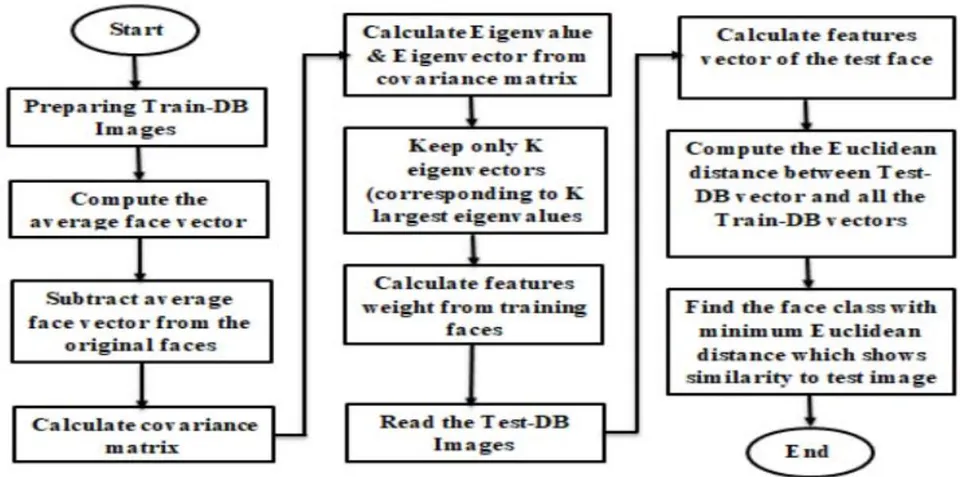
PCA by increasing the number of PCs including one dimensional value for face recognition. Experiments were carried out using MATLAB. The investigation was used to adjust the best number of images for each individual to be used in the training set, that gives the highest percentage of recognition. the highest matching ratio was made by multiples of images in the training set for each person. In this experiment, the number of PCs in the test database was increased by ten images per person in the training database as provided by the experiment. We change the PCs, trying to decide the best matching. PCA flow chart for feature extraction process can be seen in figure (2).
IV. RESULTS
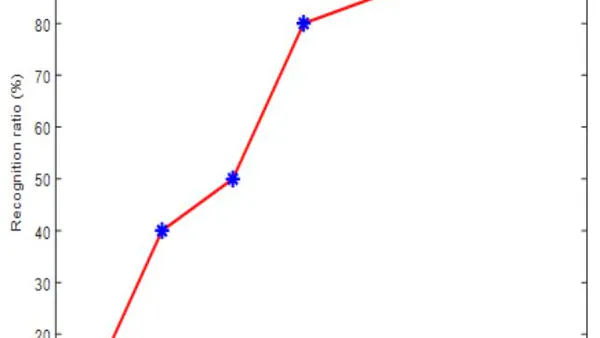
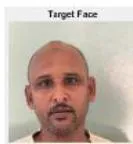
Six tests are considered for different Principal Components. In each test, different faces were matching depending on the PCs. as shown in figures and table below.
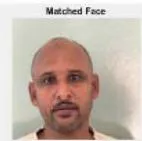














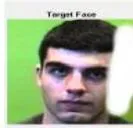










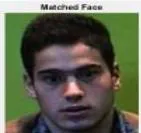











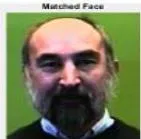
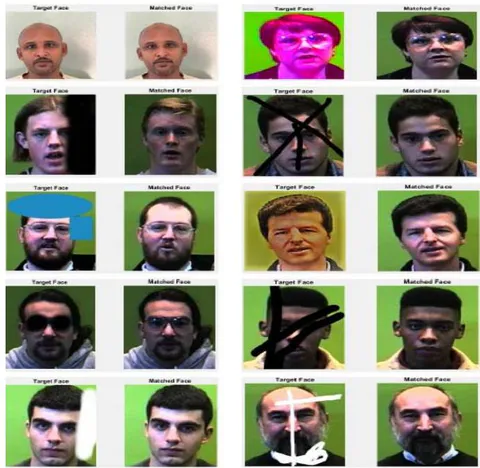
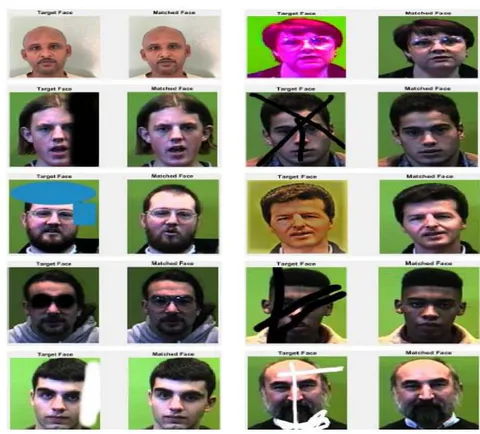
# Number of PCs Number of Matching Face Recognition Ratio (%) 1 1 1 10 2 3 4 40 3 5 5 50 4 7 8 80 5 11 9 90 6 15 10 100 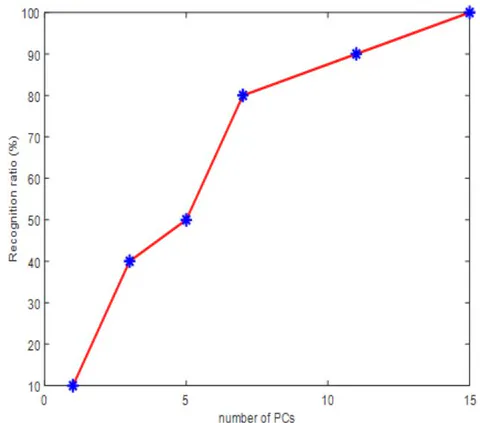
V. DISCUSSION
Increasing the number of images for each person in the training set were get best recognition rate, by comparing the results of the experiments, the enhanced algorithm gives high recognition ratio when the PCs were increased.
VI. CONCLUSION
This paper discusses how to augment the PCA feature with the selected optimization method by increasing the PCs to improve the accuracy of face recognition models. Enhancement is one of the most useful tools that can be used in image processing and, in particular, in areas such as object matching. This paper aims to optimize the face recognition using the PCA algorithm, by increasing the PCs and number of images in the training set. Our enhanced algorithm reduces the participated eigenvectors in the algorithm to reduce the computation time. Increasing the number of images for each person in the training set to get the best recognition rate causes a long computational time, which increased exponentially with the database size. By comparing the results of the experiments the improved algorithm gives a reduction of the recognition ratio when the PCs is smaller, while the enhanced algorithm shows noticeable improvement and gives considerable increase of the recognition ratio when increasing the PCs. Future work will focus on success and increasing the face recognition rate for huge databases. To improve the results, the algorithms for face recognition could be upgraded to detect multiple faces in the same image. We will try to develop a system using a video camera that will work with real-time face recognition.