I. INTRODUCTION
For several years, researchers and engineers have made advances through scientific technique and theories to develop an approach to control inherently existing engineering problems. Soil stabilization is one the numerous methods and techniques that has emerged to fit into the inadequacy. Soil stabilization is the technique of improving individual soil characteristics by various process viz chemical and mechanical in order to give rise to the required engineering soil properties. In general, soils are stabilized to enhance their strength and resilience. The characteristic properties of soil differ in a large amount from place to place or in a definite occasion at a single place. The process of soil stabilization rely on soil testing to determine the natural soil performance. Several techniques are used to stabilize soil and the methods are confirmed in the lab with the soil material prior to putting it in use in the field. Soil stabilization is a significant method used to enhance the characteristic behavior of a soil. This is often carried out when the necessary engineering characteristics required for the soil to be used are not met or an additional enhancement is necessary to attain a needed use.
Norazlan et al. (2014) stated that soil stabilization is the medium of improving the engineering and other components of the soil which includes the compressibility, conductivity of hydraulics, rigidity of strength and density. Techniques connecting to soil stabilization can be grouped in many methods these include vibration, surcharge load, building up support for structures, grouting and other methods. Different approach can be used for separate purposes (Ozawa and Ōsawa 2006). Ground treatment can improve the bearing capacity of the soil, lowers the likelihood of differential-based settlement, lowers the rate of settlement turn out, decrease the potential of liquefaction with saturated fine sand, hydraulic fills, reduce the hydraulic favorableness, water confinement, and water discharge of the soil (Zhang et al. 2007; Majeed and Taha 2012).
Soil Stabilization can be described as the remodeling of soil properties and characteristics by physical, chemical or non-chemical means, in order to facilitate the improvement of the soil behavior. Soil stabilization enhances the bearing strength and capacity of the soil, its reluctance to weathering process and soil perviousness. The durability and sound functioning of any construction project hinges on the strength of the primary material lying below. Expansive soils can generate remarkable complication for pavements or structures. Therefore, soil stabilization approach is mandatory to ascertain the firmness and stability of soil so as to efficiently carry the load of the structure.
Soil stabilization is also used in lowering the compressibility and permeability of the soil, make it more hardened, reinforce the bearing capacity and to improve the shear strength. The basic fundamentals of soil stabilization is applied to regulate the grading and particle size distribution of particles of foundation bases and sub-bases for airfields and highways. Scientist and researchers have implemented several techniques and binders which are extremely costly at moment in Nigeria's market. For instance, binders such as cement, (Osinubi 1999), lime (White 2005; Awasthi et al. 2009), fly ash (White 2005), bitumen (Osinubi 2000), cement kiln dust (Osinubi et al. 2009) etc. have been utilized to enhance the engineering properties soil. Moreover, result from several researches have revealed also that non-convectional binders such as silicates (Osinubi et al. 2009) chlorides (White et al. 2005) have been utilized in different percentages and have accomplished its intended purpose. Fiber reinforcements (Sherwood 1993) and polymers have also appear to be effective in the stabilization of engineering soil. Other researchers have also reported the on the use of admixtures and binders like rice husk ash, bagasse ash, egg-shell ash, palm kernel ash, palm bunch ash, etc. in their varying proportions in stabilizing weak and problematic engineering soil (Feynman 1960). Several studies have been centered on the use of several additives as stabilizers. Conventional materials like lime, cement, and minerals like silica fume, fly ash, and rice husk ash have been used for the enhancement of soil (Hussin et al. 2009; Hossain and Mol 2011).
The current investigation was borne out on the increasing cost of traditional materials, the demand to raise the bonding, the surface reactivation for soil, the demand to clear the surroundings of unwanted solid waste and transform it into usable engineering materials and the need to utilize low cost industrial and agricultural waste into valuable engineering use. This research is aimed at studying the stabilization potentials, performance and interaction of granite dust, dolerite dust and wood. The study area lies within Longitude 3°23′29.627′′E and Latitude 6°53′1.217′′N on the Sagamu–Papalanto highway in Ogun State Southwestern Nigeria. The road stretches up to 60km long. It serves as routes to other cities like Ewekoro, Ibese, Ifo, Lagos -Ibadan express way and other part of the country. The studied area is located on sedimentary Formation of the southwestern Nigeria. It is underlain by the basement complex (Adegoke et al. 1976). It belongs to the Ewekoro Formation which is Tertiary formed during the Paleocene and Eocene period. This also forms a greater depression of the artesian basin for groundwater formation. It is mostly made up of shale/clay (Ubido et al. 2017; 2018). The purpose of this research is aimed at assessing the impact of granite dust, dolerite dust and woodash as additives at varying proportions of 6, 12, 18 and 24% on the lateritic soil of Sagamu-Papalanto Highway.
II. MATERIALS AND METHODS
Disturbed soil sample was collected using an auger taken at depth of 2.5m from an open pit. The sample was in an air-tight sack bag so as to retain its natural moisture. The soil sample collected was sent to the Lagos state material testing Laboratory. The soil was spread on a mat to ease air drying, all the clods and lumps in the sample was broken down and reduced to fine particles before been subjected to geotechnical tests which includes; sieve analysis, Atterberg's Consistency Limit tests, Specific Gravity, Compaction, California Bearing Ratio (CBR) and uniaxial compressive test UCS tests. The tests carried out was done under BS1377 Code specification. locally available materials was used to stabilize the soil. Wood ash, granitic and dolerite dust was selected as a stabilizer used for the research investigation.
The Granite dust and Dolerite dust used was collected from a local quarry in Abeokuta Ogun state Nigeria. The collected was taken to the laboratory and thereafter, mechanically sieved. The particles passing American standard of testing materials (ASTM) sieve# 200(/751m) was used for the stabilizing process for the geotechnical test.
The wood ash (the residue powder left after the combustion of wood) was acquired from the furnace of a wood-fired oven of a bread bakery in Lagos state. The steps taken in the preparation was in accordance to Okagbue (2007). The wood ash was left uninterrupted for 1h to chill at room temperature after it was removed from the bakery furnace. It was later subjected to pass through BS sieve of 63 m in order to obtain the needed size for ash clay reaction. It was preserved in an airtight bag to remove any possible reaction with atmospheric carbon dioxide.
About 940 g of the soil and 60 g of the granite dust (equivalent to 94% soil and 6% granite dust) were properly mixed with a hand trowel. The granite dust –soil admixture were distributed into five segments. The engineering geotechnical test were replicated for three more times using 88% soil and 12% granite dust; 82% soil and 18% granite dust; 76% soil and 24% granite dust. Same procedures were replicated for dolerite dust and the wood ash. These admixtures was later subjected to Atterberg limits, specific gravity, linear shrinkage (LS), compaction, California Bearing Ratio (CBR) and UCS. These geotechnical tests were carried out in accordance to BS1377 and ASTMD1557 Code specification. The geotechnical properties of the soil when mixed with varying percentages of additives was determine. The detailed methods of these geotechnical analyses are highlighted in (Shirsavkar 2010; Punmia et al. 2005; Arora 2009; Phani Kumar 2004; Mir and Sirdharan 2013; Al-Rawas 2011).
Geochemical and mineralogical analysis of soil sample, granite dust, dolerite dust and wood ash admixtures were carried out through the use of X-ray diffraction and Florescence methods. These test were done through the techniques of (Carrol D 1971), the clays minerals were identified and percentage abundance were calculated using the area method (International Joint Committee Properties on Mineral
Powder Diffraction Standard 1980). The results of these tests were used to evaluate the efficiency of the additives and also determine geotechnical engineering properties of the soils for its use as stabilizing materials used construction for road.
III. RESULTS AND DISCUSSION Table 1: Geotechnical properties of the natural soil
| Property/Unit Quantity | Property/Unit Quantity |
| % Passing BS No. 200 sieve | 35.90 |
| Natural Moisture Content, (%) | 17 |
| Liquid Limit, (%) | 56.00 |
| Plastic Limit, (%) | 35.6 |
| Plasticity Index, (%) | 20.5 |
| Linear Shrinkage | 17 |
| Coefficient of Curvature =D302/D60 X D10 | 2.07 |
| Coefficient of Uniformity, Cu = | 5.23 |
| Specific Gravity | 2.61 |
| AASHTO classification | A-2-7 |
| USCS | GW |
| Group Index | 0 |
| Material | Silty or Clayey Sand |
| Condition/General Sub grade Rating | Good |
| Optimum Moisture Content, (%) | 24 |
| Maximum Dry Density (g/cm3) | 1.5 |
| California bearing ratio, (%) | 5 |
| Unconfined Compressive Strength, (KN/m2)28 days | 211.77 |
| Unconfined Compressive Strength, (KN/m2)14 days | 186.11 |
| Unconfined Compressive Strength, (KN/m2)7 days | 120.26 |
| Colour | Reddish Brown |
- A plasticity index of 20.5% > 17%. This condition satisfies that study area soil is a highly plastic soil. Gopal and Rao (2011) stipulated that plasticity index between 20 and 35% satisfies the condition for high swelling potential and between 25 and 41% for a high degree of expansion. Table 1 shows that the plastic limit of the soil is 35.6% whereas the plasticity index is 20.5%. This did not satisfy the
Nigerian requirement (FMWH 1997) that proposed that plasticity index should be less than 20%.
- The soil is classified as A-2-7, Table 1 according to AASHTO classification (1978) Fig.
- The soils in these group is regarded as poorly graded, poor graded(GP) on USCS soil classification with group index of 0 which is of silty, clayey gravel and sand material (Gopal and Rao 2011).
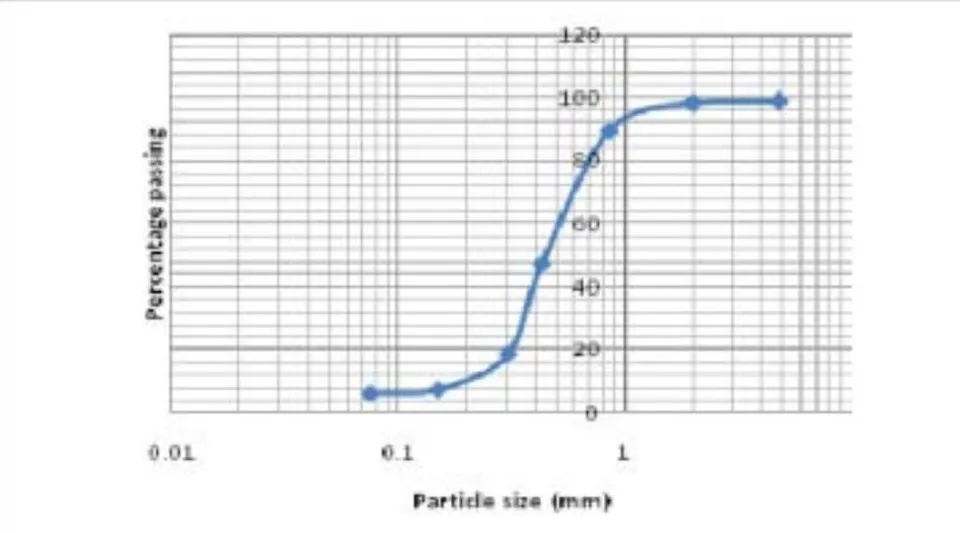
The linear shrinkage value of the soil is 17 (Brink et al. 1982; Ola 1983) reported linear shrinkage values exceeding 8% will be active and have a serious swelling potential. · The Maximum dry density (MDD) is and Optimum Moisture content is 24%. According to (NGS/FMWH 1997) which recommends that soil should be in the ranges of 1.50 to for the MDD and optimum moisture content (OMC) should range from of 8.56-12.02%.
Table 1 revealed that the CBR value of the studied location is 5%. This makes it fair for the sub-grade material according to (NGS/FMWH 1997) which states that the CBR for subgrade soil should be greater than 5%. The result also fell below the maximum of 80% recommended by (FMWH 1997) for sub base and base course.
The Unconfined Compressive Strength (UCS) of the studied soil is 211.77 kN/m at 28 days curing time Table 1. The result in with the range of 200 and 400 kN/m stipulated by (Gopal and Rao 2011; NGS/FMWH 1997) which grouped soil within the range as very stiff consistency.
| Constituents | CaO | MnO | MgO | ZnO | CuO | Total | S/R | ||||||
| % weight in the natural soil | 53.98 | 29.50 | 2.87 | 0.14 | 0.06 | 0.17 | 0.01 | 0.01 | 0.18 | 2.87 | 29.50 | 98.95 | 1.66 |
| Table 2 shows soil sample is characterized by bases (K2O and CaO). The other chemical element high amount of silica and appreciable amount of were all lower than 5% in concentrations. sesquioxides (Al2O3 and Fe2O3) reasonable amount of | |||||||||||||
| Table 3: The mineralogy of the selected natural soil samples. | |||||||||||||
| Constituents | Quartz (%) | Kaolinite (%) | Dickite (%) | Microcline (%) | Muscovite (%) | Iron sulfate (%) | Sanidine (%) | Illites (%) | |||||
| % weight.in the natural soil | 47 | 13 | - | - | - | - | - | - | 40 | ||||
| S/N | Composition | Granite concentration (%) | Dolerite concentration (%) | Wood ash concentration (%) |
| Silica ( ) | 71.10 | 42.20 | - | |
| Alumina ( ) | 14.03 | 11.60 | - | |
| Potassium oxide ( ) | 5.11 | 0.79 | 10.34 | |
| Soda ( ) | 3.21 | 2.24 | - | |
| Lime (CaO) | 1.02 | 10.54 | 67.88 | |
| Iron ( ) | 3.12 | 4.55 | 2.40 | |
| Iron (FeO) | 0.21 | 7.2 | ||
| Magnesia (MgO) | 0.38 | 18.23 | - | |
| Titanium ( ) | 0.38 | 0.001 | ||
| P2O5 | 0.01 | 0.02 | 3.10 | |
| Water ( ) | 0.03% | 2.73 | 0.001 | |
| SO3 | 0.09 | 0.03 | 1.82 | |
| TiO2 | 0.44 | 0.01 | 0.38 | |
| V2O5 | - | - | 0.083 | |
| MnO | - | 0.001 | 2.08 | |
| Cr2O3 | - | - | 0.03 | |
| Ag2O | - | - | 1.15 | |
| BaO | 0.149 | 0.01 | 0.40 | |
| Re2O7 | - | - | 0.20 | |
| LOI | 0.73 | 0.11 | 10.34 | |
| ZnO | - | - | 0.19 | |
| CuO | - | - | 0.07 | |
| 0.15 | - | - | ||
| Minor other oxides | 0.14 | 0.01 | - | |
| Specific gravity ( ) | 2.67 | 2.75 | 2.81 | |
| pH | 4-6 | 7-9 | 12–13 |
a) Effect of the additives on the geotechnical properties of the soil
i. Effect of the additives on the Consistency Limits of the soil
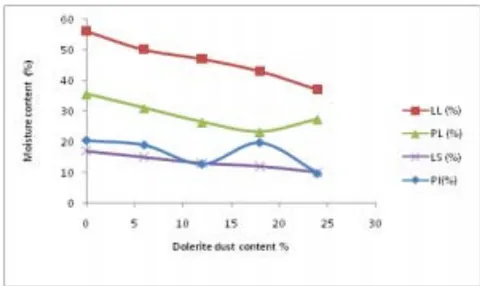
Table 5 revealed a general reduction in the liquid (LL) and plastic limit (PL) of the soils on the addition of the wood ash, dolerite and granite dust in their varying proportions.
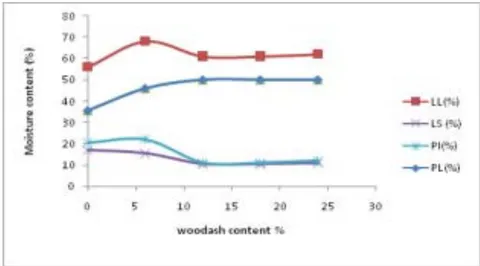
The addition of 6% additive proportion on the wood ash resulted to a 12% increase in liquid limit and a 12.2% rise in plastic limit. The addition of 18% wood ash also resulted to a 3% rise in liquid limit and a 22.2% increase in plastic limit (Fig. 2). It was revealed that the greater the increase in plastic limit the more the increase in liquid limit and a reduction in the plasticity index by (19%) on addition of 18% proportion of wood ash. The lowest reduction of 9.5% was noticed in the linear shrinkage on addition of 18% proportion of wood ash. These results agree with those of Bhuvaneshwari et al. (2005), Ismaiel (2006) and Okagbue (2007) who improved the performance of expansive soil using fly ash and wood ash. Terzaghi and Peck (1996) and Nalbantoglu and Gucbilmez (2001) explained that the reduction in plasticity of the soil was due to the reduction in the heaviness of the double surface layer of the clay particles; subsequently, from the cation exchange reaction that resulted to an increase in the attraction force that resulted to the flocculation of the particles.
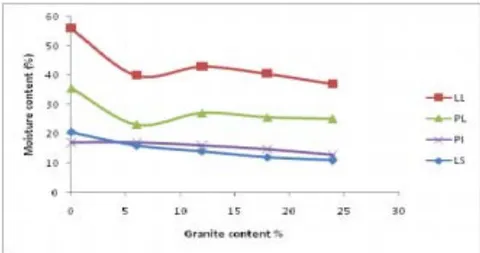
Fig. 3 revealed that the addition of 6% granite dust resulted to 16.1% decrease in liquid limit, 12.6% decrease in plastic limit and also, the addition of 18% granite dust resulted to a 15.6% decrease in liquid limit and a 10.1% decrease in plastic limit.Fig.4 shows the addition of 6% dolerite dust resulted to a 6.1% decrease in liquid limit and a 4.6% decrease in plastic limit. The addition of 18% dolerite dust resulted to a 13.1% decrease in liquid limit and a reduction by 12.40% in plastic limit. It was also observed that 10.9% decrease in plasticity index of the natural soil was achieved on the addition of 24% dolerite dust. The result revealed that it will require tripled quantity of wood ash and double quantity of granite to reduce the plasticity of the natural soil in comparison to that of the dolerite dust.
The difference observed could be as a result of the chemical composition of the additives Table 4 which revealed that the calcium oxide (Cao) content of wood ash which is (71.88%) is higher than that of dolerite dust (14.14%) and granite dust (1.02%). Wong (2015); Ene and Okogbue (2009); Ku -mar and Sharma (2004); Ismaiel (2006) and Ji-ru and Xing (2002) reported a direct proportion between the calcium oxide content of unconventional expansive soil stabilizers to and its immediate stabilizing ability.
| S/No | Admixture | Consistency | Proctor compaction test | CBR (%) | ||||
| Limits | MDD (g/cm3) | OMC (%) | ||||||
| LL (%) | PL (%) | LS (%) | PI (%) | |||||
| Soil sample only (S) | 56.1 | 35.6 | 17 | 20.5 | 1.52 | 24 | 5 | |
| S + 6% W | 68 | 46 | 15.5 | 22 | 1.49 | 29 | 12 | |
| S + 12% W | 61 | 50 | 10.5 | 11 | 1.51 | 23 | 16 | |
| S + 18% W | 61 | 50 | 10.5 | 11 | 1.52 | 22 | 23 | |
| S + 24% W | 62 | 50 | 10.9 | 12 | 1.51 | 23 | 30 | |
| S + 6% G | 40 | 23 | 16 | 17 | 1.48 | 21 | 17 | |
| S + 12% G | 43.0 | 27 | 14 | 16.0 | 1.46 | 20 | 23 | |
| S + 18% G | 40.5 | 25.5 | 12 | 14.7 | 1.97 | 18 | 30 | |
| S + 24% G | 30.0 | 25 | 11 | 12.8 | 1.43 | 18.5 | 48 | |
| S + 6% D | 50 | 31 | 15 | 19 | 1.50 | 25 | 19 | |
| S + 12% D | 47 | 26.4 | 13 | 12.7 | 1.46 | 26 | 29 | |
| S + 18% D | 43.0 | 23.2 | 12 | 19.8 | 1.39 | 20.5 | 33 | |
| S + 24% D | 37.0 | 27.4 | 10 | 9.6 | 1.49 | 25.5 | 35 | |
Effect of the Additives on the Compaction Properties of the Soil
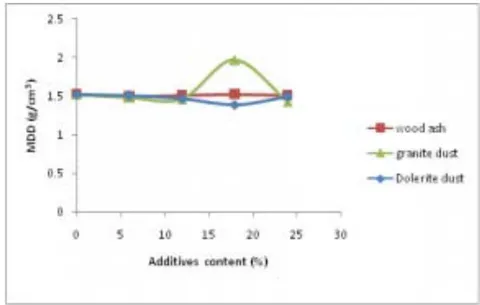
The maximum dry density (MDD) and optimum moisture content (OMC) values of the natural soil and samples with varying percentages of additives are presented Table 5. Figs. 5 and 6 revealed that the value of MDD of the natural soil was reduced on addition of 12% of wood ash, granite and dolerite dust. However, there was an increase on the addition 18% proportion of granite dust. This increment continued on for the 24% additive of dolerite dust. However, it decreased when the same percentage of granite dust was added. The decrease and subsequent increase in the value of the MDD on the addition of wood ash, granite and dolerite dust additives was also reported by Okagbue and Yakubu (2000) to have been as a result of flocculation and agglomeration of the clay particles. This is as a result of the chemical reaction between lime and clay minerals. The flocculated particles caused an increase in the void ratio of the admixture; hence, a reduction in the MDD. Furthermore, the MDD is affected by the chemical reaction between lime and clay minerals (Kezdi 1979), the fluctuating phenomenon notice on the addition of granite dust could be as a result of variation in the mineralogical composition of the natural soil. Comparing the three additives, the highest was achieved on the addition of 18% granite dust compared to the that was achieved on the addition of 24% dolerite dust.
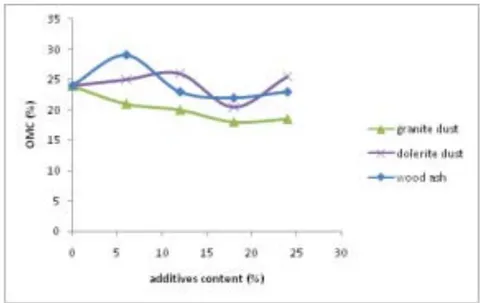
Similarly, Fig. 6 revealed that there was a gradual decrease in the OMC of the natural soil on the addition of varying additives proportions up till to 18%. However, on the addition of 12% additives, the OMC of the wood ash, the granite dust soil gradually increased and that of the dolerite dust sharply increased. Furthermore, this behavior could be as a result of reaction between the lime and clay minerals. At a lower content of additives, the lime-clay reaction could not be initiated. Thus, at this point the grain size distribution of the clay soil changes to a coarser configuration of silty to sandy soil and hence, a decrease in OMC (Drnevich et al; 2009). In addition, as the percentage of additives increases, the reaction between lime and clay is initiated. This process of cation exchange which is exothermic reaction usually result to drying of soil, it makes more water to be required for subsequent reaction which is dissociation of calcium hydroxide into and OH ions resulting to an increase in OMC (Okagbue and Yakubu 2000; National lime association 2004). However, the lowest reduction in OMC was reached on the addition of 18% additives.
Effect of the Additives on the California Bearing Ration (CBR) Properties of the Soil
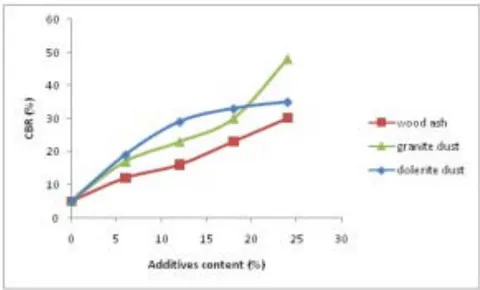
Table.5 shows the result of the California bearing ration (CBR) test conducted on the natural soil with varying proportions of additives. It was revealed that there is a steady increase in CBR values with increasing percentages of the wood ash, granite and dolerite dust in the modified soil Fig.7. Moreover, the addition of the 18% dolerite dust resulted to a steady decrease in the CBR value and a steady increase in wood ash and granite dust proportion. Various authors have reported the reasons for this increase. Croft (1967) stated that the growth and the thickening of the gelatinous reaction products and inter-growth of crystalline, hydrous calcium silicates and aluminates are responsible for cementation in clay-soils stabilized with cement, lime and lime-fly ash. Thompson (1965) reported that the increase in CBR was as a result of cation exchange and agglomeration reactions that occur on the addition of additives to the clay soil. Ene and Okogbue (2009) also attributed it to the formation of bonds of calcium alumina hydrate and silicate hydrate on the addition of additives to the clay soils.
Effect of the additives on the unconfined compressive strength (UCS) of the soil
Tables 6-8 and Figs. 8, 9 and 10 show the results of the effect of the additives on the UCS on the stabilized soil. It was deduced that 24% granite dust proportion gave the highest unconfined compressive strength of 398.56 KN/m at 28 days curing time. This satisfies the condition for very stiff consistency soil available for use as a subbase and base course material (Nigeria General Specification 1997; Gopal and Rao 2011). The (6%) wood ash proportion which is the lowest percentage of admixture gave the lowest UCS value of . This satisfies the condition of stiff consistency for use as a sub grade based on (NGS/FMWH 1997; Gopal and Rao 2011). The increase in strength attained is attributed to the spherical agglomeration of particles in the presence of the highly pozzolanic granite dust, dolerite dust and wood ash. In addition, the presence of the admixtures in the soil increased the frictional angle of the stabilized mixture.
This is connected to the physicochemical, pozzolanic attributes of the admixtures and also to its potential to lessen adsorbed water. This process make soils with higher clay content to act like granular soil.
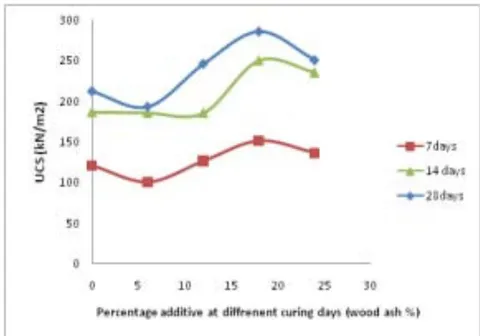
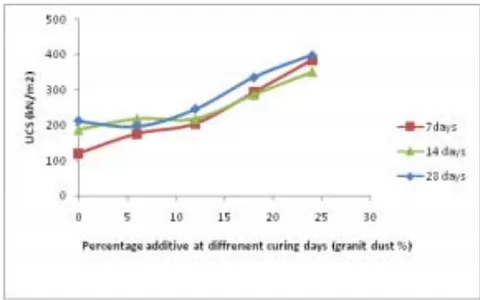
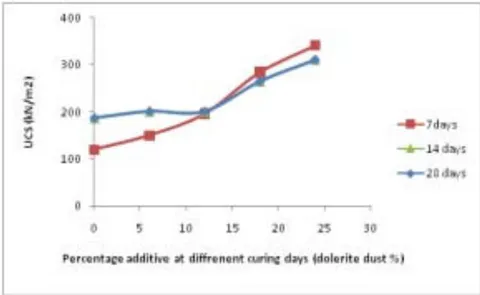
| Wood Proportion (%) | ash | 0 | 6 | 12 | 18 | 24 |
| At 7 (kN/m2) | days | 120.26 | 100.05 | 125.89 | 150.67 | 135.75 |
| At 14 (kN/m2) | days | 186.11 | 185.01 | 185.01 | 250.44 | 235.45 |
| At 28 (kN/m2) | days | 211.77 | 192.76 | 245.61 | 285.45 | 250.26 |
| Proportion (%) | 0 | 6 | 12 | 18 | 24 | |
| At 7 (kN/m2) | days | 120.26 | 175.32 | 203.89 | 292.07 | 383.45 |
| At 14 (kN/m2) | days | 186.11 | 217.03 | 217.03 | 285.94 | 350.04 |
| At 28 (kN/m2) | days | 211.77 | 196.97 | 245.61 | 335.26 | 398.56 |
| Proportion (%) | 0 | 6 | 12 | 18 | 24 |
| At 7 days (kN/m2) | 120.26 | 150.45 | 195.85 | 284.01 | 340.90 |
| At 14 days (kN/m2) | 186.11 | 200.34 | 200.05 | 264.34 | 310.05 |
| At 28 days (kN/m2) | 211.77 | 194.65 | 225.75 | 299.49 | 375.47 |
Comparison of the geotechnical properties of unstabilized soil and stabilized soils with the Nigerian Standards to determine their suitable for different type of structure
The geotechnical properties of wood ash, granite dust and dolerite admixtures and the natural soil were compared to the Nigerian standards and presented in Tables 9, 10 and 11. Analyses of the wood ash, granite dust and dolerite dust to the natural soil mixtures at varying percentages with reference to the Nigerian standards revealed that the wood ash, granite dust and dolerite dust were potentially effective stabilizing agents for the studied expansive soil. Generally, the natural soils stabilized with 18% and 24% of the granite dust, wood ash and dolerite dust additives proportion measured up to the Nigerian standard for use as materials in general filling, embankment and sub base. However, 24% granite dust additive proportion met the recommended standard stipulated for base materials for road construction in the study area. Wood ash and dolerite at their varying proportions of soil admixture fell short of the Nigerian standard for road as base course materials. It was concluded from this investigation on the stabilization of the natural soil with wood ash, granite dust and dolerite dust that the pozzolanic effect of the soil differ in strength slightly for both categories of additives. The 18% and 24% granite dust met the required standard the base material other additives in varying proportions may be appropriate for other engineering use.
| Possible use of soil | Geotechnical | Nigerian | Unstabilized soil | 6% granite dust | 12% granite dust | 18% granite dust | 24% granite dust | |
| (engineering construction) | Properties of soil | specification | (0% dust) | granite | ||||
| General filling and embankment | MDD (g/m3) | >0.04 | 1.52 | 1.48 | 1.46 | 1.97 | 1.43 | |
| OMC (%) | <18 | 24 | 21 | 20 | 18 | 18.5 | ||
| Liquid limit (%) | <40 | 56.1 | 40 | 43.0 | 40.5 | 37.0 | ||
| Plasticity index | <20 | 20.5 | 17 | 16.0 | 14.7 | 12.8 | ||
| Sub-base course | Liquid limit (%) | <35 | 56.1 | 40 | 43.0 | 40.5 | 34.0 | |
| Plasticity index | <16 | 20.5 | 17 | 16.0 | 14.7 | 12.8 | ||
| Unsoaked CBR at OMC | ≤25 | 5 | 17 | 23 | 30 | 48 | ||
| Base course | Liquid limit (%) | ≤30 | 56.1 | 40 | 43.0 | 40.5 | 30.0 | |
| Plasticity index | ≤13 | 20.5 | 17 | 16.0 | 14.7 | 12.8 | ||
| Unsoaked CBR at OMC | ≤80 | 5 | 17 | 23 | 30 | 48 | ||
| Possible use of soil | Geotechnical | Nigerian | Unstabilized soil | 6% woodash ash | 12%woodash ash | 18%woodash ash | 24%woodash |
| (engineering construction) | properties of soil | specification | (0% ash) | wood | |||
| General filling and embankment | MDD (g/m3) | >0.04 | 1.52 | 1.49 | 1.51 | 1.52 | 1.51 |
| OMC (%) | <18 | 24 | 29 | 23 | 22 | 23 | |
| Liquid limit (%) | <40 | 56.1 | 68 | 61 | 61 | 62 | |
| Plasticity index | <20 | 20.5 | 22 | 11 | 11 | 12 | |
| Sub-base course | Liquid limit (%) | <35 | 56.1 | 68 | 61 | 61 | 62 |
| Plasticity index | <16 | 20.5 | 22 | 11 | 11 | 12 | |
| Unsoaked CBR at OMC | ≤25 | 5 | 12 | 16 | 23 | 30 | |
| Base course | Liquid limit (%) | ≤30 | 56.1 | 68 | 61 | 61 | 62 |
| Plasticity index | ≤13 | 20.5 | 22 | 11 | 11 | 12 | |
| Unsoaked CBR at OMC | ≤80 | 5 | 12 | 16 | 23 | 30 |
| Possible use of soil (engineering construction) | Geotechnical properties of soil | Nigerian specification | Unstabilized soil (0% dolerite dust) | 6% dolerite dust | 12% dolerite dust | 18% dolerite dust | 24% dolerite dust |
| General filling and embankment | MDD ( ) | >0.04 | 1.52 | 0 | 1.46 | 1.39 | 1.49 |
| OMC (%) | <18 | 24 | 25 | 26 | 20.5 | 25.5 | |
| Liquid limit (%) | <40 | 56.1 | 50 | 47 | 43.0 | 37.0 | |
| Plasticity index | <20 | 20.5 | 19 | 12.7 | 19.8 | 9.6 | |
| Sub-base course | Liquid limit (%) | <35 | 56.1 | 50 | 47 | 43.0 | 37.0 |
| Plasticity index | <16 | 20.5 | 19 | 12.7 | 19.8 | 9.6 | |
| Unsoaked CBR at OMC | ≤25 | 5 | 19 | 29 | 33 | 35 | |
| Base course | Liquid limit (%) | ≤30 | 56.1 | 50 | 47 | 43.0 | 37.0 |
| Plasticity index | ≤13 | 20.5 | 19 | 12.7 | 19.8 | 9.6 | |
| Unsoaked CBR at OMC | ≤80 | 5 | 19 | 29 | 33 | 35 |
IV. CONCLUSION
It can be concluded from the investigations that the natural soil was not suitable for as sub-grade material because it recorded a MDD 1.54 g/cm . However, the addition of the right proportions of the additives resulted to an increase in the soil strength. It was revealed also that the addition of wood ash, granite dust, and dolerite dust with the studied soil in their varying proportions resulted to a reduction in the LL, PI and LS of the soil. This is attributed to the calcium oxide content in the wood ash that was not readily available nor sufficient enough for pozzolanic reaction to take place immediate but for a period of at least seven days before notable strength can be achieved in the soil. Furthermore, at the addition of 24% by weight of granite dust, the UCS acquired sufficient strength to meet the requirements for sub-base and base course. However, granite dust, dolerite dust and wood ash which is cheap and readily available and often considered as a waste material can be utilized as stabilizing material for problematic soils. This will lessen the cost of carrying out engineering constructions on expansive soils and also minimize the environmental problems linked with their indiscriminate disposal. Finally, the usage of these additives has proven beyond doubts that it has potentials for use as stabilizers in road construction. The use of the additives at their varying proportions was seen to enhance the engineering properties of the problematic soil.
ACKNOWLEDGEMENTS
The authors appreciate the Engineering and Environment Research group of the University of Nigeria Nsukka for improving this manuscript through thorough scrutiny and also to the anonymous reviewers for a job well done.
Author's contribution
Ubido Oyem Emmanuel carried out the field and Laboratory work drafted the manuscript. Igwe Ogbonnaya and Ukah Bernadette Uche: Conceived the study participated in its design, coordination and gave academic guidance.
All authors read and approved the final manuscript.
Acknowledgements
Not applicable
Funding
Funding of the entire work was personal
Availability of data and materials
The data sets used and analyzed during the current study are available from the corresponding author on request.
Competing interests
The authors declare that they have no competing interests.
Author's details and Affiliation
Faculty of Physical Sciences, Department of Geology University of Nigeria, Nsukka, Nigeria.