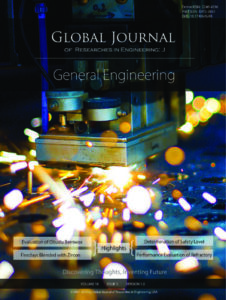
Performance Evaluation of Refractory Bricks Produced from Nigerian Fireclays Blended with Zircon

α
Ugochukwu Philip Ochieze
α University of Lagos University of Lagos

Send Message

To: Author

Performance Evaluation of Refractory Bricks Produced from Nigerian Fireclays Blended with Zircon

Article Fingerprint

ReserarchID

B81ZA

Performance Evaluation of Refractory Bricks Produced from Nigerian Fireclays Blended with Zircon Banner

AI TAKEAWAY

Connecting with the Eternal Ground
  • English
  • Afrikaans
  • Albanian
  • Amharic
  • Arabic
  • Armenian
  • Azerbaijani
  • Basque
  • Belarusian
  • Bengali
  • Bosnian
  • Bulgarian
  • Catalan
  • Cebuano
  • Chichewa
  • Chinese (Simplified)
  • Chinese (Traditional)
  • Corsican
  • Croatian
  • Czech
  • Danish
  • Dutch
  • Esperanto
  • Estonian
  • Filipino
  • Finnish
  • French
  • Frisian
  • Galician
  • Georgian
  • German
  • Greek
  • Gujarati
  • Haitian Creole
  • Hausa
  • Hawaiian
  • Hebrew
  • Hindi
  • Hmong
  • Hungarian
  • Icelandic
  • Igbo
  • Indonesian
  • Irish
  • Italian
  • Japanese
  • Javanese
  • Kannada
  • Kazakh
  • Khmer
  • Korean
  • Kurdish (Kurmanji)
  • Kyrgyz
  • Lao
  • Latin
  • Latvian
  • Lithuanian
  • Luxembourgish
  • Macedonian
  • Malagasy
  • Malay
  • Malayalam
  • Maltese
  • Maori
  • Marathi
  • Mongolian
  • Myanmar (Burmese)
  • Nepali
  • Norwegian
  • Pashto
  • Persian
  • Polish
  • Portuguese
  • Punjabi
  • Romanian
  • Russian
  • Samoan
  • Scots Gaelic
  • Serbian
  • Sesotho
  • Shona
  • Sindhi
  • Sinhala
  • Slovak
  • Slovenian
  • Somali
  • Spanish
  • Sundanese
  • Swahili
  • Swedish
  • Tajik
  • Tamil
  • Telugu
  • Thai
  • Turkish
  • Ukrainian
  • Urdu
  • Uzbek
  • Vietnamese
  • Welsh
  • Xhosa
  • Yiddish
  • Yoruba
  • Zulu

Abstract

In Nigeria, importation of several additives usually used in blending fireclays is on the increase. Similarly, other materials available in the country are currently underutilized. These materials could be used as additives to alter/improve the refractory properties of fireclay. The performance behavior of refractory bricks produced from a single and multi-component blending of Osiele and Ikorodu fireclays with Azara-Lafia zircon was studied. The chemical compositions of the raw materials were determined using the Atomic Absorption Spectrophotometer (AAS-PG990AFG). The Osiele and Ikorodu fireclays were blended with Azara-Lafia zircon at varying mass proportions of 10 -35%. The blended samples were mixed with water (3 -4%), molded into bricks using the Hydraulic Press (Paul-Weber D-7084) to 300KN. The bricks were air dried for 24 hours and later fired in the Carbolite RHF-16/15 furnace at 800oC to 1200oC. Cold crushing strength test were conducted using Testometric M-500-30KN D7940.

References

9 Cites in Article
  1. F Apeh,D Esezobor,G Lawal (2011). Characterization of Onibode and Owede-Ketu clays for use as refractory materials in foundry industry.
  2. A Chesti (1986). Refractories: Manufacture, Properties, and Applications.
  3. D Esezobor,E Obidiegwu,G Lawal (2014). The Influences of Agro Forestry Wastes Additives on the Thermal Insulating Properties of Osiele Clay.
  4. B Gunter,B Andreas,P Raymond (2005). LAS VEGAS SANDS CORP., a Nevada corporation, Plaintiff, v. UKNOWN REGISTRANTS OF www.wn0000.com, www.wn1111.com, www.wn2222.com, www.wn3333.com, www.wn4444.com, www.wn5555.com, www.wn6666.com, www.wn7777.com, www.wn8888.com, www.wn9999.com, www.112211.com, www.4456888.com, www.4489888.com, www.001148.com, and www.2289888.com, Defendants..
  5. O Gupta (2008). Fuels, Furnaces and Refractories.
  6. A Guzmán,P Rodríguez,E Sereno (2006). Test Method for Testing of Glass Exudation from AZS Fusion-Cast Refractories.
  7. W Kingery,H Bowen,D Uhlmann,R Frieser (1976). Introduction to Ceramics.
  8. R Krebs (1998). The History and Use of our Earth's Chemical Elements.
  9. (2007). Zirconium, CRC Handbook of Chemistry and Physics.

Funding

No external funding was declared for this work.

Conflict of Interest

The authors declare no conflict of interest.

Ethical Approval

No ethics committee approval was required for this article type.

Data Availability

Not applicable for this article.

How to Cite This Article

Ugochukwu Philip Ochieze. 2018. \u201cPerformance Evaluation of Refractory Bricks Produced from Nigerian Fireclays Blended with Zircon\u201d. Global Journal of Research in Engineering - J: General Engineering GJRE-J Volume 18 (GJRE Volume 18 Issue J5): .

Download Citation

Journal Specifications

Crossref Journal DOI 10.17406/gjre

Print ISSN 0975-5861

e-ISSN 2249-4596

Keywords
Classification
GJRE-J Classification: FOR Code: 091299
Version of record

v1.2

Issue date

December 8, 2018

Language
en
Experiance in AR

Explore published articles in an immersive Augmented Reality environment. Our platform converts research papers into interactive 3D books, allowing readers to view and interact with content using AR and VR compatible devices.

Read in 3D

Your published article is automatically converted into a realistic 3D book. Flip through pages and read research papers in a more engaging and interactive format.

Article Matrices
Total Views: 2990
Total Downloads: 1454
2026 Trends
Related Research

Published Article

In Nigeria, importation of several additives usually used in blending fireclays is on the increase. Similarly, other materials available in the country are currently underutilized. These materials could be used as additives to alter/improve the refractory properties of fireclay. The performance behavior of refractory bricks produced from a single and multi-component blending of Osiele and Ikorodu fireclays with Azara-Lafia zircon was studied. The chemical compositions of the raw materials were determined using the Atomic Absorption Spectrophotometer (AAS-PG990AFG). The Osiele and Ikorodu fireclays were blended with Azara-Lafia zircon at varying mass proportions of 10 -35%. The blended samples were mixed with water (3 -4%), molded into bricks using the Hydraulic Press (Paul-Weber D-7084) to 300KN. The bricks were air dried for 24 hours and later fired in the Carbolite RHF-16/15 furnace at 800oC to 1200oC. Cold crushing strength test were conducted using Testometric M-500-30KN D7940.

Our website is actively being updated, and changes may occur frequently. Please clear your browser cache if needed. For feedback or error reporting, please email [email protected]

Request Access

Please fill out the form below to request access to this research paper. Your request will be reviewed by the editorial or author team.
X

Quote and Order Details

Contact Person

Invoice Address

Notes or Comments

This is the heading

Lorem ipsum dolor sit amet, consectetur adipiscing elit. Ut elit tellus, luctus nec ullamcorper mattis, pulvinar dapibus leo.

High-quality academic research articles on global topics and journals.

Performance Evaluation of Refractory Bricks Produced from Nigerian Fireclays Blended with Zircon

Ugochukwu Philip Ochieze
Ugochukwu Philip Ochieze University of Lagos

Research Journals