Neural Networks and Rules-based Systems used to Find Rational and Scientific Correlations between being Here and Now with Afterlife Conditions
Neural Networks and Rules-based Systems used to Find Rational and
Article Fingerprint
ReserarchID
CSTNWS6Y8V8
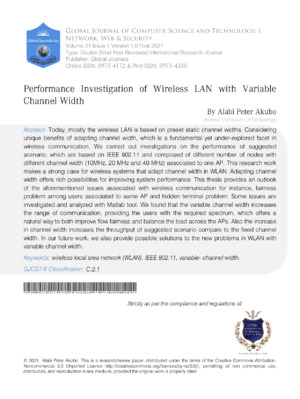
Today, mostly the wireless LAN is based on preset static channel widths. Considering unique benefits of adapting channel width, which is a fundamental yet under-explored facet in wireless communication, We carried out investigations on the performance of suggested scenario, which are based on IEEE 802.11 and composed of different number of nodes with different channel width (10MHz, 20 MHz and 40 MHz) associated to one AP. This research work makes a strong case for wireless systems that adapt channel width in WLAN. Adapting channel width offers rich possibilities for improving system performance. This thesis provides an outlook of the aforementioned issues associated with wireless communication for instance, fairness problem among users associated to same AP and hidden terminal problem. Some issues are investigated and analyzed with Matlab tool. We found that the variable channel width increases the range of communication, providing the users with the required spectrum, which offers a natural way to both improve flow fairness and balance the load across the APs. Also the increase in channel width increases the throughput of suggested scenario compare to the fixed channel width. In our future work, we also provide possible solutions to the new problems in WLAN with variable channel width.
alabi_peter_akubo. 2021. \u201cPerformance Investigation of Wireless LAN with Variable Channel Width\u201d. Global Journal of Computer Science and Technology - E: Network, Web & Security GJCST-E Volume 21 (GJCST Volume 21 Issue E1): .
Crossref Journal DOI 10.17406/gjcst
Print ISSN 0975-4350
e-ISSN 0975-4172
The methods for personal identification and authentication are no exception.
Total Score: 101
Country: Unknown
Subject: Global Journal of Computer Science and Technology - E: Network, Web & Security
Authors: Alabi Peter Akubo (PhD/Dr. count: 0)
View Count (all-time): 229
Total Views (Real + Logic): 3722

Total Downloads (simulated): 873

Publish Date: 2021 08, Fri
Monthly Totals (Real + Logic):
Neural Networks and Rules-based Systems used to Find Rational and
A Comparative Study of the Effeect of Promotion on Employee
The Problem Managing Bicycling Mobility in Latin American Cities: Ciclovias
Impact of Capillarity-Induced Rising Damp on the Energy Performance of
Today, mostly the wireless LAN is based on preset static channel widths. Considering unique benefits of adapting channel width, which is a fundamental yet under-explored facet in wireless communication, We carried out investigations on the performance of suggested scenario, which are based on IEEE 802.11 and composed of different number of nodes with different channel width (10MHz, 20 MHz and 40 MHz) associated to one AP. This research work makes a strong case for wireless systems that adapt channel width in WLAN. Adapting channel width offers rich possibilities for improving system performance. This thesis provides an outlook of the aforementioned issues associated with wireless communication for instance, fairness problem among users associated to same AP and hidden terminal problem. Some issues are investigated and analyzed with Matlab tool. We found that the variable channel width increases the range of communication, providing the users with the required spectrum, which offers a natural way to both improve flow fairness and balance the load across the APs. Also the increase in channel width increases the throughput of suggested scenario compare to the fixed channel width. In our future work, we also provide possible solutions to the new problems in WLAN with variable channel width.
We are currently updating this article page for a better experience.
Lorem ipsum dolor sit amet, consectetur adipiscing elit. Ut elit tellus, luctus nec ullamcorper mattis, pulvinar dapibus leo.