I. INTRODUCTION
Desalination is one of the most primitive forms of water treatment, and it is still a popular treatment solution throughout the world. Desalination methods utilize large amount of energy (fossil fuels) to remove a portion of pure water from seawater. The fossil fuels create pollution on environment. A solar still is a device, which used in solar desalination process to produce drinkable water from brackish and saline water by using solar energy. Although solar still is a very simple device, easy to fabricate and require less maintenance, it is economical and not familiarly used because of its lower productivity. Numerous solar distillation systems were developed over the years using the above principle for water purification in many locations in the world. Many researchers analyzed the works carried out on the solar still to augment the productivity of the simple solar still. [Sebaii et al. 2009], [Madhlopa and Johnstone 2011]. Glass, rubber and pebble are some of materials that used as thermal storage materials [Abdel-Rehimaand Lasheen 2005], [Nafey et al. 2001]. A solar still was tested with a special phase changing material as energy storage media at its base. [Naim and Abd El Kawi 2002], [Bassam and
Himzeh 2003] reported that, as providing of energy storing materials, wick materials, reducing water depth in basin increases the output. The productivity of a solar still increased from 18% to 27% with different size sponge cubes placed in the basin. [Velmurugan et al. 2008], [Velmurugan et al. 2009a] designed and analyzed a stepped still. Where a maximum increase in output of 98% is reported in stepped solar still when fin, sponge and pebbles are used in this basin. As well as [Velmurugan et al. 2009b] studied the augmentation of salt water streams in solar stills integrated with a mini solar pond. a highest production of 100% was obtained when the fin type solar still was integrated with pebble and sponge. When solar pond, basin type stepped solar still and a single basin solar still are located in series, a highest productivity of 80% is found, when fins and sponges are used in both the solar stills. When solar pond, stepped solar still and wick type solar still are coupled in series, it is found that maximum productivity of 78% occurred, when fins and sponges are used in the stepped solar still. [Tabrizi et al. 2010] Constructed two cascade solar stills with and without latent heat thermal energy storage system (LHTESS). It was observed that the total productivity of still without LHTESS is slightly higher than the still with LHTESS.
II. THEORETICAL ANALYSIS
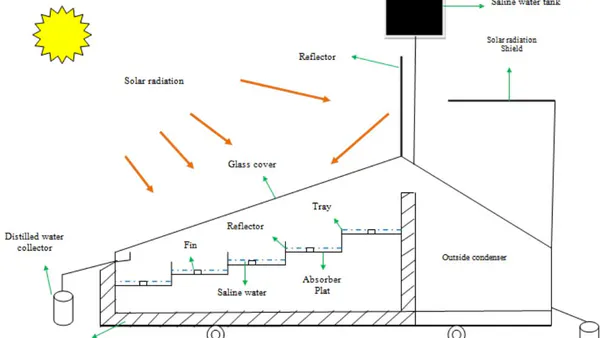
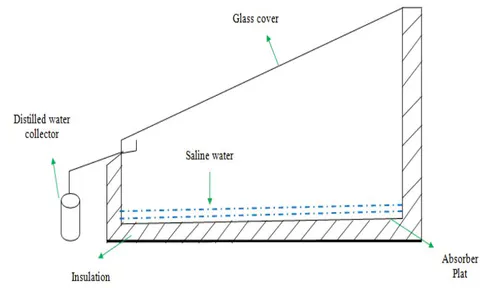
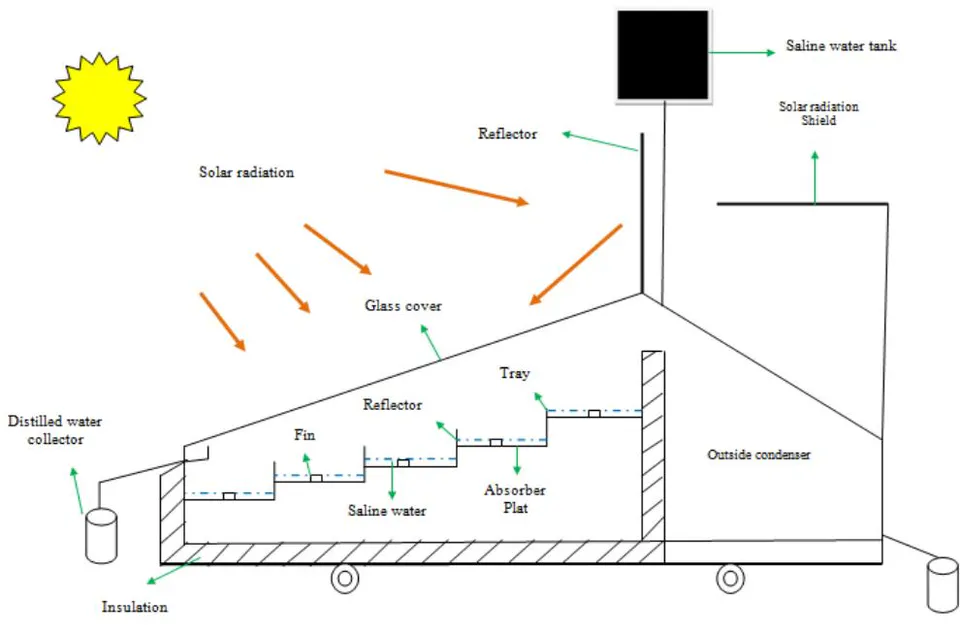
Theoretical analysis have been performed at the same conditions for two types of the solar still included modified stepped solar still and conventional solar still. The schematic diagram of the conventional solar still is shown in Figure 1. Basin area of conventional solar still (single basin solar still) ( ) Basin of the still fabricated from a black painted galvanized iron sheet to increase the absorptivity. The cover of the still is made up of glass. Figure 2 shows the schematic diagram of stepped solar still. The stepped still has the same dimension and construction of conventional still. As well as absorber plate of stepped still is made up of 5 steps, (each of size ). the stepped solar still integrated with an external condenser to increase the evaporation, fins to increase the absorptivity, and an external and an internal mirrors to increase the solar radiation on the still. The water vapour inside the still condensed on the cooler inner surface of the glass, thus, forming droplets and running down the glass. The covering glass prepares the smooth surface to flow the condensate. The distilled water dripped into tilted troughs attached to the lower edges of the glass cover. The condensed water was collected in the V-shaped cross section channel drainage provided below the glass lower edge on one sides. The distillates were collected in a bottle.
However, MS-Excel/VBA computer program is used to predict the results of the developed energy balance model for all types of solar stills, which in turn require the computation of thermodynamic and transport properties for water/vapor substance the analytical results are obtained by solving of the energy balance equations for the basin plate, saline water and glass cover of the solar still. The temperature of saline water, basin plate and glass cover can be evaluated at every 30s.
III. RESULTS AND DISCUSSIONS
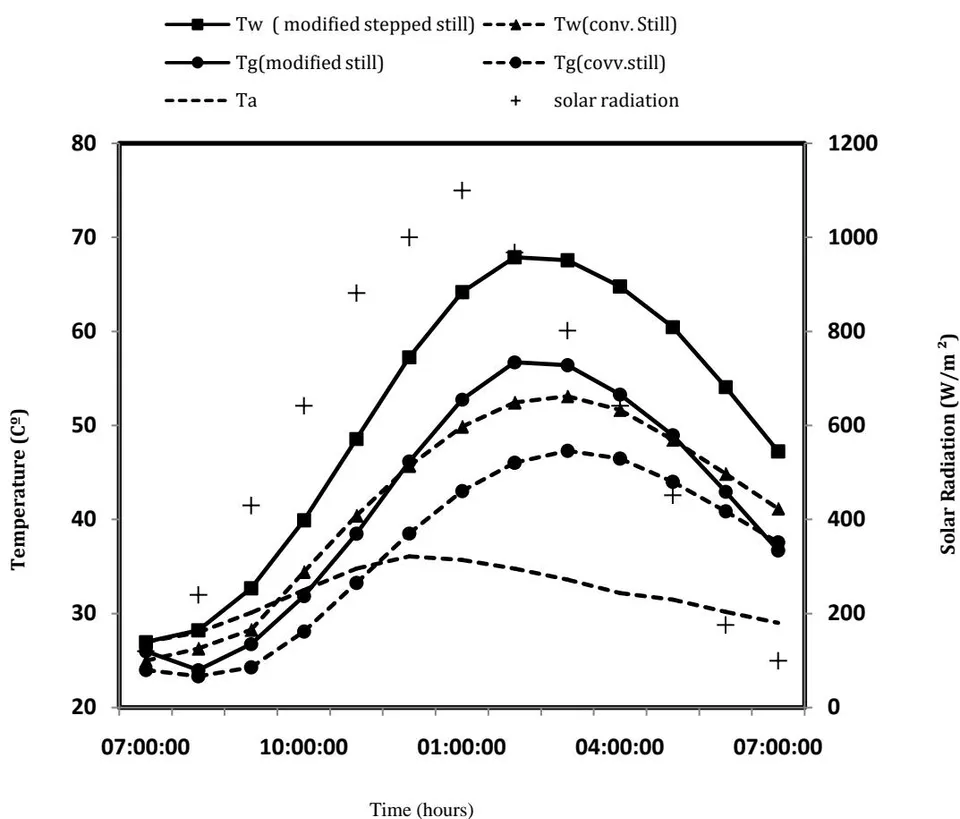
Numerical calculations have been performed at the same conditions for three types of the solar still included modified stepped solar still, stepped solar still without modification, and conventional solar still. The variation of solar radiation, ambient temperature, water temperature and glass temperature of solar stills are shown in Figure 4. It is observed that the temperatures at all points increase as the time increase till a maximum value at noon and decrease after that. This is due to the increase of solar radiation intensity in the morning and its decrease in the afternoon. From the results shown in Figure 3, it is seen that the solar radiation achieve maximum values of . Increase in solar radiation increases the saline water temperature. This in turn increases the productivity rate. Ambient air temperature proportionately increased with increase of solar intensity and decreasing trends were noticed during off-sunshine hours. Maximum ambient temperature was found at 36.2°C at 12:10 PM whereas lowest ambient temperature reached up to 27°C at 07:00 AM. In addition From Figure 3 it can be observed that the maximum basin water temperature of modified stepped solar still and conventional solar still was about 73.7°C and 54.6°C. The maximum value of glass temperature of modified stepped solar still and conventional solar still was about 69°C and 49.1°C, respectively. The solar still performance was improved at mid-noon, and this due to the increase of solar radiation which leads to higher ambient temperature and higher solar still temperature. From Figure 3, it can be indicated that the saline water temperature and glass temperature of modified stepped solar still are higher than that of conventional solar still by about 14.1°C, 19.9°C respectively. This is because adding reflector of the stepped still. This reflector reflects a fraction of the radiation onto the water surface, thus consequently increase the water and glass temperatures of the stepped solar still. So, the evaporation condensation rates in stepped solar stills were higher than that of conventional still.
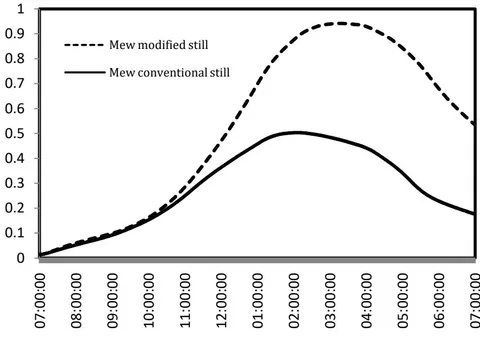
The hourly productivity is seen to increase dramatically during sunshine hours when the stepped solar still modified is used. The maximum values of hourly productivity of modified stepped solar still and conventional solar still are found to be 1.158 and 0.541 (kg/m h) respectively. Therefore, the corresponding daily productivities are obtained as 9.9 and 4.3 (kg/m d) respectively. It is seen that the daily productivity of the modified stepped solar still is higher than that of conventional solar still by 103%.
IV. CONCLUSION
For augmenting the evaporation rate, a transient mathematical model was presented for a modified stepped solar still, and a conventional solar still which could maintain minimum depth in the basin. The performance of a modified stepped solar still was investigated and compared with a conventional solar still. The results show that the thermal performance of a modified stepped solar still can be considerably improved through the new modification the corresponding daily productivities are obtained as 9.9 and 4.3 (kg/m d). The production rate of the modified stepped solar still is higher than that of conventional solar still by 103%.