
Performance Study of Downlink Users in Non- Orthogonal Multiple Access (NOMA) for 5G Communications

1
Mwewa Mabumba
Mwewa Mabumba Researcher/Senior Engineer/Lecturer
2
Simon Tembo
Simon Tembo
3
Lukumba Phiri
Lukumba Phiri
1 University of Zambia

Send Message

To: Author

GJCST Volume 23 Issue E1

Article Fingerprint

ReserarchID

CSTNWSDXCP7

Performance Study of Downlink Users in Non- Orthogonal Multiple Access (NOMA) for 5G  Communications Banner
  • English
  • Afrikaans
  • Albanian
  • Amharic
  • Arabic
  • Armenian
  • Azerbaijani
  • Basque
  • Belarusian
  • Bengali
  • Bosnian
  • Bulgarian
  • Catalan
  • Cebuano
  • Chichewa
  • Chinese (Simplified)
  • Chinese (Traditional)
  • Corsican
  • Croatian
  • Czech
  • Danish
  • Dutch
  • Esperanto
  • Estonian
  • Filipino
  • Finnish
  • French
  • Frisian
  • Galician
  • Georgian
  • German
  • Greek
  • Gujarati
  • Haitian Creole
  • Hausa
  • Hawaiian
  • Hebrew
  • Hindi
  • Hmong
  • Hungarian
  • Icelandic
  • Igbo
  • Indonesian
  • Irish
  • Italian
  • Japanese
  • Javanese
  • Kannada
  • Kazakh
  • Khmer
  • Korean
  • Kurdish (Kurmanji)
  • Kyrgyz
  • Lao
  • Latin
  • Latvian
  • Lithuanian
  • Luxembourgish
  • Macedonian
  • Malagasy
  • Malay
  • Malayalam
  • Maltese
  • Maori
  • Marathi
  • Mongolian
  • Myanmar (Burmese)
  • Nepali
  • Norwegian
  • Pashto
  • Persian
  • Polish
  • Portuguese
  • Punjabi
  • Romanian
  • Russian
  • Samoan
  • Scots Gaelic
  • Serbian
  • Sesotho
  • Shona
  • Sindhi
  • Sinhala
  • Slovak
  • Slovenian
  • Somali
  • Spanish
  • Sundanese
  • Swahili
  • Swedish
  • Tajik
  • Tamil
  • Telugu
  • Thai
  • Turkish
  • Ukrainian
  • Urdu
  • Uzbek
  • Vietnamese
  • Welsh
  • Xhosa
  • Yiddish
  • Yoruba
  • Zulu

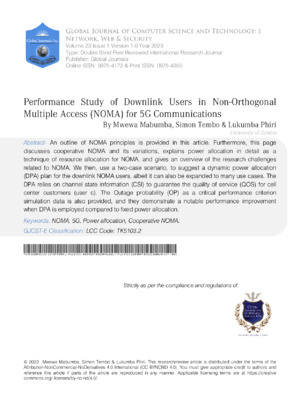
An outline of NOMA principles is provided in this article. Furthermore, this page discusses cooperative NOMA and its variations, explains power allocation in detail as a technique of resource allocation for NOMA, and gives an overview of the research challenges related to NOMA. We then, use a two-case scenario, to suggest a dynamic power allocation (DPA) plan for the downlink NOMA users, albeit it can also be expanded to many use cases. The DPA relies on channel state information (CSI) to guarantee the quality of service (QOS) for cell center customers (user c). The Outage probability (OP) as a critical performance criterion simulation data is also provided, and they demonstrate a notable performance improvement when DPA is employed compared to fixed power allocation.

Funding

No external funding was declared for this work.

Conflict of Interest

The authors declare no conflict of interest.

Ethical Approval

No ethics committee approval was required for this article type.

Data Availability

Not applicable for this article.

Mwewa Mabumba. 2026. \u201cPerformance Study of Downlink Users in Non- Orthogonal Multiple Access (NOMA) for 5G Communications\u201d. Global Journal of Computer Science and Technology - E: Network, Web & Security GJCST-E Volume 23 (GJCST Volume 23 Issue E1): .

Download Citation

Analyzes non-orthogonal multiple access (NOMA) performance in 5G networks for improved communication technology.
Journal Specifications

Crossref Journal DOI 10.17406/gjcst

Print ISSN 0975-4350

e-ISSN 0975-4172

Keywords
Classification
GJCST-E Classification: LCC: TK5103.2
Version of record

v1.2

Issue date

August 1, 2023

Language

English

Experiance in AR

The methods for personal identification and authentication are no exception.

Read in 3D

The methods for personal identification and authentication are no exception.

Article Matrices
Total Views: 2266
Total Downloads: 16
2026 Trends
Research Identity (RIN)
Related Research

Published Article

An outline of NOMA principles is provided in this article. Furthermore, this page discusses cooperative NOMA and its variations, explains power allocation in detail as a technique of resource allocation for NOMA, and gives an overview of the research challenges related to NOMA. We then, use a two-case scenario, to suggest a dynamic power allocation (DPA) plan for the downlink NOMA users, albeit it can also be expanded to many use cases. The DPA relies on channel state information (CSI) to guarantee the quality of service (QOS) for cell center customers (user c). The Outage probability (OP) as a critical performance criterion simulation data is also provided, and they demonstrate a notable performance improvement when DPA is employed compared to fixed power allocation.

Our website is actively being updated, and changes may occur frequently. Please clear your browser cache if needed. For feedback or error reporting, please email [email protected]
×

This Page is Under Development

We are currently updating this article page for a better experience.

Request Access

Please fill out the form below to request access to this research paper. Your request will be reviewed by the editorial or author team.
X

Quote and Order Details

Contact Person

Invoice Address

Notes or Comments

This is the heading

Lorem ipsum dolor sit amet, consectetur adipiscing elit. Ut elit tellus, luctus nec ullamcorper mattis, pulvinar dapibus leo.


High-quality academic research articles on global topics and journals.

Performance Study of Downlink Users in Non- Orthogonal Multiple Access (NOMA) for 5G Communications

Mwewa Mabumba
Mwewa Mabumba University of Zambia
Simon Tembo
Simon Tembo
Lukumba Phiri
Lukumba Phiri

Research Journals





























































