The present article aims to present the data recorded in the Permanent Education Municipal Plans (Planos Municipais de Educação Permanente -PLAMEP) regarding the educational activities offered to professionals working in Primary Care services under the Regional Health Coordination Office -East in the period from 2017 to 2020. The article seeks to highlight the quantity and type of areas/themes proposed; of actions offered and their periodicity. Some important issues have emerged in this survey, among them: the prevalence of more vertical methods deployed in educational actions, such as training and courses, along with a prevalent monthly periodicity of such activities; differences in the amount of educational actions proposed in the course of the period considered; a diversity of actions not circumscribed to the areas previously defined in the survey; the lack of filling in some information such as executing area and periodicity in the first years of the PLAMEP implementation; the lack of standardization and uniformity in the spreadsheets of 2017 and 2018; and an improvement in the organization of data between 2019 and 2020.
## I. INTRODUCTION
Historically, Campo & Gigante (2016) highlight, investment in the training of health professionals has been grounded on positivist models combined with the use of conservative methodological techniques. Under such guidelines, the authors emphasize, knowledge is fragmented and reduced to technical efficiency.
Based on a model of technical rationality, the professional education activities thus biased are grounded on repetitive practices, on the separation of theory and practice, and on the mere relay of information, which result in overall uncritical professional education, with the predominance of an individualistic, mechanistic practice, the authors argue.
In the opposite direction to this kind of reproductive training, Campo & Gigante (2016, p. 747) point out that the Unified Health System (SUS), for its full development, requires a critical, sensitive and humanistic training of its health professionals, so that they can think and perform in complex and uncertain contexts, being able to apprehend the health-disease process as not exclusively circumscribed to anatomical and physiological aspects, but instead consider it in a broad manner, through the articulation between individual and society; an "integrative training of personal, social and professional dimensions".
Mendes and Sacardo (2017), also highlight the importance of the SUS\` consolidation as the ground for training of health workers, from graduation to work as full professionals in the health services.
Guided by this necessary review of professional training and performance, the National Policy for Permanent Education in Health aims to train health workers, as well as care for their development, thus constituting an important strategy within SUS, Campos and Gigante highlight (2016).
The term Permanent Education appeared in Brazil in the 1980s, opposing the Continuing Education model, which is characterized by being exclusively technical and fragmented, focused on the relay of knowledge and on a traditional education bias. Unlike this model, Permanent Education presupposes a kind of learning that takes place in the work place itself, based on the health professional's experience (Mishima et al., 2015).
However, this has not been an easy task. Many are the challenges faced in structuring this policy, which are developed in complex contexts with different challenges to both care and management practices, as highlighted by Campos and Gigante (2015). Silva et al (2020, p. 242) also discuss this aspect, pointing out that what persists in most services in Brazil are narrowly specified educational activities, characterized as training, often exclusively technical, without clear objectives or with the sole purpose of solving an emergency brought by the population and/or by an institutional demand.
As such activities are carried out, they are organized in spreadsheets (the Permanent Education Municipal Plans - PLAMEPs), which is an instrument to log the educational activities offered to health professionals from different areas and backgrounds during each year, in each one of the coordination offices[^2].
## II. METHODOLOGICAL ASPECTS
This work, of quantitative approach[^3], relied on a survey of the activities recorded in the four PLAMEPs of the Eastern Regional Health Coordination Office. The process of gathering the data[^4] recorded in the PLAMEPs relied on: 1- survey of the educational activities logged in the PLAMEP by the East Regional Health Coordination Office; 2- survey of the format taken up by such activities as to: denomination of the activities launched (capacity building, training, seminars, courses, congresses, symposiums); 3- survey of the didactic-pedagogical alternatives; 4- survey of the target audience reached; 5- aims of the educational activities; 6- continuity or discontinuity of the proposed actions.
After the survey, the data gathered was systematized, based on a theoretical framework on continuing education in health and on documentary analysis (Cellard, 2010).
It is important to note the relevance of considering the PLAMEPs from different periods, ranging from 2017, when it was created, to 2020. The idea was to evaluate changes and continuities regarding educational activities and other items featured in the document, as can be seen in the results below, where data from 2017 and 2020 is presented.
The worksheets of the Eastern Regional Health Coordination Office were divided into 4 parts: one worksheet corresponding to 2017 (adding up to 445 actions), one corresponding to 2018 (adding up to 512 actions), another corresponding to 2019 (adding up to 356 actions), and one corresponding to 2020 (adding up to 275).
For the analysis of the results, the following categories were chosen: proponent and executing area; type of action; periodicity.
## III. RESULTS AND DISCUSSION
The results presented here refer to the 2017 to 2020 spreadsheets.
### 1. Graph of the years of the actions collected
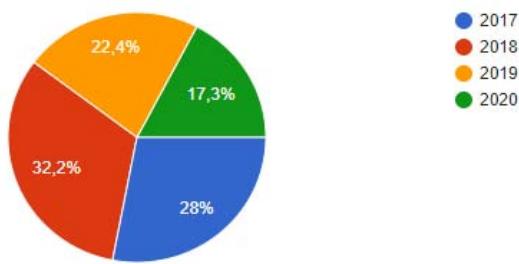
Source: Elaborated by the group, 2023.
#### 2. Graph of the structure in charge of carrying out the actions
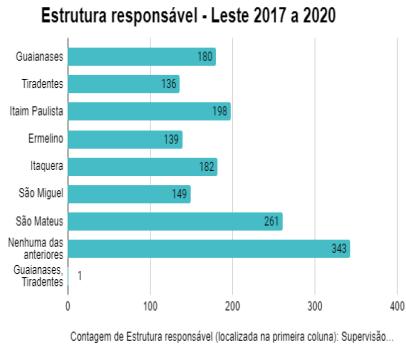
Source: Elaborated by the group, 2023.
Structure in Charge - East 2017 to 2020
Guianazes....
...None of the above
Counting of structure in charge (placed in the first column). Supervision
#### 3. Area proposing the actions
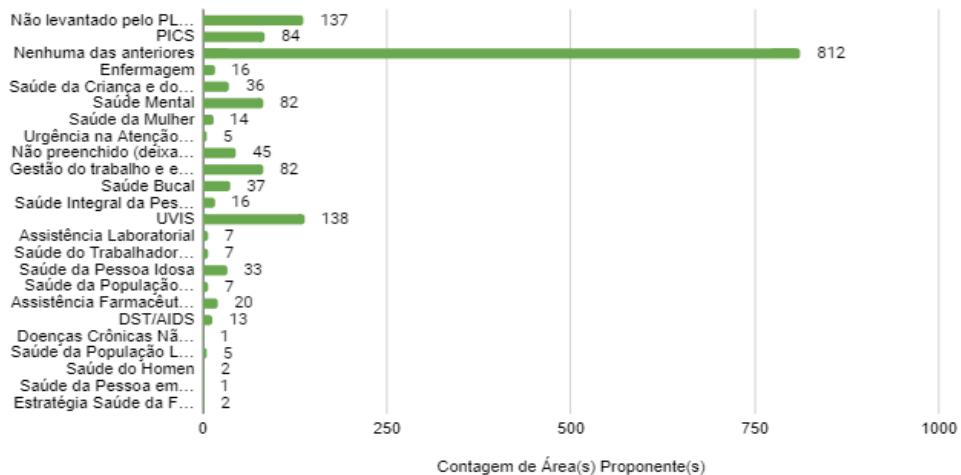 Área(s) Proponente(s) - Leste 2017 a 2020
Source: Elaborated by the group, 2023.
Not surveyed by the PL...PICS
None of the above
Nursing
Health of the Child and of...
Mental Health
Women's Health
Urgency in Attention
Not filled in (let...
Labor Management and
Mouth Health
Full Personal Health
UVIS
Laboratorial Assistance
Workers' Health
Elderly Person's Health
Health of the Population...
Pharmaceutical Assistance
STD/AIDS
Chronic non... diseases
Health fo the Poçulaiton...
Men's Health
Health of the Person in...
Health Strategy of...
#### 4. Graph of Executing Area
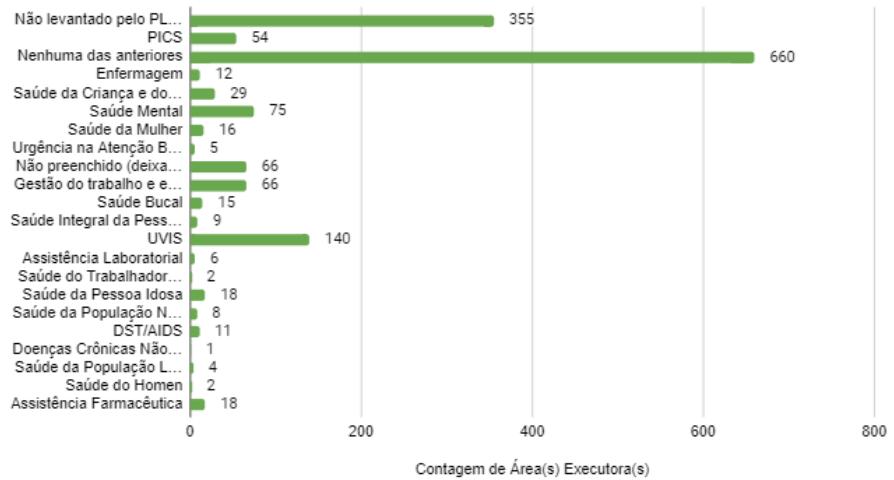 Área(s) Executor(a) - Leste 2017 a 2020
Source: Elaborated by the group, 2023.
Executing Area(s) - East 2017 to 2020
Not surveyed by the PL...
PICS
None of the above
Nursing
Child and Teenage Health
Mental Health
Women's Health
Urgency in Attention
Not filled in (let...
Work Management and Health Education
Mouth Health
UVIS
Laboratorial Assistance
Workers' Health
Elderly Person's Health
Health of the Population...
STD/AIDS
Chronic non... diseases
Health of the Population...
Men's Health
Pharmaceutical Assistance
#### 5. Graph of the type of action
Tipodaço/Atividade educativa-Leste 2017a 2020
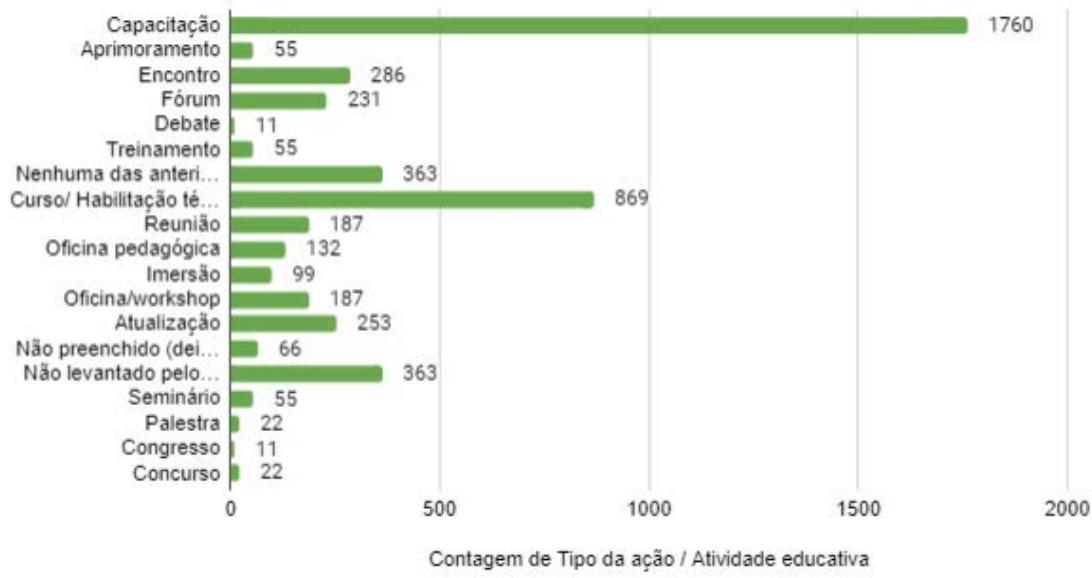 Figure 5: Graph of the type of action/Educational Activity - East 2017 to 2020
Source: Elaborated by the group, 2023.
Capacity Building
Improvement
Gathering
Forum
Debate
Training
Course/Technical Habilitation
Meeting
Pedagogic Workshop
Updating
Not filled in...
Not surveyed by...
Seminar
Lecture
Counting of Type of Action/Educational Activity
Congress
Entry Examination
#### 6. Periodicity of Actions
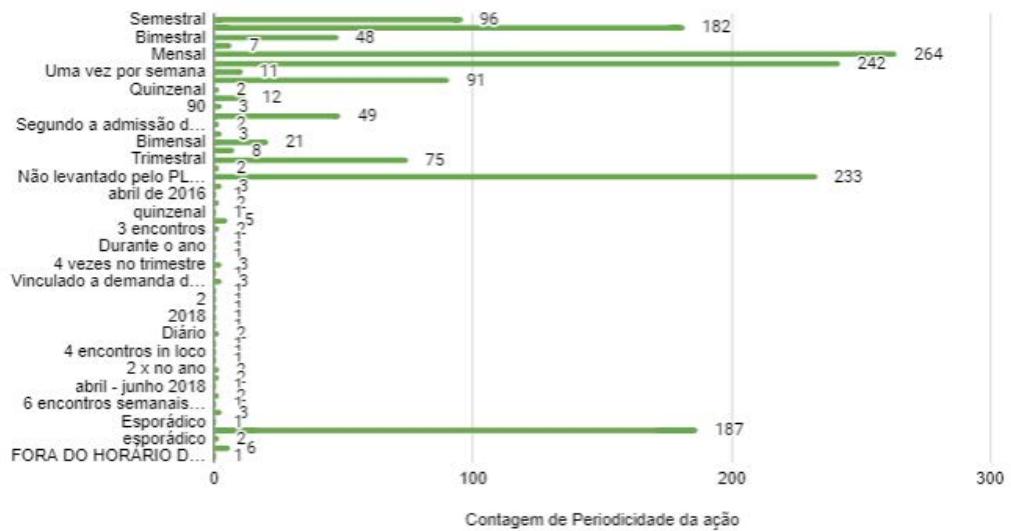 Periodicidade da ação - Leste 2017 a 2020
Source: Elaborated by the group, 2023.
Semestral
Bimestral
Monthly
Once a week
Fortnightly
90
According to the admission...
April 2016
Fortnightly
3 meetings
Along the year
4 times in the semester
The survey revealed a certain amount of errors in the original filling out of forms and also in the formulation, by the project team, of the descriptors used in the survey. We observed that most times there is no information about the proponent area (info not filled in) or else there is information about an area that, at first, was not included in the list developed by the project team. This shows us, from a methodological point of view, the need for fresh adjustments to the surveying tools for a better visualization and organization of the data featured in the PLAMEPs.
As Cellard (2010, p. 296) develops, the "researcher who works with documents must overcome several obstacles and be wary of numerous pitfalls before being in a position to make in-depth analysis".
Anyway, from the data collected, some important considerations can be pointed out: the areas that carry out the most educational activities in the spreadsheets were the Health Surveillance Units (Unidades de Vigilancia em Saude - UVIS), with 140 answers, followed by other prevalent areas such as Mental Health (75); Work and Health Education Management (66); and Child and Teenage Health (29).
Linked to demand...
2
2018
Daily
4 years in loco
Twice in the year
April-June 2018
6 weekly meetings
Sporadic sporadic
Out of Hours...
Regarding the areas that put forwards the activities, we found, with the highest prevalence, the Health Surveillance Units, with 138 answers; followed by Mental Health (82); Work Management and Health Education (82); Child and Teenage Health (36) and Elderly People's Health (33), which shows the centrality of these areas in terms of the permanent training of health professionals in this region and in the period considered.
Thus, there is a larger number for the Health Surveillance Units, both as executing and proposing areas. Mental health and health work management are also highlighted in these two analyzed areas.
Regarding the type of educational action, we noticed a strong prevalence of Training (1760) and Technical Courses/Habilitation (869). Other categories that presented most answers were: Gathering (286) and Updating (253). The frequency with the highest number of answers was Monthly (264), followed by once a week (242); Sporadic (187) and Bimestral (182).
It is also important to understand the distributions in relation to the different periods, that is, the greater recurrences and the most significant changes presented in the course of the years analyzed. This analysis is in progress, as is the reorganization of the data based on new groupings of terms, which may bring in new results.
## IV. FINAL REMARKS
Permanent Education is defined as an important tool for the constant updating of health professionals, resulting in an encounter between the production of care and pedagogical production in health systems (MICCAS & BATISTA, 2014).
In the case of São Paulo City Eastern Regional Health Coordination Office, the PLAMEP data survey shows a prevalence of the offering of courses and training, which can be interpreted as routine actions, i.e., ones that frequently occur in the daily routine of health services aimed at personnel improvement. Most of the time, traditional, verticalized teaching methods are used in such improvement activities.
This state of affairs may show a difficulty in reconciling more integrative and horizontal teaching methods with the health units' operation and the participation of health professionals, making it difficult to rethink the practice in a reflective and expanded way, as advocated by the National Policy of Continuing Education in Health.
Also noteworthy is the existence of differences in relation to the number of educational actions proposed in the course of the years. The lowest number of actions, recorded in 2020, was probably the result of the Covid-19 pandemic, a period in which the roles of health professionals and indeed the entire health services' operations had to be rearranged in order to deal with infections by the virus.
On the other hand, the year with the highest number of actions recorded, 2018, may also only indicate a greater effectiveness in the completion of PLAMEPs, since it was in its second year of operation, having already undergone the adaptation period in 2017. Moreover, it is necessary to understand that the very lack of filling in some information such as the executing area or periodicity in the first years of implementation of PLAMEP offers us important data not only about the document itself but also about the dynamics of the services.
The lack of standardization and uniformity of the spreadsheets in 2017 and 2018 reveals inconsistencies in the correct completion of PLAMEPs, resulting, among other aspects, from communication difficulties between team members in charge of this task. However, the improvement in the filling in of spreadsheets in 2019 and 2020 is clear, now better organized and standardized, indicating the corrective attitudes implemented to better describe the existing items in the documents.
Interviews are a fundamental technique for the understanding of the data surveyed and will be carried out seeking to clarify the existing gaps as well as the prevalence of certain themes. The unnamed executing areas and types of actions will be found out with the managers in charge of the development of permanent education actions in the Eastern Regional Health Coordination Office and other regions of the city of São Paulo. As Silva and Oliveira (2022, p. 7) point out, the expansion of and sophistication in the understanding of quantitative data "is only possible from the encounter between researcher and researched, through listening to the latent and manifest discourses, where not only the word, but the silence itself and the pause, give meaning to the speech".
[^2]: The Municipality of São Paulo has 6 coordination offices: east, south, north, west, center, southeast and mid-west. The data presented in this text regards information collected in the East Coordination Office. - The project was approved by the Ethics Committee of the School of Arts, Sciences and Humanities EACH/USP and by the Research Ethics Committee of the Municipal Health School. - The work of data collection from the PLAMEPs and the construction of the graphs was performed by students with a scholarship from the Unified Scholarship Program of the University of São Paulo-Brazil, under the supervision of the professors supervising the project. The data survey regarding the PLAMEPs of the East Health Coordination Office was performed by the students: Bárbara Mariano Estorino, Bruna Fernandes dos Santos, Caroline Gonçalves de Oliveira, Jennyfer Lopez de Souza, Juliana Vitoria da Silva, Ramon Ribeiro de Souza and Thais Santos Martins. _(p.2)_
Generating HTML Viewer...
References
6 Cites in Article
Gws; Campos,R Gigante (2016). Política de formação e educação permanente em saúde no Brasil: bases legais e referências teóricas.
R; Memdes,D Sacardo (2017). Formação profissional em saúde: do conhecimento instrumental ao trabalho como princípio educativo.
Fernanda Miccas,Sylvia Batista (2014). Educação Permanente em Saúde: Metassíntese.
S Mishima,A Aiub,A Rigato (2015). Perspectiva dos gestores de uma região do estado de São Paulo sobre educação permanente em saúde.
E Silva,R Oliveira,D Andrade,A Viude (2021). Análise das atividades de educação permanente para profissionais da atenção primária à saúde.
Lucimara Fornari,Ellen Fernandes De Oliveira,Cleoneide Oliveira,Brígida Faria,Jaime Ribeiro,Elza Higa (2022). Investigação Qualitativa em Saúde: Avanços e Desafios / Investigación Cualitativa en Salud: Avances y Desafíos.
No ethics committee approval was required for this article type.
Data Availability
Not applicable for this article.
How to Cite This Article
Régia Cristina Oliveira. 2026. \u201cPermanent Education in Health: A Documentary Investigation on the Eastern Region of the City of São Paulo\u201d. Global Journal of Human-Social Science - G: Linguistics & Education GJHSS-G Volume 23 (GJHSS Volume 23 Issue G5): .
Explore published articles in an immersive Augmented Reality environment. Our platform converts research papers into interactive 3D books, allowing readers to view and interact with content using AR and VR compatible devices.
Your published article is automatically converted into a realistic 3D book. Flip through pages and read research papers in a more engaging and interactive format.
The present article aims to present the data recorded in the Permanent Education Municipal Plans (Planos Municipais de Educação Permanente -PLAMEP) regarding the educational activities offered to professionals working in Primary Care services under the Regional Health Coordination Office -East in the period from 2017 to 2020. The article seeks to highlight the quantity and type of areas/themes proposed; of actions offered and their periodicity. Some important issues have emerged in this survey, among them: the prevalence of more vertical methods deployed in educational actions, such as training and courses, along with a prevalent monthly periodicity of such activities; differences in the amount of educational actions proposed in the course of the period considered; a diversity of actions not circumscribed to the areas previously defined in the survey; the lack of filling in some information such as executing area and periodicity in the first years of the PLAMEP implementation; the lack of standardization and uniformity in the spreadsheets of 2017 and 2018; and an improvement in the organization of data between 2019 and 2020.
Our website is actively being updated, and changes may occur frequently. Please clear your browser cache if needed. For feedback or error reporting, please email [email protected]
Thank you for connecting with us. We will respond to you shortly.