

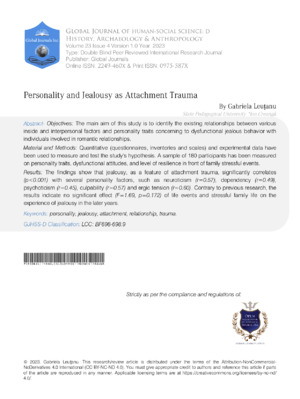

Personality and Jealousy as Attachment Trauma

Article ID

1BEJS

Characteristics, family influence, and trauma impact.

Personality and Jealousy as Attachment Trauma

Gabriela Leuțanu
Gabriela Leuțanu
DOI

Abstract

Objectives: The main aim of this study is to identify the existing relationships between various inside and interpersonal factors and personality traits concerning to dysfunctional jealous behavior with individuals involved in romantic relationships. Material and Methods: Quantitative (questionnaires, inventories and scales) and experimental data have been used to measure and test the study’s hypothesis. A sample of 180 participants has been measured on personality traits, dysfunctional attitudes, and level of resilience in front of family stressful events. Results: The findings show that jealousy, as a feature of attachment trauma, significantly correlates (p

Objectives: The main aim of this study is to identify the existing relationships between various inside and interpersonal factors and personality traits concerning to dysfunctional jealous behavior with individuals involved in romantic relationships. Material and Methods: Quantitative (questionnaires, inventories and scales) and experimental data have been used to measure and test the study’s hypothesis. A sample of 180 participants has been measured on personality traits, dysfunctional attitudes, and level of resilience in front of family stressful events. Results: The findings show that jealousy, as a feature of attachment trauma, significantly correlates (p<0.001) with several personality factors, such as neuroticism (r=0.57), dependency (r=0.49), psychoticism (r=0.45), culpability (r=0.57) and ergic tension (r=0.60). Contrary to previous research, the results indicate no significant effect (F=1.69, p=0.172) of life events and stressful family life on the experience of jealousy in the later years. Conclusions: Personality traits start developing within early childhood, influenced mainly by the family environment a child is brought in. But as time goes by, individuals can become more attached to the new relationships they get involved in, displaying attitudes and behaviors guided mainly by their innermost fears and insecurities reflected in jealous behavior. Romanian individuals appear to discount the family background and hardships they come from, manifesting more loyalty to their family of origin, as seen in the findings of the quantitative data.

Gabriela Leuțanu
Gabriela Leuțanu

No Figures found in article.

Gabriela Leuțanu. 2026. “. Global Journal of Human-Social Science – D: History, Archaeology & Anthropology GJHSS-D Volume 23 (GJHSS Volume 23 Issue D4): .

Download Citation

Journal Specifications

Crossref Journal DOI 10.17406/GJHSS

Print ISSN 0975-587X

e-ISSN 2249-460X

Issue Cover
GJHSS Volume 23 Issue D4
Pg. 39- 43
Classification
GJHSS-D Classification: LCC: BF698-698.9
Keywords
Article Matrices
Total Views: 1098
Total Downloads: 26
2026 Trends
Research Identity (RIN)
Related Research
Our website is actively being updated, and changes may occur frequently. Please clear your browser cache if needed. For feedback or error reporting, please email [email protected]

Request Access

Please fill out the form below to request access to this research paper. Your request will be reviewed by the editorial or author team.
X

Quote and Order Details

Contact Person

Invoice Address

Notes or Comments

This is the heading

Lorem ipsum dolor sit amet, consectetur adipiscing elit. Ut elit tellus, luctus nec ullamcorper mattis, pulvinar dapibus leo.


High-quality academic research articles on global topics and journals.

Personality and Jealousy as Attachment Trauma

Gabriela Leuțanu
Gabriela Leuțanu

Research Journals





























































