Physical Neuro-Urological Examination in Patients with Spinal Cord Injury Revisited

α
Wyndaele Jean Jacques
σ
Wyndaele Michel
Wyndaele Michel

Send Message

To: Author

Physical Neuro-Urological Examination in Patients with Spinal Cord Injury Revisited

Article Fingerprint

ReserarchID

FBOL2

Physical Neuro-Urological Examination in Patients with Spinal Cord Injury Revisited Banner

AI TAKEAWAY

Connecting with the Eternal Ground
  • English
  • Afrikaans
  • Albanian
  • Amharic
  • Arabic
  • Armenian
  • Azerbaijani
  • Basque
  • Belarusian
  • Bengali
  • Bosnian
  • Bulgarian
  • Catalan
  • Cebuano
  • Chichewa
  • Chinese (Simplified)
  • Chinese (Traditional)
  • Corsican
  • Croatian
  • Czech
  • Danish
  • Dutch
  • Esperanto
  • Estonian
  • Filipino
  • Finnish
  • French
  • Frisian
  • Galician
  • Georgian
  • German
  • Greek
  • Gujarati
  • Haitian Creole
  • Hausa
  • Hawaiian
  • Hebrew
  • Hindi
  • Hmong
  • Hungarian
  • Icelandic
  • Igbo
  • Indonesian
  • Irish
  • Italian
  • Japanese
  • Javanese
  • Kannada
  • Kazakh
  • Khmer
  • Korean
  • Kurdish (Kurmanji)
  • Kyrgyz
  • Lao
  • Latin
  • Latvian
  • Lithuanian
  • Luxembourgish
  • Macedonian
  • Malagasy
  • Malay
  • Malayalam
  • Maltese
  • Maori
  • Marathi
  • Mongolian
  • Myanmar (Burmese)
  • Nepali
  • Norwegian
  • Pashto
  • Persian
  • Polish
  • Portuguese
  • Punjabi
  • Romanian
  • Russian
  • Samoan
  • Scots Gaelic
  • Serbian
  • Sesotho
  • Shona
  • Sindhi
  • Sinhala
  • Slovak
  • Slovenian
  • Somali
  • Spanish
  • Sundanese
  • Swahili
  • Swedish
  • Tajik
  • Tamil
  • Telugu
  • Thai
  • Turkish
  • Ukrainian
  • Urdu
  • Uzbek
  • Vietnamese
  • Welsh
  • Xhosa
  • Yiddish
  • Yoruba
  • Zulu

Abstract

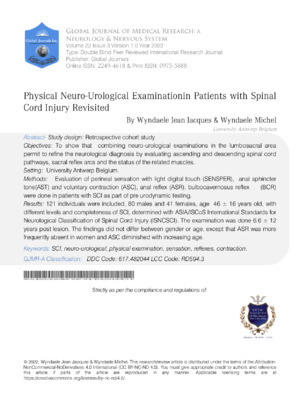
Objectives: To show that combining neuro-urological examinations in the lumbosacral area permit to refine the neurological diagnosis by evaluating ascending and descending spinal cord pathways, sacral reflex arcs and the status of the related muscles. Setting: University Antwerp Belgium. Methods: Evaluation of perineal sensation with light digital touch (SENSPER), anal sphincter tone(AST) and voluntary contraction (ASC), anal reflex (ASR), bulbocavernosus reflex (BCR) were done in patients with SCI as part of pre urodynamic testing. Results: 121 individuals were included, 80 males and 41 females, age 46 ± 16 years old, with different levels and completeness of SCI, determined with ASIA/ISCoS International Standards for Neurological Classification of Spinal Cord Injury (ISNCSCI). The examination was done 6.6 ± 12 years post lesion. The findings did not differ between gender or age, except that ASR was more frequently absent in women and ASC diminished with increasing age.

References

30 Cites in Article
  1. J Wyndaele,D Vodusek (2015). Approach to the male patient with lower urinary tract dysfunction.
  2. A Comarr (1959). THE PRACTICAL UROLOGICAL MANAGEMENT OF THE PATIENT WITH SPINAL CORD INJURY.
  3. S Kirshblum,F Biering-Sorensen,R Betz,S Burns,W Donovan,D Graves,M Johansen,L Jones,M Mulcahey,G Rodriguez,M Schmidt-Read,J Steeves,K Tansey,W Waring (2014). International Standards for Neurological Classification of Spinal Cord Injury: Cases with classification challenges.
  4. N Finnerup,C Gyldensted,A Fuglsang-Frederiksen,F Bach,T Jensen (2004). Sensory perception in complete spinal cord injury.
  5. T Katner,E Kasarskis (2014). Muscles tone: Encyclopedia of the neurological sciences, second edition.
  6. Mélanie Morin,Yitzchak Binik,Daniel Bourbonnais,Samir Khalifé,Stéphane Ouellet,Sophie Bergeron (2017). Heightened Pelvic Floor Muscle Tone and Altered Contractility in Women with Provoked Vestibulodynia.
  7. A Malouf,M Kamm (2001). A winking anus may signify spinal injury.
  8. Wei Sun,Nicholas Read,T Donnelly (1990). Anorectal function in incontinent patients with cerebrospinal disease.
  9. M Zakari,J Nee,W Hirsch,B Kuo,A Lembo,K Staller (2017). Gender differences in chronic constipation on anorectal motility.
  10. M Nielsen,J Pedersen (1996). Changes in the Anal Sphincter with Age.
  11. N Vásquez,S Knight,J Susser,A Gall,P Ellaway,M Craggs (2015). Pelvic floor muscle training in spinal cord injury and its impact on neurogenic detrusor over-activity and incontinence.
  12. W Campbell (2013). The superficial (cutaneous) reflexes.
  13. W Campbell (2013). The superficial (cutaneous) reflexes.
  14. G Rodriguez,J King,S Stiens (2011). Physical Medicine and Rehabilitation.
  15. William Donovan (2018). The importance of the anal exam in neurologic classification of spinal cord injury.
  16. David Vodušek (2008). Neural Control of Pelvic Floor Muscles.
  17. E Bors,A Comarr (1971). Chapter II Micturition.
  18. Jack Lapides,J Bobbitt (1956). DIAGNOSTIC VALUE OF BULBOCAVERNOUS REFLEX.
  19. Claire Yang,William Bradley (1999). INNERVATION OF THE HUMAN GLANS PENIS.
  20. Zhaoxia Wang,Han Deng,Xing Li,Limin Liao (2021). The Video-Urodynamic and Electrophysiological Characteristics in Patients With Traumatic Spinal Cord Injury.
  21. Jerry Blaivas,A Zayed,Kamal Labib (1981). The Bulbocavernosus Reflex in Urology: A Prospective Study of 299 Patients.
  22. Jean Wyndaele,Jörgen Quaghebeur,Michel Wyndaele (2022). What is the clinical meaning of a negative bulbocavernosus reflex in spinal cord injury patients?.
  23. Jean Previnaire,Marcalee Alexander (2020). The sacral exam—what is needed to best care for our patients?.
  24. J Wyndaele (1997). Correlation between clinical neurological data and urodynamic function in spinal cord injured patients.
  25. Brigitte Schurch,Daniel Schmid,Karen Kaegi (2003). Value of sensory examination in predicting bladder function in patients with T12-L1 fractures and spinal cord injury.
  26. M Alexander,C Carr,Y Chen,A Mclain (2017). The use of the neurologic exam to predict awareness and control of lower urinary tract function post SCI.
  27. S Moslavac,I Dzidić,A Moslavac,P Vlahek,Z Filipan (2014). Uroloska disfunkcija u osoba s ozljedom kraljeznicne mozdine [Urinary tract dysfunction in spinal cord injury patients.
  28. J Soler,J Previnaire,G Amarenco (2017). Dartos reflex as autonomic assessment in persons with spinal cord injury.
  29. Chiara Pavese,Marc Schneider,Martin Schubert,Armin Curt,Giorgio Scivoletto,Enrico Finazzi-Agrò,Ulrich Mehnert,Doris Maier,Rainer Abel,Frank Röhrich,Norbert Weidner,Rüdiger Rupp,Alfons Kessels,Lucas Bachmann,Thomas Kessler (2016). Prediction of Bladder Outcomes after Traumatic Spinal Cord Injury: A Longitudinal Cohort Study.
  30. Giorgio Scivoletto,Chiara Pavese,Lucas Bachmann,Martin Schubert,Armin Curt,Enrico Finazzi Agro,Alfons Kessels,Thomas Kessler (2018). Prediction of bladder outcomes after ischemic spinal cord injury: A longitudinal cohort study from the European multicenter study about spinal cord injury.

Funding

No external funding was declared for this work.

Conflict of Interest

The authors declare no conflict of interest.

Ethical Approval

No ethics committee approval was required for this article type.

Data Availability

Not applicable for this article.

How to Cite This Article

Wyndaele Jean Jacques. 2026. \u201cPhysical Neuro-Urological Examination in Patients with Spinal Cord Injury Revisited\u201d. Global Journal of Medical Research - A: Neurology & Nervous System GJMR-A Volume 22 (GJMR Volume 22 Issue A3): .

Download Citation

High-quality image of a neuro-robotic exam for spinal cord injury patients.
Journal Specifications

Crossref Journal DOI 10.17406/gjmra

Print ISSN 0975-5888

e-ISSN 2249-4618

Keywords
Classification
GJMR-A Classification: DDC Code: 617.482044 LCC Code: RD594.3
Version of record

v1.2

Issue date

August 26, 2022

Language
en
Experiance in AR

Explore published articles in an immersive Augmented Reality environment. Our platform converts research papers into interactive 3D books, allowing readers to view and interact with content using AR and VR compatible devices.

Read in 3D

Your published article is automatically converted into a realistic 3D book. Flip through pages and read research papers in a more engaging and interactive format.

Article Matrices
Total Views: 1542
Total Downloads: 41
2026 Trends
Related Research

Published Article

Objectives: To show that combining neuro-urological examinations in the lumbosacral area permit to refine the neurological diagnosis by evaluating ascending and descending spinal cord pathways, sacral reflex arcs and the status of the related muscles. Setting: University Antwerp Belgium. Methods: Evaluation of perineal sensation with light digital touch (SENSPER), anal sphincter tone(AST) and voluntary contraction (ASC), anal reflex (ASR), bulbocavernosus reflex (BCR) were done in patients with SCI as part of pre urodynamic testing. Results: 121 individuals were included, 80 males and 41 females, age 46 ± 16 years old, with different levels and completeness of SCI, determined with ASIA/ISCoS International Standards for Neurological Classification of Spinal Cord Injury (ISNCSCI). The examination was done 6.6 ± 12 years post lesion. The findings did not differ between gender or age, except that ASR was more frequently absent in women and ASC diminished with increasing age.

Our website is actively being updated, and changes may occur frequently. Please clear your browser cache if needed. For feedback or error reporting, please email [email protected]

Request Access

Please fill out the form below to request access to this research paper. Your request will be reviewed by the editorial or author team.
X

Quote and Order Details

Contact Person

Invoice Address

Notes or Comments

This is the heading

Lorem ipsum dolor sit amet, consectetur adipiscing elit. Ut elit tellus, luctus nec ullamcorper mattis, pulvinar dapibus leo.

High-quality academic research articles on global topics and journals.

Physical Neuro-Urological Examination in Patients with Spinal Cord Injury Revisited

Wyndaele Jean Jacques
Wyndaele Michel
Wyndaele Michel

Research Journals