pl: Isoelectric point
I. INTRODUCTION
Rice (Oryza sativa L.), is one of the staple food crop for millions of people worldwide, provides 27 per cent of dietary energy supply and 20 per cent of dietary protein intake. Rice protein is superior in lysine content to wheat, corn and sorghum (Hegsted, 1969) and has a more balanced amino-acid profile. Highprotein rice has the potential to enhance human nutrition in poor rural families where rice serves as the staple food (Li et al., 2004). Therefore, in the improvement of rice storage protein, the main target has been to improve the quantity and nutritional quality of the protein in rice.
The major storage proteins found in rice are the glutelins, which according to previous studies, account for 80% or more of the total seed protein (Tecson et al., 1971; Juliano, 1972; Villareal and Juliano, 1978). The remaining 20% is divided as follows: albumins, 1 to 5%; globulins, 4 to 15%; and prolamines, 2 to 8% (Houston et al., 1968). Till date there are some little efforts have been made to characterize this rice glutelin protein. Earlier report on characterization of glutelin protein shows a remarkable similarity exists between the globulin storage protein fraction of oat (Brinegar and Peterson, 1982; Walburg and Larkins, 1983) and the 11S globulin or legumin fraction of pea (Derbyshire et al., 1976) and soybean (Derbyshire et al., 1976). Hence, the present study was undertaken and it was predicts some of the properties of rice glutelin protein such as physicochemical properties, secondary structure prediction, putative phosphorylation sites, motifs searches etc. The study will be valuable to understand the structural features and molecular function of rice glutelin protein and will raise the prospects of its potential use in research. The obtained results could be used for further in silico analysis and homology modeling studies.
II. MATERIAL AND METHODS
a) Sequence retrieval
Expasy (uniprot KB) that provides protein sequences and annotation data (Jain et al., 2009) was used to retrieve the chalcone synthase 1 protein sequences. These were downloaded in FASTA format to be used for further analysis (http://www.uniprot.org).
b) Physio-chemical characterization
For Physio-chemical characterization, theoretical Isoelectric Point (pl), molecular weight, total number of positive and negative residues, extinction coefficient, instability index, aliphatic index and grand average of hydropathy (GRAVY) were computed using the Expasy Protparm server (Gasteiger et al., 2005) (http://us.expasy.org/tools/protparam.html).
c) Secondary structure prediction
SOPMA tool (Self-Optimized Prediction Method with Alignment) (Geourjon and Deleage, 1995) was applied to extract the information regarding the secondary structures that consist of Alpha helix, Extended strand, Beta turn and Random coil.
d) Putative phosphorylation sites and motif search
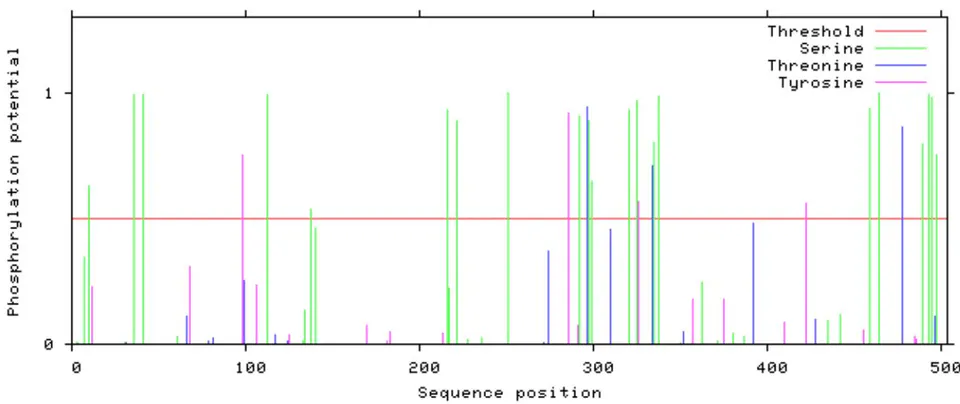
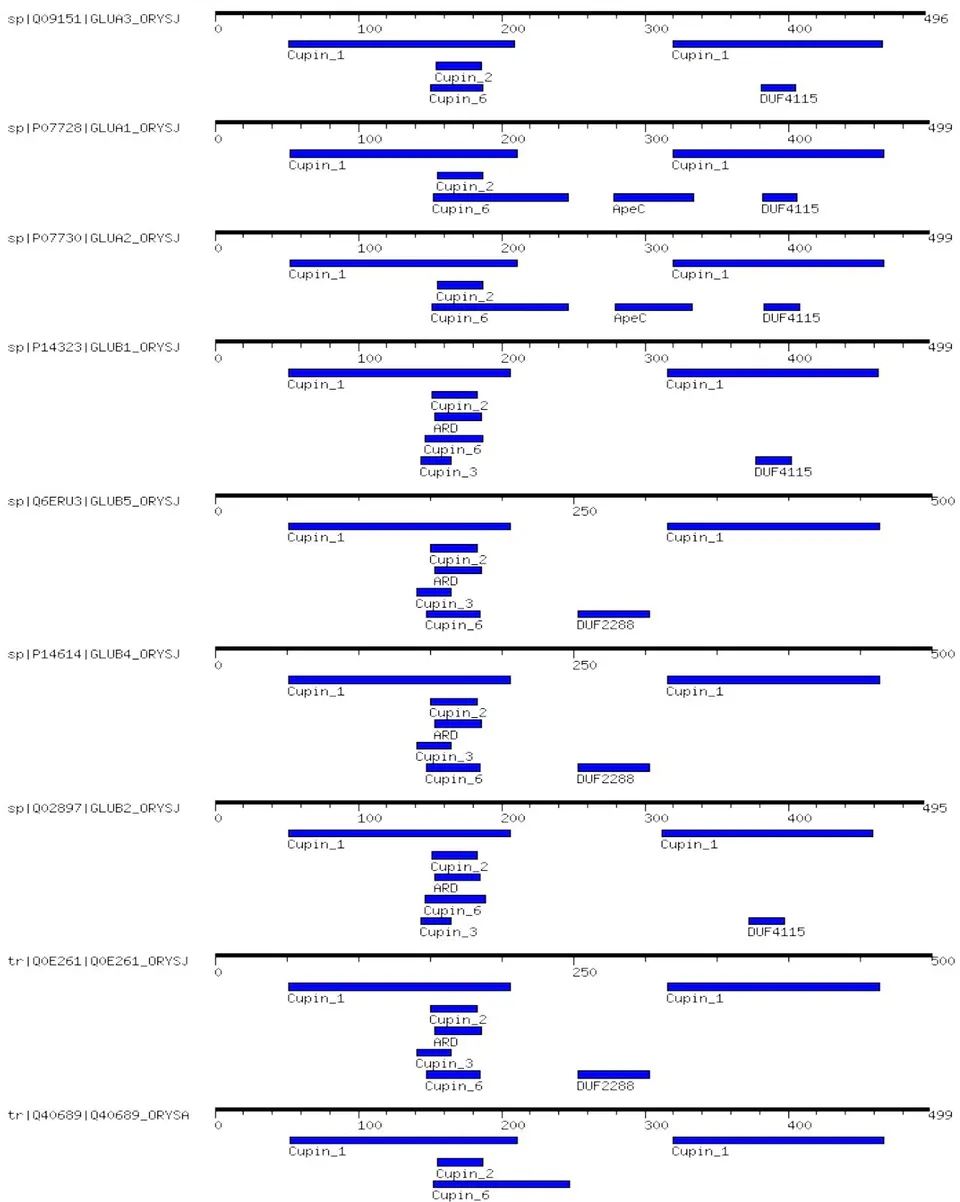
The amino acid sequences of the selected plants were analyzed for the putative phosphorylation sites at the NetPhos 2.0 Server (http://www.cbs.dtu.dk/services/NetPhos/) (Blom et al., 1999). Motif search (www.genome.jp/tools/motif) was used to find the number of motifs, motif ID, description and position of the motif found. Analysis of domain and conserved protein motifs was performed using MEME (http://meme.sdsc.edu/meme/meme.html) (Timothy et al., 1994).
III. RESULTS AND DISCUSSION
a) Physiochemical characterization
Glutelin protein sequences of Oryza sativa (Table 1) were analyzed in this study and corresponding protein sequences were collected from Uniport (http://www.uniprot.org/). Physiochemical properties of these protein sequences computed using Expasy Protparm server and the analyzed results were presented in table 2. The isoelectronic point is the pH at which the protein does not migrate in an electric field. It plays an important role in protein purification. The computed pl value that was less than 7 (pl<7) indicates that proteins were considered as acidic or greater than 7 (pl>7) reveals that proteins were basic in character. The pl value of all the sequences under study having more than 7 (pl>7) reveals that these proteins were basic in nature. The computed isoelectric point will be useful for separating the protein on a polyacrylamide gel by isoelectric focusing. Total numbers of negatively charged residues are lower than the total number of positively charged residues implies that these proteins are having extracellular portion. The extinction coefficient of a protein as calculated by the program depends on the molar extinction coefficient of Tyrosine, Tryptophan and Cysteine residues. Difference in the extinction coefficient values these glutelin proteins as evident from Table 2 was due to the difference in concentration of these three residues. The extinction coefficient can be used to calculate the concentration of a protein in solution. Instability index relies upon the occurrence of certain dipeptides along the length of the protein to distinguish between the unstable and stable protein. If the index is less than 40, it is probably stable in the test tube. If the value is greater than 40, it is probably not stable (Guruprasad et al., 1990). The value for instability index for glutelin proteins are more than 40, hence these proteins are probably not stable (Guruprasad et al., 1990). The aliphatic index refers to the relative volume of a protein that is occupied by aliphatic side chains and contributes to the increased thermo stability of protein. The aliphatic index of a protein is a measure of the relative volume occupied by aliphatic side chain of the following amino acids viz., alanine, valine, leucine and isoleucine. The aliphatic index values of glutelin protein sequences ranging from 74.26 to 80.95. The very high aliphatic index of all glutelin protein sequences supports the view that these may be stable for a wide range of temperatures. Grand average of hydropathicity (GRAVY) index indicates the solubility of proteins: a positive GRAVY value indicates that proteins are hydrophobic in nature whereas a negative GRAVY value indicates more surface accessibility of the protein to interact with water (hydrophilic in nature). GRAVY values of glutelin protein sequences were ranged from -0.456 to -0.568. The very low GRAVY index of glutelin protein sequences implies that these protein sequences could result in a better interaction with water (hydrophilic in nature).
b) Functional characterization
The secondary structure of the protein sequences were predicted using SOPMA server (Table 3). It was observed that alpha helix was predominant, followed by random coil, extended strand and least beta turn was found. The secondary structure was predicted by using default parameters (window width 17, similarity threshold: 8 and number of conformational states: 4). Using the NetPhos 2.0 Server the putative phosphorylation sites were identified for glutelin proteins (Table 4). The output score was given in 0.000-1.000 range and the score above the threshold (0.500) shows the confidence rate of true phosphorylation site by the server. Several putative phosphorylation sites are completely conserved in plant species and interestingly more phosphorylation sites were found in these protein sequences. Conserved protein motifs subjected to MEME to obtain the best possible matches (table 5). Other protein motifs found in the glutelin proteins are most of them belongs to cupin family proteins (fig 2).
c) Conclusion
The present in silico study describes some important physiochemical and functional properties of rice glutelin proteins. Physiochemical and functional analysis reveals that rice glutelins are a basic, hydrophilic, thermo stable, having some extracellular portion and which has many phosphorylation sites. Conserved protein motifs are observed in these proteins and other protein motifs found in the glutelin proteins are most of them belongs to cupin family proteins. The obtained results could be used for further in silico analysis and homology modeling studies of these glutelin proteins.
IV. ACKNOWLEDGEMENTS
We express our gratitude to the Department of Biotechnology, Government of India for providing fellowship and to the Indian Institute of Rice Research, Hyderabad for providing the facilities.
| Entry | Entry name | Protein names | Gene names | Organism | Length (No. of A.A) |
| Q09151 | GLUA3_ORY SJ | Glutelin type-A 3 | GLUA3 GLUA-3 GT22 GT3 Os03g0427300 LOC_Os03g31360 OSJNBa0083F15.19 | Oryza sativa subsp. japonica (Rice) | 496 |
| P07728 | GLUA1_ORY SJ | Glutelin type-A 1 | GLUA1 GLUA-1 Os01g0762500 LOC_Os01g55690 P0460E08.38 P0512C01.36 | Oryza sativa subsp. japonica (Rice) | 499 |
| P07730 | GLUA2_ORY SJ | Glutelin type-A 2 | GLUA2 GLUA-2 GT1 Os10g0400200 LOC_Os10g26060 OSJNBa0050N08.16 | Oryza sativa subsp. japonica (Rice) | 499 |
| P14323 | GLUB1_ORY SJ | Glutelin type-B 1 | GluB1-A GluB-1 Os02g0249800 LOC_Os02g15169 OJ1113_G05.6 OSJNBa0011N12.36; GLUB1-B GLUB-1 Os02g0249900 LOC_Os02g15178 OJ1113_G05.4 OSJNBa0011N12.34 | Oryza sativa subsp. japonica (Rice) | 499 |
| Q6ERU3 | GLUB5_ORY SJ | Glutelin type-B 5 | GLUB5 GLUB-5 Os02g0268100 LOC_Os02g16820 P0693E08.14 | Oryza sativa subsp. japonica (Rice) | 500 |
| P14614 | GLUB4_ORY SJ | Glutelin type-B 4 | GLUB4 GLUB-4 Os02g0268300 LOC_Os02g16830 P0693E08.16 | Oryza sativa subsp. japonica (Rice) | 500 |
| Q02897 | GLUB2_ORY SJ | Glutelin type-B 2 | GLUB2 GLUB-2 GluB-7 GLUB7 Os02g0249600 LOC_Os02g15150 OSJNBa0011N12.30 | Oryza sativa subsp. japonica (Rice) | 495 |
| Q0E261 | Q0E261_ORY SJ | Glutelin | Os02g0268300 OsJ_06189 | Oryza sativa subsp. japonica (Rice) | 500 |
| Q40689 | Q40689_ORY SA | Glutelin | Gt2 | Oryza sativa (Rice) | 499 |
| Entry | Entry name | Length (No. of A.A) | M.wt | pl | -R | +R | EC | II | AI | GRAVY |
| Q09151 | GLUA3_ORYSJ | 496 | 56015.0 | 8.81 | 44 | 51 | 45435 | 46.23 | 80.95 | -0.456 |
| P07728 | GLUA1_ORYSJ | 499 | 56246.9 | 9.09 | 42 | 52 | 45435 | 51.36 | 76.77 | -0.539 |
| P07730 | GLUA2_ORYSJ | 499 | 56306.1 | 8.93 | 42 | 50 | 50935 | 50.18 | 76.37 | -0.509 |
| P14323 | GLUB1_ORYSJ | 499 | 56550.5 | 9.26 | 39 | 50 | 50685 | 52.11 | 76.19 | -0.495 |
| Q6ERU3 | GLUB5_ORYSJ | 500 | 56808.0 | 9.00 | 42 | 50 | 43820 | 47.94 | 78.22 | -0.508 |
| P14614 | GLUB4_ORYSJ | 500 | 56818.0 | 9.00 | 42 | 50 | 43820 | 47.81 | 78.22 | -0.510 |
| Q02897 | GLUB2_ORYSJ | 495 | 56046.8 | 9.11 | 39 | 48 | 50685 | 51.22 | 74.26 | -0.498 |
| Q0E261 | Q0E261_ORYSJ | 500 | 56818.0 | 9.00 | 42 | 50 | 43820 | 47.81 | 78.22 | -0.510 |
| Q40689 | Q40689_ORYSA | 499 | 56239.9 | 9.09 | 42 | 52 | 45435 | 50.14 | 75.19 | -0.568 |
| Entry | Entry name | Alpha helix | Extended strand | Beta turn | Random coil |
| Q09151 | GLUA3_ORYSJ | 32.86% | 21.98% | 13.91% | 31.25% |
| P07728 | GLUA1_ORYSJ | 32.67% | 20.64% | 14.83% | 31.86% |
| P07730 | GLUA2_ORYSJ | 32.26% | 21.84% | 12.42% | 33.47% |
| P14323 | GLUB1_ORYSJ | 33.87% | 21.04% | 12.63% | 32.46% |
| Q6ERU3 | GLUB5_ORYSJ | 35.20% | 22.00% | 11.00% | 31.80% |
| P14614 | GLUB4_ORYSJ | 35.20% | 20.80% | 11.00% | 33.00% |
| Q02897 | GLUB2_ORYSJ | 36.36% | 18.99% | 13.74% | 30.91% |
| Q0E261 | Q0E261_ORYSJ | 35.20% | 20.80% | 11.00% | 33.00% |
| Q40689 | Q40689_ORYSA | 29.86% | 21.44% | 14.63% | 34.07% |
| Entry | Entry name | Putative phosphorylation residues | ||
| Serine | Threonine | Tyrosine | ||
| Q09151 | GLUA3_ORYSJ | 15 | 2 | 3 |
| P07728 | GLUA1_ORYSJ | 15 | 2 | 3 |
| P07730 | GLUA2_ORYSJ | 21 | 3 | 4 |
| P14323 | GLUB1_ORYSJ | 14 | 2 | 3 |
| Q6ERU3 | GLUB5_ORYSJ | 20 | 3 | 4 |
| P14614 | GLUB4_ORYSJ | 11 | 4 | 2 |
| Q02897 | GLUB2_ORYSJ | 14 | 2 | 3 |
| Q0E261 | Q0E261_ORYSJ | 14 | 2 | 3 |
| Q40689 | Q40689_ORYSA | 15 | 2 | 3 |
| Motif | Width | Best Possible Match |
| 1 | 50 | SQSQKFRDEHQKIHRFRQGDIVALPAGVAHWCYNDGDAPVVAIYVTDLNN |
| 2 | 50 | HYVVLKKAEHEGCQYIAFKTNPNSMVSHMAGKNSIFRAMPVDVIANAYRI |
| 3 | 50 | ADTYNPRAGRITNLNSQKFPILNLVQMSATKVNLYQNAILSPFWNINAHS |