I. INTRODUCTION
Morocco, a country in northern Africa, known for its climate (Mediterranean, semi-arid) and the nature of its soils, has a particularly rich and varied flora in medicinal and food plants [1], traditionally used to treat several diseases, including diabetes, cardiovascular diseases, digestive system pathologies and other pathologies [2].
Moroccan flora brings together several species of plants that have not yet been studied or have been studied, but endowed with real pharmacological properties. This wealth must now be exploited [3].
As part of the promotion of aromatic plants from the ESSAOUIRA region, a study of two very well-known medicinal plants widely used in traditional Moroccan medicine known under the name of HALHAL "Lavandula stoechas" and JAADIA "Teucrium Polium". These plants grown spontaneously possessing mainly analgesic, anti-infectious and antispasmodic properties and can be used as a culinary condiment [4].
II. BOTANICAL DESCRIPTION
a) Lavandula stoechas
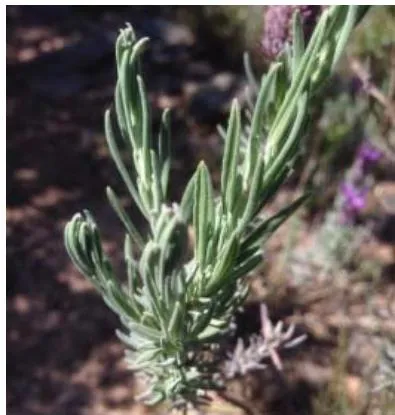
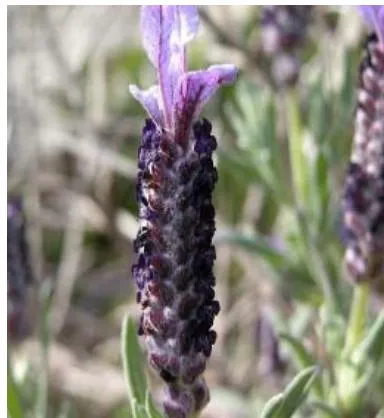
The leaves of Lavandula stoechas are opposite linear 1-4 cm long, with a rolled margin, to mentose and gray on both sides (Figure 1). While the Flowers are grouped by 6-10 in false quadrangular whorls, very tight 2-3 cm wide, forming false terminal spikes. Rhomboidal-spatulate bracts 4-8 mm long, brownish purple (Figure02); the tallest, sterile, are much larger (1-5cm long) and blue-violet. Tubular calyx 4-6 mm long with 13 veins and 5 teeth, the upper tooth being terminated by an enlarged appendix. Dark violet corolla 6-8 mm long, vaguely bilabiate, with 5 lobes 4 stamens 2 short and 2 long, inhabiting dry locations, rocky, non-calcareous mountain pastures [5].
b) Teucrium polium
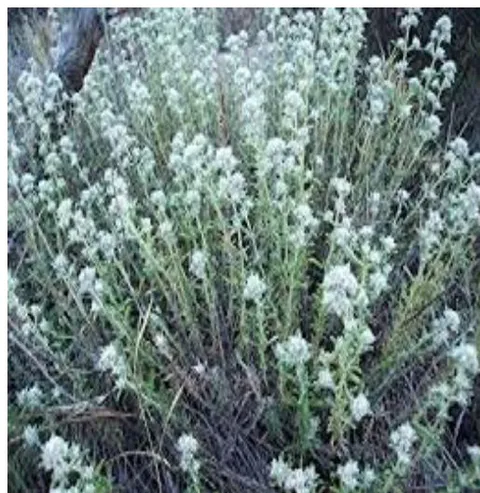
Teucrium polium is a whitish, perennial herbaceous plant, very fragrant and very polymorphic, where determination of micro morphs is always delicate. It is branched from the base, has linear, greyish-green leaves strongly revolving on the margins, is a perennial plant often taken, covered with woolly hairs which give it a bluish gray color and its size varies between 6 and 25 cm.
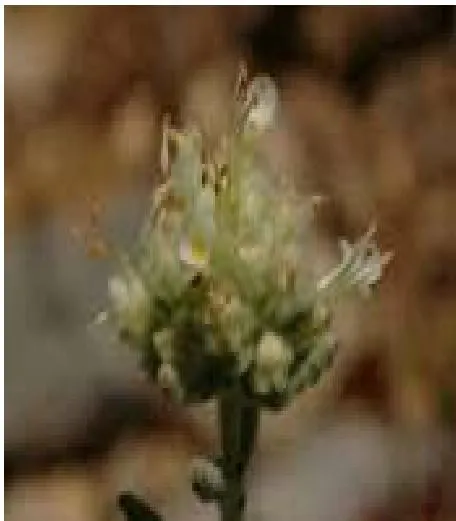
The flowers are white or yellowish in dense clusters at the top of the twigs [6]. Their characteristic is to have only one lip, the lower lip, grouping together the 5 fused petals [7].
III. PREPARATION OF PLANT MATERIAL
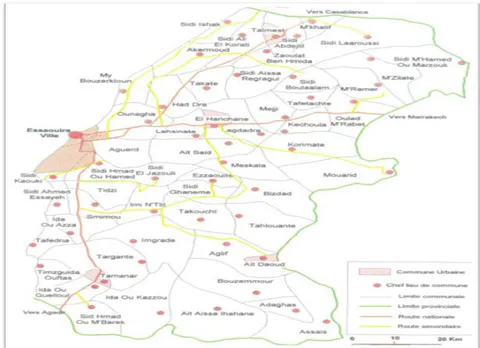
The plant material used during this study is the aerial part of Lavandula stoechas and Teucrium Poliums collected in February 2019 in the region of EL HRARTA province of Essaouira Morocco.
After harvesting, the used parts of the plant (leaves and stems) were dried in a well ventilated place, for one month, at room temperature and protected from light to avoid any modification or degradation of the constituents present.
After drying, these parts were cut into small pieces, then subjected to extractions in order to extract the different classes of chemical compounds contained in our plant for phytochemical tests.
a) Extraction of total polyphenols
There are various extraction methods which are particularly suitable for the extraction of polyphenols, from which the method which was carried out by.
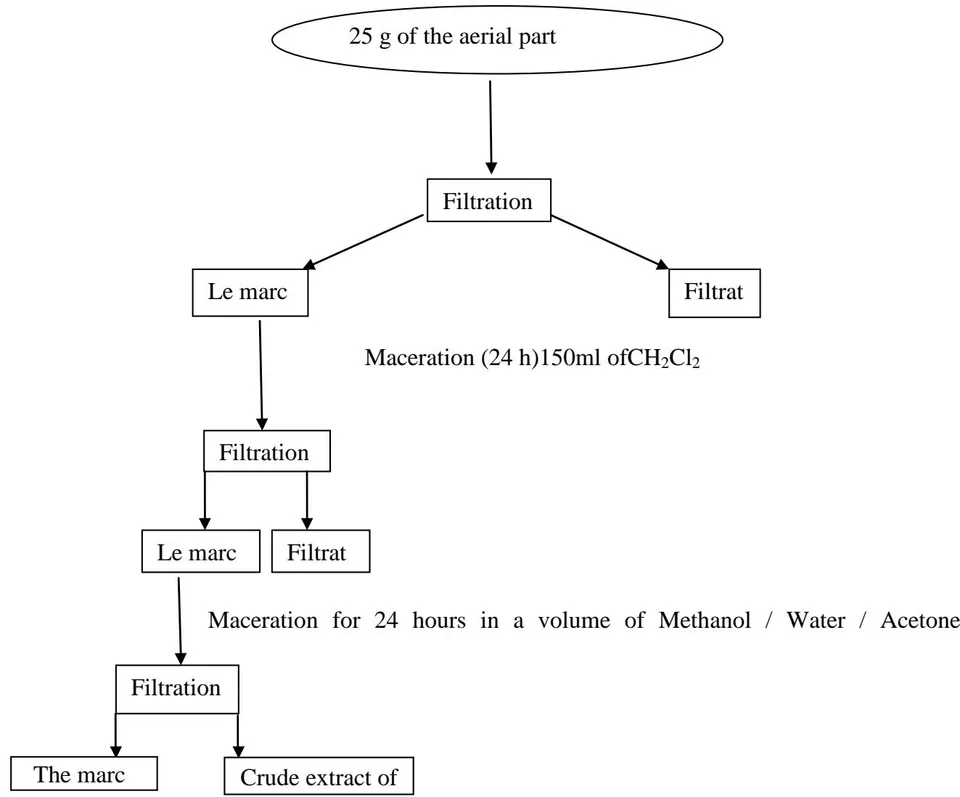
25 g of the aerial part of the plant is subjected to maceration, respectively, with hexane and dichloromethane in order to remove all pigments and lipids.
The marc thus obtained is subjected to maceration for 24 hours in the presence of a mixture (methanol/water/acetone (60/10/30)).
The crude extract of total polyphenols is obtained after evaporating the filtrate to dryness in a rotary evaporator at a temperature of (Figure 4).
b) Extraction of essential oils by hydro-distillation
The essential oils of Lavandula stoechas and Teucrium Poliums were isolated by hydro distillation using a Clevenger type apparatus. It consists of directly immersing the plant material (200 g) to be treated in a flask filled with distilled water (3.5 L) surmounted by a column 60 cm in length connected to a condenser. Everything is then brought to the boil for 3 hours.
c) Soxhlet extraction
The extracts of the two plants studied were obtained by mounting Soxhlet with a continuous solvent of a chemical species contained in a solid powder.
| Lavandula stoechas | Teucrium Polium | |
| Solvent | Dichloromethane | Ethyl acetate |
| Volume | 350 ml | 350 ml |
| Masse de la plante | 50g | 50g |
IV. RESULTS AND DISCUSSIONS
a) Moisture level of the two plants
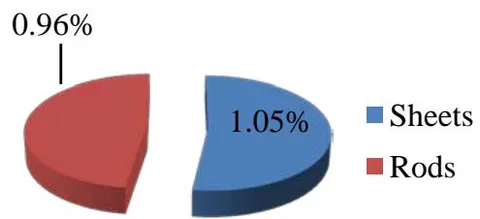
After having treated the two plants Lavandula stoechas and Teucrium Poliumsin an oven at a temperature of for 4 hours, the humidity level corresponds to approximately 52.9% for Lavandula stoechas and 2.01% for Teucrium Polium distributed as shown in Figures 14 and 15. More than half of the fresh weight of the lavandula species is water while the majority of the Teucrium Polium species is in the dry form.
b) Lavandula stoechas
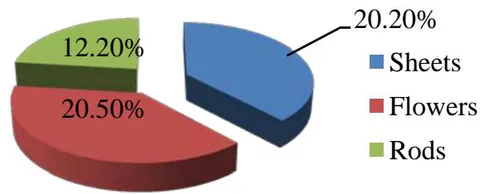
c) Teucrium polium
d) Extraction yields of essential oils and extracts
The essential oils were obtained by hydro distillation, and the extracts by the Soxhlet assembly, the yields of different extractions are shown in figure 7.
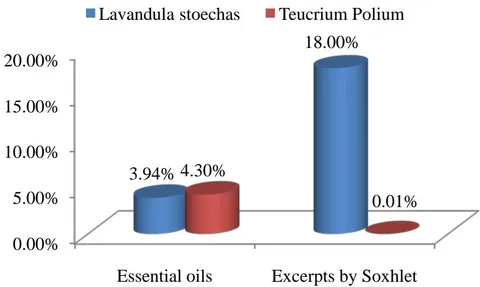
The extraction results obtained show that Lavandula stoechas gave a very good yield of essential oil (3.94%), this plant also gives a significant amount of extract (18%). On the other hand, Teucrium Polium has a very low quantity of essential oil (0.01%) but it gives a lesser quantity of extract (4.30%).
e) Results of the phytochemical tests of the two plants studied
The phytochemical tests carried out on the different preparation methods made it possible to demonstrate the presence of some secondary metabolites present in the two plants studied by qualitative reactions (precipitation, coloring with specific reagents, or by examination under UV light). The results are summarized in Table 2.
These tests showed the richness of two plants in alkaloids, tannins, flavonoids and saponosides, with the absence of starch, proteins, iridoids and prothocynidols. But Lavandula stoechas is richer than Teucrium Poliumen in glucosides, sterols and triterpenes.
Table 2: Results of the phytochemical tests of Lavandula stoechas and Teucrium Poliums
f) Total polyphenol content of the two plants
The estimation of the total polyphenol contents was carried out by the spectrophotometric method and the Folin-Ciocalteu reagent. The results obtained are expressed in milligram gallic acid equivalent per gram of extract (mg GAE/mg extract). The linear regression equation of the plotted gallic acid calibration curve is: (Figure 8).
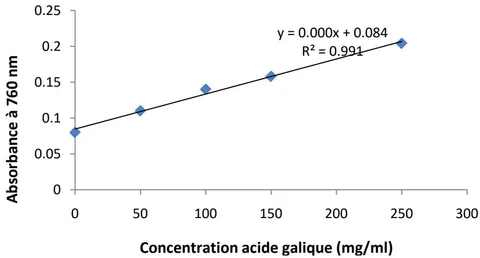
The results obtained are of the order of 95.18 mg EAG/mg extract for Lavandula stoechas and 72.26 mg EAG/mg extract for Teucrium Polium. The concentration of phenolic compounds is noted in the extract of Lavandula stoechas. The highest concentration of phenols was measured in the extract of Figure stoechas extract by GC/MS gave the chromatogram shown in Figure 9.
V. GAS CHROMATOGRAPHY OF THE TWO PLANTS
a) Lavandula stoechas
Lavandula stoechas essential oil and extract has been identified by GC/MS. Analysis of the Lavandula
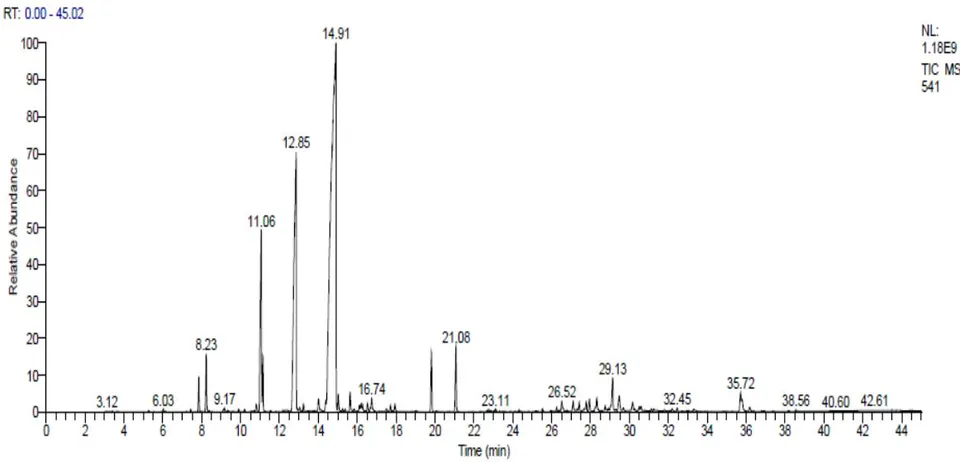
The results of the analysis of the majority chemical composition of the extract and essential oil are identified by comparing their spectral data and retention times with those of reference compounds and databases (NIST).
Analysis of Lavandula stoechas extract showed 35 peaks, 9 of which were predominant, of which (+) - 2-Bornanone was the most predominant (55.68%) (Table 3).
| Retention time | Brute formula | Molecules | Molecule structure | Percentage(%) |
| 7.85 | α-Pinene |  | 0,98 | |
| 8.23 | Camphene |  | 1.66 | |
| 11.06 | Eucalyptol |  | 7.86 | |
| 11.14 | D-Limonene |  | 1.46 | |
| 12.85 | Fenchone |  | 17.51 | |
| 14.91 | (+)-2-Bornanone |  | 55.68 | |
| 19.82 | Isobornyl acetate |  | 1.94 | |
| 21.08 | Myrtenylacetate |  | 2.18 | |
| 29.13 | 1HCycloprop[e]azulen-4-ol,decahydro-1,1,4,7-tetramethyl-, [1aR (1aà,4á,4aá,7à,7aá,7bà)]- |  | 1.34 |
Likewise, the analysis of the essential oil of Lavandula stoechas by CG/MS, gave us the chromatogram shown in figure 10.
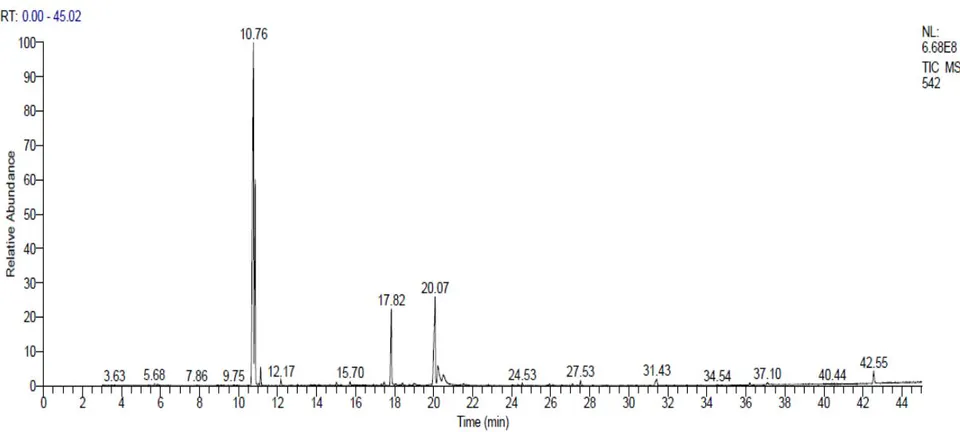
Analysis of the essential oil of Lavandula stoechas revealed 36 compounds, 19 of which were predominant, including Cyclohexene, 1-methyl-4-(1-methylethylidene), which very much abandoned (47.57%) (Table 4).
| Retention time | Brute formula | Molecules | Molecule structure | Percentage (%) | |
| 10.76 | α-Terpinolene |  | 47.57 | ||
| 10.85 | o-Cymene |  | 18.15 | ||
| 11.13 | D-Limonene |  | 1.52 | ||
| 12.17 | δ-Terpinene |  | 0.53 | ||
| 15.01 | 6,6-Dimethylhepta-2,4-diene |  | 0.34 | ||
| 15.70 | 1-(1,2,3-Trimethylcyclopent-2-enyl)-ethanone |  | 0.45 | ||
| 17.46 | 1S,2R,4R,7R)-4Isopropyl-7-methyl-3,8-dioxatricyclo[5.1.0.02,4]octane. |  | 0.38 | ||
| 17.82 | Ascaridole |  | 8.65 | ||
| 18.40 | 7Oxabicyclo[4.1.0]heptan-2-one,3-methyl-6-(1-methylethyl)- |  | 0.27 | ||
| 18.99 | trans-Ascaridol glycol |  | 0.27 | ||
| 20.07 | Isoascaridol |  | 12,24 | ||
| 20.21 | Thymol |  | 2.72 | ||
| 20.49 | Phenol,2-methyl-5-(1-methylethyl)- |  | 1.27 | ||
| 24.53 | Heptyl(E)-2-methylbut-2-enoate |  | 0.22 | ||
| 27.53 | Octyltiglate |  | 0.51 | ||
| 31.43 | Geranylangelate |  | |||
| 36.20 | 2-Pentadecanone, 6,10,14-trimethyl- |  | 0.22 | ||
| 37.10 | Hexadecen-1-ol, trans-9- | 0.32 | |||
| 42.55 | Phytol | 1.39 | |||
b) Teucrium polium
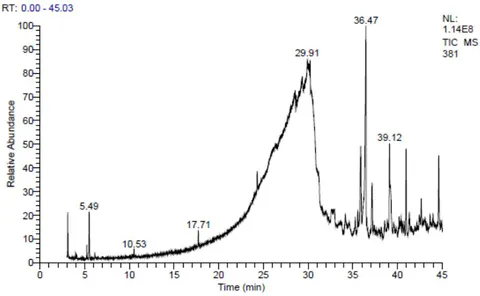
The results of the analysis of the majority chemical composition of the extract are identified by comparing their spectral data and their retention times with those of reference compounds and databases (NIST).
Analysis of the Teucrium Polium extract revealed 35 peaks, 10 of which were predominant, including Tricyclo [5.1.0.0 (2,4)] oct.-5-ene-5-propanoic acid, 3,3,8,8-tetramethyl-(17.53) is the most predominant (Table 5).
| Retention time | Brute formula | Molecules | Molecule structure | Percentage (%) |
| 3.09 | Toluène |  | 2,37 | |
| 5.49 | o-Xylène |  | 2.93 | |
| 29.91 | 8-Hexadecenal, 14-méthyl-, (Z)- |  | 3.22 | |
| 30.08 | Aromadendrene oxide-(1) |  | 2.76 | |
| 30.22 | Hexadécane | 2.59 | ||
| 31.19 | Murolan-3,9(11)-diene-10-peroxy |  | 3.32 | |
| 35.90 | 6-(1 Hydroxy-methylvinyl)-4,8a-dimethyl-3,5,6,7,8,8 a-hexahydro-1H-naphthal en-2-one |  | 9.37 | |
| 36.47 | Tricyclo[5.1.0.0(2,4)]oct-5-ene-5 propanoic acid, 3,3,8,8-tetramethyl- |  | 17.53 | |
| 39.12 | n-Hexadecanoicacid |  | 12.61 | |
| 40.97 | Cyclodecasiloxane,eicosamethyl- |  | 6.62 |
VI. CONCLUSION
Analysis of the chromatogram of the extract of Lavandula stoechas revealed 9 major compounds including bornanone which is high proportion (55.68%), While the Teucrium Polium extract contains 10 major compounds including Tricyclo [5.1.0.0 (2,4)] oct-5 -ene-5-propanoic acid, 3,3,8,8-tetramethyl- (17.53%) which in large quantity.