In conceptual terms, PMI new edition of PMBOK is aligned with values and principles at the edge of the social sciences, neurosciences, and information sciences of our days. As things change faster and predictability shortens a de facto standard should allow for a higher degree of interpretation, letting each approach be tailored by the context of each case. We focus on this stimulating paradigm shift from edition 6 to edition 7 of PMBOK with the aim of strengthening and making it more actionable. We believe we are contributing to the clarification of intents.
## I. INTRODUCTION
Project Management Institute (PMI) provided a paradigmatic change to its project management guide from the 6th to the 7th edition. This paradigm shift of PMBOK is very welcome, but it is still open to many opportunities of improvement. The introduction of 'principles' as core concept is very interesting, but needs careful presentation and contextualization. It should be more explained and clearly addressed. The shift from processes to principles and from knowledge areas to domains carries with it a deep culture innovation. It cannot just be mentioned, it must be understood and internalized\[1\](Nonaka et al., 2000). New concepts cannot be imposed dogmatically, by prescription \[2\](Emel, 2012). Paradigm shifts are difficult social processes and, if mishandled, can end up destroying a wealth of opportunity. This suggests that we should work longer on the concepts and clear the message \[3\](Polani, 1958). We may have to introduce new concepts and strengthen their coherence with contextual narratives\[4\](Elain, 2016).
In the text of PMBOK 7th Edition, the principles are presented in a very confusing way. There is no effective explanation of the deep meaning of what principles represent in the context of project management, and each principle is not clearly explained. It is also not explained why we address principles. Furthermore, being a new concept in what we intend to be a new project management approach paradigm, they are referred in random order along the text. The same thing occurs with the domains. It is crucial to explain why we address domains instead of knowledge areas, but that explanation is not provided.
So, it results unclear the crucial importance of addressing domains, how important they are in an integrative assertion of the concept. To be sound, the thesis of this new paradigm approach to PMBOK must be conceptually more robust, more clear and precise. We need to put a stronger effort into making the new approach more intuitive, attractive, and above all more clear.
A lot more work must also be done in other perspectives. The overall idea is that when "teaching" or orienting, guiding project managers to be systemic and proactive, based on principles, and value oriented concerns, evolving from knowledge areas to domains... the PMI narrative is prescriptive in a sense that is not effective \[5\](Bergenholtz and Gouws, 2011). If we say that something must be done this way but don't explain why, giving examples, metaphors, meanings, we increase the risk of not being followed. PMI is definitely moving in the right direction but should make an effort to be more effective, explaining why this paradigm shift is important and producing a clear guide that could help people shifting from one paradigm to the other. We must always remember we all tend to resist change, [6] Val and Fuentes (2003), [7] Goldstein (1988), so, only if we are very convincing and persuasive we can act as change agents.
The "teaching" narrative strategy should be avoided and adapt to another paradigm shift, that of passing from "teaching" to "learning", [8] Bloom et al (1956), [9] Barr and Tagg (1995), [4] Elain (2016). In a fast changing unpredictable world, we need to evolve from teaching to learning\[10\](Drucker, 1980),\[9\](Barr and Tagg, 1995). Prescribing is teaching and it is not effective\[4\](Elain, 2016). The only way to be productive in a community of project managers is to work on the background, indirectly, to help construct communities that reflect, discuss, engage in controversies, in a learning process able to produce and report results. Project managers need to tune up a team, stressing what is more important and effective to coordinate this team and make it effective so they have to internalize the meaning of these new concepts very well.
PMI has this huge advantage of having a wide and well distributed clientele that can facilitate research and the ability to construct a sound body of knowledge. If PMI engage in this kind of learning community process, orienting PMs to develop themselves in a reflective practice it would be not only more effective, but much more powerful. In our view, the direction of this change from the 6th Edition to the 7th Edition is very good, but, as it is, it does not look as effective as it could be. The narrative should be improved, and this is not a detail. It means getting to the roots of the learning processes and the mechanisms of the mind use to develop and learn, [11] Goodson and Scherto (2011), \[12\](Goodson et. al. 2010).
Resuming, principles, values and domains cannot be addressed in a prescription mode if we want to make them effective and useful. It would be a good choice to use stories, and engage in powerful metaphors and make their use in practice something consistent, in order to take the most of them and learn.
Tailoring, as PMI well propose for projects, should be extended to the intrinsic approach and narrative of the text of the guide itself. That is, the text need to be tailored to a more clear version. Besides, value and tailoring as we address it can only be understood in a cultural context, a Project Management cultural context.
Besides, as the paradigm shifted from industrial economies to knowledge economies, the importance of the project context in project management increased dramatically. The global economy shifted from trading materials to exploring mind. You can order and buy materials, change schedules, but in what concerns knowledge, mainly tacit knowledge, we are not on the list of what we can purchase. You need to develop it by yourself. In yourself and in your team by subjecting it to learning contexts. Tacit knowledge is developed by experiencing and reflecting\[3\](Polanyi, 1958), and by being defied to explain yourself, something you develop when moving in controversies with interesting people, exploring the dynamic of groups, and taking advantage of teams. Always with a debate approach in a spirit where the politically correct attitude is not welcome.
A final remark in this introduction is about the term "optimization". The use of this term is not accurate. Optimizing is guarantying that you achieve the best solution of them all, that is, your solution is better than all the others, all the others are guaranteed as worse. In the realm of Project Management, we should ban optimization from the vocabulary. We have no time to optimise when managing projects. Our purpose is not that one, our purpose is to be as effective as we can. That, of course, if our project is not about to optimize a process, or practice.
In this paper we focus on the stimulating paradigm shift promoted by the transition from edition 6 to edition 7 of PMBOK with the aim of strengthening this effort. We try to make it more understandable and clear. We would like to believe that we can contribute for the success of this journey. That is the main purpose of this paper.
## II. VALUE AND TAILORING
Let's do an attempt to clarify our critical approach. Let's take two distinctive concepts stressed on PMBOK 7th edition (2021). Value and Tailoring. Let's try to insert them into a story to engage people on the perfect meaning they both have, and how important they really are for project managers. Stories and metaphors are the basic languages of learning and reflexion, they are in the roots of mankind and communities evolution through times\[12\](Ivor et. al. 2010).
We have people who cannot read, they are alphabet, people who can read but don't understand, illiterate people, people who read and understand, maybe the huge majority, but that can be still useless. In fact, we need two more stages in this progression to be effective. Beyond understanding we must internalize \[13\](Nonaka and Takeuchi, 1995). This is about developing knowledge, tacit knowledge, not transferable knowledge. But the last stage is the one that finally adds value, it is about to be able to act. To transform information into action. This is the real value production.
The idea of being driven by value is much better, interesting, and effective then being driven by cost. Value has sustainability attached to it, it includes cultural and social dimensions, a systemic behaviour. Carlo Cipolla (1998) [14] was a bright Italian professor, expert in Middle Ages Economics, professor in Italy and in the United States, namely Professor emeritus in Berkley. He wrote many books on his expertise domain, but published one directed to us all, "The Basic Laws of Human Stupidity". In a very short text, he uses a simple inspiring model to absorb what value is. This model is in itself a very effective narrative about value.
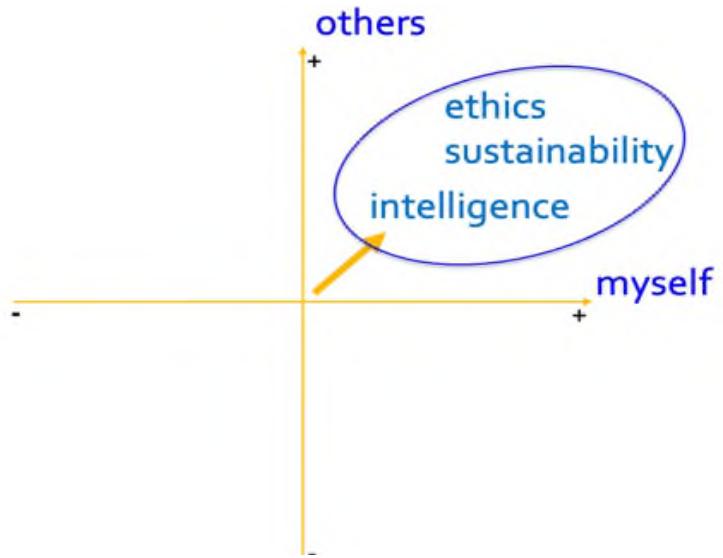 Figure 1: Cipolla Value Model (1988)
In figure 1, we have four quadrants formed by the cross of the two axes. One axis represents the impact of our action on ourselves (it can be positive or negative) and in the other axis we represent the impact of our actions on the others (it can be positive or negative). If your actions are good for yourself and bad for the others you are like a bandit, a cheater. If your actions are bad for you and bad for the other, you are stupid. That is an interesting definition of stupid, someone who doesn't create value at all, at all. If your actions are good for the others and bad for you, you are naif. If your actions are good for you, and for the others, you are intelligent, you are behaving in a sustainable way, you are creating value for all, you are being effective.
This is a concept of value that is visited through its meaning, using a story, a metaphor, a model, and not addressed as a top down idea. We can as well illuminate the same concept with another story.
The author of Critical Chain, (1997) [15] the project management methodology, is an accomplished writer who writes novels. These novels are very inspiring in pointing you towards action. Critical Chain was basically a novel, and it was so powerful in terms of a subjacent project management methodology that the author and other people in Project Management decided to extend the book reasoning and develop a sound methodology - Critical Chain. Goldrat also have a book on value, "Necessary but not Sufficient" (2005) [16]. It is about the value ERPs bring to business and how easy is to develop and produce systems that end up not providing value for the firm. This story is also powerful in terms of metrics. How should we measure value? Cost and time can be only numbers, but value is a much more accomplished concept and needs another degree of conceptual reasoning, it needs a comprehensive context.
That is the kind of value we should try to create in the management of our projects, we tried to describe the kind of actions we should plan and execute to provide this kind of value. Our focus should always be in that quadrant of good outcomes for all, if possible. We let the reader of this text to imagine exceptions, because there are exceptions. Our concern should be about creating value for all, but we know that sometimes this is wishful thinking. Not a reason to not try.
Of course, we should be very concerned with cost, time and performance, but we should be guided by value, the general principle. Principles kind of encapsulate our actions, our practices, our processes and activities. For example, to measure medical effectivity by the number of patients consulted in a day would provide a wrong bias.
PMI, in the 7th edition of PMBOK (2021), also stresses tailoring. In fact, to improve our project culture, we should tailor our project habits, work on habits of effectiveness, according to an evolving progress and a context of action. This is a step-by-step learning process. We learn to adapt our knowledge, habits, guesses, intuition, reasoning, creativity, and critical thinking to specific cases, a specific project.
As far as tailoring is concerned, managing projects obliges us to see the tree and the forest, to be able to identify things in a micro setting, a space of details, and a macro setting, a wider space of integrated context, or environment. If we want to understand something deeply, we need to train this bifocal approach. Only by integrating the two views can we refine and align our actions in a wider understanding of the system, being intelligent agents of value creation and sustainability.
## III. STEWARDSHIP ATTITUDE
The stewardship attitude is also very important. As humanity evolved from a rural economy to an industrial economy, into a knowledge economy, we also changed our relationship with work\[17\](Sennett, 2008). In the rural ages, work was mainly handicraft in the production of direct goods, artefacts to the producer's use and food to heat. At that time even trade was unusual. At that stage of our working development, we learned directly with the others, looking at what the older people (more experienced) did, how they did it, and experimenting ourselves. Our relationship with work was emotional, we were engaged by what we did, it was our life, usually without social restrictions, we worked with our own family, there were no dichotomies, social life and work were intertwined, [17] Sennett (2008).
Later, in the industrial age, our work became something separate, a separate reality, more abstract, without any emotion involved, most of the times doing what someone else told us to do, forgetting to think and reflect. We became flatter, [18] Latour (1993), with less cultural dimensions, we lost the habit of thinking by ourselves, deciding our own lives, we began to behave like herds. Nietzsche called it herd morality! See also Simon Williams (1998) [19].
That is the way we have entered the knowledge age, [10] Drucker (1980). Simple people, flat, in a knowledge age but with poor thinking abilities and reflection habits. Too specialized in little things, unable to see the tree and the forest, unable to put things in perspective. More and more unable to think conceptually.
That is the kind of attitude we all should rethink to change and reinvent. Like computers, we need a reset. We need to fight this pathology of normality, [20] Fromm (1953), each one of us needs to wake up, take responsibility, do what needs to be done, be alive, be logic, be creative, and be critical, [21] Brabandere (2021).
The stewardship attitude is represented by elements in the team that try to guide others in their work, if there are more experienced than them. Using the project management team we can play roles and circulate, now I stewardship you, after you stewardship me.
## IV. PRINCIPLES AND DOMAINS
Principles in project management shouldn't be prescriptive by nature. They are intended to guide the behaviour of people involved in projects in a soft way, an indirect way, based on practices, processes, defined and accepted by the team. It is difficult to impose these practices with rules, and with prescriptions. To integrate the principles in your action we need to internalize them before. And this is a knowledge creating activity (Nonaka and Takeuchi, 1995). Only deep reflection mixed with practice will help here. Should we abandon processes in managing projects to begin using principles? No, it would be impossible and, hopefully, not what PMI wants. But PMI is not clear because it doesn't address processes anymore. With the 7th edition of PMBOK we still use processes, plan processes, and execute processes. And even the management process groups are kept inline. PMBOK just suggests that internalizing the principles in a higher perspective you will act accordingly, within a purpose. Many mistaken positions about this can already be found in various texts and papers published about PMBOK 7th edition (2021).
Principles should be envisaged as general reference lines for behaviour. They provide a different way of performing activities, because they align these activities with a general goal. Consider, for instance, a project to produce a technological artefact. Without principles, we can plan and develop the project in ways that produce an artefact that is not safe for children use, and that heavily pollutes the environment. With a sustainability principle driving us, all the planning and execution of the project provide activities that guarantee the final result is neither dangerous for children, nor harmful for the environment. That is the way principles act on processes and activities. By the way, the principle of sustainability might be a good addition to PMBOK 7th edition.
"Descartes Error", the book by [22] Damasio (1994), which is also a research that has been evolving for more than forty years, in the fields of neurosciences, psychology and the brain, shows us that to be successful we must be able to reconcile rationality with emotion. To divide in order to understand is not a good strategy when we deal with complexity and complex systems. Systems are not the sum of their parts, and sometimes they are not even similar to their parts in terms of behavior and even matter.
And, in order to reason, we need whole persons, rationalists with emotion, people who are able to practice deductions and inferences and explore abduction and guessing, people who are able to educate their intuition with experience and reflection. Guessing, conjecturing, are welcome practices in science, as they are fundamental in project management.
People cannot act by mere reasoning. Reasoning live in contexts, if not in the context of specific settings reasoning produces automata. People must be able to learn by doing, continually, and when they learn by doing they can extrapolate from the principles, they have grown up during their consequent lives, to action, [23] Sadler and Zeidler (2005). They can mold their actions according to the specificity of the circumstances. This is also tailoring of action, [24] Boytsov (2011).
So, we need new people, alive people, creative people, not people who live sleeping, like zombies, like Nietzsche's herds. We need creative people, who can be logical and know how to reason, but who can also be creative and able to think out of the box, to explore new dimensions. And they must be critical, able to excel in systemic and critical thinking. If we are able to facilitate the flourishing of this kind of person in our teams, we will be able to reach excellence. If not, we are just preparing change for nothing, because no principles, nor anything else, will be internalized and made effective. We will be carrying out wishful thinking, not action.
In the context of or reasoning, the domains are a logical result. Do we need to divide things in areas of expertise? Why create silos of domesticated thinking? Can we teach or learn skills and competences one by one? No, our skills and our competences are moored to our tacit knowledge. It takes our whole life to develop and grow this personal knowledge. Areas cannot be silos of action, we need to integrate and interweave them, in ways that let them gain sense, or loose sense. We use them, or we don't. Our lives suffer from circular behaviors and is always pressed towards excesses. We need perspective. We need to understand the environment and how it can affect our projects, we need to be able to discover threats and opportunities in this environment. We need to evaluate the impacts of our action and the impacts of our project and of our project outcomes.
The eight domains named by PMI offer the opportunity for one more, communication. We should consider communication as an organized and articulated set of activities that are critical to the project. Communication calls for specific skills and competences and needs particular and specific focus of our action. Communications need alignment, completeness, background organization, and a constant demand for quality and excellence. Communication also needs specific tools, integrated and systemic tools, information platforms. Communication is a domain that accompanies all life cycle of our projects, develops inside and outside of our projects, exercises formally and informally.
The stakeholder domain, as it is basically the same name of the previous knowledge area, needs a special look. What are our main concerns in this domain? Surely to facilitate the communication with stakeholders, negotiate and debate with them. Requirements are not a result of stakeholders, they are the output of a negotiation process with the stakeholders. A negotiation of meanings. Negotiation and controversies are our main activities in this domain, trying to stabilize concerns, views and specifications and get all the parts thinking together. This negotiation process needs to be clear, honest and frontal. And, remember value, we should always be envisaging solutions with better value for all. We need all to align, and communication is the grout of this aligning process.
In the team domain, it is essential that, as a starting point, we develop a common view of the problem. The problem should be setup, setting or formulating the problem \[25\](Schon, 1991) should be considered a very important piece of teamwork and is in itself a negotiation process. Only with an internalized common view of the project can we align efforts to attain the right outcomes effectively, in a value perspective.
The planning domain also gains if we are focused in a systemic approach, using critical thinking. The project should always be envisaged as a system in a changing context. Try to define action that is scalable. Actions based on habits you developed by thinking and experimenting, by learning, habits that are effective and protective from mistakes. So, we need to develop habits of effectivity and then train them, internalize them, be sure we use them. If you do things right, if the things you do are effective, you should use them as procedures and scale them up during the project lifecycle. If not, you should stop and revise the way you are acting. Like Edwards Deming once said "Does experience help? No! Not if we are doing the wrong things" \[26\](The Deming Institute).
## V. SOME CLARIFICATIONS
Please let us all ban "optimization" from our mindset in project management. Optimization is a serious business, but we do not need it to be present in managing projects. What is the real value of proving that your solution is the best of them all (definition of optimization)? is that even possible in a project context? Can you even know how much time you would waste in attempts to optimize? No, in project management we should focus on good solutions, effective and sustainable solutions, not optimal! There is no need, it is not our purpose, except in a very specific kind of project in which optimization is the core itself. In all other project situations we focus on the "as good as possible" under the circumstances \[27\](Epstein, 2019).
Revisiting the nine schools of thought in project management \[28\](Bredillet, 2008) and [29] Turner et all, 2013), behavioral is the one that is aligned with the flow of our time (the nine schools were governance, behavior, optimization, decision, success criteria, modelling, marketing, contingency, and process). Aligned with a growing complexity of things, of projects and/or project contexts, a shift from an industrial economy to a knowledge economy, the basic and most important aspect in project management is the team member and the team as a whole. The quality and skills of the team, the capacity to understand, reflection abilities, and learning attitude. It is exactly for these same reasons that we need to be flexible and adopt principles, trying to think on processes only after this general alignment, as we have explained. And always investing in the quality of the team. The quality of the project manager and of the whole project team. They cannot be numb executors, they need to be reflective practitioners, Schön (1991) in order to be able to feel things right, manage their part effectively, be emotionally involved, motivate one another, be available and ready, and always bound in learning.
The team, its values, its reasoning ability, the principles they intuitively follow (constructed intuitions, educated guessing), the way they understand all things as systemic, observing and respecting integration, interdependence and tangling, is the pillar of good project management.
## VI. CONCLUSION
If we were invited to give our say on what is more important in successful project management, we would embark in a short list. And one conviction. That will be our special list.
First of all, problematize, working in group, involving all the team members and the relevant stakeholders. We need to debate and negotiate about what the problem really is. It looks like obvious, but it isn't, many times the problem is hidden, often disguised.
After that we should hear people, everybody. The project team members should be deeply involved with the client and the users. Most of the times the problem is obvious, but often it is not. We, all together, need, with creativity, and guessing, explore conjectures defining the problem. When we arrive at a stable idea of the definition of the problem, we should progress formulating the problem in a clear and effective way. A way that all accept and agree upon. All the team should be aligned in the meaning, and aligned with the relevant stakeholders, all aligned with the purpose of the project. So, first identify, then define, then formulate.
After that, we need to define clearly and deeply our purpose. A first draft of scope should be the result of our effort. A statement of work (SOW) and a project charter are basic collective achievements.
I already mentioned that communication is very, very important. We need to create and define clear rules of communication, where information is: who can update, what are the practices and responsibilities. We need to use a powerful infrastructure that helps us manage all relevant details, having space for short comments and chains of comments. It is very mobilizing to see that our repositories are alive and not something static.
When we think about tailoring, we need to feel that we can create our own space and tricks to manage our projects. Having the main principle in mind we assure a better value performance. We need to understand that the reason why we migrate from areas of knowledge to domains is the systemic view. We should envisage projects as systems and employ our skills and competences integrating the "space" of areas into the domains. Principles and domains are helpful metaphors.
In any learning experience we deal with today we should understand that each one of us learns in his or her own way. We don't need to systematize too much, each of us can construct the necessary arguments, parallels, images, perceptions. Learning is a total experience, not only a rational approach. Learning involves all senses.
So, a good attitude in project management is to invest in the learning experience of the project. Always try to finish your project knowing much more then at the beginning. If possible do it every day. It is not a principle, it is a challenge.
Generating HTML Viewer...
References
28 Cites in Article
Ikujiro Nonaka,Noboru Konno,Ryoko Toyama (2000). Emergence of “Ba”: A Conceptual Framework for the Continuous and Self-transcending Process of Knowledge Creation.
Ultanır Emel (2012). An Epistemological Glance at the Constructivist Approach: Constructivist Learning in Dewey, Piaget, and Montessori.
M Polanyi (1958). Personal knowledge, Towards a Post-critical Philosophy.
Bonnie Elain (2016). A Paradigm Shift in Classroom Learning Practices to Propose Methods Aligned with a Neuroeducation Conceptual Framework.
Henning Bergenholtz,Rufus Gouws (2011). A Functional Approach to the Choice between Descriptive, Prescriptive and Proscriptive Lexicography.
Manuela Val,Clara Del,Fuentes (2003). Resistance to change: a literature review and empirical study.
J Goldstein (1988). A far-from-equilibrium systems approach to resistance to change.
B Bloom,) Ed,M Engelhart,E Furst,W Hill,D Krathwohl (1956). Taxonomy of Educational Objectives, Handbook I: The Cognitive Domain.
Robert Barr,John Tagg (1995). From Teaching<i>to</i>Learning —<i>A New Paradigm For Undergraduate Education</i>.
P Drucker (1980). Managing in turbulent times.
Ivor Goodson,R Scherto,Gill (2011). TOWARDS AN ALTERNATIVE PEDAGOGY.
No ethics committee approval was required for this article type.
Data Availability
Not applicable for this article.
How to Cite This Article
José Figueiredo. 2026. \u201cPMBOK 7th Edition in the Good Direction but how Effective\u201d. Global Journal of Research in Engineering - J: General Engineering GJRE-J Volume 23 (GJRE Volume 23 Issue J3): .
Explore published articles in an immersive Augmented Reality environment. Our platform converts research papers into interactive 3D books, allowing readers to view and interact with content using AR and VR compatible devices.
Your published article is automatically converted into a realistic 3D book. Flip through pages and read research papers in a more engaging and interactive format.
In conceptual terms, PMI new edition of PMBOK is aligned with values and principles at the edge of the social sciences, neurosciences, and information sciences of our days. As things change faster and predictability shortens a de facto standard should allow for a higher degree of interpretation, letting each approach be tailored by the context of each case. We focus on this stimulating paradigm shift from edition 6 to edition 7 of PMBOK with the aim of strengthening and making it more actionable. We believe we are contributing to the clarification of intents.
Our website is actively being updated, and changes may occur frequently. Please clear your browser cache if needed. For feedback or error reporting, please email [email protected]
Thank you for connecting with us. We will respond to you shortly.