
I. INTRODUCTION
Over the history of pandemics, political and socioeconomic activities have always suffered some setbacks. Since the outbreak of the COVID-19 pandemic, there is no gainsaying the fact that virtually every facet of humans and nations' lives have been adversely impacted in diverse ways. While this effect could be devastating for individuals, the effect of the pandemic on national politics and economies, especially those of developing countries, could be more devastating. This is because the individual livelihoods which is often a reflection of the general state of national economies, are adversely affected by the pandemic. This paper thus, examines the political and socioeconomic implications of the COVID-19 pandemic on the politics and economies of developing countries, taking Nigeria as a case study.
As reported by Imperial News (2020); Aljazeera (2020); and Rediff Realtime News (2020), the pandemic has negatively impacted global economies, especially with respect to travel restrictions, and disruptions in tourism. These duo have meant a reduced economic output globally. According to the United Nations Trade and Development Agency (UNCTAD), the global economic cost in terms of losses imposed by the COVID-19 pandemic amounts to about 2 trillion US dollars (UNCTAD, 2020, as cited in Stanley, Nkporbu & Stanley, 2020). These losses were largely as a result of the lockdowns, and a cut in global demand for crude oil, and the consequent fall in crude oil prices (Stanley, et al. 2020). This had further plummeted the world into recession.
While COVID-19 has impacted adversely on global economies, Lanchimba, Bonilla-Bolanos and Diaz-Sanchez (2020), and OECD (2020) argue that the effect will be more felt by developing economies. According to the authors, this is due to the fragility of the health system, and economies of developing states, compared to their European and much developed counterparts. Ozili and Arun (2020) also ascribed this worse effect among developing countries to the effect of globalisation, and spill over effects of the COVID-19 pandemic to developing economies due to their overdependence on developed economies. These impacts could be noticeable at the levels of firms and households. Firms may be affected by adapting their mode of operation in order to remain in the market, or maintain growth; or leave the market temporarily. At the household level, consumption preferences may be affected because of the shutdown of most businesses, and the shortfall in incomes (Lanchimba, et al. 2020). At the socio-political level, migration movements, gender violence, and the flow of remittances are affected at household levels. Both the impact at firms and household levels combine to create national socioeconomic consequences.
Although COVID-19 has adversely impacted global economies, it should be noted that there was an already stressed and declining global economy prior to the outbreak of the pandemic. For instance, CEPAL (2020, as cited in Lanchimba, et al. 2020) posits that between 2011 and 2019, global economic growth rate was at barely 2.8 percent on the average. This is a decline from the 3.4 percent growth rate recorded between 1997 and 2006. Also, the report shows that the global economy grew by only 2.5 percent in 2019 – signalling the worst growth rate since 2007. World trade volume had also fallen to a low of 0.4 percent in 2019 – the first decline since the last in 2008/2009 (CEPAL, 2020). In the same vein, economic crises were not new in developing economies, and that of Nigeria specifically prior to the outbreak of COVID-19 in 2019. This is as Nigeria experienced, and had managed an economic crisis between 2016 and 2019 (Ozili, 2020). The implication of these pre-COVID evidences emphasises the fact that the pandemic came in the middle of a global economic strain, thereby making matters even worse.
Global supply and demand have been adversely impacted. Supply of goods and services has been affected by the infections which has in turn reduced labour productivity and supply; and by restrictions in movement, social distancing policies, and business closure (Vitenu-Sackey & Barfi, 2021). On the other hand, loss of jobs and income, reduced household consumption, and firms' investments owing to bad economic prospects have disrupted demand (Chudik, et al. 2020).
Politically, the COVID-19 pandemic has not also spared countries, as it has caused changes in the political environment and status quo of several countries, including those of developing countries. Albert-Makyur, et al. (2020) aver that the pandemic has affected the political structure of over 85 countries across the world, resulting in the modifications in electoral procedures, election postponements, suspension or postponement of other political activities, and the death of politicians. All the elections conducted amidst the pandemic, including those of the United States witnessed new modus operandi, and guidelines/safety protocols to guide the elections. In some cases, political participation has also been adversely impacted by the pandemic.
From the foregoing background, correct to aver that the political and socio-economic implications of the COVID-19 pandemic has been widely studied, albeit, the focus has often been on developed economies of the West, and the Asian Tigers. Studies appraising the implications for developing countries are scanty, where they do exist, the focus is often on economic implications alone, without a consideration of the political aspect. Hence, the need for this research intervention. This paper therefore, seeks to, through the eyes of the Nigerian economy (being the largest in Africa), appraise the political and socio-economic implications of the COVID-19 pandemic on developing countries. This is important because any attempt to resolve the national political and socio-economic crisis occasioned by the pandemic, requires a clear understanding of the enormity and magnitude of such impacts. This paper thus aims to midwife policy recommendations that will guide government, and policy makers on how to resolve the political and socioeconomic crises occasioned by the pandemic, and get the economy and political activities back on track through policy actions.
II. RESEARCH METHOD
The paper adopts an exploratory research design, and the qualitative method, relying on secondary data and document analysis as sources of data. Data was thus, retrieved from relevant literature on the subject matter such as textbooks, journal and magazine articles, official documents and gazettes, Newspapers, and the Internet. Data so collected was subjected to content analysis.
III. RESULTS AND DISCUSSION
a) Political and Socio-economic Implications of Pandemics for Developed and Developing Countries
Evidence shows that throughout the history of mankind, endemics, epidemics, and pandemics had had adverse political and socio-economic implications on nations. This is so because the health of a nation in terms of life expectancy, mortality rate, etc. is directly related to growth and development of such a nation (Bhargava, et al. 2001; Haacker, 2004; Robalino, et al. 2002). These implications cut across those of rich, average and poor economies. Nevertheless, rich and developed countries are often better prepared and well positioned to respond to pandemics (Lanchimba, et al. 2020), hence, they experience less severe political and socio-economic consequences than poor developing countries.
Haacker (2004) avers that through various dimensions (such as increased business cost, and changed labour supply decisions), HIV/AIDS has had negative consequences on households, businesses, and national governments. Surveying 8,719 firms, the World Economic Forum (2004) found that HIV/AIDS had adverse effect on workforce and other operations within the business. While 16 percent of the firms in high income countries expected the HIV/AIDS pandemic to have adverse impact on their businesses; 35 percent of those in low income countries, and 45 percent in sub-Saharan Africa expected the pandemic to have adverse impact on their businesses respectively. With respect to the SARS epidemic of 2003, Lee and McKibbin (2004) found that despite the somewhat few number of deaths recorded, the epidemic still had dire economic consequences among countries where it had spread. This manifested in the drastic reduction in the consumption of goods and services, and skyrocketed costs of running businesses, among others. Chou, et al. (2004); Hai, et al. (2004); and Sui and Wong (2004) also found the same impact of the SARS 2003 on the national economies of Taiwan, China, and Hong Kong respectively.
The Influenza pandemic also left its mark on global economies. For instance, Meltzer, et al. (1999) found that the Influenza pandemic had adversely impacted on the U.S. economy. They estimated the economic impact of Influenza on the U.S. economy to be between 73.1 and 166.5 billion US dollars. The Congressional Budget Office (CBO) of the United States (2005) also estimates the economic impact of the Influenza on the U.S. It found that at the mild level of infections, the U.S. GDP contracted by 1.5 percent, whereas at the severe level, the GDP experienced up to 5 percent contraction. On a global scale, the Influenza pandemic was found to have cost global economy between 300 million and 4.4 trillion US dollars (McKibbin & Sidorenko, 2006). In the same vein, Bloom, et al. (2005) found a 0.6 percent reduction in global GDP, 2.5 trillion US dollars contraction in the global trade of goods and services, equivalent to a 14 percent contraction due to the avian influenza strain. The Middle East Respiratory Syndrome (MERS) which broke out in South Korea in 2015 has been held accountable for the infection of 200 people, 38 deaths, and over 8.5 billion US dollars loss (Okenna, 2020).
With specific reference to COVID-19, and having continued to spread across the world for over a year, the political and socio-economic effect have been recorded, and still counting. The COVID-19 pandemic has been held responsible for severe social and economic implications for both individuals and national economies (Aljazeera, 2020; Imperial News, 2020), leading to a contracted global economy (Deloitte Insights, 2020; Impey, 2020). Lanchimba, et al. (2020) found an adverse impact of COVID-19 on the economies of Latin American countries (LAC), with Argentina, Ecuador, and Venezuela being the worst hit. They found that this impact was felt by both firms and households in the LAC region. Ozili (2020) avers that the COVID-19 pandemic has affected the global economy in two major ways. One is in the area of shutdown of businesses and financial markets occasioned by social distancing policy; while the other is in the area of reduction in consumption and investment due to uncertainties created by the pandemic (Ozili & Arun, 2020). Indeed, the pandemic has not failed predictions about its ability to throw the world into recession (Financial Times, 2020).
More succinctly, Baldwin (2020) captured how the COVID-19 pandemic is adversely impacting national economies. According to him, as households get lesser income, consumption and savings are consequently reduced. The declined saving inevitably results in drastic drop in capital stock. Also, the pandemic has caused a reduction in household demands for imports - this reduces income for the countries of the world, and reduces their exports. Baldwin (2020) further aver that the shocks in demand and supply occasioned by COVID-19 disrupts domestic and international supply chains. Lastly, these shocks and disruptions lead to a decline in output, and an inevitable reduction in the deployment of factors of production, in which labour is the worst affected.
In the fourth quarter of 2020 alone, Baker, et al. (2020) found that COVID-19 shock on global economy had resulted in a GDP contraction by 11 percent. With specific reference to the U.S., Coibion, et al. (2020) found that the lockdown occasioned by the COVID-19 pandemic resulted in a sharp decline in consumption, employment, mortgage payment, etc. To study the economic impact of COVID-19 on the U.S. economy, Lewis, Mertens and Stock (2020) used a weekly economic index (WEI) to track the impact. They found that one a weekly basis, specifically between March 21 and 28, 2020, the WEI dropped by 6.19 percent. They attributed this to factors such as fall in the sale of fuels, a drop in consumer confidence, and a rise in unemployment insurance claims, among others. COVID-19 has also adversely impacted the economies of crude oil producing and dependent nations like Angola, Venezuela, and Nigeria. These countries are still experiencing shocks as a result of a fall in demand for crude oil, and a subsequent crash in global crude oil price (Ozili & Arun, 2020). Ozili and Arun (2020) also observed that the economies of import dependent economies of developing countries have suffered massive setback from the COVID-19 pandemic. This lack of access to import goods led to an increase in the prices of old imported stocks, despite the decline in demand. The UNDP (2020) reports that owing to a decline in production and demand, restrictions in movement, and increased trade barriers occasioned by the COVID-19 pandemic, there has been high levels of unemployment and job losses in Asia and the Pacific.
Politically, Repucci and Slipowitz (2020), Atkinson, et al. (2020), and the Commonwealth (2020) aver that pandemic can drastically reduce citizen participation in the national political process. This is correct to the extent that during pandemics, elections are postponed, and legislative activities suspended; and citizen mobilisation restricted. The International Foundation for Electoral Systems (IFES) (2020) posits that many elections especially at subnational levels, were postponed indefinitely and to future dates in the wake of COVID-19 outbreak. These incidents of election postponement thus, resulted in litigations and questions as to the legality of tenure elongation for those incumbents whose tenure had come to an end (Ellena, 2020). In cases where elections were held, Wahab and Ojedokun (2021) posit that such elections were held under new and unfamiliar guidelines that threw up controversies in some democracies. For instance, the increase in mail ballots as a result of the COVID-19 pandemic during the 2020 U.S. presidential elections, meant that vote results were delayed for up to four days
- this raised serous controversy in the U.S. electoral/political process (Fessler, 2020).
In the history of pandemics, they have been found to have adverse political effects in areas such as low voter turnout, disrupted supply chain for electoral materials, fear, litigations on the legality of election postponement and modification of the electoral process, reduced citizen participation in the political process, and disinformation, among others (Buril & Darnolf, 2020; Commonwealth, 2020; Ellena, 2020; IFES, 2020). Beall, Hofer and Schaller (2016) found that Ebola had adverse effect on voter behaviour and decision making during the 2014 U.S. federal elections. For fear of contracting the disease, ad hoc electoral officials are often difficult to recruit during national elections, thereby, impacting on electoral man power (Behrens & Rouan, 2020). In Niger Republic, COVID-19 resulted in the dis-information of the electorate about the electoral process, which had eventually disrupted the electoral process (Commission Electorale Nationale Indépendant, 2020). Dis-information occasioned by pandemic are capable to disrupt democratic process. Murillo (2020) also observed with respect to Latin America, that the COVID-19 pandemic dealt a blow to elections and protests – the two most important tools for ensuring democratic accountability.
In a study of 192 democracies across the world, a Freedom House Report shows that democracy has been weakened in 80 countries owing to the COVID-19 pandemic (Repucci & Slipowitz, 2020). Among 24 elections studied, the report also shows that electoral credibility was in question in Trinidad and Tobago, and Belarus, while Singapore banned political rallies. The Commonwealth (2020) posits that the pandemic also constitute a strain in the operations of election management bodies (EMBs) across the world, with EMBs from developing countries with weak crisis management plans, more affected. The COVID-19 pandemic had also adversely impacted the political structure of over 85 countries the world over, including the postponement of parliamentary activities and death of politicians (Albert-Makyur, 2020).
Conversely, and on a positive note, writing on the socio-economic impact of epidemics on national economies, Simonsen, et al. (1998) posit that epidemics are harshest on youth and elderly population. This trend thus, tends to reduce dependency ratio, which the authors claim may have positive impact on economies. This results in fewer non-income earners, and fewer dependents for income earners, thereby, increasing the chances for a rise in per capita income (Bloom & Canning, 2006). For instance, Bell and Lewis (2004) aver that the Black Death which hit Western Europe in the century, wiping out a fourth of the population, had positive impacts on incomes. In England and France, Bloom and Mahal (1997) found that the Black Death had little or no effect on incomes. Also, while although the
1918 Flu killed millions of people across the world, it had positive effect on the U.S. economy (Brainerd & Siegler, 2003). In India, Bloom and Mahal (1997) found an insignificant effect of the Black Death on the economy. Bloom and Canning (2006) explains the factors responsible for insignificant effect of epidemic on national economies. For them, flexible and resilient economies, coupled with adaptation to unforeseen economic changes were key. Also, they aver that while most epidemics claim many lives, they may not stay around long enough to cause long term damages on the economy. Nevertheless, remove these factors, epidemics sure have negative effects on individual households, families, firms, and national economies.
b) Political and Socio-economic Implications of the COVID-19 Pandemic for Nigeria
As it is the case the world over, and among other developing countries, the COVID-19 pandemic has had its toil on the Nigerian political and socioeconomic atmosphere. While the COVID-19 had implications for all the political activities conducted amidst its outbreak, including political campaigns, and elections, it also constituted nuisance for the economy. The fact that the mainstay of the Nigerian economy – crude oil, experienced a drastic fall in price, had naturally translated into huge economic disaster for the country. Like its counterparts around the world (Reuters, 2020), Nigeria had had to adjust and re-adjust its national annual budget, including the presentation of supplementary budgets, in order to come to terms with the reality of the fallen crude oil price. The COVID-19 pandemic had met Nigeria in the middle of efforts to savage the economic shock already experienced since the sharp decline in crude oil price of 2016 (Ozili, 2020; Reuters, 2020). This situation had somewhat worsened the economic crisis in Nigeria as a result of the COVID-19 pandemic.
Despite the fact that economic crisis is not new in Nigeria, the COVID-19 had damaging and far more damaging effect than previous economic crises in the country. Ozili (2020) attributes this to the fact that the relevant stakeholders/agents that could have helped the economy to bounce back, were not able to engage in economic activities due to the lockdown and restrictions occasioned by the pandemic, and fear of contracting the virus. The economic crisis occasioned by COVID-19 had led to fear that the Nigerian economy was at the verge of collapse, which invariably resulted in the stock pile of essential foods and commodities, panic buying, drastic decline in consumption, hoarding of foreign currency, and reduced operating costs, among others (Ozili, 2020: 3).
Ololo, Madueke and Iheorun (2020) aver that the COVID-19 pandemic has impacted Nigerian economy in three main aspects, viz: decline in consumption and supply chain; decline in financial flows in terms of remittance; and the impact on health and tourism. While these three components are very germane to the economic progress of any country, they were adversely affected by the COVID-19 pandemic in Nigeria, thus, resulting in dire consequences for the economy. The closure of businesses had invariably led to a sharp decline in consumption and supply. While remittance from abroad constitute a major source of economic growth and viability in Nigeria, this was adversely affected by COVID-19 restrictions. Health care system was over-burdened, and there was a total clamp down on tourism – another source of income for the economy. All of these stunted economic growth in the country. Socio-economically, Oludayo (2020) posits that the COVID-19 pandemic in Nigeria impacted on citizens' livelihoods; caused food insecurity, and a decline in federal government revenue.
On a national scale, Ozili (2020) is of the opinion that the COVID-19 pandemic has impacted the Nigerian economy in at least five different areas. The first is in the area of a decline in borrowers' capacity to service loans which had resulted in skyrocketed non-performing loans, which in turn drastically reduced bank earnings, and stability. Also, global crude oil demand, and shock resulted in an unprecedented fall in global crude oil price, which left devastating effect on the revenue of government. Thirdly, is in the area of global supply shocks, and inevitable reduction of imports into the country, leading to a short fall in import goods in the country. Furthermore, national budget was also not spared by the pandemic. Whereas, the 2020 budget was initially planned with a benchmark of crude oil price at 57 US dollars per barrel, with a decline in oil price to 30 US dollars per barrel, it implied that the budget had to be readjusted. The fifth area identified by Ozili (2020: 9), is that of the Nigerian stock market as investors lost over 2.3 trillion naira (5.9 billion US dollars) only three weeks into the pandemic. This had led investors to pull out their investments.
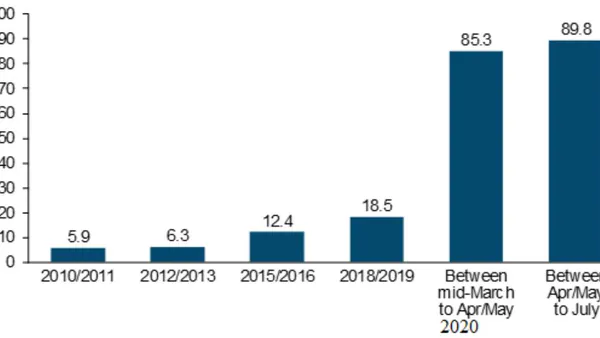
The graphs below shows clearly some impacts of the COVID-19 pandemic on the Nigerian economy.
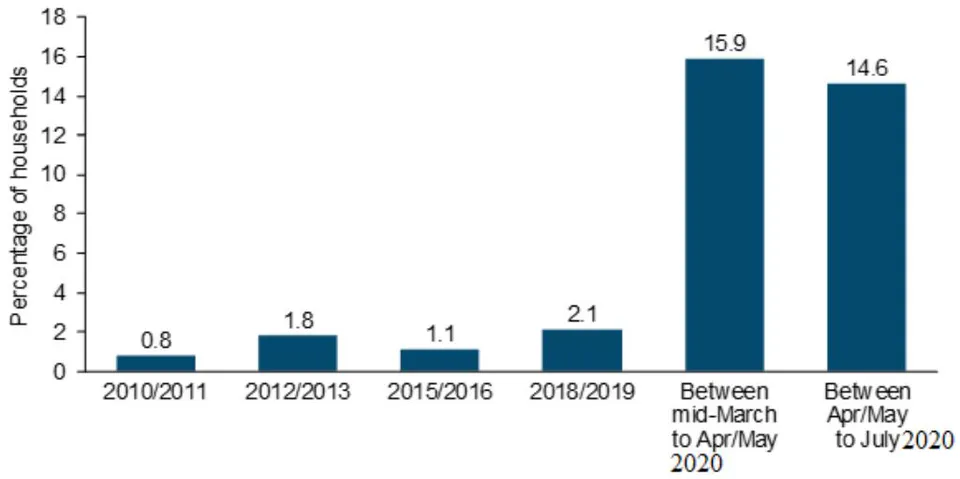
Figure 1: Household Reporting Job Losses in the Wake of the COVID-19 Pandemic in Nigeria
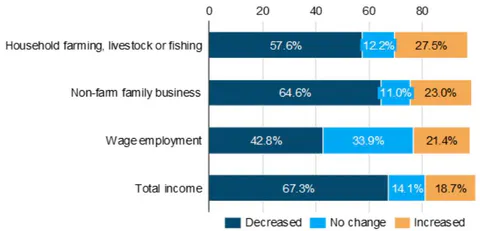
Source: National Bureau of Statistics (2020)
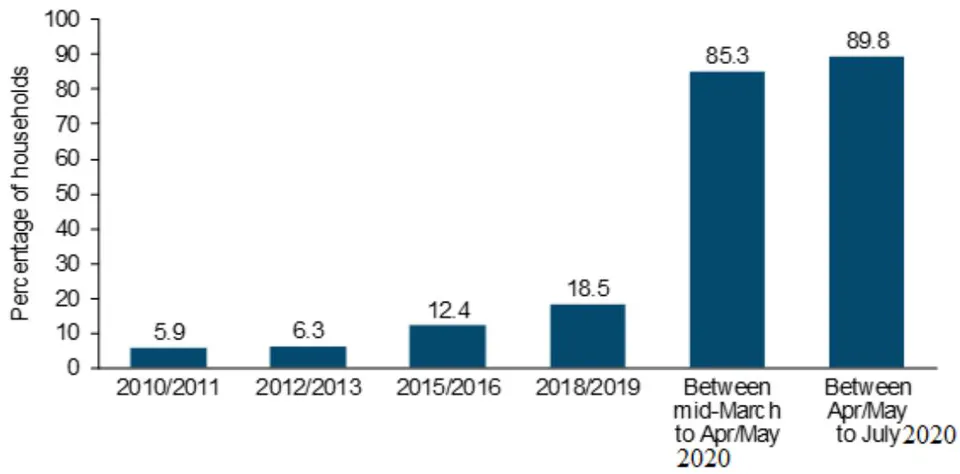
Figure 3: Households Experiencing Shock of Increase in Price of Major Food Items Consumed in the Wake of the COVID-19 Pandemic in Nigeria
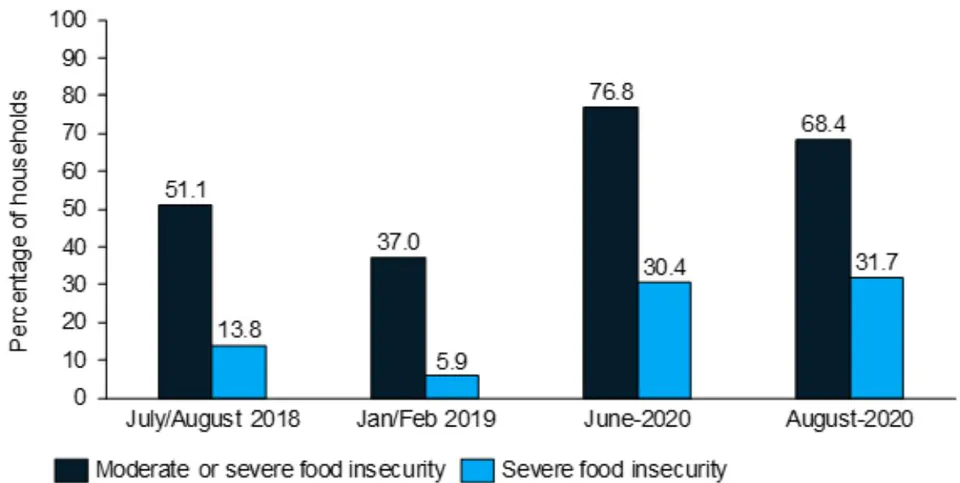
Source: National Bureau of Statistics (2020)
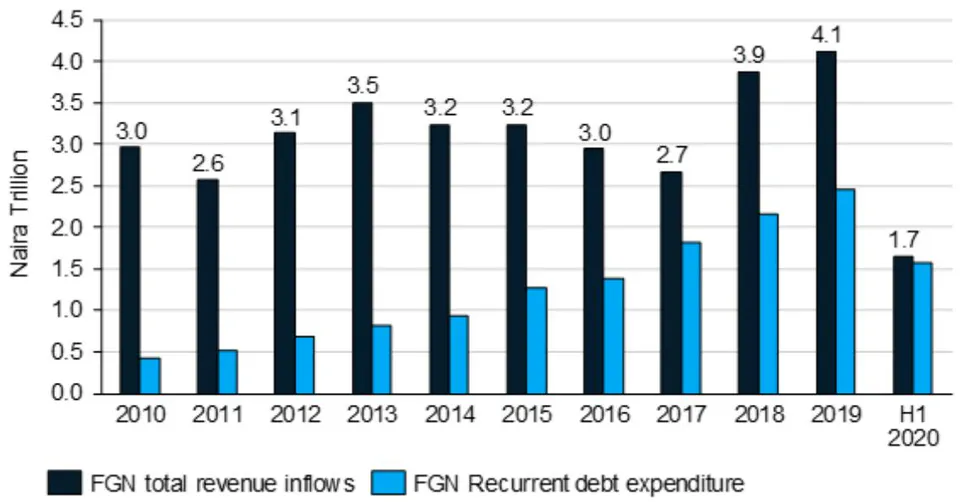
Source: Budget Office of the Federation, Federal Ministry of Finance (2020)
Politically, political activities were grounded in the country due to COVID-19 outbreak. The Nigerian Parliament was under lock and key, abandoning legislative business for a while, owing to the COVID-19 outbreak (Albert-Makyur, et al. 2020). This had left serious and urgent national, and legislative matters and bills unattended to within the periods. The Federal Executive Council (FEC) could no longer meet regularly and physically, turning meetings into virtual platforms. Idowu (In Press) also highlighted how the COVID disrupted the democratic process in Nigeria, in terms of electoral process, and human rights protection. Owing to the COVID-19 outbreak, several subnational elections had been postponed, with others held under new guidelines. In an attempt to curtail the spread of the pandemic, the COVID-19 also saw the flagrant abuse of human rights in the country during the period.
While most elections and political campaigns were postponed in Nigeria, Wahab and Ojedokun (2021) aver that the two state elections (Edo and Ondo) held amidst the pandemic were conducted using new safety protocols to keep both voters and electoral officials safe. They also report a sharp decline in voter turnout for the two elections compared to previous elections in the state - a factor the authors' however acknowledged may be due to a complexus of other factors and not necessarily the COVID-19 pandemic alone. Nevertheless, it is worth mention that the inability of the Independent National Electoral Commission (INEC) to conduct the continuous voters' registration which was supposed to precede the elections, had a way to affect citizen participation. Also, there was high rate of uncollected permanent voters' card by eligible voters, owing to the restrictions, and the fact that INEC offices were closed as a result of the pandemic. The delay in the conduct of the elections as a result of challenges posed by the pandemic also threw up litigations as to the elongated tenures of the incumbent governors of the states (Wahab & Ojedokun, 2021).
Furthermore, the pandemic is also impacting the preparations for the 2023 general elections in Nigeria. While the continuous voters' registration in preparations for the elections was previously slated to resume in 2020 (The Guardian, 2020), the COVID-19 pandemic had ensured that this had to be put on hold until the second quarter of 2021. The exercise has now also been taken online, rather than the physical approach it had taken in the past, pre-COVID.
IV. CONCLUSION AND RECOMMENDATIONS
The paper has been able to appraise the implications of the COVID-19 pandemic on political and socio-economic activities of developing countries, taking Nigeria as a case study. Like their counterparts all over the world, and like every other pandemics, the COVID-19 pandemic has adversely impacted the political and socio-economic affairs of developing countries, cum Nigeria. It has seen to the disruption in political and economic activities, resulting in sharp decline in government revenue, loss of jobs, household food insecurity, and fallen crude oil prices, among others. It has also resulted in disruptions in the democratic and political process, midwifing new circumstances for electoral process, low citizen participation, and controversies over tenure of incumbent governments, among others.
Conversely, and on a positive note, the pandemic has also opened new opportunities for the deployment of technologies for political activities in the country – a feat which was not thinkable pre-COVID. For instance, government activities can now been done online, including the registration of voters, rather than having citizens queue under the scorching heat of the sun, and go through cumbersome process to partake in the exercise. It has also exposed the weakness in the economy and health system of developing countries, including that of Nigeria, thereby serving as a reawakening call for developing countries to build strong and viable economy and health infrastructure. It has also exposed the risk of over-dependence on crude oil for a country like Nigeria, as such, a wakeup call to build a diversified national economic base.
The paper recommends that as things begin to return to normal, the government of Nigeria, and those of developing countries at large, must put frantic efforts in place to revive the economy, and restore political events to the norms prior to the COVID-19 outbreak, while retaining the positive lights, like technological deployment for political activities. Sincere efforts must be made to recover, and fix the adverse impacts of COVID-19 pandemic on the political and socioeconomic activities in the country. There is an urgent need for Nigeria, and indeed other crude oil-dependent developing countries to begin to diversify their economies away from crude oil. The lessons learnt from the COVID-19 outbreak must be taken seriously, and necessary adjustments should be made in that light, in order to be prepared for future endemics, epidemics, and pandemics.