
I. INTRODUCTION
The information society has made it possible to reinforce the creation and distribution of information, generating new opportunities for human beings to more accurately and consciously understand the world around them. Information and combined data are now the most precious asset for human beings, even though this combination and understanding are increasingly complex and machine-oriented due to its exponential growth.
In Portugal, ever since the 1990s, and in conjunction with the European Union, several initiatives have taken place that has made it possible for this country to be at the forefront in implementing initiatives that foster the Information Society. Among many objectives and initiatives, we highlight the modernization and digitization of services, generalized access to the Internet, broadband, and even, fundamentally, the offer of various training processes regarding the use of Information and Communication Technologies. These training processes make it possible to improve inclusion, digital literacy, and safe Internet browsing by the Portuguese population. Fundamental training processes aim to reduce the digital illiteracy that still exists.
In Mexico, throughout the years, various actions have been implemented which have facilitated aspects related to the availability and flow of information in different sectors of society: the creation of a library and information infrastructure at a national level; the development of new information policies; the development of legislation and documentary standardization; as well as the strengthening of technological infrastructure, and telecommunications networks.
Of the various initiatives related to establishing an Information Society in Mexico, the National Information Policy stands out, including the creation of the National Information Infrastructure, the development of digital information services and policies related to technological infrastructure, fostering the development of data networks infrastructure, the stimulus of scientific and technological research in computer science, among others.
According to data from 2020, of the Portuguese, out of a total population of 10.31 million inhabitants, used in 2020 the Internet (Marktest, Bareme Internet 2020; ITU, 2021). In the first half of 2021, of the Portuguese population accessed the Internet through smartphones (Marktest, Utilização de Internet por plataformas, 2021), and of Portuguese families had access to fixed broadband services at their residence, during the same period (ANACOM, 2021).
Regarding Mexico, it is estimated that around 90 million people use the Internet. The most common device for Internet access is the smartphone, with over 100 million active profiles on social networks. In 2021, relative to 2020, Mexico showed a loss of 407 thousand connections, representing a decrease of in mobile device connections. However, the percentage of Internet users rose by , adding 3.5 million new users (Alvino, 2021).
According to OECD data, between June 2019 and June 2020, Mexico was the third member country with the highest annual growth in fixed broadband penetration, increasing . For the reference period, fixed broadband access through fiber optics in Mexico grew (OCDE, 2021).
It should also be noted, as part of the set of measures adopted by the Portuguese and Mexican Governments to address the COVID-19 pandemic, it was the schools, from the different study cycles, which migrated to a process of online learning intending to minimize the impact of the health contingency on the teaching-learning process. It has been verified that the most frequent Internet users in 2020 and 2021 have been students. This sudden change to distance learning caused an increase in Internet traffic compared to the same semester of the previous year.
Thus, we can say that the Information Society, the Internet, and other networks have driven, over the years, access to information, primarily through mobile devices. Given the unstoppable growth in the volume of data and its rapid circulation, it is crucial to take measures to ensure and guarantee widespread, accurate, verifiable, and trustworthy access to information.
This article aims to identify the use, and the frequency of use of social networks in Portugal and Mexico, in times of pandemic, and in two regions of each country, respectively: Guarda and Chiapas, trying to understand if their citizens consider them a valid and reliable sources of information. In this way, we address the issue of Fake News, trying to understand the profile of these users.
II. FAKE NEWS, A COMPANY THROUGHOUT HISTORY
If it is true that the Information Society, on the one hand, has stimulated the creation, development, and distribution of information, it is no less accurate that the massive creation and distribution of data in social networks has given rise to a considerable amount of false information, the so-called Fake News. Questions of how, when, for what purpose, and who created them are increasingly challenging to answer due to their rapid replication across networks and between users.
In recent years, the frequency of false news in the media has notably increased, negatively interfering in various sectors of society, e.g., politics, health, and security. Popular terms such as Fake News, post-truth, and disinformation have brought to light a huge problem: how can human beings verify the veracity and reliability of the information disseminated on the Internet (Sintra, 2019)?
Fake News can be considered a form of publication that consists of deliberately distributing false news to promote disinformation and deceive people (Fallis, 2015; Kaplan, 2020; Merriam-Webster, 2021). Having critical and independent thinking is critical when making decisions freely. Due to its nature, content, and objective, Fake News prevents the construction of rational and well-informed judgment (Comunicación, 2018). The term Fake News can also be defined as news presented as factual, objective, and credible when, in fact, it is fictitious (Love, 2007).
It is essential to mention that the term Fake News was only enhanced by the growth of technologies and access to platforms associated with the Internet, verifying documented records of its existence from the Roman Empire (Social, 2021). Thus, it allows us to say that the dissemination of false information, farce, or half-truths has always been part of humanity and can occur due to political or financial conspiracies or a lack of information or ignorance part of the population. Fake news has alarmed the scientific community, which is beginning to question to what extent it is possible to recognize the truth in the information universe (Ochando, 2018).
a) Fake News: Internet and Social Networks
The use of new technologies and massive access to the Internet, new habits of information consumption, and its easy exchange, provided by different platforms, allows users to distribute any type of information or news using a simple "click". This type of news does not require rigor in its production and enables the participation of different actors (Fallis, 2015).
The ease with which Fake News spreads on social networks is because it is possible to disseminate misleading news merely, given that these platforms use algorithms that distribute the most relevant content for each user, ensuring that the information shown is conditioned and filtered for specific users. On the other hand, the different political interests, partisans, or simply attempt to create confusion become reasons for misleading content to go viral more frequently (IFJ, sd). The previous paradigm, in which the media had the primacy of information, has changed radically (Comunicación, 2018).
Another fact related to the use of social networks and the dissemination of Fake News says that these networks provide a perfect space for the free and rapid dissemination of news according to patterns that cause different and appealing emotions to their users (Lerman, K., & Ghosh, R. 2010) (Vosoughi, S.; Roy, D.; Aral, S. 2018). According to specialists, this appeal to the most immediate emotions is one of the main characteristics of false content.
In 2018, a study conducted by researchers from the Massachusetts Institute of Technology (MIT) (Vosoughi, Roy, & Aral, 2018) has verified that false news receives more retweets than truthful news on the social network Twitter.
The 2020 edition of the Reuters Digital News Report mentions that of Portuguese respondents and of Mexicans trust the news circulating on social networks (Nielsen et al., 2020).
In 2021, this same organization, together with OberCom (Observatório da Comunização), presented a new report that identified that television and the Internet (including social networks) continue to be the primary sources of information for the Portuguese population, with a percentage of for the Internet and for social networks. of the Portuguese use Facebook to access news, and use YouTube (Journalism & OberCom, 2021).
The study carried out by INEGI provides proof that of Mexicans say that they access the Internet to obtain information, while mention that they access social networks (INEGI, 2021). The most often used social network to access news (60%) is Facebook, followed by YouTube with 37% (Gutiérrez-Renteria, 2021).
The exchange of news on social networks is one of the most frequent practices in consuming information online (Journalism & OberCom, 2021). Although Facebook and YouTube continue to be the most used social networks, both have registered a loss of users and news consumption compared to the year 2020 in both Portugal and Mexico (Gutiérrez-Renteria, 2021)(Journalism & OberCom, 2021).
Finally, it is worth noting that the growing concern of journalism companies and others that manage social networks is the increasing number of false news circulating in these media. From the pandemic's start to April 2021, Facebook and Instagram have removed more than 20 million pieces of content for violating their counterinformation policies and damages related to COVID-19 (LUSA, 2021; AVAAZ, 2021).
The different studies analyzed, within the scope of this study, allow us to conclude that social networks have not, up to now, taken sufficient measures to verify the veracity of the information, and there is still a long way to go in this field.
III. METHOD
The study presented is exploratory-descriptive, framed in a research design of a quantitative approach methodology employing questionnaires to gather information. The questionnaire consisted of 16 items and was designed ad hoc to collect data about how Internet and social network users perceive the information as true. In order to carry out the effective execution of this study, the following methodological phases have been developed:
- Exploratory and design phase: preparation of the instrument following the objectives.
- Validation and administration phase: For the questionnaire's validation, it was taken into consideration if the questionnaire adequately measures the variable to be measured from the perspective of the subjects. The instrument was evaluated considering the opinion of 3 doctorate-level experts. Subsequently, a pilot test of the questionnaire was carried out with ten students and five teachers from the Polytechnic Institute of Guarda-Portugal.
- Results analysis and conclusions phase: the data obtained in the investigation were analyzed using the SPSS 23 program with which descriptive statistics (e.g., frequencies, percentages, measures of central tendency and dispersion) and inferential statistics (test of Chi-Square of independence between two variables) were calculated. Data
privacy and confidentiality were guaranteed at all times.
General information was requested regarding the demographic profile of the participants and their level of education and information according to the study's objective. Google Forms was used to prepare the questionnaire.
IV. RESULTS
The data collection method regarding the information that supports this study was based on quantitative research. Data was collected by applying a questionnaire to Internet users in Portugal and Mexico through the Facebook social employing two accounts: professors from the Polytechnic Institute of Guarda, Portugal, and professors from the Autonomous University of Chiapas, Mexico, between May to June. Although the questionnaire was addressed only to the population of Internet users and, in particular, employing the Facebook social network, an attempt was made to incorporate three levels of representativeness of the population (taking into consideration age, gender and schooling).
The main objective of the questionnaire was to understand:
How news consumption is carried out and spread in Portugal and Mexico;
What trust does the user place in the content that circulates on social networks, and,
What opinion do individuals have about the disinformation that exists in the context of Covid-19.
a) Sample
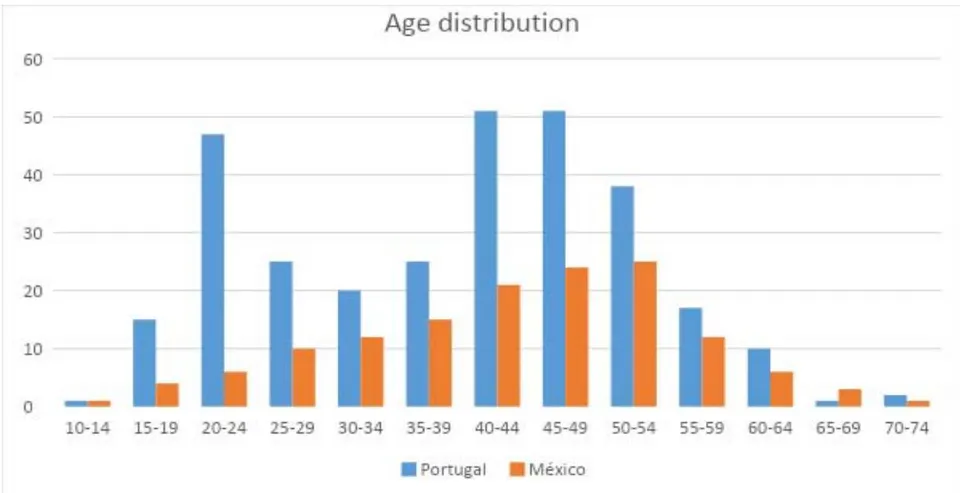
The sample used in this research study comprises 444 participants, 303 of whom are from the district of Guarda, Portugal, and 141 from the state of Chiapas, Mexico, corresponding to (270) female respondents. Regarding the distribution of ages, the groups that have provided the most responses are the groups between the age range of 45-49 years old, followed by those between 40-44 years old, and, subsequently, ages between 50 and 54 years old and 20-24 years. These groups represent of the sample (See Figure 1).
If the level of education is taken into account, the data illustrates that 444 respondents have a higher level of education. This data concurs with how and by whom the questionnaire was applied (by a Facebook profile of higher education teachers).
Table 1 allows us to affirm that there is a significant dependency between gender and the frequency of use of social networks since it has been verified that women use social networks more frequently (See Table 1).
| Gender | Mexico N | Mexico % | Portugal N | Portugal % | Sample % |
| Man | |||||
| 1-2 times a week | 0 | 0.0% | 7 | 2.3% | 2% |
| 3-5 times a week | 3 | 2.1% | 12 | 4.0% | 4% |
| Every day | 50 | 35.5% | 99 | 32.7% | 37% |
| Woman | |||||
| 1-2 times per week | 2 | 1.4% | 5 | 1.7% | 2% |
| 3-5 times a week | 9 | 6.4% | 10 | 3.3% | 5% |
| Every day | 75 | 53.2% | 169 | 55.8% | 60% |
| Chose not to answer | |||||
| 3-5 times a week | 0 | 0.0% | 1 | 0.3% | 0% |
| Every day | 2 | 1.4% | 0 | 0.0% | 0% |
Women are more active than men on social networks. As can be seen, they use them more and are more participative than men, and spend a more significant number of hours using social media (See
Table 2). The average connection time on a social network, for of respondents, is between 1 to 4 hours per day. Connected users between 4 to 6 hours per day, correspond to female.
| Gender | Mexico | Portugal | Male/Female N | Sample |
| Male | 53 | 118 | 171 | 444 |
| less than 1 hour | 6 | 35 | 24.0% | 9.2% |
| Between 1 to 2 hours | 18 | Four. Five | 36.8% | 14.2% |
| Between 2 to 4 hours | 18 | 26 | 25.7% | 9.9% |
| Between 4 to 6 hours | 9 | 9 | 10.5% | 4.1% |
| More than 6 hours | two | 3 | 2.9% | 1.1% |
| Female | 86 | 184 | 270 | 444 |
| less than 1 hour | 10 | 34 | 16.3% | 9.9% |
| Between 1 to 2 hours | 31 | 66 | 35.9% | 21.8% |
| Between 2 to 4 hours | 28 | 57 | 31.5% | 19.1% |
| Between 4 to 6 hours | 14 | 20 | 12.6% | 7.7% |
| More than 6 hours | 3 | 7 | 3.7% | 2.3% |
| Choose not to answer | 2 | 1 | 3 | 444 |
| Between 2 to 4 hours | 2 | 1 | 1% | 0.7% |
According to respondents, regarding the type of social network most often used, the results illustrate that
Facebook, WhatsApp, and YouTube are the most popular social networks (See Table 3).
| Social Network | n | % | % of respondents (n=444) |
| 333 | 39.5% | 75.0% | |
| 24 | 2.8% | 5.4% | |
| 30 | 3.6% | 6.8% | |
| Snapchat | 5 | 0.6% | 1.1% |
| TikTok | 10 | 1.2% | 2.3% |
| 295 | 35.0% | 66.4% | |
| YouTube | 147 | 17.4% | 33.1% |
| 844 | 100.0% |
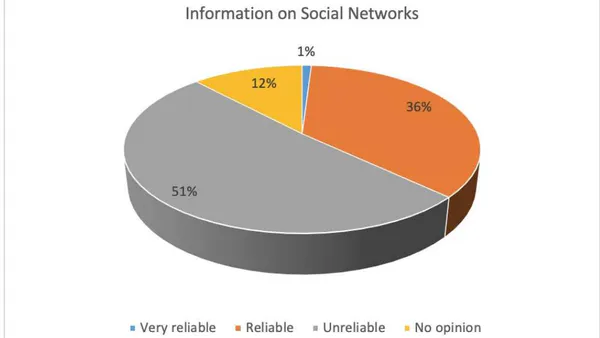
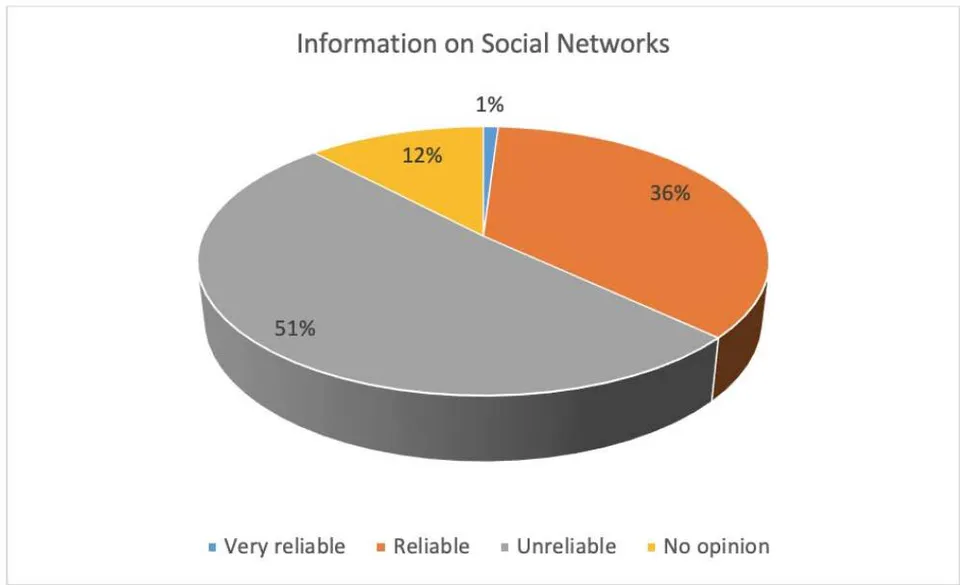
Participants were asked their opinion about social networks and their content. The results reflect that consider that content is unreliable, believe that the Content is Reliable, while only feel that the Content is Very Reliable and of those who inquired have no opinion (See Figure 3).
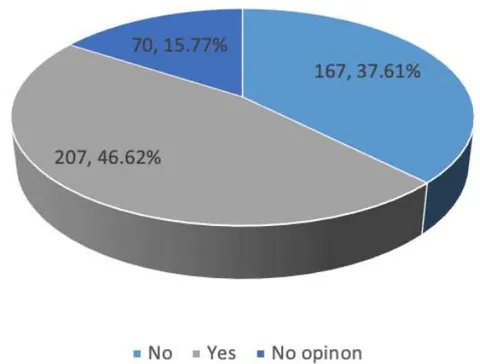
Regarding the veracity of the information provided on social networks, a very high number of users, , responded Yes, that is, that social networks are a good source of information; answered No, and had no opinion (See Figure 4).
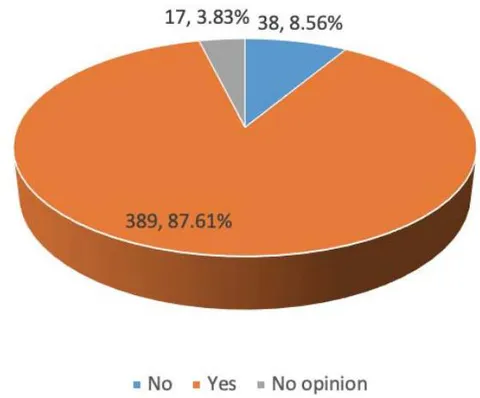
According to our findings, we can conclude that there is an evident concern among the people regarding the existence of fake news. A very high percentage of users (87.61%) have stated that they are concerned about the presence of Fake News/False Data circulating in the networks. (See Figure 5).
Finally, participants were questioned if they had ever received from their social networks any information about Covid-19, in particular news that the virus is less severe than the flu virus. The results illustrate that claim to have read and watched this news, of respondents have indicated that they did not have access to this type of publication, have verified the veracity of this information in other sources of information, and, in an also significant percentage, stated that they had verified the veracity of this information through official sources (See Table 4).
| The first publications that emerged on social networks about the Coronavirus (COVID 19) refer that the virus is less severe than the flu virus I...: | n | % | % of total inquired (n=444) |
| I have just read/viewed the post | 136 | 26.5% | 30.6% |
| I have placed an emotion icon (e.g., like) | 6 | 1.2% | 1.4% |
| I have commented on this type of post | 16 | 3.1% | 3.6% |
| I have shared this information on my social network | 22 | 4.3% | 5.0% |
| I have verified the veracity of this information in other sources of information (e.g., Internet sites) | 100 | 19.5% | 22.5% |
| I have verified if from official sources | 99 | 19.3% | 22.3% |
| I have not had access to this type of publication | 70 | 13.6% | 15.8% |
| I have ignored the post | 64 | 12.5% | 14.4% |
| 513 |
V. CONCLUSIONS
According to the analysis of the results, with the expansion of technologies, the Internet, and social networks, as well as its massive use and false news, misinformation spreads faster and to a more significant number of people, interfering in a negative intentional way in various sectors of society.
This situation has caused great concern in all sectors, and there is currently a much greater tendency to validate the veracity of the information provided on the Internet. However, it is still impossible to validate all of the content circulating through these networks.
It is verified that there is a significant difference in using social networks among the female population in both countries. Statistically, they are the ones that spend the most time on social networks.
According to the participants in this research study, YouTube, Facebook, and WhatsApp are the most popular social networks.
When they were questioned about the veracity of the content circulating on social networks, we verified a clear division amongst those inquired, between those who believe that the published content is credible and those who have doubts about its veracity. However, a significant number of users state that networks are a reasonable means of obtaining information.
A large number of respondents expressed concern about the veracity of the information circulating on social networks.
When explicitly asked about COVID-19 and how they obtained information about the pandemic, we observed that a significant majority did not access official sources to verify the content disseminated on their social networks.
This study allows us to state a clear division between users who consider social networks to be a good source of information and those who have any doubts about the veracity of the information that circulates on these platforms. It should be noted that a large majority of those surveyed consider that there is a real problem in the veracity of the information circulating on social networks.
In addition, the study demonstrates erratic behavior on social network users when they have been questioned about how they have obtained and validated certain information, in this case, about false news about COVID-19.
As a result, it is vital to educate Internet users to be critical of the information they receive and distinguish between what is relevant and insignificant. Schools should develop a curriculum to teach students to discern between true and false information. Faced with this situation is an essential global strategy for countries to achieve digital literacy to combat Fake News.
ACKNOWLEDGMENTS
This work is financed with National Funds through the FCT - Foundation for Science and Technology, IP, within the framework of the Ref a UIDB/05507/2020 project. We also want to thank the Center for Studies in Education and Innovation (CI&DEI) and the Polytechnic Institute of Guarda, Portugal, for their support.