During this current period of global business, economic and environmental change, and with reference to the societal effects of the covid pandemic, it is clear that post-school education provision is being subject to a range of competing pressures. This paper examines the effects of these changes on current educational provision. It examines factors such as possible emergent changes in traditional societal expectations, financial barriers to accessing established post-school education and increasing financial pressure on existing education providers to reduce costs and maintain current levels of activity within the existing academic structures. Through surveys conducted of employers, students and teaching staff, possible improvements and adaptations are identified and proposed, which may be more effective in meeting the potentially rapidly changing needs of global society in the future.
## I. INTRODUCTION
The nature of employment in terms of demands for staff with traditional knowledge and skills sets, and where work takes place has always been subject to a process of change, and current events demonstrate that these changes have been, and will continue to be, more far reaching and occur more rapidly than before. The main effects fuelling change in the demands being placed on post-school education provision can be said to comprise the effects of the Covid 19 global pandemic on society as a whole, the marked rise in energy prices and the cost of living, the increased use of virtual environments for workplace communication, a growing awareness of the impact of the use of traditional energy sources on the environment and the need for widespread adoption of 'green' or 'carbon neutral' energy sources, the comprehensive use of information technology and emergent artificial intelligence in all aspects of life and the impact of new technologies on traditional service-based industries.
The effect of the Covid Pandemic on all aspects of society were sudden and far-reaching, with lasting effects on global society. The pandemic, which may have started as an isolated factor, has seemed to act as both a trigger and accelerator alongside subsequent factors in terms of societal change, in a manner similar to that proposed in 2007 in which 'It can be argued that incremental changes produced endogenously, despite its apparent small scale, can end up deriving in a process of gradual paradigm change' (Capano, 2003; Howlett & Cashore, 2007). In terms of the delivery of education provision, face-to face classes ceased for a considerable period of time and the delivery of education throughout schools, colleges and universities was carried out almost exclusively on a remote basis. It is now quite common for courses to have retained an element of remote learning, especially paying a greater attention to methods and factors for effective delivery of educational experience (Gluoksnyte, White, 2022). With regards to the nature of people's working lives, the level of change was also immediate and far-reaching, with the remote methods introduced also lasting into the post-pandemic period. Those employed in retail, entertainment, and leisure in particular have found that their employment opportunities have diminished, partly due to changes in consumer habits resulting from the pandemic but also due to the reduction in consumer discretionary income (Alfadala et al., 2020).
With reference to the availability of higher education in the UK, Paul Bolton noted that in 1953 in the United Kingdom, just under 20.000 students graduated with a combination of ordinary and higher-level university degrees. By 2010, this level had reached a level of just under 300,000 for that year (Bolton, 2012). With such a significant increase in the number of graduates, without a real focus on effective change in the provision of education and the needs of the global economy, it may no longer be correct to assume that education will provide the 'heavy lifting' in terms of alleviating poverty (Buchanan, et. al., 2020). In addition, as the World Economic Forum stated in their 2021 article 'What will education look like in 20 years?', we cannot take the future of education for granted. The question that they put, 'Is an entirely different approach to the organisation of people, spaces, time and technology in education needed?' is entirely relevant to this paper (Buchanan, et. al., 2020).
This paper, which examines a field of research comparatively new in education studies and research, and which may be usefully followed up by further studies in the near future, notes the impact on existing models of post-school educational provision of the change factors mentioned. It then considers the effects of these changes and as a result, describes possible models for a series of effective responses that can be made to meet this challenge on a lasting basis. In summary, the aim of the study is to discover existing concerns and possible appropriate adaptive changes to existing models of post-school education delivery, so that an understanding may be reached as to how provision may be more effective in meeting the future needs of students, academic staff, and employers.
## II. EDUCATIONAL PROVISION
In an article entitled 'The Future of Work' by Matthew Lauer (2019) published by the World Economic Forum, theorised that 'The real challenge of the Fourth Industrial Revolution, then, isn't the robots - it's that we aren't properly training humans for the available jobs'. There is the need for effective and ongoing collaboration between the providers of education and employers themselves to encourage the formulation of both new programme structures and content. This should then encourage more rapid and appropriate learning experiences which will in turn promote quicker, more effective, and more immediately applicable skill sets. With regards to this, it is interesting to note that from autumn 2024, the UK will pilot an apprenticeship model for the Doctor of Medicine qualification, with an initial intake of 240 candidates. The same academic and professional standards will apply; however, apprentices will be employed (rather than have student status), earning a salary, and be exposed to the practical work environment from the beginning. This is a notable expansion of the apprenticeship model of training, more traditionally used to train people in skilled manual trades and which is now used extensively in the Skills Development Scotland organisation to deliver the 'Modern Apprenticeship' scheme. (Skills Development Scotland Equality Action Plan report 2019 (2), 2019). In Lithuania, the new EU project "EdTech" is being implemented where different fields in education are being implemented - additional bachelor, master, doctor study programmes are financed by the project, new 10 STEAM centres are established, educational institutions infrastructure is improved, other courses are offered for the leaders of educational institutions, digital learning/teaching means have been created, etc. (https://www.edtechlithuania.com/).
The importance of choice of programme in relation to employment is also highlighted in the study entitled 'Over Qualification and Skills Mismatch in the graduate labour market' by Craig Holmes and Ken Mayhew (2015), the Chartered Institute for Personnel and Development suggested that 'although the expansion of higher education provision has been a general phenomenon, it is noteworthy that the UK's graduation rate is higher than that of any country listed. A combination of higher taxes and more flexible repayment loans might be used to pay for training and study, an example of which is the proposed United Kingdom Lifelong Learning Entitlement which can be used to pay for flexible training as needed throughout the working life of an individual.
Another facet is that whilst there are examples of certain occupations where roles are upgraded as posts are taken up by increasing numbers of graduates, there are many other occupations that have experienced what was termed 'job competition, where those with degrees simply replace non-graduates in less demanding jobs or enter jobs where the demand for graduate skills is non-existent or falling'. The UK was found to be not particularly effective in generating new skilled employment for its large stock of graduates, again suggesting that many graduates had qualified in fields for which there was not a high demand. This, inevitably, leading to a devaluation of advanced level qualifications themselves and leaving graduates in the position of having accumulated relatively large amounts of student debt, and in turn entering the job market with reduced prospects of finding a position which would be appropriate for their skill set or earning expectation (https://www.timeshighereducation.com/news/too-many-graduates-non-professional-jobs-personnel-body-says) Note that in the UK, with regards to non-traditional models of programme delivery the Open University has been providing remote and flexible higher education provision since 1969, and indeed during World War 2, many UK universities offered concentrated 2-year degrees. This latter phenomenon has seen a resurgence, with a growing number of universities such as the University of Buckingham (https://www.buckingham.ac.uk/) offering degrees over a 2-year period by introducing a four-semester structure for the academic year. The University of Dundee also offers a 3-year honours level degree in Nursing, with integrated work experience placements. This means that graduates will be both qualified and sufficiently experienced to be immediately productive in their first post-qualification position. Again, with regards to the field of training in the nursing profession, within the United Kingdom, the shortage of qualified nurses is being addressed in part through the offering of 'Foundation or Introductory Level' programmes at colleges, which provide a pathway to concentrated and shortened degree qualifications (with integrated work experience) at university. In Lithuania the universities are not shortening the bachelor and master degrees duration period as it directly depends on the Ministry of Science, Education and Sport. There are practices included in the study programmes but it is not offered as a job.
The general need for academic practice and delivery to evolve in parallel with industry has been emphasised in an article in the Smithsonian Magazine (the long-established magazine of the Smithsonian Institute in Washington, District of Columbia USA, 2018), which highlighted the need for providers of higher education to change as the nature and profile of business and manufacturing also changes. 'Automation and artificial intelligence technologies are transforming manufacturing, corporate work, and the retail business, providing new opportunities for companies to explore, and posing major threats to those that don't adapt to the times. Equally daunting challenges confront colleges and universities, but they've been slower to acknowledge them.' (https://www.smithsonianmag.com/ innovation/will-traditional-colleges-universities-become-obsolete-180967788/)
The research paper 'The future of Higher technical Education in England' emphasised the need for education provision to be responsive to the sometimes-rapid level of change in demand for workforce staff and to support the need for qualified staff in high growth areas (2022). However, of particular note was the notion that integrated real work experience would help to bring about a genuine preparation for working life in the student's chosen field. This would then help to reduce instances of new entrants leaving chosen fields of employment early due to inaccurate impressions formed earlier. 'Taster' programmes would also be very useful in this regard. This would also reduce the financial burden on candidates who may have to retrain further and mitigate against years of wasted study. One proposal from the report authors is that of a requirement for teaching staff to undertake regular industrial placement periods linked to their academic specialism. This would be one means of keeping in touch both with the realities of the workplace outside the education environment, and more in touch with current technology and practice. (https://www.respublica.org.uk/wp-content/uploads/2022/04/The-Future-of-Higher-Technical-Education-in-England-LEC-Report.pdf).
In further relation to the realities of postqualification life, reports have emerged of the very unsatisfactory experience for some graduates. In 2015, the British Broadcasting Corporation published interviews with students, describing their experiences. The individual student experiences described can perhaps be broadly summarised in a further quote from a former student, interviewed by the BBC, who graduated in 2012: "I do think when you graduate, the job market is not reflective of the quantity of graduates that actually are leaving university."
In Scotland, unlike in England, students do not pay tuition fees for higher education qualifications. Tuition fees are paid directly to the educational institution by the Student Awards Agency Scotland (SAAS). Loans from SAAS are mainly used to help with living and accommodation costs. How much a student can borrow each year will depend on household income. At present, up to £8,100 can be borrowed each year if the household income is less than £20,999. If the household income is £34,000 and above, £5,100 can be borrowed on a yearly basis. Although the cost of higher education is considerably less than that of students who study in England (tuition fees alone can be up to £9,250 each year, with living costs to be added to this figure:
the average total loan debt in England for graduating students is £45,000) it is still possible in Scotland to accrue a sizeable total loan amount. In Scotland, the threshold for beginning loan repayments is currently £25,375 before tax. Students pay $9\%$ of the amount the earn over this limit on loan repayments, with any outstanding sum cancelled after 30 years. In Lithuania, for example, the payment for higher education depends on high school graduation examinations as there are state financed and non-financed places.
Currently in England, students following post-school education programmes of study must pay for their tuition fees and take out a loan to cover the cost of this, and also to help towards their living costs. In Scotland, students do not pay for their tuition fees but must exercise care in that the present system does not allow for much flexibility to change courses once a choice has been made and the programme is under way. In Lithuania, the loan system is quite effective for the students to make agreements with banks for the whole studying process.
With regards to this, UNESCO, in their publication 'Pathways to 2050 and beyond' listed among the necessary targets for higher education, those of being affordable and available to all, serving society in inclusive ways, being student choice driven, and providing skills for life and responsible citizenship (Sabzalieva, E. et al. (2021)).
With regards to this issue, in the United Kingdom as well as in Lithuania at present, there is an emergent recognition from the government of a need for new models of delivery, with particular regard to the need to be able to adapt to a more rapidly changing labour market. It is a recognition of the need for 'lifelong learning' on a meaningful basis. Universities and colleges have been invited to bid for funding to create new short courses across five subject areas: STEM (Science, Technology, Engineering and Management), Healthcare, Digital Innovation, Education, and supporting Net Zero. Providers will be given the task of developing courses under these topics, which could be as short as six weeks – or as long as a year if studied part-time. The aim is to help change the existing perception (which is starting to go through this change of perception at present), that traditional three- and four-year degree courses are the only route for higher learning. Students will be able to structure their studies and learn at a pace that is right for them, including opting to build up their qualifications over time, within both colleges and universities. The first short courses have been available since September 2022.
Furthermore, there is a current trial of the UK Government's Lifelong Learning Entitlement Plan which will allow adult learners to study more flexibly through short courses, allowing them to upskill, retrain, and/or work towards a full qualification as both their circumstances and the economy change. As an adjunct, it is interesting to note that Open Learn offers a course entitled 'Learning how to Learn'. In the course description, learning is defined as a 'process we all engage in throughout our lives' (Open Learn, learning how to learn, The Open University).
In the EU (notably and most recently in France, Lithuania, UK, etc.), the retirement age has been gradually increasing. In the United Kingdom, the retirement age for men and women is now 66. This is the age at which it is possible to receive the State Pension. This is set to further rise to at least age 67 for those born after April 1960, with further rises certain in the future. The rise in post-World War 2 life expectancy and the increasing demands on health and social care are given as the cause of this. Whilst it is not uncommon for people to work past retirement age, there are many occupations where the physical demands are such that working in them until your late 60s is not feasible.
To supplement the UK state pension (which at £141.85 per week is not enough in itself to live on), it is now compulsory to enrol in an employer's pension scheme, from which you can only withdraw by special agreement. This 'Private' or 'Employer-contributory' pension, is meant to supplement the state pension, however the age limit for accessing this has also been raised to 58. People who are beginning their working life, face the prospect of this becoming ever longer in terms of at what stage can they begin to consider either stopping, or at least seriously consider reducing their working commitment. The pensions in Lithuania are also too small to live without difficulties. People, on the contrary, search for extra jobs to add up to their pensions.
This further emphasises the requirement for people to be able to adapt to training for changing roles throughout their working life, not only in terms of changing technology but in terms of the inevitable physical ability to continue to work as working life increases.
## III. EXPERIMENTAL METHODOLOGY
Subjects and sampling method comprised a set of three questionnaires, designed and posted on Pollmill, with one each being respectively aimed at students, teaching staff and employers.
The questionnaire for students invited feedback on issues such as the importance of the prospects of employment on successful course completion, what courses they thought gave the highest prospects of employment and what courses they thought should be developed to meet emerging new skills areas, and also courses which may no longer be so relevant to the workplace.
The questionnaire for academic staff invited feedback on issues such as possible alternative structures to the traditional academic year, the desirability of closer collaboration with employers to ensure that curricula remain consistently relevant to the world of work, the extension of work experience placements throughout a greater range of courses and what they feel might be the greatest barriers to students entering post-school education.
Employers were invited to contribute their views, including those on matters such as how relevant they consider the current range of post-school education programmes to be, the possible frequency of retraining that may be necessary for staff in their future working lives, possible alternative models of funding education provision, the role of remote learning in complementing practical work situation experience and the possible value of extending the apprenticeship model to training for a much wider range of occupational roles.
The questionnaires were prepared and posted online, and the link was sent to Lithuanian and UK teachers, students, employers. Question types used: dichotomous, Likert scale, and multivariate. The first part aimed to assess the concept of post-school provision, options, subjects to be chosen, opinion on studies accessibility, etc. The second part of the questionnaire asks questions about a user's demographics, age, position. A valid study was conducted, comprising employers $n = 24$, academic staff $n = 34$, students (higher education and high education, $n = 114$ ), with the chosen quantitative research method (survey) achieving the goal of relevant data collection.
Various scientific literature and Internet databases were analysed on the topic. Respondents were therefore grouped according to their position: employers, academic staff, and students.
## IV. RESULTS AND DISCUSSION
The online questionnaires were distributed in two countries where 172 respondents completed the questionnaires. Firstly, responses from employers (24 respondents) are analysed.
### a) Employers' Survey Analysis
To the first question about the main concerns of employers regarding the current range and duration of post-school courses the answers could be analysed as follows: quoting an employer in the leisure industry in the United Kingdom 'Here in the UK, a high percentage of our part-time staff are at university. I find then well-educated but on a very limited range of topics. Postpandemic this has become even more prevalent. The lack of simple life skills does amaze me. Decent, well educated, mostly polite young people...but lost in the real world. We have to ground them & start again.' Also, the course length was felt to be a factor of concern and the general previous life experience, relevance, and level of employment readiness for work and career progression that courses provided; the feedback of particular interest was encapsulated in this response: 'In my experience, there is certainly a growing disconnection between what is being taught (and perhaps those doing the teaching) in further and higher education and the "real" world of business and practice. I also feel that there need to be closer links between business and education'. This point was raised by other providers. Again, there is the suggestion of the need for a closer link between education providers and employers (mentioned in the Times 'Future of Higher Technical Education in England report), with perhaps the requirement for a programme of regular skills update and technical work experience for academic staff; finally, one employer did comment that in terms of study leave for employees, this would have to organised in such a way that it was integrated into the organisational routine of the company, and that therefore there was no disruption to productivity.
The points made in the previous paragraphs in this section do seem to be in line with the study by Matthew Lauer 2019 study previously mentioned, in which a growing need is noted to increase the focus in matching training with industry needs. This is also noted in the Holmes and Mayhew article listed earlier, which focusses on the skills and qualification disparity in the graduate employment market.
Analysing the results about the need to retrain in people's working lives, $12.5\%$ of the respondents thought that people will have to retrain completely probably each decade. As the pace of change accelerates, so many different new skills will be required, $12.5\%$ indicated 'a few' to 2-3 times, another $12.5\%$ of respondents stated that Continuing Professional Development (including retraining where necessary) should be often, or ongoing through duration of working lives, as people need to keep abreast of new initiatives, legislation, and innovative practices, which will also benefit employers, the rest of the respondents still thought that this may happen less often, ranging from every 10-15 years.
Talking about a possibility to move away from the traditional academic year structure and course duration, although one quarter of respondents indicated that they at present have no definite opinion, a clear majority (three quarters) of employers considered that changes to the present structure of the academic year and course duration is desirable.
The question about alternative models of student funding showed a strong majority of opinion from employers, in that the existing model of student funding is overwhelmingly considered to need in depth review. It could be suggested that both past and present funding models contribute to a tendency for education providers to undergo a form of goal displacement, in that the growth of the provider itself assumes an importance at least as great as, and perhaps greater than in some cases, the provision of employment-ready graduates with up to date and readily applicable qualifications.
The answer ratio for this question " Do you feel that remote learning can be delivered so that it complements practical experience?' is exactly the same as for the previous one. Employers overwhelmingly consider that the remote learning experience (naturally, if delivered in a considered and appropriate manner) can effectively supplement practical work in context.
Talking about the less useful courses to employers, the responses indicated that this would depend on the employment sector for which the qualifications were intended, however, it was felt that numeracy and literacy skills should remain a core part of any future provision. Respondents also indicated that educational organisations do have a key responsibility in ensuring that qualifications are rigorously reviewed in terms of content, industry relevance, meaningful and substantial practical work experience, and consequent graduate employment opportunities.
Analysing new courses and subject areas that should be developed, a clearer set of responses were received to this question and indicated the following opinions: there is considerable scope for the development of programmes in the fields of Artificial Intelligence, Information Technology (for example, the growing use of 'Blockchain' methods), STEM, new fields of Medicine and Medical Techniques and the development and use of Green Energy technology; the courses that employ futuristic ways of learning should be developed, and all courses should be wholly relevant to the industry they are designed for, also, the courses for Trades like plumbing, joinery, electrical, engineering should continue, and be expanded to include renewable energy servicing.
Asking about the 'apprenticeship' model, for this question there was a very large majority of the opinion that the apprenticeship model of learning and training should indeed be extended to a greater range of employment roles than has traditionally been the case, $92\%$ answered positively, and only $8\%$ did not provide the answer.
Analysing colleges and universities effective work together with employers, so that the curriculum is relevant to industry and commerce, responses, which did tend to indicate in general the desire for a closer level of cooperation between academia and industry regarding curriculum delivery and design, included the following points: education provision must address the needs of all industries and keep up with them as they inevitably evolve, with greater effective agreement on development and review of course theory and practical content which is relevant to industry; there must be improved communication between those who teach and develop curriculum and those who practice in business and industry. A two-way relationship to the benefit of both and this may imply the increasing use of part time teaching staff who maintain employment in the industry in which they specialise, or at least a continuing professional development programme that involves regular periods of industry placement.
The last question about the work experience as a concept has been (perhaps previously to a greater degree than at present) common practice in the United Kingdom and respondents in general affirmed that this was considered to be essential. This methodology would embed theoretical application in practical skills. The stated length varied from 6 weeks to 1 year, with models of distribution of this varying from allocated regular weekdays to weekly or monthly blocks or even longer (20 weeks was suggested by one respondent).
### b) Academic Staff Survey Analysis
24 teachers from Lithuania and 10 academic personnel from Scotland were the respondents in this part of the survey.
The question about the main concerns for prospective students, and what may prevent them from entering higher education received a variety of interesting responses, with the main concern being that of the financial barrier to studies, followed by that of appropriate and relevant employment prospects following course completion, particularly in the years immediately after graduation. One respondent again felt that there may be a possibility of a 'goal displacement' which may be present in some educational organisations, in which the goal of their own growth may gradually, and perhaps unwittingly, surpass that of the students which they serve. This reluctance to change long established organisational systems, methods and goals does reflect the findings of the Smithsonian study which notes the threats to all organisations that fail to adapt to the changing needs of industry.
Purely in terms of cost reduction for students, many respondents argued for a closer partnership between education and employers, with a blended model of qualification achievement and paid work, together with a reduction in programme length. Other respondents focussed on measures such as tax reductions and other forms of government help, an increase in scholarship places, increased student support with living costs and a wider access to low-cost student loans. In the present economic climate, it may be difficult to envisage how these measures may be realised, either in whole or in part. In addition, simply reducing the financial burden of study to participating students will not in itself (although certainly a worthy aim) change any of the issues involved in developing a more effective and appropriate model for education provision and curriculum development in the face of rapid societal, economic, and industrial change.
For this question if it is possible or desirable to move away from the traditional academic year structure and course duration, $62.5\%$ of respondents feel that the structure of the traditional academic year could certainly be revised, offering greater flexibility of access to students from across society and, if such changes were to make the structure of post-school educational provision more like that of the workplace, lead to a more effective level of work-readiness for graduates. $6\%$ of respondents indicated that they did not at present have an opinion on this issue, with only $31.5\%$ considered that the present structure should remain. One valid recommendation was for affordable and flexible childcare provision for students to encourage participation in the development of more flexible academic provision.
The most common recommendations about new courses and subject areas that should be developed were courses which cover the latest developments in Information Technology, Business Studies, and Mechatronics and Virtual Reality. Green Energy was also mentioned as a field in which there was a need of programme development and two respondents listed Innovation Management and its practical application. Three mentioned 'meta' skills as public speaking, creativity and problem solving as being factors for incorporation into all courses.
For this question "Which courses, in your opinion, may be becoming obsolete or need significant change?", $9\%$ of respondents had no definitive opinion, however others cited Sports Management, Traditional format Business Programmes, Psychology, Social Care, Theatre Arts, Pre-School Education, and general programmes as either perhaps needing revision or becoming obsolete. One respondent mentioned 'manual skills' programmes as becoming less attractive to students, which is an interesting response as certainly in the United Kingdom, traditional trade apprenticeships remain popular and on qualification, above average earnings can easily be reached.
From the responses of the academic staff to the question about less attractive courses, $6\%$ of staff indicated that they had no opinion on this matter, however $9\%$ indicated that they believed that programmes which were more general in nature and did not lead directly to specific employment fields were becoming less popular. Responses also indicated that traditional maths and science programmes were less attractive, and that female enrolment in 'STEM' subjects was low. Again, 'meta skills' were mentioned and, is interesting and is relevant to the concept of 'learning to learn' being potentially a crucial future employment related skill. A possible indication of the emergence of commercial rather than public education and training provision was given as a less potentially expensive and more concentrated approach to qualification achievement.
For the question about popular courses, the responses do seem to indicate that there is an apparent increase in the popularity of programmes which can lead directly into employment in a work-based specialism, with one respondent stating specifically this. Of the responses indicating courses which showed an increase in popularity with students, $38\%$ indicated the field of Information Technology with related business and engineering applications, $12\%$ indicated Law, $12\%$ indicated Nursing and the rest indicated Beauty Therapy, Psychology, Pedagogy, and Innovation. $3\%$ of respondents had no opinion.
To the question "How often do you review course provision?" the results indicate that just under 1/3 of respondents were not involved in a programme review process or were involved infrequently. It would be useful to conduct further study into the depth and nature of the review and the openness of the educational provider to necessary change.
Being asked "How can colleges and universities effectively work together with employers, so that the curriculum is relevant to industry and commerce?" all responses except for one emphasise the importance of ongoing effective communication between employers and education providers. The responses do indicate a general awareness of the need for communication to be transformed into mechanisms to ensure that education provision evolves so as to meet the changing needs of industry. There are undoubtedly established liaisons at present, however their effectiveness and responsiveness may require to be re-examined.
For the final question about including an element of work experience in every course and for how long, responses (apart from one: 'not necessarily') all indicate the perceived desirability of work experience being integrated of within the structure of post-school educational programmes. The estimates of required work experience duration estimation varied and included weekly, monthly, quarterly, and half-yearly (in the final year of a programme).
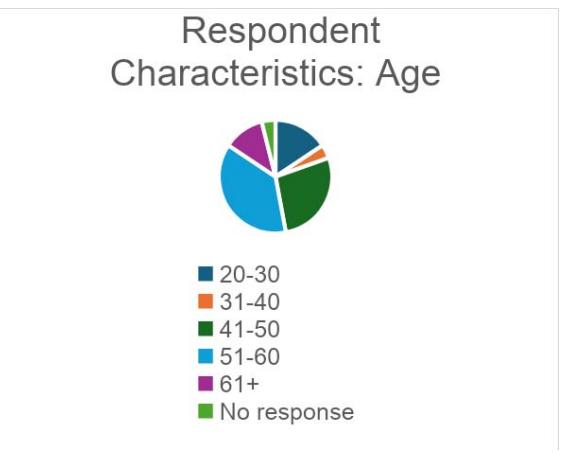
Responses were received from academic staff and Marijampoles Kolegija/Higher Education Institution in Lithuania and Glasgow Kelvin College in Scotland, females dominating, most answers from the respondents in their fifties (see Table 1).
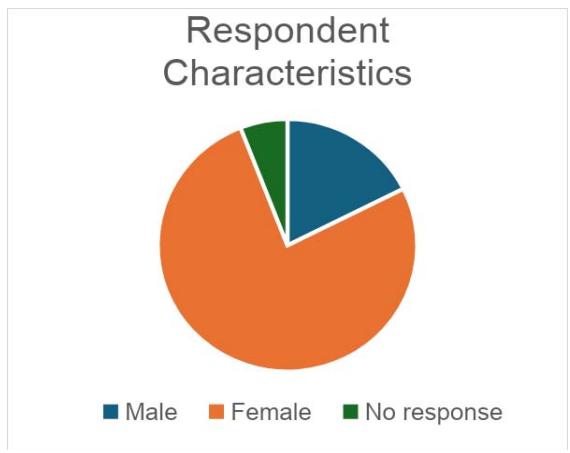 Table 1: Respondent Characteristics
### c) Students' Survey Analysis
The final set of questions was put to students (114 in total) and responses received were as follows.
First, the importance of prospects of employment after graduation was analysed.
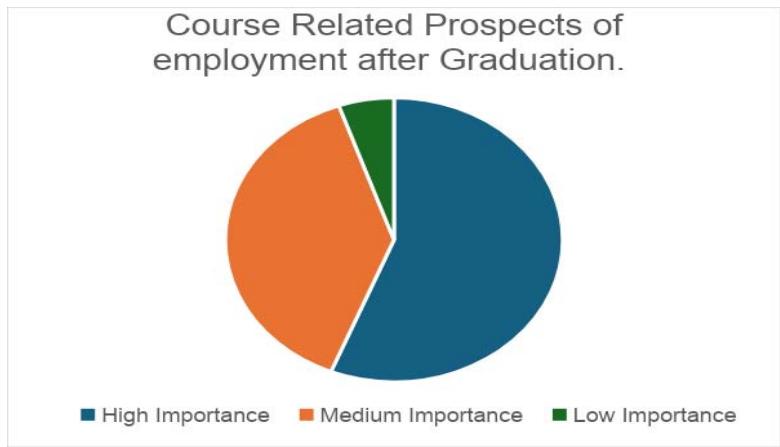 Table 2: Importance of Prospects of Employment after Graduation
Whilst it is as expected that over half of the student respondents indicated that employment prospects on course completion are held to be of high importance, it may be surprising that over one third of respondents considered this factor to be of medium importance, in particular given the present international economic situation of high inflation and failure of salaries to keep up with the increases in cost of living and the growth of what in the United Kingdom is termed as the 'gig economy', that is, work which has a low level of job security, and which offers less than full-time employment hours (Table 2). Age grouping may be a factor in this response, and it also may be indicative of a change in value norms of 'generation $z$ ', that is young people born between the mid-1990s and early 2010s.
Analysing the courses appropriate for employment the results are summarised as follows:
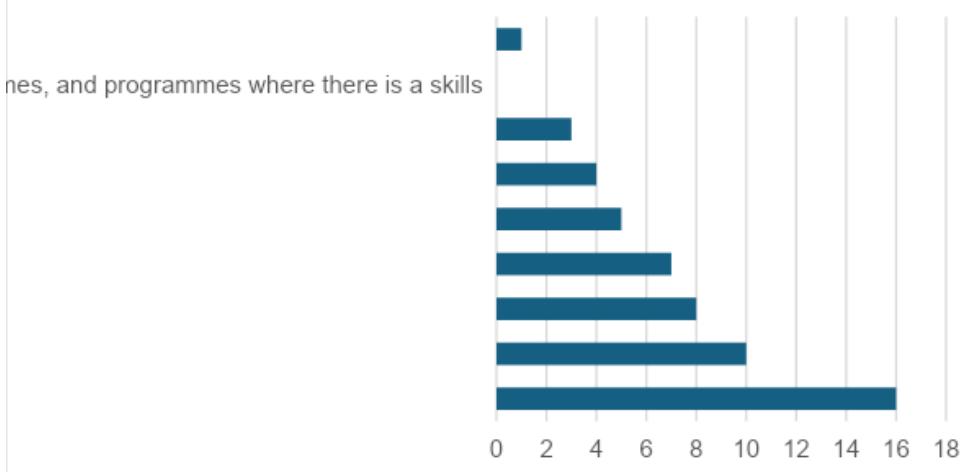 Table 3: Courses Appropriate for Employment Student consideration: Courses Appropriate for Employment
As expected, programmes in Information Technology, Business English and Business Studies scored highly, as did mathematics (it may be inferred that high competency in this field will be a positive factor in scientific engineering and information technology employment fields), followed by law. One particularly interesting response is that which proposes the high prospects of employment are high in emergent specialisms in which there may be a low level of qualified or experienced staff (see Table 3). This may be linked to the findings of the quoted research by the BBC in 2015 and the quote by one graduate in which they observe the seeming lack of opportunities for the sheer number of students entering the job market.
The largest single response indicated a belief that new programmes in Information Technology would be necessary, followed by a need for courses in virtual reality and metaverse technology and social media and marketing. Three respondents considered developing emotional intelligence, psychology and stress management should be provided as 'meta skills'. These may be useful skills to have in parallel with the rapid development of information technology and artificial intelligence. There was, surprisingly, no mention of green technology development and that only one respondent mentioned crypto currency and data analytics, which is now very widely used in social research, marketing, and commercial and political communications. This would be worth investigating further in the future across a wider student cohort.
Analysing the responses about the main barriers that would prevent you from beginning a course, the issues relating to finance and funding constituted the greatest number of individual responses, closely followed by that of pressure of time. This is reflected in the following article published in The Guardian, entitled 'It's broken me'. Although written during the Covid Pandemic, very similar issues are being experienced currently during high price inflation and the cost-of-living crisis. Age was the next most frequent factor along with previous grade results. The latter was linked to perceived programme complexity and a subsequent lack of self confidence in programme uptake. Three respondents each stated that programme delivery language would mitigate against programme choice as would programme location. Programmes being sufficiently practical or flexible contributed to negative perceptions. Uncertainty of personal direction, although only indicated once in this study, is not uncommon amongst the broad student cohort and could be addressed, to some extent, by the provision of 'taster' courses before full commitment to a full programme of study.

Almost half of respondents consider that the traditional academic calendar and course duration are still valid, another half - that it could be modified. Although no clear majority is indicated in favour of either option, the equal split indicates that it would be worthwhile carrying out a further investigation, especially for students who may be in an older age range in comparison to students who are directly leaving school, and who may already be in work and wish to further their career of change direction.
Being asked about to retrain during their working life, just over half of the students thought that this would be necessary, with a small percentage acknowledging this possibility. A further small percentage (4%) gave no response, however just over one third (36%) thought that retraining would not be necessary during their working life. For those who did not believe that they would have to retrain during their working lives, reasons given included their belief that their career choice would remain in demand and that the familiarity with skills and duties would be enough to see them through their working lives. However, those that did believe that their initial job would not be a 'job for life' gave reasons that included the necessity of constant skills improvement, changes in employment patterns with perhaps an overall change in life direction, the need to remain competitive and the realisation that life in general is subject to change.
As the age for retirement will gradually increase, how the issue of an increase in expected individual working life for all can be met was asked. Perhaps not unexpectedly given the age distribution of respondents, $23\%$ indicated that they did not know how this issue might be addressed, whilst $20\%$ stated that they believed that legislators should have a better appreciation of working life before deciding on such issues. And whilst healthcare and life expectancy may be improving, how physically demanding your work is will certainly have a significant effect on how long you can di the type of work you can do. For example, how viable would it be to continue employment as a construction worker into your late 60s or 70s? Social and interpersonal aspects may also be relevant factors. Other points raised include making retirement conditions specific to the job (for example in Scotland and Lithuania police officers receive their occupational pension after only 25 years or service) and where people have to work longer, making sure that they are employed in conditions that are age and health appropriate. Allowing older people to have access to suitable education and retraining provision so that they will have the skills to continue working in an appropriate job is also a relevant factor. The study by Sabzalieva et. al (2021) previously quoted is relevant here in terms of the stated need for education to be inclusive and comprehensively serve the needs of society and students.
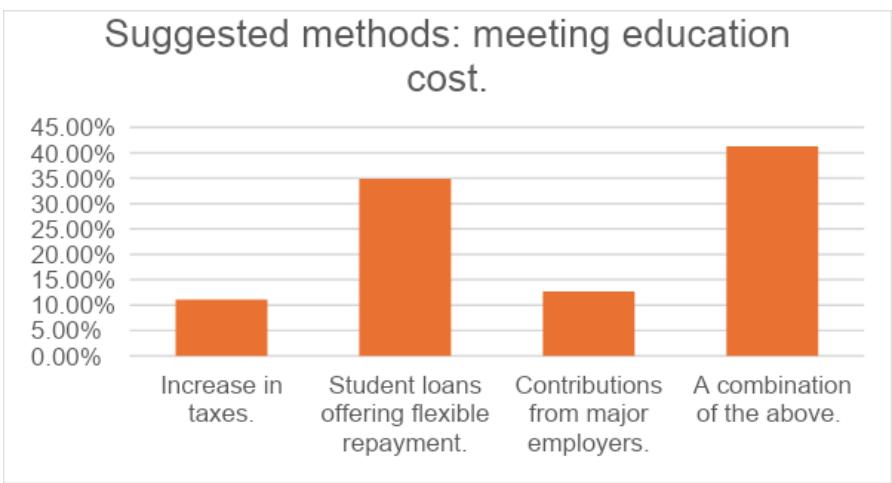 Table 4: Cost of education
Table 4 shows the greatest number of responses is that for meeting the cost of education by a combination of increases in taxes, provision of student loans offering flexible repayment methods and duration and contributions from major employers. The concept of 'job competition as noted earlier in the Times Higher Education Supplement is again relevant here, as for graduates subsequently working in a non-graduate role on a comparatively lower rate of pay, the spectre of debt will be a feature of their lives for a very considerable time, with the subsequent consequences for finance providers.
## V. CONCLUSIONS AND RECOMMENDATIONS
In the light of the current period of societal, economic, industrial, and environmental change, this study has been useful to highlight some of the changes in post-school educational provision which may very possibly be necessary in the future to meet the changing nature of business and the global economy, environmental issues and societal expectations and norms. Firstly, many people will no longer have a 'job for life' and several career changes may be necessary throughout their working lives, in particular as new technology replaces the human element in many roles and new job roles themselves evolve. There is perhaps a growing level of awareness for employees to be increasingly able to adapt and show a level of flexibility in how they work (with 'learning to learn' being a key skill in adapting to changes in necessary skill sets in the work environment), however although this level of awareness may not yet be so apparent amongst some sections in the student body, it is indeed almost certainly accurate to propose that this awareness is growing, both in terms of the acquisition of relevant initial qualifications and also skill updates throughout working life. This will require an ongoing element of curricula review by providers of post-school education.
It is becoming clear that the traditional methods of the delivery and structure of post-school education provision will need to change in line with this, significantly beyond that of the long-established academic year, and certainly with a higher level of close cooperation with employers than may presently be the case. Education provision which is linked to the acquisition of workplace skills (for people of all ages) will have to be accessible and highly flexible in terms of content and delivery and be able to deal with what may be frequent and significant changes in what is required to update and develop occupational skills. In summary, the one constant is change and the future may soon require a much more flexible model for education and training, and the blurring of the previously perceived harder boundary between education and work.
## VI. LIMITATIONS OF THE STUDY
The study could have reached a wider spectrum of respondents not only in Lithuania and the UK, but also in the whole world. Also, the number of respondents could have been expanded to search for more optional findings. Moreover, the wider spectrum of respondents could have been used as the main factor of survey. Also, as it is initial research, more research should be conducted in the future. To maintain the continuity of the survey, it is planned to carry out additional surveys in the future.
Generating HTML Viewer...
References
12 Cites in Article
; Capano,Cashore Howlett (2003). Unknown Title.
(2020). Schooling disrupted, schooling rethought: How the Covid-19 pandemic is changing education.
P Bolton (2012). Education: Historical statistics Standard Note: SN/SG/4252.
J Buchanan 1,Et,Al (2020). Global Education Monitoring Report – Gender Review: Education for people and planet: Creating sustainable futures for all.
J Buchanan,S Allais,M Anderson,R Calvo,S Peter,T Pietsch (2020). The futures of education for participation in 2050: educating for managing uncertainty and ambiguity.
Odeta Gluoksnytė,Colin White Distance Learning: Methods and Factors for Effective Delivery of Educational Experience // International Journal on Lifelong Education and Leadership.
M Lauer (2019). The Future of Work.
(2019). EU Initiatives In Cross-National Recognition of Skills and Qualifications.
P Cheese (2015). Times Educational Supplement.
Sh Kak (2018). Will traditional universities and colleges become obsolete?.
E Sabzalieva (2021). Tomorrowland Proven Pathways Forward.
Explore published articles in an immersive Augmented Reality environment. Our platform converts research papers into interactive 3D books, allowing readers to view and interact with content using AR and VR compatible devices.
Your published article is automatically converted into a realistic 3D book. Flip through pages and read research papers in a more engaging and interactive format.
During this current period of global business, economic and environmental change, and with reference to the societal effects of the covid pandemic, it is clear that post-school education provision is being subject to a range of competing pressures. This paper examines the effects of these changes on current educational provision. It examines factors such as possible emergent changes in traditional societal expectations, financial barriers to accessing established post-school education and increasing financial pressure on existing education providers to reduce costs and maintain current levels of activity within the existing academic structures. Through surveys conducted of employers, students and teaching staff, possible improvements and adaptations are identified and proposed, which may be more effective in meeting the potentially rapidly changing needs of global society in the future.
Our website is actively being updated, and changes may occur frequently. Please clear your browser cache if needed. For feedback or error reporting, please email [email protected]
Thank you for connecting with us. We will respond to you shortly.