Introduction
Posterior reversible encephalopathy syndrome (PRES), also known as posterior reversible encephalopathy syndrome, is a radioclinical entity characterized by reversible central nervous system dysfunction and typical brain MRI or CT imaging [1]. This syndrome was first described in 1992 and brought to light by Hinchey et al. in 1996 [2,3,4]. PRES is generally a rare complication of a sudden increase in blood pressure occurring in a chronically hypertensive patient [5]. We report a case of a patient who developed PRES secondary to hypertension.
Case Report
This is a 61-year-old patient transferred from an intensive care unit for a behavioral disturbance characterized by monologue, visual hallucinations, agitation, verbal aggression, and acting out. These symptoms had been developing rapidly for five days. He had a history of poorly controlled hypertension. Neurological examination revealed disorientation, anterograde and retrograde amnesia, acalculia, and a vacant stare. The remainder of the neurological examination was normal. His blood pressure was 170/112 mmHg. Other vital signs were normal. A diagnosis of delirium was initially considered. Brain CT scans performed without contrast (Fig. 1) and with contrast (Fig. 2) revealed a hypodense edematous infiltrate within the cortical sulci in the parietal, posterior temporal, and occipital lobes, bilaterally and symmetrically. Minimal hypodensity of the periventricular corneal white matter and the centrum semiovale was also observed, indicating leukoaraiosis.
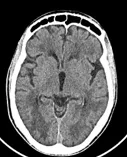
Brain CT scan without contrast showing hypodensity in the posterior regions, symmetrically and bilaterally.
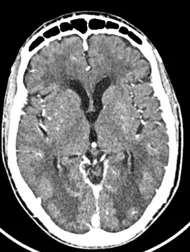
Brain CT scan with contrast, shows hypodensity in the posterior regions symmetrically and bilaterally.
The patient received a treatment of Amlodipina at a dose of 10 mg per day. One week into treatment, his condition was marked by a normal neurological examination. We concluded that he had posterior progressive encephalopathy syndrome secondary to hypertension.
Discussion
Posterior reversible encephalopathy syndrome (PRES) is a rare but severe disease of the central nervous system. Its onset and presentation are characterized by significant clinical polymorphism, sometimes making diagnosis difficult [1]. Numerous predisposing factors exist, including hypertension. This is a classic finding and was the first factor described. Moderate hypertension has been observed in 75
In our case, hypertension was the identified predisposing factor. Other circumstances may include eclampsia, chemotherapy, septicemia, chronic renal failure, autoimmune diseases, etc. [1,8]. The clinical presentation is nonspecific, neuroradiological signs are characteristic, and the triggering factors or associated pathophysiological conditions are numerous [5]. Neurological manifestations are varied and frequently include seizures, sometimes complicated by status epilepticus, headaches, confusion, nausea, and vomiting [6]. These clinical manifestations depend on the associated pathology. Hypertension with a diastolic blood pressure greater than 120 mmHg is usually observed [9]. The clinical presentation of our patient was mental confusion. The therapeutic strategy depends on the etiology and clinical presentation of PRES. Discontinuation of the triggering or aggravating factor is the first therapeutic measure [5]. Controlling hypertension is the primary aspect of treatment. This involves the usual antihypertensive agents, calcium channel blockers, beta-blockers, and diuretics. The therapeutic goal is to maintain a mean arterial pressure between 105 and 125 mmHg, without reducing this pressure by more than 25
Conclusion
Diagnostic workup must absolutely identify the cause of PRES in order to implement appropriate corrective measures. Therefore, PRES should be considered in any case of acute encephalopathy. The diagnosis is generally appropriate in the presence of hypertension or other predisposing factors. Knowledge of this syndrome should encourage the avoidance of unnecessary repeat imaging studies when the clinical course is favorable.