Postsecondary Mathematics during the Covid-19 Pandemic: A Systematic Review

α
Dr. Manuel Rodriguez
α West Coast University

Send Message

To: Author

Postsecondary Mathematics during the Covid-19 Pandemic: A Systematic Review

Article Fingerprint

ReserarchID

RB40N

Postsecondary Mathematics during the Covid-19 Pandemic: A Systematic Review Banner

AI TAKEAWAY

Connecting with the Eternal Ground
  • English
  • Afrikaans
  • Albanian
  • Amharic
  • Arabic
  • Armenian
  • Azerbaijani
  • Basque
  • Belarusian
  • Bengali
  • Bosnian
  • Bulgarian
  • Catalan
  • Cebuano
  • Chichewa
  • Chinese (Simplified)
  • Chinese (Traditional)
  • Corsican
  • Croatian
  • Czech
  • Danish
  • Dutch
  • Esperanto
  • Estonian
  • Filipino
  • Finnish
  • French
  • Frisian
  • Galician
  • Georgian
  • German
  • Greek
  • Gujarati
  • Haitian Creole
  • Hausa
  • Hawaiian
  • Hebrew
  • Hindi
  • Hmong
  • Hungarian
  • Icelandic
  • Igbo
  • Indonesian
  • Irish
  • Italian
  • Japanese
  • Javanese
  • Kannada
  • Kazakh
  • Khmer
  • Korean
  • Kurdish (Kurmanji)
  • Kyrgyz
  • Lao
  • Latin
  • Latvian
  • Lithuanian
  • Luxembourgish
  • Macedonian
  • Malagasy
  • Malay
  • Malayalam
  • Maltese
  • Maori
  • Marathi
  • Mongolian
  • Myanmar (Burmese)
  • Nepali
  • Norwegian
  • Pashto
  • Persian
  • Polish
  • Portuguese
  • Punjabi
  • Romanian
  • Russian
  • Samoan
  • Scots Gaelic
  • Serbian
  • Sesotho
  • Shona
  • Sindhi
  • Sinhala
  • Slovak
  • Slovenian
  • Somali
  • Spanish
  • Sundanese
  • Swahili
  • Swedish
  • Tajik
  • Tamil
  • Telugu
  • Thai
  • Turkish
  • Ukrainian
  • Urdu
  • Uzbek
  • Vietnamese
  • Welsh
  • Xhosa
  • Yiddish
  • Yoruba
  • Zulu

Abstract

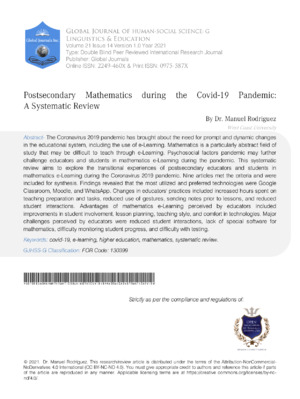
The Coronavirus 2019 pandemic has brought about the need for prompt and dynamic changes in the educational system, including the use of e-Learning. Mathematics is a particularly abstract field of study that may be difficult to teach through e-Learning. Psychosocial factors pandemic may further challenge educators and students in mathematics e-Learning during the pandemic. This systematic review aims to explore the transitional experiences of postsecondary educators and students in mathematics e-Learning during the Coronavirus 2019 pandemic. Nine articles met the criteria and were included for synthesis. Findings revealed that the most utilized and preferred technologies were Google Classroom, Moodle, and WhatsApp. Changes in educators’ practices included increased hours spent on teaching preparation and tasks, reduced use of gestures, sending notes prior to lessons, and reduced student interactions. Advantages of mathematics e-Learning perceived by educators included improvements in student involvement, lesson planning, teaching style, and comfort in technologies. Major challenges perceived by educators were reduced student interactions, lack of special software for mathematics, difficulty monitoring student progress, and difficulty with testing.

References

21 Cites in Article
  1. E Agormedah,E Henaku,D Ayite,E Ansah (2020). Online learning in higher education during COVID-19 pandemic: A case of Ghana.
  2. Jeong Ahn,Akugizibwe Edwin (2018). An e-Learning Model for Teaching Mathematics on an Open Source Learning Platform.
  3. K Attiah (2020). Africa has defied the covid-19 nightmare scenarios.
  4. Mutiara Ayu (2020). Online Learning: Leading e-Learning at Higher Education.
  5. R Cassibba,D Ferrarello,M Mammana,P Musso,M Pennisi,E Taranto (2021). Teaching mathematics at distance: A challenge for universities.
  6. (2017). An introduction to systematic reviews.
  7. Muhammad Irfan,Betty Kusumaningrum,Yuyun Yulia,Sri Widodo (2020). CHALLENGES DURING THE PANDEMIC: USE OF E-LEARNING IN MATHEMATICS LEARNING IN HIGHER EDUCATION.
  8. Sonia Lopez,Glenna Bruun,Michael Mader,Robert Reardon (2021). The Pandemic Pivot: The Impact of COVID-19 on Mathematics and Statistics Post-Secondary Educators.
  9. Javed Khan (2021). A Novel Hybrid Optimization Model for Technical Efficiency Assessment in Public Hospitals: A Comparative Study During and Post-COVID-19 Pandemic.
  10. G Marinoni,H Van't Land,T Jensen (2020). The impact of Covid-19 on higher education around the world.
  11. Jayaluxmi Naidoo (2020). Postgraduate mathematics education students’ experiences of using digital platforms for learning within the COVID-19 pandemic era.
  12. Lorenz Neuwirth,Svetlana Jović,B Mukherji (2020). Reimagining higher education during and post-COVID-19: Challenges and opportunities.
  13. Theophile Nsengimana,Gabriel Bazimaziki,Asterie Nyirahabimana,Jean Mushimiyimana,Vedaste Mutarutinya,Leon Mugabo,Venuste Nsengimana (2021). Online Learning during COVID-19 Pandemic in Rwanda: Experience of Postgraduate Students on Language of Instruction, Mathematics and Science Education.
  14. S Olivia,J Gibson,R Nasrudin (2020). Indonesia in the Time of Covid-19.
  15. Matthew Page,Joanne Mckenzie,Patrick Bossuyt,Isabelle Boutron,Tammy Hoffmann,Cynthia Mulrow,Larissa Shamseer,Jennifer Tetzlaff,Elie Akl,Sue Brennan,Roger Chou,Julie Glanville,Jeremy Grimshaw,Asbjørn Hróbjartsson,Manoj Lalu,Tianjing Li,Elizabeth Loder,Evan Mayo-Wilson,Steve Mcdonald,Luke Mcguinness,Lesley Stewart,James Thomas,Andrea Tricco,Vivian Welch,Penny Whiting,David Moher (2021). The PRISMA 2020 statement: an updated guideline for reporting systematic reviews.
  16. Andrea Saglietto,Fabrizio D’ascenzo,Giuseppe Zoccai,Gaetano De Ferrari (2020). COVID-19 in Europe: the Italian lesson.
  17. R Sakhapov,S Absalyamova (2018). Fourth industrial revolution and the paradigm change in engineering education.
  18. G Siregar,Hidayat,Sukmawarti,M Siagian (2021). Evaluation of online learning for mathematics education students.
  19. Nancy Stiegler,Jean-Pierre Bouchard (2020). South Africa: Challenges and successes of the COVID-19 lockdown.
  20. N Sulistyani,B Utomo,Y Kristanto (2021). Emergency remote teaching experiences of mathematics education lectures to address COVID-19 pandemic.
  21. Wondwosen Tamrat,Damtew Teferra (2009). African Private Higher Education: Progressive Policies and Ambivalent Stances.

Funding

No external funding was declared for this work.

Conflict of Interest

The authors declare no conflict of interest.

Ethical Approval

No ethics committee approval was required for this article type.

Data Availability

Not applicable for this article.

How to Cite This Article

Dr. Manuel Rodriguez. 2022. \u201cPostsecondary Mathematics during the Covid-19 Pandemic: A Systematic Review\u201d. Global Journal of Human-Social Science - G: Linguistics & Education GJHSS-G Volume 21 (GJHSS Volume 21 Issue G14): .

Download Citation

Analyzes postsecondary math education impact during Covid-19 pandemic, highlighting systematic review findings.
Issue Cover
GJHSS Volume 21 Issue G14
Pg. 1- 11
Journal Specifications

Crossref Journal DOI 10.17406/GJHSS

Print ISSN 0975-587X

e-ISSN 2249-460X

Keywords
Classification
GJHSS-G Classification: FOR Code: 130399
Version of record

v1.2

Issue date

January 8, 2022

Language
en
Experiance in AR

Explore published articles in an immersive Augmented Reality environment. Our platform converts research papers into interactive 3D books, allowing readers to view and interact with content using AR and VR compatible devices.

Read in 3D

Your published article is automatically converted into a realistic 3D book. Flip through pages and read research papers in a more engaging and interactive format.

Article Matrices
Total Views: 1841
Total Downloads: 782
2026 Trends
Related Research

Published Article

The Coronavirus 2019 pandemic has brought about the need for prompt and dynamic changes in the educational system, including the use of e-Learning. Mathematics is a particularly abstract field of study that may be difficult to teach through e-Learning. Psychosocial factors pandemic may further challenge educators and students in mathematics e-Learning during the pandemic. This systematic review aims to explore the transitional experiences of postsecondary educators and students in mathematics e-Learning during the Coronavirus 2019 pandemic. Nine articles met the criteria and were included for synthesis. Findings revealed that the most utilized and preferred technologies were Google Classroom, Moodle, and WhatsApp. Changes in educators’ practices included increased hours spent on teaching preparation and tasks, reduced use of gestures, sending notes prior to lessons, and reduced student interactions. Advantages of mathematics e-Learning perceived by educators included improvements in student involvement, lesson planning, teaching style, and comfort in technologies. Major challenges perceived by educators were reduced student interactions, lack of special software for mathematics, difficulty monitoring student progress, and difficulty with testing.

Our website is actively being updated, and changes may occur frequently. Please clear your browser cache if needed. For feedback or error reporting, please email [email protected]

Request Access

Please fill out the form below to request access to this research paper. Your request will be reviewed by the editorial or author team.
X

Quote and Order Details

Contact Person

Invoice Address

Notes or Comments

This is the heading

Lorem ipsum dolor sit amet, consectetur adipiscing elit. Ut elit tellus, luctus nec ullamcorper mattis, pulvinar dapibus leo.

High-quality academic research articles on global topics and journals.

Postsecondary Mathematics during the Covid-19 Pandemic: A Systematic Review

Dr. Manuel Rodriguez
Dr. Manuel Rodriguez West Coast University

Research Journals