




I. INTRODUCTION
Literature survey revealed KIO3/KI in acetic acid The conversion of ketones to the more versatile enone functionality is an important transformation in organic synthesis due to the utility of enones as intermediates in multistep production of pharmaceuticals and biologically active compounds. One of the earliest strategies for the synthesis of enones involves the pre-functionalization of the ketone a-position with a halogen, which can be eliminated upon treatment with base at high temperatures. Utilizing aselenide intermediates is similarly broad in scope as these species can be formed under mild conditions through trapping of a lithium enolate with PhSeX. The second step entails conversion of the selenide moiety to the corresponding selenoxide, which allows for spontaneous generation of aunsaturated products via a 2,3-sigmatropic rearrangement.
Literature survey revealed in acetic acid is used as iodination agent at Combination of iodic acid and potassium iodide has been used for trimethylsilylation of alcohols and phenols in the presence of HMDS and iodination of aromatic amines . Recently Kelsey B. LaMartina et al showed that the combinations of ammonium iodate and catalytic N-hydroxyphthalimide (NHPI) in presence of acetic acid for the selective oxidation of n-butylbenzene directly to 1-phenylbutyl acetate in high yield and it is also reported as catalyst for the -sulfenylation of enaminones . Recently Rai et al used , as a novel oxidising agent for the synthesis of isoxazolines .
This prompted us to use this reagent for the dehydrogenation of cyclohexanone. This metal free process is less time consuming and the easy availability and its stability makes it a versatile novel reagent for the dehydrogenation of cyclohexanone. Further applications of this novel reagent are under progress.
Typically the dehydrogenation is carried out by heating equimolar mixture of cyclohexanone, potassium iodate and acetic acid in ethanol under reflux for 4-6 hrs. The dehydrogenated compound was confirmed by comparison with the known compound.
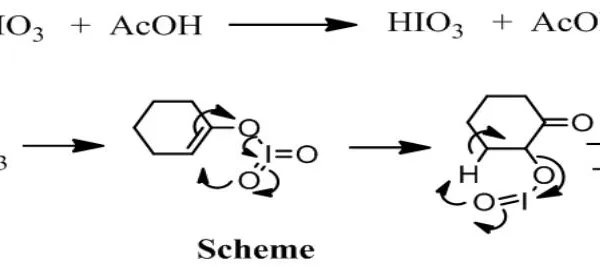
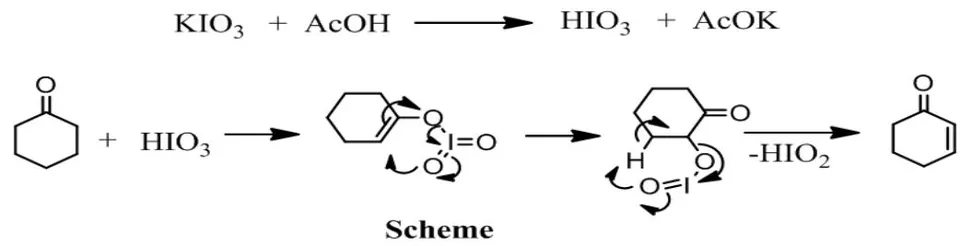
Probable mechanism is given in Scheme. The reaction involves the protonation of cyclohexanone followed by enolization and esterification leads to enol ester. This ester undergoes rearrangement to give -keto ester, followed by cis elimination of leads to the formation of cyclohexenone in almost quantitative yield.
II. EXPERIMENTAL
a) Dehydrogenation of cyclohexanone
In a typical procedure cyclohexanone was to react with a new reagent as oxidizing agent under reflux conditions for 4-6 hours in the presence of acetic acid in catalytic amount and ethanol as solvent. The completion of the reaction was monitored by TLC. After completion, the residue was extracted with ether (25mL×3), the extract was washed successively with water (15mL×2), 10% NaOH (15mL×2), and saturated brine solution (10mL). The organic layer was dried over anhydrous .


