
Potential Effects of a Herbal Remedy

1
Kporou Kouassi Elisée
2
Gbogbo Moussa
Gbogbo Moussa
3
Ouattara Sitapha
Ouattara Sitapha
4
Yao Akissi Nadège
Yao Akissi Nadège
5
Tanoh Aya Honorine
Tanoh Aya Honorine
6
Traore Aboubakar
Traore Aboubakar
7
Kroa  Ehoule
Kroa Ehoule
8
Djaman Allico Joseph

Send Message

To: Author

GJMR Volume 22 Issue B3

Article Fingerprint

ReserarchID

PDDTM7LV58

Potential Effects of a Herbal Remedy Banner
  • English
  • Afrikaans
  • Albanian
  • Amharic
  • Arabic
  • Armenian
  • Azerbaijani
  • Basque
  • Belarusian
  • Bengali
  • Bosnian
  • Bulgarian
  • Catalan
  • Cebuano
  • Chichewa
  • Chinese (Simplified)
  • Chinese (Traditional)
  • Corsican
  • Croatian
  • Czech
  • Danish
  • Dutch
  • Esperanto
  • Estonian
  • Filipino
  • Finnish
  • French
  • Frisian
  • Galician
  • Georgian
  • German
  • Greek
  • Gujarati
  • Haitian Creole
  • Hausa
  • Hawaiian
  • Hebrew
  • Hindi
  • Hmong
  • Hungarian
  • Icelandic
  • Igbo
  • Indonesian
  • Irish
  • Italian
  • Japanese
  • Javanese
  • Kannada
  • Kazakh
  • Khmer
  • Korean
  • Kurdish (Kurmanji)
  • Kyrgyz
  • Lao
  • Latin
  • Latvian
  • Lithuanian
  • Luxembourgish
  • Macedonian
  • Malagasy
  • Malay
  • Malayalam
  • Maltese
  • Maori
  • Marathi
  • Mongolian
  • Myanmar (Burmese)
  • Nepali
  • Norwegian
  • Pashto
  • Persian
  • Polish
  • Portuguese
  • Punjabi
  • Romanian
  • Russian
  • Samoan
  • Scots Gaelic
  • Serbian
  • Sesotho
  • Shona
  • Sindhi
  • Sinhala
  • Slovak
  • Slovenian
  • Somali
  • Spanish
  • Sundanese
  • Swahili
  • Swedish
  • Tajik
  • Tamil
  • Telugu
  • Thai
  • Turkish
  • Ukrainian
  • Urdu
  • Uzbek
  • Vietnamese
  • Welsh
  • Xhosa
  • Yiddish
  • Yoruba
  • Zulu

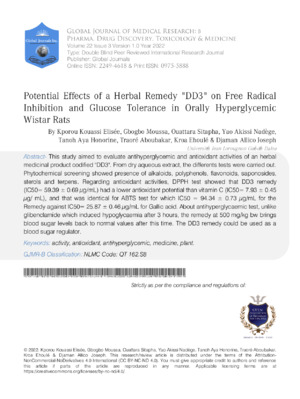
This study aimed to evaluate antihyperglycemic and antioxidant activities of an herbal medicinal product codified “DD3”. From dry aqueous extract, the differents tests were carried out. Phytochemical screening showed presence of alkaloids, polyphenols, flavonoids, saponosides, sterols and terpens. Regarding antioxidant activities, DPPH test showed that DD3 remedy (IC50= 59.39 ± 0.69 µg/mL) had a lower antioxidant potential than vitamin C (IC50= 7.93 ± 0.45 µg/ mL), and that was identical for ABTS test for which IC50 = 94.34 ± 0.73 µg/mL for the Remedy against IC50= 25.87 ± 0.46 µg/mL for Gallic acid. About antihyperglycaemic test, unlike glibenclamide which induced hypoglycaemia after 3 hours, the remedy at 500 mg/kg bw brings blood sugar levels back to normal values after this time. The DD3 remedy could be used as a blood sugar regulator.

Funding

No external funding was declared for this work.

Conflict of Interest

The authors declare no conflict of interest.

Ethical Approval

No ethics committee approval was required for this article type.

Data Availability

Not applicable for this article.

Kporou Kouassi Elisée. 2026. \u201cPotential Effects of a Herbal Remedy\u201d. Global Journal of Medical Research - B: Pharma, Drug Discovery, Toxicology & Medicine GJMR-B Volume 22 (GJMR Volume 22 Issue B3): .

Download Citation

Potent herbal remedy for hyperglycemia in managing blood sugar levels.
Journal Specifications

Crossref Journal DOI 10.17406/gjmra

Print ISSN 0975-5888

e-ISSN 2249-4618

Keywords
Classification
GJMR-B Classification: NLMC Code: QV 704
Version of record

v1.2

Issue date

February 11, 2023

Language

English

Experiance in AR

The methods for personal identification and authentication are no exception.

Read in 3D

The methods for personal identification and authentication are no exception.

Article Matrices
Total Views: 1285
Total Downloads: 12
2026 Trends
Research Identity (RIN)
Related Research

Published Article

This study aimed to evaluate antihyperglycemic and antioxidant activities of an herbal medicinal product codified “DD3”. From dry aqueous extract, the differents tests were carried out. Phytochemical screening showed presence of alkaloids, polyphenols, flavonoids, saponosides, sterols and terpens. Regarding antioxidant activities, DPPH test showed that DD3 remedy (IC50= 59.39 ± 0.69 µg/mL) had a lower antioxidant potential than vitamin C (IC50= 7.93 ± 0.45 µg/ mL), and that was identical for ABTS test for which IC50 = 94.34 ± 0.73 µg/mL for the Remedy against IC50= 25.87 ± 0.46 µg/mL for Gallic acid. About antihyperglycaemic test, unlike glibenclamide which induced hypoglycaemia after 3 hours, the remedy at 500 mg/kg bw brings blood sugar levels back to normal values after this time. The DD3 remedy could be used as a blood sugar regulator.

Our website is actively being updated, and changes may occur frequently. Please clear your browser cache if needed. For feedback or error reporting, please email [email protected]
×

This Page is Under Development

We are currently updating this article page for a better experience.

Request Access

Please fill out the form below to request access to this research paper. Your request will be reviewed by the editorial or author team.
X

Quote and Order Details

Contact Person

Invoice Address

Notes or Comments

This is the heading

Lorem ipsum dolor sit amet, consectetur adipiscing elit. Ut elit tellus, luctus nec ullamcorper mattis, pulvinar dapibus leo.


High-quality academic research articles on global topics and journals.

Potential Effects of a Herbal Remedy

Kporou Kouassi Elisée
Gbogbo Moussa
Gbogbo Moussa
Ouattara Sitapha
Ouattara Sitapha
Yao Akissi Nadège
Yao Akissi Nadège
Tanoh Aya Honorine
Tanoh Aya Honorine
Traore Aboubakar
Traore Aboubakar
Kroa  Ehoule
Kroa Ehoule
Djaman Allico Joseph

Research Journals





























































