## I. INTRODUCTION
In the field of the preservation-restoration of cultural heritage, it has been necessary to maintain substances in contact with the surface of the area to be treated in order to be more effective, and for this purpose different possibilities have been used.
The terminology related to application of absorbent materials on a surface is called "Poultridge" [1](English term), which in the Italian bibliography corresponds to "Papetta" or "impacco" [2], and to "Pasten und Kompressen" in Germanic terminology [3]. The term used in Spanish is "apósitos" [4] or "papeta" [5].
Handmade placement of poultices is slow and laborious, which makes it difficult to put them on site and to control the time of action on the products applied. During a long time, the authors have developed an automatic projection method using compressed air to solve these problems and to work on large surfaces (including complete buildings). The physical properties of the resulting "Gunpoint mix" poultices (we will call them "GPM", they are produced by the use of compressed air), which have a quite different behavior from that of the "handmade poultice", had not been analyzed in detail yet. A comparative analysis of the two types of poultices is presented here.
The term "projected poutrice" is reserved for projection methods that release a previously mixed paste (mortar projection machines), which we consider to be very different from GPM.
We must point out that our automated method mixes cellulose fiber with water in the air (at gun point, see fig. 1 and [6]), which is a significant difference with other machines; generally adapted mortar projection machines that project a cellulose plaster with water that has been previously kneaded. Although initially it was the application time/ease that motivated us to use our automated method, its use made clear that the projected poultices had a different behavior from the handmade ones, so we finally carried out this characterization.
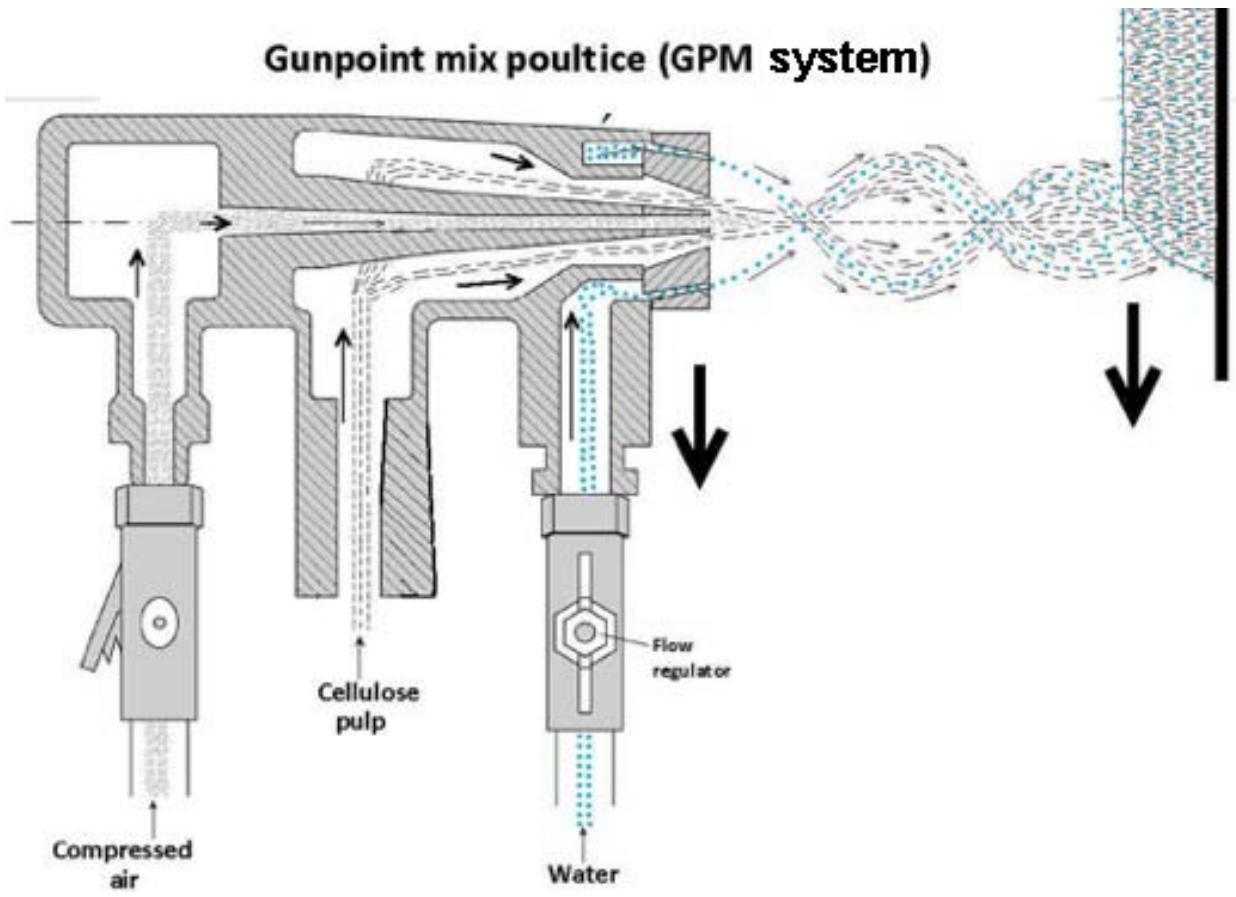 Figure 1: Operation of the gun. Gun Point Mix (GPM) system.
Note the helical path of the water flow. The gun has two small holes that project water at an angle that generates torsion of the air jet so that it produces a complete mixture of air with cellulose and water
## II. BACKGROUND
Classical works on restoration materials for the production of poultices [7] [8] Naud et Al 1990 (Redman 1999), establish the weight ratio between dry cellulose pulp and water of 1:5 as the optimal for workability and adhesion. In addition to characterizing the solid materials, they describe the flow and ebb of the liquid produced by the interaction of the two capillary systems (that of the pulp of paper and that of the substrate). This interaction between flows and ebbs, in its dynamic aspect, has not been studied in depth; we quote ([9] GISBERT) as the only case. Subsequent syntheses, focused mainly on desalination [10] Vergès-Belmin V. and Siedel H. (2005), investigate many aspects of the poultice-substrate system, although they do not characterize in detail the advectionflows and ebbs. Most of the works focus on characterizing the porous system of the poultices and the substrate in desalination-oriented development. The main conclusion until 2005 was that in order to obtain a dominant advection towards the paper fiber (which is a necessary requirement for an efficient desalination), the poultice must have a finer porous system than that of the substrate.
- [11] SAWDY A., HERITAGE A. and PEL L. (2008) studied the behavior of the poultice, indicating that it is based on the principles of diffusion and/or advection and that the efficiency of the method depends on the type of poultice, specifying that an average size of the poultice's pore diameter smaller than that of the substrate is recommended.
- [12] [13] BOURGUIGNON 2009 synthesis describes all the previous experiences of automated projection systems and insists on the important role of the discontinuity between the poultice and the substrate in terms of the interaction between both subjects. This author studies the adhesion of the poultice (handmade) and establishes the optimum water values in the kneading in order to maximize adhesion. It must be noted that little attention has been paid to the methodologies of preparation and placement of the poultice in scientific literature until now; in this sense, the work of [13] Bourguignon is a remarkable contribution.
- [14] Bourges, A., and Vergès-Belmin, (2010) develop three tests to measure the consistency, workability and degree of adhesion of a poultice inspired in the tests used to characterize the setting of mortars. [15] Lubelli B., van Hees R.P.J.2010 and [16] Vergès-Belmin et al.
2011 characterize the poultices with different Arbocel® fibers and study its workability indicating that the optimum humidity is Wc = 3.5 and 4 for BWW40; Wc = 4.5, 5, 5.5 and 6 for BC200, BC1000, and mixture BC1000/BWW40. They also study the retraction during drying, concluding that it is of the order of 4 to $9\%$ depending on the humidity of the air and the connection with the substrate. The stronger and thinner the adhesion of the poultice to the substrate is, the smaller the contraction will be. In order to work with cellulose poultices, substrate porosity greater than $15\mu \mathrm{m}$ and not lower than $10\mu \mathrm{m}$ is recommended.
Regarding the way in which the poultice is elaborated and placed, we can establish that [17] Fassina et Al describe for the first time the manufacture of a poultice with a mechanical system of mortar projection. [18] Ettl, H. et M. Krus. 2003 indicate that the contact between poultice and substrate is a discontinuity that constitutes the main factor in the loss of effectiveness of the treatments. [19] Michael Auras (2008) cites that he elaborates poultices with mortar projecting machines and indicates that with those machines it is possible to inject particles into the substrate and that it is also convenient to interpose Washi (Japanese paper). [20] Gisbert et al (2011) patented a poultice projection system that mixes Arbocel® with water at gunpoint (GunPoint Mix system) [6], system that was used in this research. This system has been used in several restoration works. [21] Although there are citations about the use of projection systems, there are no studies regarding the variation of properties between projected poultices and handmade poultices.
## III. OBJECTIVES
Characterizing the differences in physical characteristics and the behavior of cellulose fiber poultices depending on the type; this is, handmade poultice or Gunpoint mix poultice (made with an automated projection system).
## IV. METHODOLOGY
### a) Materials (Table 1)
In order to elaborate the poultices, both "Handmade" and "GPM", Arbocel® fibers with a size of BWW40 (from Arbocel®) and an average length of 200 μm were used. Other fibers were not used because the projection system gets clogged with longer fibers. However, it is possible to project the BWW40 with clays, but this possibility is not explored in this first publication.
In order to carry out the microscopic observation of the poultices, these were consolidated with Gurit SP 115 epoxy resin with yellow Struers Epodye dye (6135-1431). For microscopy, the preparations were performed in the SAI of the Universidad of Zaragoza, and viewed in a polarized light microscope. For the observation at higher magnifications a SEM (model JEOL SM 6400) of the SAI of the Universidad of Zaragoza was used. Using SEM photos, an exact drawing of each component was made and the percentages were obtained through digital image processing. The drying and the environmental control of the experiments were achieved by means of a climatic chamber (Binder KBF240).
To evaluate the effectiveness of each poultice in terms of penetration of the restoration products in a substrate, the consolidant Syton® X30 (from KREMER) was used. It is an aqueous silica acid dispersion that presents a silica concentration of $30\%$ and a specific weight of $1200\mathrm{g}/$ liter. When it dries, the dispersion hardens turning into a dry gel structure with high chemical adhesion power. Due to the high chemical and temperature resistance, Syton® X30 is used as binder for mortars, surface modification medium and estender. This consolidant was chosen because of its versatility and relative low viscosity (another product was also evaluated (epoxy resin), but it presented high viscosity).
Table 1: General characteristics of the involved materials. After [23] [26]
<table><tr><td></td><td></td><td colspan="3">Restoration products</td><td></td><td></td><td></td><td></td><td></td><td></td><td></td><td></td><td></td></tr><tr><td>Name</td><td></td><td>Brand</td><td></td><td>O Clast</td><td>Density</td><td>Viscosity (20°C)</td><td></td><td></td><td></td><td></td><td></td><td></td><td></td></tr><tr><td>Resin Epoxi</td><td></td><td>Gurit SP 115</td><td></td><td></td><td>1,16</td><td>856 cp</td><td></td><td></td><td></td><td></td><td></td><td></td><td></td></tr><tr><td>Cellulose pulp</td><td></td><td>Fiber BWWW40 Rettenmaier</td><td></td><td>200x10</td><td>1,44</td><td></td><td></td><td></td><td></td><td></td><td></td><td></td><td></td></tr><tr><td>Consolidant Syton X30</td><td></td><td>Kremer</td><td></td><td></td><td>1,2</td><td>0,020 cp</td><td></td><td></td><td></td><td></td><td></td><td></td><td></td></tr><tr><td></td><td></td><td></td><td></td><td></td><td></td><td></td><td>Average size</td><td>Bulk</td><td>Open</td><td>Capillary</td><td>Average</td><td></td><td></td></tr><tr><td></td><td></td><td colspan="3">Substrate materia [14]</td><td></td><td></td><td>of clast</td><td>Density</td><td>Porosity</td><td>Coefficient</td><td>Pore Size</td><td></td><td></td></tr><tr><td>Material</td><td></td><td>Mineralogy</td><td></td><td>Geological age</td><td>Classification [15]</td><td>O</td><td>BD</td><td>OP</td><td>CC</td><td>PS</td><td>Fossils</td><td></td><td></td></tr><tr><td colspan="2">CALATORAO STONE</td><td>Calcite</td><td></td><td>Jurassic</td><td>Wackestone</td><td>0,1</td><td>2,66</td><td>1,03</td><td>0,3 to 0,9</td><td>0,1</td><td>Positra bouchi</td><td></td><td></td></tr><tr><td colspan="2">CAMPIANI LSTONE</td><td>Calcite</td><td></td><td>Miocene</td><td>Wackestone-Packstone</td><td>0,2-0,4</td><td>1,9 to 2,1</td><td>10 to 24</td><td>60 to 120</td><td>0,8</td><td>Charophytes, ostracods, bivalves</td><td></td><td></td></tr><tr><td colspan="2">UNCASTILLO SANDSTONE</td><td>Quart, calcite, dolomite, Feldspar, Clay</td><td>Miocene</td><td></td><td>Litoarenite</td><td>0,2-0,8</td><td>2,24 to 2,23</td><td>8 to 14</td><td>60 to 120</td><td>15-30</td><td>ne</td><td></td><td></td></tr><tr><td colspan="2">ALASTRUEY SANDSTONE</td><td>Quart, calcite, dolomite, Feldspar, Clay</td><td>Paleocene</td><td></td><td>Litoarenite</td><td>0,1-0,3</td><td>2,3-2,7</td><td>3,5 to 5,5</td><td>6 to 12</td><td>3</td><td>ne</td><td></td><td></td></tr><tr><td>PINEWOOD</td><td></td><td>Celulose</td><td></td><td>Quaternary - recent</td><td>Natural fiber of cellulose</td><td></td><td>0.4 to 0,5</td><td></td><td>4 to 9</td><td>0,22</td><td>ne</td><td></td><td></td></tr><tr><td></td><td></td><td></td><td></td><td></td><td></td><td>mm</td><td>g/cm3</td><td>%</td><td>g/m2·s-0,5</td><td>microns (mμ)</td><td></td><td></td><td></td></tr></table>
### b) Temporary phases of work
The work we present here was carried out in three different phases.
First phase: Projected poultices were elaborated with a prototype of industrial projection [6] [20] using Arbocel® cellulose pulp (Rettenmaier Ibérica BWW40 fiber). Two poultices (one was "GPM" and the other one "Handmade") were placed on two test tubes of $5 \times 10 \times 10$ cm of sandstone from Uncastillo (upper side of $10 \times 10 \mathrm{~cm}$ ). Later, the poultice-rock aggregate was consolidated by pouring $10 \mathrm{~g}$ of the epoxy resin onto the surface of the poultice, and by allowing it to penetrate by suction. Once the resin had hardened we carried out the observation/description of the poultices, both by SEM and through optical microscopy. In both cases, a rock/poultice slice had to be cut, in order to introduce it into the respective observation systems. In this way, the microscopic observation of the structure, as well as of the rock-poultice connection, were carried out, completing the textural and morphological characterization phase.
The projection tests carried out with the "industrial" machine evidenced the lack of effectiveness of this equipment for its use inside a building given the amount of dust it generated. It was becoming necessary to create a prototype of a specific projection machine to be used in laboratorytests.
In the second phase a small projection machine was created, which was achieved by the modification of a microabrasimeter.
Arbocel® cellulose kneaded with water was used for both types of poultices. These two types are "Handmade" poultices, and "GunPoint Mix" poultices (we will call them "GPM", they are produced by the use of compressed air).
In this second phase, the suitability in the size of the substrate test tubes was tested, verifying that the $5 \times 5 \times 5$ test tubes used were too small to adequately characterize the processes. We also used a sandstone (Alastruey stone) with very low porosity, that was later replaced in the final experiments by another sandstone (Stone from Uncastillo) that had a greater porosity. However, in this phase a set of actions were taken in order to evaluate the cleaning difficulty for each type of poultice.
In the third phase the definitive tests were carried out, using test tubes of $10 \times 10 \times 5 \mathrm{~cm}$ of pine wood, limestone from Calatorao, sandstone from Uncastillo and Campanil limestone whose characteristics are known [23]; eight test tubes of each type in total (tables 1 and 2).
Table 2: Petrophysical characteristics of each individual test tube. Measurement methodologies according to [22]
<table><tr><td colspan="12">PETROPHYSICAL PARAMETERS</td></tr><tr><td rowspan="3">Bed orientation</td><td rowspan="3">Slab Test number</td><td rowspan="2">Rock type [15] Textural classification</td><td rowspan="2">Average size of clast</td><td rowspan="2">Bulk Density</td><td></td><td rowspan="2">Open porosity</td><td colspan="2">Porosity</td><td colspan="3">CONSOLIDATION</td></tr><tr><td>Humidity</td><td>Inaccessible</td><td>Total</td><td>gr/m2 S0.5</td><td>gr/m2 S0.5</td><td></td></tr><tr><td>TC</td><td>φ mm</td><td>BD g/cm3</td><td>W%</td><td>OP%</td><td>IP%</td><td>TP%</td><td>CC</td><td>CC</td><td></td></tr><tr><td colspan="12">CALATORAO STONE</td></tr><tr><td>II</td><td>C1</td><td>Mudstone</td><td></td><td>2,65</td><td>0,66</td><td>1,73</td><td>0,88</td><td>2,6</td><td>0,90</td><td></td><td></td></tr><tr><td>II</td><td>C2</td><td>Mudstone</td><td></td><td>2,64</td><td>0,74</td><td>1,96</td><td>0,77</td><td>2,7</td><td>0,65</td><td></td><td></td></tr><tr><td>II</td><td>C3</td><td>Mudstone</td><td></td><td>2,65</td><td>0,72</td><td>1,89</td><td>0,60</td><td>2,5</td><td>0,77</td><td></td><td></td></tr><tr><td>⊥</td><td>C4</td><td>Mudstone</td><td></td><td>2,65</td><td>0,36</td><td>0,95</td><td>1,45</td><td>2,4</td><td>0,26</td><td></td><td></td></tr><tr><td>II</td><td>C5</td><td>Mudstone</td><td></td><td>2,64</td><td>0,73</td><td>1,90</td><td>0,91</td><td>2,8</td><td>0,39</td><td></td><td></td></tr><tr><td>II</td><td>C6</td><td>Mudstone</td><td></td><td>2,65</td><td>0,70</td><td>1,83</td><td>0,76</td><td>2,6</td><td>0,65</td><td></td><td></td></tr><tr><td>II</td><td>C7</td><td>Mudstone</td><td></td><td>2,66</td><td>0,62</td><td>1,63</td><td>0,59</td><td>2,2</td><td>0,52</td><td></td><td></td></tr><tr><td>⊥</td><td>C8</td><td>Mudstone</td><td></td><td>2,67</td><td>0,26</td><td>0,69</td><td>1,21</td><td>1,9</td><td>0,52</td><td></td><td></td></tr><tr><td colspan="12">CAMPANIL STONE</td></tr><tr><td>II</td><td>CP1</td><td>Wackestone</td><td>0,4</td><td>1,94</td><td>12,30</td><td>23,65</td><td>4,42</td><td>28,1</td><td>66,49</td><td>103,93</td><td></td></tr><tr><td>II</td><td>CP2</td><td>Wackestone</td><td>0,3</td><td>1,92</td><td>12,80</td><td>24,32</td><td>4,41</td><td>28,7</td><td>61,58</td><td>111,80</td><td></td></tr><tr><td>⊥</td><td>CP3</td><td>Wackston-packstone</td><td>0,3</td><td>2,22</td><td>5,89</td><td>12,96</td><td>4,68</td><td>17,6</td><td>61,58</td><td>38,73</td><td></td></tr><tr><td>II</td><td>CP4</td><td>Mudstone-wackestone</td><td>0,2</td><td>2,20</td><td>8,02</td><td>17,42</td><td>1,02</td><td>18,4</td><td>65,84</td><td>49,32</td><td></td></tr><tr><td>II</td><td>CP5</td><td>Wackestone</td><td>0,2</td><td>1,94</td><td>12,27</td><td>23,54</td><td>4,52</td><td>28,1</td><td>140,72</td><td>108,06</td><td></td></tr><tr><td>II</td><td>CP6</td><td>Wackestone</td><td>0,2</td><td>1,91</td><td>12,90</td><td>24,51</td><td>4,43</td><td>28,9</td><td>131,55</td><td>118,13</td><td></td></tr><tr><td>⊥</td><td>CP7</td><td>Wackestone</td><td>0,5</td><td>2,21</td><td>5,95</td><td>13,13</td><td>4,71</td><td>17,8</td><td>36,92</td><td>37,57</td><td></td></tr><tr><td>II</td><td>CP8</td><td>Mudstone</td><td>0,1</td><td>2,07</td><td>10,56</td><td>21,57</td><td>1,43</td><td>23,0</td><td>85,85</td><td>85,21</td><td></td></tr><tr><td colspan="12">UNCASTILLO SANDSTONE</td></tr><tr><td>II</td><td>U1</td><td>Litoarenite</td><td>0,1</td><td>2,19</td><td>5,82</td><td>12,67</td><td>6,46</td><td>19,13</td><td>55,77</td><td>66,49</td><td></td></tr><tr><td>II</td><td>U2</td><td>Litoarenite</td><td>0,1</td><td>2,19</td><td>5,92</td><td>12,90</td><td>6,29</td><td>19,19</td><td>73,97</td><td>61,58</td><td></td></tr><tr><td>II</td><td>U3</td><td>Litoarenite</td><td>0,3</td><td>2,17</td><td>5,92</td><td>12,77</td><td>7,15</td><td>19,92</td><td>98,37</td><td>61,58</td><td></td></tr><tr><td>II</td><td>U4</td><td>Litoarenite</td><td>0,3</td><td>2,17</td><td>5,81</td><td>12,42</td><td>7,37</td><td>19,79</td><td>87,27</td><td>65,84</td><td></td></tr><tr><td>II</td><td>U5</td><td>Litoarenite</td><td>0,1</td><td>2,21</td><td>5,38</td><td>11,82</td><td>6,38</td><td>18,20</td><td>51,12</td><td>58,48</td><td></td></tr><tr><td>II</td><td>U6</td><td>Litoarenite</td><td>0,1</td><td>2,20</td><td>5,71</td><td>12,48</td><td>6,19</td><td>18,67</td><td>52,93</td><td>59,77</td><td></td></tr><tr><td>II</td><td>U7</td><td>Litoarenite</td><td>0,3</td><td>2,14</td><td>6,41</td><td>13,51</td><td>7,56</td><td>21,07</td><td>145,37</td><td>106,64</td><td></td></tr><tr><td>II</td><td>U8</td><td>Litoarenite</td><td>0,28</td><td>2,14</td><td>6,20</td><td>13,14</td><td>7,80</td><td>20,93</td><td>145,37</td><td>104,83</td><td></td></tr><tr><td colspan="12">PINEWOOD Trunk of 15 cm O. rings 4 mm thick in old slabs</td></tr><tr><td>⊥</td><td>M1</td><td colspan="10">Trunk of 15 cm O. rings 4 mm thick in old slabs</td></tr><tr><td>⊥</td><td>M2</td><td colspan="10">Trunk of 15 cm O. rings 4 mm thick in old slabs</td></tr><tr><td>⊥</td><td>M3</td><td colspan="10">Trunk of 15 cm O. rings 4 mm thick in old slabs</td></tr><tr><td>⊥</td><td>M4</td><td colspan="10">Trunk of 15 cm O. rings 4 mm thick in old slabs</td></tr><tr><td>⊥</td><td>M5</td><td colspan="10">Trunk of 15 cm O. rings 4 mm thick in old slabs</td></tr><tr><td>⊥</td><td>M6</td><td colspan="10">Trunk of 15 cm O. rings 4 mm thick in old slabs</td></tr><tr><td>⊥</td><td>M7</td><td colspan="10">Trunk of 15 cm O. rings 4 mm thick in old slabs</td></tr><tr><td>⊥</td><td>M8</td><td colspan="10">Trunk of 15 cm O. rings 4 mm thick in old slabs</td></tr><tr><td colspan="12">Density in the powder of the solid constituents the material</td></tr><tr><td></td><td></td><td></td><td></td><td></td><td></td><td></td><td></td><td></td><td></td><td></td><td></td></tr><tr><td></td><td></td><td></td><td></td><td></td><td></td><td></td><td></td><td></td><td></td><td></td><td></td></tr><tr><td></td><td></td><td></td><td></td><td></td><td></td><td></td><td></td><td></td><td></td><td></td><td></td></tr><tr><td></td><td></td><td></td><td></td><td></td><td></td><td></td><td></td><td></td><td></td><td></td><td></td></tr><tr><td></td><td></td><td></td><td></td><td></td><td></td><td></td><td></td><td></td><td></td><td></td><td></td></tr><tr><td></td><td></td><td></td><td></td><td></td><td></td><td></td><td></td><td></td><td></td><td></td><td></td></tr><tr><td></td><td></td><td></td><td></td><td></td><td></td><td></td><td></td><td></td><td></td><td></td><td></td></tr><tr><td></td><td></td><td></td><td></td><td></td><td></td><td></td><td></td><td></td><td></td><td></td><td></td></tr></table>
### c) Production of the poultices
Methodology: In both cases we used the same cellulose pulp mixed with demineralized water. In the case of handmade poultices, 38.4 grams of dry cellulose were mixed with $100\mathrm{ml}$ of water. Inthe case of GPM poultices the proportion was $52\mathrm{gr}$ of dry cellulose with $100\mathrm{ml}$ of demineralized water.
#### Projection method (Fig 1.):
In order to generate the "GPM macro" poultice, an industrial equipment was used; it was a prototype of our own manufacture which needed a compressed air compressor of at least 7 atmospheres of pressure and a flow rate of $2\mathrm{m}^3/\mathrm{min}$.
The laboratory equipment used for the generation of "GPM micro" poultices consisted in a CTS 6microabrasimeter. Cellulose was placed in an abrasive tank that has been modified by introducing a stirrer to prevent the cellulose from caking.
"GPM micro" method allowed to generate a poultice at constant speed; $420~\mathrm{cm}^2$ per minute (5 mm thick); On the other hand, using "GPM macro" method, 3300 cm2 per minute were achieved (in Spain it has been used for the cleaning/desalination of entire buildings, see [6] [21 a, b, c]). The system generated a poultice with a very good adhesion and it even allowed to place the poultice in vaults (upside down) without detachments and with a minimum pressure (that of the compressed air jet).
Handmade method allowed to produce between $120 - 150~\mathrm{cm}^2$ per minute depending on the skill of the operator and provided that the mixture of cellulose and water was previously prepared.
### d) Substrates, types and characteristics (Tables 1 and 2)
The description of the behavior involved the use of stone supports that present known physical characteristics. In this sense, rocks described in previous works of the research team were used (Table 1). These rocks covered a wide range of possible porosities in stone substrates. Test tubes of pine wood were used as well, but given wood was not one of the main objectives; its group is unique (pine wood).
Test tubes were cut two by two from the same block so that one individual of each pair supported a "GPM" poultice and the other individual a "handmade" poultice; in this way we guaranteed that the comparative analysis is strict with regard to the support.
Forty test tubes of $10 \times 10 \times 5 \mathrm{~cm}$ were used (table 2), except for the color measurements, which used $5 \times 5 \times 5$ test tubes. The sides of all test tubes were waterproofed with plastic film in order to concentrate the absorption/evaporation processes on the face covered by the poultice. The upper face of the test tubes was covered with a "handmade" poultice on 4 specimens and with a "GPM" poultice on the other 4.
## V. RESULTS
### a) Characterization of the materials used as a substrate
In rocky substrates, the water properties of each test tube ([22] RILEM) (water absorption and suction) were measured to determine the apparent density and open porosity (Table 2). These same parameters were established for the poultices using a similar slightly modified methodology (Table 3).
The same flow of water was always used in the "GPM" method. Therefore, the absolute values of water consumption could not be considered characteristic of the method. The flow allowed regulation and could be greater or lower than the values (water flow) used in these experiments. In addition, the excess of water that did not penetrate the substrate was not taken into consideration. Consequently, the measured water values depended on the porosity of the substrate and the time of application.
In "handmade" poultices (), whose application was much slower, the penetration -in the same substrate- was always greater.
The efficiency and the water and cellulose consumption of the placement/projection systems were measured. Other measures regarding the behavior of the poultice consisted in the absorption of water (using an infiltrometer), water desorption, absorption/penetration of two different consolidants (epoxy resin and Syton®) and color change between the two cleaning phases (chance of cleaning $100\%$ of the fibers) after the removal of the poultice with a standard cleaning.
The consolidant was applied by pouring $10\mathrm{g}$ of the product (consolidant + solvent) onto the upper surface of the poultice; the liquid was not spilled because the lateral waterproofing was made to stand out in order to avoid this possibility. The test pieces were weighed after two months of hardening and drying and the amount of consolidant infiltrated (without solvent) was determined in milligrams per $\mathrm{cm}^2$.
In order to evaluate the difficulty of cleaning, the color was measured two times, before starting the process and after a standard cleaning. As a "standard cleaning", the test pieces were washed with slightly soapy water (1 g of detergent per liter), wiping them with 10 soft brush strokes. Finally they were rinsed with distilled water using the same amount of water.
### b) Microscopic characterization of the poultices (Fig 2 and 3)
After the application of the two poultices (one "handmade" and another "GPM macro") over the sandstone from Uncastillo, they were dried completely before the epoxy resin was applied.
Macroscopically (fig 2A), it could be seen that the "handmade" had lost volume during drying, which resulted in loss of thickness and detachment of the substrate. The "GPM" maintained volume and adhesion. At this scale it is also possible to observe that the epoxy resin had penetrated about 1.5 mm under the "handmade" poultice and 3 mm under the "GPM" poultice.
Using optical microscopy it was visible (fig 2B)
1) In the area immediately above the substrate, the "GPM" already had the homogeneous characteristics and micropores of the same order as the size of the fibers; conversely, "handmade" poultice presented a section of 1.5 mm with high macroporosity (holes of 10 to 30 times the size of the fibers).
2) In the upper sections away from contact with the substrate, the "GPM", as in the initial section, had a fiber orientation of 45 to $90^{\circ}$ with respect to the ones in contact with the substrate and it presented an homogeneous porosity. On the other hand, the "handmade" did still contain macropores although in a smaller proportion than in the initial section, and as we moved away from the substrate we could see a greater orientation of the fibers, with angles similar to those of the "GPM" ones.
3) Electronic microscopy (fig 3) has allowed to elaborate a detailed scheme (fig 3 results) of the porosities and of the penetration of the epoxy resin, the results were:
a. The "handmade" had more macropores with a larger size (10.7% of 200-300 microns) and with an irregular distribution. In some cases the macropores drew the limits of the cellulose pellets that were formed in the kneading of the plaster. In the underlying substrate the penetration of epoxy resin was 16.7%.
b. The "GPM" had less number of macropores that were smaller, and presented a more regular distribution (3.1% of 30-50 microns). In the underlying substrate, the penetration of epoxy resin was $25\%$.
Regarding the differences in the amount of resin penetrated, it could not be ruled out that the difference had occurred because the substrate under the "GPM" was $8\%$ more porous than the one under the "handmade", as it was deduced from the calculations made with digital image processing. The quantitative data of the porosity of each type of poultice are presented in fig 4 and seem very reliable since they are very close to those obtained by a different method (water absorption, table 3). The value in the "GPM" was almost the same (87,5 versus 86,11), proof of the greater homogeneity of this type of poultice, and in the "handmade", the difference was somewhat higher (85.7 versus 79.17), which indicates a greater variability in this case.
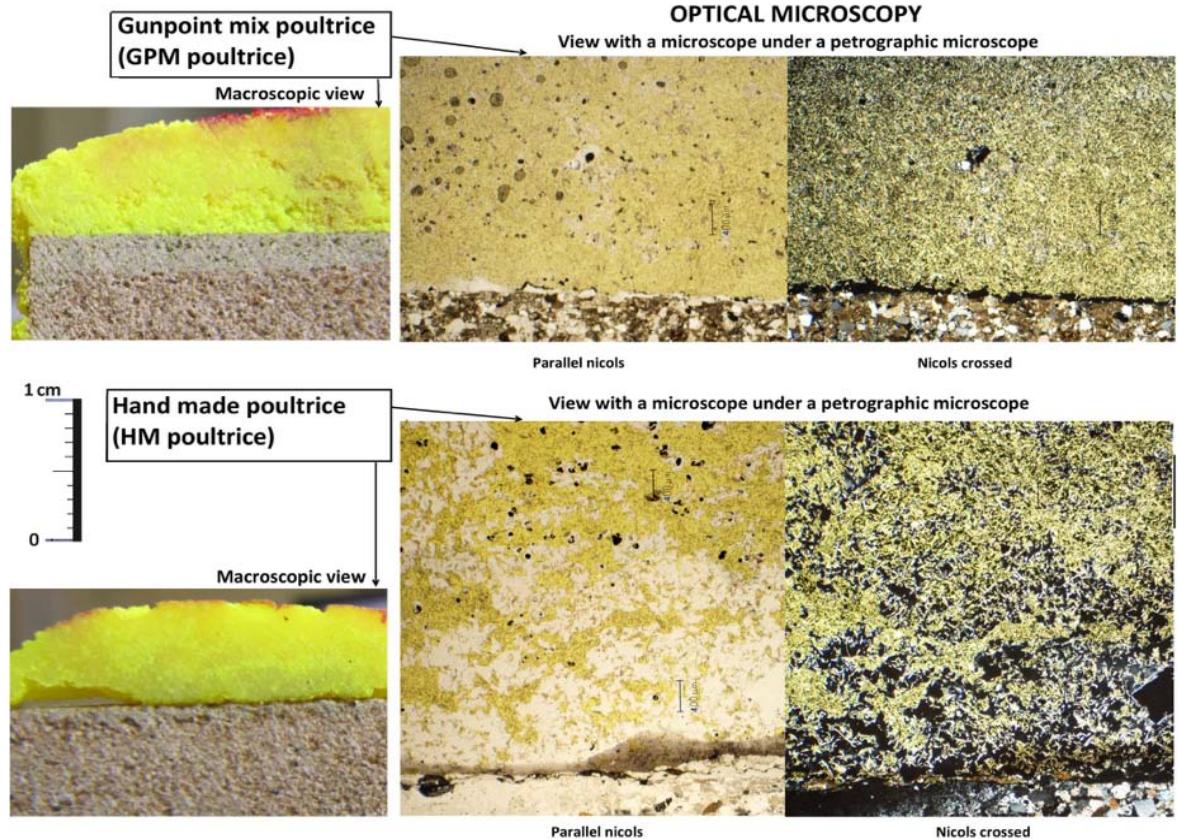
Figure 2A Figure 2B Fig. 2A: Macroscopic appearance of the two types of poultices. Fig. 2 B: Texture of the poultices in the optical microscope
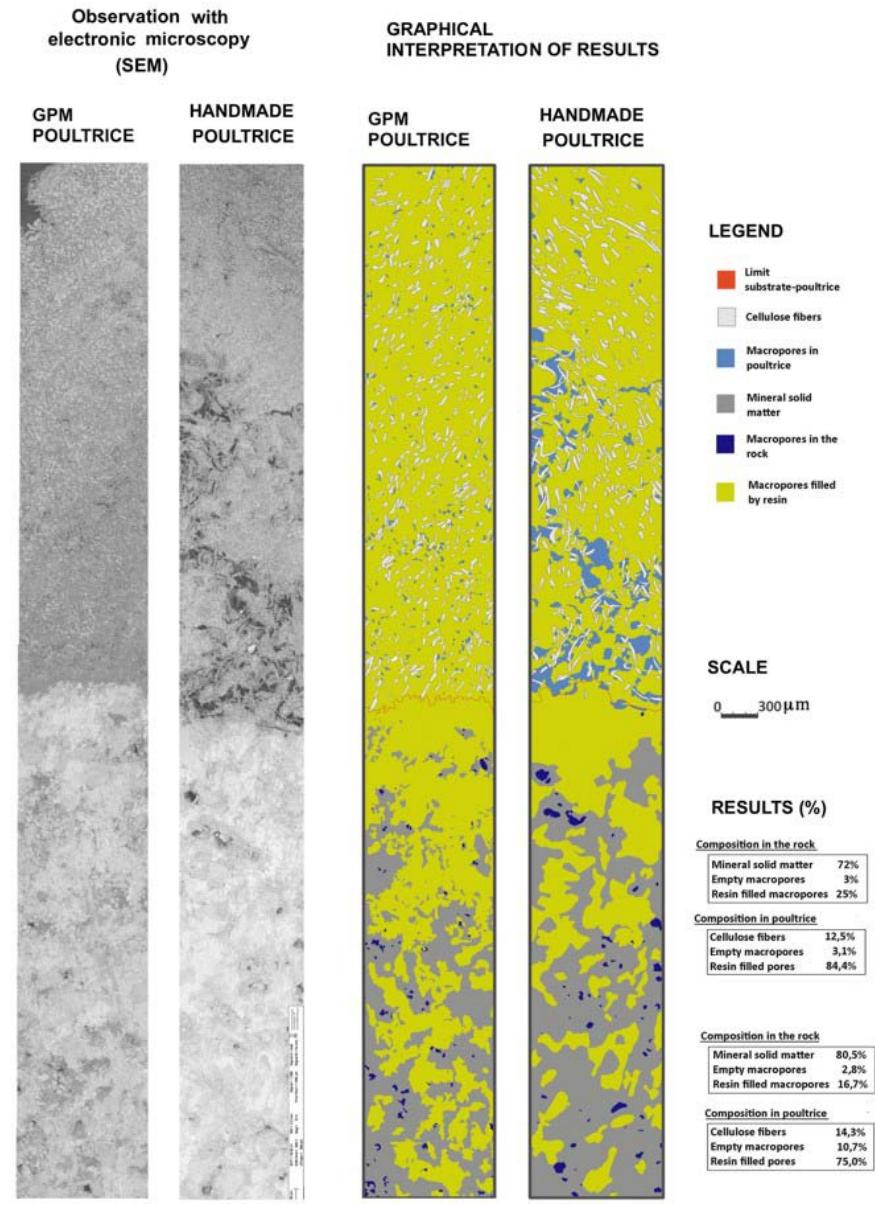 Fig. 3: Electron microscopy(SEM) and textural interpretation
### c) Efficiency of the materials (water and Arbocel®) in each type of poultice
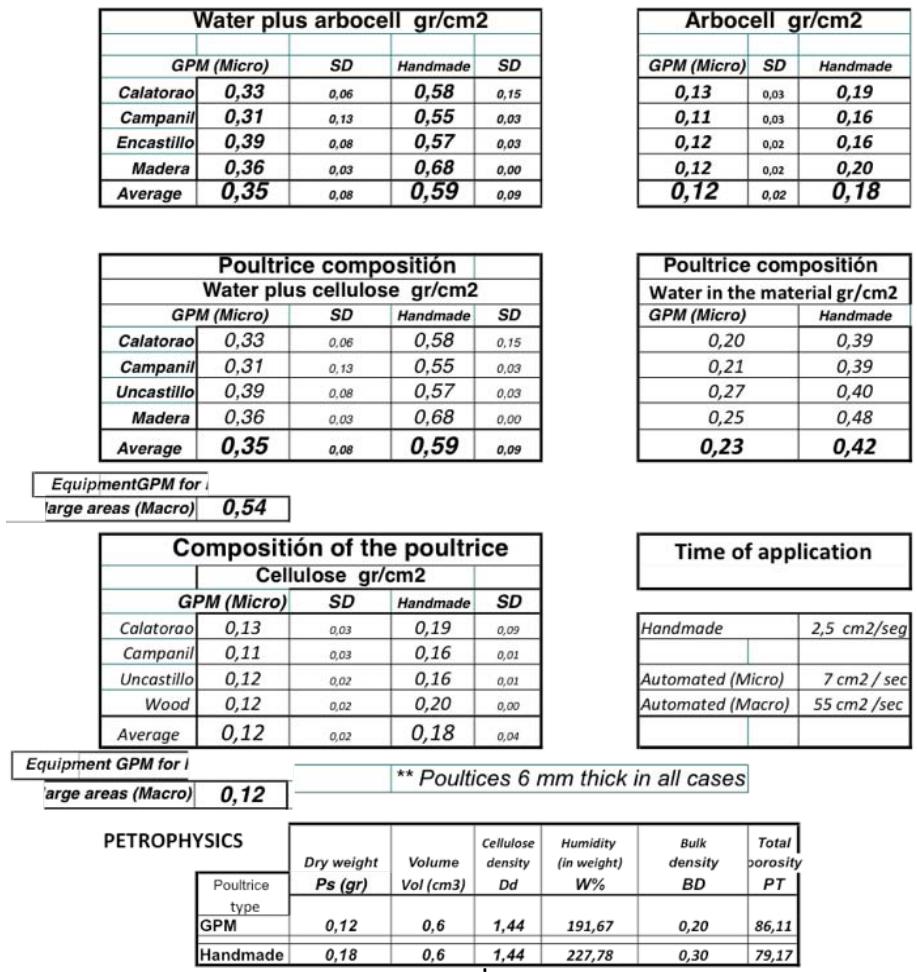
The composition of the poultices produced for this work were measured through weight control, divided in three steps: 1) before placing the poultice, 2) immediately after the placement, 3) after drying the substrate/poultice aggregate. The results of the process efficiency are presented in Table 3; these values provide a comparative analysis between both poultices. The detail of the substrate has been included because its roughness/porosity can also influence the consumption. Given the materials of the specimens were chosen with the idea of covering a wide range of roughness/porosity, the average values of all of them can be considered characteristic of the method itself.
In the "GPM" method, the same water flow (which allows regulation) was always maintained. Thus, the absolute values of water consumption could not be considered characteristic of the method. On the other hand, the measured water was the one that has penetrated into the substrate, which depended a lot on the porosity of the material as well. The measured values were greater in the handmade application since its slowness allowed a greater intrusion of the liquid.
Cellulose consumption is representative of the method to the point that the amount of Arbocel® per $\mathrm{cm}^2$ was the same (0.12 gr/cm2) in the "GPM" method (Micro -mean of the 20 test tubes) than in the poultice projected using the industrial equipment (Macro-mean of 10 applications with $3000\mathrm{m}^2$ of projection- [21]), fact that was surprising to us and that indicated that the difference between the projection equipment "Macro" and "Micro" was only its speed, of $55\mathrm{cm}^2$ / second in the "Macro" and of $7\mathrm{cm}^2$ / second in the "Micro". In any case, this result points to an extraordinary homogeneity in the functioning of the "GPM", as we have designed it, by mixing water and cellulose in the air at gunpoint.
The efficiency in handmade placement was conditioned by the initial cellulose/water mixture (38.4 gr Cell/100gr water) and by the porosity of the material since, in the case of the less porous samples, a superficial runoff/loss of water that had not been absorbed occurred, even though this factor had a human component according to the handling style and the pressure applied.
In any case, handmade poultices were a third denser in comparative terms (they are 1/3 heavier in terms of cellulose per $\mathrm{cm}^2$ ).
The process of placing "handmade" poultices was much slower than the "GPM" version, and the adhesion of the poultice was much lower, being difficult to place them on inclined surfaces and impossible in an inverted position (upside down).
[15](Lubelli et al 2010) determined an average pore size of 15 microns for BW40 Arbocel® compresses; from the SEM images (fig 3) it could be deduced that the "GPM" poultice had a slightly superior pore size but with an homogeneous distribution, whereas the "handmade" poultice would have a slightly lower pore size (the fiber is more packed and the bulk density is somewhat higher) but with a more irregular distribution and with the presence of macropores that did not exist in "GPM" poultices.
Table 3: Performance, composition and physical parameters of the poultices Water and cellulose expense in each case. The petrophysical values have been calculated on the average volume of the dry papettaand with the density value of the cellulose of 1.44
### d) Water absorption: Evaluation with the infiltrometer
The infiltrometer is a device that is used to know the infiltration capacity and water parameters in soils [16] and is very suitable in poultices for two reasons:
1) It allows to measure the infiltration when placed on the substrate that wants to be studied.
2) Poultices are similar to soils both in its physical characteristics and in the fact that they have to be
studied using a method that does not modify its original texture.
The infiltrometer allows to experimentally measure the suction coefficient of the poultice in a quick and easy way. This data is very hard to calculate by other means.
The device was placed on the poultice with a water height pressure of $2 \mathrm{~mm}$. With this pressure (which can be considered equal to atmospheric pressure), the absorption speed and the total volume of infiltrated water were measured until, besides the poultice, the rock also began to absorb water. This moment could be established very precisely; the slope of the infiltration curve varied substantially (fig.4). In each test we measured the absorption coefficient (in two modalities); first, as Cumulative Linearization (CL), that corresponded to the calculation method of the coefficient of absorption by linear regression of the first infiltration values with respect to the square root of time. The second one corresponded to the numerical optimization method of the simplified equation of [25] Haverkamp (1994). The latter, being more precise, coincided with the suction coefficient and therefore was
directly comparable with the coefficient calculated for substrates according to the RILEM method. (22)
Table 4 shows the values of the six tests carried out, in which it can be seen that "GPM" poultices have coefficients and absorption speeds of more than double that of the "handmade" ones.
The detail of the infiltration curves on the poultice/substrate pair was reproduced in one of the cases (stone from Calatorao), so that the calculation steps can be understood. In the case mentioned, the rock presented a very low suction coefficient (table 4b) and was adequate to delimit the behavior of the poultice.
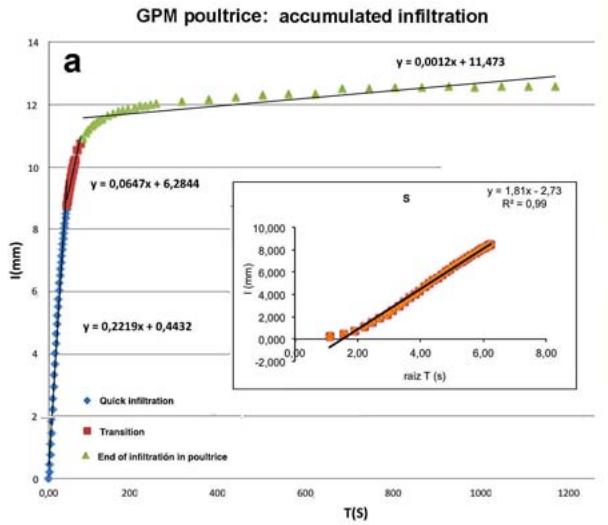
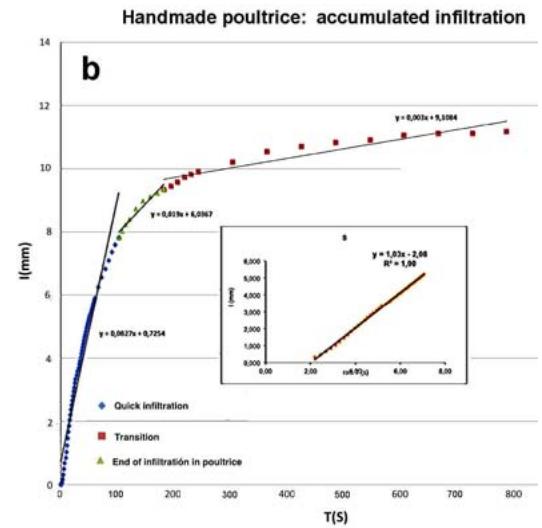 Fig. 4: Infiltration curves of the two types of paper on Calatorao St.
The reduced graph with a line is the one used to calculate the coefficient using the most characteristic section. The large graph in each case represents the behavior throughout the test time. The infiltration begins very fast, stretch in blue; Within this section you can see a faster first behavior (the water is only entering the papeta) and a slightly slower second (the water enters the papeta and also into the rock.) The green stretch corresponds to the absorption of the rock in its early stages (surface of the active but unsaturated rock.) The final red stretch corresponds to the slowest absorption of the rock when it has the entire saturated suction surface.
Infiltration on the pair "Poultice/limestone from Calatorao"
We assume that the curve represents the infiltration on the poultice, given the effect of the rock is considered negligible (it has a very low quantitative value, see coefficients of suction in Table 4b). In figures 4a and 4b we can observe the behavior of the two types of poultices.
In the curve of the "GPM" poultice (fig 4a) infiltration begins very fast (0.22 ml/s, stretch in blue); as the test tube soaks, the rhythm decreases (0.03 ml/s; stretch in red), and when apparently, the entire poultice is soaked, infiltration almost stops (0.001 ml/s, stretch in green). This stopping was not complete, although this did not imply that water infiltrated into the stone from Calatorao, as water percolated through the contact surface and the sides. The behavior was very homogeneous within each stretch.
The curve of the "handmade" poultice (fig 4b) is similar but presents curves with loose slopes (0.1 ml/s, stretch in blue 0.02 ml/s, stretch in red and 0.003 ml/s, stretch in green) and with a slightly more irregular behavior.
### e) Desorption: drying speeds
The tests were carried out in a controlled atmosphere at $50\%$ RH and $21^{\circ}\mathrm{C}$. In the cases in which the poultices were placed on a waterproof substrate (glass, see table 5), drying occurred slightly faster in "handmade" poultices for the first 8 hours. After 8-10 hours the situation was reversed and "GPM" poultices dried up faster.
In the cases in which the poultices were placed on porous substrates (table 6) the opposite happened; at the beginning, the "GPM" poultice dried up much faster but 3 hours later thesisuation was the opposite.
Regarding the physical evolution and the changes in the volume of the poultices during drying process we can affirm (see table 6 and fig 5):
1) The adhesion was very high in "GPM" poultices and notably lower in "handmade" ones.
2) The loss of volume was greater in "handmade" poultices; these were the only ones that presented superficial cracks. The lateral losses of adhesion were not very significant since they were produced by the contact with a flexible film.
<table><tr><td></td><td>Accumulated evaporation rate (0-24h)</td><td>Evaporation rate in the interval 0-1h.</td><td>Evaporation rate in the interval 1-3h.</td><td>Evaporation rate in the interval 3-6h.</td><td>Evaporation rate in the interval 6-24h.</td></tr><tr><td>Handmade (20ml)</td><td>13,54</td><td>25,45</td><td>21,82</td><td>21,42</td><td>10,65</td></tr><tr><td>GPM (20ml)</td><td>13,43</td><td>21,90</td><td>18,53</td><td>18,47</td><td>11,55</td></tr><tr><td>Handmade (10ml)</td><td>6,63</td><td>15,80</td><td>14,07</td><td>14,29</td><td>4,01</td></tr><tr><td>GPM (10ml)</td><td>6,68</td><td>14,87</td><td>13,30</td><td>12,99</td><td>4,44</td></tr><tr><td></td><td></td><td></td><td></td><td></td><td></td></tr></table>
Table 5 Evaporación rate on waterproof substrate GPM poultrytrices
<table><tr><td></td><td>Evaporation rate (0-1h)</td><td>DESVEST</td><td>Evaporation rate (0-3h)</td><td>DESVEST</td></tr><tr><td>Calatorao stone</td><td>0,47</td><td>0,13</td><td>0,18</td><td>0,05</td></tr><tr><td>Campanil stone</td><td>0,37</td><td>0,06</td><td>0,15</td><td>0,02</td></tr><tr><td>Uncastillo sandstone</td><td>0,44</td><td>0,05</td><td>0,18</td><td>0,02</td></tr><tr><td>Pinewood</td><td>0,31</td><td>0,02</td><td>0,13</td><td>0,01</td></tr><tr><td>Average</td><td>0,40</td><td></td><td>0,16</td><td></td></tr></table>
Handmade poultry
Table 6 Evaporación rate on porous substrate
<table><tr><td></td><td>Evaporation rate (0-1h)</td><td>DESVEST</td><td>Evaporation rate (0-3h)</td><td>DESVEST</td></tr><tr><td>Calatoro stone</td><td>0,39</td><td>0,07</td><td>0,42</td><td>0,08</td></tr><tr><td>Campanil stone</td><td>0,33</td><td>0,03</td><td>0,30</td><td>0,03</td></tr><tr><td>Uncastillo sandstone</td><td>0,37</td><td>0,03</td><td>0,38</td><td>0,03</td></tr><tr><td>Pinewood</td><td>0,24</td><td>0,01</td><td>0,25</td><td>0,01</td></tr><tr><td>Average</td><td>0,33</td><td></td><td>0,34</td><td></td></tr></table>
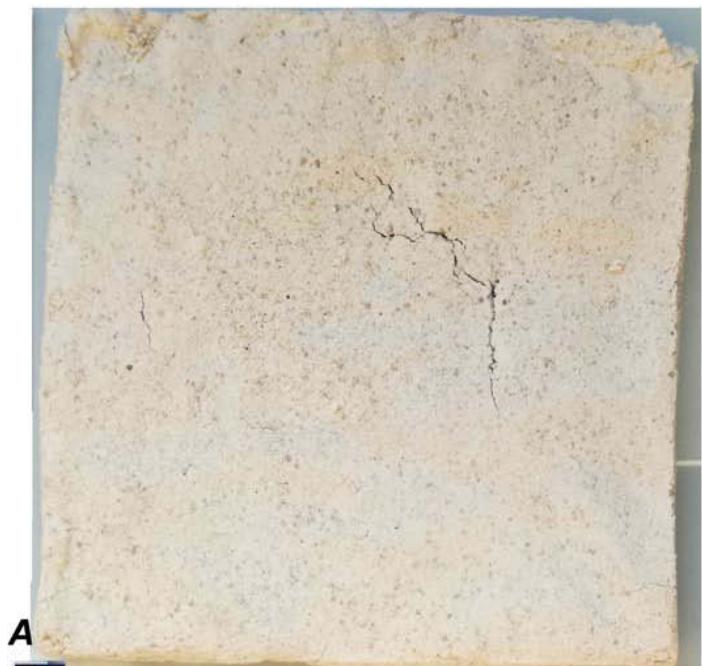
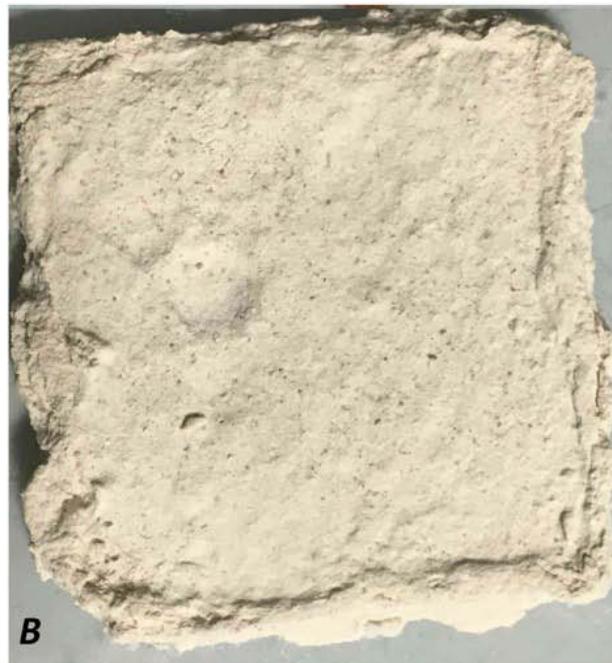
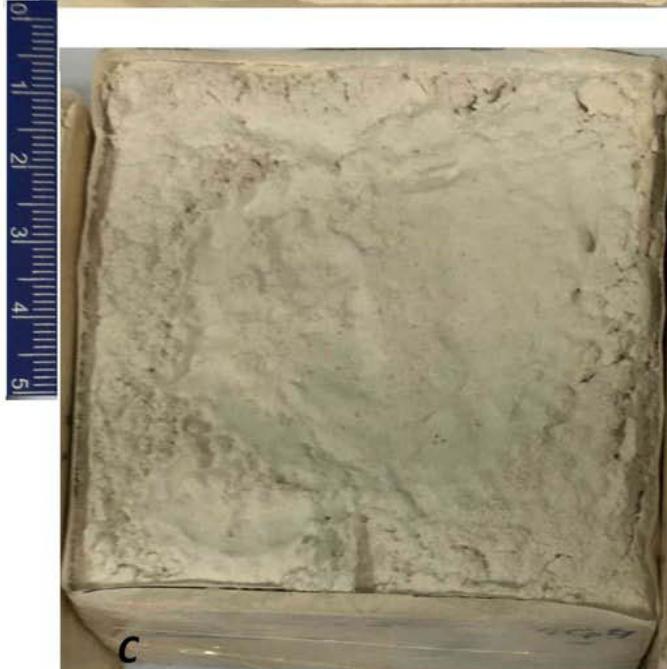
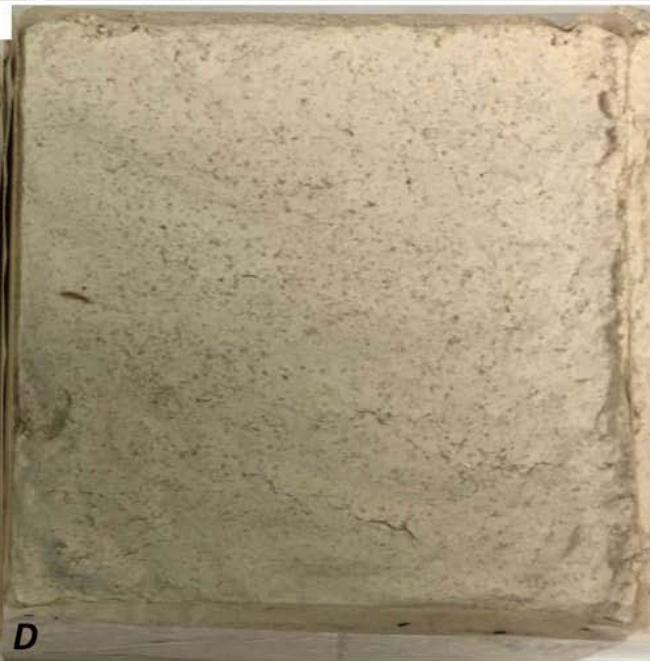 Fig. 5: Photographs of the retraction suffered by the poultices
A.-Handmade poultice on glass
C-. GPM poultice on Campanil St
### f) Penetration of the consolidants depending on the type of poultice used
The consolidants were applied by pouring $10\mathrm{g}$ of the product into each test tube and by removing the poultice 30 minutes after its application. The test tubes were weighed after two months of hardening and drying. The amount of infiltrated consolidant (without solvent) was determined in milligrams per $\mathrm{cm}^2$.
The penetration of consolidants was evaluated in terms of quantity (either total weight or percentage by weight) and quality (suction coefficient variation). See tables 8 and 9.
B. - GPM poultice on glass
D.- handmade poultice on Campanil St
The data about Campanil and Uncastillo stone's was not very significant because the standard deviations were of the same order as the value of the data. The values indicated that the penetration was greater in "GPM" samples in the case of the limestone from Calatorao, the Campanil limestone and the pine wood, while in the case of the sandstone from Uncastillo it was higher in "handmade" test tubes. In the case of the Campanil limestone, a marked absorption anisotropy was seen in the direction perpendicular to that of the stratification, especially in "GPM" poultices.
The qualitative analysis consisted in comparing the change produced in the suction of the rocks, both in water suction (capillary suction coefficient expressed in $\mathrm{g} / \mathrm{m}^2$ $\mathrm{s}^{1/2}$ ) and in the penetration height (penetration coefficient expressed in $\mathrm{cm} / \mathrm{h}^{1/2}$ ). The comparison aimed to evaluate whether the penetration was homogeneous or to what extent it formed a superficial crust. This analysis was carried out only for the rocks from Uncastillo, Campanil limestone and for the pine wood.
We must explain that both in the "handmade" and "GPM" poultices that were placed in sandstone from Uncastillo and in Campanil limestone, there were two test tubes that presented thicker pores and two that presented thinner pores.
In the sandstone from Uncastillo (handmade poultice) the fine pored sandstones gained suction coefficient when consolidated and the thick pored ones lost it. In the case of the "GPM", the same happened, but only with the fine pored sandstones, as the second ones lost suction coefficient when consolidated.
In the Campanil limestone, both in "GPM" and in "handmade" poultices, those with fine pores gained suction coefficient (although the values were close to zero) and those with thick pores lost it. The gain in fine pores limestones was greater in the "GPM" ones.
Regarding pine wood, the "GPM" test tubes lost suction coefficient and the "handmade" specimens gained it (with the exception of one test tube), although the surpassing values were very low in both cases.
In summary, the results showed significant differences depending on the pore size of the test tubes and the materials, which seemed to consolidate more homogeneously in the finest pore sizes. There were no significant differences depending on the type of poultice used. The results indicated a complex interaction between the consolidant, the poultice and the substrate.
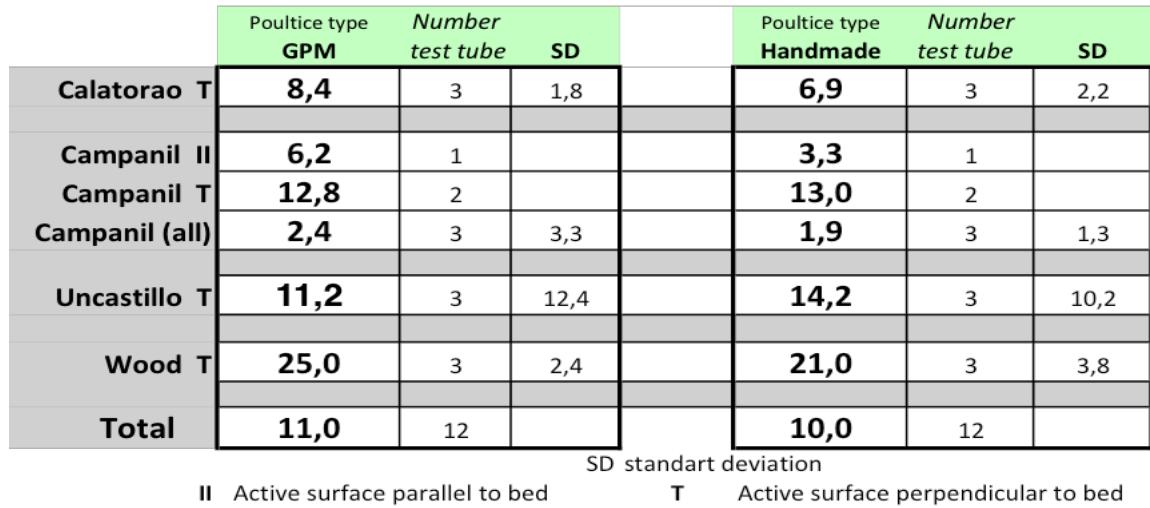
Table 8.- Penetration of consolidant in test tube (mgr/cm2)
#### UNCASTILLO STONE
GPS POULTICES
Difference: consolidated - previous state
<table><tr><td></td><td>U1**</td><td>U2**</td><td>U3</td><td>U4</td><td>Average</td></tr><tr><td>W final%</td><td>0,27</td><td>-0,58</td><td>-1,59</td><td>-1,51</td><td>-0,86</td></tr><tr><td>UNE-EN</td><td>10,72</td><td>-12,39</td><td>-36,79</td><td>-21,43</td><td>-14,98</td></tr><tr><td>Penetration</td><td>0,29</td><td>-0,33</td><td>-0,99</td><td>-0,58</td><td>-0,40</td></tr></table>
HANDMADE POULTICES
Difference: consolidated - previous state
<table><tr><td></td><td>U-5**</td><td>U-6**</td><td>U-7</td><td>U8</td><td>Average</td></tr><tr><td>W final%</td><td>0,18</td><td>0,16</td><td>-1,53</td><td>-1,20</td><td>-0,59</td></tr><tr><td>UNE-EN</td><td>7,36</td><td>6,84</td><td>-38,73</td><td>-40,54</td><td>-16,27</td></tr><tr><td>Penetration</td><td>0,20</td><td>0,18</td><td>-1,04</td><td>-1,09</td><td>-0,44</td></tr></table>
#### CAMPANIL STONE
GPS POULTICES
Difference: consolidated - previous state
<table><tr><td></td><td>CP1</td><td>CP2</td><td>CP3**</td><td>CP4*</td><td>Average</td></tr><tr><td>W final%</td><td>-2.78</td><td>-4.42</td><td>0.96</td><td>0.78</td><td>-1.36</td></tr><tr><td>UNE-EN</td><td>-12.26</td><td>-26.72</td><td>0.77</td><td>0.00</td><td>-9.55</td></tr><tr><td>Penetration</td><td>-0.33</td><td>-0.72</td><td>0.02</td><td>0.00</td><td>-0.26</td></tr></table>
HANDMADE POULTICES
Difference: consolidated - previous state
<table><tr><td></td><td>CP5</td><td>CP6</td><td>CP-7**</td><td>CP8*</td><td>Average</td></tr><tr><td>W final%</td><td>-0.74</td><td>-0.65</td><td>-0.02</td><td>0.13</td><td>-0.32</td></tr><tr><td>UNE-EN</td><td>-32.66</td><td>-13.43</td><td>0.65</td><td>-0.65</td><td>-11.52</td></tr><tr><td>Penetration</td><td>-0.88</td><td>-0.39</td><td>-0.30</td><td>-0.27</td><td>-0.46</td></tr></table>
#### PINEWOOD
GPS POULTICES
Difference: consolidated - previous state
<table><tr><td></td><td>M 1</td><td>M 2</td><td>M 3</td><td>M 4</td><td>Average</td></tr><tr><td>W final%</td><td>-0.04</td><td>0,21</td><td>-0.30</td><td>0,05</td><td>-0.02</td></tr><tr><td>UNE-EN</td><td>-1.16</td><td>-0.13</td><td>-1.42</td><td>-1.42</td><td>-1.03</td></tr></table>
HANDMADE POULTICES
Difference: consolidated - previous state
Table 9.- Variation of capillarity after consolidation
<table><tr><td></td><td>M 5</td><td>M 6</td><td>M 7</td><td>M 8</td><td>Average</td></tr><tr><td>W final%</td><td>0,34</td><td>0,75</td><td>-0,73</td><td>0,24</td><td>0,15</td></tr><tr><td>UNE-EN</td><td>0,77</td><td>1,68</td><td>-3,36</td><td>1,03</td><td>0,03</td></tr></table>
Negative balance
Positive balance
Difference (+ or -) insignificant
** Fine-grained (Uncastillo) or low-porous samples (Campanil)
The results are presented as the subtraction between the suction coefficient after consolidation minus the initial value
### g) Ease of cleaning
The colors of the rocks were compared before and after the placement of the poultice, with two cleaning phases (that have been already described in the methodology). In order to avoid the interference of the possible chromatic change produced by the consolidant, we only took into account the luminosity $(\mathsf{L}^{\star})$. In this way, we have taken advantage on the fact that this value is the most significant parameter in the difference between the color of the substrate and the poultices. The results are shown in table 10.
The pulp of paper without manipulation was slightly whiter than the poultices, and "GPM" ones were in turn whiter than the "handmade" ones. Even though, in the latter case, we checked that it depended on the surface roughness, because when an escape of liquid water had smoothed the surface of the "GPM" poultice, its values were identical to those of "handmade" poultices.
From a physical point of view, when wet, "GPM" poultice was compacted with less pressure and in greater proportion than the "handmade" one. Once the poultices were dry, this phenomenon remained, and in addition, the "GPM" was disaggregated much more easily than the "handmade" one.
In order to evaluate the adhesion of Arbocel® pulp (tablet 10) for cleaning purposes, the following values were subtracted: initial luminosity in each substrate (C1), the values after the detachment of the poultice (C2) and the values after brushing (C3).
In C2-C1 subtraction, the values that represent the best possible cleaning would be the values of zero, and the greater adhesion of the paper pulp would correspond to the positive values. Negative values are theoretically impossible.
In C3-C1subtraction the case is similar to the previous one.
In C3-C2 subtraction the best cleaning values would be the negative ones (the more negative, the cleaner it would be) and the greater adhesion of the paper would correspond to negative values close to zero. Positive values are theoretically impossible.
In all cases regarding stone substrates, the results indicated that "GPM" poultice could be cleaned much better than the "handmade" one, whereas in wood the results were the opposite, this is, in the three cases the "handmade" poultice showed better results.
<table><tr><td colspan="11">INITIAL ORIGINALS COLORS (C1)</td></tr><tr><td></td><td></td><td></td><td>L*</td><td></td><td>C</td><td></td><td>h2</td><td></td><td>a*</td><td>b*</td></tr><tr><td>Arbocell pulp</td><td></td><td></td><td>96,41</td><td></td><td>5,33</td><td></td><td>78,64</td><td></td><td>1,05</td><td>5,23</td></tr><tr><td>Handmade poultrice</td><td></td><td></td><td>80,3</td><td></td><td>6,5</td><td></td><td>81,1</td><td></td><td>1,0</td><td>84,4</td></tr><tr><td></td><td></td><td></td><td>3,3</td><td></td><td>0,2</td><td></td><td>0,9</td><td></td><td>0,1</td><td>220,5</td></tr><tr><td></td><td></td><td></td><td>4,1</td><td></td><td>2,4</td><td></td><td>1,1</td><td></td><td>9,7</td><td>261,3</td></tr><tr><td>"GPM" poultrice</td><td></td><td></td><td>84,3</td><td></td><td>6,8</td><td></td><td>81,7</td><td></td><td>1,0</td><td>6,8</td></tr><tr><td></td><td>SD</td><td></td><td>2,6</td><td></td><td>1,0</td><td></td><td>0,6</td><td></td><td>0,2</td><td>1,0</td></tr><tr><td></td><td>RSD</td><td></td><td>3,1</td><td></td><td>13,9</td><td></td><td>0,7</td><td></td><td>19,6</td><td>14,2</td></tr><tr><td colspan="2">Calatorao</td><td></td><td>52,29</td><td></td><td>0,83</td><td></td><td>79,285</td><td></td><td>0,135</td><td>0,82</td></tr><tr><td colspan="2">SD</td><td></td><td>2,15</td><td></td><td>0,34</td><td></td><td>6,77</td><td></td><td>0,04</td><td>0,35</td></tr><tr><td colspan="2">RSD</td><td></td><td>4,11%</td><td></td><td>40,89%</td><td></td><td>8,54%</td><td></td><td>26,19%</td><td>43,12%</td></tr><tr><td colspan="2">Campanil</td><td></td><td>73,23</td><td></td><td>12,765</td><td></td><td>78,68</td><td></td><td>2,505</td><td>12,51</td></tr><tr><td colspan="2">SD</td><td></td><td>1,47</td><td></td><td>2,06</td><td></td><td>1,68</td><td></td><td>0,73</td><td>1,95</td></tr><tr><td colspan="2">RSD</td><td></td><td>2,01%</td><td></td><td>16,12%</td><td></td><td>2,14%</td><td></td><td>29,07%</td><td>15,60%</td></tr><tr><td colspan="2">Alastruey</td><td></td><td>58,765</td><td></td><td>10,505</td><td></td><td>76,58</td><td></td><td>2,445</td><td>10,21</td></tr><tr><td colspan="2">SD</td><td></td><td>2,21</td><td></td><td>0,62</td><td></td><td>1,70</td><td></td><td>0,45</td><td>0,52</td></tr><tr><td colspan="2">RSD</td><td></td><td>3,77%</td><td></td><td>5,86%</td><td></td><td>2,22%</td><td></td><td>18,22%</td><td>5,12%</td></tr><tr><td colspan="2">Madera</td><td></td><td>85,15</td><td></td><td>20,785</td><td></td><td>80,63</td><td></td><td>3,38</td><td>20,51</td></tr><tr><td colspan="2">SD</td><td></td><td>0,33</td><td></td><td>0,11</td><td></td><td>0,27</td><td></td><td>0,11</td><td>0,08</td></tr><tr><td colspan="2">RSD</td><td></td><td>0,38%</td><td></td><td>0,51%</td><td></td><td>0,33%</td><td></td><td>3,35%</td><td>0,41%</td></tr></table>
Table 10: Color variations after cleaning the poultrice
<table><tr><td colspan="10">LIGHTNESS DIFFERENCES (L*) BEFORE AND AFTER CLEANING
Three measurements were taken of all the specimens (32x2)
C2 Color after the withdrawal of poutrice
C3 Color after brushing</td></tr><tr><td colspan="6">Handmade poutrice</td><td colspan="4">GPM poutrice</td></tr><tr><td rowspan="2">Type</td><td>C2-C1</td><td></td><td>C3-C1</td><td></td><td>C3-C2</td><td></td><td>C2-C1</td><td></td><td>C3-C2</td></tr><tr><td>AL*</td><td></td><td>AL*</td><td></td><td>AL*</td><td></td><td>AL*</td><td></td><td>AL*</td></tr><tr><td>Calatorao St</td><td>7,53</td><td></td><td>6,8</td><td></td><td>0,73</td><td></td><td>2,26</td><td></td><td>-0,26</td></tr><tr><td>SD</td><td></td><td></td><td></td><td></td><td></td><td></td><td></td><td></td><td></td></tr><tr><td>RSD</td><td></td><td></td><td></td><td></td><td></td><td></td><td></td><td></td><td></td></tr><tr><td>Campanil</td><td>7,33</td><td></td><td>6,87</td><td></td><td>0,46</td><td></td><td>5,07</td><td>6,72</td><td>-1,65</td></tr><tr><td>SD</td><td>1,38</td><td></td><td>2,36</td><td></td><td>1,10</td><td></td><td>3,48</td><td>5,98</td><td>2,56</td></tr><tr><td>RSD</td><td>18,88%</td><td></td><td>34,29%</td><td></td><td>241,68%</td><td></td><td>68,67%</td><td>89,02%</td><td>-154,92%</td></tr><tr><td>Alastruey</td><td>7,27</td><td></td><td>6,75</td><td></td><td>0,52</td><td></td><td>4,52</td><td>4,55</td><td>-0,03</td></tr><tr><td>SD</td><td>0,38</td><td></td><td>0,51</td><td></td><td>0,20</td><td></td><td>0,71</td><td>1,12</td><td>0,52</td></tr><tr><td>RSD</td><td>5,21%</td><td></td><td>7,50%</td><td></td><td>37,88%</td><td></td><td>15,70%</td><td>24,58%</td><td>-19,36</td></tr><tr><td>Madera</td><td>-0,06</td><td></td><td>0,10</td><td></td><td>-0,16</td><td></td><td>0,28</td><td>0,30</td><td>-0,02</td></tr><tr><td>SD</td><td>0,21</td><td></td><td>0,43</td><td></td><td>0,22</td><td></td><td>0,92</td><td>0,96</td><td>0,08</td></tr><tr><td>RSD</td><td>-372,82%</td><td></td><td>427,90%</td><td></td><td>-143,49%</td><td></td><td>329,42%</td><td>319,43%</td><td>-396,86%</td></tr><tr><td colspan="6">More cleanliness has been achieved if the values are:</td><td colspan="4"></td></tr><tr><td colspan="3">zero</td><td colspan="3">negative</td><td>zero</td><td>zero</td><td colspan="2">negative</td></tr><tr><td>Others</td><td colspan="2">Negative impossible</td><td colspan="3">Positive impossible</td><td colspan="2">Negative impossible</td><td colspan="2">Positive impossible</td></tr><tr><td>SD Standart Deviation</td><td colspan="9">RSD Coefficient of variation</td></tr></table>
## VI. DISCUSSION
A) The microscopic data are very clear in terms of the textural characterization of both poultices: In this sense, we highlight the concordance of the porosities obtained by optical methods with those obtained by petrophysical methods. Regarding the retraction differences between the two types of poultices, obviously the individual fibers have had to contract the same magnitude, but in the case of "GPM" that retraction was resolved at microscopic level and was not transmitted to nearby fibers due to lack of "contact between them". On the other hand, "handmade" poultice's greater interlacement of the nearby fibers caused the retraction (at microscopic level) to be transmitted tothe whole poultice.
B) Regarding water and cellulose consumption in the elaboration of the poultices, in the case of the "handmade", a reasonable workability was found in 2.5 grams of water per gram of cellulose and in the case of "GPM" poultices it dropped to 1,9. However, in both cases some variation was allowed, although "GPM" had a great advantage due to its higher adhesiveness (with the same or less water percentage). The working speed was clearly favorable to the "GPM" (55 cm/sec versus 7 cm/sec in the "handmade"). "GPM" poultice had the additional advantage of being able to regulate the amount of water at will during the application process.
C) Data regarding total porosity and density of the poultices, although approximate, were very relevant, because they allowed us to get an idea of the petrophysical behavior and to better explain the phenomena described in this paper. Thus, "GPM" poultice was less dense and more porous, but with a much more constant and homogeneous porous system than that of the "handmade" one. In regards to the capacity of infiltration/suction coefficient, there was no doubt of the greater capacity of "GPM" poultices, which was twice that of the "handmade" ones.
D) Regarding the penetration of the consolidants, the amount of consolidant that penetrated was slightly higher if the process was controlled by "GPM" poultice. The difference, without being very large, seemed significant since it was graded by the pore size of the substrate. The biggest difference (in favor of the "GPM") could be seen with stone from Calatorao (pore size 0.01 micron), then wood (0.2 micron) and finally Campanil limestone (pore size 1 micron). In sandstone from Uncastillo, that presented an average pore size of the order of 30 microns, more consolidant penetrated when using the "handmade" poultice; the apparent contradiction in the case of epoxy resin is not such if we consider that the difference is produced because the substrate under the "GPM" is $8\%$ more porous than the one beneath the "handmade", as it was deduced from the calculations made through digital image processing (fig 4). However, the greater homogeneity of penetration seemed to be a relevant result, provided that this variable did not depend on the total porosity. This seemed to indicate that the orientation of the fibers in the "GPM" led the intrusion of the consolidant into the smaller pores and that when the pores were greater than 15 microns, the process was no longer effective and the size of the conduit became the most relevant factor.
If we add the results in the modification of the suction coefficient to the above-mentioned data, we can observe a complex interaction between the type of consolidant, its viscosity, its contact angle with the material that has to penetrate, pore size in the substrate, orientation of the substrate (anisotropy depending on the stratification plane) and type of poultice. This situation complicates the data and its interpretation. However, taking into consideration that the modification of the suction coefficient is similar in both types of poultices and that the amount of consolidant that penetrates with the "GPM" poultice is higher, we can conclude that the homogeneity in the distribution of the product is better in the case of the "GPM" ones since a greater incorporation of product to the substrate increases the possibility of "plugging" the porous system, and this effect does not occur. The textural analysis of how the epoxy resin penetrates (fig 4) also points in this same direction.
E) Regarding original colors, the darkness of the poultice over that of the pulp of paper that had not been applied is likely due to the fact that the manipulation deforms the fibers and incorporates dirt and salts impurities. The presence of small amounts of moisture after a gentle drying would act in the same way.
F) Regarding the ease of cleaning, it must be first clarified that, in the comparison of color by subtraction between the three moments of measurement, the results that were considered "theoretically impossible" (negative values in C2-C1 and C3-C1 and positive values for C3-C2) are possible in practice for two reasons:
1) Experimental error.
2) The variability in surface color caused by not measuring exactly in the same place.
The analysis of the physical behavior of each poultice, after drying, indicated that in the "handmade" poultice the fibers were more locked together and formed a more solid, dense and coherent aggregate than in the "GPM" ones, observation that was in accordance with the manufacturing method and the petrophysical data of both (fig 3 and 4, table 3). These physical aspects were consistent with the fact that in all cases of stone substrates, cleaning was easier in the "GPM" ones; this result is consistent with the greatest incoherence of the cellulose particles in the "GPM" poultices.
Wood test tubes worked the opposite (although the difference was small), which is quite peculiar. This may be due to the fact that this substrate is composed of cellulose and the projection system favors a certain tangle between the cellulose particles of the substrate and the poultice.
## VII. CONCLUSIONS
Gun Point Mix poultice (GPM), produced automatically with compressed air, has an apparent density of $0.2\mathrm{g/cm^3}$, an application speed between 420 and $3300\mathrm{cm^2/s}$ (depending on the projection equipment) and a great homogeneity and adhesiveness (it allows to generate poultices in upside-down vaults), without this last property being translated into greater soiling. The porosity is homogeneous, of the order of $86\%$, mostly $(82.9\%)$ with a size of the same order as the fiber used $(10x200\mu\mathrm{m})$ and to a lesser extent $(3.1\%)$ with larger pores $(30-50\mu\mathrm{m})$. Its hydraulic conductivity is $1\mathrm{l/m^2 s^{-2}}$. The system allows to regulate the amount of water at operator's will and needs a gun and compressed air equipment specially designed for the projection.
The "handmade" poultice has an apparent density of $0.3\mathrm{g/cm^3}$, an application speed between 120 and $150\mathrm{cm^2/s}$ (depending on the operator skills), a low homogeneity and adhesiveness and a soiling capacity similar to that of the "GPM" poultice. The porosity, of the order of $86\%$, is bimodal; mostly $(75\%)$ with a size of the same order as the fiber used $(10x200\mu m)$ and another $(10.7\%)$ of larger size $(300-500\mu m)$ derived from the handmade kneading process. Its hydraulic conductivity is $0.6\mathrm{l/m^2s^{-2}}$. The system allows to regulate the amount of water at operator's will, whose skills can partially modify the characteristics that have been described.
During drying, in the first phase (dragging by suction of liquid water to the surface) "handmade" poultices dry faster, and in the second phase (water vapor diffusion) the "GPM" ones are more efficient.
The "handmade" poultice allows the products to more efficiently infiltrate in substrates with an average pore size greater than $15\mu \mathrm{m}$, while the "GPM" is more efficient in rocks with smaller poresizes.
When drying, the "GPM" is less coherent and more prone to being sprayed than the manual.
The ease of cleaning is good in all cases, but in stone substrates the "GPM" is significantly better. In the case of wood, the opposite happens, "handmade" poultice is slightly better.
### ACKNOWLEDGMENTS
The evaluation of the poultices has not been possible without the creation of the projection machines. A first thank you to those who made possible the creation of the prototypes and more specifically to Manuel Blanco and Manel Iglesias.
Generating HTML Viewer...
References
24 Cites in Article
C Isaksson (2017). Solvent gel versus solvent poultice: evaluating two techniques for the removal of pressure-sensitive tape stains from paper in Gels.
M Matteini,A Moles (2007). La chimica nel restauro. I materiali dell'arte pittorica.
Michael Stahr (2016). Gewinnung - Abbau - Bearbeitung.
Ipce (2013). Proyecto COREMANS "Criterios de intervención en materiales pétreos/Coremans Project "Criteria forworking in stone materials.
Javier Ortega (2015). Vademécum del conservador.
C Naud,M Martelli-Castaldi (1990). Utilisatión des absorbants por le nettoyage des fresques 9th Trienial Meeting.
Redman Ch (1999). Cellulose sorbents: an evaluation of their working properties for use in wall painting conservation The Conservator.
J Gisbert,B Franco,I Mateos,Navarro P Congreso,Geiic (2002). Product deterioration eliminated.
V Verges-Belmin,H Siedel (2005). Desalination of Masonries and Monumental Sculptures by Poulticing: A Review / Entsalzen von Mauerwerk und Steinfiguren mit Hilfe von Kompressen: Ein Überblick.
A Sawdy,A Heritage,Pel L (2008). A review of salt transport in porous media, assessment methods and salt reduction treatements Salt weathering on Buildings and Stone Sculptures.
E Bourguignon,F Bertrand,A Bourges,P Coussot,N Shahidzadeh-Bonn (2008). Poultice characterization and MRI study of desalation of model stones.
E Bourguignon (2009). Dessalement de matériaux poreux modèles par la méthode des compresses Tesis Doctoral Ecole Nationale des Ponts et Chaussées París 269.
Ann Bourgès,Véronique Vergès-Belmin (2010). Application of fresh mortar tests to poultices used for the desalination of historical masonry.
Barbara Lubelli,Rob Van Hees (2009). Desalination of masonry structures: Fine tuning of pore size distribution of poultices to substrate properties.
Renduo Zhang (1997). Determination of Soil Sorptivity and Hydraulic Conductivity from the Disk Infiltrometer.
Véronique Vergès-Belmin,Alison Heritage,Ann Bourgès (2011). Powdered Cellulose Poultices in Stone and Wall Painting Conservation - Myths and Realities.
Vasco Fassina,Monica Favaro,Andrea Naccari,Marta Pigo (1998). Evaluation of compatibility and durability of a hydraulic lime-based plaster applied on brick wall masonry of historical buildings affected by rising damp phenomena.
H Ettl,M Krus (2003). Salzreduzierung am Schloss Frankenberg: Kompressen im Test, begleitende rechnerische Untersuchungen.
M Auras (2008). Poultices and mortars for salt contaminated masonry and stone objects SWBSS.
J Gisbert,M Blanco,Jd (2011). Equipo electromecánico para la aplicación de mezclas de productos sólidos y líquidos para la limpieza y rehabilitación de superficies y procedimientos de aplicación de la mezcla.
(1980). Federación de Rusia - Medidas que afectan a la importación de equipo ferroviario y sus partes.
Oscar Buj,Josep Gisbert (2010). Influence of pore morphology on the durability of sedimentary building stones from Aragon (Spain) subjected to standard salt decay tests.
R Dunham (1962). Classification of carbonate rocks according to depositional texture.
R Haverkamp,P Ross,K Smettem,J Parlange (1994). Three‐dimensional analysis of infiltration from the disc infiltrometer: 2. Physically based infiltration equation.
Explore published articles in an immersive Augmented Reality environment. Our platform converts research papers into interactive 3D books, allowing readers to view and interact with content using AR and VR compatible devices.
Your published article is automatically converted into a realistic 3D book. Flip through pages and read research papers in a more engaging and interactive format.
Our website is actively being updated, and changes may occur frequently. Please clear your browser cache if needed. For feedback or error reporting, please email [email protected]
Thank you for connecting with us. We will respond to you shortly.