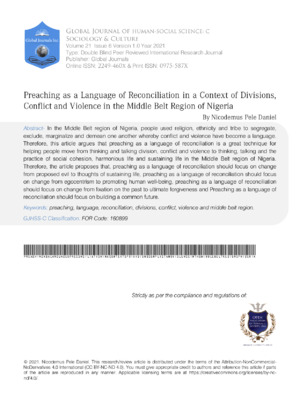
Preaching as a Language of Reconciliation in a Context of Divisions, Conflict and Violence in the Middle Belt Region of Nigeria

Article ID

6604K

Efforts to address conflict and promote peace in Nigeria's Middle Belt through dialogue and community engagement.

Preaching as a Language of Reconciliation in a Context of Divisions, Conflict and Violence in the Middle Belt Region of Nigeria

Nicodemus Pele Daniel
DOI

Abstract

In the Middle Belt region of Nigeria, people used religion, ethnicity and tribe to segregate, exclude, marginalize and demean one another whereby conflict and violence have become a language. Therefore, this article argues that preaching as a language of reconciliation is a great technique for helping people move from thinking and talking division, conflict and violence to thinking, talking and the practice of social cohesion, harmonious life and sustaining life in the Middle Belt region of Nigeria. Therefore, the article proposes that, preaching as a language of reconciliation should focus on change from proposed evil to thoughts of sustaining life, preaching as a language of reconciliation should focus on change from egocentrism to promoting human well-being, preaching as a language of reconciliation should focus on change from fixation on the past to ultimate forgiveness and Preaching as a language of reconciliation should focus on building a common future.

Preaching as a Language of Reconciliation in a Context of Divisions, Conflict and Violence in the Middle Belt Region of Nigeria

In the Middle Belt region of Nigeria, people used religion, ethnicity and tribe to segregate, exclude, marginalize and demean one another whereby conflict and violence have become a language. Therefore, this article argues that preaching as a language of reconciliation is a great technique for helping people move from thinking and talking division, conflict and violence to thinking, talking and the practice of social cohesion, harmonious life and sustaining life in the Middle Belt region of Nigeria. Therefore, the article proposes that, preaching as a language of reconciliation should focus on change from proposed evil to thoughts of sustaining life, preaching as a language of reconciliation should focus on change from egocentrism to promoting human well-being, preaching as a language of reconciliation should focus on change from fixation on the past to ultimate forgiveness and Preaching as a language of reconciliation should focus on building a common future.

Nicodemus Pele Daniel

No Figures found in article.

Nicodemus Daniel. 2021. “. Global Journal of Human-Social Science – C: Sociology & Culture GJHSS-C Volume 21 (GJHSS Volume 21 Issue C6): .

Download Citation

Journal Specifications

Crossref Journal DOI 10.17406/GJHSS

Print ISSN 0975-587X

e-ISSN 2249-460X

Issue Cover
GJHSS Volume 21 Issue C6
Pg. 57- 66
Classification
GJHSS-C Classification: FOR Code: 160899
Keywords
Article Matrices
Total Views: 1729
Total Downloads: 860
2026 Trends
Research Identity (RIN)
Related Research
Our website is actively being updated, and changes may occur frequently. Please clear your browser cache if needed. For feedback or error reporting, please email [email protected]

Request Access

Please fill out the form below to request access to this research paper. Your request will be reviewed by the editorial or author team.
X

Quote and Order Details

Contact Person

Invoice Address

Notes or Comments

This is the heading

Lorem ipsum dolor sit amet, consectetur adipiscing elit. Ut elit tellus, luctus nec ullamcorper mattis, pulvinar dapibus leo.

High-quality academic research articles on global topics and journals.

Preaching as a Language of Reconciliation in a Context of Divisions, Conflict and Violence in the Middle Belt Region of Nigeria

Nicodemus Pele Daniel

Research Journals