

Neural Networks and Rules-based Systems used to Find Rational and Scientific Correlations between being Here and Now with Afterlife Conditions
Neural Networks and Rules-based Systems used to Find Rational and

To: Author
Article Fingerprint
ReserarchID
6GJ4W
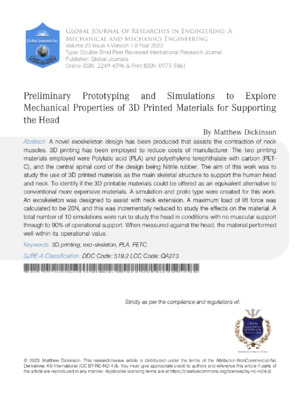
A novel exoskeleton design has been produced that assists the contraction of neck muscles. 3D printing has been employed to reduce costs of manufacturer. The two printing materials employed were Polylatic acid (PLA) and polyethylene terephthalate with carbon (PET-C), and the central spinal cord of the design being Nitrile rubber. The aim of this work was to study the use of 3D printed materials as the main skeletal structure to support the human head and neck. To identify if the 3D printable materials could be offered as an equivalent alternative to conventional more expensive materials. A simulation and proto type were created for this work. An exoskeleton was designed to assist with neck extension. A maximum load of lift force was calculated to be 20N, and this was incrementally reduced to study the effects on the material. A total number of 10 simulations were run to study the head in conditions with no muscular support through to 90% of operational support. When measured against the head, the material performed well within its operational value.
Matthew Dickinson. 2026. \u201cPreliminary Prototyping and Simulations to Explore Mechanical Properties of 3D Printed Materials for Supporting the Human Head\u201d. Global Journal of Research in Engineering - A : Mechanical & Mechanics GJRE-A Volume 23 (GJRE Volume 23 Issue A4): .
Crossref Journal DOI 10.17406/gjre
Print ISSN 0975-5861
e-ISSN 2249-4596
The methods for personal identification and authentication are no exception.
Total Score: 131
Country: United Kingdom
Subject: Global Journal of Research in Engineering - A : Mechanical & Mechanics
Authors: Matthew Dickinson (PhD/Dr. count: 0)
View Count (all-time): 218
Total Views (Real + Logic): 1024
Total Downloads (simulated): 14
Publish Date: 2026 01, Fri
Monthly Totals (Real + Logic):
Neural Networks and Rules-based Systems used to Find Rational and
A Comparative Study of the Effeect of Promotion on Employee
The Problem Managing Bicycling Mobility in Latin American Cities: Ciclovias
Impact of Capillarity-Induced Rising Damp on the Energy Performance of
A novel exoskeleton design has been produced that assists the contraction of neck muscles. 3D printing has been employed to reduce costs of manufacturer. The two printing materials employed were Polylatic acid (PLA) and polyethylene terephthalate with carbon (PET-C), and the central spinal cord of the design being Nitrile rubber. The aim of this work was to study the use of 3D printed materials as the main skeletal structure to support the human head and neck. To identify if the 3D printable materials could be offered as an equivalent alternative to conventional more expensive materials. A simulation and proto type were created for this work. An exoskeleton was designed to assist with neck extension. A maximum load of lift force was calculated to be 20N, and this was incrementally reduced to study the effects on the material. A total number of 10 simulations were run to study the head in conditions with no muscular support through to 90% of operational support. When measured against the head, the material performed well within its operational value.
We are currently updating this article page for a better experience.

Lorem ipsum dolor sit amet, consectetur adipiscing elit. Ut elit tellus, luctus nec ullamcorper mattis, pulvinar dapibus leo.






























































