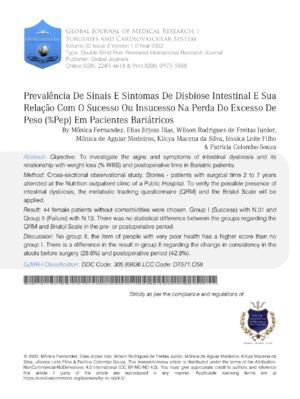
Prevalência De Sinais E Sintomas De Disbiose Intestinal E Sua Relação Com O Sucesso Ou Insucesso Na Perda Do Excesso De Peso (%Pep) Em Pacientes Bariátricos

Article ID

6V5FM

Alt: Study on symptoms and diagnosis of irritable bowel syndrome, highlighting prevalence and risk factors.

Prevalência De Sinais E Sintomas De Disbiose Intestinal E Sua Relação Com O Sucesso Ou Insucesso Na Perda Do Excesso De Peso (%Pep) Em Pacientes Bariátricos

Mônica Fernandez
Mônica Fernandez
Elias Jirjoss Ilias
Elias Jirjoss Ilias
Wilson Rodrigues De Freitas Junior
Mônica De Aguiar
Mônica De Aguiar
Medeiros
Medeiros
Klícya Macena Da Silva
Jéssica Leite Filho
Jéssica Leite Filho
Patrícia Colombo-Souza
DOI

Abstract

To investigate the signs and symptoms of intestinal dysbiosis and its relationship with weight loss (% WBS) and postoperative time in Bariatric patients. METHOD: Cross-sectional observational study. Stories – patients with surgical time 2 to 7 years attended at the Nutrition outpatient clinic of a Public Hospital. To verify the possible presence of intestinal dysbiosis, the metabolic tracking questionnaire (QRM) and the Bristol Scale will be applied. RESULT: 44 female patients without comorbidities were chosen. Group I (Success) with N.31 and Group II (Failure) with N.13. There was no statistical difference between the groups regarding the QRM and Bristol Scale in the pre- or postoperative period.

Prevalência De Sinais E Sintomas De Disbiose Intestinal E Sua Relação Com O Sucesso Ou Insucesso Na Perda Do Excesso De Peso (%Pep) Em Pacientes Bariátricos

To investigate the signs and symptoms of intestinal dysbiosis and its relationship with weight loss (% WBS) and postoperative time in Bariatric patients. METHOD: Cross-sectional observational study. Stories – patients with surgical time 2 to 7 years attended at the Nutrition outpatient clinic of a Public Hospital. To verify the possible presence of intestinal dysbiosis, the metabolic tracking questionnaire (QRM) and the Bristol Scale will be applied. RESULT: 44 female patients without comorbidities were chosen. Group I (Success) with N.31 and Group II (Failure) with N.13. There was no statistical difference between the groups regarding the QRM and Bristol Scale in the pre- or postoperative period.

Mônica Fernandez
Mônica Fernandez
Elias Jirjoss Ilias
Elias Jirjoss Ilias
Wilson Rodrigues De Freitas Junior
Mônica De Aguiar
Mônica De Aguiar
Medeiros
Medeiros
Klícya Macena Da Silva
Jéssica Leite Filho
Jéssica Leite Filho
Patrícia Colombo-Souza

No Figures found in article.

Mônica Fernandez. 2026. “. Unknown Journal GJMR-I Volume 22 (GJMR Volume 22 Issue I2): .

Download Citation

Journal Specifications
Classification
GJMR-I Classification: DDC Code: 305.89636 LCC Code: DT571.O58
Keywords
Article Matrices
Total Views: 1434
Total Downloads: 30
2026 Trends
Research Identity (RIN)
Related Research
Our website is actively being updated, and changes may occur frequently. Please clear your browser cache if needed. For feedback or error reporting, please email [email protected]

Request Access

Please fill out the form below to request access to this research paper. Your request will be reviewed by the editorial or author team.
X

Quote and Order Details

Contact Person

Invoice Address

Notes or Comments

This is the heading

Lorem ipsum dolor sit amet, consectetur adipiscing elit. Ut elit tellus, luctus nec ullamcorper mattis, pulvinar dapibus leo.


High-quality academic research articles on global topics and journals.

Prevalência De Sinais E Sintomas De Disbiose Intestinal E Sua Relação Com O Sucesso Ou Insucesso Na Perda Do Excesso De Peso (%Pep) Em Pacientes Bariátricos

Mônica Fernandez
Mônica Fernandez
Elias Jirjoss Ilias
Elias Jirjoss Ilias
Wilson Rodrigues De Freitas Junior
Mônica De Aguiar
Mônica De Aguiar
Medeiros
Medeiros
Klícya Macena Da Silva
Jéssica Leite Filho
Jéssica Leite Filho
Patrícia Colombo-Souza

Research Journals