I. INTRODUCTION
Climate change and its impacts on human society and ecosystems have received considerable attention from scientists, the public and governments around the world (Milly et al., 2008). The necessity for a better understanding of the consequences of climate change on water resources has been the greatest challenge in water planning and management, especially in arid and semi-arid regions, dependent on climate variability, mainly rainfall distribution (Zhaoet al., 2013).
Although climate changes occur on a global scale its impacts often vary from region to region (Trajkovic; Kolakovic, 2009). Therefore, the analysis of statistical variations in the meteorological variables of rainfall, as well as of temperature, represent important tasks in detection of climate changes on regional scale (Gocic and Trajkovic, 2013). In this perspective the semiarid region of Brazil has the variability as feature of your rainfall pattern, with intense rains concentrated in short periods of time (12 mm min ), in addition to a large variation of rainfall recurrence, irregular spatial and temporal occurrence of their rains (Cantalice et al., 2013).
Rainfall variability is an important feature of semiarid climates, and climate change is likely to increase this variability in many of these regions around the world (Batisaniand Yarnal, 2010). In this sense, Ramos and Martinez-Casasnovas (2006) add that semiarid climates exhibit complex patterns of spatial and seasonal variability of rainfall, accentuated by the unpredictability of rainfall year by year, within the year and even during a single rainfall.
The analysis of frequency distribution of rainfall provides subsidies for water planning, mainly in determining critical periods prevailing in a certain region, be them drought events, as well as floods, the knowledge of rainfall distribution behavior provides us with information that aims to reduce the consequences caused by rainfall variability (Silva et al., 2013).
In several future scenarios of climate change, mainly due to the increase in greenhouse gases concentrations in the atmosphere, it's often assumed that only the average can change, with the standard deviation remaining unchanged (Ben-Gai et al., 1998). However been demonstrated by Mearns et al. (1984), Katz (1991), and Katz and Brown (1992), that the relative frequency of extreme events depends on changes in standard deviation and not just of the average. Katz (1991) assumes that a change in a climate variable that has a probability distribution will also result in a change in the form of that distribution.
The idea of using probability distributions as a statistical paradigm in climate change studies was previously suggested by Katz (1991) that emphasizes; consequently, a climate change may involve a combination of two statistical results: a change of extreme event location combined with a change in the scale of the distribution function.
In this sense, said Naghettini and Portela (2012), that although the great difference between cities in relation to a better adjustment of probability distribution in the monthly and annual rainfall data, all the models found they're part the set of probabilistic models for continuous random variables, with probability density functions and probability distribution, defined by parameters, these being commonly applied to hydrological variables.
According to Mamoon and Rahman (2017), many studies have been developed involving probability distribution adjustments or probability estimation, using the Probability Distribution Functions in climatic variables analysis, and is emphasized that the benefits in planning activities that minimize climatic risks. Therefore, Sharma and Singh (2010) said that the selection of a probability distribution that gives the best adjustment to rainfall data is an important research topic in the field of statistical hydrology. The best use of water resources from rainfall requires adequate knowledge of the behavior of the rainfall regime, mainly in relation to the probability of occurrence of rainfall, as well as the use of Probability Distributions Functions in water planning (Catalunha et al., 2002; Silva et al., 2013).
However, Khudri and Sadia (2013), warns that the distribution adjustment is a procedure of selecting a statistical distribution that best suits a set of data generated by some random processes, and the distribution of probability is an important instrument to deal with uncertainty; however, the wrong selection of the statistical distribution results in a wrong planning.
Thus, the objective of this research was to select the statistical distribution that can better adjust to rainfall data and express the rains data distribution pattern of the Brazilian semiarid cities under climatic change risk.
II. MATERIALS AND METHODS
a) Study area
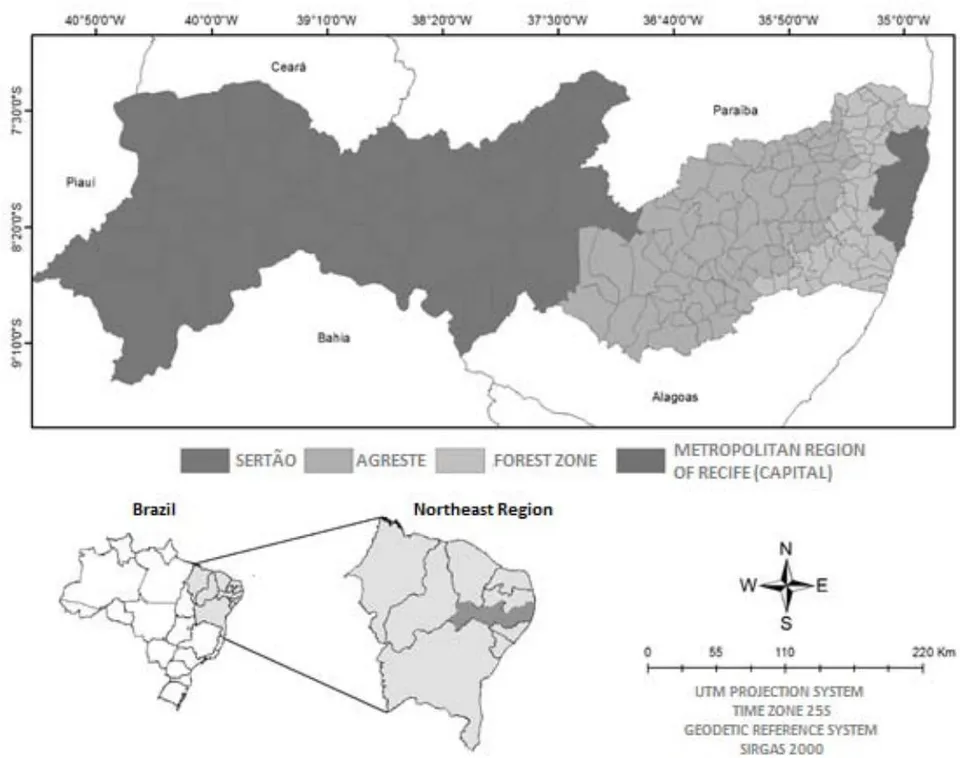
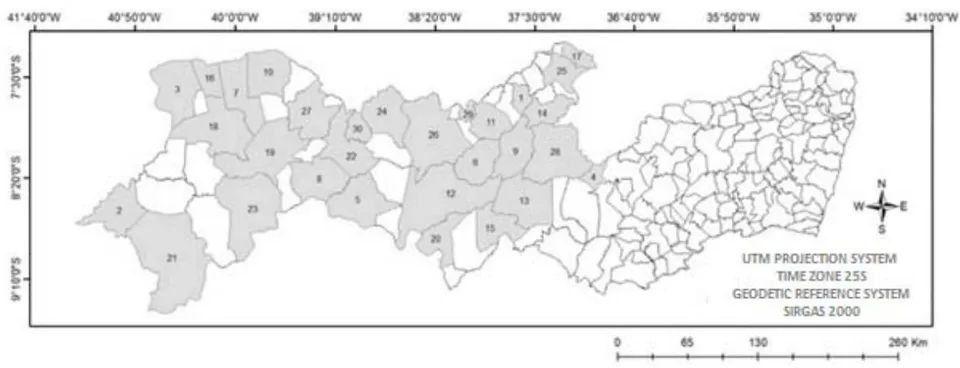
The thirty cities this study were selected of Brazilian Pernambuco State that are inserted in the Brazilian semiarid, in the Northeast of Brazil (Figure 1 and 2), which is characterized by an irregular (space/time) rainfall regime, low rainfall index, with average annual rainfall of or less, average annual temperatures ranging from 23 to , average insolation of year , and the predominant climate of the semiarid are of the Pernambuco State is classified as being of the hot dry type or BSh of Köppen (Alvares, 2014).
b) Rainfall time series
The time series rainfall data used are part of the SUDENE (1990) database, Water and Climate Pernambuco Agency (APAC) database; National Water Agency (ANA); Agronomic Institute of Pernambuco (IPA); National Department of Works Against Drought (DNOCS); Company of Technical Assistance and Rural Extension of the State of Pernambuco (EMATER-PE); Mineral Resources Research Company (CPRM) and
San Francisco Hydroelectric Company (CHESF), compiled and made available from the Hidroweb of the National Water Agency (ANA) website.
The rainfall time series analyzed had different periods, where the selection criterion was a minimum data record of 30 years, as shown in table 1, which is the standard for the statistical description in terms of average and variability of the climatic elements, as recommended by the World Meteorological Organization (WMO), specialized agency of the United Nations for meteorology.
c) Distribution Adjustment
i. Kolmogorov-Smirnov test
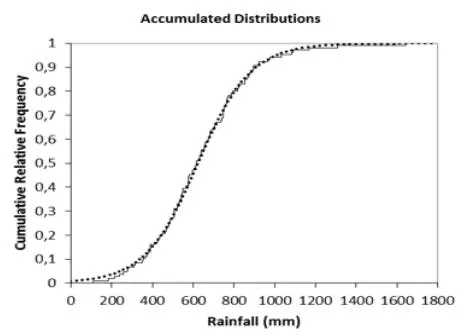
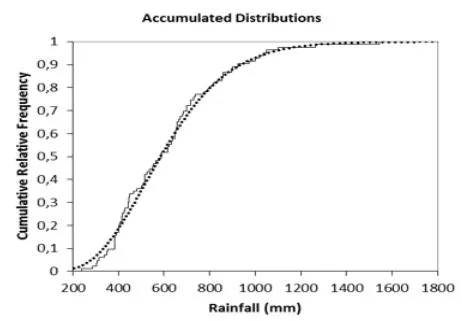
The Kolmogorov-Smirnov test, was applied to verify the adherence or distribution adjustment, to the rainfall data of the cities under climatic change risk, at the 5% significance level, in order to determine which probability distribution model best adhered to the distribution of the dataset of each rainfall time series. The Kolmogorov-Smirnov test compares an empirical distribution function with an observed distribution function, and the test is based on the empirical cumulative distribution function (CDF), which is given by:
The statistic of the Kolmogorov-Smirnov test (D) is given by the largest vertical difference between the functions of cumulative distribution theoretical and empirical:
The adjustment adherence test essentially evaluates the compatibility of random samples of the assumed theoretical probability distribution, when the null hypothesis - H0: data of the variable in question follows a given distribution, while the alternative hypothesis - H1: data of the variable in question don't follow any known distribution, or the assumed distribution (when the intention is to evaluate the adjustment or not to a predetermined distribution). In the application of the adherence test or distribution adjustment, we can accept the null hypothesis H0 if the observed test statistic (p-value) exceeds the critical value of the stipulated level of significance.
III. RESULTS AND DISCUSSION
a) Rainfall regime from some Brazilian semiarid cities under climatic change risk
The table 4 show the monthly and annual average rainfall to time series of the 30 selected cities. The monthly rains were concentrated within 3 to 5 months of year, sometimes beginning in December, but mainly the monthly rains had occurred between January and April, and occurring weak rains in May.
The Arcoverde and Triunfo cities showed a monthly rainfall quite different due to the rains both are impacted by orography, Arcoverde and Triunfo has respectively, altitude of 663m and 1010m, as well this cities are on a climatic transition zone that coincides with boundaries between watersheds. The drought period occurs between June and December, however, nine cities had showed monthly rainfall less than 30 mm in May.
Also was observed annual rainfall average of 845.8 mm in Ipubi city to 55 years of records, and 400.2 mm in 82 years records in Petrolandia City, showing high space and temporal variability, even these cities are 372 km from each other. Rocha (2009) and Moura et al (2009) had reported an annual rainfall average among 200 and 800 mm to all Brazilian semiarid. In addition another factor that we must take into account is the time series size can influences in these rainfall average values.
The inter-annual or seasonal variability characteristic of precipitation in the Northeastern semi-arid region is associated with variations of the Sea Surface Temperature patterns over the tropical oceans, affecting the position and intensity of the Intertropical Convergence Zone on the Atlantic Ocean, which contributes to the occurrence or not of rainfall in the region (Hastenrath, 1984; Moura and Shukla, 1981), thus, the occurrence of low total annual rainfall values during the rainy season (December-May) is closely related to interannual variability in rainfall records.
In specific studies on climate in the northeastern semi-arid developed by NAE (2005), Kayano and Andreoli (2009), Marengo et al. (2011) discussed important aspects of the water regime and the vulnerability of this region to extremes of climatic variability, where the authors reiterate that the occurrence of periods like a "small summers" in the rainy season, that depending on intensity and duration, can cause serious damage to agriculture local.
The time series records confirmed this interannual variability of the rainfall; in addition, a high intraseasonal variability in the rainfall regime can be observed through the standard deviation ( ) in the table 2, where were observed values higher than the time series average for some months, whether in rainy season or the dry season. According to Kayano and Andreoli (2009), the Brazilian semiarid is the one with the highest intra-seasonal variability in South America.
b) Distribution of Probability of monthly and annual rainfall time series
The table 3 show the best Probability distribution functions best adjusted to the monthly and annual rainfall time series of the analyzed cities. Observing the results, there was a predominance of a better fit for the Weibull distribution (type 3) in the rainy season (December - May), rarely the same distribution was also found in some cities during the dry season in the region, however, in most cases during the dry season the data didn't adjusted for any of the Probability distribution functions tested.
The difficult to adjust Probability distribution functions in dry seasons from arid and semiarid environments, according to Haddad and Rahman (2011) said, that the selection of the best distribution adjustment is not an easy task as there are many possible distributions that could be used. In addition, there are many estimation methods of available parameter that could be applied to the selected probability distribution.
Still in the Brazilian semiarid, Silva et al. (2013) analyzing the probability distribution in rainfall time series of 76 years (1913 - 1989) had observed a great monthly and annual diversification of functions that had adjusted to the rainfall data. There was to Ceara State a predominance of adjust to the Gumbel distribution in to the Cities in April and in January, and also, the Weibull distribution was well adjusted in of the stations for February and of the stations in May. The Weibull Probability distribution functions was the unique that showed good adherence in all the months of the rainy period of that region (January - May). This findings are quite different of the results to present study of the Pernambuco State.
From results is possible conclude and agree to Cataluñaet al. (2002) and Silva et al. (2013), that the use of probability distributions functions is directly related to the nature of the data to which the function relates, that is, some have good estimation capacity for a small number of data, while others need a larger time series.
In a study developed in Qatar, Mamoon and Rahman (2017) selected best adjustment of probability distributions for historical rainfall series data ranging from 24 to 49 years in 29 climatic stations, with an average annual rainfall of 77.9 mm, with an average number of rainy days of only 13 days, corresponding to the typical interval for the arid region (between 10 and 50 rainy days), and like reported by Noy-Meir (1973), 14 different types of probability distributions were tested under three adjustment and adherence tests: Kolmogorov-Smirnov, Anderson-Darling and Chi-square. The authors verified that there is no a single distribution that to adjust the annual rainfall data, but the GEV (Generalized Extreme Values) distribution obtained the best performance among the other distributions in the adjustment for that country, with a 72% of observations.
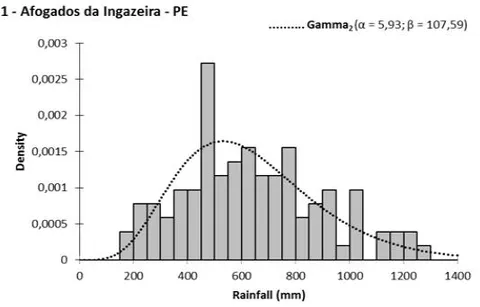
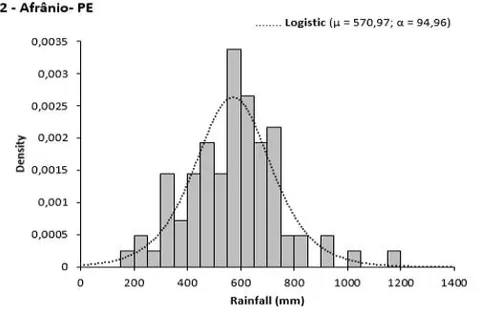
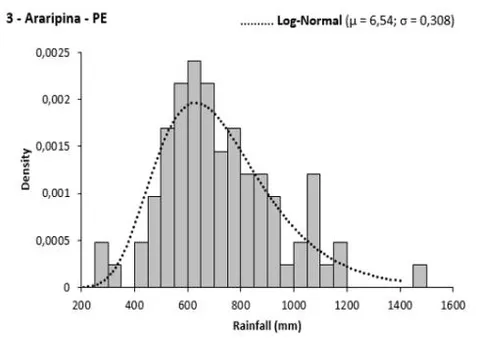
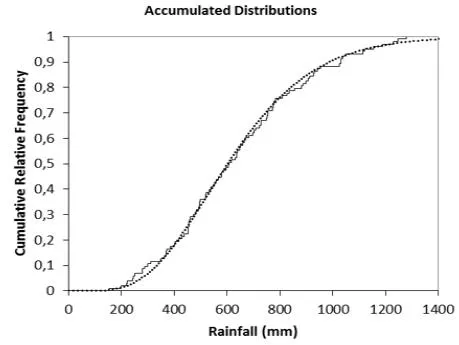
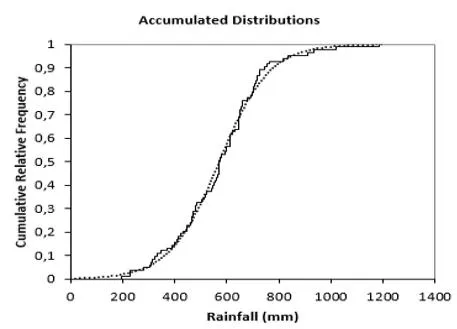
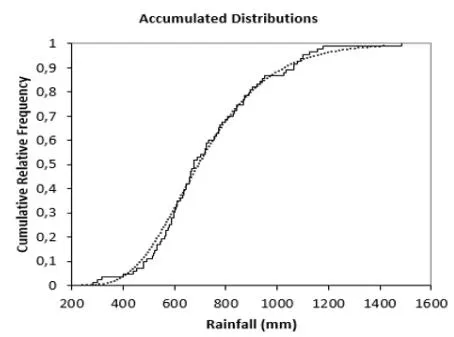
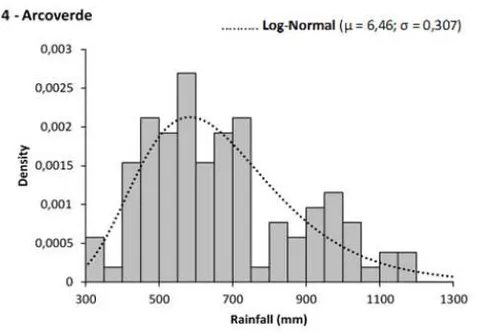
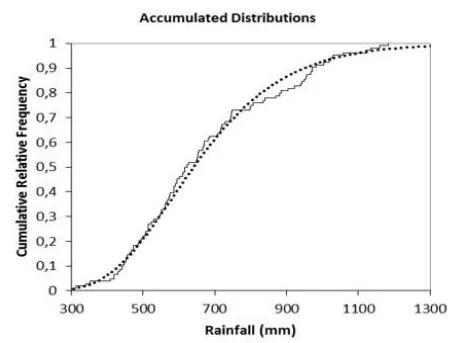
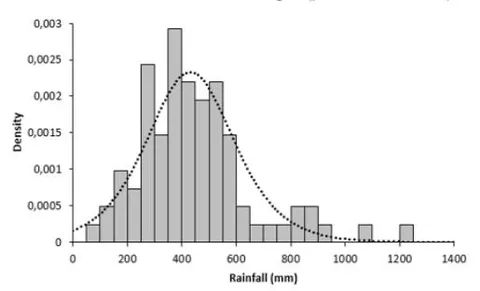
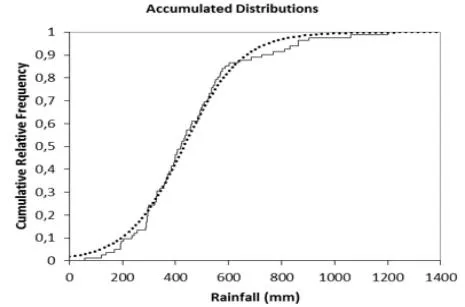
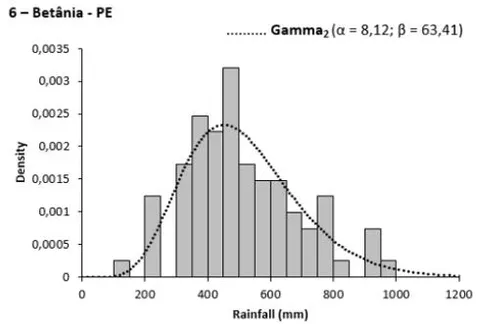
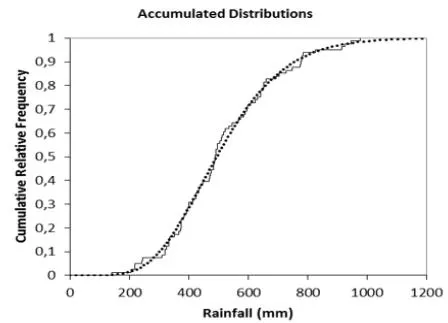
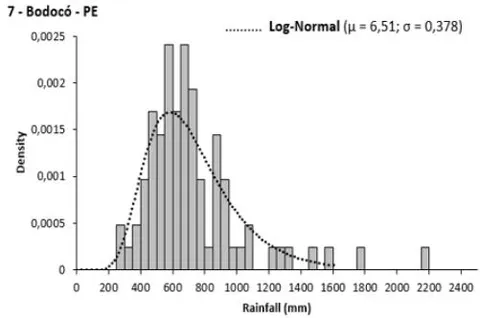
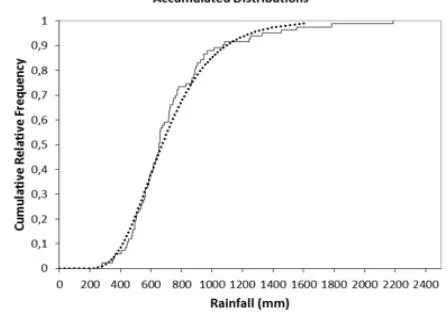
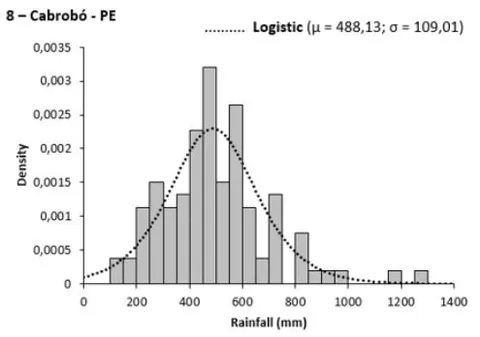
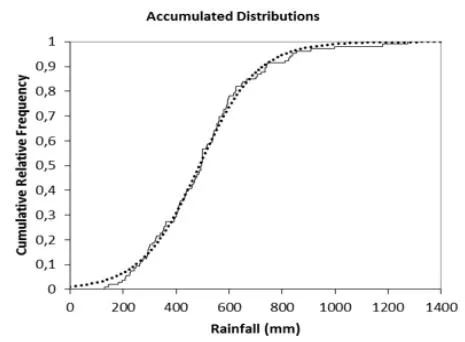
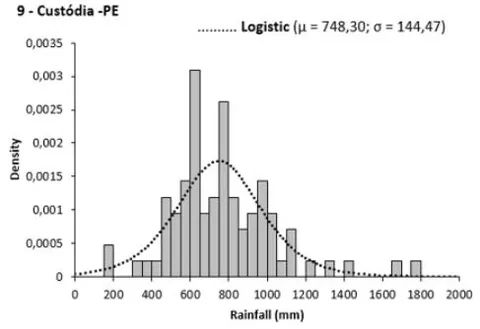
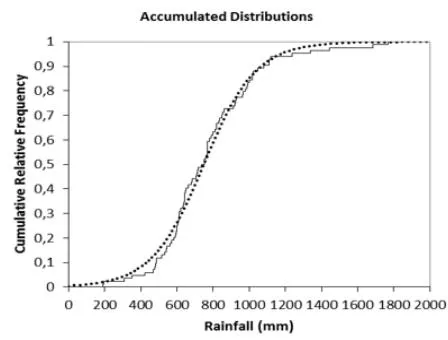
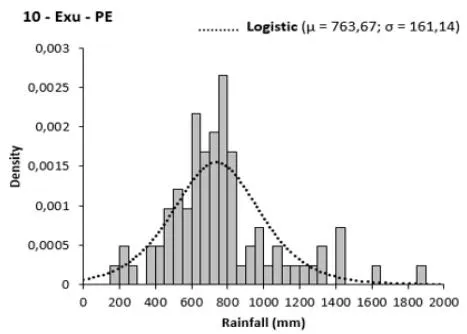
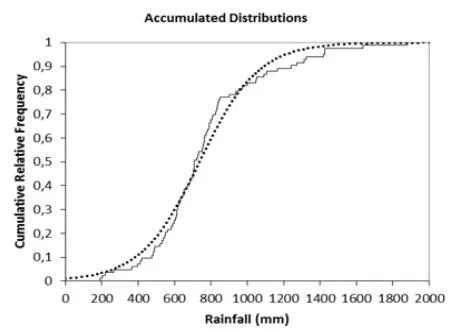
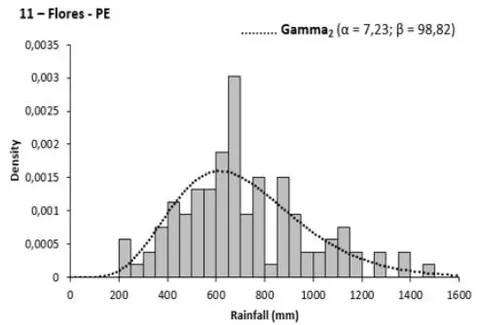
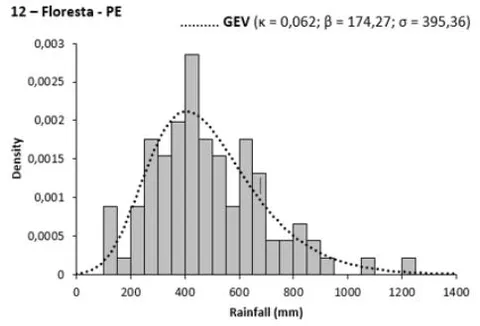
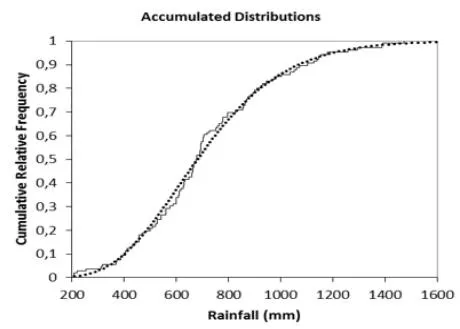
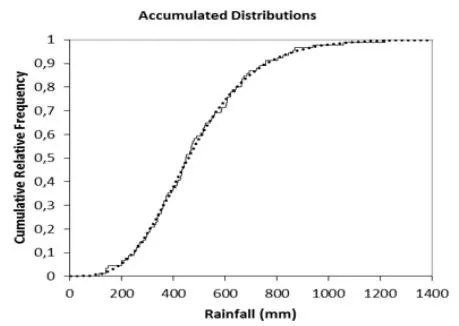
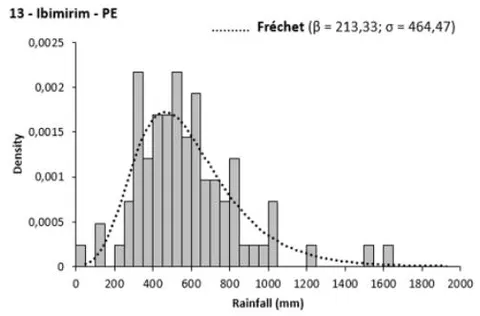
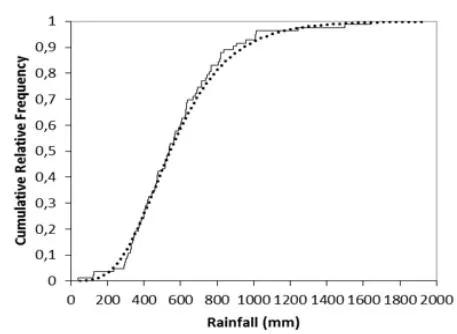
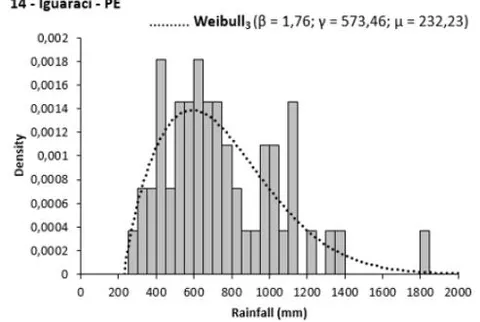
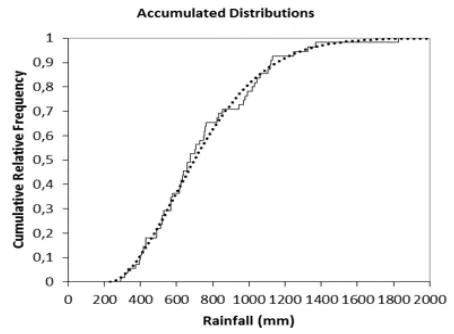
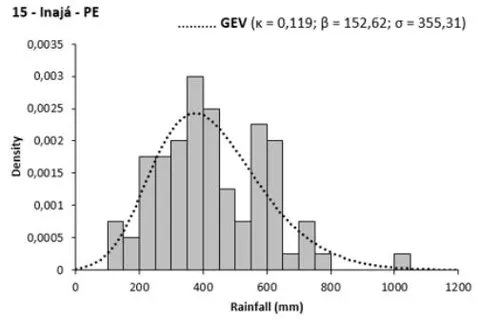
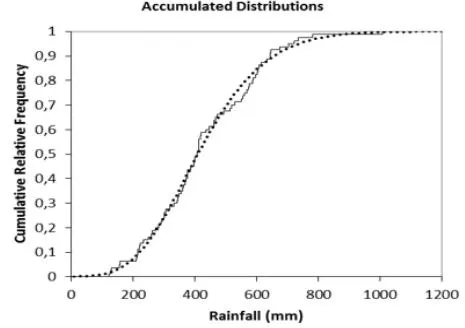
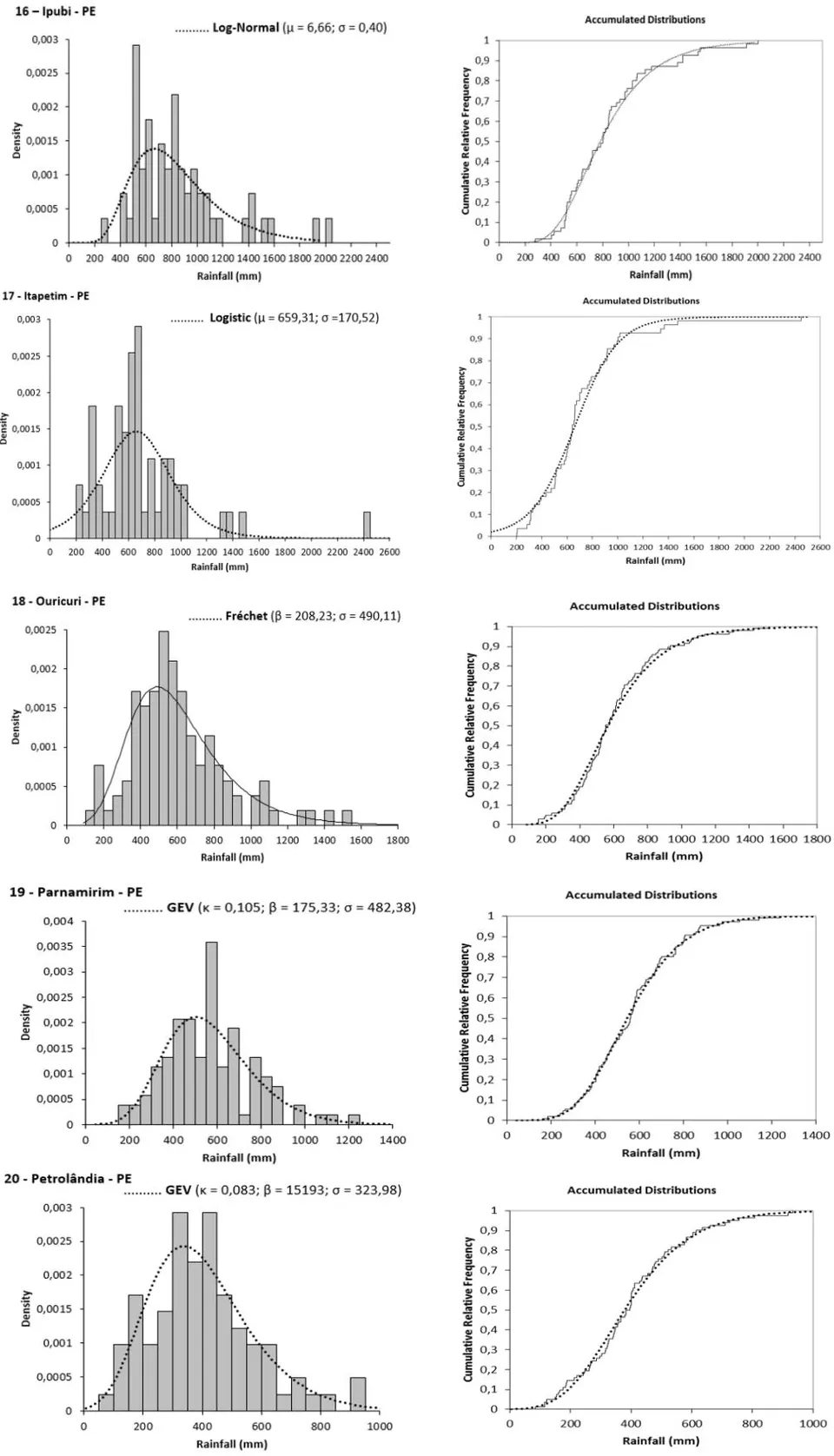
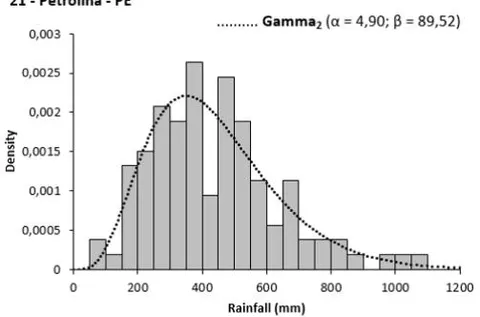
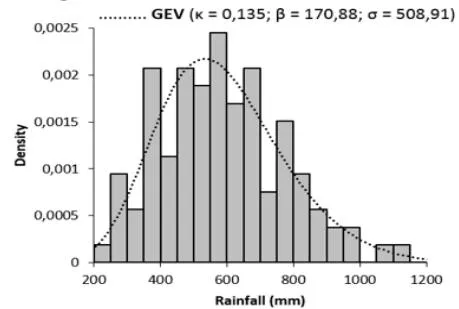
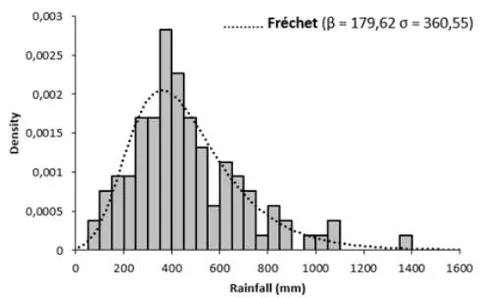
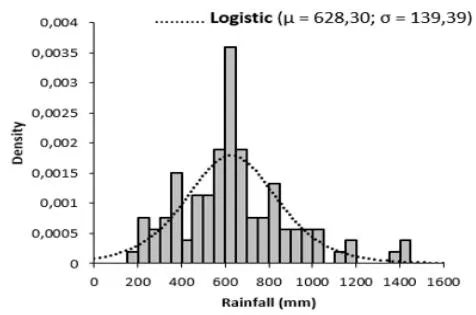
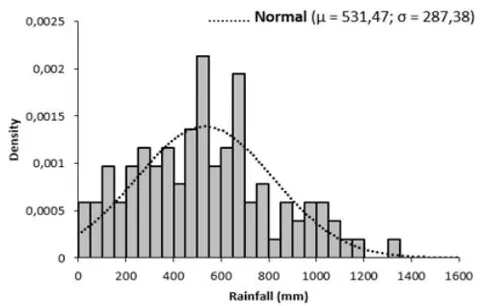
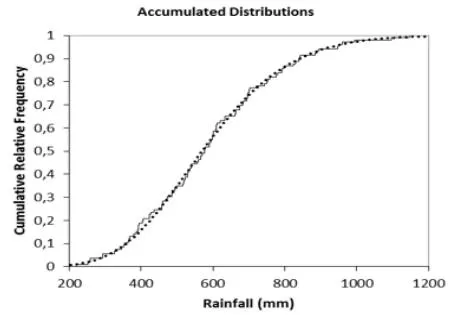
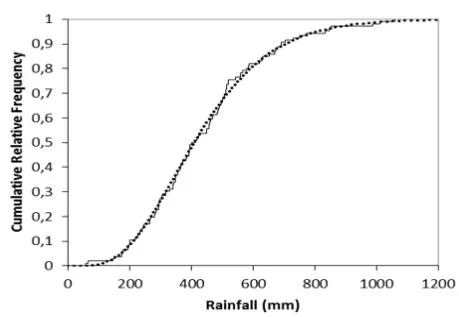
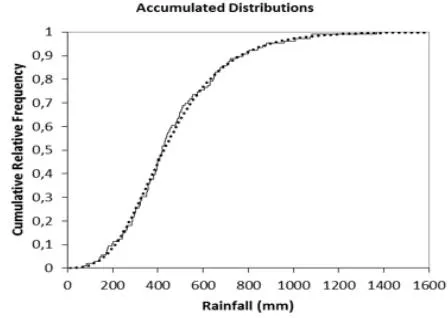
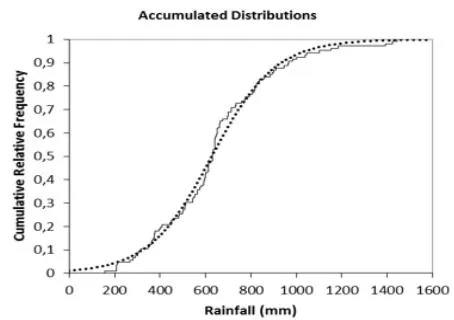
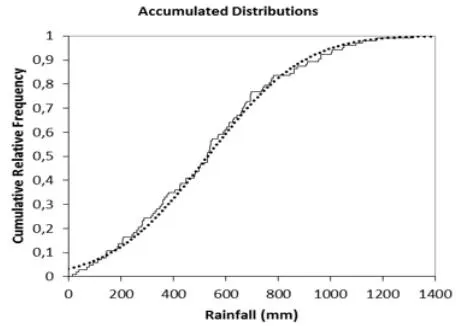
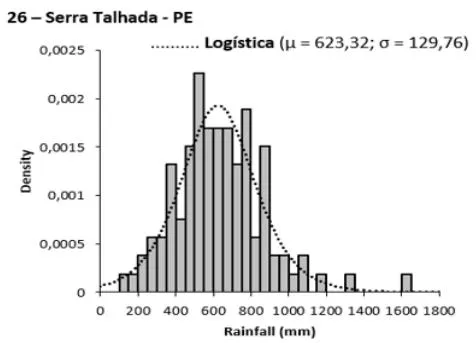
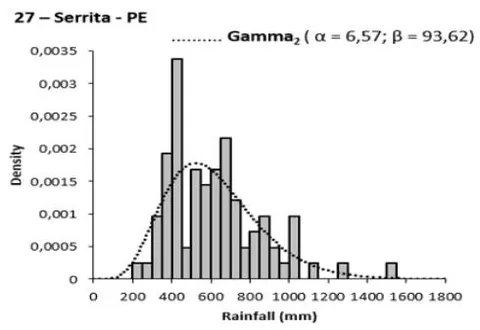
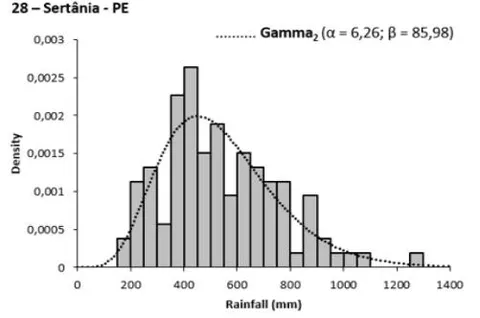
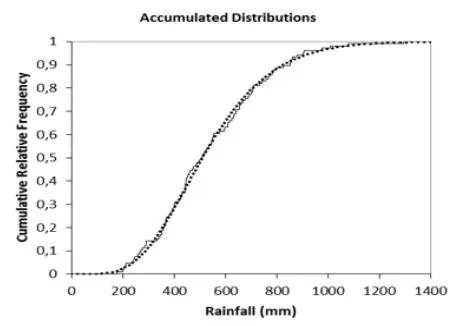
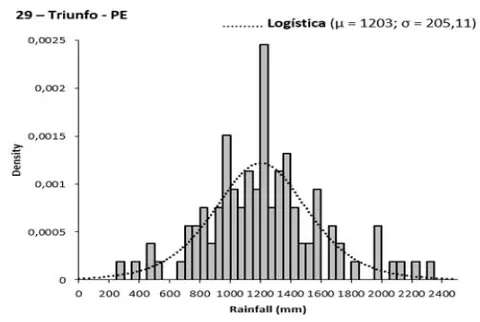
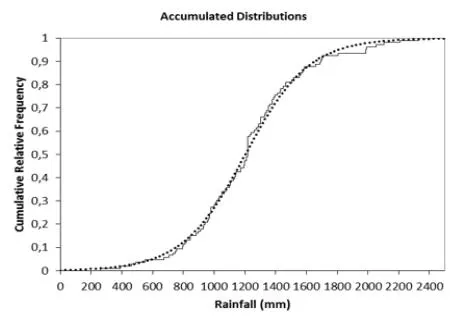
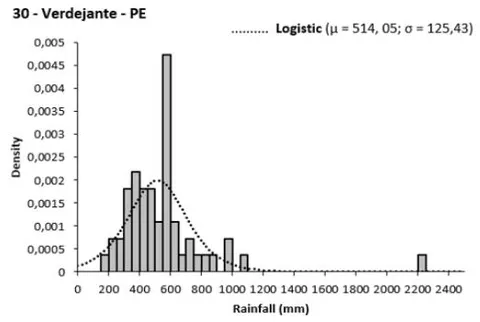
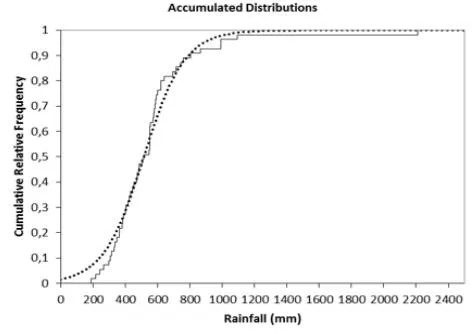
The figure 3 show the best fits between Probability Distributions Functions (PDFs) for annual rainfall of the studies cities from Brazilian semiarid. The GEV distribution obtained good adherence in 5 of the 30 analyzed cities: Floresta, Inaja, Parnamirim, Petrolandia and Salgueiro. The Logistic PDF was better fit to 10 cities, while the distribution Gama (type 2) to 6 cities, other distributions found were Log-Normal distribution to 4 cities, Fréchet distribution (Fisher-Tippett type 2) in 3 cities, and Weibull and Normal distribution just to one city each.
To similar analysis of fits between Probability Distributions Functions (PDFs) and rainfall distribution to 28 cities of Pernambuco State from Brazilian semiarid between 1963 and 1991 (28 years), Souza et al. (2010) using six probability distributions: Normal, Exponential, Log-Normal, Beta, Gamma and Weibull, using the Chi-square test, observed that the Normal and Exponential distribution were unable to model any of the months under study, the Log-Normal distribution was adequate for the Julyrains, August, September and October (drought period); the Gama distribution did not adjust to the February and March rains, and again, the Weibull distribution obtained good adherence to February and March rains, but did not adjust to the month of February. However, the Beta distribution adjusted well to all months of the year, these results reinforce the idea that there is no single distribution that adjust the monthly or annual rainfall data.
Sanches and Aparicio (2017) in the Spanish semiarid observed the best adjust between the Wakeby Probability distribution function and monthly maximum, seasonal maximum, and annual maximum. In a Chilean semiarid snow-glacier fed watershed, Balocchi et al. (2017) again had used the Gumbel and Goodrich probability distribution functions, and again the Log-Normal Probability Density Function (PDF) was better adjusted to the precipitation and streamflow behavior on this watershed.
IV. CONCLUSIONS
The selection of the Probability Distributions Functions (PDF) best adjusted to the monthly and annual rainfall data from 30 Brazilian semiarid cities confirmed the high spatial-temporal variability of these events according to the time series used for each city, with a monthly predominance of a better adjustment for the Weibull distribution (type 3) in the rainy season.
While in the annual time series, the distribution that obtained the best adherence to the data among those observed, was the Logistics distribution, obtaining a better adjustment in 10 cities, the distribution Gama (type 2) 6 cities, GEV distribution (Generalized of Extreme Values) (4 cities), Fréchet distribution (Fisher-Tippett type 2) in 3 cities, Weibull distribution (type 3) and Normal distribution, in 1 city each.
ACKNOWLEDGEMENTS
This research was supported by the National Council for Scientific and Technological Development (CNPq) of the Brazilian Government, by the project entitled: hydrological trends analysis and sediment transport rates from semiarid watersheds in Connection with Climate Change, approved in 2013. Besides the grant of a scholarship supported by(CAPES) and the Soil Science Graduate Program of Rural Federal of Pernambuco University.
Accumulated Distributions
Station Code Station Latitude (S) Longitude (W) Altitude (m) Period (No of years) 00737023 1 Afogados da Ingazeira-PE 07°44' 37°38' 525 1914-2016 (103) 00841015 2 Afrânio-PE 08°29' 41°00 530 1934-2016 (83) 00740014 3 Araripina-PE 07°33' 40°34' 620 1934-2016 (83) 00837005 4 Arcoverde-PE 08°26' 37°04' 663 1913-2016 (104) 00838004 5 Belém de São Francisco-PE 08°45' 38°57' 305 1935-2016 (82) 00838005 6 Betânia-PE 08°17' 38°02' 431 1936-2016 (81) 00739021 7 Bodocó-PE 07°48' 39°56' 440 1934-2016 (83) 00839002 8 Cabrobó-PE 08°30' 39°19' 350 1911-2016 (106) 00837011 9 Custódia -PE 08°06' 37°39' 542 1933-2016 (84) 00739023 10 Exu-PE 07°31' 39°43' 510 1934-2016 (83) 00737027 11 Flores-PE 07°52' 37°58' 460 1911-2016 (106) 00838000 12 Floresta-PE 08°32' 38°11' 361 1926-2016 (91) 00837025 13 IbimirimPE 08°23' 37°38' 445 1934-2016 (83) 00737030 14 Iguaraci-PE 07°55' 37°31' 585 1962-2016 (55) 00837038 15 Inajá-PE 08°55' 37°49' 355 1937-2016 (80) 00740018 16 Ipubi-PE 07°39' 40°08' 560 1962-2016 (55) 00737031 17 Itapetim-PE 07°22' 37°11' 630 1962-2016 (55) 00740021 18 Ouricuri-PE 07°53' 40°04' 432 1912-2016 (105) 00839013 19 Parnamirim-PE 08°05' 39°34' 379 1911-2016 (106) 00938000 20 Petrolândia-PE 09°04' 38°18' 282 1935-2016 (82) 00940006 21 Petrolina-PE 09°23' 40°30' 376 1911-2016 (106) 00839016 22 Salgueiro-PE 08°04' 39°07' 415 1911-2016 (106) 00839018 23 Santa Maria da Boa Vista-PE 08°48' 39°50' 452 1911-2016 (106) 00738029 24 São José do Belmonte-PE 07°52' 38°47' 460 1911-2016 (106) 00737036 25 São José do Egito-PE 07°28' 37°17' 575 1914-2016 (103) 00738030 26 Serra Talhada-PE 07°59' 38°18' 435 1911-2016 (106) 00739026 27 Serrita-PE 07°49' 39°29' 440 1934-2016 (83) 00837033 28 Sertânia-PE 08°05' 37°16' 605 1911-2016 (106) 00738032 29 Triunfo-PE 07°50' 38°07' 1010 1911-2016 (106) 00738036 30 Verdejante-PE 07°55' 38°59' 455 1962-2016 (55)
Table 2: Monthly and Annual Rainfall Average (mm) and Standard Deviation (
) of the Time Series of Analyzed cities
| Station | January | February | March | April | May | June | July | August | September | October | November | December | ANNUAL | |
| 1 | Afogados da Ingazeira-PE | 68,0 ± 75,5 | 101,7 ± 74,1 | 150,0 ± 105,1 | 121,7 ± 84,7 | 66,4 ± 63,5 | 36,1 ± 33,6 | 26,0 ± 28,0 | 9,8 ± 18,9 | 4,6 ± 10,5 | 10,2 ± 21,6 | 13,0 ± 22,5 | 30,4 ± 42,4 | 638,0 ± 262,0 |
| 2 | Afrânio-PE | 90,2 ± 95,5 | 84,5 ± 53,5 | 110,3 ± 71,6 | 75,2 ± 61,7 | 22,2 ± 17,0 | 10,5 ± 7,0 | 6,1 ± 4,7 | 4,8 ± 2,9 | 15,0 ± 9,8 | 35,5 ± 24,1 | 52,3 ± 42,9 | 66,0 ± 52,0 | 572,5 ± 174,4 |
| 3 | Araripina-PE | 116,3 ± 56,4 | 120,2 ± 51,4 | 170,2 ± 73,3 | 88,0 ± 63,8 | 37,4 ± 62,4 | 17,8 ± 47,9 | 12,0 ± 51,3 | 7,2 ± 29,7 | 9,9 ± 15,1 | 20,2 ± 20,6 | 47,9 ± 26,1 | 77,8 ± 39,7 | 724,8 ± 218,6 |
| 4 | Arcoverde-PE | 50,4 ± 56,4 | 61,5 ± 51,4 | 95,9 ± 73,3 | 86,8 ± 63,8 | 86,2 ± 62,4 | 72,2 ± 47,9 | 71,4 ± 51,6 | 37,9 ± 29,7 | 18,4 ± 15,0 | 24,2 ± 20,6 | 28,2 ± 26,1 | 38,4 ± 39,7 | 671,4 ± 207,4 |
| 5 | Belém de São Francisco-PE | 76,4 ± 98,6 | 65,4 ± 66,5 | 104,6 ± 91,0 | 58,5 ± 59,5 | 25,6 ± 36,1 | 11,6 ± 12,5 | 9,4 ± 9,1 | 3,5 ± 7,2 | 3,2 ± 6,9 | 7,1 ± 13,6 | 37,6 ± 56,1 | 47,7 ± 53,4 | 450,4 ± 204,8 |
| 6 | Betânia-PE | 67,8 ± 64,4 | 74,3 ± 59,9 | 122,9 ± 85,6 | 79,3 ± 60,2 | 40,2 ± 37,7 | 23,1 ± 24,6 | 17,9 ± 20,4 | 5,4 ± 7,5 | 7,1 ± 11,0 | 10,4 ± 16,6 | 23,1 ± 31,3 | 43,1 ± 44,4 | 514,6 ± 180,6 |
| 7 | Bodocó-PE | 115,4 ± 114,6 | 117,8 ± 109,9 | 146,4 ± 89,5 | 115,7 ± 112,6 | 46,2 ± 55,5 | 13,3 ± 11,5 | 12,6 ± 13,9 | 3,7 ± 6,6 | 4,8 ± 10,0 | 21,0 ± 27,2 | 48,3 ± 58,6 | 80,6 ± 84,2 | 725,8 ± 317,9 |
| 8 | Cabrobó-PE | 69,9 ± 64,1 | 82,2 ± 75,1 | 112,6 ± 82,3 | 72,2 ± 64,0 | 28,1 ± 31,6 | 14,1 ± 14,9 | 9,0 ± 10,9 | 3,1 ± 4,3 | 4,1 ± 11,2 | 10,4 ± 15,8 | 39,2 ± 40,7 | 55,8 ± 67,2 | 500,6 ± 202,8 |
| 9 | Custódia -PE | 73,7 ± 72,8 | 105,9 ± 74,7 | 168,2 ± 138,2 | 132,0 ± 87,4 | 85,7 ± 69,8 | 58,0 ± 46,0 | 39,9 ± 38,5 | 16,6 ± 17,7 | 13,8 ± 19,1 | 13,9 ± 21,8 | 27,4 ± 33,0 | 34,6 ± 34,0 | 769,6 ± 275,9 |
| 10 | Exu-PE | 104,5 ± 82,1 | 122,0 ± 91,6 | 159,9 ± 88,4 | 106,0 ± 90,5 | 74,0 ± 71,5 | 33,3 ± 31,5 | 25,3 ± 34,0 | 12,0 ± 20,1 | 7,3 ± 15,3 | 21,5 ± 38,3 | 40,6 ± 49,4 | 61,1 ± 55,6 | 767,7 ± 310,3 |
| 11 | Flores-PE | 82,7 ± 75,1 | 115,4 ± 82,2 | 163,2 ± 105,4 | 126,9 ± 82,7 | 69,0 ± 56,0 | 35,3 ± 37,7 | 25,6 ± 27,7 | 9,7 ± 14,4 | 8,2 ± 14,5 | 14,4 ± 25,6 | 26,4 ± 36,4 | 37,6 ± 43,8 | 714,4 ± 265,7 |
| 12 | Floresta-PE | 67,5 ± 74,8 | 83,9 ± 76,6 | 120,0 ± 94,5 | 67,0 ± 61,0 | 25,9 ± 23,9 | 17,8 ± 21,2 | 12,5 ± 13,2 | 3,9 ± 4,8 | 5,4 ± 10,9 | 9,2 ± 17,6 | 21,4 ± 28,7 | 51,5 ± 60,1 | 486,0 ± 208,8 |
| 13 | Ibimirim-PE | 54,2 ± 64,5 | 76,8 ± 66,7 | 128,7 ± 109,5 | 100,8 ± 103,8 | 61,2 ± 58,4 | 37,9 ± 44,6 | 27,9 ± 34,5 | 11,4 ± 21,7 | 5,7 ± 11,8 | 11,3 ± 21,0 | 21,7 ± 27,6 | 38,8 ± 42,7 | 576,5 ± 270,3 |
| 14 | Iguaraci-PE | 78,6 ± 79,0 | 100,9 ± 73,4 | 164,7 ± 116,7 | 139,4 ± 107,1 | 75,5 ± 59,4 | 46,9 ± 32,3 | 32,2 ± 31,0 | 15,7 ± 24,8 | 11,2 ± 14,6 | 13,5 ± 20,6 | 22,5 ± 25,1 | 41,9 ± 48,3 | 743,1 ± 310,5 |
| 15 | Inajá-PE | 52,6 ± 55,6 | 49,9 ± 50,5 | 82,7 ± 75,8 | 50,0 ± 49,0 | 35,0 ± 33,5 | 31,7 ± 24,4 | 32,5 ± 23,0 | 15,1 ± 14,1 | 8,7 ± 12,4 | 9,1 ± 14,4 | 22,2 ± 25,6 | 37,9 ± 51,1 | 427,4 ± 172,2 |
| 16 | Ipubi-PE | 128,7 ± 106,2 | 135,0 ± 109,7 | 194,2 ± 142,7 | 116,8 ± 124,7 | 54,1 ± 55,8 | 30,6 ± 36,5 | 21,6 ± 26,0 | 6,5 ± 9,6 | 11,7 ± 19,6 | 17,2 ± 19,1 | 49,6 ± 43,5 | 79,7 ± 66,7 | 845,8 ± 362,3 |
| 17 | Itapetim-PE | 81,8 ± 70,9 | 114,8 ± 148,1 | 143,7 ± 95,2 | 137,0 ± 125,4 | 68,4 ± 68,8 | 41,1 ± 36,5 | 29,7 ± 24,9 | 12,9 ± 19,8 | 5,9 ± 9,6 | 16,8 ± 29,1 | 12,2 ± 17,0 | 34,8 ± 39,2 | 698,9 ± 363,1 |
| 18 | Ouricuri-PE | 91,9 ± 80,9 | 99,0 ± 84,1 | 137,3 ± 112,0 | 90,4 ± 79,1 | 36,2 ± 57,6 | 12,8 ± 19,4 | 8,8 ± 10,9 | 3,4 ± 7,3 | 5,6 ± 15,4 | 20,3 ± 31,0 | 38,4 ± 49,5 | 63,2 ± 57,8 | 607,2 ± 261,8 |
| 19 | Parnamirim-PE | 87,9 ± 78,7 | 104,1 ± 69,1 | 132,5 ± 89,6 | 78,8 ± 71,1 | 29,2 ± 33,1 | 11,7 ± 14,5 | 9,5 ± 12,8 | 3,1 ± 5,2 | 4,7 ± 11,0 | 13,5 ± 25,3 | 32,6 ± 44,9 | 59,3 ± 59,9 | 566,7 ± 200,6 |
| 20 | Petrolândia-PE | 54,4 ± 55,5 | 50,4 ± 50,3 | 82,4 ± 82,8 | 45,3 ± 51,9 | 28,9 ± 27,0 | 25,6 ± 23,2 | 21,1 ± 21,6 | 7,7 ± 7,2 | 8,9 ± 20,9 | 7,2 ± 11,1 | 28,6 ± 28,9 | 39,7 ± 44,2 | 400,2 ± 178,3 |
| 21 | Petrolina-PE | 71,6 ± 77,1 | 81,3 ± 81,2 | 97,4 ± 90,3 | 53,1 ± 58,6 | 8,7 ± 16,2 | 6,0 ± 14,3 | 3,4 ± 6,1 | 2,0 ± 4,2 | 3,8 ± 9,3 | 11,6 ± 22,3 | 42,6 ± 45,7 | 57,4 ± 56,5 | 438,8 ± 198,2 |
| 22 | Salgueiro-PE | 92,0 ± 71,9 | 103,3 ± 72,3 | 147,5 ± 96,7 | 83,8 ± 65,5 | 29,2 ± 35,1 | 10,6 ± 13,9 | 9,2 ± 12,2 | 3,6 ± 6,5 | 6,1 ± 12,0 | 14,5 ± 22,6 | 31,8 ± 37,1 | 56,2 ± 53,1 | 587,8 ± 191,2 |
| 23 | Santa Maria da Boa Vista-PE | 73,0 ± 86,7 | 78,8 ± 64,6 | 110,5 ± 103,1 | 62,1 ± 66,7 | 22,6 ± 27,8 | 8,2 ± 10,2 | 6,3 ± 11,6 | 2,0 ± 5,1 | 2,5 ± 6,3 | 13,4 ± 24,8 | 31,3 ± 40,0 | 52,0 ± 50,6 | 463,6 ± 231,3 |
| 24 | São José do Belmonte-PE | 95,4 ± 83,3 | 114,8 ± 82,5 | 163,3 ± 117,5 | 105,0 ± 80,7 | 36,2 ± 36,9 | 19,8 ± 19,9 | 12,6 ± 16,1 | 3,0 ± 5,7 | 4,4 ± 9,1 | 10,6 ± 18,1 | 31,0 ± 41,0 | 46,5 ± 49,2 | 642,6 ± 256,6 |
| 25 | São José do Egito-PE | 57,8 ± 62,6 | 82,1 ± 75,6 | 119,5 ± 95,3 | 109,7 ± 87,2 | 59,6 ± 59,2 | 33,5 ± 36,4 | 20,1 ± 24,1 | 6,6 ± 14,6 | 3,4 ± 9,1 | 6,4 ± 16,3 | 8,1 ± 15,6 | 24,8 ± 37,6 | 531,5 ± 287,4 |
| 26 | Serra Talhada-PE | 83,3 ± 82,4 | 106,1 ± 77,9 | 146,6 ± 96,5 | 101,8 ± 68,8 | 48,9 ± 45,8 | 27,5 ± 28,9 | 16,7 ± 18,3 | 7,4 ± 16,4 | 5,1 ± 11,3 | 12,7 ± 22,4 | 28,0 ± 38,6 | 50,1 ± 50,7 | 634,3 ± 240,3 |
| 27 | Serrita-PE | 91,1 ± 72,1 | 100,4 ± 70,3 | 141,5 ± 115,3 | 96,9 ± 78,7 | 40,4 ± 49,8 | 12,5 ± 12,7 | 9,9 ± 13,9 | 3,0 ± 5,5 | 3,5 ± 6,6 | 13,3 ± 18,5 | 37,9 ± 51,5 | 65,0 ± 61,0 | 615,4 ± 240,0 |
| 28 | Sertânia-PE | 53,6 ± 59,1 | 74,9 ± 59,3 | 121,1 ± 94,2 | 97,8 ± 73,7 | 55,7 ± 49,4 | 32,2 ± 30,4 | 22,2 ± 26,3 | 9,8 ± 13,1 | 7,4 ± 13,1 | 16,6 ± 22,7 | 17,7 ± 26,2 | 29,3 ± 41,1 | 538,3 ± 215,1 |
| 29 | Triunfo-PE | 110,7 ± 86,4 | 153,8 ± 108,9 | 209,5 ± 124,8 | 184,8 ± 117,3 | 146,0 ± 115,4 | 120,9 ± 82,8 | 97,0 ± 59,1 | 46,8 ± 44,3 | 22,1 ± 24,8 | 30,4 ± 34,4 | 37,7 ± 39,9 | 57,6 ± 51,1 | 1217,2 ± 377,7 |
| 30 | Verdejante-PE | 84,6 ± 75,0 | 111,2 ± 114,5 | 127,3 ± 76,5 | 98,1 ± 100,9 | 27,7 ± 34,0 | 14,3 ± 25,7 | 8,9 ± 16,0 | 3,9 ± 11,7 | 5,2 ± 12,7 | 8,7 ± 12,4 | 18,5 ± 24,9 | 43,0 ± 48,5 | 551,5 ± 297,3 |
| Station | January | February | March | April | May | June | July | August | September | October | November | December | ANNUAL | |
| 1 | Afogados da Ingazeira-PE | (0,976) | Fr (0,902) | (0,993) | (0,872) | (0,946) | (0,941) | (0,129) | * | * | * | * | * | (0,996) |
| 2 | Afrânio-PE | LN (0,301) | Fr (0,557) | Lo (0,623) | (0,320) | * | * | * | * | * | * | (0,160) | LN (0,290) | Lo (0,954) |
| 3 | Araripina-PE | (0,875) | (0,868) | Lo (0,652) | (0,404) | Fr (0,083) | * | * | * | * | * | Lo (0,144) | (0,576) | LN (0,948) |
| 4 | Arcoverde-PE | (0,325) | (0,447) | (0,303) | Fr (0,465) | (0,576) | Lo (0,571) | Lo (0,366) | (0,686) | * | * | * | * | LN (0,715) |
| 5 | Belém de São Francisco-PE | (0,691) | (0,996) | (0,772) | (0,881) | (0,205) | (0,693) | (0,254) | * | * | * | * | (0,730) | Lo (0,744) |
| 6 | Betânia-PE | (0,866) | (0,925) | (0,992) | (0,688) | (0,433) | (0,894) | (0,175) | * | * | * | (0,096) | (0,207) | (0,964) |
| 7 | Bodocó-PE | Lo (0,165) | (0,978) | GEV (0,980) | (0,499) | (0,518) | (0,155) | (0,185) | * | * | (0,063) | (0,102) | (0,491) | LN (0,565) |
| 8 | Cabrobó-PE | (0,287) | (0,339) | (0,493) | (0,349) | (0,213) | (0,138) | (0,163) | * | * | * | * | Ex (0,282) | Lo (0,974) |
| 9 | Custódia -PE | (0,331) | (0,742) | Lo (0,484) | (0,735) | (0,847) | Lo (0,457) | (0,649) | (0,556) | * | * | (0,173) | (0,285) | Lo (0,833) |
| 10 | Exu-PE | (0,907) | (0,780) | Lo (0,982) | (0,948) | (0,302) | (0,486) | (0,068) | * | * | * | (0,071) | (0,205) | Lo (0,321) |
| 11 | Flores-PE | (0,953) | (0,710) | (0,943) | GEV (0,990) | (0,999) | (0,378) | (0,217) | * | * | * | * | (0,085) | (0,747) |
| 12 | Floresta-PE | (0,680) | (0,929) | (0,997) | (0,975) | (0,823) | (0,568) | (0,906) | * | * | * | (0,038) | (0,664) | GEV (0,999) |
| 13 | Ibimirim-PE | (0,571) | (0,820) | (0,515) | (0,868) | (0,277) | (0,796) | (0,192) | * | * | * | (0,051) | (0,386) | Fr (0,922) |
| 14 | Iguaraci-PE | Er (0,964) | Fr (0,800) | (0,953) | (0,855) | (0,622) | No (0,844) | (0,605) | * | * | * | (0,147) | Ex (0,306) | (0,894) |
| 15 | Inajá-PE | (0,294) | (0,984) | Ex (0,859) | (0,596) | (0,857) | (0,965) | Lo (0,699) | (0,947) | * | * | (0,252) | (0,714) | GEV (0,850) |
| 16 | Ipubi-PE | (0,995) | (0,991) | Lo (0,500) | (0,966) | (0,835) | (0,613) | (0,221) | * | * | (0,074) | (0,373) | (0,792) | LN (0,944) |
| 17 | Itapetim-PE | Lo (0,504) | (0,631) | Fr (0,980) | (0,332) | Er (0,793) | Ex (0,447) | (0,303) | * | * | * | * | (0,133) | Lo (0,639) |
| 18 | Ouricuri-PE | (0,988) | (0,748) | (0,986) | (0,561) | (0,071) | * | * | * | * | * | (0,062) | (0,629) | Fr (0,883) |
| 19 | Parnamirim-PE | (0,918) | (0,999) | (0,981) | (0,828) | (0,169) | (0,076) | * | * | * | * | (0,277) | Ex (0,867) | GEV (0,907) |
| 20 | Petrolândia-PE | (0,303) | (0,880) | (0,633) | (0,591) | (0,434) | (0,635) | (0,423) | (0,675) | (0,122) | * | (0,243) | Ex (0,429) | GEV (0,882) |
| 21 | Petrolina-PE | (0,739) | (0,550) | (0,815) | (0,591) | * | * | * | * | * | * | (0,188) | (0,857) | (0,941) |
| 22 | Salgueiro-PE | (0,953) | (0,984) | (0,699) | (0,895) | (0,210) | (0,414) | * | * | * | * | (0,825) | (0,974) | GEV (0,993) |
| 23 | Santa Maria da Boa Vista-PE | (0,995) | (0,744) | (0,756) | (0,656) | (0,111) | * | * | * | * | * | * | (0,446) | Fr (0,984) |
| 24 | São José do Belmonte-PE | (0,506) | Fr (0,710) | Lo (0,272) | (0,743) | (0,483) | (0,135) | * | * | * | * | (0,051) | (0,189) | Lo (0,448) |
| 25 | São José do Egito-PE | (0,349) | (0,484) | (0,858) | Fr (0,655) | (0,607) | (0,454) | (0,059) | * | * | * | * | * | No (0,964) |
| 26 | Serra Talhada-PE | (0,661) | (0,792) | (0,827) | (0,843) | (0,921) | (0,935) | (0,235) | * | * | * | (0,089) | (0,823) | Lo (0,998) |
| 27 | Serrita-PE | (0,901) | (0,995) | (0,970) | (0,825) | (0,429) | (0,278) | * | * | * | * | (0,460) | (0,880) | (0,708) |
| 28 | Sertânia-PE | (0,667) | GEV (0,679) | (0,919) | (0,881) | (0,896) | (0,894) | (0,734) | * | * | * | * | * | (0,994) |
| 29 | Triunfo-PE | (0,281) | (0,190) | Fr (0,273) | GEV (0,683) | (0,078) | (0,275) | Lo (0,578) | (0,158) | Ex (0,150) | (0,063) | (0,134) | (0,214) | Lo (0,849) |
| 30 | Verdejante-PE | (0,681) | Ex (0,364) | GEV (0,808) | (0,775) | (0,171) | (0,074) | * | * | * | * | * | (0,129) | Lo (0,616) |