




1. Introduction
The jeans garment industry constitutes an important segment of the textile and apparel sector, contributing significantly to employment generation, industrial development, entrepreneurship, and regional economic growth. In Karnataka, Ballari City has emerged as a prominent garment manufacturing centre, with numerous micro and small-scale enterprises engaged in the production of jeans garments for domestic and regional markets. Despite its industrial significance, the sector continues to encounter several operational challenges, including labour shortages, technological limitations, financial constraints, infrastructural deficiencies, and policy-related issues, which may affect its productivity and long-term competitiveness.
At the same time, opportunities arising from technological advancement, market expansion, sustainable manufacturing practices, entrepreneurial capability, and a favourable investment climate provide considerable potential for future growth. Although earlier studies have examined various aspects of the garment industry, limited empirical evidence is available on the integrated assessment of both the problems and growth prospects of jeans garment manufacturing units in Ballari City. In this context, the present empirical study seeks to identify the major problems, examine the growth prospects, and analyse the relationship between these dimensions based on evidence collected from garment manufacturing units. The findings are expected to provide useful insights for industry practitioners, policymakers, and researchers in promoting the sustainable development of the jeans garment industry.
2. Review of Literature
Kumari and Minajigi (2015) examined the production and organizational challenges affecting the readymade garment industry in Bangalore City with the objective of identifying the major constraints influencing operational performance. The investigation employed a descriptive research methodology, using structured questionnaires and personal interviews to collect primary data, while secondary information was obtained from journals and industry publications. Percentage analysis was applied to interpret the collected data. The analysis identified shortages of skilled labour, increasing production costs, inadequate infrastructure, irregular power supply, and regulatory constraints as the principal factors adversely influencing productivity and manufacturing efficiency. The authors emphasized that these operational issues substantially affected industrial performance. The study suggested that technological modernization, continuous workforce skill development, and improved infrastructural facilities are essential for strengthening production efficiency and promoting the sustainable development of the readymade garment industry.
Yallamma and Guledgudda (2018) examined the problems and future prospects of garment exporters in Davanagere District with emphasis on regional industrial and export development. The primary objective of the study was to evaluate exporter performance and identify the operational constraints influencing business expansion. A descriptive research methodology was employed, utilizing structured questionnaires for primary data collection, while secondary information was obtained from government publications, journals, and institutional records. The collected data were analysed using percentage and ranking techniques. The analysis identified inadequate infrastructure, shortage of skilled manpower, limited financial accessibility, policy-related constraints, and competitive market pressures as the major factors affecting export performance. The authors emphasized that strengthening infrastructure, improving workforce skills, expanding financial assistance, and ensuring consistent government policy support are essential for enhancing export competitiveness and promoting the sustainable development of garment exporters.
Gangadhara and Naik (2023) investigated the socio-economic and occupational challenges experienced by workers employed in the readymade garment industry of Ballari District, Karnataka. The study aimed to identify the major economic, social, wage-related, and health issues affecting garment workers and to propose suitable welfare measures. A descriptive research methodology was adopted, with primary data collected through structured questionnaires and supplemented by relevant secondary sources. Percentage analysis was applied to interpret the collected information. The analysis demonstrated that low wages, job insecurity, inadequate social security, unsafe working conditions, occupational health issues, and insufficient welfare facilities were the predominant challenges faced by workers. The authors suggested that effective implementation of labour welfare measures, improved social security coverage, enhanced occupational health facilities, and stronger institutional support are essential for improving employee well-being and strengthening workforce productivity.
Rasim and Girija (2023) explored denim jeans product development by analysing consumer preferences and prevailing market trends in the Indian apparel industry. The principal objective was to develop an effective product development model by integrating customer expectations with competitive market intelligence. The investigation adopted a descriptive research methodology, collecting primary data through consumer surveys and secondary information from market analysis. The collected information was analysed using web scraping, competition mapping, and percentage analysis. The findings indicated that fit, fabric quality, colour, style, and price significantly influenced consumer purchase decisions, whereas brand name and durability received comparatively lower preference. The authors concluded that a consumer-oriented product development strategy supported by market intelligence can improve product acceptance, strengthen market competitiveness, and contribute to the sustainable growth of the denim jeans industry.
Choudhary, Khan, and Randhelia (2024) analysed the problems and prospects of the garment industry in Madhya Pradesh within the broader context of India’s apparel sector. The study primarily sought to identify the operational constraints, labour-related challenges, and future growth opportunities affecting industrial performance. A descriptive research methodology was employed, utilizing primary data collected through structured questionnaires and secondary information gathered from journals, reports, and official publications. Percentage analysis served as the principal analytical technique. The analysis demonstrated that labour shortages, wage-related concerns, inadequate infrastructure, limited government support, and insufficient basic facilities adversely influenced industrial performance. The authors suggested that effective policy implementation, improved infrastructural facilities, enhanced labour welfare measures, and institutional support are fundamental to achieving sustainable industrial growth and strengthening the competitiveness of the garment industry.
Priya (2024) investigated the managerial challenges encountered by garment manufacturing factories in Bengaluru with the objective of identifying the factors influencing operational efficiency and workforce management. The study employed a descriptive research methodology, collecting information from garment manufacturing units to examine managerial and operational issues. The analysis revealed that labour unrest, shortage of skilled workers, supply chain disruptions, inadequate employee training, fluctuating market demand, and regulatory compliance issues adversely affected production efficiency and organizational performance. The author emphasized that the adoption of modern managerial practices, continuous workforce skill development, effective supply chain coordination, and strengthened regulatory compliance are essential for improving organizational efficiency and ensuring the sustainable growth of garment manufacturing enterprises.
Gupta and Pant (2025) examined fabric waste generation in readymade garment manufacturing units in Kolkata with particular emphasis on sustainable production practices. The study aimed to assess the quantity of fabric waste generated by different categories of garment manufacturing units and evaluate the influence of unit size on waste generation. An exploratory research methodology was adopted, utilizing structured questionnaires administered to sixty garment manufacturing units and supported by relevant secondary information. The collected data were analysed using percentage analysis, the independent sample t-test, and Pearson’s correlation. The analysis indicated that fabric waste constituted the largest proportion of production waste, particularly within the cutting department, while micro and small enterprises generated comparatively higher waste due to technical and resource limitations. The study suggested that systematic waste management practices, efficient production planning, and sustainable manufacturing strategies are essential for minimizing material losses and improving environmental performance.
3. Research Gap
The reviewed studies primarily focused on labour welfare, production challenges, managerial issues, product development, garment exporters, and sustainable manufacturing practices. However, limited empirical evidence is available on the integrated assessment of both the problems and growth prospects of the jeans garment industry in Ballari City from the perspective of manufacturing units, thereby justifying the present study.
4. Significance of the Study
The present study provides empirical evidence on the major problems and growth prospects of the jeans garment industry in Ballari City, an important garment manufacturing cluster in Karnataka. The findings contribute to a better understanding of the operational challenges and future development opportunities perceived by manufacturing units. The study offers useful insights for policymakers, industry associations, entrepreneurs, and researchers in formulating strategies to enhance industrial competitiveness and sustainable growth. Furthermore, the pilot investigation validates the research instrument and analytical framework, thereby establishing a reliable methodological foundation for the main study and future empirical research in the garment manufacturing sector.
5. Objectives of the Study
To identify the major problems faced by the Jeans Garment Industry in Ballari City.
To examine the growth prospects of the Jeans Garment Industry in Ballari City.
To examine the relationship between the major problems and the growth prospects of the Jeans Garment Industry in Ballari City.
6. Hypotheses of the Study
6.1. Hypothesis 1
H₀₁: There is no significant relationship between the problems faced by the jeans garment industry and its growth prospects.
H₁₁: There is a significant relationship between the problems faced by the jeans garment industry and its growth prospects.
6.2. Hypothesis 2
H₀₂: The identified problem dimensions do not significantly influence the growth prospects of the jeans garment industry.
H₁₂: The identified problem dimensions significantly influence the growth prospects of the jeans garment industry.
7. Research Methodology
The present empirical study adopted a descriptive research design to examine the problems and growth prospects of the jeans garment industry in Ballari City. Primary data were collected from 30 jeans garment manufacturing units through a structured questionnaire developed in accordance with the research objectives. Secondary data were obtained from journals, books, government reports, and other relevant publications. The reliability of the research instrument was assessed using Cronbach’s Alpha. The collected data were analysed using descriptive statistics, Pearson’s correlation, and multiple linear regression to achieve the research objectives and test the proposed hypotheses. Statistical analyses were performed using IBM SPSS Statistics and Microsoft Excel.
8. Data Analysis and Interpretation
Table 1: Summary Profile of the Respondents (N = 30)
| Profile Variable | Major Characteristic | Frequency (n) | Percentage (%) |
|---|---|---|---|
| Experience in Garment Business | Above 20 Years | 12 | 40 |
| Type of Garments Manufactured | Jeans | 30 | 100 |
| Percentage of Jeans Production | 25–50% and Above 75% (Highest Response) | 10 | 33.3 |
| Number of Employees | Less than 10 Employees | 19 | 63.3 |
| Market Coverage | State Market | 18 | 60 |
| Membership in Trade Association | Yes and No (Equal Distribution) | 15 | 50 |
Source: Computed from Primary Data.
Interpretation:
The demographic and operational profile of the respondents reflects the characteristics of the manufacturing units selected for the pilot investigation. The analysis indicates that 40.0 per cent of the respondents possessed more than 20 years of experience in the garment manufacturing business, signifying substantial industrial expertise and practical exposure. All respondents (100.0 per cent) were engaged in the production of jeans garments, thereby ensuring complete alignment with the objectives of the present study. Regarding production composition, an equal proportion (33.3 per cent each) reported that jeans constituted 25–50 per cent and more than 75 per cent of their total garment production. Furthermore, 63.3 per cent of the surveyed establishments employed fewer than 10 workers, indicating the predominance of micro and small-scale manufacturing units in the study area. In addition, 60.0 per cent of the respondents primarily served the state market, while an equal proportion (50.0 per cent each) were members and non-members of garment or trade associations, reflecting a balanced representation of institutional affiliation among the surveyed enterprises.
Table 2: Reliability Analysis of the Measurement Scales
| Research Measurement Scales | Number of Items | Cronbach’s Alpha () | Reliability Status |
|---|---|---|---|
| Problems Faced by the Jeans Garment Industry | 32 | 0.685 | Acceptable |
| Growth Prospects of the Jeans Garment Industry | 28 | 0.794 | Good |
| Overall Questionnaire | 60 | 0.762 | Good |
Source: Computed from Primary Data.
Interpretation:
The reliability assessment of the research instrument demonstrates that the measurement scales possess an acceptable degree of internal consistency. The Problems Faced by the Jeans Garment Industry construct, comprising 32 items, produced a Cronbach’s Alpha coefficient of 0.685, indicating satisfactory reliability for measuring the identified problem dimensions. Likewise, the Growth Prospects of the Jeans Garment Industry construct, consisting of 28 items, achieved a Cronbach’s Alpha value of 0.794, reflecting good internal consistency among the measurement items. Collectively, the complete research instrument, incorporating 60 items, yielded an overall Cronbach’s Alpha coefficient of 0.762, confirming a satisfactory level of reliability. These reliability coefficients indicate that the questionnaire consistently measures the intended constructs and provides a dependable basis for undertaking subsequent descriptive and inferential statistical analyses within the scope of the present study.
Table 3: Descriptive Statistics of the Problems Faced by the Jeans Garment Industry
| Sl. No. | Dimension | No. of Items | Mean | Standard Deviation | Rank |
|---|---|---|---|---|---|
| 1 | Labour and Skill-related Problems | 6 | 4.039 | 0.594 | 1 |
| 2 | Technology-related Problems | 7 | 4.038 | 0.644 | 2 |
| 3 | Financial Problems | 6 | 3.956 | 0.636 | 3 |
| 4 | Policy and Institutional Problems | 7 | 3.943 | 0.674 | 4 |
| 5 | Infrastructure-related Problems | 6 | 3.756 | 0.587 | 5 |
Source: Computed from Primary Data.
Interpretation:
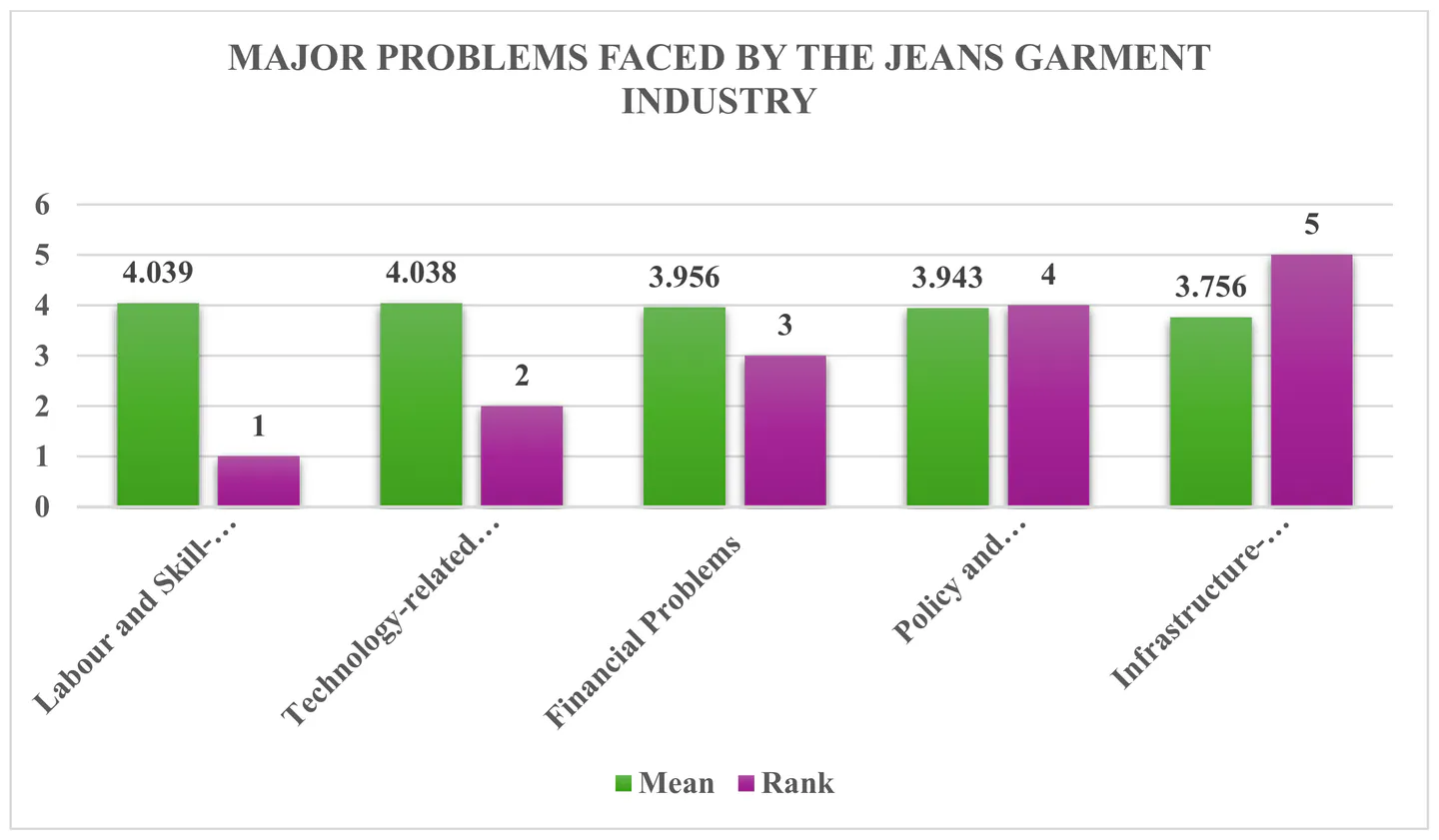
The descriptive analysis highlights the relative significance of the major problem dimensions affecting the jeans garment industry in Ballari City. Among the five dimensions examined, Labour and Skill-related Problems recorded the highest mean score (Mean = 4.039; SD = 0.594), indicating that workforce-related issues represent the most critical operational challenge confronting manufacturing units. Technology-related Problems (Mean = 4.038; SD = 0.644) and Financial Problems (Mean = 3.956; SD = 0.636) also registered comparatively high mean values, suggesting that technological inadequacies and financial constraints continue to exert a considerable influence on industrial performance. Conversely, Infrastructure-related Problems obtained the lowest mean score (Mean = 3.756; SD = 0.587), implying that although infrastructural deficiencies remain relevant, they were perceived as comparatively less severe than the other categories of problems. Overall, the findings demonstrate that each problem dimension exerts a meaningful influence on the operational efficiency and sustainable growth of jeans garment manufacturing units, although their relative intensity differs across the identified dimensions.
Table 4: Descriptive Statistics of the Growth Prospects of the Jeans Garment Industry
| Sl. No. | Dimension | No. of Items | Mean | Standard Deviation | Rank |
|---|---|---|---|---|---|
| 1 | Technological Advancement | 4 | 4.117 | 0.537 | 1 |
| 2 | Sustainability Practices | 7 | 4.11 | 0.538 | 2 |
| 3 | Market Development | 6 | 4.083 | 0.606 | 3 |
| 4 | Entrepreneurial Capability | 6 | 4.061 | 0.561 | 4 |
| 5 | Investment Climate | 5 | 4.04 | 0.601 | 5 |
Source: Computed from Primary Data.
Interpretation:
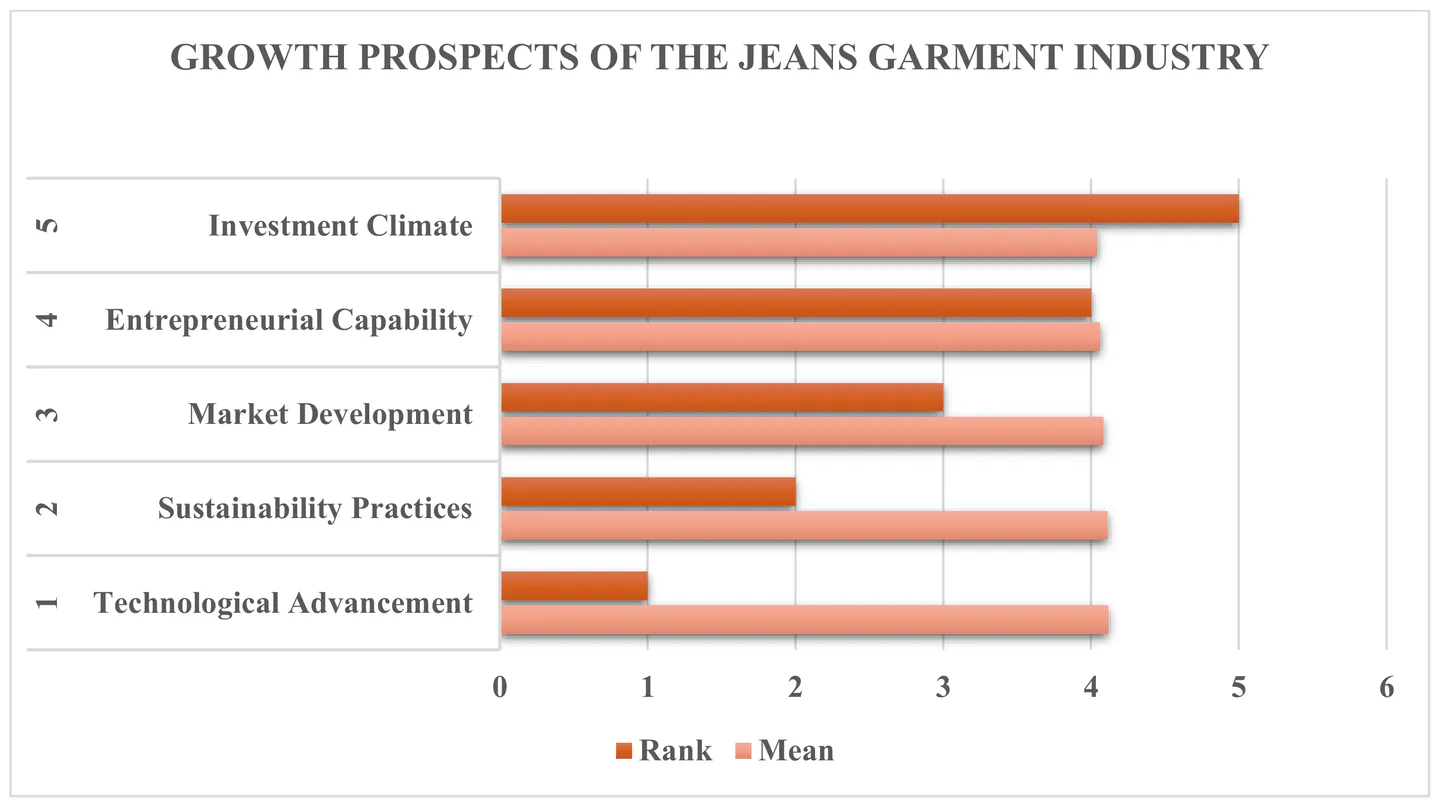
The analysis of the growth prospect dimensions demonstrates a favourable outlook for the future development of the jeans garment industry in Ballari City. Among the identified dimensions, Technological Advancement emerged as the most prominent growth driver, recording the highest mean score (Mean = 4.117; SD = 0.537). This finding indicates that respondents assigned greater importance to technological innovation in enhancing production efficiency, industrial competitiveness, and long-term sustainability. Sustainability Practices (Mean = 4.110; SD = 0.538), Market Development (Mean = 4.083; SD = 0.606), and Entrepreneurial Capability (Mean = 4.061; SD = 0.561) also recorded relatively high mean scores, highlighting their substantial contribution to strengthening the future growth prospects of the industry. Although Investment Climate registered the lowest mean score (Mean = 4.040; SD = 0.601), respondents nevertheless acknowledged its importance in supporting industrial expansion. Taken together, the results suggest that all five dimensions constitute significant determinants of sustainable growth and long-term competitiveness of the jeans garment industry in Ballari City.
Table 5: Pearson’s Correlation Matrix between Problems and Growth Prospects of the Jeans Garment Industry (N = 30)
| Variables | Mean | SD | Problems | Growth Prospects |
|---|---|---|---|---|
| Problems | 3.947 | 0.463 | 1 | 0.136 |
| Growth Prospects | 4.083 | 0.402 | 0.136 | 1 |
| Significance (2-tailed) | — | — | — | 0.475 |
Note: Pearson’s correlation coefficient () and two-tailed significance values are reported. Source: Computed from Primary Data.
Interpretation:
The Pearson’s correlation analysis was performed to examine the relationship between the problems faced by the jeans garment industry and its growth prospects in Ballari City. The findings revealed a weak positive correlation between the two variables (r = 0.136), indicating a marginal positive association. However, the relationship was not statistically significant, as the obtained significance value (p = 0.475) exceeded the accepted 0.05 level of significance. This result suggests that the problems encountered by the respondents did not have a statistically significant relationship with their perceptions of the industry’s growth prospects within the pilot sample. Therefore, the null hypothesis was retained, indicating insufficient statistical evidence to establish a meaningful association between the study variables. Although the direction of the relationship was positive, its magnitude was relatively weak and statistically insignificant. These findings highlight the need for further investigation using a larger sample size to obtain more robust and generalizable empirical evidence regarding the relationship between the problems and growth prospects of the jeans garment industry.
Table 6: Model Summary of Multiple Linear Regression Analysis
| Model | Multiple Correlation () | Coefficient of Determination () | Adjusted | Standard Error of Estimate |
|---|---|---|---|---|
| 1 | 0.369 | 0.136 | -0.044 | 0.274 |
Source: Computed from Primary Data.
Interpretation:
The multiple linear regression model was estimated to examine the extent to which the five identified problem dimensions explain variations in the growth prospects of the jeans garment industry in Ballari City. The model produced a multiple correlation coefficient (R = 0.369), indicating a weak positive relationship between the predictor variables and the dependent variable. The coefficient of determination (R² = 0.136) reveals that the selected problem dimensions collectively account for 13.6 per cent of the variation in growth prospects. However, the Adjusted R² value (-0.044) suggests that the explanatory power of the regression model is limited within the pilot sample. These findings indicate that the model provides only preliminary evidence regarding the influence of the identified problem dimensions on growth prospects.
Table 7: ANOVA Results of Multiple Linear Regression Analysis
| Source | Sum of Squares | df | Mean Square | Sig. | |
|---|---|---|---|---|---|
| Regression | 0.194 | 5 | 0.039 | 0.757 | 0.589 |
| Residual | 1.23 | 24 | 0.051 | — | — |
| Total | 1.424 | 29 | — | — | — |
Source: Computed from Primary Data.
Interpretation:
The Analysis of Variance (ANOVA) was performed to assess the overall statistical significance of the multiple regression model. The results yielded an F-value of 0.757 with an associated p-value of 0.589, which exceeds the prescribed 5 per cent significance level. This indicates that the regression model is not statistically significant and that the five identified problem dimensions, when considered collectively, do not explain a significant proportion of the variation in the growth prospects of the jeans garment industry within the pilot sample. Accordingly, the regression model does not provide sufficient statistical evidence to establish a significant predictive relationship between the explanatory variables and the dependent variable.
Table 8: Multiple Linear Regression Coefficients
| Independent Variables | B | Standardized Beta () | t-value | p-value | Statistical Decision |
|---|---|---|---|---|---|
| Constant | 3.186 | — | 2.516 | 0.019 | Significant |
| Infrastructure Problems | -0.081 | -0.128 | -0.501 | 0.621 | Not Significant |
| Financial Problems | -0.088 | -0.223 | -0.975 | 0.339 | Not Significant |
| Labour & Skill-related Problems | 0.068 | 0.087 | 0.349 | 0.73 | Not Significant |
| Technology-related Problems | 0.288 | 0.336 | 1.476 | 0.153 | Highest Positive Influence (Not Significant) |
| Policy & Institutional Problems | 0.023 | 0.059 | 0.27 | 0.79 | Not Significant |
Note: Dependent Variable: Growth Prospects; significance level = 0.05. Source: Computed from Primary Data.
Interpretation:
The multiple regression coefficient analysis was performed to evaluate the individual contribution of each identified problem dimension to the growth prospects of the jeans garment industry in Ballari City. The findings indicate that Technology-related Problems recorded the highest standardized regression coefficient (β = 0.336), reflecting a relatively stronger positive association with the dependent variable compared with the other explanatory variables included in the model. Nevertheless, the corresponding significance value (p = 0.153) exceeded the prescribed 5 per cent level of significance, indicating that the observed association was not statistically significant. Likewise, Infrastructure Problems, Financial Problems, Labour and Skill-related Problems, and Policy and Institutional Problems also produced statistically insignificant regression coefficients (p > 0.05), suggesting that their independent contributions to the prediction of growth prospects were not supported by the pilot study data. Although the regression coefficients differed in both magnitude and direction, none of the explanatory variables demonstrated a statistically significant individual effect on the dependent variable. Therefore, the findings indicate that the identified problem dimensions did not independently explain variations in the growth prospects of the jeans garment industry within the pilot study sample and should be interpreted as preliminary evidence requiring further validation through the main survey with a larger sample size.
9. Major Findings
The pilot study revealed that the majority of the respondents possessed considerable industrial experience, with 40.0 per cent having more than 20 years of experience in garment manufacturing. All respondents were engaged in jeans garment production, and 63.3 per cent of the manufacturing units operated with fewer than ten employees, indicating the predominance of micro and small-scale enterprises in the study area.
The reliability analysis confirmed that the research instrument demonstrated acceptable to good internal consistency. The Cronbach’s Alpha coefficients of 0.685 for the Problems construct, 0.794 for the Growth Prospects construct, and 0.762 for the overall questionnaire indicate that the instrument was sufficiently reliable for conducting the subsequent statistical analyses.
The descriptive analysis identified Labour and Skill-related Problems as the most critical operational challenge (Mean = 4.039), followed closely by Technology-related Problems (Mean = 4.038) and Financial Problems (Mean = 3.956). Although Infrastructure-related Problems recorded the lowest mean score (Mean = 3.756), respondents continued to recognise infrastructure as an important factor influencing industrial performance.
Among the growth prospect dimensions, Technological Advancement recorded the highest mean score (Mean = 4.117), followed by Sustainability Practices, Market Development, Entrepreneurial Capability, and Investment Climate. These findings indicate that respondents perceived technological innovation and sustainable business practices as the principal drivers of future industrial growth and competitiveness.
Pearson’s correlation analysis revealed a weak positive relationship (r = 0.136) between the problems faced by the industry and its growth prospects. However, the relationship was not statistically significant (p = 0.475), indicating that the pilot study did not provide sufficient empirical evidence to establish a significant association between the two variables.
The multiple linear regression model explained 13.6 per cent of the variation in growth prospects (R² = 0.136), but the overall regression model was not statistically significant (F = 0.757; p = 0.589). This suggests that the five identified problem dimensions did not collectively predict the growth prospects of the jeans garment industry within the pilot sample.
The regression coefficient analysis showed that Technology-related Problems recorded the highest standardized regression coefficient (β = 0.336). Nevertheless, none of the five problem dimensions demonstrated a statistically significant independent influence on growth prospects (p > 0.05), indicating that the pilot study findings should be considered preliminary and verified using the larger sample in the main investigation.
10. Suggestions
Strengthen skill development initiatives by providing regular technical training, vocational programmes, and capacity-building activities to improve labour productivity and address skill shortages within jeans garment manufacturing units.
Promote technological upgradation by facilitating access to modern machinery, digital production systems, and automation technologies through financial incentives, subsidy schemes, and technology support programmes.
Improve financial accessibility by expanding institutional credit facilities, simplifying loan procedures, and providing affordable financial assistance to micro and small-scale garment manufacturing enterprises.
Enhance infrastructural and institutional support through the development of common industrial facilities, reliable power supply, transportation networks, and stronger coordination between government agencies, industry associations, and manufacturing units.
Undertake further research using a larger sample size to obtain more robust and generalisable empirical evidence regarding the relationship between the problems faced by the jeans garment industry and its growth prospects. The pilot study findings provide a useful methodological foundation for the main investigation but should be interpreted as preliminary in nature.
11. Conclusion
The present empirical study examined the major problems and growth prospects of the jeans garment industry in Ballari City through a pilot investigation involving garment manufacturing units. The findings indicate that labour and skill-related issues, technological constraints, financial limitations, and policy-related challenges continue to influence the operational performance of manufacturing units. At the same time, respondents expressed favourable perceptions regarding future growth prospects, particularly in relation to technological advancement, sustainable practices, market expansion, and entrepreneurial development. Although the correlation and multiple regression analyses did not establish statistically significant relationships between the identified problem dimensions and growth prospects within the pilot sample, the research instrument demonstrated satisfactory reliability and methodological adequacy. Therefore, the pilot study successfully validated the research design and analytical framework for the main investigation. The findings provide a useful empirical foundation for conducting the large-scale survey and are expected to contribute to a better understanding of the challenges and future development of the jeans garment industry in Ballari City.


