This study is part of a qualitative research project aimed at analyzing the production of arithmetic, geometric, and algebraic meanings through Investigative Educational Practices, based on sequences of figurate numbers, within a teacher education process involving preservice mathematics teachers. The research is epistemologically grounded in the Semantic Fields Model (SFM) and the principles of Investigative Educational Practices (IEP), which emphasize collaborative work. Based on this foundation, particularly on enunciation residues, the meanings generated by participants are analyzed using the plausible reading method, which considers both local and global interpretations. Centered on the theme of three-dimensional figurate numbers, the study explores relationships involving generalizations and recursion, fostering integration among Arithmetic, Algebra, and Geometry, especially in learning environments that value investigation and collaboration.
## I. INTRODUCTION
This work is an excerpt from a qualitative research study (Andrade, 2024), developed using Case Study methodology (Yin, 2015) and grounded in Investigative Educational Practices (IEP), as proposed by Chaves (2004; 2005). The study is based on the Semantic Fields Model (SFM), through which meanings produced by in-service and pre-service mathematics teachers were analyzed, using educational practices involving various forms of meaning-making through figurate number sequences.
An examination of certain official educational documents reveals the fundamental role of Mathematics and its developments as an essential component in students' education. When Mathematics is addressed as a field of knowledge, the multiple domains that compose it become evident, underscoring the importance of articulations between them. This importance becomes even more pronounced when analyzing the National Common Curricular Base (Brasil, 2018).
Apesar de a Matemática ser, por excelência, uma ciência hipotético-dedutiva, porque suas demonstrações se apoiam sobre umsystema de axiomas e postulados, é de fundamental importância también considerar o papel heurístico das experimentações na aprendizagem da Matemática. No Ensino Fundamental,essa area,por meio da articuição de seuis diversos Campos-Aritmética,Elgebra, Geometria,Estatística e Probabilité-,precisa garantir que os alunos relacionem observações empíricas do mundo real a representacoes (tabelas, figuras e esquemas) e associam estas representacoes a uma atividade matemática (conceitos e propriedades), fazendo induções e conjecturas (Brasil, 2018, p. 265).
Although this issue is currently highlighted, we still observe a significant separation between the fields of Arithmetic, Algebra, and Geometry. This fragmented approach treats Mathematics as a set of isolated compartments, which may lead to the perception that these domains do not connect. However, according to our understanding and theoretical-epistemological foundation (Lins; Giménez, 1997), this view is not a model to follow, as the structures of these three fields are deeply interconnected, allowing for a logical transition between them that fosters the construction of new knowledge and the production of different meanings.
To support this idea, we rely on the book Perspectives in Arithmetic and Algebra for the 21st Century (Lins; Giménez, 1997), which critically reflects on the practice of teaching Arithmetic before Algebra, as if the latter were merely a continuation or generalization of the former. From this perspective, we propose actions and Investigative Educational Practices (IEP) aimed at teachers and pre-service mathematics teachers, with the goal of emphasizing the potential for an integrated development between Arithmetic, Algebra and Geometry. our intent is to foster connections between these fields, enabling the production of meanings and knowledge as interrelated parts of Mathematics.
By highlighting possible ways of meaning-making in the context of educational practices with figurate number sequences, we seek to value the logic of operations and the methods of operation used by participants during the process. These aspects are often overlooked when mathematical fields are addressed in a compartmentalized manner, as is common in traditional teaching, which is marked by a hegemonic and non-integrative view of mathematics.
For this proposal, we reference research and extension projects developed by the Study and Research Group on the Semantic Fields Model and Mathematics Education (Gepemem), affiliated with the Federal Institute of Espírito Santo - Vitoria campus (Ifes). Building on these initiatives, we continued investigations addressing the contributions of the Pythagorean school, including the famous Pythagorean theorem and the study of figurate numbers.
In the first phase, we developed the project "Pythagoras: In (and Beyond) the Theorem," registered with the Ifes Research Directorate under code PJ00004234, running from September 2017 to December 2019. This project had three main areas of focus: (a) History of Mathematics; (b) Historical proofs of the Pythagorean theorem; (c) Pythagorean arithmetic, with a special emphasis on figurate numbers. The results generated various academic productions. Given that many aspects remained unexplored, a second phase of studies was proposed, titled "Pythagorism: Historical, Philosophical, Epistemological, and Practical Foundations" (code PJ00006481 - Sigpesq, Chaves et al., 2021). This project expanded the investigations into four areas: (i) Pythagorean arithmetic; (ii) Historical proofs of the Pythagorean theorem; (iii) History and Philosophy; (iv) Possible interactions between Mathematics and Music.
Another phase involved the research entitled "Meanings Produced Regarding Biases Between Pascal's Triangle, Tetrahedral Numbers, and Triangular Figurate Numbers in a Mathematics Teacher Training Process" (Andrade, 2021). This investigation analyzed the meanings produced by participants in the context of Investigative Educational Practices (IEP), focusing on tetrahedral figurate numbers.
Thus, the goal of this work was to analyze the meanings produced by participants, relating the ways of producing arithmetic, geometric, and algebraic meanings through IEP with three-dimensional figurate numbers. With this goal, we promoted a Complementary Teaching Action (ACE), integrated into a teacher training process for Mathematics. Fourteen pre-service teachers, involved in the Institutional Scholarship Program for Teaching Initiation (Pibid), one master's student, one doctoral student, and five monitors, all members of Gepemem, participated in this ACE. The sessions were held in person, with a duration of four hours each, totaling a workload of 40 hours.
## II. OBJECTIVES
A Based on our concerns and the justification provided, we formulated the following guiding question: What meanings are produced by participants regarding possible transitions between modes of meaning-making in arithmetic, geometry, and algebra, through Investigative Educational Practices, involving three-dimensional figurate numbers?
Based on this direction, we established the following general objective: To analyze, in light of the Semantic Fields Model (MCS), the meanings produced by participants in a teacher training process for Mathematics educators in basic education, as well as their methods of operation and the corresponding logic of operations involving possible modes of meaning-making in arithmetic, geometry, and algebra, through IEP, with three-dimensional figurate numbers.
Thus, we established the following research actions:
- (i) Identify the meanings produced by participants, based on enunciation residues, within the IEP activities.
- (ii) Analyze the production of arithmetic, geometric, and algebraic meanings, as well as the methods of operation and the corresponding logic of operations used by participants in the practices developed.
- (iii) Develop an educational product containing the practices developed, in light of SFM and IEP, discussing pedagogical possibilities and meanings produced by teachers.
### And as field actions:
- (i) Offer a teacher training course (for both in-service and pre-service teachers) in the form of a Complementary Teaching Action (ACE), based on historical, geometric, arithmetic, and algebraic aspects of two-dimensional and three-dimensional figurate numbers.
- (ii) Conduct educational practices and develop didactic-pedagogical materials (DPM) through the lens of IEP, providing teaching and learning processes, as well as the production of meanings and possible plausible readings of the proposals presented in the respective field actions.
- (iii) Produce data that enables plausible readings regarding the training process developed.
- (iv) Validate the produced educational product with the Gepemem group.
- (v) Hold a plenary discussion with the ACE participants, monitors, and teachers regarding the meanings produced by the research participants.
## III. THEORETICAL FRAMEWORK
As previously mentioned, our research is epistemologically grounded in the Semantic Fields Model (SFM). The first glimpses of this epistemological model emerged between 1986 and 1987, when its creator, the mathematical educator Prof. Dr. Romulo Campos Lins (1955-2017), sought to overcome the reductionist view of the concept of "error." His concern focused on understanding the thoughts underlying responses considered incorrect. The use of quotation marks around the word "error" is intentional, as within the SFM, the focus is not on categorizing answers as correct or incorrect, but rather on understanding the reasons behind them and analyzing why something was said in a particular way.
The thesis entitled A Framework for Understanding What Algebraic Thinking Is was defended by Romulo Campos Lins in 1992 at the University of Nottingham (UK). After returning to Brazil, he became a faculty member at the São Paulo State University (Unesp), Rio Claro campus, where he remained for 25 years.
In 1993, Lins published his first article presenting the initial ideas of the Semantic Fields Model (SFM). Since then, he has argued that the SFM is not a theory to be studied but rather a theorization that develops through practice. This is because the Model's central aspect of learning is the production of meanings, which only exists through action—that is, within an activity. In Lins (1999), this perspective is reinforced by treating the production of meanings as a political and pedagogical act, essential to an implementable proposal in inclusive Mathematics Education.
To support our analysis through the lens of SFM, it is necessary to present some foundational ideas within the SFM perspective, such as knowledge, interlocutor, local stipulations, meaning, object (Lins, 1999), as well as semantic field, nucleus, and communicative space (Lins, 2012).
In the context of SFM, knowledge consists of a belief-statement accompanied by a justification. As Lins (2012, p. 12) asserts: "Knowledge consists of a belief-statement (the subject enunciates something they believe) along with a justification (what the subject understands as authorizing them to say what they say)." Thus, knowledge exists at the moment of enunciation, within the activity.
Enunciation is always produced by an author, who establishes a reader as the direction for what is said. The reader, in turn, produces meaning for what they believe has been said, generating what is called the residue of enunciation. Therefore, knowledge is configured in the relationship between the speaker/performer (author) and the direction in which they speak/perform (interlocutor).
In this context, meaning refers to everything that is said/done about an object, always considering its context within an activity. The object is that which meanings are produced about (Lins, 2012).
In a process of meaning production, we have a semantic field, which is related to a nucleus, made up of local stipulations—absolute truths established within an activity, which are local and may change as new stipulations are incorporated or old ones are abandoned (Lins, 1997, p. 144).
In Lins (2012), we also find the concept of communicative space, which offers an alternative to the traditional concept of communication. Rather than one cognitive subject simply addressing another, the communicative space involves two subjects speaking in the same direction, meaning they share interlocutors.
## IV. METHODOLOGY
This research is of a qualitative nature, focusing on the production of meanings, as discussed by Silva (2003), Lins (2012), Chaves, Cezar, and Teixeira (2021), and developed in Andrade (2021). We adopted a methodological approach with similarities to Case Study (Yin, 2015), through which we conducted Investigative Educational Practices (PEI) focused on three-dimensional figurate numbers in the context of Mathematics teacher education. The field actions were carried out through Complementary Teaching Actions (ACE), involving students from the Pibid program and undergraduates and postgraduates in Mathematics. These actions included practices with figurate number sequences, addressing different modes of meaning production: geometric, algebraic, and arithmetic.
The figurate numbers, the objects of our practices, were studied within the Pythagorean school (Andrade, 2021; Dutra, 2020; Roque, 2014; Almeida, 2002). These numbers form sequences organized according to geometric patterns associated with either planar or three-dimensional shapes. These sequences possess various properties and are interrelated in complex ways, which have enabled—and continue to enable—extensive study.
We are grounded in the project "Pythagoreanism: historical, philosophical, epistemological, and practical foundations," as outlined by Chaves et al. (2021), while continuing the investigations initiated in Andrade (2021) on the study of tetrahedral numbers.
For the development of the proposed practices, we relied on the concept of Investigative Educational Practices (PEI), as defined in Chaves (2004; 2005), as a means to foster the production of meanings in a Mathematics teacher education process.
Entendemos por Pratica Educativa Investigativa (PEI) aquela que não se restringe ao ambiente da sala de aula, que se constrói atraves de ambientes e cenários investigativos em que há o compromisso de estimular a curiosidade, a espontaneidade de pensamentos e de ações. Uma PEI por/agregar os indivíduos envolvidos no processo em torno da resolution de um problema local, Construira a partir das dúvidas e das incertezas que surgem ao longo do processo — na alternária (Chaves, 2005, p. 128).
Thus, we aimed to promote the interaction and development of the critical thinking of the participants involved, who are currently or will be acting as teachers in training processes. For this reason, we chose the case study as the methodological approach, understanding that this choice can contribute to the success of our practices, as it favors more empirical research and provides more effective interaction between the participants.
### a) Complementary Teaching Action (ACE)
This ACE was carried out with 14 Mathematics teachers in training. In each meeting, the participants were organized into workgroups of three to four members, which allowed us to perform analytical readings both locally—considering individual actions within the groups—and from a broader perspective, observing the interactions and productions of the groups as a whole. Throughout the process, nine in-person meetings were held, each lasting four hours (Chart 1), in which we facilitated discussions and practical activities centered on figurate numbers.
Chart 1: List of ACE Meetings
<table><tr><td>Meeting 1</td><td>Presentation of the ACE and Serlimat</td><td>06/05/2023</td></tr><tr><td>Meeting 2</td><td>History of figurate numbers; Triangular and square numbers</td><td>13/05/2023</td></tr><tr><td>Meeting 3</td><td>Pentagonal, hexagonal numbers; Sum of triangular numbers</td><td>20/05/2023</td></tr><tr><td>Meeting 4</td><td>Generalization of two-dimensional figurate numbers</td><td>27/05/2023</td></tr><tr><td>Meeting 5</td><td>Mathematical recursion laws</td><td>03/06/2023</td></tr><tr><td>Meeting 6</td><td>Tetrahedral numbers</td><td>17/06/2023</td></tr><tr><td>Meeting 7</td><td>Generalization of the rods of tetrahedral numbers</td><td>24/06/2023</td></tr><tr><td>Meeting 8</td><td>Square pyramidal numbers</td><td>01/07/2023</td></tr><tr><td>Meeting 9</td><td>Final plenary</td><td>08/07/2023</td></tr></table>
## V. ANALYSIS OF ENUNCIATION RESIDUES
The enunciation residues derived from the speech and actions of the participants were analyzed regarding the proposals presented through the PEI. To ensure this, we recorded audio and video dialogues, kept notebook records, made notes, and analyzed student tasks based on these practices.
To guide the data analysis, we relied on the plausible reading method (Lins, 2012; Silva, 2003), in line with the Model of Semantic Fields (MCS). This method contrasts with the Piagetian model of developmental stages, as it rejects the notion of error as absence. In plausible reading, we do not seek to interpret the subject by what they "lack" in order to reach what we expect, as this would deny the legitimacy of their production of meanings.
Thus, we used plausible reading as an analytical tool for the processes of meaning production, considering, as highlighted by Silva (2003), five main elements for this analysis—also referred to as notion-categories.
i) A constituição de objetos - coisas sobre as quais sabemos fazer algo e dizemos - que nos permite observar tanto os novos objetos que está SEND而成uados quando os significados produzidos para eles objetos; ii) A formação de um núcleo: as estipulações locais, as operações e sua lógica; iii) A producao de conhecimiento;
- jjj) Os interlocutores;
kkk) As legitimidades, isto é, o que é legítimo ou não dizer no interior de uma atividade (Silva, 2003, p. 65).
By highlighting some of these analyses, we observed that the participants began to constitute, as objects within the activity, tables, geometric representations, recursive strategies, and processes of generalization. The ways of operating of these participants predominantly involved establishing comparisons between the rows and columns of the tables they built, relating the terms of the numerical sequences to their respective positions within these structures.
<table><tr><td>Ordem</td><td>Distribuição gnomônia</td><td>Número quadrado relativo à ordem</td></tr><tr><td>1</td><td>1</td><td>1</td></tr><tr><td>2</td><td>1 + 3</td><td>4</td></tr><tr><td>3</td><td>1 + 3 + 5</td><td>9</td></tr><tr><td>4</td><td>1 + 3 + 5 + 7</td><td>16</td></tr><tr><td>5</td><td>1 + 3 + 5 + 7 + 9</td><td>25</td></tr><tr><td>:</td><td>:</td><td>:</td></tr><tr><td>n</td><td>1 + 3 + 5 + 7 + 9 +... + 2n - 1</td><td>f4(n) = n2</td></tr></table>
Figure 1: Square Figurative Numbers
We can analyze, as shown in Figure 1, that the actors in the process, the subjects involved in our research, began to identify and stipulate the last term of each row, organizing the information through arithmetic progressions (AP), in order to structure recurring patterns within these numerical sequences. Thus, from the general term and the sum of the terms, respectively, they arrived at the general term of the gnomonic distribution and also at the general term of each of the sequences of planar figurate numbers. Therefore, why not use such methods instead of recursively searching for a pattern (numerical or geometric)? Because our main goal is to analyze the production of meaning by the subjects of knowledge, which we stipulate within this process, examine the thematicization of the logic of operations and the ways of operating by the participants, as well as the constitutions and transformations of the cores, highlighting some elements that constitute this process. Through this, we consider that:
Por umazo, fica claro que tanto as abordagens "letristas" quando as "facilitadoras" está, cada uma a seu modo, profundamente equivocadas. As "letristas", por ignorarem completenessque o texto em letras" não carrega, em si, significado algoum, e que este significado é produzido em relaço a um nucleo, e que via de regra há muitos significados possveis; todo "calculo comletras" está subordinado a uma lógica das operações, essalógica imprime caracteristicas particulares às possibilidades desse calculo. As "facilitadoras", por ignorarem que a passagem de um Campo semantico constituiço em torno de um nucleo familiar para um outro Campo semantico constituído em tomo de um outro nucleo - possível e até provavelmente não-familiar - não se dá por "passagem suave", "abstração", "generalização" ou qualquer outras coisa que sugira que permanece de alguma forma uma "essência" (Lins; Giménez, 1997, p. 131)
Thus, by adopting the perspective of the Semantic Fields Model (MCS), our focus is directed toward reading the process of meaning production, rather than fixating on final products or permanencies. This is because our interest lies in the dynamics of the process, in the logic of the operations performed by the subjects, in the constitution and transformation of the cores, and in the way meanings are produced throughout the activity.
We defined as a mode of meaning production the beginning with the sequence of square numbers, organizing them in a table (Figure 1), taken as the object. Based on the idea of recursiveness, we considered that this organization would allow us to highlight that the terms in the third column (representing square numbers in terms of their order) corresponded to the squares of the values in the first column (the order).
From this perspective, the modes of meaning production can be understood as "[...] 'idealized semantic fields' that exist in the form of repertoires through which we prepare ourselves to try to anticipate what others are talking about or whether what they say is legitimate or not" (Lins, 2012, p. 29). Thus, we anticipated that the participants' way of operating could occur through the comparison between numerical columns, establishing relationships between the square figurate number $[f_4(n)]$ and its respective order $[n]$.
Another analysis we highlight relates to Meeting 7. In this session, practices were developed around the stems (or "rods") of tetrahedral numbers (Figure 2), based on the construction of this figurate number.
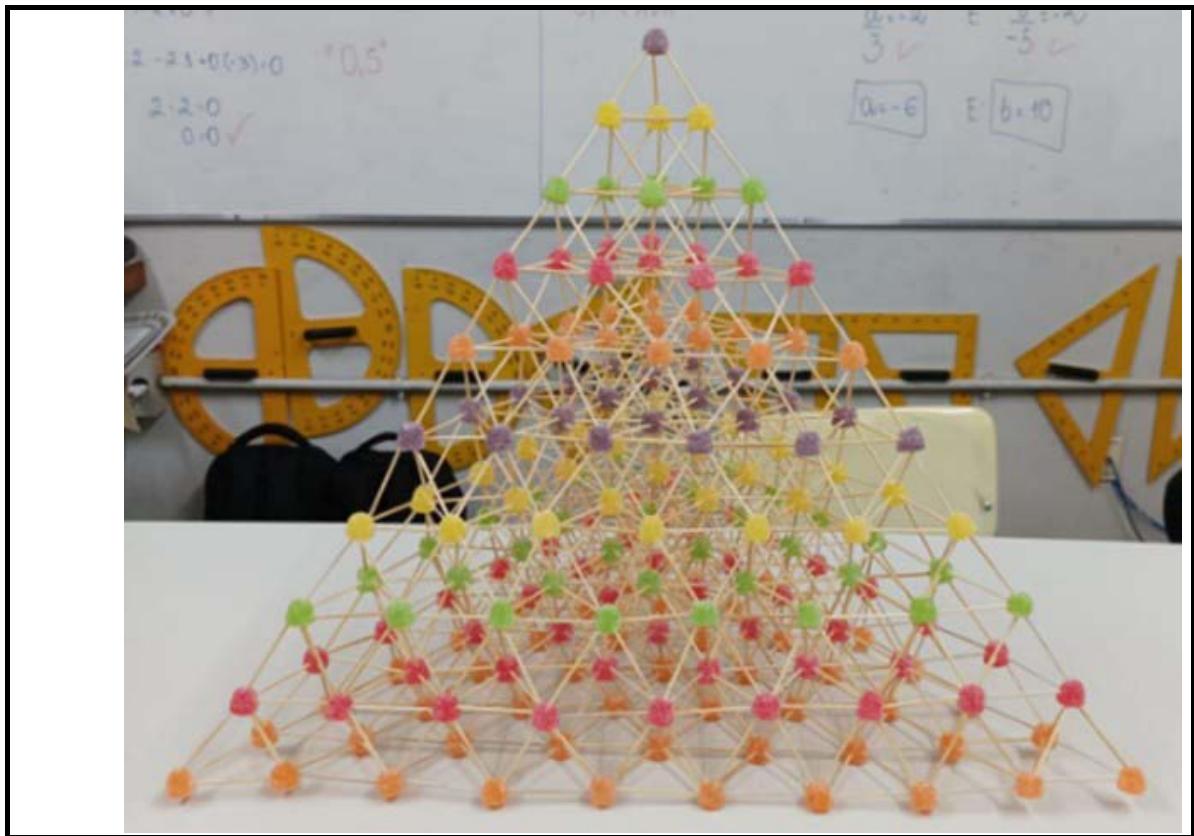 Source: (Andrade, 2024) Figure 2: Counting rods from pictorial models of tetrahedral numbers
During this process, the following dialogue emerged (Chart 2):
Chart 2: Dialogue about the practice involving tetrahedral numbers
- $\left[\mathrm{RE}_{81}\right] - \text { Professor } - \text { Let 's think about the number of sticks we had in each order. }$ In order 1 we didn't have any sticks, because it was just one gumdrop; in order 2 we had 6 sticks. How many sticks would there be in the other orders? Would it be possible to find a general term?
- $\left[\mathrm{RE}_{82}\right] - \mathrm{Pedro} - \mathrm{An}$ idea I had was to look at the smaller tetrahedrons of order 2, to divide the larger one into several small ones. For example: how many do I have in this one of order 3? I have 4 of order 2. So, to find out the number of gumdrops, I need to know how many tetrahedrons of order 2 there are and multiply by the number of sticks.
- $\left[\mathrm{RE}_{83}\right] - \mathrm{Lord} - \mathrm{So}$ you're taking a tetrahedron of order 2 as the standard unit, right? And you think that wouldn't be a problem?
- $\left[\mathrm{RE}_{84}\right] - \mathrm{Pedro} - I$ thought about it because there's no intersection of sticks like there is with the jujubas, so it would work to treat each unit separately.
- $\left[\mathbf{R}\mathbf{E}_{85}\right] - \mathbf{Lord} - I$ see. And have you tested it for the different orders?
- $\left[\mathrm{RE}_{86}\right] - \mathrm{Pedro} - I$ tested it for orders 1, 2, and 3, and it worked. Now I'll check for order 10.
- $\left[\mathrm{RE}_{87}\right] - \mathrm{Pedro} - \text{For order 10, it gave 720.}$
- $\left[\mathbf{R}\mathbf{E}_{88}\right] - \mathbf{Lord} - \text { Check this out, because 720 would be for order 9, not order 10. }$ What do you think could be the issue?
- $\left[\mathbf{R}\mathbf{E}_{89}\right] - \mathbf{Pedro} - \text { Alright, it looks like it 's always giving one order earlier. I'll try to understand it and fix the formula. }$
- $\left[\mathrm{RE}_{90}\right] - \text { Pedro } - I$ solved it. Actually, you have to use the term from the previous order, because in order 1 there will be no sticks, and in order 2 it will be 6 times 1, and so on, it will always be a quantity from the previous order of the tetrahedron of the order.
Source: (Andrade, 2024) (translated)
At this moment, participant Pedro presented the following idea (Figure 3):
Figure 3: Participant Pedro's method for counting sticks
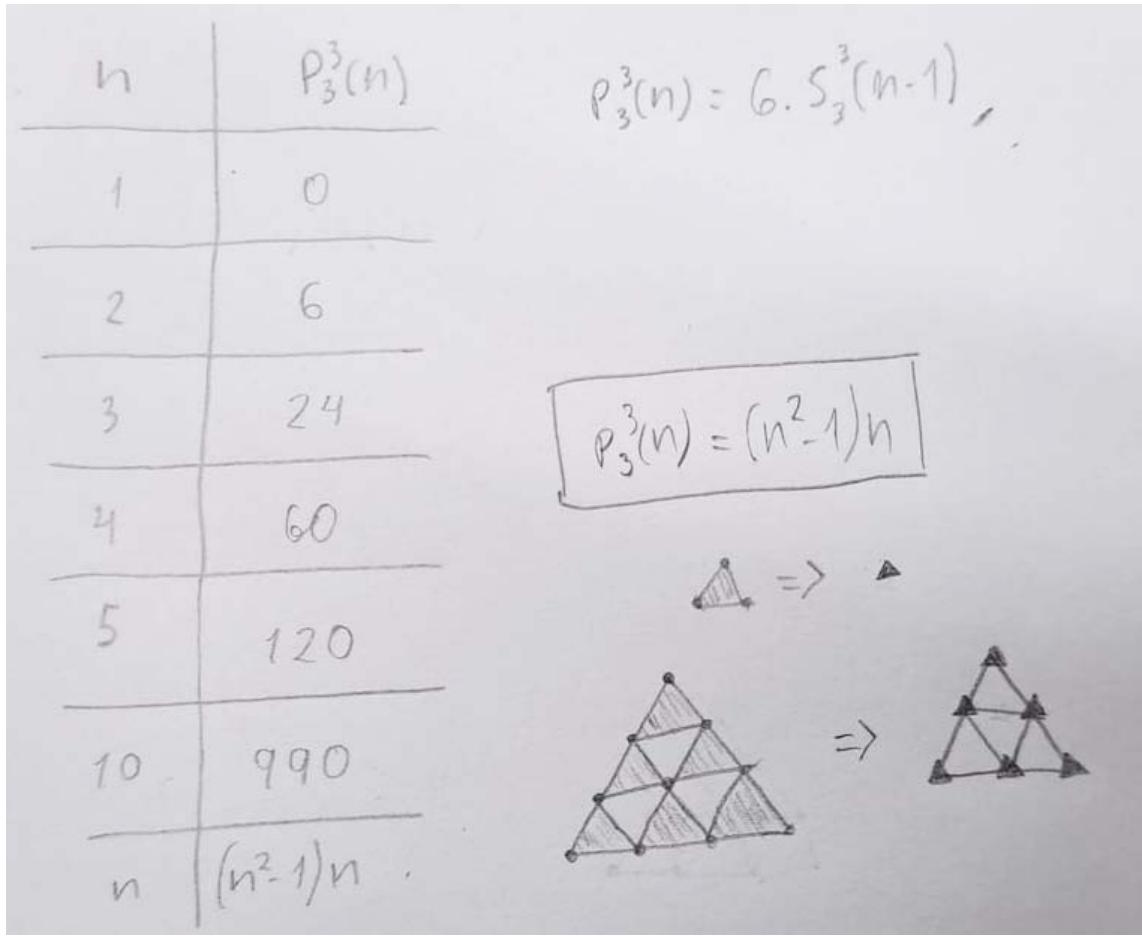 Figure 4
Source: (Andrade, 2024)
Pedro developed what he called $P_3^3 (n) = 6 \cdot S_3^3 (n - 1)$, where $P_3^3 (n)$ represents the number of sticks in his pictorial tetrahedron model, with n referring to the order number. By writing a table for orders 1 to 5, 10, and n on paper, he arrived at the simplified term, as shown in Figure 3.
NumIn a local reading process, we observed that Pedro followed the way of operating that we had been adopting in our ACE, that is, he used recursion to establish a counting process for the pictorial models from orders 1 to 5. Pedro also established the tetrahedron of order 2 as the object (standard unit) and began operating within a geometric semantic field, as we can identify in his notes (Figure 3).
On one hand, Professor $(\mathrm{RE}_{81})$ suggests an action of transformation of a given material - as presented in Davidov (1999) and cited earlier - by suggesting that, based on what they had already produced, they think about quantifying sticks with the intention of developing algebraic thinking and producing meanings for algebra (as stated by Lins and Giménez (1997)). On the other hand, Davidov's (1999) idea of referring to the concrete constitution of human activity and its components (needs, motives, objectives, conditions and means at hand, actions and operations), in Leontiev's perspective, was fundamental to Pedro's interaction in the process $(\mathrm{RE}_{82}, \mathrm{RE}_{84}, \mathrm{RE}_{86}, \mathrm{RE}_{87}, \mathrm{RE}_{89} \text{ e } \mathrm{RE}_{90})$, who established a dialogical relationship with Lord $(\mathrm{RE}_{83}, \mathrm{RE}_{85} \text{ e } \mathrm{RE}_{88})$, helping him reach his conclusions $(P_{3}^{3}(n) = (n^{2} - 1)n)$. This is because, as seen in Davidov (1999), the learning need emerged from Pedro's need to experientially (or mentally) engage with the proposed material, breaking it down into both essential general aspects and particular aspects, observing how these aspects interrelate.
In addition to Pedro's group, the other groups also arrived at $P_3^3 (n) = 6 \cdot S_3^3 (n - 1)$ and, in the same way, concluded that $P_3^3 (n) = (n^2 - 1)n$. They also constituted the tetrahedron of order 2 as the standard unit object, but each group did so based on their own ways of operating.
## VI. SOME CONSIDERATIONS
This research provided a formative process for teachers, conducted through our ACE, grounded in investigation, collaborative work, and the joint construction of knowledge. Highlighting the historical foundations of Pythagorean arithmetic, particularly in the study of bidimensional and tridimensional figurate numbers, it was emphasized, referencing the works of Lins and Giménez (1997), the importance of developing algebraic thinking, promoting connections between modes of producing arithmetic, algebraic, and geometric meanings. These connections emerged from the actions and tasks developed with figurate number sequences, showcasing the participants' operational logics and the construction of shared communicative spaces.
When considering figurate numbers solely as a product, the object of study for many mathematicians throughout history, there is a risk of attributing them a merely folkloric character or a simple pastime. However, by focusing on the processes—especially the production of meanings—this theme gains greater depth, revealing itself as a fertile field for creating diverse learning environments. Therefore, figurate numbers remain relevant, bridging generations of teachers and mathematics educators.
Generating HTML Viewer...
References
16 Cites in Article
M Almeida (2002). Platão Redimido: a teoria dos números figurados na Ciência antiga & moderna.
F Andrade,De (2021). Significados produzidos a respeito de vieses entre triângulo de Pascal, números tetraédricos e figurados triangulares em um processo de formação de professores de matemática.
F Andrade,De (2024). Anais do(a) SEMINÁRIO INTEGRADO DE PÓS-GRADUAÇÃO EM EDUCAÇÃO EM CIÊNCIAS E MATEMÁTICA.
Brasil (2018). Ministério da Educação. Secretaria de Educação Básica. Base nacional comum curricular.
R Chaves (2005). Material pedagógico na base nacional comum na linha da pedagogia da alternância: ensino de Matemática nas Escolas Família-Agrícolas.
R Chaves (2004). Por que anarquizar o ensino de Matemática intervindo em questões socioambientais? 223p. Tese (Doutorado em Educação Matemática) -Programa de Pós-Graduação em Educação Matemática.
Rodolfo Chaves,Mariana Cezar,Bea Teixeira (2021). Regimes de Verdade e Discursos na Manutenção de uma Matemática como Instrumento de Exclusão.
Elisabete Corcetti,Susane Petinelli-Souza (2021). Ações afirmativas no ensino superior brasileiro.
Carolina Melo Linhares,Isadora Almeida Soares,Carlos Guimarães Medeiros (1999). DESENVOLVIMENTO DE UM SIMULADOR SOLAR DE BAIXO CUSTO PARA FINS DIDÁTICOS.
T Dutra (2020). Produção de significado a respeito de números figurados em um processo de formação de professores de Matemática.
R Lins (2012). Modelo dos Campos Semânticos e Educação Matemática: 20 anos de História.
R Lins (1999). Por que discutir teoria do conhecimento é relevante para a Educação Matemática.
R Lins,J Giménez (1997). Unknown Title.
T Roque (2012). História da Matemática: uma visão crítica, desfazendo mitos e lendas. 2. Reimp.
A Silva (2003). Programa de Pós-Graduação em Educação Matemática do Instituto de Geociências e Ciências Exatas.
Robert Yin (2015). Estudo de caso: planejamento e métodos.
No ethics committee approval was required for this article type.
Data Availability
Not applicable for this article.
How to Cite This Article
Filyppe Neves de Andrade. 2026. \u201cProduction of Meaning in Practices Involving Three-Dimensional Figurate Numbers\u201d. Global Journal of Science Frontier Research - F: Mathematics & Decision GJSFR-F Volume 25 (GJSFR Volume 25 Issue F1): .
Explore published articles in an immersive Augmented Reality environment. Our platform converts research papers into interactive 3D books, allowing readers to view and interact with content using AR and VR compatible devices.
Your published article is automatically converted into a realistic 3D book. Flip through pages and read research papers in a more engaging and interactive format.
This study is part of a qualitative research project aimed at analyzing the production of arithmetic, geometric, and algebraic meanings through Investigative Educational Practices, based on sequences of figurate numbers, within a teacher education process involving preservice mathematics teachers. The research is epistemologically grounded in the Semantic Fields Model (SFM) and the principles of Investigative Educational Practices (IEP), which emphasize collaborative work. Based on this foundation, particularly on enunciation residues, the meanings generated by participants are analyzed using the plausible reading method, which considers both local and global interpretations. Centered on the theme of three-dimensional figurate numbers, the study explores relationships involving generalizations and recursion, fostering integration among Arithmetic, Algebra, and Geometry, especially in learning environments that value investigation and collaboration.
Our website is actively being updated, and changes may occur frequently. Please clear your browser cache if needed. For feedback or error reporting, please email [email protected]
Thank you for connecting with us. We will respond to you shortly.