
I. BACKGROUND
Efforts to address maternal and newborn health in Low- and Middle-Income countries have resulted in mixed results globally (1). While some countries have registered success, about 830 women die every day from pregnancy- or childbirth-related complications, the majority from Low and Middle-Income Countries (2). Tanzania is not an exception in this trend as it recorded significant success in child health but continued to suffer from poor maternal outcomes (3). Such a trend helped the country to attain the millennium development goal for child health, but not in maternal health (4, 5). Notwithstanding the level of investment in maternal health in the country, maternal mortality has remained stagnant for over two decades (3). Challenges and attributes to such burden vary (6) making it difficult to use a single approach to address them, further increasing complexity of the maternal health landscape.
Like for Tanzania mainland, Zanzibar also suffers from poor maternal health while child health indicators are making positive strides. Maternal mortality in Zanzibar was 350/100,000 live births in 2016 (7). Facility-based data show an increase of maternal deaths from 187 per 100,000 live births in 2014 to 276 per 100,000 live births in 2016. Differently to another context, most of such deaths in Zanzibar occur within the health facilities owing to close proximity to health facilities for the 95% of the population (8). With such good access to health facilities, the main challenge was the quality of health services, particularly the emergency obstetric and neonatal care (EmONC) (9).
Ensuring better EmONC indicators calls for improvement of the nine signal functions of EmONC (10). The signal functions are the key interventions used to treat direct obstetric complications that arise during pregnancy and childbirth and cause the majority of maternal deaths (11). The signal functions include administration of parenteral antibiotics, administration of uterotonic drugs, administration of parenteral anticonvulsants for pre-eclampsia and eclampsia, manual removal of the placenta, removal of retained products of conception, the performance of assisted vaginal delivery and performance of basic neonatal resuscitation. Facilities able to perform all seven signal functions are classified as basic EmONC facilities while those who perform all basic services plus caesarean section and blood transfusion are Comprehensive EmONC facilities.
Monitoring the progress made with response to investment in maternal and newborn health, helps to gauge the effectiveness of the interventions. In Zanzibar, the ministry of health in collaboration with UNFPA conducted the first EmONC assessment in 2012 (8). Addressing the burden of maternal health needs continuous monitoring of signal functions for EmONC. The ministry therefore, called for another survey to examine progress if any made throughout the six years—in the year 2018. This paper reports the gains in particular for signal functions pertinent to EmONC.
II. METHODS
a) Study design and settings
This cross-sectional study used a quantitative approach to examine progress made in maternal health services provision. A standardized questionnaire was used using face-to-face interviews. We conducted this study in the 83 selected health facilities providing maternal health services in Zanzibar. The facilities were from 10 districts in all five regions of Zanzibar (Zanzibar North, Zanzibar South, Town West, Pemba North, and Pemba South). Zanzibar has three levels of care in her health system: Primary level: Health Care Units and Centers (PHCUs, PHCU+ and Primary Health Care Centres-PHCCs); Secondary level: District Hospitals; and Tertiary level: Mnazi Mmoja National Hospital. Functionally, the PHCUs provide Primary health care services, while PHCU+ gives in addition, services such as delivery, dental, laboratory and pharmacy services. Moreover, PHCCs offers the same services as PHCU+ with the addition of inpatient and X-ray services. District hospitals deliver second line referral services, including simple surgical procedures and the tertiary hospital (Mnazi Mmoja Hospital) provides referral services.
b) Sampling
The research team worked with the technical experts from Ministry of Health who also participated in the previous EmONC study to select and list health facilities to be used for data collection that were used in 2012. The team conducted the current research in the similar health facilities included in the 2012 survey by Fakih and colleagues (8). They include: 30 health facilities in Pemba and 53 facilities in Unguja. Of the 83, a total of 48 were PHCU+ and above; 29 were PHCU; and 6 were private facilities ranging from low level to specialized maternity home. One was a military health facility that also takes care of public clients.
c) Measurements
The research team used the validated tool to gather data for signal functions in Zanzibar. The Averting Maternal Death and Disability (AMDD) program module (12) systematically assesses maternal and newborns case management which includes essential case management practices of women in labor and during delivery, care provided to newborn at birth including neonatal resuscitation, monitoring of babies and evaluate the appropriate use of medicines and equipment. The Open Data Kit (ODK), a free and open-source set of tools uploaded in the tablets was used to collect, synchronizes, and manages data.
d) Data collection
The trained research assistants collected data working in a team of three people in one facility supervised by one experienced researcher. We made five teams, each with four people. Three teams were deployed to Unguja and two in Pemba. Fifteen research assistants and five team leaders received one-week training. The training oriented research teams about data collection tools and process, standard guidance on research ethics and upholding confidentiality of respondents and data. The training workshop for research assistants and team leaders was finalized by practical aspect in two-selected health facility.
e) Analysis
All data were cross-checked every day for consistency and synchronized into a database for further analysis using STATA software. We conducted descriptive analyses and reported using frequency and percentages. We used the WHO handbook on monitoring emergency obstetric care to guide the description of the EmONC signal functions (11).
They include:
i. Administration of parenteral antibiotics.
ii. Administration of parenteral uterotonics.
iii. Administration of parenteral anticonvulsants.
iv. Manual removal of the placenta (MRP).
v. Removal of retained products.
vi. Assisted Vagina Delivery (AVD).
vii. Neonatal resuscitation.
viii. Blood transfusion, and
ix. Obstetric surgery.
III. RESULTS
a) Availability of EmONC services
Table 1 shows the results of the facilities with CEmONC and BEmONC services three months before the survey. We analyzed data from 80 health facilities for the availability of EmONC services. Of the total facilities, only 2.5% provided CEmONC services, and 3.8 provided BEmONC services. The Mnazi Mmoja hospital, which is a national referral hospital in Zanzibar, was rated as a CEmONC facility. Of the five district hospitals, one was a CEmONC facility, while other four were rated as partially BEmONC facilities in this assessment. About 75% of PHCC facilities had BEmONC capacity while 80% of PHCU+ had partially BEmONC capacity. Only one in four of PHCU was of partially BEmONC capacity 71% were Non-EmONC facilities.
| Health Facility Status | |||||
| Health Facility Type | Total | CEmONC | BEmONC | Partially BEmONC | Non-EmONC |
| n (%) | n (%) | n (%) | n (%) | ||
| Number of health facilities | 80 | 2 (2.5) | 3 (3.8) | 47 (58.7) | 28 (35.0) |
| National Hospital | 1 | 1 (100.0) | 0 (0.0) | 0 (0.0) | 0 (0.0) |
| District hospital | 5 | 1 (20.0) | 0 (0.0) | 4 (80.0) | 0 (0.0) |
| PHCC | 4 | 0 (0) | 3 (75.0) | 1 (25.0) | 0 (0.0) |
| PHCU+ | 41 | 0 (0) | 0 (0.0) | 33 (80.5) | 8 (19.5) |
| PHCU | 28 | 0 (0) | 0 (0.0) | 8 (28.6) | 20 (71.4) |
| Maternity hospital | 1 | 0 (0) | 0 (0.0) | 1 (100.0) | 0 (0.0) |
b) Signal functioning
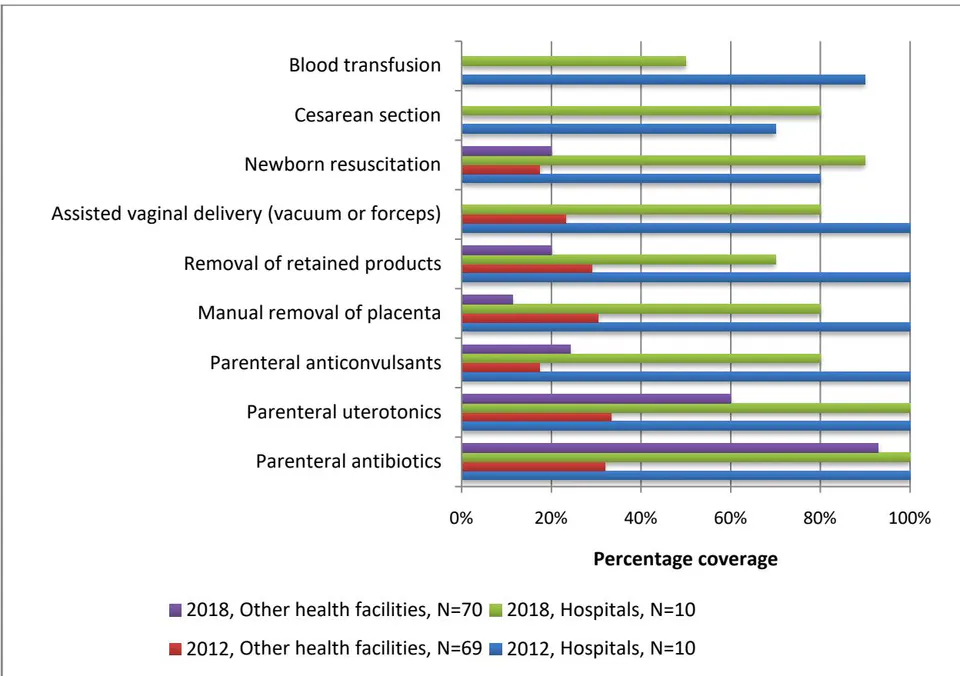
The nine signal functions were measured in all surveyed facilities and compared with those of 2012 survey (Figure 1). The results of the proportion of health facilities in the provision of each of the nine signal functions in health facilities three months before data collection. Evidence suggests that, only 50% of the hospitals that provide blood transfusion services in 2018 compared to 90% in 2012 survey. Cesarean sections were performed by more hospitals in 2018 compared to
2012 (80% vs. 70%). Health facilities performed newborn resuscitation more frequently in 2018 compared to 2012 survey (90% vs. 80%). In all other signal functions the 2012 study had higher ratings compared to 2012 in performance. For other health facilities, we observed better performance in terms of signal functions compared to 2012 survey for the use of parenteral uterotonics, parenteral antibiotics, parenteral antibiotics, and newborn resuscitation.
c) Minimum acceptable number of BEmONC and CEmONC facilities
Table 2 shows the available health facilities providing EmONC services. Zanzibar needs a minimum of 15 EmONC facilities to meet the needs of 1.3 million people. This includes 3 CEmONC facilities. Of them, one CEmONC facility is required to serve Pemba and two for Unguja to adequately serve the population.
In this study, Zanzibar met only 66.7% of required CEmONC facilities and only 33.3% of the required EmONC facilities. Pemba island had 100% of the required CEmONC facilities while only 40% of required EmONC facilities were available. Unguja island has only achieved 30% of the required EmONC facilities but reached 100% of required minimum number of CEmONC facilities.
| Total Population | Surveyed facilities (all) | Existing BEmONC | Existing CEmONC | Min number of CEmONC | Overall min number of facilities required (Basic + Comp) | % of the facilities available (Basic + Comp) | % of Comp facilities available | |
| Overall | 1,303,569 | 80 | 3 (3.8) | 2 (2.5) | 3 | 15 | 33.3 | 66.7 |
| By Zones | ||||||||
| Pemba | 406,848 | 30 | 1 (3.3) | 1 (3.3) | 1 | 5 | 40.0 | 100.0 |
| Unguja | 896,721 | 50 | 2 (4.0) | 1 (2.0) | 2 | 10 | 30.0 | 100.0 |
e) Distribution of health facilities in the visited districts
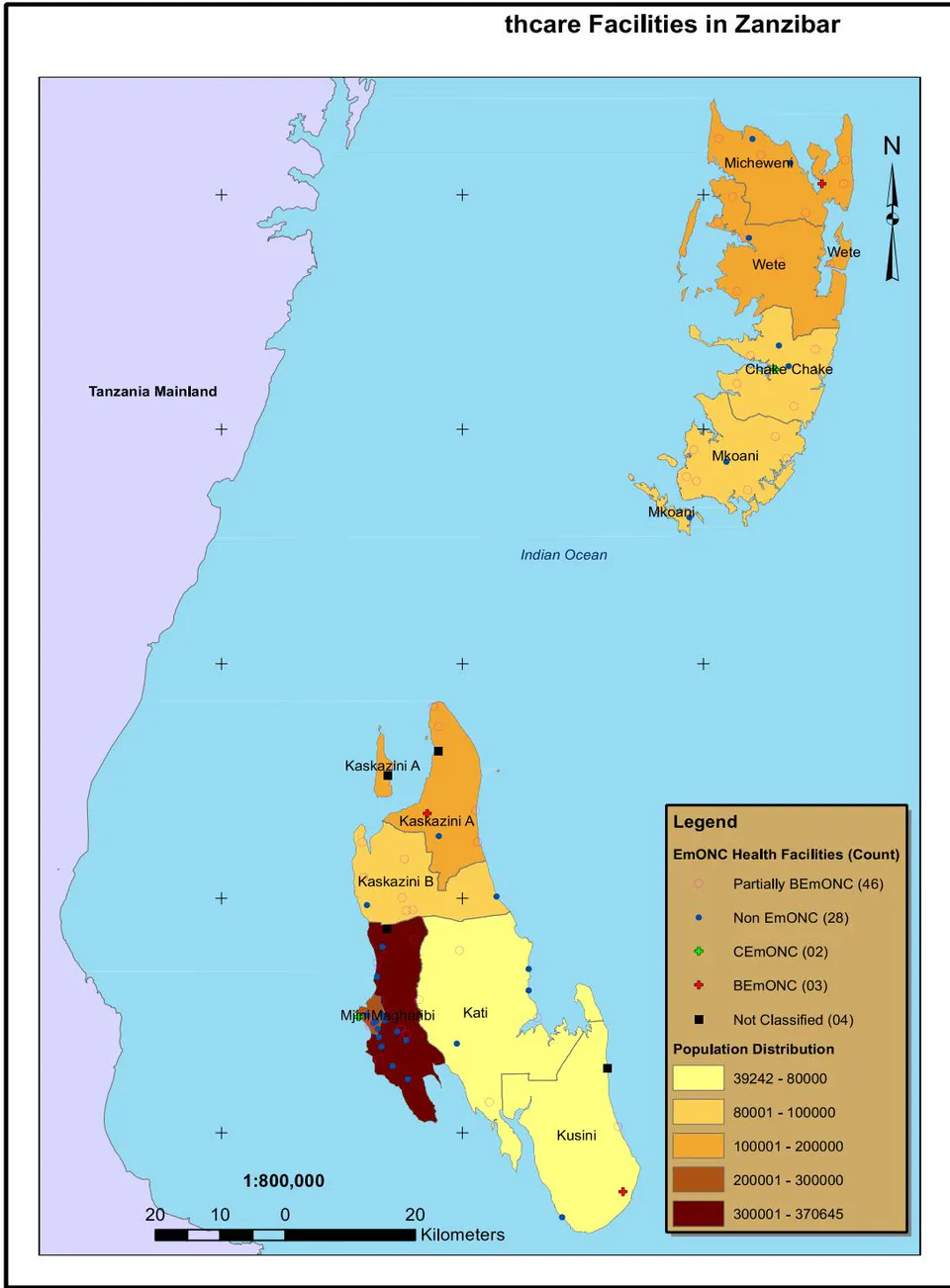
Figure 2 shows that CEmONC health facilities were found in Chake-Chake and Mjini Magharibi districts. BEmONC health facilities were found in Micheweni, Kaskazini A, and Kusini.
IV. Discussion
Addressing maternal and newborn health challenges calls for strengthened health system responding to unprecedented burden thereof (13-15). It is critical to ensure Emergency Obstetrics and Neonatal Care (EmONC) services are strengthened to achieve the global and national targets (16). Moreover, tracking the progress in such efforts will help to determine the state of maternal and child health and remaining challenges. For this purpose, the ministry of health conducts periodic evaluations of EmONC in Zanzibar. The current survey was conducted to examine the progress made since 2012 (8) in EmONC in the two isles.
Evidence generated from the current survey suggests that EmONC has deteriorated compared to that of 2012(8). For every 500,000 populations, the minimum acceptable number of EmONC facilities is five and one of which should be CEmONC(11). Although the number of non-EmONC facilities has significantly reduced in Zanzibar compared to 2012(35% vs. 55.7%), and that of partially BEmONC facilities increased compared to 2012 survey(58.7% vs. 28%), the minimum acceptable number of both basic and comprehensive services in Zanzibar according to the population size remains low. The current study found that only 2(2.5%)and 3(3.8%)provided comprehensive and basic EmONC services respectively in Zanzibar. These results are different from those of the 2012 survey where more health facilities provided CEmONC services(9% in 2012 vs. 2.5% in 2018)and BEmONC services(7.6% in 2012 vs. 3.8% in 2018). Like in other developing countries(17, 18), disparity in urban and rural areas according to EmONC were also obvious in Zanzibar. The facilities with reported EmONC capacity are in urban settings, creating further challenges in areas where the majority of populations reside. This survey also showed uneven distribution of EmONC services available in Unguja and Pemba districts. The districts with higher non-EmONC facilities were in Unguja compared to Pemba. This is also true for the regional distribution where the two regions of Pemba had a lower proportion of non-EmONC health facilities compared to those of Unguja.
Majority of the population can access health services in Zanzibar owing to the high number of health facilities and their close proximity to the people. However, poor health system remains a barrier for quality health care. In this regard, most of maternal deaths occur within health facilities. Moreover, neonatal mortality trend has remained flat over the same period. Zanzibar reported 33 neonatal deaths for 1000 live births in 2010 compared to 25 neonatal deaths for 1000 live births in 2015 (3). Poor health system performance contributes to such trends (19). Interventions are known to reduce the burden of maternal and child mortality (20). One of the effective ways is by ensuring better indicators in signal functions constituting EmONC. It is however noted that such indicators are not getting any better in Zanzibar.
The researchers made efforts to ensure quality of data presented in this study. However, even under such careful measures there is a need to interpret the findings with care owing to the following limitations. First, evidence on EmONC services availability relied on cases managed under the selected facilities within the three months before data collection. The reported absence of such services could also mean such case did not exist during the reported period or not registered. Lack of information may therefore not directly mean absence of capacity to handle such a case. This is a standardized method for determining signal function. The alternative method would be asking facility in charges on ability of their facilities to provide EmONC services, which again would be subjective to reporting bias. Second, the study design was cross sectional which has causality limitation. Third, despite covering all districts and regions in Zanzibar, data on EmONC presented in this report lacks generalizability to the context beyond health facilities. Although antenatal attendance is high in Zanzibar, it is understood that delivery at home also remains common and therefore maternal complications may not feature in this report. Home delivery is significantly high in the isles (3).
In conclusion, Non-EmONC Health facilities deteriorated from 55.7% in 2012 to 35% in 2018. However, facilities with partially BEmONC services increased from 28% in 2012 to 58.7% in 2018. CEmONC and BEmONC facilities have declined, where the minimum recommended level for EmONC was met in only 33.3% facilities. Compared to Unguja, districts and regions in Pemba had better EmONC indicators. More efforts are needed to improve capacity of health facilities in providing EmONC services. This will also call for improvement of human resource capacity to conduct resuscitation, caesarean sections, as well as improving health facilities infrastructure, and increasing supplies needed to provide health care for ultimate improvement of maternal and new born health indicators.