I. INTRODUCTION
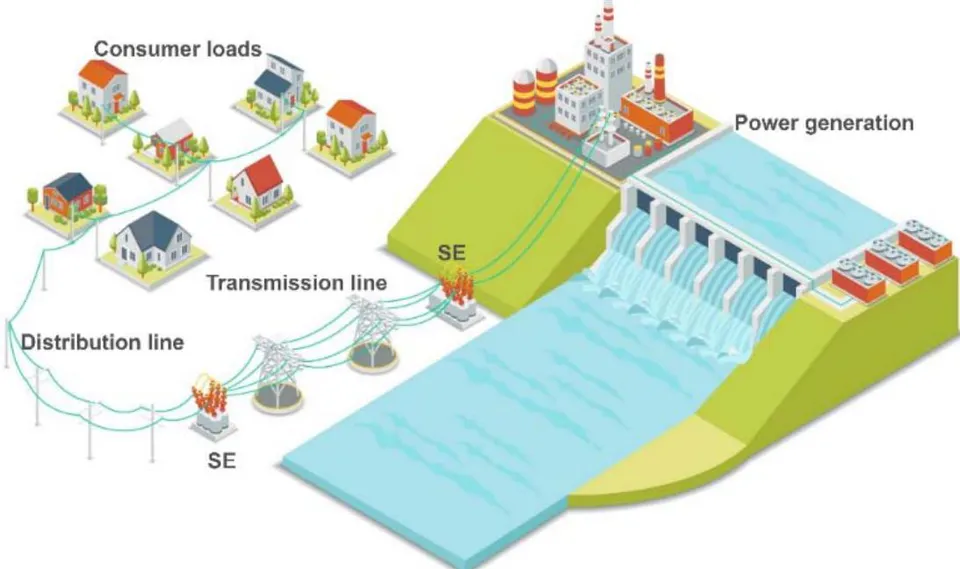
Electrical energy is essential for a country's economy to guarantee all support to social and cultural aspects(Siemens, 2014). In this context, electricity must be present in the urbanization of new areas and transported over large distances through electric power transmission lines, which have the function of connecting generating stations to distribution systems, while the distribution systems connect individual loads of a certain area to the transmission lines as shown in figure 1. Since the voltage amplitudes in the generation, transmission and distribution processes differ, it is necessary to adapt them to the consumption centers by lowering or raising the voltage levels when the energy is transmitted. In these situations, the substations (SE) are used to adjust the voltage values between the processes through transformers of specific ends and equipment that allow the maneuver, measurement and protection of the electric power system (Grigsby, 2006; Loschi et al., 2015).
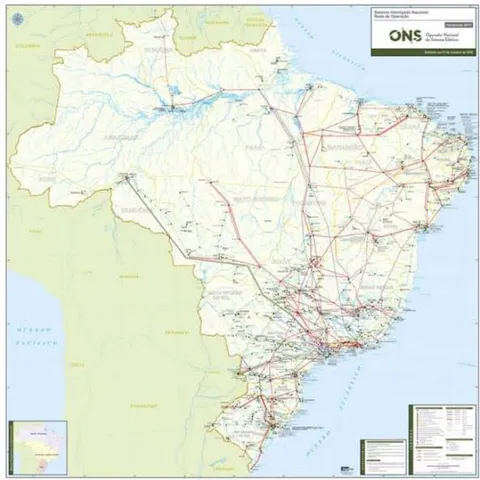
According to (IBGE, 2018), Brazil has about 208 million inhabitants, with the population having access to the electricity grid and the Brazilian electricity sector encompassing electricity generation, transmission, distribution and commercialization services. For reaching each part of Brazil it employs the National Interconnected System (SIN), demonstrated in figure 2a, a transmission electrical grid integrated by 134.765 thousand km of extension at 230 kV or superior voltage level - a system composed of power plants, transmission lines and distribution assets covering all the country and shown in figure 2b(ONS, 2016). Altogether, the electricity supply is carried out by 75 electric power companies providing between transmission and distribution services (ANELL, 2018).
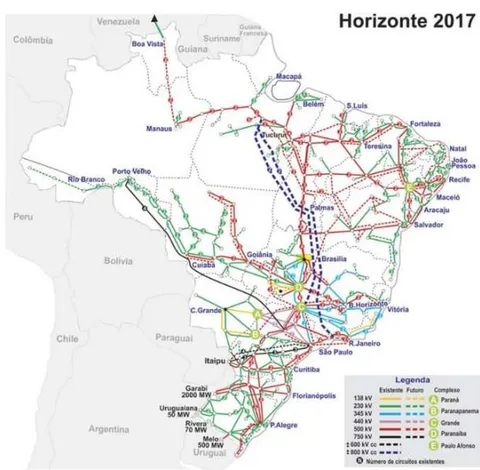
b) Brazilian electrical transmission grid mapping.
To demonstrate improvements in maintenance actions of electric energy assets and in compliance with national sustainability policies Section 2 shows concepts of dielectric, electrical characteristics and classification. In Section 3 sustainable dielectrics and advanced materials used in high voltage equipments are presented. In Section 4, a prospective analysis on the use of environmentally friendly materials by the electrical insulation ensures that the current flows only along the conductors and not between individual conductors or between the conductor and the ground and can also serve as a support for electrical conductors, from low to high voltage levels (order of up to hundreds of kilovolts) (Chudnovisk, 2017). Conduction of current through a
Brazilian electric utilities through sustainability reports, case study and use in the distribution system are presented. Finally, trends in the electricity market and future studies are described in Section 5.
II. HIGH VOLTAGE EQUIPMENT DIELECTRICS
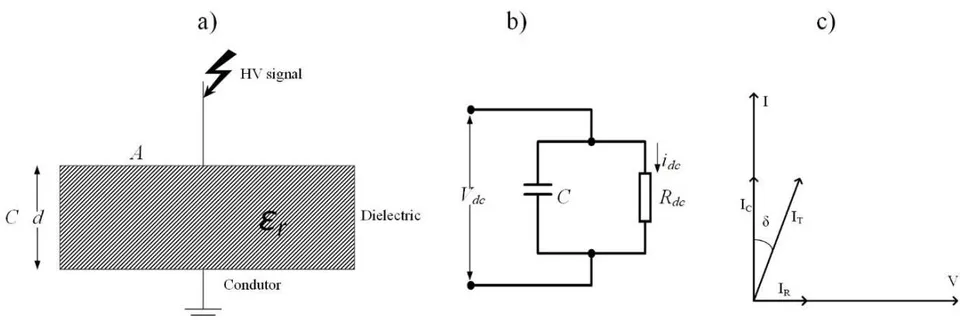
Dielectric depends mainly on its relative permittivity number and the type and amplitude of the voltage signal. While conductors have resistance and coils have inductance, dielectrics can be electrically modeled as capacitances. So a typical parallel plate capacitor is demonstrated in Figure 3 (Arora & Mosch,2011).
, the capacitance C is given by:
Where: –absolute permittivity or dielectric constant is8.854. ou[1/(36π)]. F/m; – number of relative permittivity; A – plate areas inm ; d – distance between plates. The DC (direct current) resistance provided by an insulating material represents the insulation resistance concept of a dielectric and is generally described as specific insulation resistance, which is the reciprocal of the conductivity , expressed by(Arora & Mosch, 2011),
When the direct current is applied through the two uniform field electrodes separated by a block of insulating material having an area A and a length d (Figure3a.) of the equivalent circuit diagram (Figure3b.), constituting a capacitance C(Figure3a.) and a DC resistance in parallel(Figura3b.), the following relationship can be described,
Considering Ohms's Law, the (figure 3b.) can be expressed:
For a uniform field (E = U/d), the following equation is valid,
As well as conductivity , the specific resistance of the insulation depends heavily on the temperature and is a function of time with respect to the applied voltage. When two conductors are insulated from each other, a layer of gas or insulating material fills the medium between them, forming the electrical insulation. The equivalent circuit of a practical capacitor is therefore an ideal capacitor in parallel with a resistance as shown in Fig. 3b. Considering figure 3c., where is the total current and V is the voltage source applied with a frequency , the loss of power in the capacitor is given by(Holtzhausen & Vosloo, 2011),
Where, and are resistive the capacitive currents, respectively, and f is the signal frequency. The tangent delta term ( ) is known as loss factor or loss tangent and it can be expressed as (Arora & Mosch, 2011),
The tan indicates the quality of the insulation material and is important in the evaluation of insulating liquids e.g. liquid dielectric of transformers. In this way, the main characteristics of dielectrics to be analyzed in order to identify the state of the insulator are: the relative permittivity of the material (dielectric constant), polarization, dielectric strength, tangent delta properties and applications as expressly by(Arora & Mosch, 2011; Holtzhausen & Vosloo, 2011).
The liquid and solid insulation systems have polarization properties, resulting in a dielectric constant greater than unity and, therefore, are composed of dipoles as shown in Figure 4.
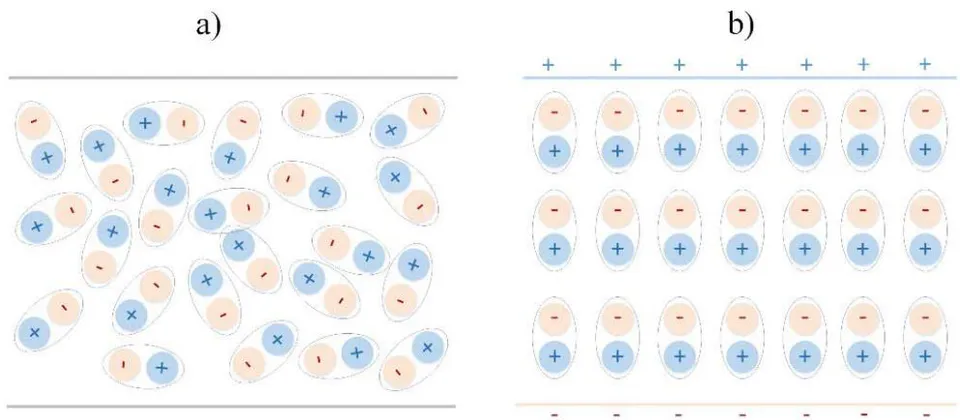
The dipoles can occur due to positive and negative charge centers of the molecules do not match or due to the distribution in the crystalline structure of the material. When the dielectric is not energized, the dipoles are randomly arranged (Figure 4a) and when subjected to DC signal voltage, the dipoles are aligned (Figura 4b). In the case of an alternating voltage from AC (alternating current) signal, the dipoles vibrate according to the frequency of inversions of polarity, resulting in heating of the dielectric due to friction (these dielectric losses are also the principle of microwave oven operation). As no insulation material is a perfect insulator, there are also conduction losses (Holtzhausen & Vosloo, 2011).
The insulation systems comprises air spacings, solid insulation and immersion in insulating liquid and are classified, according to their intended purpose, as being of external use or internal use. In addition, they can still be classified as self-regenerative (they have the capacity to recover the electrical rigidity, after occurrence of discharge caused by the application of the test voltage) and non-regenerative (Frontin, 2013). The present analysis takes into consideration only non-regenerative insulation systems since they form equipments those requires continuous dielectric state assessment as described by (Aguiar do Nascimento et al., 2018) in which demonstrates maintenance tests of instrument transformers' dielectrics. Furthermore, it was investigated the insulating replacement for sustainable procedures by energy concessionaires power.
a) Solid Insulating Materials
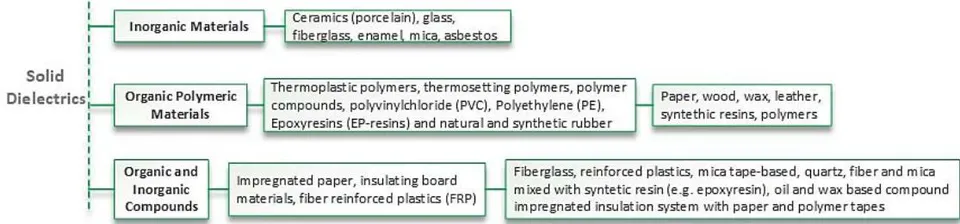
Solid dielectrics are classified according to their chemical compositions, being classified in inorganic, organic materials and composed of both materials. The main dielectric materials are described in Table 1.
In the diagram shown in Figure 5, as described by (Arora & Mosch, 2011), a summary of the main insulators.
| Material | εr | tan δ | Electric Strength | Properties | Applications |
| Mica | 5.5 - 7 | - | Stable at high temperatures | Insulation of rotating machine windings (up to 20 kV) together with epoxies. | |
| Paper | - | 20 – 50. | - | - | Oil-impregnated in HV transformer winding insulation. |
| Glass | 4.5 - 7 | 10 - 100. | 10 – 50 | Brittle | Glass cap and pin insulators. Glass fibres together with epoxy resin. |
| Porcelain | 6 | 3 – 30. | 20 – 40 | - | Insulators, bushings. |
| Polythene | 2.3 | 1 - 10. | 30 – 40 | - | Cross-linked (XLPE) polythene used in hv cables up to 110 kV. |
| PVC | 5.5 | >100. | 11 – 30 | - | LV cables. |
| PTFE | 2 | 19 | - | High temperature applications. | |
| Epoxy resin (with silica filler) | 4 | - | 18 | - | Encapsulation of MV Ct's and VT's Transformer bushings and insu-lators: cycloaliphatic resin. |
| EPDM rubber | 2 - 3 | - | - | - | Insulators, using a fibre glass core. |
| Silicone rubber | 3 - 6 | - | - | Hydrophobic surface properties | Insulators, using a fibre glass core. |
Therefore, taking into consideration Table 1 and Figure 5, the main inorganic insulation materials are porcelain, glass and mica. As organic polymeric materials are in extensive use paper, PVC (Polyvinyl chloride) and PE (Polyethylene) and various rubbers e.g.
silicone and EPDM (Ethylene propylene diene monomer) rubber. Among organic and inorganic compounds the epoxy resin and impregnated paper are used.
b) Liquid Insulating Material
A liquid can be expressed as an extremely compressed gas as a molecular arrangement, the molecules being very close to each other - called the kinetic model of the liquid structure. Thus, the constituent molecules have free movement and without the tendency to separate. Some of the functions provided by liquid dielectrics are: insulation between energized parts, e.g. insulation between containers and grounded containers, as in transformers; insulation impregnation produced in thin layers of paper or other materials e.g. transformers, cables, capacitors;
convective refrigerant action in transformers and oil-filled cables action in transformers and oil filled cables through circulation; filling voids, in order to make the dielectric integrally added; arc extinction in circuit breakers; higher capacitance (liquids of greater permissivity) in power capacitors. In this state of matter, the dielectrics can be synthetic or natural, with high dielectric strength and with varying viscosity and permissiveness over a wide range. In figure 6, we have the main materials that form the liquid dielectrics: Nitrogen , Helium (He), Sulfur Hexafluoride , as described by (Arora & Mosch, 2011).
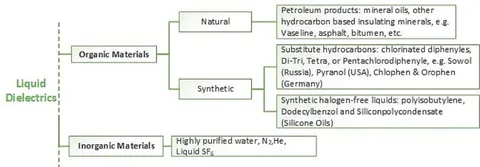
The liquid dielectric materials can be divided into two major classifications: organic and inorganic. Organic dielectrics are basically chemical compounds that contain carbon. Among the main natural insulating materials of this type are petroleum products and mineral oils and the most important and widely used organic liquid dielectrics for electrical energy equipment are mineral oils. The other natural organic insulating materials are asphalt, vegetable oils, wax, natural resins, wood and fiber plants (fibrins). In this case, the permissiveness, tangent delta and dielectric strength were taken into account, as shown in Table 2, where properties of some materials used in electrical equipment are demonstrated. Inorganic materials have limited application due to the high cost and complexity handling in high voltage environment so it is not addressed here and can be found in (Arora & Mosch, 2011).
| Material | Electric Strength | Applications | ||
| Mineral In sulating Oils | 2.0 | (Transformers) (Circuit Breakers) | Power transformers, CTs, PTs, Circuit Breakers,Bushings,Cables and Condensers | |
| Linseed oil | 3.2 | - | - | |
| Castor oil | 4.2 and 4.5 | 175 – 250 | Condensers | |
| Chlorinated Diphenyles | 4 - 6 | 250 – 500 | Transformers, condensers | |
| Silicone oils | 2.6 | 300 – 400 | Cables, condensers, bushings |
Liquid insulation material is usually used in conjunction with solid insulation, such as paper in cables or transformers. In this way, the liquid impregnates the insulation material of paper or linen and displaces air or gas (Holtzhausen & Vosloo, 2011).
c) Gaseous Dielectrics
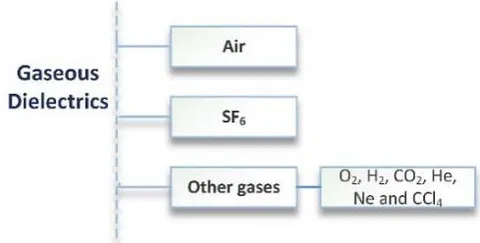
The gas is the most recommended gaseous dielectric today in the power system after the air. There are a lot of other insulating gases, but they do not have the proper properties required for electrical insulation such as Oxigen ( ), Hidrogen ( ), Carbon dioxide ( ), Helium (He), Neon (Ne), Carbon tetrachloride (CCl4), Sodium (Na) or Dichlorofluoromethane ( ). However, air is the most important because it is freely available and the cheapest gaseous dielectric (Arora & Mosch, 2011). Figure 7 shows some of the main gaseous insulators used in the electrical industrial environment.
Even though atmospheric air is the cheapest and most common dielectric, it has very poor insulation properties. Thus, atmospheric air insulation systems have comparatively very large geometric dimensions. The electric field prevalent in these systems is an extremely non-uniform field. As transmission voltages increase, the size of transmission towers, lines and substations have increased to achieve the required requirements. In this case, the size can be reduced by changing the extremely non-uniform fields in atmospheric air insulation systems in weakly non-uniform fields in gas isolated systems (GIS). Better utilization of the dielectric properties is achieved in weakly non-uniform fields. Therefore, it reduces the dimensions of the equipment to a certain rated voltage. Atmospheric air, even under high pressure, has a relatively lower dielectric strength. The most suitable gas, widely used since 1960, as an alternative to air and nitrogen, is Sulfur Hexafluoride (SF6) (Arora & Mosch, 2011) and its properties are described in Table 3.
Figure 7: Gaseous dielectrics used in high voltage equipments. Table 3: dielectric properties (Arora & Wolfgang, 2011; Mosch & Hauschild, 1979).
| Property | Physical Conditions | Symbol | Value |
| Relative Permittivity | 0.1 MPa, 25 °C-51 °C (liquid) | εr | 1.0021.81 ± 0.02 |
| Dielectric Loss Tangent | 0.1 MPa-51 °C (liquid) | tanδ | <5 · 10-6<1 · 10-3 |
The potential of SF6 as a greenhouse gas is extremely high, although the amount of SF6 in the atmosphere, as compared to concentrations of natural occurrence and other man-made greenhouse gases, is extremely low. This has led to growing concern about the possible long-term environmental impact of (Arora & Wolfgang, 2011).
d) Conventional Insulating Materials
The electrical equipments present in the generation, transmission and distribution systems have the purpose of switching, transforming, protecting and regulating the electric voltage and, if necessary, compensating the reactive power and, for this purpose, use electric insulation systems to realize such
| Equipment | Description | Insulating Material |
| Power Transformer | Transmits electrical power or power from one circuit to another, transforming voltages and currents into an alternating current circuit, or modifying values of electrical circuit impedances | Insulating oil and cellulose (paper or presspan) |
| Shunt reactors | Neutralizes the effect of line reactance in order to compensate for the natural capacitive reactance of the transmission line | Insulating oil and cellulose (paper and presspan). The cooling system is specified as ONAN - natural oil and natural air or KNAN - natural ester and natural air |
| Bushing | Insulated electrical components that allow safe passage of electrical energy through a grounded barrier eg transformer tank, building wall or GIS | Insulation paper and, or, mineral oil and can be used insulating paper and either resin or gas |
| Current Transformer | Provides insulation against high voltage of the circuit and converts the primary current to secondary to a level suitable for measuring instruments | Liquid - mineral oil; solid - insulation Kraft paper, crepe paper, pressed paper, cotton tapes, high adhesive polyester film tape, PVC tape, Bakelite, PVC insulated copper cable, quartz, silica porcelain, alumina porcelain, resin system epoxy |
| Potential Transformer | Electrical equipment used to isolate the primary circuit from the secondary by converting the voltage from the primary circuit to the secondary circuit in order to carry out the voltage measurement at appropriate levels of measuring instruments | Liquid - mineral oil; solid - Kraft insulation paper, crepe paper, pressed paper, cotton tapes, high adhesive polyester film tape, PVC tape, Bakelite, densified and non-impregnated laminated wood, enameled winding wire, PVC insulated copper cable, quartz, silica porcelain, alumina porcelain, epoxy resin system |
| Arresters | Also called voltage surge suppressors, they are devices that control part of the overvoltages in the SEP, in order to contribute to the reliability, economy and continuity of operation | Consisting of a set of nonlinear resistive network elements, or series-parallel, associated with a spark plug encapsulated in a porcelain or amorphous or crystalline polymer shell. The polymeric sheaths are systems composed of glass fiber reinforced element in epoxy resin and covered by polymer. The resistors can consist of zinc carbide (SiC) - resistors with scintillators and zinc oxide (ZnO) - resistors without scintillators |
| Switch Disconnect or | They have the function of ensuring a safe insulation distance after opening of main current blocking equipment, usually circuit breakers, in order to protect equipment from electrical discharges | Porcelain, glass or polymer |
| Circuit Breaker | Interrupts short-circuit currents at short intervals and shall be capable of establishing fault currents and establish and interrupt low-amplitude currents and isolate part of the systems when in the open position | Oil, compressed air, or vacuum |
| Capacitors | They allow the realization of capacitive reactive compensation of electrical energy of the network, resulting in voltage control, power factor correction, network capacity increase, loss reduction, energy reduction and harmonic filtering when used as passive filters | Shunt Capacitors: In units with two bushings, the terminals and capacitive elements are isolated from the carton by means of paper impregnated with synthetic oil (family of aromatic hydrocarbons), free of chlorinated compounds and PCB (polychlorinated biphenyls); series capacitors: paper impregnated in oil. |
| Insulators | Provide proper connection of live conductors to grounded support structures. Therefore, they are used to guarantee the electrical integrity of the system under various climatic conditions and the mechanical integrity through the associated mechanical stress support | They are classified into two types: ceramic - made of glass and porcelain; and polymeric (non-ceramic) - made from composite insulation (glass fiber, EPDM rubber and silicon rubber) and cycloaliphatic epoxy resin |
In the electrical sector, residues considered to be aggressive and dangerous to the environment are, mainly, lubricating and insulating oils and materials containing oils, which in case of equipment failure or leakage, the hydrocarbon compounds, given their relatively high solubility in water, can migrate, with
Infiltration of rainwater, from the surface to the first layer of the water table (Leme & Ribeiro, 2017). Therefore, the concern to use sustainable materials by the concessionaires of electrical energy in their equipment becomes evident due to the amount of non-biodegradable materials generated during maintenance and replacement of the electrical equipment.
III. CONSIDERATION ON THE ADVANCED MATERIALS AND SUSTAINABLE DIELECTRICS
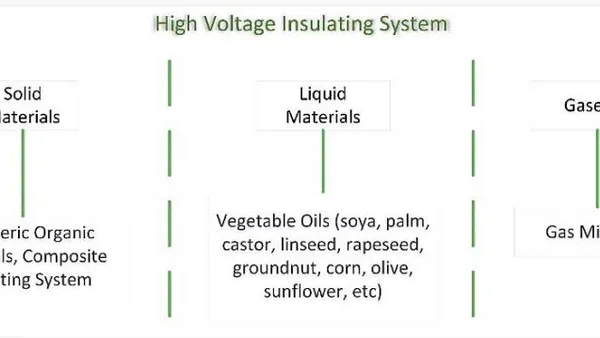
Advanced materials can contribute to increase equipment life, improve operation under emergency conditions, reduce ohmic losses, assist in compacting substations, improve insulation, etc (Frontin, 2013). In this sense, the concerns are related to the development of different techniques of analysis and manufacture of the materials constituting the insulation paper to obtain them with higher quality in order to support the various requests to which they are subject. Figure 8 shows the types of emerging and sustainable materials for use as solid, liquid and gaseous dielectrics (Arora & Mosch, 2011).
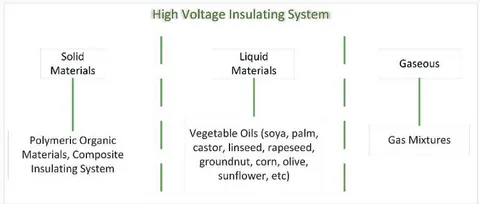
It has been found that the application of innovations is related to insulating papers, vegetable oils and gas mixture, as detailed below:
a) A way to improve the development of paper is the use of aramid, a special polymeric material with chemical properties and making it possible to make considerable progress in reforming and using power transformers. Aramid has characteristics much higher than those of cellulose, a material commonly used in the manufacture of solid insulation (Front in, 2013). Its dielectric rigidity is higher than that of cellulose, it resists significantly higher temperatures, does not absorb water, does not propagate flames and practically does not degrade under higher temperatures (Wykrota, 2004). The paper that uses this aramid is known as Nomex®, which can withstand temperatures in the range of 180 °C to 200 °C. The advantages of Nomex® papers include(DuPont, 2016): Inherent dielectric strength; Mechanical resistance; Thermal stability; Chemical compatibility; Flame resistance; Insensitivity to moisture; Cryogenic capacity; Radiation resistance; Non-toxic formulation. Considering that cellulose is the most fragile parameter of a power transformer, its substitution by aramid allows the transformer to operate, without major consequences, at a higher temperature, so that the power density in the transformer increases significantly (Frontin, 2013);
b) The search for an alternative to mineral oil results in the use of vegetable oil, which is based on natural esters, because it is biodegradable and provides safety for the equipment. Natural oils (vegetable oils) are seed-based oils containing edible grade materials suitable for various categories as high fire resistance; superior dielectric strength and viscosity close to that of the Mineral Insulating Oil (MIO), however with relatively high melting point(Oliveira, 2013). It was observed that the vegetable oil is decomposed in the environment in only 45 days, while the mineral takes 15 years to be totally degraded (junior, 2006). In addition, the literature reports that Vegetable Insulating Oil (VIO) oxidation products are not harmful to insulating Kraft paper and prevent their early degradation (McCone, Gauger, Rapp, Luksich, & Cork ran, 2001). Electrical equipment isolated from VIO presents no risk of failure due to corrosive sulfur, since this fluid is free of sulfur compounds (H. M. Wilhelm, Tulio, & Uhren, 2009). Due to its chemical nature, VIO has great affinity with water and this property contributes to the increase in the life of the solid insulation. The aging of Kraft paper in vegetable oil is much slower than in conventional mineral oil, because the main degradation factors of Kraft paper in transformers are: temperature (thermo-kinetic degradation) and amount of water (thermo hydrolytic degradation). In this case, natural esters can accommodate a greater amount of water than mineral oils, causing more water to be displaced from the paper into the fluid. This is one of the advantageous characteristics of the natural esters used as insulators, since there is a significant increase in the useful life of the paper and therefore the increase in the useful life of the electrical equipment(Arora & Mosch, 2011);
SF6 has extremely high global warming potential which requires its release into the environment to be minimized. One way to achieve this is to use other gases or mixtures of SF6 instead of pure SF6 gas. The other major gases considered so far are air, nitrogen, carbon dioxide and helium. Gases with very strong fixing properties, usually halogenated hydrocarbons, were also considered as mixed with SF6 to obtain higher dielectric properties than pure SF6. Various gas mixtures show considerable promise for use in new equipment. However, the equipment should be designed specifically for use with a gas mixture (Christophorou, Olthoff, & Green, 1997). It was observed that only about 25% of SF6 in the mixture entails more than 75% of the electrical resistance properties of the pure SF6 are achieved. Mixtures of almost equal quantities of SF6 and N2 exhibit dielectric properties suggesting that they could be used as "universal application" gas for both electrical insulation and arc end, or, current disruption. Mixtures of low concentrations (<15%) of SF6 in N2 show excellent potential for use in gas-insulated transmission lines. A mixture of SF6 and helium has shown promise when used in gas-insulated circuit-breakers and should be investigated. An important desirable property of gaseous insulation is that they should be environmentally friendly. Therefore, the use of SF6 mixtures with other gases requires investigation of decomposition of the new blend and the effects of newer byproducts on the electrical equipment (Arora & Mosch, 2011).
IV. BRAZILIAN ELECTRICAL COMPANIES LANDSCAPE
Considering that most of the electrical power equipment (e.g. power transformers, capacitor banks, circuit breakers, reactors, switches) present in the plant of the electricity distribution companies in Brazil use mineral insulating oil and that the extension of continental proportions of Brazil and its interconnected power system of great complexity, it is evident the concern with the methods to be used to protect the environment, since any economic activity that impacts the environment must be submitted to compulsory environmental licensing throughout the national territory, provided for in Federal Law 6938/81.
Therefore, the electric energy concessionaires must comply with the National Environment Policy (PNMA) - which establishes the environmental licensing system as one of the environmental management instruments - and with the National Solid Waste Policy (PNRS), established in Law 12305/2010 and regulated by Decree No. 7,404/2010, which establishes principles, objectives, instruments and guidelines related to the management and management of solid waste (including hazardous waste) applicable to generating companies, public authorities and economic instruments.
In view of this, it was observed that one of the first actions to use sustainable materials was the replacement of the mineral insulating oil by natural sterility, from vegetable oil(H. M. Wilhelm et al., 2009). The first commercial products of vegetable insulating oil (VIO) launched in the national market were: 1. Biotemp, with insulation medium, dielectric, advanced and developed by ABB. It has fluid based on sunflower oil, obtained through genetically selected or manipulated seeds.
- Envirotemp FR3, marketed by Cooper Power System and manufactured by Cargill, based on soybean oil. And 3.BIOVOLT, which has dielectric fluids based on vegetable oils obtained with different oleaginous and formed by the isolates Biovolt HW (sunflower oil), Biovolt A (corn oil); Biovolt B (soybean oil)(Schmidt, 2016; TULIO, 2008; H. M. Wilhelm et al., 2009) and AGBIOELETRIC, divided into W3 - soybean-based insulation vegetable; W6 - canola base; W9 - high oleic sunflower base, which are in use in medium voltage level distribution transformers (FAG, 2011). Thus the Table 5 presents a physical-chemical summary comparison between the Lubrax Industrial AV-58 - a type of mineral oil insulating (MIO), from Petro bras company,), and the BIOTEMP and Biovolt B (VIO) isolators.
| Test | Mineral Oil | Vegetal Oil | ||
| Property | Method | AV-58 | BIOTEMP | Biovolt B |
| Visual Analysis | Clear, Limpid | Clear, Limpid | Clear, Limpid | |
| Neutralization Index [mg KOH/g oil] | ABNT NBR 14248 | 0.01 | 0.01 | 0.03 |
| WaterContent | ABNT NBR 10710/B | 16 | 81 | 150 |
| Color | ABNT NBR 14483 | 0.0 | L0.5 | 0.5 |
| Density at 20°C [g/mL] | ABNT NBR 7148 | 0.8880 | 0.9159 | 0.9184 |
| Dielectric Loss Factor at 25 °C [%] | ABNT NBR 12133 | 0.01 | 0.05 | 0.15 |
| Dielectric Loss Factor at 100 °C [%] | ABNT NBR 12133 | 0.17 | 1.6 | 2.5 |
| Flash Point [°C] | ABNT NBR 11341 | 142 | 322 | 316 |
| Combustion Point [°C] | ABNT NBR 11341 | 154 | 356 | 348 |
| DielectricStrength [kV] | ABNT NBR 6869 | 53 | 45 | 51 |
| Viscosityat 20 °C [cSt] | ABNT NBR 10441 | Not performed | 82 | 70.6 |
| Viscosityat 40 °C [cSt] | ABNT NBR 10441 | 9.63 | 39.63 | 33.2 |
| Viscosityat 100 °C [cSt] | ABNT NBR 10441 | 2.34 | 8.53 | 7.9 |
| CorrosiveSulfur | ABNT NBR 10505 | Non-corrosive | Non-corrosive | Non-corrosive |
| PCB Content | ABNT NBR 13882/B | Not detected | Not detected | Not detected |
| Pour Point [°C] | ABNT NBR 11349 | < -30 | -18 | - |
Due to their chemical composition, the natural sterols present greater water affinity compared to MIO, resulting in the dryness of the cellulose present in Kraft paper, although manufacturers report that use of VIO provides a life of 2 to 5 times longer than that provided by the MIO. (Martins, 2008), however, describes that the useful life occurs only in temperatures above 130 °C and 140 °C. Among these and other characteristics, natural sterols are increasing their market share as insulation fluid for high-power transformers. The characteristic of biodegradability, high flash point (>300 °C) and possibility of increasing insulation paper life are more relevant points that can be approached (Oliveira, 2013).
This review survey demonstrates the use of insulating system of alternative electrical equipment to conventional dielectrics through biodegradable materials and by means of management techniques used in large Brazilian electric power concessionaires, research centers and educational institutions. For that, the Proceedings of the National Seminar of Production and Transmission of Electric Energy - SNPTEE; case studies of Brazilian electric energy concessionaires; sustainability reports of energy companies; and evaluation of use in electric energy distribution systems.
In the articles of the SNPTEE the studies of the Study Group of Transformers, Reactors, Materials and Emerging Technologies (GTM) were evaluated. In XXIII SNPTEE, carried out in 2015, it was verified: in GTM 11, COPEL (Companhia Paranaense de Energia), tests were carried out with VIO on elevating transformers at UHE Guaricana and it was verified that the lack of internal technical preparation in relation to the use of a new technology was surpassed by the experience of the Engineering and O&M team members with the assistance of the assembly company, the manufacturer and the supplier of the VIO (Nogarolli, 2015).
In the GTM 12, carried out by CARGILL and ELETRONORTE (Brazilian North Central Electrical Company SA), it describes the use of a three-phase 145 kV/11.1 MVar reactor with OVI that operated for 7 years with a defective sealing system, allowing the VIO oxidized during the field tests and occurrence presented in this article confirm the insulating vegetable oil (natural ester) as a robust and reliable solution, presenting a performance far superior to the life expectancy of the transformer, in both free and adverse conditions such as assembly deviations or eventual exposure to the environment (Sbravati, Arantes, Martins, & Rapp, 2015). In GTM 07, developed by Cargill and University of Stuttgart, conducted in XXIV in 2017, the level of field concentration was investigated which results in divergences between VIO and MIO insulation liquids.
Despite the great similarity between vegetable oil and mineral in relation to dielectric behavior, the liquids are chemically different, which can lead to different results. The identified difference in the tensile stress between mineral and vegetable oil is limited to extremely high field concentration levels, situated in the Schwaiger factor 0.01 <η<0.1. Despite these differences in dielectric behavior, no barriers were identified for the application of vegetable oils in any voltage class, either AC or CC (Sbravati, Rapp, Haegele, & Tenbohlen, 2017).
As conclusion of the SNPTEE GTM study group, we have: Increased reliability in transformers with insulating vegetable oil. Increase the life of insulation paper in transformers with insulating vegetable oil. It was evidenced the need to improve the quality of the fences in equipment with insulating vegetable oil. It has been found that dissolved gas analysis methodologies for the insulating mineral oil can be used for the insulating vegetable oil, preferably the duval triangle. The analysis of results of monitoring and diagnostic systems for decision-making purposes should consider the application of different techniques: agd-dissolved gas analysis, partial discharge analysis-dp-acoustic method and electric method, power factor and response in frequency-SFRA. Trendency to establish maintenance centers with information integration and monitoring.
In the case study, sustainable actions were observed by Cemig, Light S.A and AES Eletropaulo: it was verified that Trench provides equipment with renewable dielectric materials, providing sustainability in power generation, transmission and distribution systems eg the Trench Blue instrument transformer, which consists of core-to-air insulation, instead of SF6 and oil, and operates up to 245 kV. The high voltage shunt reactors supplied by Trench are of the dry type and used in applications up to 500 kV, as shown in Figure 9.
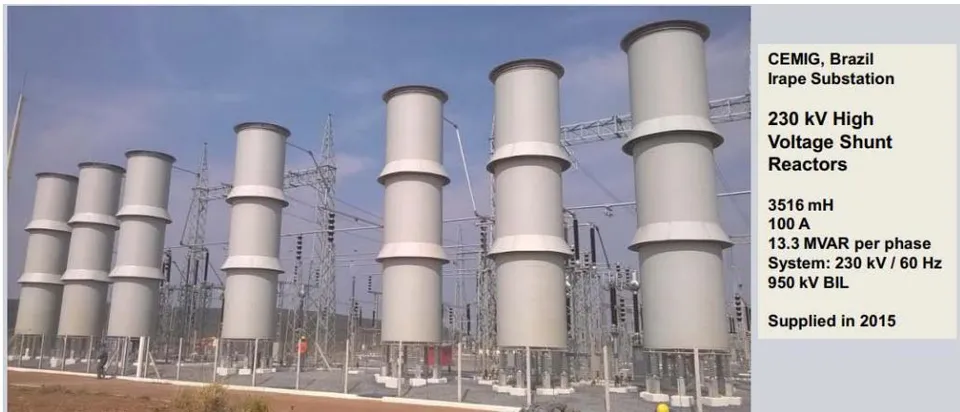
The main advantage with respect to oil immersed reactors is that there is no aggression to the environment because it does not need to perform the handling of insulating mineral oil, which is aggressive to the environment. In addition, there is no greater effort for maintenance, there is a fire risk, lower investment cost; there is no inrush current of excessive magnetization because it has no iron core; cold start capability (Trench, n.d.).
The Light S. Aenergetic Company performs research and development of sustainability indicators as a tool for LIGHT solid waste management and the development of alternative solutions for the disposal of various types of waste. Among the actions used, were discarded mineral oil and use of vegetable oil in electric transformers: In relation to the effect of moisture that acts on the MIO as a catalyst agent in the decomposition of cellulose, thus reducing the useful life of the electrical equipment, the VIO due to its chemical nature shows great affinity with water. In addition, in cases of accidents the remediation processes of the systems impacted by the VIO are simpler and with lower costs, since the VIO is easily degraded by the microorganisms present in the environment (Souza et al., 2011).
Opportunities for Improvement in Waste Management in Company were observed in AES Eletropaulo. In 2009, this company generated almost 4 thousand tons of non-hazardous waste, subdivided into 30 types (e.g. wooden crosshead, metals parts and others). In addition, it would be possible to internalize porcelain waste on substation floors and/or to build gabions to contain slopes. Still, discarded pieces of galvanized iron could be reused, from pickling and new galvanizing (Mancini et al., 2011).
In the sustainability reports of the Energisa, Equatorial and Cemig companies, sustainable actions were identified, such as the use of soybean-based insulating vegetable oil, the reuse of dielectric materials and the sale of solid waste. Energisa has proposed the R&D of a modular substation of a fragmented mobile SE, consisting of three products in one (mobile transformer, AT and mobile BT breakers), with transport by two truck horses, with 38 MVA. The distributor also carried out sustainable actions for the correct disposal of materials (lamps), recycling (cables, ferrous scraps and meters), co processing of oil-contaminated soil, regeneration of insulating oil from electrical equipment, reverse logistics of spray paints and tonner, among others initiatives (Energisa, 2016).
The Equatorial Group identified electrical equipments containing as carel oil and were removed from energy distribution systems, discarding mineral oil, selling scrap (wires, cables, equipment and fittings of the electrical system in general) for refineries and recyclers which have environmental licensing. Equatorial's distributors tracked the waste to its final destination, as required, reuse of materials (wood), reused as packaging or other purposes or donated (Equatorial, 2018). At Cemig, waste consisting of 45.5 thousand tons of cables and wires, scrap transformers, metal scrap, meter scrap, poles, crosses, trimmings and wood residues were sold, generating revenues that represented a reduction of approximately 13.4% over the previous year's revenue. In addition, 187.5 tons of contaminated waste and equipment containing PCBs were sent for thermal destruction in an environmentally licensed company. There was a 22.7% decrease in the generation of oil-impregnated waste in relation to the previous period, due to the greater control in the equipment maintenance activities (CEMIG, 2016).
With regard to the use of insulation systems in distribution of electric energy, at medium voltage levels (up to 69 kV), the distribution network transformer core is insulated by insulation oil, as shown in Figure 10a at a level of 13.8 kV. An example of application is the Green Distribution Transformer, from the CPFL (Companhia Paulista de Força e Luz) electricity company, which has biodegradable insulating vegetable oil as its insulator, shown in Figure 10a. As shown in Figure 10b, green transformers is already a reality and it can be seen by electric power distribute on poles within large urban centers since 2007 (e.g. São Paulo, Campinas, etc).
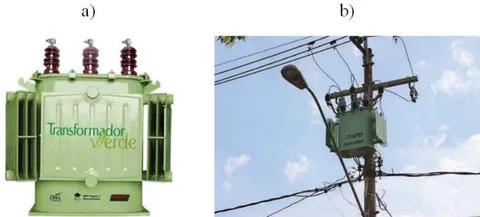
The Green Transformer has the same electrical operating principles as a conventional transformer by insulation in mineral oil and is used as a substitute because the oil degradation time has been reduced from 15 years to 45 days. In addition, the transformer allows a 20% higher load of the nominal power in steady state (Junior, 2006). Therefore, it was observed that the main factors that led these distributors to adopt insulating vegetable oil were the concern with environmental preservation in their concession area, reduction of fire risks, reduction of maintenance costs and new works, since mineral oil does not attack exclusively the environment, but also the equipment that uses it, through corrosion.
Although the use of environmentally sustainable materials is advantageous from the point of view of environmental sustainability and gave its cost-benefit, some factors imply in the difficulty of insertion of them in the Brazilian electricity market. These are: a) Cost. The cost of vegetable oil is considered the biggest barrier to its entry into the market, around 70% higher than that of the MIO (Soares, 2015).b) New materials: materials still under development, as verified in SNPTEE;
c) Brazilian oil attractiveness: despite the growth in oilseed production, oil as a raw material in the manufacture of
MIO is still a lower cost solution in relation to the development of VIO. Despite this, some independent institutions continue to develop solutions such as the development of AGBIOELECTRIC by the Assis Gurgacz Faculty jointly with the concessionaire COPEL Distribuição; Lack of government incentive: during the development of this survey, it was not observed tendencies for incentives and government policies to occur in the production of VIO for use in electrical systems.
V. CONCLUSION
In this paper, it was presented the usage of emerging materials and sustainable actions carried out by Brazilian energetic companies through Proceedings of the National Seminar of Production and Transmission of Electric Energy (SNPTEE), company's sustainable reports and case studies. It was observed that insulating vegetable oil can be considered the oil of the future, because its cost of production combined with the consequences of mineral oils' sleakage or spillage and its facilitated biodegradability has become attractive to the electric sector. Although there were no reports pointing out the using SF6 with other gases, it was observed the replacement of air-cored equipment rather than SF6 or mineral oil filling. The use of solid insulators observed was mainly due to the substitution of paper and kraft cellulose by the use of aramid (Nomex®), which, although not indicated by the electric power concessionaires was described by companies manufacturing electrical materials, e.g. for immersed liquid transformer e.g. Dupont Nomex 900 series papers and pressboards in liquid immersed applications used by power utilities. Thus Brazilian energetic companies could provide training courses about installation and maintenance of sustainable materials in order to improve environmental indicators and solutions to the using of environmentally aggressive material.
Finally, in spite of the integration between academic and industrial activities as described in case studies, the potential commodities production (such as vegetable oil) is not fully exploited due to the high cost associated with the generation of such products, lack of governmental incentive and lapse of companies specialized in the generation of OVI. One way to overcome this issue is provide continuous incentive the production of sustainable materials such as Normative Instruction N° 1,514 from November 20th, 2014, which exempts companies from PIS/Pasep (Programs of Social Integration and Formation of the Patrimony of the Public Servant) and Cofins (Contribution to Social Security Financing) taxes levied on revenues from the sale of raw material of vegetable origin intended for the production of biodiesel.
ACKNONWLEGMENTS
The authors are grateful to the: Coordenação de Aperfeiçoamento de Pessoal de Nível Superior (CAPES); Conselho Nacional de Desenvolvimento Científico e Tecnológico (CNPq); Fundação de Amparo à Pesquisa do Estado de São Paulo (FAPESP); Departamento de Comunicações (DECOM); Faculdade de Engenharia Elétrica e de Computação (FEEC); and Universidade Estadual de Campinas (UNICAMP), for their support to the development of this research.