I. INTRODUCTION
Pediatric subtrochanteric fracture defined as 10% percent the length of the whole femur below the lesser trochanter. Subtrochanteric fractures constitute 1% in children. Adolescent subtrochanteric fractures are unusual and have received less attention in literature. There are various deforming forces around this fracture like proximal fracture tends to flex, abduct, and external rotate and distal fragment adducts. Due to various deforming forces around this fracture, this fracture requires special attention. There are number of management available for this fracture in each age group. Infants are with Pavlik harness, children (6month – 5 years) with a hip spica cast. The dilemma starts after the age of 10 years. There is no definite consensus available for this age group. Management of this fracture in the adolescent age group is deficient. Traction alone found unsatisfactory and incapable of providing reduction and stability. According to literature fixation with elastic nailing is inadequate and had various complication like malunion and shortening.
II. AIMS AND OBJECTIVES
To study the functional and radiological outcomes of open reduction and internal fixation of closed subtrochanteric fracture with a proximal humerus locking plate.
III. MATERIALS AND METHODS
a) Study Area
The study was done from November/2016 to June/2018 at Safdarjung Hospital New Delhi.
b) Study Population
In our series age of patient was 10 to 20 years with the diagnosis of closed subtrochanteric fracture attending the Department of Orthopaedics, Safdarjung Hospital New Delhi managed surgically.
c) Sample Size and Sample Technique
Five adolescent patients attended the hospitals from November/2016 to June/2018 presented in emergency with the closed subtrochanteric fracture.
d) Data Collection Technique and Tools
Five adolescent patients operated with open reduction and internal fixation with a proximal humerus locking plate, followed by physiotherapy and range of movement exercises. Follow-up was done at 2wks, 6wks, 12wks, 24wks, and 36 wks.1 All patients gave their informed consent.
Inclusion Criteria
1. Age 10 – 20 yrs,
2. Closed fracture
- Fracture without a distal neurovascular deficit.
Exclusion Criteria
1. Patient with other life-threatening comorbidities
2. Previous hip surgery
3. Pathological fracture
4. Previous hip pathology.
Preoperative: Each patient had given the informed consent. We had sent blood investigation for preanesthetic clearance. Temporary Bohlerbraun splint with skin traction applied to relieve some pain and improve some fracture deformity.
Perioperative: Implant choice – Under general anesthesia, open reduction and internal fixation performed with proximal humerus interlocking osteosynthesis plate through lateral approach to the thigh. Proximal humerus locking plate found to have a low profile and narrow which is a right amount of thickness for adolescent patients.
Procedure: 1. Under general anesthesia, patient positioned in a lateral decubitus position. The patient's affected limb painted and draped.
Dead lateral incision over thigh given. Good hemostasis achieved. Lift Vastus lateral is from linea aspra instead of splitting it. Partial proximal origin of vastus lateral is removed to make space for the plate. Open reduction was done with temporary k wire fixation. Proximal locking screws were kept short of femoral head physis to avoid its injury.
Fracture was fixed with Proximal humerus interlocking plate. A thorough wash was given. An incision was closed in layers with suction drain insitu.
Postoperative: First dressing was done after 48 hrs of surgery. Immediate postoperative x rays were taken. Static quadriceps exercise, knee range of motion exercises, and ankle range of motion exercises were started after 24 hrs from time of surgery. Patients were discharged on the fourth postoperative day.
Follow up: Patients were advised for strict non-weight bearing and in bed ambulation exercises. Patients were followed at 2wks, 6 wks, 12 wks, and 24 wks as outpatients.
e) Expected Outcome and Complication
1. Union
2. Nonunion
3. Infection
4. Implant failure
f) Data Analysis
Qualitative variables/Categorical variables were presented in number and percentage (%), and Quantitative variables/continuous variables were presented as mean SD (whenever required). P-value 0.05 was taken as a level of statistical significance. The data was analyzed by SPSS (statistical package for social sciences) Statistical software version 17.0.
IV. RESULTS
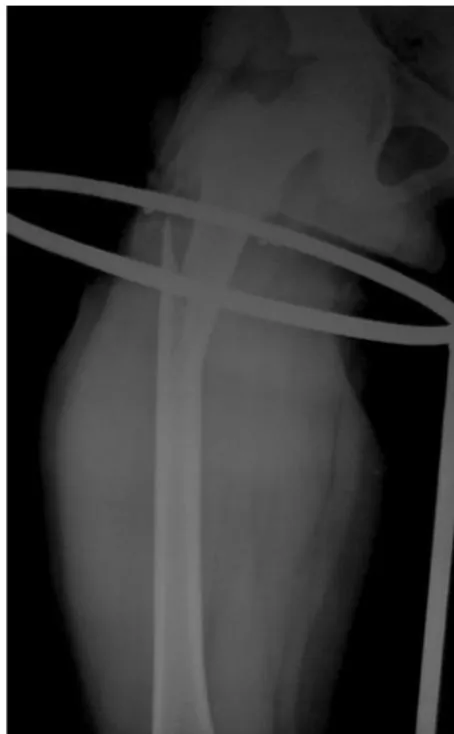
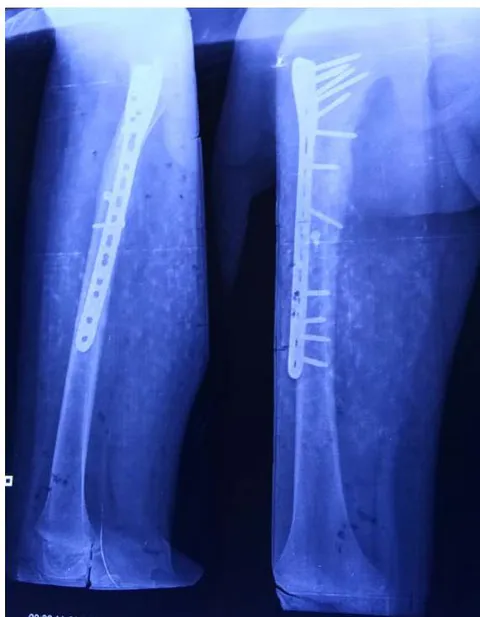
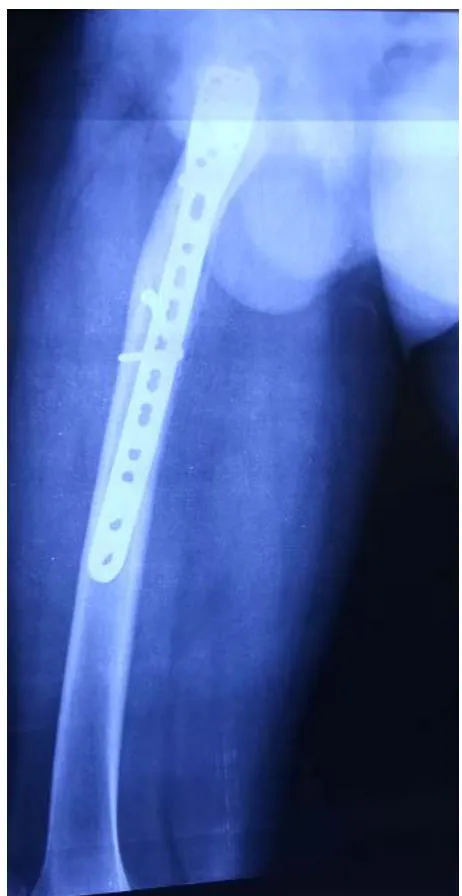
There were five patients (Male – 3, female – 2). There was no gender difference in the incidence of this fracture. Pediatric age group was found to have a high potential for the union. Long spiral fracture found to be the most common pattern of fracture in our study. There was no failure in our study. The patient's visual analog scale for pain improved in two weeks from an average of 8 to 3. The radiological first sign of union on x-ray was visible at an average of 4 weeks of fixation. Average Harris hip score was 34 (2wks), 68 (4wks), 87 (6wks), >90 (after 2 months). Patients were mobilized with protected weight bearing with some support at 21/2 months. Weight-bearing was gradually increased according to the comfort of the patient. The patients were started long walking at the end of 5 months. The patient started using public transport at the end of 8 months.
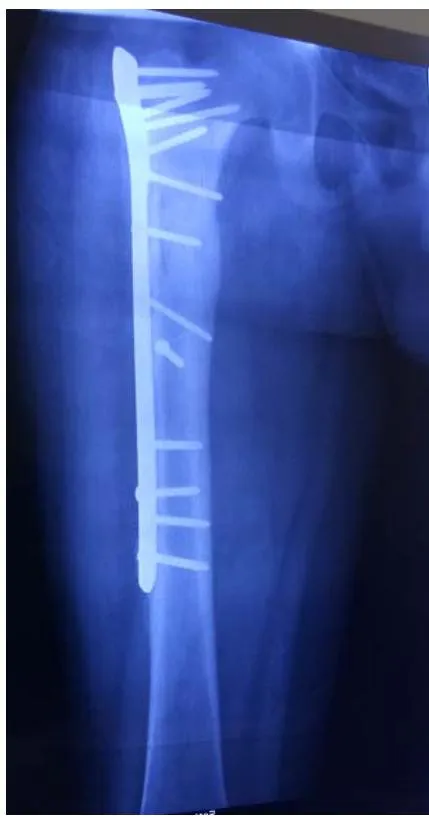

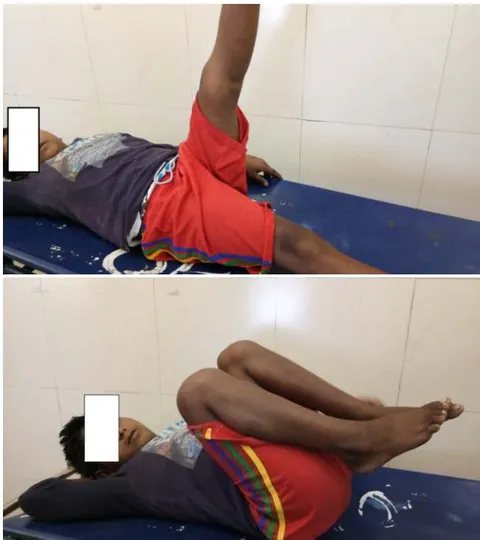
| Serial No. | Age/sex | Complication | Time of union | Final herris hip score | Nature of fracture | End point | Follow up |
| 1 | 11 | - | 12 weeks | 92 | Long spiral | Union | 36wks |
| 2 | 13 | - | 11 weeks | 91 | Comminuted | Union | 36wks |
| 3 | 11 | - | 10 weeks | 87 | Short oblique | Union | 36wks |
| 4 | 14 | - | 14 wks | 95 | Long spiral | union | 36wks |
| 5 | 12 | - | 10 wks | 89 | Long spiral | union | 36wks |
V. Discussion
Pediatric subtrochanteric fracture is a rare and unstable type of fracture. Closed displaced subtrochanteric fracture require operative intervention.
Sanders and EgoI presented two cases in which adult, pre-contoured, lower extremity periarticular locking plates were utilized for fixation of subtrochanteric femur fractures in pediatric patients. They proposed that a proximal tibial locking plate in an adolescent and distal tibial locking plate in a young child correspond well to the proximal femur and are thus a viable option in their management.
Cortes et al managed atrophic non-union of subtrochanteric femur fractures in an 11-year-old boy using an adult proximal humerus locking plate and packing the non-union site with the demineralized bone matrix. They chose PHLP as they found it to be adequately matched to the surface anatomy of the proximal femur. Six months after the surgery for non-union, radiographs showed complete union with the maintenance of fracture alignment and morphology of proximal femoral epiphysis. The child was completely asymptomatic with a symmetric range of motion of his hips and knees.
In our study, the proximal humeral locking plate found to be the implant of choice for fixation of any pattern of subtrochanteric fracture. Plate's pre-contouring found to be well-fitting to the proximal femur lateral surface.
VI. LIMITATIONS
There were various limitations to our study. The small numbers of cases due to low incidence, affordability of the patient's attendant, and different patterns of fractures were the limitation. The strength was a single institute and a single operating team. Though we recommend study with larger number of follow-up period with a longer period of follow up.
VII. CONCLUSION
Open reduction and internal fixation with proximal humerus locking plate found to be an excellent implant for fixation of subtrochanteric fracture in adolescent age group. Proximal humerus locking plate found to have an optimum amount of profile thickness for the adolescent proximal femur. This plate found to be well-fitting to the proximal femur. Proximal humerus locking plate found to be good for any pattern of subtrochanteric fractures. The direction of locking screw in this plate found to have good purchase in the calcar of neck of femur, which absolute stability for fracture union. Another conclusion drawn to our attention was that lateral decubitus position found to be ideal for adequate reduction of proximal fragment deformities as compared to the supine position. It also provided better visibility. Lateral decubitus posture on the operating table assists in the reduction of the fracture via better visibility and gravity assistance. Direction and length of the locking screws didn't damage the proximal femur physis. Most proximal screws were kept short of physis to avoid damage to proximal femur physis.
Footnotes
wks– follow up x rays and Harris hip scoring was done. Non-weight bearing walking with walker support was started. (p.2) ↩