
I. INTRODUCTION
Journalism is a prominent career in Bangladesh, and those who work in this noble field contribute significantly to the development of the country's various industries. Despite the fact that journalism is a very significant career, there are no specific requirements for becoming a journalist or a politician in the United States. However, recently, there has been a little improvement in this scenario. A graduate can pursue a career in the media. However, in some circumstances, a bachelor's degree in journalism from an accredited university is a requirement for employment. Recruitment is an important part of every business [1]. In Bangladesh two thousand registered in daily newspapers published around the country, with more than four hundred of them being dailies. It is vital to note that more than two hundred newspapers are printed in the capital every day. Dhaka is the capital of
Bangladesh [2]. Justice Sultan Hossain Khan, a former head of the Bangladesh Press Council, expressed his opinion that in compared to the country's economic situation, the number of daily newspapers issued is enormous. In addition the statement emphasized that the publication of a newspaper should be seen as a commercial endeavor. The People who are financially well-off should step forward and take the initiative to build a newspaper publication system industry. Furthermore, in order to protect press freedom, the minimal financial soundness of the publication must be maintained. Journalists should be given first priority [3]. However, it is a source of regret that journalists are frequently subjected to this. In Bangladesh, not receiving a salary for months on end is not uncommon [4]. The working conditions of journalists in rural and remote places are not suitable. A significant percentage of the local journalists who work for the newspapers are not properly compensated. In Bangladesh context Journalism, a prestigious job and those who are involved in this noble profession play vital role in different sectors like political, economic, social, science and technology, sports, entertainment and other sectors of this country. As a profession journalism is a very important one but no qualification is specified for becoming journalist likely politician. However, this situation has been slightly changed in last few years. A graduate can join the media organization, but in some cases university degree in journalism is prerequisite condition of the recruitment. The condition of journalists working at local areas is not satisfactory. A good number of the dailies do not provide salary properly to their local journalists. Most of the pressmen of the different dailies published from divisional and district level are drawing less than Taka one thousand per month that is even less than a day labor [1]. According to a study in 1995 on Dhaka city newspapers, about journalists are getting salary as per wage board but they are not enjoying other facilities or incentives stated in wageboard. Journalists are blaming the owners' commercial attitude for this sort of deprivation. For this reason most of the journalists are not satisfied with their present jobs. In a study regarding journalism found that 50 percent journalists are not satisfied to their salary and other facilities. That study was based on the interview of Journalists of 67 dailies published from six divisions including Dhaka. That study showed pressmen felt disappointed being connected with journalism profession [5]. Consequently, the researcher has designed this present study. The aim of this study was to explore a survey in the northern divisions of Bangladesh to know the prospects and challenges of Journalism in northern Bangladesh.
Research Questions: What are the prospects and challenges of journalism in the northern divisions in Bangladesh?
Objective
- To determine the prospects and challenges of the journalists in the northern divisions of Bangladesh.
II. METHODOLOGY
This prospective cross-sectional study was conducted in the northern divisions of Bangladesh during June 2021 to June 2022. The ethical clearance of this study was obtained from the Institutional Review Board (IRB) of Shikkabarta.com. The purpose and benefits of the study was disclosed to the respondents in local language and written informed consent was taken from the respondents of the study. Purposive sampling method as per inclusion criteria was applied for the study. Samples were selected conveniently according to inclusion and exclusion criteria and availability of cases and a total of 167 male and female journalists aged above 18 years from Rajshahi and Rangpur divisions were enrolled in this study. Both qualitative and quantitative data were applied to find out best possible outcome. A pre structured questionnaire was used to collect data from the respondents through face-to-face interview. The collected data were edited, cleaned, entered and analyzed using Statistical Package for Social Science (SPSS) version 23.0. Descriptive analysis such as frequencies and mean were used for this study. The result of this study was presented by using tables graphs and pie charts. The inclusion and exclusion criteria of this study were as follows:
Inclusion criteria
Exclusion criteria a. Age years b. Male and Female Journalist c. Physically or mentally able to participate in this study a. Age years b. Unwilling to participate in this study c. Physically or mentally unable to participate in this study
III. RESULTS
| Variables | Frequency (n) | Percent (%) | |
| Gender | Male | 157 | 94.01 |
| Female | 10 | 5.99 | |
| Age | 18 >29 | 42 | 25.1 |
| 30>39 | 63 | 37.7 | |
| 40>49 | 49 | 29.3 | |
| 50>59 | 10 | 6.0 | |
| 60>69 | 3 | 1.8 | |
| Religion | Islam | 154 | 92.2 |
| Hindu | 13 | 7.8 | |
| Education | S.S.C | 8 | 4.8 |
| H.S.C | 40 | 24.0 | |
| Under Graduate | 84 | 50.3 | |
| Post Graduate | 35 | 21.0 | |
| Marital Status | Married | 139 | 83.2 |
| Unmarried | 28 | 16.8 | |
| Number of children | 0 | 60 | 35.9 |
| 1 | 28 | 16.8 | |
| 2 | 61 | 36.5 | |
| 3 | 17 | 10.2 | |
| 5 | 1 | .6 | |
| Designation | Sub-district Correspondent | 125 | 74.9 |
| Staff Reporter | 34 | 20.4 | |
| Sub-district Reporter | 4 | 2.4 | |
| Editor& Publisher | 2 | 1.2 | |
| Advertising Manager | 1 | .6 | |
| Publicity Editor | 1 | .6 |
were reported having 2 children, were reported having 3 children and were reported that they have 5 children. According to the designation were reported sub-district correspondent, were staff reporter, were sub-district reporter, were editor & publisher, were advertising manager while was publicity editor.
| Service Length | Frequency (n) | Percent (%) |
| 1>5 | 25 | 15.0 |
| 6>10 | 55 | 32.9 |
| 11>15 | 23 | 13.8 |
| 16>20 | 17 | 10.2 |
| 21>25 | 30 | 18.0 |
| 26>30 | 8 | 4.8 |
| 31>35 | 9 | 5.4 |
| Total | 167 | 100.0 |
| Variables | Frequency (n) | Percent (%) | |
| Division | Rajshahi | 49 | 29.3 |
| Rangpur | 118 | 70.7 | |
| District | Naogaon | 10 | 6.0 |
| Pabna | 12 | 7.2 | |
| Rangpur | 12 | 7.2 | |
| Kurigram | 19 | 11.4 | |
| Lalmonirhat | 9 | 5.4 | |
| Natore | 28 | 16.8 | |
| Nilphamari | 21 | 12.6 | |
| Thkurgaon | 12 | 7.2 | |
| Gaibandha | 20 | 12.0 | |
| Dinajpur | 11 | 6.6 | |
| Rajshahi | 13 | 7.8 | |
| Upazila | Mahadevpur | 10 | 6.0 |
| Iswardi | 12 | 7.2 | |
| RangpurSadar | 9 | 5.4 | |
| Chilmari | 14 | 8.4 | |
| KurigramSadar | 4 | 2.4 | |
| Ulipur | 1 | .6 | |
| Hatibandha | 7 | 4.2 | |
| Patgram | 1 | .6 | |
| Kaligong | 1 | .6 | |
| Natore | 14 | 8.4 | |
| Pirgachha | 3 | 1.8 | |
| Saidpur | 10 | 6.0 | |
| Naldanga | 14 | 8.4 | |
| Thkurgaon | 10 | 6.0 | |
| Baliadangi | 2 | 1.2 | |
| Sadullahpur | 18 | 10.8 | |
| Gaibandha | 2 | 1.2 | |
| Fhulbari | 11 | 6.6 | |
| Godagari | 13 | 7.8 | |
| Nliphamari | 11 | 6.6 | |
| Total | 167 | 100.0 | |
(Table 3): Shows division wise respondents distribution. were reported from Rajshahi division, were from Rangpur division. According to the district report Naogaon , Pabna , Rangpur , Kurigram , Lalmonirhat , Natore , Nilphamari , Thakurgaon , Gaibandha , Dinajpur , Rajshahi . According to the upazila report Mahadevpur , Iswardi ,
Rangpur Sadar (2.4%), Chilmari (8.4%), Kurigram Sadar (2.4%), Ulipur (0.6%), Hatibandha (4.2%), Patgram (0.6%), Kaligong (0.6%), Natore (8.4%), Pirgacha (1.8%), Saidpur (6.0%), Naldanga (8.4%), Thakurgaon (6.0%), Baliadangi (1.2%), Sadullahpur (10.8%), Gaibandha (1.2%), Fulbari (6.6%), Godagari and (7.8%) respondents were from Nilphamari district.
| Opinion | Frequency (n) | Percent (%) | |
| Are you a member of local press club | Yes | 120 | 71.9 |
| No | 47 | 28.1 | |
| Have you received appointment letter from your organization | Yes | 102 | 61.1 |
| No | 65 | 38.9 | |
| Have you drowned salary from your organization? | Yes | 34 | 20.4 |
| No | 133 | 79.6 | |
| Does your organization pay you salary regularly? | Yes | 28 | 16.8 |
| No | 139 | 83.2 | |
| Does organization give you any allowance for the education of your offspring? | Yes | 32 | 19.2 |
| No | 135 | 80.8 | |
| Does your organization provide insurance? | Yes | 21 | 12.6 |
| No | 146 | 87.4 | |
| Does your organization provide festival allowance? | Yes | 36 | 21.6 |
| No | 131 | 78.4 | |
| Does your organization provide with you a conducive working hour? | Yes | 49 | 29.3 |
| No | 118 | 70.7 | |
| Does your organization arrange yearly performance awarded? | Yes | 64 | 38.3 |
| No | 103 | 61.7 | |
| Do you need to have more professional training and workshop? | Yes | 126 | 75.4 |
| No | 41 | 24.6 | |
| Have you received any performance award? | Yes | 63 | 37.7 |
| No | 104 | 62.3 | |
| Does your organization provide relevant training? | Yes | 64 | 38.3 |
| No | 103 | 61.7 | |
| Does your organization provide promotion opportunity in time? | Yes | 67 | 40.1 |
| No | 100 | 59.9 | |
| Does your organization provide you stress counseling? | Yes | 51 | 30.5 |
| No | 116 | 69.5 | |
| Does your higher authority recognized risks and undertake specific mitigation strategies? | Yes | 47 | 28.1 |
| No | 120 | 71.9 | |
| Does your office provide you transport at the time of news covering? | Yes | 47 | 28.1 |
| No | 120 | 71.9 | |
| Does your organization provide electronic devices? | Yes | 42 | 25.1 |
| No | 125 | 74.9 | |
| Does your organization provide office? | Yes | 39 | 23.4 |
| No | 128 | 76.6 | |
| Does your organization provide insurance support? | Yes | 20 | 12.0 |
| No | 147 | 88.0 | |
| Does your organization provide provident fund facilities? | Yes | 24 | 14.4 |
| No | 143 | 85.6 | |
| Does your organization provide gratuity facility? | Yes | 34 | 20.4 |
| No | 133 | 79.6 | |
| Does your organization provide leave facility? | Yes | 53 | 31.7 |
| No | 114 | 68.3 | |
| Do your family members are in your support regarding your job? | Yes | 112 | 67.1 |
| No | 55 | 32.9 | |
| Do you fear for your physical security? | Yes | 101 | 60.5 |
| No | 66 | 39.5 | |
| Do you fear for your digital security? | Yes | 88 | 52.7 |
| No | 79 | 47.3 | |
| Have you experienced threats in relation to your work? | Yes | 103 | 61.7 |
| No | 64 | 38.3 | |
| Have you ever experienced tapping/hacking and /or digital security threats? | Yes | 64 | 38.3 |
| No | 103 | 61.7 | |
| Do you use protection in digital communication including appropriate software and other precautionary measures? | Yes | 69 | 41.3 |
| No | 98 | 58.7 | |
| Have you taken any digital safety training to keep your data safe? | Yes | 68 | 40.7 |
| No | 99 | 59.3 | |
| Are you aware of the protection against ICT act? | Yes | 89 | 53.3 |
| No | 78 | 46.7 | |
| Total | 167 | 100.0 | |

opportunity in time while reported their organization doesn't.28.14% participants reported that the higher authority of their organization recognizes risks and undertake specific mitigation strategies hours while 71.86% reported their organization doesn't.28.14% participants reported that their organization provides transport at news covering time while 71.86% reported their organization doesn't.25.15% participants reported that their organization provides electronic devices while 74.85% reported their organization doesn't. 23.35% participants reported that their organization provides office while 76.65% reported their organization doesn't. 11.98% participants reported that their organization provides insurance support while 88.02% reported their organization doesn't.14.37% participants reported that their organization provides provident fund facility while 85.63% reported their organization doesn't.20.36% participants reported that their organization provides gratuity facility while 79.64% reported their organization doesn't.32.93% participants reported that their family supports regarding their job while 67.07% reported their family doesn't support.60.48% participants feel fear for their physical security while 39.52% reported they doesn't fear.52.69% participants fear for their digital security while 47.31% reported they doesn't fear at all.61.68% participants reported that they had experienced work-related threats while 61.68% reported they didn't.38.32% participants reported that they had experienced digital security threats while 61.68% reported they didn't.41.32% participants reported that they use proper software for the protection of digital communication system while 58.68% reported they doesn't.40.72% participants reported that they took digital security training to keep data safe while 59.26% reported they didn't take any training.53.29% participants were aware of the protection against ICT act while 46.71% were unaware regarding digital security Act.
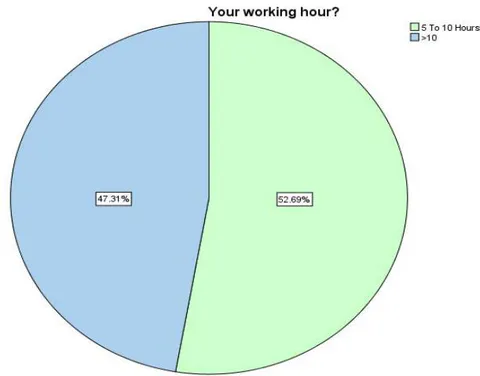
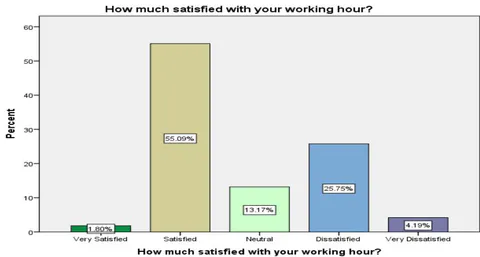
Figure 4: Shows the satisfaction level of the respondents regarding working hours. According to the satisfaction level with working hour were very satisfied, were satisfied, were neutral, were dissatisfied and were very dissatisfied.
Among the respondents respondents are satisfied followed by are neutral dissatisfied, are very dissatisfied and are very satisfied.
IV. DISCUSSION
Once upon a time, journalism was seen as a calling. The media upholds democracy and rights of mass people in the contemporary globe, and it is regarded as the fourth estate of a state to all [6]. Its significance to the Bangladeshi revolution is immense. On the other hand, things have turned around. This is now the standard practice in the commercial world. The journalists in the northern part of Bangladesh confront a lot of difficulties. Due to a lack of Pressures from owners for marketing and profit-making, coupled with government assistance, financial difficulties, low salaries, feudal rule, and historical precedents for these structures, journalists face nowadays. Journalists often raised the issues of low salaries, financial difficulties, and the absence of government assistance. Journalists aren't compensated fairly, and they don't get overtime pay. According to Riaz's (2015) research on the vernacular press, these are the primary economic concerns of local journalists.[7] The present study found that participants reported that they got appointment letter from the organization while reported they didn't get. participants reported that they drowned salary from their organization while reported they didn't do that. participants reported that their organization pays their salary regularly while reported their organization doesn't. participants reported that their organization gives allowance for their offspring while reported their organization doesn't. participants reported that their organization provides insurance while reported their organization doesn't. participants reported that their organization provides festival allowance while reported their organization doesn't. participants reported that their organization provides conducive working hours while reported their organization doesn't. participants reported that their organization arranges yearly performance award while reported their organization doesn't. participants reported that they need further professional training and workshop while reported they doesn't need. participants reported that they got performance award while reported they didn't get yet. participants reported that their organization provides relevant training while reported their organization doesn't. participants reported that their organization provides promotion opportunity in time while reported their organization doesn't. participants reported that the higher authority of their organization recognizes risks and undertake specific mitigation strategies hours while reported their organization doesn't. [8-12] The major focus of the study was to explore the relationships of journalists' economic issues and ethical journalism. Concept of political economy suggests that media has become industry and political, economic elites used media for their interests (Baran & Davis, 2010[13]; Boyd-Barrett, 1995; McQuail, 2010). [14]
V. LIMITATIONS OF THE STUDY
This study was conducted within a short period of time with limited sample size. So, total scenario of prospects and challenges of journalism in the northern divisions of Bangladesh may not depict. Consequently, further study is recommended on a large scale
VI. CONCLUSION
This study identifies challenges affecting the Journalism Profession in northern divisions of Bangladesh, such as work instability, risk, poor facilities, and a lack of an appropriate job policy. Despite its shortcomings, the study recommends encouraging and growing journalism in Bangladesh.
Disclosure Statement
None of the authors has any conflicts of interest regarding the content of this article.
ACKNOWLEDGEMENT
All the Presidents and the Secretaries of Local Press Clubs of Rajshahi and Rangpur divisions of Bangladesh.