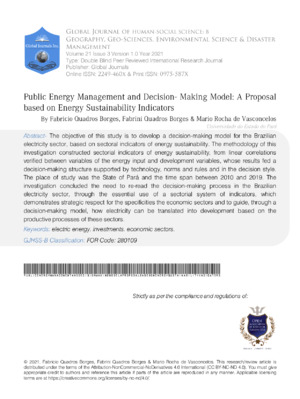
Public Energy Management and Decision-Making Model: A Proposal based on Energy Sustainability Indicators

1
Fabricio Quadros Borges
2
Fabrini Quadros Borges
3
Mário Rocha de Vasconcelos

Send Message

To: Author

GJHSS Volume 21 Issue B3

Article Fingerprint

ReserarchID

D4S9L

Public Energy Management and Decision-Making Model: A Proposal based on Energy Sustainability Indicators Banner
  • English
  • Afrikaans
  • Albanian
  • Amharic
  • Arabic
  • Armenian
  • Azerbaijani
  • Basque
  • Belarusian
  • Bengali
  • Bosnian
  • Bulgarian
  • Catalan
  • Cebuano
  • Chichewa
  • Chinese (Simplified)
  • Chinese (Traditional)
  • Corsican
  • Croatian
  • Czech
  • Danish
  • Dutch
  • Esperanto
  • Estonian
  • Filipino
  • Finnish
  • French
  • Frisian
  • Galician
  • Georgian
  • German
  • Greek
  • Gujarati
  • Haitian Creole
  • Hausa
  • Hawaiian
  • Hebrew
  • Hindi
  • Hmong
  • Hungarian
  • Icelandic
  • Igbo
  • Indonesian
  • Irish
  • Italian
  • Japanese
  • Javanese
  • Kannada
  • Kazakh
  • Khmer
  • Korean
  • Kurdish (Kurmanji)
  • Kyrgyz
  • Lao
  • Latin
  • Latvian
  • Lithuanian
  • Luxembourgish
  • Macedonian
  • Malagasy
  • Malay
  • Malayalam
  • Maltese
  • Maori
  • Marathi
  • Mongolian
  • Myanmar (Burmese)
  • Nepali
  • Norwegian
  • Pashto
  • Persian
  • Polish
  • Portuguese
  • Punjabi
  • Romanian
  • Russian
  • Samoan
  • Scots Gaelic
  • Serbian
  • Sesotho
  • Shona
  • Sindhi
  • Sinhala
  • Slovak
  • Slovenian
  • Somali
  • Spanish
  • Sundanese
  • Swahili
  • Swedish
  • Tajik
  • Tamil
  • Telugu
  • Thai
  • Turkish
  • Ukrainian
  • Urdu
  • Uzbek
  • Vietnamese
  • Welsh
  • Xhosa
  • Yiddish
  • Yoruba
  • Zulu

The objective of this study is to develop a decision-making model for the Brazilian electricity sector, based on sectoral indicators of energy sustainability. The methodology of this investigation constructed sectorial indicators of energy sustainability, from linear correlations verified between variables of the energy input and development variables, whose results fed a decision-making structure supported by technology, norms and rules and in the decision style. The place of study was the State of Pará and the time span between 2010 and 2019. The investigation concluded the need to re-read the decision-making process in the Brazilian electricity sector, through the essential use of a sectorial system of indicators, which demonstrates strategic respect for the specificities the economic sectors and to guide, through a decision-making model, how electricity can be translated into development based on the productive processes of these sectors.

Funding

No external funding was declared for this work.

Conflict of Interest

The authors declare no conflict of interest.

Ethical Approval

No ethics committee approval was required for this article type.

Data Availability

Not applicable for this article.

Fabricio Quadros Borges. 2021. \u201cPublic Energy Management and Decision-Making Model: A Proposal based on Energy Sustainability Indicators\u201d. Global Journal of Human-Social Science - B: Geography, Environmental Science & Disaster Management GJHSS-B Volume 21 (GJHSS Volume 21 Issue B3): .

Download Citation

Alt text: A research article on green energy storage management and sustainability practices.
Journal Specifications

Crossref Journal DOI 10.17406/GJHSS

Print ISSN 0975-587X

e-ISSN 2249-460X

Keywords
Classification
GJHSS-B Classification: FOR Code: 280109
Version of record

v1.2

Issue date

October 8, 2021

Language

English

Experiance in AR

The methods for personal identification and authentication are no exception.

Read in 3D

The methods for personal identification and authentication are no exception.

Article Matrices
Total Views: 2008
Total Downloads: 916
2026 Trends
Research Identity (RIN)
Related Research

Published Article

The objective of this study is to develop a decision-making model for the Brazilian electricity sector, based on sectoral indicators of energy sustainability. The methodology of this investigation constructed sectorial indicators of energy sustainability, from linear correlations verified between variables of the energy input and development variables, whose results fed a decision-making structure supported by technology, norms and rules and in the decision style. The place of study was the State of Pará and the time span between 2010 and 2019. The investigation concluded the need to re-read the decision-making process in the Brazilian electricity sector, through the essential use of a sectorial system of indicators, which demonstrates strategic respect for the specificities the economic sectors and to guide, through a decision-making model, how electricity can be translated into development based on the productive processes of these sectors.

Our website is actively being updated, and changes may occur frequently. Please clear your browser cache if needed. For feedback or error reporting, please email [email protected]
×

This Page is Under Development

We are currently updating this article page for a better experience.

Request Access

Please fill out the form below to request access to this research paper. Your request will be reviewed by the editorial or author team.
X

Quote and Order Details

Contact Person

Invoice Address

Notes or Comments

This is the heading

Lorem ipsum dolor sit amet, consectetur adipiscing elit. Ut elit tellus, luctus nec ullamcorper mattis, pulvinar dapibus leo.

High-quality academic research articles on global topics and journals.

Public Energy Management and Decision-Making Model: A Proposal based on Energy Sustainability Indicators

Fabricio Quadros Borges
Fabrini Quadros Borges
Mário Rocha de Vasconcelos

Research Journals