
I. INTRODUCTION
Entrepreneurial business is sometimes referred to as small business. Small businesses all over the world are generally acclaimed as the engine of growth of economies, as far back late 19th century (Oboreh, 2021). There is need to sustain the small business because they account for at least seventy percent of employment and contributes significantly to economies and development of nations (Anyanwu, 2012). Product quality is paramount, as it contributes to the survival of the enterprise. Quality can be said to be the opinion by a customer or user of such product or service, relating to the extent to which the customers or users judges the product or service satisfaction (Adams, 2020; Idemobi, 2010; Pyzdek, 2000). Most developing countries are experiencing violent competition in their business environment, especially in the last two decades, quality management would go a long way to help businesses compete favorably, (Abuo, Ezeokonkwo, 2018 in Oyibo 2021). Manufacturers have to provide quality products, focusing on cost reduction and ensuring sustainable customer's satisfaction (Jimoh, Oyewole, Isa, & Waziri 2019).
Quality control must be clearly stated in terms of the requirement for each part of the production process so that workers will clearly understand the required characteristics of their output and in order to provide the basis for determining whether a limit of product is acceptable (Agosi & Pakdeeajirakul 2013; Imaga, 1992; Imade, 1984; Koontz & O'Donnell, 1968). The goal of a business is to assure consumers that the standards of their product and goods are high. Quality is an inherent property of a product that satisfies the consumer. An entrepreneur who is desirous in sustaining products that contribute to social and environmental gains for others in society (Shepherd & Patzelt, 2011; Hockerts & Wustenhagen, 2010).
Demirbag, Tatoglu, Tekinkus & Zaim (2006) stated that the concept of quality control involves all those activities or functions that must be performed to fulfill the business's quality objectives. The aspect of quality assurance (activities and function concerned with the attainment of quality such as design specification quality management and quality control) that concerns the practical means of securing quality as set out on the specification, Santos-Vijande & Alvarez-Gomez (2007).
The quality control in Innoson Motors start by ensuring that the components in assembly production are the right grade and that the planning of production include quality consideration in every aspect of the production circle, from purchase of raw components to the delivery of the product to the final consumers.
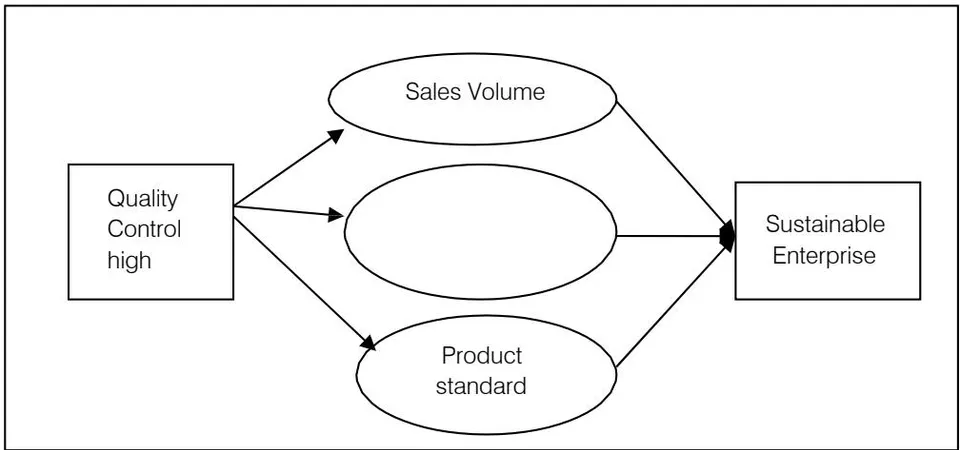
In the light of the aforementioned, it becomes necessary to consider quality control of Innoson Motors, in relationship to sustainability of the business using its assembly plant in Nnewi in Anambra State of Nigeria. The study aimed at examining the quality control in respect to entrepreneurship sustainability of its products in competitive market. Specifically, the study sought to: i) determine the relationship between the uses of quality control and sales volume ii) know the relationship between the uses of quality control and product standardization.
In line with the above objectives, two hypotheses were raised: i) There is no significant relationship between the uses of quality control and sales volume; ii) There is no significant relationship between quality control and product standardization.
The paper aimed to help the enterprise to have an in-depth knowledge of the importance of quality control on the organization and how to retain its products in the competitive market.
A company's success is greatly influenced by the quality of product the firm provides and by the cost incurred in achieving that quality. Consumers access the value they can obtain by purchasing products from the firm where value is the amount of quality they can obtain for a given price (Hisrich, & Peters, 2010). The quality of the company's product and its reputation for customer service and satisfaction influences the customer's decision. Managers have a major responsibility to help the company deliver to the customer quality products at reasonable prices (Hart & Mistein, 2003).
Entrepreneurship is the willingness and ability of a person to seek for investment opportunities to set up and operate a business successfully, Suleiman, 2006 in Oboreh, (2018). The spirit of entrepreneurship is a required condition to an entrepreneurial society and culture. This ethos is required for the general economic growth of any nation, mostly developing countries like Nigeria and the need to strengthen it. The view is in line with Onwumere & Egbo (2008) that entrepreneurship is the readiness and individual's ability or a firm or an organization to recognize an environmental change, check quality management and utilize such an opportunity to produce goods and services for public use. In addition entrepreneurship can be sustained through total quality management of an organization. It can also be described as an organizational and management approach that enables an individual to respond to change and solve problems in whatever situation they may find themselves. An enterprise success is greatly influenced by the quality of product the company provides and by the cost incurred in achieving that quality. Benzing, Hung & Chu, 2009 stated that consumers access the value they can obtain by purchasing products from the company where value is the amount of quality they can obtain for a given price. The quality of the entrepreneur's product and its reputation for customer service and satisfaction greatly influence the customer's decision. Managers have a major responsibility to help the enterprise deliver to the customer a quality product at a reasonable price (Sharmilee & Muhammad, 2016). From the view of the customer, a significant part of the quality of a good or service is fitness for his or her intended use of it. A product must be suitable for the use that the consumer has in mind (Agosi & Pakdeejjirakul, 2013). Quality includes total product and service features of marketing, engineering, manufacture and maintenance per which the product and service in use needs to meet customer's expectations (Idemobi, 2010).
Munoz & Cohen, 2018; Schaltegger & Wagner, 2011; Madu, 1986 affirmed that entrepreneurship sustainability can be seen as the process of managing an enterprise by considering three different approaches, economic, social and ecological value. Sustainable entrepreneurship is directed on the protection of nature, life support, and community in the search of real opportunities to bring into existence future products, processes, and services for gain, where gain is broadly interpreted to include economic and non-economic gains to individuals, the economy and society as whole (Farny & Binder, 2021).
In the same vein, Abuo & Ezeokonkwo (2018); Farny & Binder (2021) focused on sustainable entrepreneurship and sustainable development. The main idea that brings entrepreneurs together is such activities in pursuit of financial gain which must not adversely affect the natural and social environments in which they operate. Total quality comprises of the entire organization so that workers can view the activities of each employee level in order to steadily advance products and services delivered to customers through developing helpful organizational culture, implementing and management of available tools provided. Genaparapapu & Prathigada (2015) evaluated total quality management for competitive advantage in international business. The study adopted a cross-sectional survey. Data collected were analyzed using descriptive statistics and it was revealed that total quality management practices significantly influence the performance of organizations, hence advocated for improved quality management in the organization to enable higher recognition of the business.
a) Product Standardization
The Standard Organization of Nigeria (SON) is an independent institution empowered by government to control quality of products produced in Nigeria, SON (1971). The institution specifies quality requirements for a particular product and ensures that entrepreneurs or companies produce according to specification. Where the companies do not abide to its regulations, it can attract penalties which could lead to closure and ceasing of license. Among the principal functions and roles of SON are to: organize tests of the product, investigate quality of facilities, materials and products, guarantee reference standards for calibration and proof of measures and measuring instruments, gather an inventory product requiring standardization, to obey with Nigeria standard specification, SON (1971).
III. METHODOLOGY
The paper uses the cross-sectional method. The study population and sample size include the store manager, marketing manager and production representative officers in Innoson Motors, Nnewi, Anambra State, Nigeria. The population of the study was 45, since N population is small, the researcher decided to use the entire population N as the sample size (Spigiel, 1984). A total of 45 questionnaires were administered to all departments out of which 40 questionnaires were retrieved while 5 were not returned. In order to ascertain the reliability of the research instrument, Cronbach Alpha reliability coefficient was used. The data collected were analyzed using the Spearman Rank Order Correlation Coefficient. The level of significance of 0.05 was adopted as a criterion for the probability of accepting the null hypothesis in or rejecting the null hypothesis in .
IV. DATA ANALYSIS AND RESULTS
Test of Hypothesis
: There is no significant relationship between the uses of quality control and sales volume
Table 4.1: Correlation Result for the Uses of Quality Control to Increase Sales Volume of the product
| Quality Control | Sales volume of the product | ||
| Correlation Coefficient | 1.000 | .414 | |
| Quality control | Sign. (2-tailed) | 0.017 | |
| Spearman's (rho) | N | 40 | 40 |
| Correlation Coefficient | .317 | 1.000 | |
| Sales volume of the product | Sign. (2-tailed) | 0.017 | |
| N | 40 | 40 |
From the result in table 4.1 above, it is shown that there is a significant and positive relationship between quality control and sales volume. The value 0.317 shows the relationship and significant at p . The correlation coefficient is high which indicate that there is strong relationship. Therefore, the null hypothesis is hereby rejected and the alternate upheld, which stated that there is significant relationship between quality control and sales volume.
Test of Hypothesis Two
: There is no significant relationship between quality control and product standardization.
Table 4.2: Correlation Matrix for Quality and Product Standardization
| Quality Control | Product Standardization | ||
| Quality control | Correlation Coefficient | 1.000 | 0.451 |
| Sign. (2-tailed) | .020 | ||
| Pearson Correlation (rho) | N | 40 | 40 |
| Product Standardization | Correlation Coefficient | 0.451 | 1.000 |
| Sign. (2-tailed) | .020 | ||
| N | 40 | 40 |
The result from the table 4.2 above showed that the correlation coefficient (rho) has a positive relationship between quality control and product standardization. The correlation coefficient 0.451 confirms the degree and strength of this relationship and it is statistically significant at . The correlation coefficient represents a high correlation between the variables. Therefore, based on empirical findings the null hypothesis earlier stated is hereby rejected and the alternate accepted. Thus, there is a significant relationship between quality control and product standardization in Innoson Motors.
V. DISCUSSION OF FINDINGS
The results revealed a strong and positive relationship between the quality control and entrepreneurship sustainability of Innoson Motors in Nnewi, Anambra State, Nigeria using the Pearson Product Moment Correlation Coefficient and at confidence interval. The findings of the paper confirmed that there is a strong and positive relationship between quality control, sales volume and product standardization. From hypothesis one, it was revealed that there is correlation exist between quality control and sales volume of product which is in line with the previous studies of Sutrisno, & Timotius (2019); Worlu & Obi (2019) and Ogbu (2015) that quality control influences customers desire to purchase goods which in turn brings high sales.
The paper also found that product standardization has an effect on quality control of an enterprise, in the second hypothesis. The findings tally with Hart & Mistein (2010) which opined that to resolve the issue of quality, compliance to standards approach for customer satisfaction should be put into consideration and that all elements within the enterprise must conjointly engage.
Other study on sustainable entrepreneurship through quality control by Alintah-Abel, Okolie & Agu (2019), also posited that where quality control is well applied, it brings about improvement and increases the effectiveness in satisfying customers which raises profit of the enterprise. The relevance of quality control in an enterprise cannot be overemphasized.
VI. CONCLUSION
Quality is the judgment by the customer or user of a particular product or service, it tells to what extent the customers or users of the product believe the product or service surpasses their needs or expectation. Quality of a particular product determines its volume of demand as well as customers attractiveness to purchase the product. For an enterprise to survive in midst of sharp competition, there is need for product standard through quality control.