I. INTRODUCTION
In the works included in the book "FOUNDATIONS of Quantization Principles" a detailed, scrupulous analysis of a number of aspects of Quantization is given. His main task was to fish out fundamental errors in the historical "turns of thought", which led away from the real Quantization. If Max Planck himself went to Quantization on the way to eliminate the Divergence, "scientifically" called the Singularity, then the modern "Quantum Theory" actually came down to the search for Divergences and, thereby, from avoiding Reality into Mysticism. So the book provides the identification and, if possible, the strict elimination of the theoretical mysticism of Divergences - Singularities, modestly called by Pearls "Surprises" [1].
But these "Surprises" are nothing more than the limits of applicability of the mathematical formulas used, and, often elevated to the rank of "Discoveries", only led away from Reality into Mysticism, veiled by scientific appearance. Here are the presented beginnings of modeling in the right direction and allowed us to formulate the ESSENCE of Real, and not Mystical Quantization. And, if we highlight the main finishing elements of the works presented in the book, then this ESSENCE, in contrast to Mysticism, based on what is not given to UNDERSTAND, is quite SIMPLE-CLEAR. At the same time, instead of interpreting the imaginary solutions of the Schrödinger equation, it returns the very UNDERSTANDING of the ESSENCE of Quantization given by the brilliant Planck as an undamped resonance of waves. And it is necessary to eliminate mysticism from the entire modern "Quantum Theory", which now gives a continuous "quantum bluff" [2, 3, 4], disorienting not only scientists, but also ordinary people.
II. RESONANCES
Allowed Quantum States, as Planck himself introduced them for radiation, calling them Quanta, are undamped resonances. Electromagnetic resonances in various media are well known - these are standing electromagnetic waves. At the same time, Planck realized that each length of the resonant wave corresponds to its minimum amplitude and, accordingly, its minimum energy. Both the first, minimum energy, and subsequent ones, since waves can, if they are in phase, adiabatically add up in a given region of space, can be written in the following form:
We will not dwell on the displacement of antiphase waves from a given region of space to neighboring ones and on electrostatics.
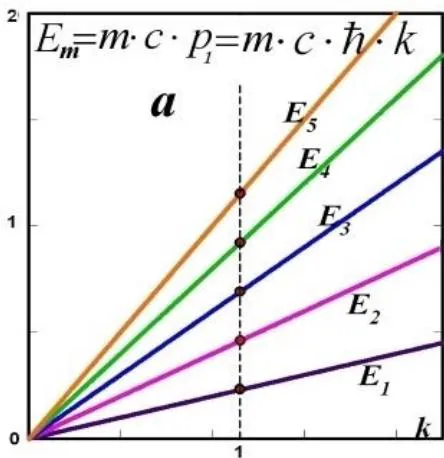
And for any traveling waves, the law of their dispersion can be written - the dependence of their energy on the momentum, which can be written in accordance with formula (1) in the form
where is the phase velocity of the wave (the speed of light for electromagnetic waves or the speed of sound for acoustic waves), the wave vector differing from the impulse by the Planck factor is usually called the quasi-momentum.
So, for an extended medium, quanta are resonant waves, which are marked with dots on a series of dispersion dependences for waves in a medium (Fig. 1a)
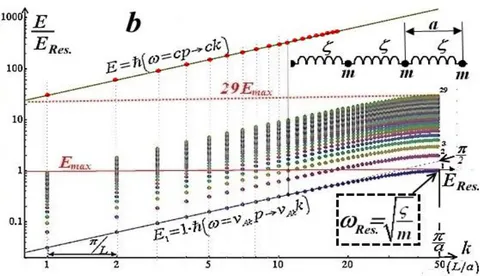
And for any medium, the linear dispersion law (f.2) corresponding to a harmonic wave is violated at large impulses and goes to an asymptotics determined by a certain local region - the translation period and the local resonant frequency (Fig. 1b). For solids, this is the size of an elementary cell and the frequency of atomic or molecular vibrations in it, described by Newton's solution for the Harmonic Oscillator. The increase in the amplitude of these local oscillations and, accordingly, their energy, according to Planck, is stepwise.
Those. an increase in the amplitude of the Harmonic Oscillator is an increase in the number of corresponding high-frequency acoustic quanta, which leads either to the melting of the entire crystal or to local destruction of the molecule (which is usually associated with each other). This local resonant frequency is also felt by optical quanta in a crystal, while in an optically active one they are absorbed and excite the noted mechanical vibrations. In this case, the dispersion law for light intersects with the maximum energy for the first acoustic oscillation (much to the left of the pulse region shown in Fig. 1b, since the light pulse is very small) and, similarly, at large pulses, the dispersion and photons saturate. But the presence of this optically active local resonant frequency, in accordance with the principle of causality, changes the phase velocity of light at all frequencies below the resonant one, which manifests itself in an increase in the refractive index of the medium at low frequencies (the Kramers-Kronig relation). Similarly, we can assume that the minimum spatial size and the corresponding resonant frequency also exist for electromagnetic waves in vacuum (to the right of the region of impulses shown in Fig. 1b), and that it is precisely this, with a large number of corresponding quanta, that leads to the splitting of the vacuum with the formation of a particle and an antiparticle.
But when exciting waves both in a Solid Body and in vacuum, it must be taken into account that Newton received only a Particular Solution for the Elementary Harmonic Oscillator A, as analysis showed [5], and the Partial Solution he himself obtained, as well as its subsequent rough addition in order to obtain the General The solution under the action of a driving force at a frequency different from the resonance one, strictly speaking, does not take into account natural oscillations at the resonance frequency. Newton, by reducing (by the method of separation of variables) a differential equation to an algebraic one, simplified it and, thereby, considered the excitation of oscillations only at the frequency of the driving force. And for small attenuations, the Harmonic Oscillator and its own oscillations make a significant contribution to the spectral dependence of the total oscillation amplitude (total interference), in principle, in an infinite frequency range. For the Ideal case, the total oscillation consists of the interference of two harmonics, each of which has its own frequency dependence of the oscillation amplitude:
where the resonant frequency and amplitude of the driving force are assumed to be unity.
The frequency of the harmonic described by the first term of the complete solution without damping is a constant equal to the resonant frequency, and the frequency of the second harmonic is equal to the variable frequency of oscillations of the harmonic driving force (Fig. 2).
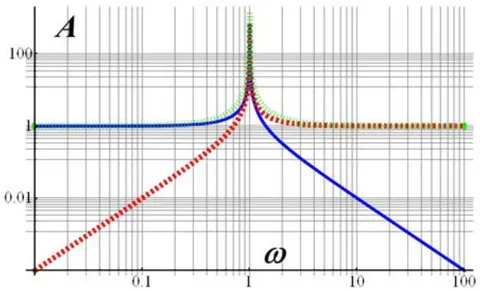
In this case, the frequency dependence of the second harmonic completely coincides with the frequency dependence of the amplitude of the oscillations of the Harmonic Oscillator, obtained by the method of separation of variables by Newton (Fig. 2, blue solid curve).
Whereas the first, skipped harmonic of OSCILLATIONS AT RESONANT FREQUENCY, which gives a small additive (response) at a frequency of the driving force below the resonant one, gives a giant additive at a frequency of the driving force greater than the resonant one (Fig. 2, red dotted curve).
The Newtonian term determines, as a consequence of RESONANCE, the change in the properties of the crystal at frequencies below it. Whereas the missing term defines RESONANCE as a consequence of the driving force at frequencies above it!
And at low attenuation, the relative contribution of the missing term is the greater, the higher the frequency of oscillations of the driving force. Strictly speaking, not up to infinite frequencies - up to a frequency reciprocal of the attenuation. But, strictly zero damping leads to nonphysical properties of the obtained solutions. But we will not dwell on this here.
The omitted first term actually explains both the flutter and the photoelectric effect described by Einstein as the interaction of a particle of Newton's light with the resonant levels of an electron in an atom for any Planck quanta whose energy is greater than the potential barrier, and in general - optical transitions. True, because Since the momentum of the photon is very small, then the excitation of the electron must occur, in accordance with the law of conservation of momentum, from a state with an initial momentum equal to the final one, which is described by the law of dispersion of electronic waves, which is constructed similarly to the law of dispersion of acoustic waves.
And finally, when translating the Classical model of the Harmonic Oscillator into the space of operators, Schrödinger also did not take into account this first term of his Own RESONANCE. This determined the discrepancy between the calculated levels of allowed energies and the experimental values of ionization potentials, which catastrophically increases with increasing atomic mass. And since Schrödinger's calculations need not a small correction, but fundamental corrections, by orders of magnitude, they cannot be used as basic ones [6, 7, 8].
III. DUALISM
The fact that one and the same object can manifest simultaneously both the properties of a particle and the properties of a wave was initially supposed to be UNDERSTANDING. In fact, this "quantum-mechanical mysticism" was decided to simply ACCEPT. Adopted, among other things, for the photons that "generated" DUALISM [9]. Whereas this MISSION is simply a consequence of the fact that the particle was considered without an internal structure and as an infinitesimal Newton point or as a region of space with infinitely thin Heaviside boundaries [10]. This for photons, after the creation of lasers, became in fact obvious, but the development of MYSTICISM by Schrödinger led to UNDERSTANDING the generality of the problem of DUALISM. But Schrödinger actually wrote the operators used in the equation of the Harmonic Oscillator with a simple enumeration. Whereas Pontryagin then built a rigorous theory of DUALISM of Functional Sets. And it's up to the "small" - a new senior telegrapher Heaviside is needed, who will transfer Pontryagin's Theory to mathematical physics.
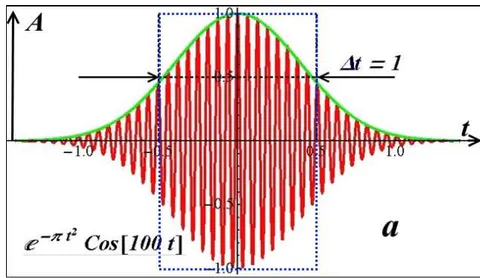
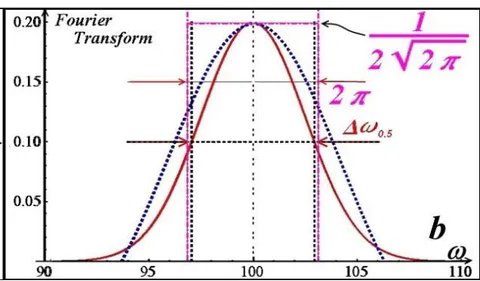
If, however, any ELEMENTARY particle, not only a photon, but, say, an electron, is represented not as the Ideal Newton Point or the Ideal Heaviside Impulse filled with de Broglie waves, but a blurred (exponentially decreasing in amplitude from the center) packet of these waves, then, in principle, the contradiction between the partial and wave descriptions of phenomena is removed. Moreover, from the parameters of the envelope of the wave amplitudes inside the particle, both the Heisenberg Uncertainty Principle and its "radio engineering" MEASURABILITY directly follow (Fig. 3)
"IMMEASURABLE" are only the energy states between Planck's QUANTUMS. But these are non-resonant rapidly decaying, so-called Forbidden States, not only for a photon, but for any, in principle, particle.
So the representation of a particle by a packet of resonant waves corresponds both to the manifestation of the wave properties of particles during the diffraction of their flow by a slit, and, in strict accordance with Pontryagin's Dualism for functional sets, and the Heisenberg uncertainty principle for an ELEMENTARY particle. It simply manifests itself when the size of the particle is commensurate with the lengths of the waves that form/fill it. Whereas in the usual macroscopic scale that we observe, either the particles forming a wave are much smaller than its length, or the size of a macroscopic body is much larger than the wavelengths of the particles filling it. Or, as in the same lasers already mentioned, all QUANTUMs are in phase, forming a coherent (continuous) wave.
But an obstacle to UNDERSTANDING THE DUALISM of the properties of ELEMENTARY particles is also the non-strict formalism of the description of the wave processes themselves [11]. If for a single wave, say a tsunami, its destructive pressure on an obstacle, equivalent to a huge mass and high speed of the wave, is obvious, then for harmonic waves with their non-strict description, these parameters are generally neglected. And an erroneous conclusion is made that all manifestations-influences of waves are described exclusively by an harmonic processes. And, as a consequence, it is argued that both the transmission of any information and the impact of the wave are determined only by its group velocity. Somehow it was simply thrown out of consideration that the force of the wind transfers part of the energy to the excitation of precisely harmonic waves moving with phase velocity to the shore washed away by them. Yes, and the total constant MEASURED pressure of sound and light waves is initially thrown out, and only the amplitude of the variable pressure is considered. Whereas it is obvious that the speed of movement of a selected section of a continuous wave with a constant phase in a medium without dispersion is simply identical to the speed of movement of a physically selected wave vector (quasimomentum) of this wave (Fig. 4):
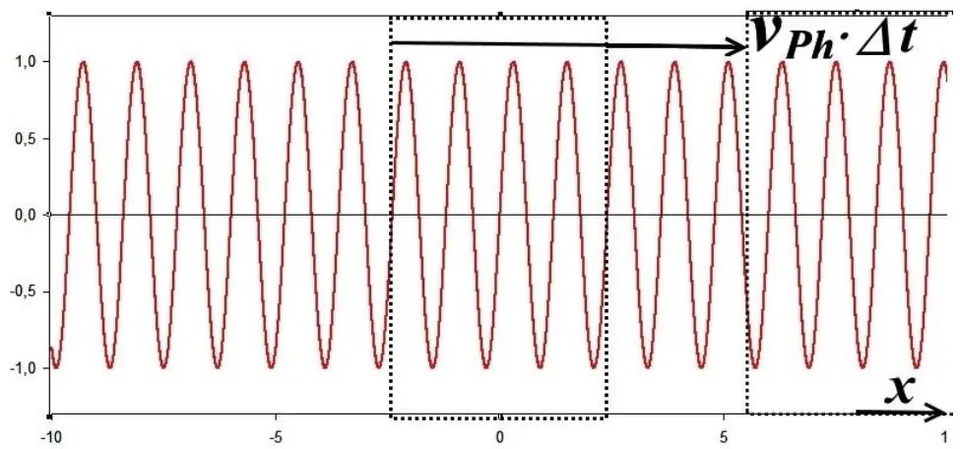
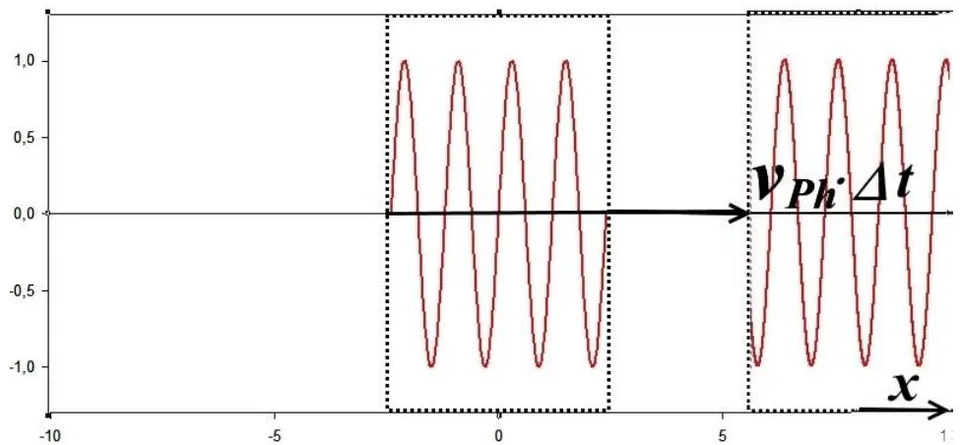
As can be seen from Fig.4, the velocities of movement of a conditionally selected section of a continuous wave and a physically selected pulse filled with this wave are identical and equal to its phase velocity multiplied by the time of recording the movement.
Thus, diffuse light "standing" in the Planck box is similar to the Brownian motion of particles and, conversely, the Brownian motion of particles is similar to the chaotic motion of short wave packets. But the OBSERVED fundamental difference between the velocities of photons and the velocities of Brownian particles is not only that the particles are packets of precisely short-wavelength waves, but also that motionless particles consist of STANDING, resonant on micro-scale waves. Whereas photons propagating with phase velocity are, in principle, NONSTANDING - freely moving with phase velocity. In the "defense" of the REALITY of the phase velocity, one can add the fact that in both radio and laser rangefinders it is the phase velocity that is used to MEASUREMENT the distance to the object. Yes, and the very fact of the identity of the phase velocity of a diffuse photon and a coherent wave in a laser, to speak about its measurability.
But the mysticism generated by the formal "prohibition" of the OBSERVABILITY of the phase velocity of photons is aggravated by the confusion in the concept of the photon mass. It is argued that its rest mass of a photon is zero, and according to the formula used by Einstein, there is only its relativistic mass, which (mysticism squared) is used for a photon, but which, in fact, is not applicable to particles with non-zero rest mass:
But the very emergence of the so-called group velocity, which differs from the phase velocity, occurs when approaching the local oscillation frequency (Fig. 1b), which is due to the fact that the photon carries
along a "fur coat" of mechanical oscillations. Those, for light, a polariton arises (mixed electromechanical oscillations), and as a result, a decrease in the group velocity to zero at a frequency corresponding to a standing wave with an increased (infinitely) "coat" mass (for acoustic oscillations at the edge of the Brillouin zone, such a "coat" becomes the mass of the entire crystal). In this case, the locality can also be set simply by the size of the macroscopic resonator, in which the resonant wave naturally stands. And similarly, for microparticles, as for short-wave packets of standing waves, their resonant nature corresponds to the polaritons of the microscopic substructure inside the elementary particle.
But according to Einstein's formula, non-zero mass tends to infinity as it approaches the speed of light. And without taking into account the above, a "logical" conclusion is made: since the mass of a photon is finite, then it has only a relativistic mass:
And they reinforce the "logic" by the fact that from the identity of the rest mass to zero from formula (8) the zero relativistic mass follows! Whereas this formula containing a singularity, strictly speaking, cannot be used for photons. Whereas from formula (7) the "relativistic" photon mass is simply equal to half the phase mass. So, exactly the opposite, from the singularity of formula (8) it follows that it cannot be considered GENERAL for any particles [12, 13]. And the use of formula (8), as a first approximation, allowed only for speeds much less than the speed of light. And its singularity for a mass near the speed of light only adds mysticism and additionally interferes with UNDERSTANDING. Moreover, this formula is easy to correct by removing the singularity from it.
Similarly, one can remove "anharmonic" mysticism from the description of light pressure.
The flow of particles is related to the speed of movement of a layer filled with a certain number of particles. So, the intensity of light (the flow of its energy - power ) divided by its "immeasurable" phase velocity will give us the relationship between the pressure of light waves and the phase mass of photons:
And for one photon incident on the surface per second, we find that its pressure on the absorbing surface is simply equal to half of its phase momentum, which, in accordance with the Planck relation for the photon energy (7), is equal to the wave vector (5), multiplied by the constant Planck
So the real phase momentum of a photon is simply proportional to the wave vector of the wave forming the photon. So, without any mysticism, the average pressure of harmonic waves is determined by their wave vector - the number of waves hitting the coast per unit time. And for a standing wave, due to its reflection from the resonator wall, the pressure is naturally equal to its whole phase momentum, which is the usual momentum of a particle described by a packet of these waves.
IV. ELECTRONIC WAVES
The mysticism of Schrödinger's wave functions actually obscured the DUALISM not only visually manifested for the Quanta of Light, but for any particles. Whereas the correct, according to Planck, quantization of electronic waves in Solid State Physics has long been and reliably used. Moreover, it is precisely these electronic but coherent waves that make it possible to describe superconductivity [14]. But everything did not prompt earlier to revise the Schrödinger equation, in the solutions of which, at the ELEMENTARY level, electronic waves in the atom are replaced by the MYSTICITY of wave functions.
And the orbital model of the atom guessed by Niels Bohr Logarithmic Relativity does not in the least contradict the wave manifestation of electron DUALISM if the resonances of these waves are correctly considered on a 3-dimensional sphere, the radius of which is determined by the resonant vibrational energy of electron waves. We will not dwell here on the subtleties of wave resonances on surfaces of the constant vibrational part of the energy, other than a sphere - and on an ideal sphere there are enough resonances that describe the allowed energy levels for an electron in an atom in the first approximation (Fig. 11) and which do not give, as Schrodinger wave functions "flying" through the nucleus of an atom, their catastrophic discrepancy with the measured ionization Potentials.
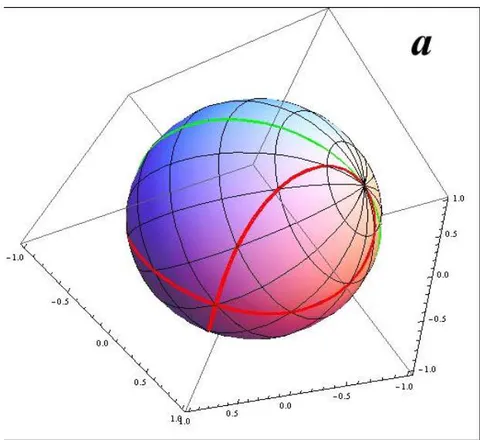
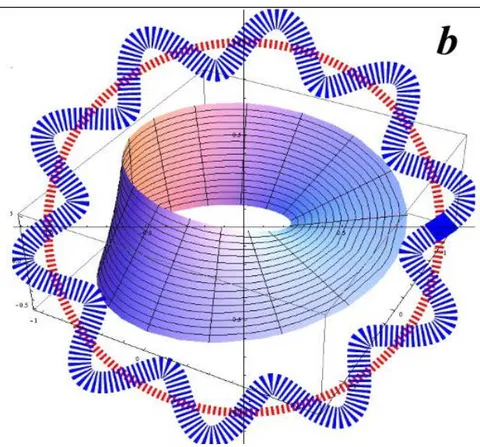
The orbit, say, of the same electron in an atom, must be built, of course, in a real 3-dimensional space, which corresponds to the Bohr model. And taking into account the Planck resonance for a wave formed from a packet of waves of an isolated particle, on a 3-dimensional sphere of constant energy, it ensures the stationarity of the orbit - the conservation of the wave energy at the resonant level, "prohibiting" its arbitrary change and the fall of an electron onto an atom. At the same time, the value of the Planck Quantum for an electron corresponding to the energy of its resonant wave, which does not contradict the Bohr orbital model in any way (like the Schrödinger wave functions), but only reveals the internal parameters of this model.
These (inside) electron waves also include de Broglie matter waves (in order to understand this, one must return to their original interpretation [15]) and Bohm pilot waves [16]. Moreover, such an approach is actually based on the conclusion made by de Broglie about the existence of matter waves. He simply translates them phenomenologically from the category of indeterminate into real small-scale waves inside the particle. In this case, the annihilation of particles corresponds to their interference cancellation at a given point at a given point with the release ("evaporation") of energy from this point in the form of electromagnetic waves.
Such an approach does not remove the question about the internal structure of de Broglie's matter waves, on the contrary, this question is raised as the following one. And in accordance with the Principle of Logarithmic Relativity, it is possible and necessary to use the models developed for macroscopic waves to determine the INVARIANTS of small-scale de Broglie waves.
This approach, in accordance with the Principle of Logarithmic Relativity, makes it possible to use models of microscopic structures, say, crystals, to determine the INVARIANTS of a substructure in general, including vacuum.
This eliminates both the mysticism of Quantization itself based on the Schrödinger equation, and their results that contradict REALITY, such as an electron in an atom for a number of orbitals spends most of the time in the nucleus - this is nothing more than finding the projection of the imaginary components of the Schrödinger wave functions onto the real axis, for which the equation is constructed.
So it's up to the "small" - behind the calculation shown in the book by the de Broglie method of resonant waves on the sphere of Planck's constant energy.
V. QUANTUM AND RELATIVITY
Galileo's Principle of Relativity, promoted by Einstein to the constancy of the speed of light in vacuum [17], was already implicitly present in the foundations of Quantization (f. 6, 7). And it is quite natural that all world constants must be taken into account when describing the phenomenon. And vice versa, it is not at all natural that not all world constants are included in the Schrödinger equation. But Einstein, pushed aside by Schrödinger's mysticism from the Fundamentals of Quantization, issued the "Special" Theory of Relativity, where he also replaced the polarity of TIME with mystical imaginary. Whereas its polarity directly follows from the Logarithmic Relativity of TIME, its polarity is visible without any mysticism (Fig. 12).
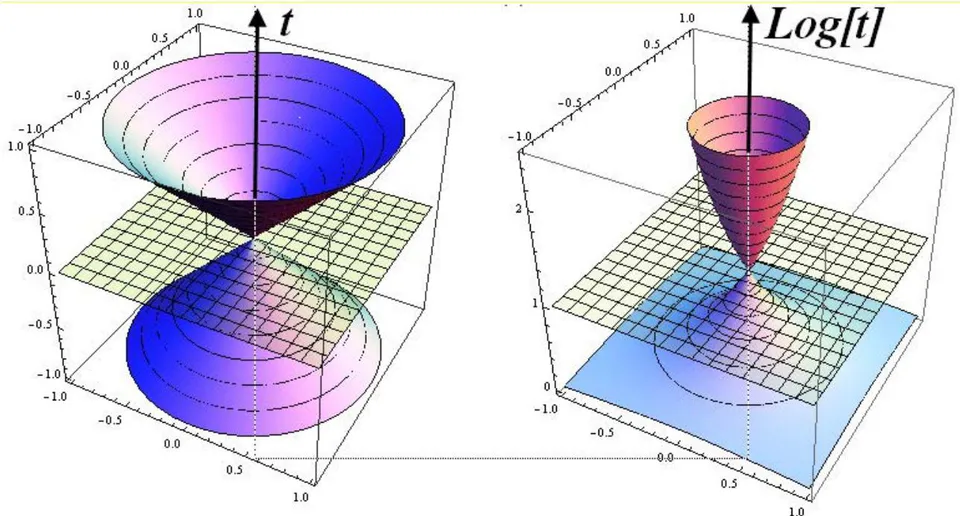
So, the "imaginary Specialty" of Einstein's Theory is connected with the distortion by the imaginary of "Quantum Mechanics", with the imaginary, the meaning of which was not understood by the authors of the formulas themselves.
The real, exponentially expanding cone of visibility of the past simply reflects the fact that Einstein himself emphasized, adding it to Galileo's Principle of Relativity - on the finiteness of the propagation speed of any perturbation of the field, which is strictly logically reflected in the fact that the particle's own field, when it is displaced, does not can change to infinity instantly. So, as can be seen from the figure, there is nothing unusual in the visible recession of distant galaxies that we see in the long past time and, as a result, the absurdity of the assumption from the visible (with a decrease in the telescope aperture) recession to conclude that the beginning of this recession is a POINT, in which there was supposedly a big explosion. Based on the thermodynamic flows in the Universe, in its Local areas constantly (everything continuously flowing TIME) both Local contractions and Local explosions arise. We can observe this on any arbitrarily large scale And only. When we look beyond its horizon, we can see expansion instead of contraction, and vice versa.
I think that with the shown expansion of the cone of visibility, they connected, erroneously, the infinitely fast recession of distant stars by switching to telescopes with a higher resolution and, accordingly, a smaller aperture. The recession, like contraction, is possible on different scales, including the scale of the visible Universe, but this also means reverse processes beyond the limits of the achieved visibility. Moreover, in the mystical expansions/contractions of the supposedly infinite Universe, an elementary logical error was made – the expansion over the visible sphere leads to compression on it at the same time.
And there is an additional point that requires adjustment - this is the luminosity of the stars, which we measure here and now. The incoming radiation registered here and now has a certain intensity, but it corresponds there to a far different radiation intensity. But a detailed study of this issue, as well as a number of others related to the mathematical blunders of SRT due to the "imaginary" TIME, will be in a separate work.