This converted HTML version may contain rendering inconsistencies. Please refer to the PDF for the authoritative version, or click here to provide feedback.
Report an Issue
Abstract
This paper proposes a unified framework connecting quantum phenomena, gravity and computation through a redefinition of matter and particle behaviour based on the Principles of Matter, or Laws of Unity. The paper addresses two fundamental questions it identifies as unresolved in current physics: how a quantum is produced and why its magnitude is discrete, by advancing a model in which matter comprises potential-energy, sharing-energy and excess-energy, whose interactions generate a unified force interpreted as inertia. Within this framework, gravity (inertia-at-rest) is attributed to sharing-energy, whereas motion and heat (inertia-in-motion) are attributed to excess-energy. On this basis, the paper redefines a quantum as a free particle that emerges when sufficient excess-energy overcomes binding sharing-energy, rather than as an intrinsically discrete packet. It then examines the implications of this reinterpretation for contemporary computing, arguing that transistor computing faces material scaling constraints and that quantum computing inherits both practical limitations and conceptual weakness on the current definition of the quantum. As an alternative, the paper introduces atom computing, in which atoms replace transistors and controlled flows of single electrons or photons enable deterministic switching, through electronic and photonic implementations. Analogue optical computing is discussed as another promising paradigm for specialised computation. The paper argues that this revised account of matter and energy interactions may support computational architectures beyond the limits of current transistor- and qubit-based systems.
Introduction
In current physics, a quantum[1] is generally defined as the minimum amount of a physical entity, such as a photon, involved in an interaction, emphasising that the magnitude of that entity can assume only discrete values corresponding to integer multiples of one quantum.
This paper argues that two foundational questions remain unresolved within that account:
How is a quantum produced?
Why is a quantum discrete in its magnitude?
Without answers to these fundamental questions, the hypothesis of quantisation, together with the definition of a quantum, is questionable, and the foundation of quantum mechanics is weak.
The aim of this paper is therefore to propose an alternative explanation of matter, inertia and free particles, and to examine its implications for both physics and computational architectures.
In his first law of motion, Isaac Newton described inertia as the natural tendency of objects in motion to remain in motion and of objects at rest to remain at rest unless acted upon by a force that changes their velocity.[2]
Newton therefore recognised two states of inertia: inertia in motion and inertia at rest. However, their causes remained unknown.
The next section introduces the Principles of Matter, or Laws of Unity, as the basis for the proposed explanation of inertia and for the subsequent redefinition of the quantum.
The Principles of Matter
A free particle is described by the Principles of Matter or Laws of Unity, updated from my original version.[3][4][5]
Matter is any substance that has mass and energy. Mass and energy are properties of matter, not physical entities. Matter’s energy is scalar, not vector.
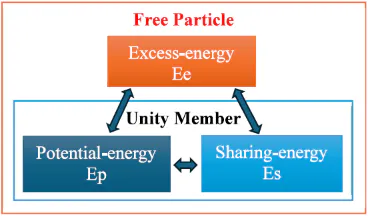
Matter retains its potential-energy () and sharing-energy () as a unity member (), within a hierarchical unit called a unity, until being pushed out of the unity by sufficient external excess-energy () as a free particle with the (). See Figure 1.
Figure 1: Matter
Matter expresses its Es and Ee as measurable vector forces to form and maintain unity, and combines them into a unity force or inertia:
where,
causes a constant pull, as inertia-at-rest or gravity () or weight (), towards the unity centre ();
produces a push, as inertia-in-motion or heat, away from the external excess-energy.
Matter oscillates away with the () as a free particle, transferring the as inertia-in-motion or heat () – for example, as light waves if the particle is a photon or a neutrino, or as electron waves with magnetic effects if the particle is an electron – until it returns to or joins a unity ().
Within the unity, , leaving only in the unity force, matter therefore orbits or gravitates towards the unity centre, like an electron orbiting an atomic nucleus or a planet orbiting a star, expressed as inertia-at-rest, gravity (), or weight (): .
Matter does not express its but converts its between its and (as shown in Figure 1). For example, when we travel upward in an airplane, our weight decreases while our potential-energy increases (). At the same time, the plane’s external excess-energy also increases our potential-energy (). When we travel even higher in a spacecraft, we become “weightless” (weighing less). When landing on the Moon or Earth, our potential-energy decreases while our weight increases ().
Breaking free a member with from a unity requires sufficient external excess-energy (), causing inertia-in-motions and heat transfers (), leading to new unities. The more energy is shared (, such as in a nuclear fusion), the tighter the formed unity (such as the produced nucleus unity), the more external excess-energy is required to break the unity, and vice versa (such as in beta decay).
Based on the above principles, I summarise:
Gravity or weight or inertia-at-rest is redefined as matter’s constant pull towards its unity centre due to its sharing-energy.
Inertia is redefined and generalised as the unity force resulting from both sharing-energy, as a pull (inertia-at-rest or gravity or weight), and excess-energy, as a push (inertia-in-motion or heat).
Matter moves relative to its unity centre, which serves as its reference point, thereby nullifying the basis of the observational reference frame and relativity.[3][4][5][6]
The New Definition of a Quantum
When matter with sharing-energy () is pushed out of its unity by sufficient external excess-energy ( ) as a free particle with the , it transfers the as inertia-in-motion or heat (involved in an interaction), by pushing or colliding with other particles while equalising their .[5] After transferring all its (), it returns to or joins a unity, pulling again with its Es or gravity.
That is, only a free particle is involved in an interaction with other particles by pushing with its .
Having crossed the threshold of its or gravity (hence a discrete value), the free particle can take continuous values of , rather than only integer multiples of .
After the initial threshold set by or gravity, the free particle does not “quantum leap”, because there is no further threshold to cross or descend from.
Therefore, the hypothesis of quantisation, together with the definition of a quantum as the foundation of quantum mechanics, is considered a misconception.
To retain the term, this paper redefines a quantum as a free particle with a minimum initial equal to its or gravity.[5]
However, current quantum theories based on the hypothesis of quantisation, including quantum mechanics and the practical quantum computing built upon them, are not easily adapted to this new paradigm. To align with this new paradigm, they require substantial revision.
This argument provides the context for reassessing contemporary computing paradigms and for considering possible alternatives.
Transistor Computing
Transistor computing[7][8] uses transistors as tiny switches to control electron flow, with On and Off representing binary 1 and 0. They operate in binary logic gates (AND, OR, NOT, NAND, NOR, XOR, XNOR) and in pairs to amplify, switch, and store data. Binary is used because it is easy to distinguish, enabling dependable, simple, and efficient circuitry.
The Principles of Transistor Computing:
Switching mechanism: Transistors have a source, receiver, and gate. Applying voltage to the gate allows electrons to flow between the source and receiver (On); whereas removing it stops the flow (Off).
Binary logic gates: Transistors are arranged into binary logic gates that perform Boolean logic, forming the foundation of processors.
Modern computers are built with Integrated Circuits (ICs), which integrate billions of transistors on a single silicon substrate (a chip) to perform calculations, manage memory, and handle graphics.[8]
ICs offer three main advantages over circuits built from discrete components: smaller size, lower cost and better performance. Chips are manufactured as single units by photolithography rather than assembled from separate transistors, which reduces both size and cost. Packaged ICs also require far less material than discrete circuits. Their performance is improved by the small size and close spacing of components, allowing faster switching and lower power consumption.
Transistor density and performance:
Miniaturization: Transistor dimensions shrink over time, allowing more transistors to fit in the same space.
Pipelining: Transistors enable pipelining, where multiple instructions are processed simultaneously in various stages.
Three-dimensional Integration: To continue scaling beyond two-dimensional limits, modern transistors are increasingly arranged in three-dimensional structures.
Exponential Growth: The number of transistors on a chip has historically doubled about every two years (Moore’s law), boosting performance while lowering cost.
Physical limitations:
Energy Requirements: Silicon transistors typically require a base-emitter voltage of 0.6–0.7 V to switch effectively.
Heat dissipation: as transistors become smaller and more densely packed, thermal management becomes a major constraint.
Noise sensitivity: further miniaturisation is limited by thermal and atomic-scale interference that can compromise integrated-circuit performance.
These constraints motivate consideration of alternative computational paradigms, including quantum computing.
Quantum Computing
In quantum computing[9], the basic unit of information is the qubit (quantum bit), which serves a function analogous to that of the bit in transistor computing. Unlike a binary bit, which occupies one of two states, a qubit can exist in multiple specific states described as a quantum superposition. During computation, this superposition is manipulated and measured, and wave interference can be used to increase the probability of a desired outcome. In this sense, a qubit can encode many probable values beyond binary 1 and 0 together with their associated manipulations.
In theory, a quantum computer using qubits can compute much faster than a transistor computer using binary bits, if the result of each qubit manipulation can be measured easily and distinguished clearly, which depends on reliable state preparation, manipulation and measurement.
However, that is a big “if”, as the reliability has been very hard to realise.
The superposition of a quantum is difficult to measure and distinguish in the presence of environmental interference, in addition to interference introduced by measurement itself. Because the result is probabilistic and carries a corresponding error rate, repeated manipulations and measurements within each computing cycle can greatly increase the overall error rate. The cost of environmental control is therefore extremely high.
Based on the argument developed here, the quantum in current physics is itself a misconception. To retain the term requires redefining the quantum as a free particle, and this reinterpretation in turn motivates a major revision of quantum computing as a computational paradigm.
Paradigm Shift – Atom Computing
As an alternative paradigm, this paper proposes atom computing, defined as the use of free particles directed at atoms to achieve faster switching and computation. Two implementations are considered: electronic atom computing based on free electrons, and photonic atom computing based on free photons.
Conceptual basis (push–release model):
Deterministic cause and effect: one definite push (heat transfer) or release causes one definite effect.
The effects or results of the push and release are easy to distinguish.
Proposed objectives:
To reduce chip size further by replacing transistors with atoms.
To minimise energy use and heat transfer by targeting atoms with single-electron or single-photon flows.
To increase computing speed through faster switching at the atomic level.
Proposed implementations:
Electronic Atom Computing:
The Process:
The design resembles the current IC, except that integrated transistors are replaced with integrated atoms, each with one outermost electron unity ().
A free electron (, where the superscript indicates high energy in this paper) from an electronic source, such as a battery, transfers its heat (Ee) and pushes the outermost electron unity () off an integrated atom (), leaving the atom with one fewer electron unity () as an On state or 1, while producing light ():
When heat transfer stops, a depleted electron () returns to the integrated atom (), producing an Off state or 0:
and a depleted photon () returns to the depleted electron () to form a new electron unity:
Materials:
Metal atoms as switches are integrated (embedded) into a current Integrated Circuit (IC), forming logic gates for control, data storage and computing.
The integrated metal atoms should ideally have only one outermost electron, such as Copper (Cu), Chromium (Cr) or Silver (Ag). Their costs (including abundance and purification requirements) and ease of integration are important considerations.
Heat Sources: batteries, such as Lithium-ion (Li-ion) batteries. The key criterion is ease of control, so that they can transfer single-electron flows.
Photonic Atom Computing:
The Process:
The design resembles the current IC, except that integrated transistors are replaced with integrated atoms – each with one outermost electron unity () – embedded in a connecting optical fibre that functions as the integrated circuit.
The outermost electron unity () of the integrated atom receives heat transfer as a push from a free photon () emitted by a photonic source, such as an LED or laser device, producing light (2 ) and leaving only the outermost electron () of the atom, as an On state or 1:
Stopping the heat transfer releases a depleted photon () to return to the outermost electron () of the integrated atom, as an Off or 0:
Materials:
Hydrogen or metal atoms – each with one outermost electron unity () – are integrated (embedded) into a connecting optical fibre as an Integrated Circuit (IC), forming logic gates for control, data storage and computation.
If Hydrogen atoms prove difficult to integrate, metal atoms with only one outermost electron unity (like Cu, Cr or Ag) may serve as suitable alternatives.
As a high-capacity, low-latency medium, optical fibre offers very high bandwidth and low signal loss, potentially relieving the “von Neumann bottleneck”[10] created by the separation of memory and compute.
Heat Sources: LED or laser devices. The key criterion is ease of control, so that they can transfer single-photon flows.
Paradigm Shift – Analog Optical Computing
In addition to atom computing, analogue optical computing is another promising paradigm, for specialised computation.
Analog optical computers (AOCs)[11] use light generated by LEDs and manipulated through lenses and modulators to perform AI inferences and optimizations. These systems combine optics with analogue electronics in a feedback loop to achieve faster, more energy-efficient computation for specific workloads than transistor computing.
Main features of Analog Optical Computers:
Mechanism: instead of binary switches, AOCs use the physical properties of light, including interference and diffraction, to perform large-scale matrix–vector multiplications.
Process: they operate by passing light through modulators, capturing it with sensors, and iterating in a feedback loop until a steady-state solution is reached.
Applications: they are designed for AI tasks, combinatorial optimisation, and complex matrix calculations rather than as replacements for digital computers.
Efficiency and Speed: they avoid the “von Neumann bottleneck”, improve energy efficiency, and may be substantially faster than digital counterparts for suitable tasks.
Technology: they use low-cost, scalable components such as micro-LED arrays, spatial light modulators, and cameras.
Noise Robustness: the iterative, fixed-point character of the design offers inherent robustness against analogue hardware noise.
Conclusion
When matter with sharing-energy () is pushed out of its unity by sufficient external excess-energy () as a free particle with the , it transfers the as inertia-in-motion or heat (involved in an interaction), by pushing or colliding with other particles while equalising their .[5] After transferring all its (), it returns to or joins a unity, pulling again with its or gravity.
That is, only a free particle is involved in an interaction with other particles by pushing with its .
Having crossed the threshold of its or gravity (hence a discrete value), the free particle can take continuous values of rather than only integer multiples of . It does not “quantum leap” after this initial threshold because there is no further threshold to cross or descend from.
On this basis, the hypothesis of quantisation, together with the current definition of a quantum on which quantum mechanics depends, is considered a misconception.
To retain the term, a quantum is redefined as a free particle, with a minimum initial equal to its or gravity.[5]
Transistor computing uses transistors as tiny switches to control electron flow, with On and Off representing binary 1 and 0. These switches operate in binary logic gates to amplify, switch, and store data in dependable, simple, and efficient circuitry.
Modern computers are built with integrated circuits (ICs) because of their advantages in size, cost, and performance, integrating billions of transistors on a single silicon chip to perform calculations, manage memory, and handle graphics.
These integrated circuits are approaching physical limits, mainly in energy requirements, heat dissipation and noise sensitivity.
Quantum computing may offer substantial computational advantages in principle, but in practice it remains constrained by the difficulty of preparing, measuring and distinguishing superposed states under environmental interference, with corresponding error rates and control costs. Within the framework advanced here, these practical limitations are compounded by the currently mis-conceptualised quantum itself.
In response, the paper proposes atom computing as an alternative paradigm in which free particles push atoms for deterministic switching through electronic and photonic implementations, with the broader implication that new computational models may emerge from a re-examination of matter, inertia and free-particle dynamics.
Analogue optical computing is discussed here as another promising paradigm, for specialised computation.
References
11 Cites in Article
1.Wikipedia (2026). Quantum. Wikipedia
2.Wikipedia Editors (2026). Newton’s laws of motion. Wikipedia
3.Changming Wang (2026). The Principles of the Universe. Global Journal of Science Frontier Research (A), 25(6), 1-4.
4.[email protected] Wang (2026). Gravity and Inertia. Global Journal of Science Frontier Research, 25(A6), 11-18.
No ethics committee approval was required for this article type.
Data Availability
Not applicable for this article.
How to Cite This Article
Changming Wang. 2026. "Quantum, Gravity and Atom Computing". Global Journal of Science Frontier Research - A: Physics & Space Science GJSFR-A Volume 26 (GJSFR Volume 26 Issue A1).
Explore published articles in an immersive Augmented Reality environment. Our platform converts research papers into interactive 3D books, allowing readers to view and interact with content using AR and VR compatible devices.
Your published article is automatically converted into a realistic 3D book. Flip through pages and read research papers in a more engaging and interactive format.