## I. INTRODUCTION
In the periodic table of elements, as one moves down any group from top to bottom, both the volume (or size) of atoms and their mass numbers generally increase. This trend reflects the addition of electron shells and the corresponding increase in atomic mass. Table 1 presents the atomic radii, mass numbers, and densities of Group I elements. As seen in the table, a consistent trend emerges—both atomic size and mass increase down the group—with the only notable exception being potassium (K).
Atomic radii $\propto$ Mass number $\propto$ density Table 1: Atomic radii, densities, and mass numbers of Group I elements in the periodic table. [1]
<table><tr><td>Element</td><td>Atomic Radii (pm)</td><td>Density (gm/cc)</td><td>Mass number (gm)</td></tr><tr><td>Lithium</td><td>152</td><td>0.53</td><td>6.94</td></tr><tr><td>Sodium</td><td>186</td><td>0.97</td><td>22.99</td></tr><tr><td>Potassium</td><td>220</td><td>0.86</td><td>39.09</td></tr><tr><td>Rebuidium</td><td>244</td><td>1.53</td><td>85.47</td></tr><tr><td>Cesium</td><td>262</td><td>1.9</td><td>132.905</td></tr></table>
Like the mass numbers (or mass $m$ ), the densities of elements also tend to increase with increasing atomic radii. A higher density implies that more mass ( $m$ ) is being concentrated within a given volume ( $V$ ). Thus, both density and mass can be seen as indicators of the 'attractive' forces operating among atoms and molecules in the universe. Based on the experimental data presented above, one can conclude that:
$$
m \propto V
$$
This implies that the absolute dimension of mass and the absolute dimension of volume must be inversely related; otherwise, the observed direct proportionality between mass and volume cannot be theoretically justified. If volume and mass were dimensionally the same—for instance, if both were represented by 2D circles—then the forces at the center
of mass and the center of volume would have to act in the same direction, as illustrated in Figure 1a below:
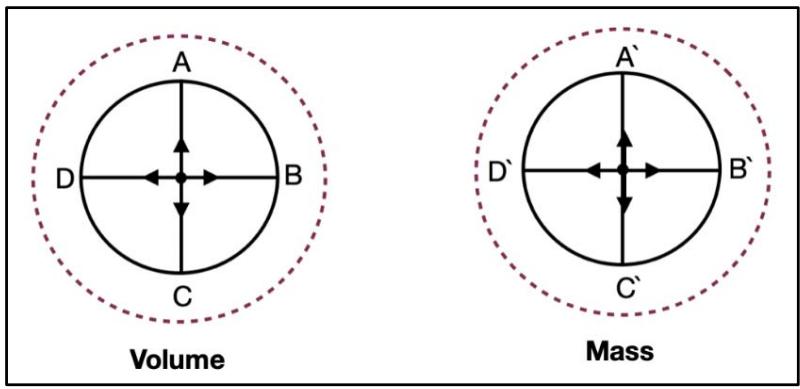 Figure 1a: Topological representation of volume and mass
Under such circumstances, the forces acting on both volume and mass would increase simultaneously as a function of atomic radii, eventually tending toward extremely large magnitudes. Since energy is defined as the product of force and distance, this would imply an infinite amount of energy—thereby violating the thermodynamic principle of conservation of both mass and energy. Such a condition is physically impermissible.
Conversely, if the topological geometries of volume and mass take on forms as illustrated in Figure 1b below, then the forces acting at the centers of mass and volume would act in opposite (inverse) directions. In such a configuration, the product of these forces would be constrained and could never approach infinity, preserving the physical and thermodynamic consistency of the system.
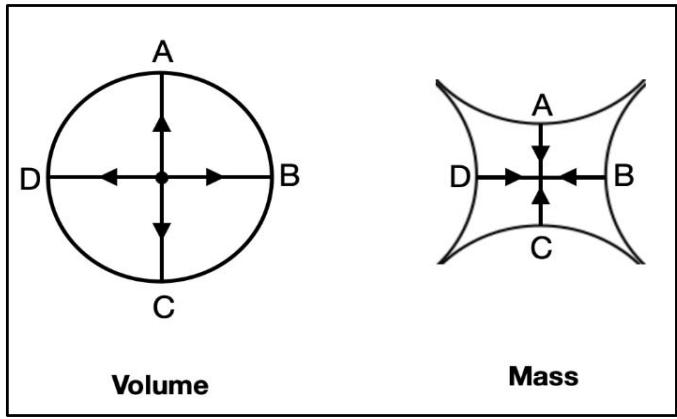 Figure 1b: Topological representation of the inverse dimensional relationship between mass and volume, illustrating the multidirectional character of volume versus the unidirectional character of mass In Figure 1b, mass is represented by a 2D saddle-shaped geometry. Importantly, the hybrid or product of volume and mass can be expressed as:
$$
(Volume \times Mass) \propto [S \times (1/Q)]
$$
Here, $S$ denotes the force acting through the center of volume, and $(1 / Q)$ represents the force acting on the center of mass, as illustrated in the figure. The detailed theoretical basis for this inverse relationship between volume and mass will be elaborated in the subsequent model. However, it is crucial to note that this inverse relation inherently prevents any violation of the principle of conservation of energy under all conditions. It will be shown that as the value of $Q$ increases, $S$ increases correspondingly, and vice versa, maintaining a balanced system.
In Anti De Sitter Space, the curvature of space like section is negative, corresponding to a hyperbolic geometry as is being shown in Figure 1b (i) below.
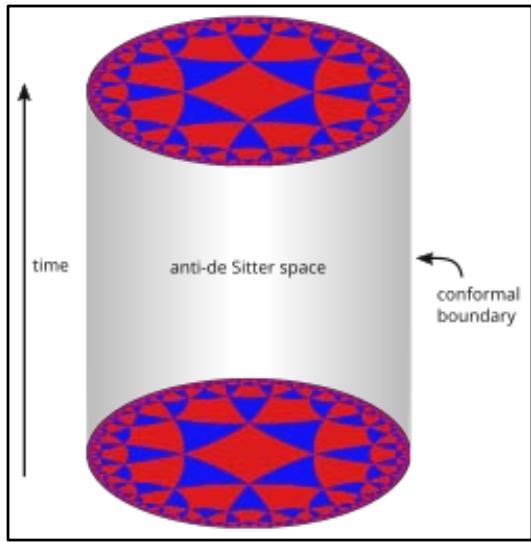 Figure 1b(i): Typical 3D presentation of a 3D Anti De Sitter hyperbolic 'time-space' of the universe While Figure 1b(i) is the typical representation of a Anti De - Sitter space which had been derived mathematically, the Figure 1b of the new model offered in this article is a topologically derived very simple formalism of the 'mass-volume' relationship and the said 'mass-volume' are the building stone of the De Sitter and Anti De Sitter 'time-space' of the universe.
## II. THEORETICAL QUANTUM MODEL OF THE SYMMETRY BREAKING PHENOMENON
This section presents a theoretical model to topologically explain how attractive forces arise among molecules—regardless of whether the substance is in a gaseous, liquid, or solid state.
In physical chemistry and physics, atoms and molecules are generally considered spherical in shape. As molecular size increases, so does molecular mass. For instance, the average atomic radius of a hydrogen atom is approximately 37 picometers, whereas that of a cesium (Cs) atom is about 260 picometers. Correspondingly, cesium is roughly 133 times heavier than hydrogen (with atomic weights of 133.9 and 1, respectively). Thus, an increase in atomic or molecular weight is typically accompanied by an increase in atomic/molecular size.
As the size of atoms increases, more electronic orbitals are added, which in turn raises their total energy. Therefore, atomic size—or volume—can also be seen as an indirect representation of an atom's energy level.
To simplify the representation in this model, atoms and molecules are illustrated in $2D$. As shown in Figure 1c below, when four molecules become entangled, energy interactions occur among them. This interaction leads to the formation of an "inverse area"—an emergent attractive energy that is fundamentally topological or geometrical in origin.
In the configuration shown in Figure 1c, if a molecule attempts to move or collide with a boundary (such as a wall), the network of interlinked 2D circles exerts a pulling force that resists this motion. This demonstrates how topological entanglement generates a binding energy among molecules.
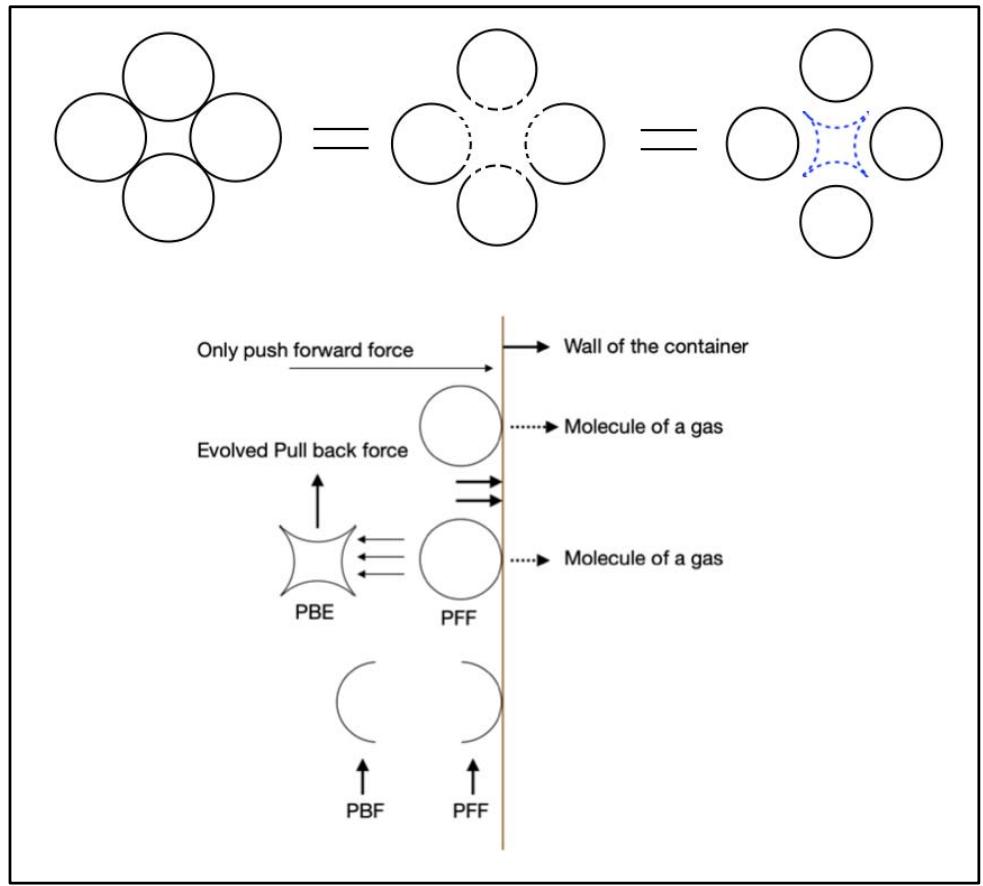 Figure 1c: Evolution of 2D saddle from 2D circle
The geometry that emerges from the interaction of entangled molecules is termed a 2D saddle. While 2D circles represent random and isotropic configurations, 2D saddles are attractive in nature due to their reversed curvature. As illustrated in Figure 2, equal areas from each of the original circles (depicted as the shaded or lined portions) are removed, resulting in new, smaller circles. These new circles have reduced areas—diminished by a certain percentage of the originals—and their combined cut-out areas form the saddle- shaped geometry. This geometry, however, is inverse in nature compared to the original circles.
As previously discussed, the size of atoms is indicative of their energy levels. In the 2D representations used here, areas correspond to volumes, and thus inverse areas represent inverse volumes. Prior to the molecular entanglement shown in Figure 5, the geometry of the system was of a "push-forward" type. However, after the formation of the 2D saddle, a "pull-back" geometry emerges.
In this model, it is shown that the product of the push-forward area (PFA) and the inverse of the pull-back area (PBA) remains constant. This relationship is expressed as:
$K = [(push$ forward area $\times$ pull back area)\] $=$ constant (1) As demonstrated in Figure 2, PFA and PBA are interconvertible. This reinforces the principle that pull-
back areas (PBA) evolve directly from push-forward areas (PFA), and conversely, PFA can evolve from PBA. These transformations highlight a dynamic equilibrium and topological symmetry in the geometry of mass-volume interaction.
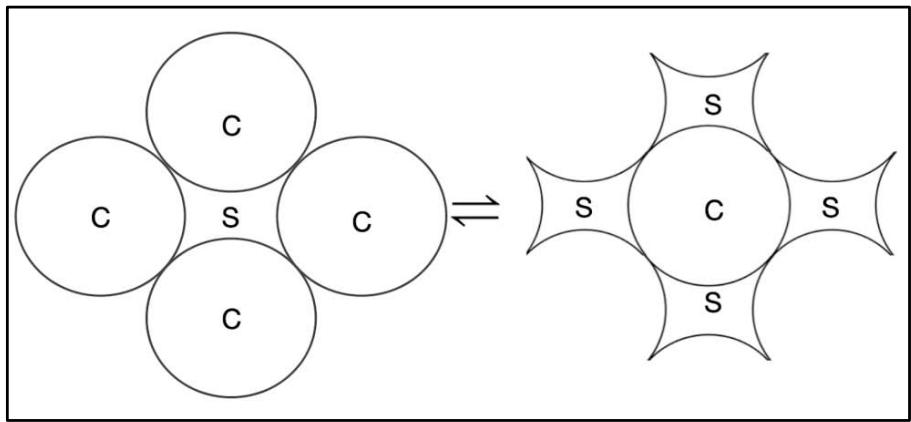 Figure 2: Interconvertibility of circle to saddle and vice versa
The Push-Forward Area (PFA) and the Pull-Back Area (PBA) are complementary to each other. As the PFA increases, the PBA also increases; however, their relationship is governed by a mathematical multiplicative inverse, as expressed in Equation (1). This inverse proportionality ensures that their product remains constant.
Figure 3 illustrates how PFAs and PBAs vary in response to each other. As shown, an increase in one corresponds to an increase in the other, yet their behavior remains constrained by their inverse relationship—preserving geometric and energetic balance within the system.
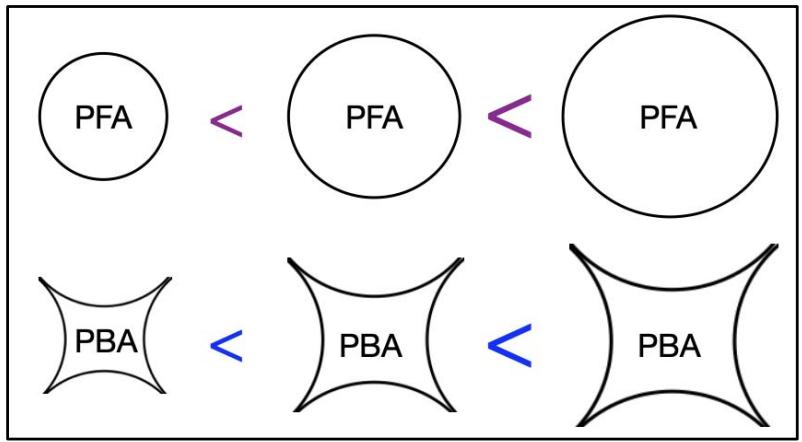 Figure 3: Topological representation of the growth dynamics of direct space (Push-Forward Area) and reciprocal or inverse space (Pull-Back Area) As observed in Figure 3, an increase in the Push-Forward Area (PFA) is accompanied by an increase in the Pull-Back Area (PBA). However, since their dimensions are inverse to each other, the growth in the inverse area exerts a dampening effect on the overall pressure of the system. This phenomenon, and its implications, will now be discussed in detail.
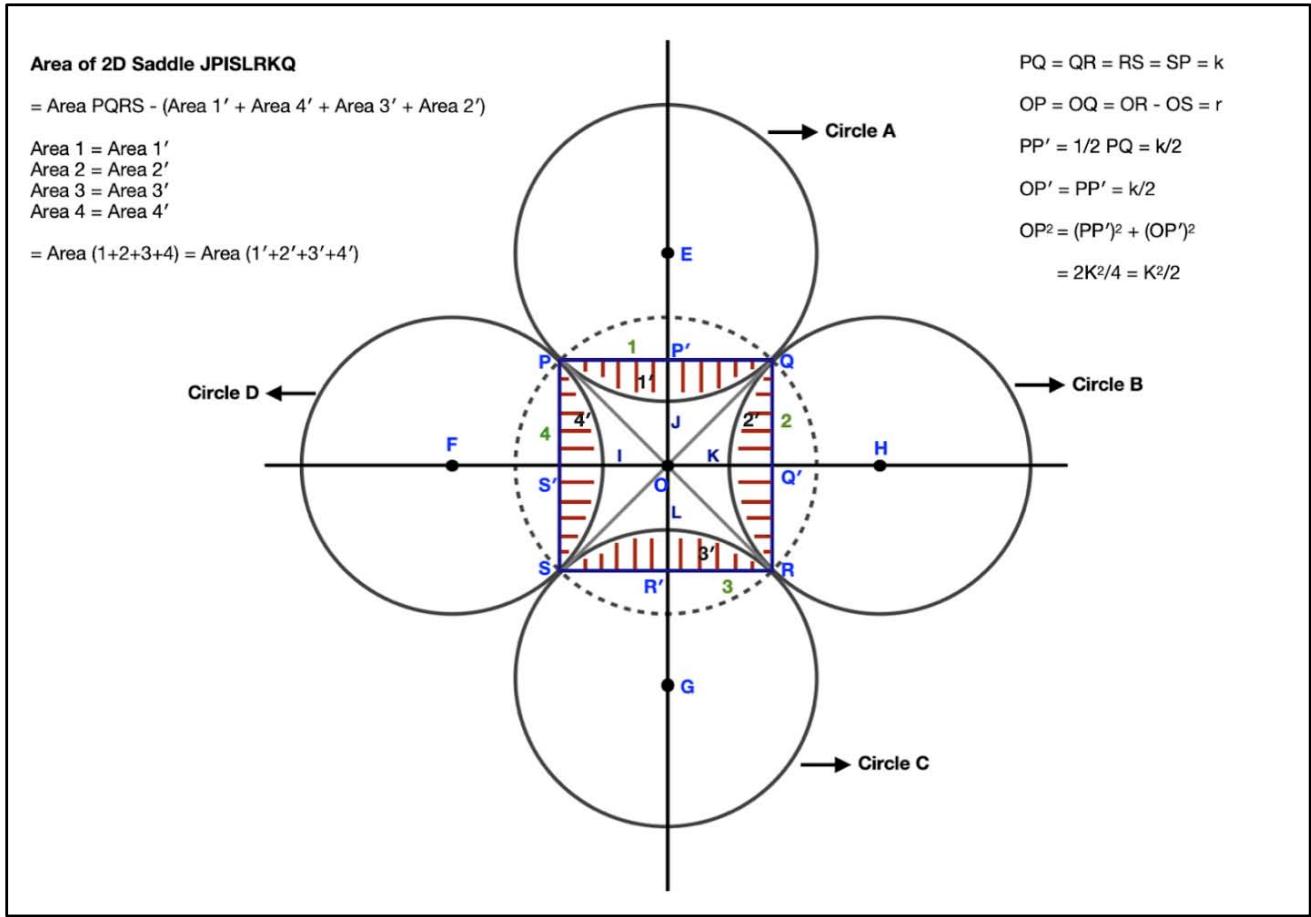 Figure 4: Topological representation of the entanglement between the area quantum and inverse area quantum, or equivalently, between the volume quantum and the mass quantum As illustrated in Figure 4, four circles—labeled A, B, C, and D with centers at E, H, G, and F respectively—each having radius $r$, undergo a molecular entanglement. This interaction results in the formation of a 2D saddle, denoted as JPISLRQ. An inner, imaginary circle PQRS, also with radius $r$, is shown for reference.
Each of the four outer circles has two symmetrical segments: the upper segments (areas 1, 2, 3, and 4) and the lower segments (areas $1'$, $2'$, $3'$, and $4'$ ), which are shaded or lined in the figure. Notably, area 1 = area $1'$, area 2 = area $2'$, and so on, indicating perfect symmetry.
From each of the four circles, identical lower segments (areas $1'$ through $4'$ ) are removed. These removed segments are then used to form four new circles of equal area. The sum total of the removed areas—that is, area $1' + \text{area } 2' + \text{area } 3' + \text{area } 4'$ —is effectively transferred to the 2D saddle geometry.
However, as this area transitions into the inverse space domain, a squeezing effect occurs—reflecting a topological compression associated with the inverse curvature of the saddle. The mathematical formulation of this transformation is presented below.
$$
\text{Theareaoftheinnercircle} = \pi r ^ {2} \tag{2}
$$
If the length of each side of the square $PQRS$ is taken to be $k$, then the lengths $PP$ and $OP$ (as indicated in Figure 4) are each equal to $k/2$. Therefore, we can deduce the following:
$$
OP^{2} = (PP)^{2} + (OP)^{2} = (k/2)^{2} + (k/ 2)^{2}
$$
Or, $r^2 = (k^2) / 2$
$$
Or, k = r 21/2 (3)
$$
Or, $\mathsf{k}^2 =$ area of the Square $= (2\mathsf{r}^{2})$ (4)
Now the Area of the saddle is $=$ \[Area of the square PQRS - sum of the area of the four numbers of lined portion $(1' + 2' + 3' + 4')$, since sum of area $(1 + 2 + 3 + 4) =$ sum of area $(1' + 2' + 3' + 4')$ and since sum of area $(1' + 2' + 3' + 4') =$ [area of the inner circle - area of the square PQRS].
$$
= \left(\pi r^{2} - 2 r^{2}\right) \\tag{5}
$$
So the Area of the 2D saddle $=$ (area of square PQRS - sum of the area of the four numbers of lined portions) $= [2r^2 - (\pi r^2 - 2r^2)] = [r^2(4 - \pi)] = 0.86r^2$ (6)
Now the total area of the non- lined portion $=$ Area $(1 + 2 + 3 + 4) = (\pi r^2 - 2r^2)$ and from each of the four numbers of outer circles $\frac{1}{4}$ th of the area of the total lined portion area is being cut out
The area of each of the new circle as being shown in Figure 1C = $[( \pi r^2 - (\pi r^2 - 2r^2) / 4 ]$
$$
= r ^ {2} [ (3 \pi + 2) / 4 ] \tag {7}
$$
So the sum total area of all the 4 new circles formed $= \mathbf{r}^2 [(3\pi +2)]$ (8)
Now, (sum total of 4 new circles/area of the formed 2D saddle JPISLRQ $(= 0.86r^2) = r^2[(3\pi + 2)/(0.86r^2)] = [(3\pi + 2)/(0.86) =$ constant (9)
Now the (area of each of each of the new circles formed) / (area of the 2D saddle formed) = $\left[r^{2}[(3\pi +2)/4]\right] / (0.86r^{2}) = [(3\pi +2)/(3.44)] =$ constant (10)
Another interesting correlation between the 'Sum total area of the 4 numbers of lined portion' (i.e. the Total cut-out Area from the 4 numbers of outer circles in Figure 4) and the 'Inverse area of the saddle' is being constant always and they are being very close to be 'Multiplicative inverse' to each other. From equation (5) and equation (6), it can be written,
[('Sum total area of the 4 numbers of lined portion') x ('Area of the saddle in the inverse magnitude')] = $(\pi r^2 - 2r^2) \times [1 / r^2 (4 - \pi)] = [(\pi - 2) / (4 - \pi)] = \text{constant} = 1.34$ (10a) To become perfectly 'multiplicative inverse' the value of the constant in equation (10a) had to attain a value of unity or 1.
In this quantum model, the 'inverse areas/volumes' that are formed from the 'direct areas/volumes' upon symmetry breaking constitute the 'masses' of the universe. Hence, the physical significance of equation (10a) is that the amount or magnitude of volume (V) flowing into the 'reciprocal space'[2] from the 'direct space' attains a value about to be equal to the inverse or reciprocal of V, i.e., $(1 / V)$, and this appears in the form of the mass of the universe. Now the value of $\pi$ had been considered as 3.145 to obtain the constant value 1.34 in equation (10a).
Equation (10a) can be expressed in the language of physics as,
(Decrease in the magnitude of area/volume) x (Increase in inverse area or mass in the mathematical inverse sense) = constant = 1.34 (10b) In this model, the total area of four circles represents the 'push forward area (PFA)', and the inverse of the area of the 2D saddle represents the 'pull back energy (PBA)'. The hybrid, or the product of the PFA and PBA, remains constant.
$$
[(Volume) x (1/(Area or Volume)) = Constant]
$$
Or (A quantum of volume) x (A quantum of mass) = constant and dimensionless (11)
This constancy of mass-volume indicates that substances in nature (solid, liquid, or gas), irrespective of the sizes of their molecules, adjust their total volumes and free volumes in such a manner that, at constant temperature (i.e., the average atmospheric temperature), the product of their 'volume' and 'mass' (as explained above) remains constant. It is to be noted that volume and mass both are being considered as 'quantum' unlike the continuous entities of classical physics. As mentioned earlier, for the pullback areas or volumes to be generated or to grow, the availability of free volume is essential. Therefore, in equation (10a), the pullback area or volume would be directly proportional to the total available free volume (FV), and the push forward area or volume would be directly proportional to the total 'hard core volumes' (THCV) of the molecules. Thus, equation (12) can be rewritten as:
$$
\left(\text{THCV} / \mathrm{F V}\right) = \text{Constant and dimensionless} \tag{12}
$$
[The free volume appears in the denominator in equation (18) since the pullback area or volume acts as the mathematical multiplicative inverse of the push forward area or volume.]
Another interesting feature is that the proportion of the area of each molecule (or each circle A, B, C, or D in Figure 4) that undergoes 'inversion' relative to the total area of each molecule always remains constant, irrespective of the radius of the molecules. The area of each molecule is $\pi r^2$, and the area of each molecule that undergoes inversion is $(\pi r^2 - 2r^2)/4$ [equation (7)]. Hence, the ratio of the two is:
$$
\begin{array}{r l} & {\left[ \left(\pi r ^ {2} - 2 r ^ {2}\right) / 4 \right] / \pi r ^ {2} = \text{fractionofenergybeinginversed}} \\& {\quad = \text{constant}} \end{array} \tag{13}
$$
The empirical data given in the following Table 2 shows that the ratio of equation (13) is independent of $r$ (Radius of each molecule).
Table 2: Data of 'fraction of energy to the total energy of the molecule' which does take place in the inversion process
<table><tr><td>Value of radius r of a molecule</td><td>Area of the circle (πr2)</td><td>Area of a circle takes place in the inversion [(πr-2r2)/4]</td><td>Ratio of [(πr2-2r2)/4] / (πr2)</td></tr><tr><td>1</td><td>3.14</td><td>0.28</td><td>0.09</td></tr><tr><td>2</td><td>12.56</td><td>1.13</td><td>0.09</td></tr><tr><td>3</td><td>28.3</td><td>2.54</td><td>0.09</td></tr><tr><td>4</td><td>50.2</td><td>4.5</td><td>0.09</td></tr></table>
The physical significance of the constant relationship between the 'push forward area' and the 'pull back area', as shown in equations (9) and (10), is that nature exhibits a fixed or constant partitioning of areas or volumes between the push forward and pull back components of substances. When the PFA increases, the PBA also increases, or vice versa, but the ratio between the two remains constant.
Irrespective of the hard core volume (HCV) of each molecule, a fixed proportion of its area or volume is cut out and undergoes inversion. This 'area or volume of inversion' flows into the free volume (FV) of the substance, where it exerts a pullback force. If sufficient free volume is not available to hold this 'inversed energy', the inversion process itself does not occur. In such cases, due to the low FV, the ratio of HCV to FV increases, and the substance exhibits higher pressure. For example, in a gas cylinder, as more and more molecules are introduced, the free volume decreases, and the pressure rises.
This model is now extended to three dimensions. The circles are replaced by spheres, and the 2D saddles are replaced by 'inverse 3D saddles', as shown in Figure (4a) below. The 3D spheres represent 'quanta of volume', and the inverse 3D saddles represent 'quanta of mass'. The symmetry-breaking phenomenon [3] shown in Figure (4a), arising from the orientational interactions of four quanta of volume, leads to the generation of mass in the universe.
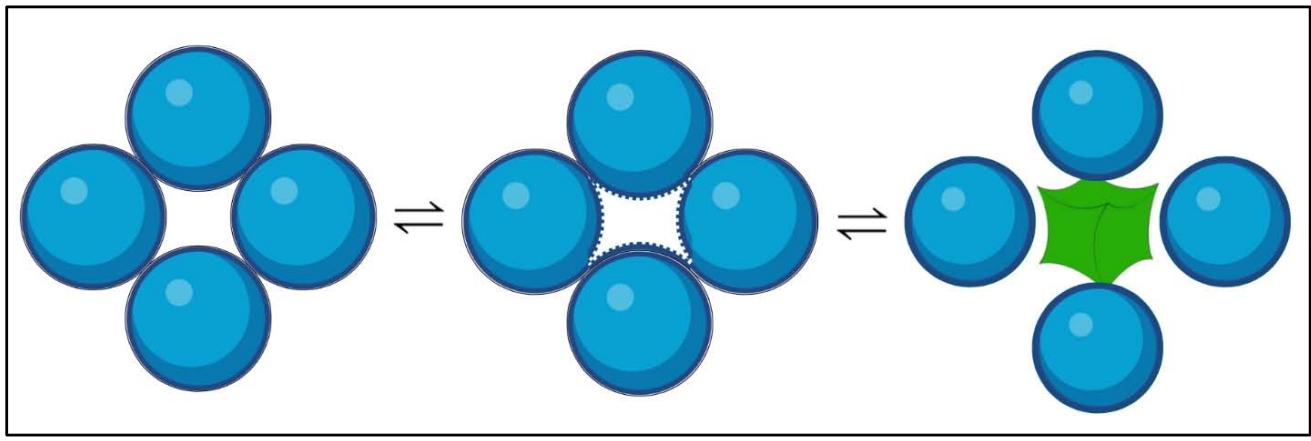 Figure 4a: Topological presentation of the entanglement of the four numbers of quantum of volume to form a quantum of mass of 3D inverse geometry
Figures 5 and 6 illustrate the mathematical relationships among the radius of the sphere, the radius of the saddle, and the depth of the saddle. [Note: The presentation has been made in 2D for simplification and ease of understanding.]
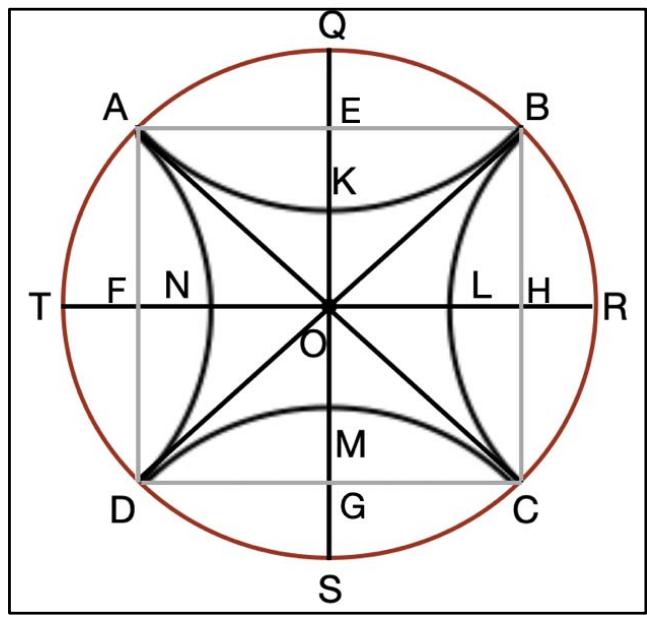 Figure 5: Geometry of the 2D saddle with its conjugate circle
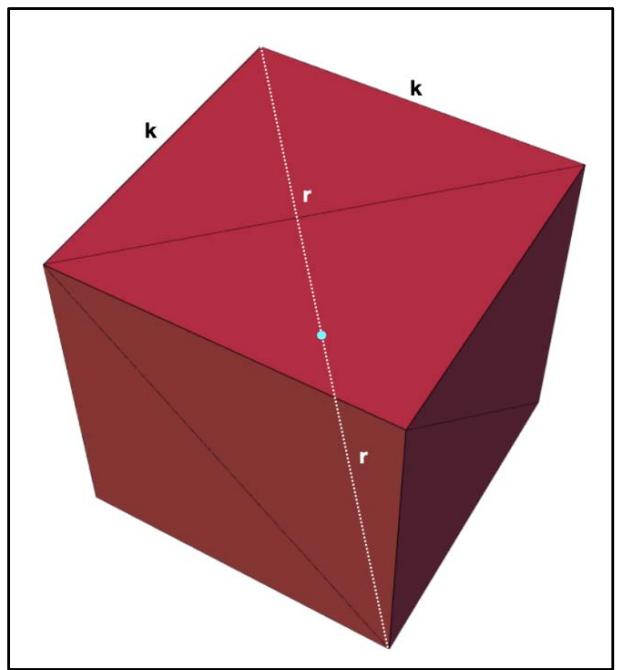 Figure 6: The inscribed cube of a sphere of radius $r$
From the above figure 5, it is to be noted that,
Radius of the sphere $=$ radius of the saddle $= r = OA$ $= OB = OC = OD$
Depth of the saddle $= R = OK = OL = OM = ON$
Now if the radius of the sphere be $r$ and the length of the each side of the inscribed cube would be $k$ as shown in Figure 6 above,
$$
(\sqrt{3}k)^{3} = (2r)^{3} \tag{14}
$$
$$
\mathrm{Or}, \quad k^{3} = \left(8r^{3}/3^{3/2}\right) \tag{15}
$$
$$
\mathrm{Or},\quad k=(2r/3^{1/2})=1.15r\tag{16}
$$
Now EQ = FT = GS = HR = small sagitta of the chord of length k = AB = AD = BC = CD = 1.15r
Now the geometric formula for the length small sagitta is, (If $r$ be the radius and $k$ be the length of the chord)
$$
\text{Lengthofsmallsagitta} = \left[ \mathrm{r} - \sqrt{\left\{r ^ {2} - \left(\frac{k}{2}\right) ^ {2}\right\}} \right] \tag{17}
$$
Now for 3D sphere, $k = 1.15r$, so,
$$
EQ = [r - \sqrt{r^{2} - 0.33r^{2}}] = [r - 0.82r] = 0.18r
$$
From the Figure 5, it is to note that as per the geometrical figure, $QE = KE = TF = NF = SG = MG = LH = LR = 0.18r$ and hence $KQ = 2EQ = 0.36r$
Now as per figure 9 above,
$$
\text{Depth} = R = O K = (O Q - E Q) \tag{19}
$$
$$
\text{Now} \quad K Q = 0.3 6 r \text{and} O Q = r \tag{20}
$$
$$
\begin{array}{l} \text{Sothedepthofthesaddle} = R = O K = (r - 0.3 6 r) = \\0.6 4 r \end{array} \tag{21}
$$
Now the volume of the 3D Saddle = \[volume of the cube - volume of the lined portion\](of Figure 4) and the volume of the lined portion = volume of the non-lined portion.
The mathematical formula in 3D of the non-lined segmented cap in Figure 4 is,
$$
\begin{array}{l} \text{Volume of a segment cap of a sphere,} V_{\mathrm{cap}} = \frac{1}{6} [\pi h (3a^{2} + h^{2})] \end{array} \tag{22}
$$
\[Where $h$ is the height of the cap $= EQ = 0.19r$, a is the base radius of the cap $= AE = (k / 2) = 0.575r$ \]
So the volume of the cap would be,
$$
V_{\text{cap}} = \frac{1}{6} \left[ \pi \times 0.19r \left\{3 (0.575r)^2 + (0.18r)^2 \right\} \right]
$$
$$
O r, \quad V _ {\text{cap}} = 1 / 6 \left[ 0.5 9 r ^ {2} + 0.0 3 6 1 r ^ {2} \right] = 0.0 3 \pi r ^ {3} \tag{23}
$$
So the volume of four numbers of non-lined cap segment $= 0.12\pi r^3$
Volume of the cube $= (1.15\mathrm{r})^3$
So, the volume of the saddle $=$ [volume of the cube - volume of the 4 numbers of cap]
$$
= \left[ r ^ {3} (1. 1 5 - 0. 1 2 \pi) \right] \tag {24}
$$
So the volume of each new sphere formed (in line with figure 1C)
$=$ [Volume of the original sphere - volume of each of the 4 numbers of non-lined segmented cap]
$$
= \left[ \frac{4}{3} \left(\pi r^{3}\right) - 0.03\pi r^{3} \right] = 1.30\pi r^{3} \tag{25}
$$
So the sum total volume of the four numbers of new sphere formed $= 5.2\pi r^3$ (26)

So, the ratio of, (sum total volumes of the four numbers of new sphere formed/ volume of the saddle)
$$
= \left[ 5.2 \pi r ^ {3} \right] / \left[ r ^ {3} (1.1 5 - 0.1 2 \pi) \right] = 5.2 \pi / (1.1 5 - 0.1 2 \pi) = \text{constant} \tag{27}
$$
Ratio of the four numbers of the non-lined cap areas to the inverse volume of the saddle
$$
\begin{array}{l} = (0. 1 2 \pi r ^ {3} / [ r ^ {3} (1. 1 5 - 0. 1 2 \pi) ] \\= [ 0. 1 2 \pi / (1. 1 5 - 0. 1 2 \pi) ] = \text {c o n s t a n t} \tag {28} \\\end{array}
$$
So the volume of the 3D saddle could be expressed in regard to the depth of the saddle as,
Volume of the saddle $= \left\lbrack {{\mathrm{r}}^{3}\left( {{1.15} - {0.12\pi }}\right) }\right\rbrack$ [equation 20],
$$
\text{Depth} \quad \text{saddle ,} \quad R = 0.6 4 r, \quad [ r = (R / 0.6 4) ] = 1.5 6 R \tag{29}
$$
So, volume of the 3D saddle $= [(1.56 \mathrm{R})^3 (4.36 - 0.45\pi)]$ (30)
So from the above topological analysis, it turns out that while the radius of the sphere $r$ increases the depth of the saddle does increase too monotonically as is being shown in Figure 9
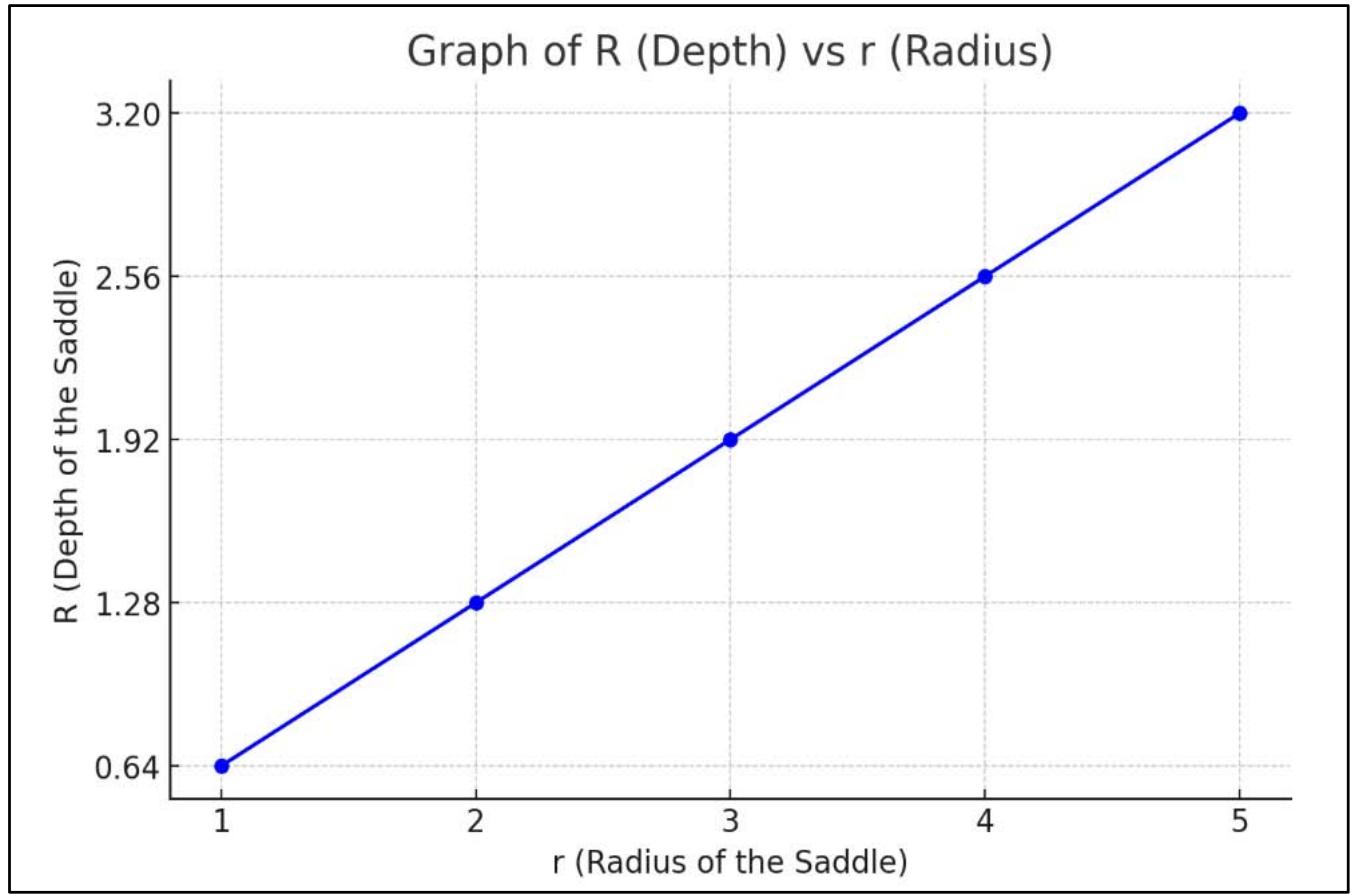 Figure 9: Graphical presentation of the variation of the depth of a 3D saddle (R) against its radius (r)
The same results are obtained for both the 2D and 3D models in terms of the mathematical relationship between the ratio of the total area of the four newly formed circles to the inverse area of the 2D saddle, and the ratio of the total volume of the four newly formed spheres to the inverse volume of the 3D saddle. This ratio is constant and dimensionless.
Similarly, identical results are observed in both models for the relationship between the ratio of the area of a single newly formed circle to the inverse area of the 2D saddle, and the ratio of the volume of a single newly formed sphere to the inverse volume of the 3D saddle. This ratio too is constant and dimensionless.
This, in fact, represents the quantum-scale equipartitioning of volume and inverse volume in the universe. A molecule in its quantum form should be represented as shown in Figure 7 below.
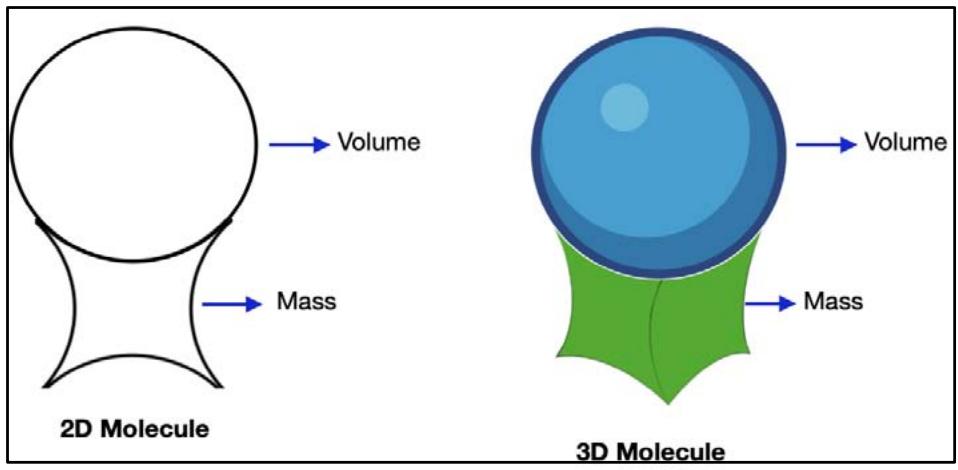 Figure 7: Topology of 'molecules' in a composite form of 'mass and volume' in 2D and 3D
The usual practice in science is to represent a molecule diagrammatically as a 2D circle or a 3D sphere. While a circle or sphere symbolizes the volume part (and, by extension, the energy) of a molecule, the 2D saddle or 3D saddle represents only the inverse volume or inverse energy component. Since 'masses' are formed through symmetry breaking [4,5,6,7], the 3D saddles—being the inverse of volume—represent the masses of the universe, as they are shown here to originate from the breaking of symmetries of the 3D spheres.
If a 'quantum of volume' is represented by $V_{\mathrm{r}}$, as shown in Figure 5, and the volume of the resulting quantum of mass (as also shown in the same figure) is represented by $m$, then
$$
\mathrm{m V} = \text{Constant} \quad \text{dimensionless} \tag{31}
$$
Equation (23), however, represents the true mass-volume conservation of the universe, rather than the abstract conservation of momentum proposed by Newton, which is expressed as the product of mass and velocity. It is considered abstract because Newton did not reveal the topological nature of either 'mass' or 'time' while formulating the law of conservation of momentum. A molecule should be represented as a composite of both 'volume' and 'mass', as shown in Figure 7 above, rather than the conventional representation using only a circle or a sphere.
Figure 8 below should be referred to for understanding the mathematical relationship among the radius of the sphere, the radius of the saddle, and the depth of the saddle. [Note: The presentation has been made in 2D for simplification and ease of understanding.]
As one moves down any group in the periodic table, the average size—or volume—of the atoms increases, and so does their mass (or mass number). Therefore, the proposed model presented in this article is strongly supported by experimental data, which demonstrates a simultaneous increase in both volume and mass across the elements of the periodic table.
The concept of singularity [8] in Einstein's General Theory of Relativity (GTR) [9] aligns with the theoretical model of symmetry breaking proposed in this article. While Einstein suggested that there must exist a point of singularity in the space-time fabric of the universe—responsible for the existence of black holes—this research identifies the center point of the 2D and 3D saddles as corresponding to Einstein's singularity. Through these central points, all mass is directed or concentrated.
As mass increases, the size of the 3D saddles also increases, but the mass always flows toward the singularity. In contrast, as the size of quantum volumes increases, the associated forces tend to disperse outward from the center and become more random. However, in the case of mass, the inverse force becomes increasingly directed toward the singularity, leading to greater order. Eventually, this results in a significant concentration of mass at a single point—the center of mass of the 3D saddle. This is why it is termed the point of singularity.
Black holes are massive objects in the spacetime of the universe, formed through the gradual collapse of stars and other celestial bodies. In this context, the inverse 3D saddles illustrated in this article may be regarded as idealized models of black holes. The center of these inverse 3D saddles (as shown in Figures 5 and 6) represents the singularity, as the entire mass of the 3D saddle either passes through or rests upon this central point.
Figure 10 illustrates how two inverse 3D saddles merge to form a larger inverse 3D saddle of greater mass, with the mass of the newly formed structure passing through a common center of mass—its singularity. Thus, the Figures 10a and 10b provide a
conceptual model for the black hole merger phenomenon in the universe [10].
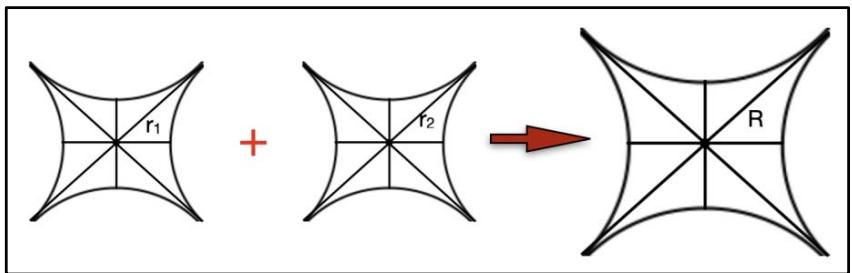 Figure 10a: Typical model of merger of 2 numbers of 2D saddles to form a larger 2D saddle
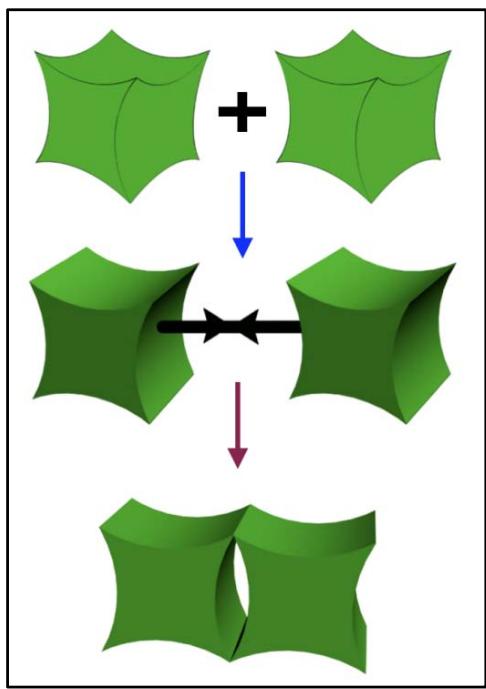 Figure 10b: Typical model of merger of 2 numbers of 3D Black Holes to form a larger 3D Black Hole In figure 11, two numbers of two masses (2D saddles, A & B) do unite to each other and form a higher mass 2D saddle (C). If the radiuses of the smaller saddles be $r_1$ and $r_2$ respectively, and $R$ be the radius of the saddle C, then following mathematical relation to hold among $r_1$, $r_2$ and $R$,
$$
[0.86 r_1^2 + 0.86 r_2^2] = 0.86 R^2\tag{33}
$$
Or, $\mathsf{R}^2 = (\mathsf{r}_1^2 +\mathsf{r}_2^2)$ (34)
Or, $\mathsf{R} = [\mathsf{V}(\mathsf{r}_1^2 +\mathsf{r}_2^2)]$ (35) As per the current quantum model, any inverse 3D saddle—or quantum of mass—existing in the time-space of the universe in isolation from its conjugate 3D spherical volume quantum is, in fact, a black hole. The existence of such inverse 3D saddles in isolation also represents the dark masses (not to be confused with dark matter) of the universe.
The geodesics representation of Anti De Sitter 'time-space' as being shown in Figure 10c [11] below is very much supportive to the model of 'Black - Hole merger' model and the concept of singularity as have been presented in Figure 10a and 10 b.
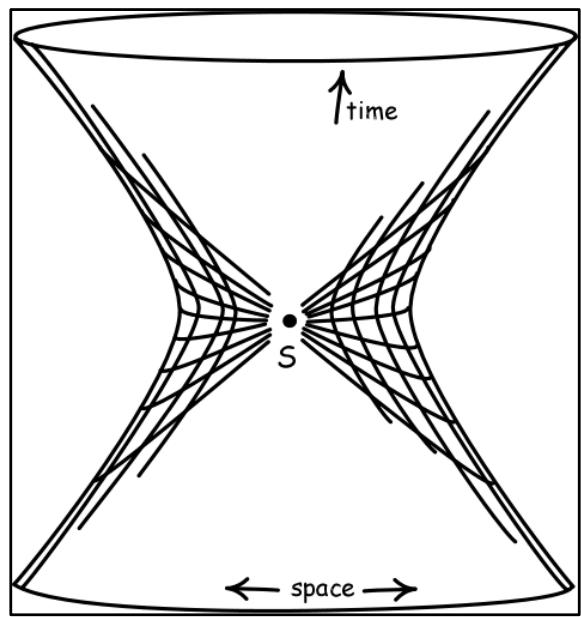 Figure 10c: The typical 2D presentation of 'Anti - De Sitter Space' showing the direction of flow of time and the point of 'singularity', 'S'
A very pertinent question may be raised: why can't these inverse dimensions (in the form of saddles) be observed using transmission electron microscopy (TEM) on a sample of a substance? The answer lies in the limitations of TEM resolution. In TEM studies, it is not possible to reach the ultra-high resolution required to observe atomic or molecular identities directly. What is typically observed are nanoscale aggregates or clusters of atoms or molecules, which appear as regular or irregular round-shaped images. Therefore, it is not possible to visualize individual molecules in their composite form—i.e., as a combination of volume (3D spheres) and mass (inverse 3D saddles).
However, when we observe at the quantum level, such as in the capillary rise of water in a glass capillary, an inverse curvature (concave upwards) meniscus is observed at the air-water boundary. Conversely, in the case of capillary depression of mercury in glass capillaries, the meniscus at the air-mercury boundary is found to be convex upwards. These phenomena serve as definitive proof of the existence of reciprocal space and direct space in conjugation within substances across the universe.
This topic of capillary rise and depression, and its connection to dimensionality, has been discussed in detail in a recently published research article. It is explained therein that capillary phenomena are not governed by surface tension alone. Rather, they arise from a combined effect of surface tension and the geometrical or topological configuration of quantum masses and quantum volumes.
## III. CONCLUSION
This research fundamentally explores the phenomenon of symmetry breaking and introduces a new theoretical quantum model that offers deeper insights into the nature of space, mass, and energy. A key result of this model is the re-interpretation of the principle of equipartition of energy—demonstrating that energy is equally partitioned between a quantum of volume and a quantum of mass as space transitions from its direct to inverse (or indirect) form. Furthermore, the conventional understanding of the conservation of momentum is redefined through a novel framework that integrates physics, topology, and mathematics. It is shown that when a quantum of volume (V) interacts with a quantum of mass (m), a new entity—a $\pi$ space quantum'—emerges, governed by the invariant and dimensionless relationship $mV = \text{constant}$. This formulation represents a more fundamental law: the conservation of mass-volume in the universe. Additionally, a model for black hole mergers is proposed, offering fresh theoretical identities for both 'black holes' and 'dark masses.' Taken together, these findings pave the way for a new direction of inquiry in space physics, cosmology, and astronomy, potentially transforming our understanding of the fabric and evolution of the universe.
### Dedication
This research article is dedicated to Ex-Professor B. M. Mandal & Late Professor S. N. Bhattacharya, Polymer Science Unit, Indian Association for the Cultivation of Science, Kolkata, West Bengal, India.
#### Declarations
Clinical Trial Registration: This study is not a clinical trial. Therefore, clinical trial registration details are not applicable.
Author Contributions: Chinmoy Bhattacharya conceived and led the research, developed the analytical framework, and performed all derivations and data analyses. Nishant Sahdev assisted in the interpretation of results, literature review, and manuscript preparation. Both authors reviewed and approved the final manuscript.
Ethics, Consent to Participate, and Consent to Publish declarations:
Not applicable.
Funding Declaration:
No funding was received for this research.
Generating HTML Viewer...
Funding
No external funding was declared for this work.
Conflict of Interest
The authors declare no conflict of interest.
Ethical Approval
No ethics committee approval was required for this article type.
Data Availability
Not applicable for this article.
C. Bhattacharya. 2026. \u201cTowards a New Quantum Model of Mass Evolution through Symmetry Breaking\u201d. Global Journal of Science Frontier Research - A: Physics & Space Science GJSFR-A Volume 25 (GJSFR Volume 25 Issue A4): .
Our website is actively being updated, and changes may occur frequently. Please clear your browser cache if needed. For feedback or error reporting, please email [email protected]
×
This Page is Under Development
We are currently updating this article page for a better experience.
Thank you for connecting with us. We will respond to you shortly.