I. INTRODUCTION
In this paper, we calculated the quantum superposition between states of the gravitational fields by Feynman path integration. Due to the fundamental field and the Lagrangian action of gravity are given in paper 1, we can calculate the quantum superposition of the states of gravitons by Feynman path integration. The calculation results indicate that in general, the quantum effects will generate negative energy in gravitational field. As we know, negative energy is related to Einstein's cosmological constant , and therefore also to dark energy. In section 2, we briefly reviewed noncommutative quantum gravity. This theory is classically equivalent to general theory of relativity. We have provided some computational results of this theory and its interpretation of dark matter. In section 3, we calculated the quantum superposition effect of states between gravitational fields by Feynman path integration. In general, the quantum effects will lead to negative energy in gravitational field, which will cause the mass defect of the gravitational sources.
II. A BRIEF REVIEW OF NONCOMMUTATIVE QUANTUM GRAVITY
In the paper [1] and [2], we introduce the theory of noncommutative quantum gravity. In this theory, we give the fundamental field variables of gravity. It is a semiclassical graviton. Its form is a Dirac- function as follows
The Lagrangian density is
The energy-momentum tensor is
T_{\mu\nu} = \eta_{\mu\nu} \mathcal{L} - \frac{\partial \mathcal{L}}{\partial (\partial^{\mu} \xi^{i})} \partial_{\nu} \xi^{i} \tag{2.3} \end{array}The free field equation is a wave equation
The Green's function can be written as
In the paper [2], we proved that the d'Alembert operator is invariant in noncommutative quantum gravitational field. Therefore the Klein-Gordon equation is invariant noncommutative quantum gravitational field.
In the general theory of relativity, the energy-momentum tensor of gravitational field itself is:
Up to a factor of a constant, it is equal to Eq.[2.3]. It is a strong evidence to prove that the quantum field theory constructed in the paper [1] and paper [2] is classically equivalent to the general theory of relativity.
In the paper [3] [4] [5] and [6], we can see that the self-interaction effects in noncommutative quantum gravity may provide an alternative explanation for dark matter-like gravitational phenomena, potentially offering a simpler theoretical framework. The metric of the general static isotropic gravitational field with self-interaction can be written as follows
where
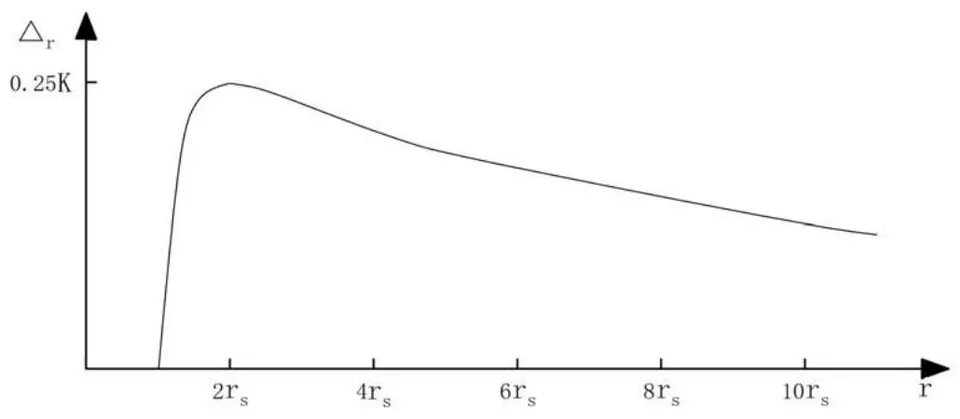
The self-interaction of noncommutative quantum gravity of the static spherically symmetric metric we calculated in Paper paper [6] is shown in Fig.1
It is consistent with the distribution of dark matter halo in galaxies.
III. QUANTUM EFFECT OF THE NONCOMMUTATIVE QUANTUM GRAVITY
In the paper [1] we introduce the locally inertial system as Eq.[2.1]. It is a wave packet approximate to the Dirac -function which can be explained as a semiclassical graviton. The dynamic variables of the locally inertial system are . Quantization only quantizes the dynamic variable . Therefore, for simplicity, in this paper we directly consider as the fundamental state function of gravitational field.
Let the gravitational source of and are and , respectively. If these two gravitational sources are independent of each other, there is
no interaction between sources and . The Feynman path integral of the initial state and can be written as follows
Denote as the final state of . Then the final states are
Merge these two gravitational sources and . This means that the two sources must be considered together. Let's study the gravitational field excited by merge of sources . The initial state is
The joint propagator of is
K_{(1+2)} = K_{(1)} \otimes K_{(2)} \[\int\mathscr{D}\left[C_{(1)}^{i} + C_{(2)}^{i}\right]e^{i\left(S\left[C_{(1)}^{i}\right] + S\left[C_{(2)}^{i}\right]\right)/\hbar}\tag{3.4}\[\int\mathcal{D}\left[C_{(1)}^{i} + C_{(2)}^{i}\right]\left(e^{iS\left[C_{(1)}^{i}\right]/\hbar}\cdot e^{iS\left[C_{(2)}^{i}\right]/\hbar}\right)\]If , , for the Lagrangian density [2.2], we have
Then
Not considering the quantum superposition of the states and , the final state is
Considering the quantum effects of the gravitational field. The quantum effects can cause the quantum superposition between the states and . In this case, the Feynman path integral should be written as follows
where denote the quantum superposition of states.
For the Lagrangian density [2.2], if , we have
Then Eq.[3.8] can be written as follows
The final state is
If , there are no effects of quantum superposition of states, then we have . In this case, the following two equations should be equal
If , it can be written as follows
The solution of Eq.[3.13] is:
Then the action of is
Therefore the action of is
where must satisfy the condition of quantization of the action.
Only in the case of that the gravitational field and excited by the sources and satisfy the solution [3.15] and [3.16], we have
Then we can deduce the gravitational source from the gravitational field in reverse by Eq.[3.17]:
In other cases, the propagator is different to
Then the final states will be different
Therefore the sources will be different
Obviously, Eq.[3.19] Eq.[3.20] and Eq.[3.21] represents the general case, while Eq.[3.17] and Eq.[3.18] is a special case. The change in gravitational field in Eq.[3.20] means a change in the energy of gravitational field itself. We can also deduce that this will change the gravitational source of the final states to become . If energy cannot be absorbed from the outside, Eq.[3.20] can only causing it to lose energy. Therefore, in general, when the gravitational sources merge, the effects of quantum superposition can be interpreted as negative energy in gravitational field. This negative energy does not depend on the choice of the zero point of energy and therefore different from the negative gravitational potential energy. Negative energy is related to Einstein's cosmological constant , So that it is also related to dark energy. Eq.[3.21] indicates that the effects of quantum superposition can lead to the mass defect of the gravitational sources caused by negative energy in the gravitational field. Thus this negative energy contribution manifests as a measurable mass defect in the gravitational source. This is consistent with the conclusions of the general theory of relativity, but differs in that it doesn't originate from the energy conversion of kinetic and potential energy during the kinetic merger of gravitational sources, just caused by the quantum superposition of the states of gravitational fields.
IV. CONCLUSION
Since the fundamental field and the Lagrangian action of gravity are given in paper [1], we can calculate the quantum superposition between the gravitational fields by Feynman path integration. The calculation results indicate that in general, the quantum effects will generate negative energy in gravitational field. As we know, negative energy is related to Einstein's cosmological constant , and therefore also to dark energy. The negative energy leading to the mass defect of the gravitational sources. Its origin is different from the origin of the mass defect in general theory of relativity. The mass defect in general theory of relativity originates from the energy conversion between the kinetic energy of gravitational sources and the potential energy between gravitational sources, while the mass defect of gravitational sources in this paper is caused by the effect of quantum superposition induced by Feynman path integration. There will be no quantum superposition effect only when the actions of the gravitational sources satisfy specific conditions Eq.[3.14], Eq.[3.15] and Eq.[3.16].